Archive | February, 2010

Tanner $6B Out on Debt

25 Feb

Media Release – Senator Barnaby Joyce, 25 Feb 2010

Finance Minister Lindsay Tanner today on Fairfax Media, shows yet again he is a person who doesn’t “dot the i’s and cross the t’s”.

Asked what Australia‘s government gross debt was, he said and I quote, “The most recent actual number is about $120 billion, that’s the gross, I don’t check day on day, week on week”.

Australia‘s gross debt is actually $126.083 billion. It cracked $120 billion back before the 28thJanuary. So is the best we can hope for month on month? But don’t worry, Mr Tanner, it’s only somebody else’s money and I suppose somebody else has to repay it.

Mr Tanner you should be checking day on day, week on week. You should be dotting the” i’s and crossing the t’s”. You should be doing everything in your power to stop the trajectory that this debt is on.

When you are out by $6 billion and you are the Finance Minister, you do not leave a sense of confidence that you are managing the problem.  It appears you are not even closely watching the problem. Mr Tanner you would have got closer to the number if instead of waving my media releases around in the chamber, you actually read them.

So Mr Tanner, if you are not watching our debt, who in the government is?

For more information –
Jenny Swan
Office of Senator Barnaby Joyce,
Leader of the Nationals in the Senate
02 6277 3697
0438 578 402
jenny.swan@aph.gov.au
Note: Unlike Lindsay Tanner –  the responsible Finance minister – Barnaby Joyce is right up-to-the-minute with his knowledge of the debt numbers. Even the Australian Office of Financial Management (AOFM) has not yet updated their home page to reflect the additional $600 million in Commonwealth Treasury Notes that were auctioned off today.

Finance Minister Lindsay Tanner today on Fairfax Media, shows yet again he is a person who doesn’t “dot the i’s and cross the t’s”.

Asked what Australia‘s government gross debt was, he said and I quote, “The most recent actual number is about $120 billion, that’s the gross, I don’t check day on day, week on week”.

Australia‘s gross debt is actually $126.083 billion. It cracked $120 billion back before the 28th January. So is the best we can hope for month on month? But don’t worry, Mr Tanner, it’s only somebody else’s money and I suppose somebody else has to repay it.

Mr Tanner you should be checking day on day, week on week. You should be dotting the” i’s and crossing the t’s”. You should be doing everything in your power to stop the trajectory that this debt is on.

When you are out by $6 billion and you are the Finance Minister, you do not leave a sense of confidence that you are managing the problem.  It appears you are not even closely watching the problem. Mr Tanner you would have got closer to the number if instead of waving my media releases around in the chamber, you actually read them.

So Mr Tanner, if you are not watching our debt, who in the government is?

For more information, Jenny Swan

Office of Senator Barnaby Joyce,

Leader of the Nationals in the Senate

02 6277 3697

0438 578 402

jenny.swan@aph.gov.au

Deeper In Debt

25 Feb

Associate Professor Steve Keen has been warning about Australia’s rising debt burden for some years:

Australians have an unsustainable debt addiction, which will be hard to kick, and painful to recover from. A new report by CPD fellow Steve Keen has found that in just 18 months time we may be spending as much of the national income on interest payments as we were in 1990 – when interest rates were at 17 per cent.

That was in 2007.

Things are far worse now, since the Labor Government has so dramatically increased public debt, while encouraging even greater levels of private debt thanks to its recently wound down “First Home Buyers Boost”.

Rogoff Sees Sovereign Defaults

25 Feb

From Bloomberg

Ballooning debt is likely to force several countries to default and the U.S. to cut spending, according to Harvard University Professor Kenneth Rogoff, who in 2008 predicted the failure of big American banks:

Following banking crises, “we usually see a bunch of sovereign defaults, say in a few years,” Rogoff, a former chief economist at the International Monetary Fund, said at a forum in Tokyo yesterday. “I predict we will again.”

Most countries have reached a point where it would be much wiser to phase out fiscal stimulus,” said Rogoff, who co- wrote a history of financial crises published in 2009.

A Clear Picture of Australia’s Debt

25 Feb

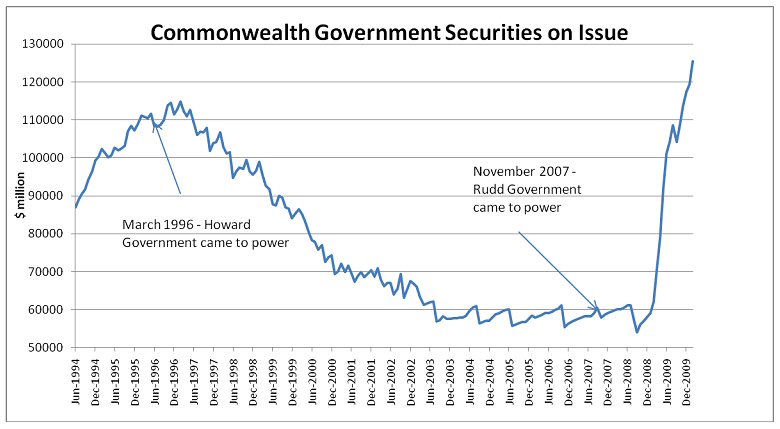
Barnaby Joyce produces a chart that says it all:

A picture paints a thousand words so a good understanding of our gross debt is seen in the graph (above).

It shows clearly that the Coalition is a government that pays off debt and that Labor is a government that creates debt and Mr Rudd is creating debt at a faster rate than has been seen in recent history. With gross debt currently in excess of $125 billion one would be foolish if they were not concerned by the trajectory of the growth in debt.   How would you feel taking this to your local bank manager as an example of your fiscal prudence, and the ceiling insulation program as an example of your management technique?

If we continue on the trajectory that is self evident in this graph we are most definitely going to arrive at a point of reckoning.

Read the entire article here.

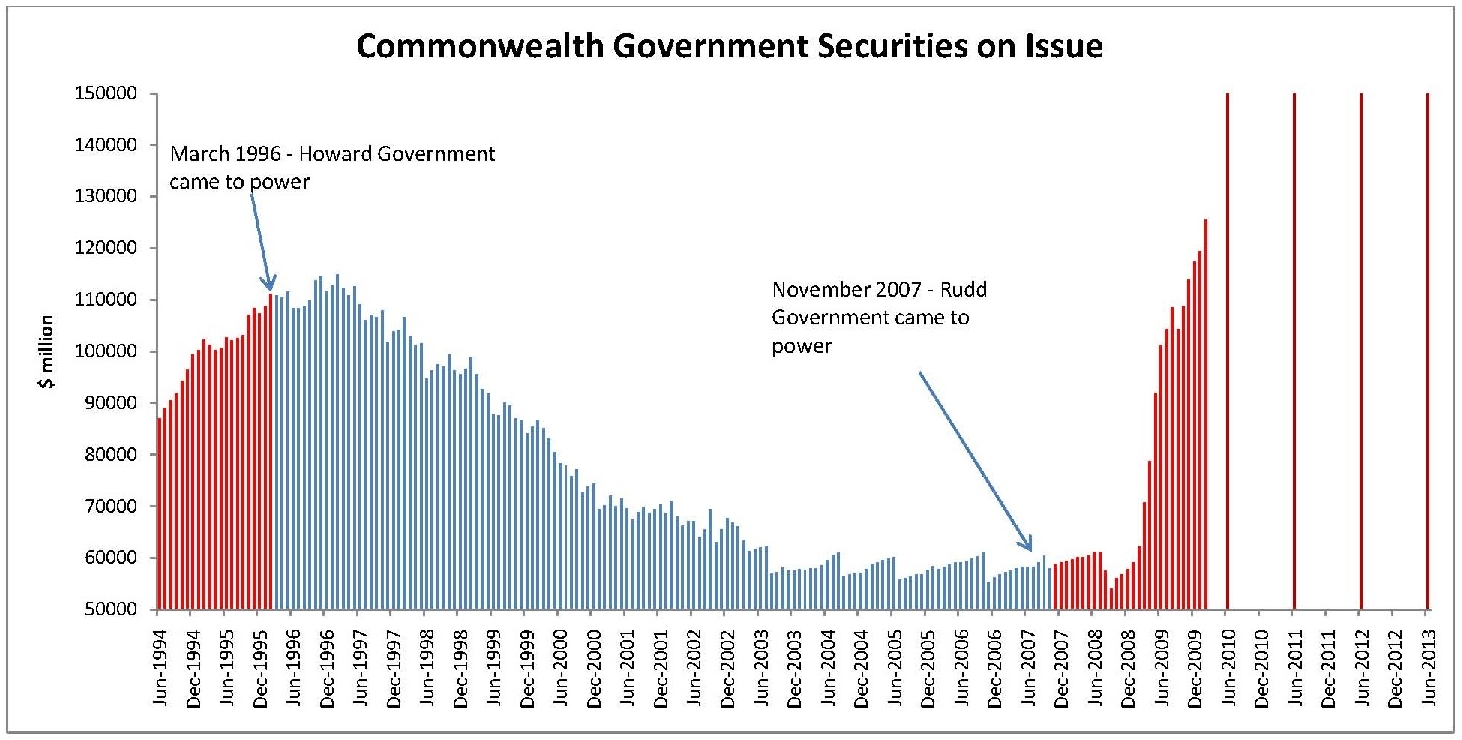
UPDATE: Barnaby offers an updated version of the above graph –

If we continue on the trajectory that is self evident in this graph we are most definitely going to arrive at a point of reckoning. This point of reckoning will place immense pressure on the budget and the delivery of such services as health, education, defence, foreign aid, childcare and everything else that relies on the public purse for payment.
Labor cannot just go on borrowing money at the rate that is portrayed in this graph and it is absurd to look at the trajectory of this graph and say that you do not have a concern. It is vastly easier to manage problems when they are manageable. It is far more prudent to “dot the i’s and cross the t’s” and manage the problem now than to wander into the chamber at a later date with a sorrowful look on your face wishing if only we had that time again we’d have done things differently.

Don’t Mention the Debt

25 Feb

Even 12 months ago – before the Rudd Government began its massive second round of “stimulus” spending on school halls and insulation – noone wanted to talk about our debt problem:

Our overseas borrowing is the great unspoken. It is the one subject assiduously avoided in public by Kevin Rudd, Malcolm Turnbull, Ken Henry, APRA, the Reserve Bank and the big banks. They probably even gloss over the matter when chatting privately among themselves.

It is Australia’s Ponzi scheme. Bernie Madoff goes to Bondi. We keep getting those foreign dollars in while sending plenty out, but never quite as much, hoping no one will blow the whistle lest the whole game end.

Read the full article in the Feb 19, 2009 Sydney Morning Herald.

The Great Reckoning Begins

25 Feb

A must-read article by the Business Spectator and ABC finance commentator, Alan Kohler:

Ken Henry and David Gruen of Treasury should spend less time sneering at Barnaby Joyce and more time contemplating the unfolding calamity in Europe, and coming to grips with what’s really going on in Australia.

As I explain below, Australia’s debt-funded fiscal stimulus is double what was announced and is only half-spent. In other words, the government is still in stimulus mode while interest rates are going up and unemployment is falling.

If you do not wish to register with the Business Spectator’s website to read the entire article, it is reproduced in full here.

Rogoff Warns of China Crisis

25 Feb

Former chief economist of the IMF, Ken Rogoff, warns of a regional crisis when the China “bubble” collapses:

China’s economic growth will plunge to as low as 2 percent following the collapse of a “debt-fueled bubble” within 10 years, sparking a regional recession, according to Harvard University Professor Ken Rogoff.

“We would learn just how important China is when that happens. It would cause a recession everywhere surrounding” the country, including Japan and South Korea, and be “horrible” for Latin American commodity exporters, he said.

The impacts on Australia – a leading commodity exporter – arising from a collapse in demand from China are obvious.

Rogoff was one of very few economists who predicted the GFC.

Design a site like this with WordPress.com
Get started