Tag Archives: barnaby joyce

Feel Free To Quote Me

25 Feb

One week ago your humble blogger coined a phrase about debt, and popular social attitudes towards debt.

Less humbly, I’m beginning to think it is up there with Senator Joyce’s prophetic line of exactly two years ago:

“If you do not manage debt, debt manages you”.

So without further ado, I’m going to proudly copyright my little phrase, and ask readers to kindly credit your not-so-humble blogger should you choose to use it:

Debt is not the new black. It is the old red. ©

Barnaby Is Right … is right.

Thumbs Up For Barnaby On Facebook

23 Feb

The good Senator now has a Facebook page.

Like” it here.

Drip Drip Drip: Eroding Your Right To Choose

23 Feb

Senator Joyce’s latest Op-ed for the Canberra Times is worthy of contemplation.

Although he does not directly point the finger – of course – nevertheless his article inadvertently highlights a variety of consequences of the creeping international(ist) socialism that is steadily eroding our right to self-determination, both as individuals and as a sovereign nation.

That is … our right to choose:

Private schools are about choice

Billy is much smarter than Ben, in dramatic arts. Paul is much happier than Pam, on Tuesday nights. Private schools get more funding than public schools, from the federal government.

Why does Mr Angelo Gavrielatos, president of the Australian Education Union, only ever tell half the story? This selective assessment of the facts seems to be something that certain sections of the teaching union have specialised in of late. This insinuation of bias towards private schools is deceitful.

Let us presume for one minute that, as many in the eastern states wish, but for which West Australians would fight virulently against, all public funding came from one pot and there were no states in Australia. The all-up government funding for public schools per student is vastly more than the all-up government funding for private schools per student.

On average, each public school gets $14,000 per student per year of public funding and each private school gets $7000 per student per year of public funding.

If you closed down all of the private schools, which no doubt the more radical parts of the teachers’ union would like, the amount of public funding for state school students would actually decrease substantially.

State schools, aka, public schools, are financed by the state. That is, the Queensland government, the NSW government, the South Australian government, etc, etc. The states generally do not finance independent and private schools, they are generally funded by parents scrimping and saving for their kids.

The federal government therefore steps in to fulfil that which is obviously a government responsibility, to assist in the funding of education services. But why does the government need to be the provider of the service if others are capable and willing of doing so? Does every lifesaver have to be a government lifesaver? Does every doctor have to be a government doctor? How would you feel if I demanded that you were only allowed to go to doctors who are employees of the government?

Let’s dispense with this myth that somehow independent schools are mechanisms to rip off public schools. They’re not, they are mechanisms for giving parents choice. In any case, it should be about the needs of the student, not the social engineering philosophies of different unions.

I went to Woolbrook Public School. We had indigenous students, we had some students who were really doing it tough. We are talking about small-village country poor. Some houses had wool packs for windows and were regularly visited by welfare agencies. I understand that those who are genuinely doing it tough need assistance. But people should also be allowed choice.

Later on my parents made the choice to send me away to boarding school. Surely it is every parents’ right to decide where their kids are educated? The government should respect that choice by not overwhelmingly financially discriminating against that choice.

We need competitive pressures in Australian education if we are to have any hope against our true competition in Taipei, Beijing, Osaka, Jakarta and other areas in our region. As people who are working in the back rooms of banks are finding out, the internet is making the world smaller and creating real competitive pressures on jobs not just between Australians but between Australians and those overseas.

Your competition does not have to live here to get your job. Excuses won’t cut it if someone who is actually on a cheaper wage can speak three languages to our one and has a more competent understanding of higher-end mathematics. We have to meet their benchmark.

In all government decisions, when we send out your money we must ask what difference it made in the outcome. Since we have borrowed the money to build school halls, to make up $16 billion of our $227 billion gross debt, are our children actually better-educated?

Maybe Canberrans understand choice better than any others because more than half of all students in Canberra go to private schools. I have always thought of Canberra as firmly pro-choice.

So Angelo Gavrielatos should just ‘fess up and be straight with us. Is $5 billion really going to make you happy or is your ultimate goal to take choice away from the Australian parents’ desire for the future of their children?

Barnaby is right.

The Single Biggest Reason Why I Will Vote For Bob Katter’s Australian Party

18 Feb

The Australian Dollar.

It is way too high relative to all our major trading partners’ currencies.

About 30% too high, in fact.

No Malcolm Farr, it does not prove that the Aussie Dollar is a “safe haven”.

No Wayne Swan, it is not because we have an economy that is “the envy of the world”.

Yes Alan Kohler, it is because speculators are borrowing billions in Zero Interest Rate Policy (ZIRP) money in the USA, UK, EU et al, and using it to gamble on the relatively high interest rate Aussie Dollar. To make easy, fast profits.

It is called the “carry trade”.

Or “hot money”.

And it seems that no one … repeat NO ONE … in Australian politics has the brains to recognise that fact. Or, the balls to do anything about it.

Except Bob Katter.

Now, let me be the first to say that I do not agree with how Bob wants to weaken the currency.

He advocates forcing the RBA to slash interest rates to 2%.

I think we should follow the lead of China … and Switzerland … and introduce a currency peg.

Nevertheless, despite this difference in preferred method, the simple fact that Bob has loudly proclaimed that he wants to weaken the dollar, and, that he is prepared to dismantle the RBA if necessary in order to do so, places him a country mile ahead of any other politician in the nation.

(Yes, including my beloved debt-warning prophet Barnaby Joyce, whose office has to date not even responded to my communications on this matter. He has been very busy with a drowned home town though, so we shall wait and see…)

A little historical background on our present currency dilemma.

Remember the year prior to the GFC crescendo in September-October 2008?

Remember how the AUD turned sharply down in July 2007, falling 9c (10%) in less than a month, when the warning signs began in the USA with the collapse of two Bear Stearns’ hedge funds? And remember how the AUD turned sharply up again, when the RBA lifted interest rates for the first time in 9 months, in August 2007?
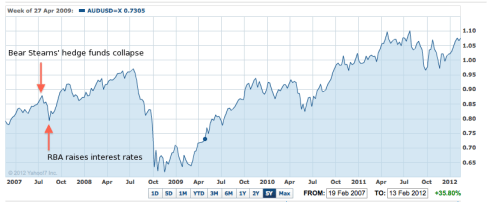
GFC begins July 2007 in USA | Click to enlarge

Remember how the RBA kept raising interest rates into the teeth of the oncoming storm, and the AUD climbed from less than 80c US in August 2007, to nearly 98c US in July 2008 … a 21% appreciation in less than a year?

Remember how the AUD fell off a cliff when the GFC peaked? Indeed, it fell so far so fast – a near 40% collapse from 98c to 60c in just a few months – that the RBA intervened in foreign exchange markets to prop up the dollar:

Click to enlarge

“Safe haven” currency, you say (Malcolm Farr)?

Utter ignorant nonsense!

The Aussie Dollar is a “speculative play”.

A profit-seekers’ gamble.

That rushing tide of “hot money” driving up the AUD exchange rate is just as likely to race out again, exactly as it did in the GFC.

But until it does, and the AUD returns to a reasonable and sustainable level, vital sectors of the Australian economy are rapidly being white-anted … and jobs destroyed in the process.

Manufacturing. Tourism. Retail. Education (ie, foreign students). To name but a few.

Many of those industries and the jobs they provide, once lost, will never come back.

And despite this disaster occurring all around us right now, both “sides” of Australian politics have done a Pontius Pilate impersonation, washing their hands of the problem, proclaiming that there’s “nothing we can do” about the dollar. That’s up to the “independent” RBA, you see. And woe betide anyone daring to question the sanctity of the RBA’s “independence”. So instead, we have an escalating, puerile argument over whether or not (and how much) to financially support affected industries.

With more borrowed money, of course.

Idiots. Invertebrates. Sans testicles.

In stark demonstration of the clueless eunuch status of both “sides” of Australian politics – and indeed, of the “independent” Reserve Bank of Australia – on the matter of dealing with a speculator-driven appreciation in your national currency, let us examine a favourite example of mine.

Norway.

Unlike the RBA’s Glenn Stevens, the Norwegian central bank governor recognises the dangers of a government over-relying on the nation’s commodities wealth, spending too much money, and putting its manufacturing industry at risk (sound familiar?):

Feb. 16 (Bloomberg) — Norway’s central bank Governor Oeystein Olsen told the government to spend less of the country’s oil money and avoid an over-reliance on its commodities wealth or risk killing manufacturing jobs.

The government should tighten its fiscal policy guidelines and limit the use of petroleum revenue to 3 percent of Norway’s sovereign wealth fund from the current 4 percent, Olsen said today in the text of his annual speech on the economy and monetary policy.

“Even though petroleum revenues are phased in gradually, a phasing out of manufacturing and other private industries may not be as smooth,” he said. “Entire industries could be lost. If spending proves to be excessive, such structural changes may be difficult, or impossible, to reverse.”

The world’s seventh-largest oil exporter, which boasts the biggest budget surplus of any AAA rated nation, has largely been shielded from the global financial crisis, in part after spending a record amount of its oil money.

Witness the stark contrast to our own Reserve Bank board of governors.

They have repeatedly indicated that they believe in crowding out (ie, screwing) the rest of the economy, to “make room” for the mining boom. Your non-mining industry and job be damned.

The high Australian dollar is actually great news to the RBA. It is helping their goal of hollowing out the rest of the economy, to “make room” for more mining.

And the high dollar is also great news to the village idiot of our national government, Treasurer Wayne Swan. With little else of substance to boast of, he proudly and deceitfully points to the high dollar as somehow representing “proof” of his own wonderful economic management!

But it is not just concerns about how the government is running the country, short-sightedly squandering its natural advantages, that show parallels between Australia and Norway.

The Norwegians too, have been faced with the problem of speculator-driven “hot money” driving up the value of their currency.

Thanks to the ongoing European debt crisis, in 2010-11 “investors” (read also, “speculators”) had been selling (borrowing) the near zero-interest-rate Euro currency, and investing (speculating) in the traditional “safe haven” currency, the Swiss Franc.  As a result, the Swiss Franc had been rising precipitously, causing problems for their economy. So, in September last year, the Swiss central bank acted to protect their economy, by pegging the value of the Franc to the Euro.

Result?

With the Swiss central bank effectively having put a cap on their potential profits, the European “hot money” went looking for profits elsewhere. They turned to Norway, with their strong economy, budget surpluses, vast nationalised commodities wealth, and AAA rating.

Now, witness the contrast between Norway’s central bank response to “hot money” flowing their way, and our RBA’s response to exactly the same situation:

Feb. 17 (Bloomberg) — Norway’s central bank is monitoring the krone after its recent gains and remains ready to act should the currency’s appreciation warrant a response, Governor Oeystein Olsen said.

“We follow closely the krone developments,” he said yesterday in an interview in Oslo. “We have observed, of course, the recent development of the krone, we’re close to the level” in September, when it touched an eight-year high, he said.

The central bank, which in December lowered its main rate by half a percentage point to 1.75 percent, will respond to krone swings to the extent that they affect inflation. The currency this week touched the highest level since Sept. 8, when the Swiss National Bank’s decision to peg the franc to the euro prompted investors to seek alternative havens…

The exchange rate continues to be a “challenge” for the government, Trade Minister Trond Giske said Feb. 13. The central bank in September signaled it was ready to take steps to curb the krone’s appreciation. Those comments helped weaken the exchange rate, triggering a 4.8 percent decline from a Sept. 8 peak through a trough two weeks later.

The Norwegian central bank acted promptly, to “talk down” the Krone back in September. It worked, for a little while.  Then they slashed interest rates by an effective 22.2% (2.25 to 1.75) in one hit in December. And now that their currency is appreciating again, they are attempting to “talk down” their currency, by reminding markets that they stand ready to act again, to protect local jobs and industry.

Our central bank is doing nothing.

Indeed, they are happy that we have an over-valued dollar that is squeezing (ie, wiping out) the “old economy” sectors.

Because it wants the non-mining sectors of the economy to shrink (ie, die), in order to “make room” for mining, which the RBA mistakenly believes will enjoy a multi-decade boom.

This is your rapidly approaching future, dear reader.

Gillard’s “New Economy”.

Australia. “Poor white trash” quarry to the world.

There are some in the Australian (alternative) financial media who have written on this problem.

The estimable “Houses and Holes” – whose clever nom de plume sardonically depicts the long-running economic policy/vision of both “sides” of Australian politics – and his team at Macro Business is a standout example.

Unfortunately, it is apparent to this humble blogger that few if any in the mainstream financial commentariat have any greater “vision” than the clueless eunuchs in Canberra for whom they act as Press agents.

So if anything is going to be done about the Aussie Dollar, it will only happen if you, dear reader, are concerned enough about the future of this country (and your job) to take action yourself.

You can start by doing as I have been doing.

Contact the invertebrates in Canberra.

Educate.

Inform.

Complain.

Harass.

Abuse.

Point out to the self-interested, overpaid, trough swilling imbeciles on both “sides” of Australian politics that there is no excuse … none … for Australia’s government and Reserve Bank deliberately failing to act to address the root of the problem – a speculator-driven AUD exchange rate.

Other “safe havens” have done it.

Switzerland has done it.

Norway has done it.

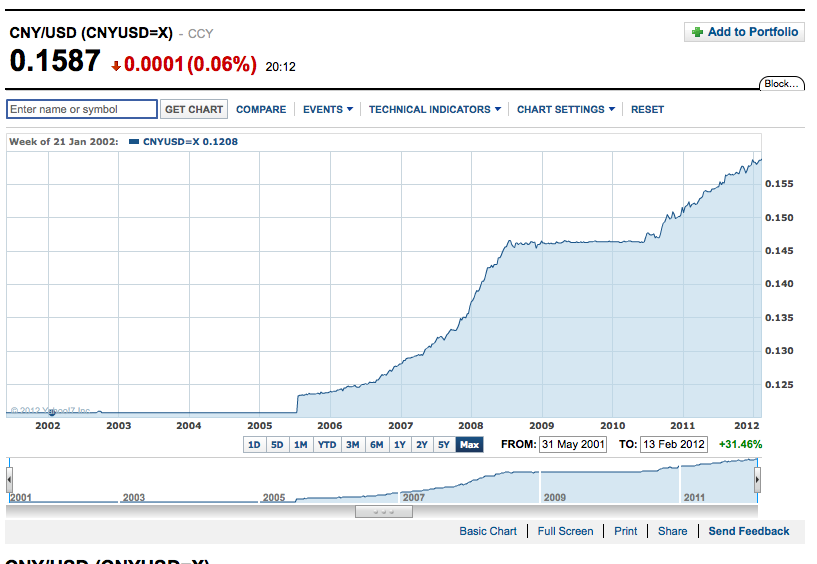
Indeed, one of the keys to China’s economic success story, has been its use of an adjustable currency peg, which has allowed their industries time to adapt to changing economic and market conditions:

Click to enlarge

You see, dear reader, our politicians, Treasury bureaucrats (looking at you, Martin “Mini-me” Parkinson!), and Reserve Bank governors are simply too beholden to flawed and failed economic ideologies.

Neo-Keynesianism.

Laissez faire capitalism.

“Free trade”.

“Free markets”.

Globalisation.

“Government debts don’t matter, if you have your own currency … you can just print, and inflate your debts away”.

They fail to recognise that the world has fundamentally changed since 2008.

Thirty-plus years of global debt-binging is over.

The masses have had their long overdue big fright … and have begun to wake up.

Debt is not the new black. It is the old red.©

And as a result, an over-leveraged debt-laden world economy, is now de-leveraging.

And in the inevitable race to the bottom, “currency wars” (ie, devaluing your currency) are a key factor.

Australia’s major trading partners are Japan and China. Both protect local industry, with a weak currency. Zero Interest Rate Policy (ZIRP) for Japan. A currency peg for China.

The USA, UK, and the European Union are all trying to protect their economies, to support and restore their manufacturing sectors, by weakening their currencies through ZIRP, QE (Quantitative Easing ie, printing money), and similar schemes via their central banks.

As usual, Australia is roughly 3 years behind the rest of the world.

But the currency wars is not a game that one can win by coming from way way behind.

Accept no excuses from our political “servants”.

Every other major “developed economy” on the planet is supporting local industry and jobs, by acting to ensure and maintain a weak currency.

Only Australia is doing nothing.

Call, write, or email our politicians now.

And if they give you the same (indeed, any) pathetic, close-minded, imbecilic excuses for not acting on the over-valued, speculator-driven Aussie dollar?

KAP the useless bastards.

Vote 1 Bob Katter.

Vote 1 Katter’s Australian Party.

If the “old” parties won’t act on the most urgent issues facing the nation … I will vote for someone who will.

And will loudly proclaim my intent, all the way to the next election.

UPDATE:

By the way … do not fall for the Coalition’s line, that job losses and business shutdowns are due to businesses preparing for the carbon “tax”. Regular readers know that I have been and remain a vehement opponent of the banksters’ CO2 derivatives scam … and even I don’t buy that bullshit.

Sure, job losses will inevitably mount when the derivatives scam launches.

But right now, job losses and business shutdowns are primarily a result of the speculator-driven AUD:

Death knell looms for Caltex jobs

The global dance of death could come quickly to Caltex’s two refineries after it slashed the value of its refining assets by $1.5 billion due to a confluence of factors strangling profits in this part of its business.

It is another example of Australia’s manufacturing going to the wall due to the strong Australian dollar, rising costs and stiff competition from Asia.

The rise of big Asian refineries with an overcapacity of product is turning the screws for local operators and has prompted Caltex management to announce a strategic review of two key refineries of its own – the Kurnell plant in Sydney and Lytton in Brisbane.

And this comes on the heels of Caltex closing one of its petrol-making units at Kurnell last year.

The review was instigated six months ago and is expected to take another six months before investors and customers know the verdict, which could include the sale, closure or further investment in the business.

Given today’s writedown of $1.5 billion of assets due to expectations of a prolonged period of pain, the market is expecting the review will recommend closure of at least one of these two plants which convert oil into petrol and diesel.

Indeed, Caltex supplies one third of Australia’s transport fuels, so the review will need to make sure it does not adversely impact its customers.

Soon, we will not only have given up our food security, by selling the farm to foreigners.

We will not only have sold off our mineral wealth and sent the profits abroad, thanks to a disaster-in-waiting “mining tax” that will actually help the Big 3 multi-national miners to grow their oligopoly.

Soon, we will have given up fuel security too.

And with no manufacturing sector left either, well, any future war would be fun, wouldn’t it?

Carbon permit face-slapping, anyone?  To the death?

Oh wait … they’re not even paper.

They’re just electronic digits.

Exactly like your “cash” in the bank.

UPDATE 2:

Lighthouse Securities’ Greg McKenna, aka “Deus Forex Machina” at Macro Business, has written an excellent overview on this problem too:

The Australian Dollar is higher than it has been in decades. Indeed it is more than 30 cents higher than the average since it was floated in December 1983. Yet while we see businesses constantly in the news contemplating or actualising job losses and off shoring the arms of government and policy makers here in Australia can’t, won’t or don’t want to do anything about it.

This is at a time when most countries in the globe seem intent on manipulating there currency to the best advantage that they can.

I still call the Aussie Dollar “the battler” – its a legacy of it past when it always caught pneumonia at the first signs of the slightest global cold. But back then we didn’t have China, a mining boom and a central bank, our beloved RBA, with a structural bias to tighten in a world necessitating the exact opposite for most countries ( if you are interested why here’s a blog I did last April which explains why the RBA has a bias to tighten ).

It doesn’t battle much anymore though does it, well except for supremacy.

But what to do?

We know the RBA and Australian Treasury are on Board with a multi-decade China boom but do they really want to napalm the rest of the economy and just leave us with an economy full of houses and holes.

I hope not but I fear so.

Please read his article. Greg agrees that action to alleviate the impacts of the high AUD is vital. He also has some important insights on the views expressed by Treasury Secretary Martin “Mini-me” Parkinson. But (unlike myself) Greg does not favour a currency peg, and instead prefers and explains an alternative solution.

This is a debate that must be had. And urgently.

I thank Greg for his contributions to stoking the fires of that discussion.

Gillard’s Deficit Of Moral Hygiene

16 Feb

Can you smell that, Australia?

That awful smell is Julia Gillard’s deficit of moral hygiene.

Senator Joyce smells the end for that bad smell, in his column for the Canberra Times:

Gillard’s inevitable end now in sight

As said in Willy Wonka and the Chocolate Factory ”for some moments in life there are no words”. Julia Gillard should have pondered this in a far more deliberate manner before staff members started putting words to paper justifying her impending assassination of the then prime minister while she was emphatically denying any knowledge of such.

It was the latest farce in a retinue of quite unbelievable and contradictory statements to add to the ever expanding list of unbelievable and contradictory statements given in her time as Prime Minister of Australia.

It is all over for Julia; it is merely a political sleepwalk to the inevitable cliff. If you have a mortgage and it is based on a politician’s wage and you have a politician’s temperament then you are going to cover your bets and Julia Gillard is full weight on a very slow horse on a very heavy track. Only a fool backs a circus pony on a fine day at Randwick.

No one cares that she is ambitious as all politicians are. They care that on repeated issues she has been shown as not putting any worth in her own word. The PM’s office comes with a great and honourable creed answerable to 22.5 million people and the lives of many more who have passed but whose legacy underpins all we have. Public policy is public business and the higher the office the more esteemed your warrant should be held.

In the opposition of late we are starved of attention as blanket media coverage deals with the issue of not whether but when the inevitable will happen and PM Gillard, like a Roman Emperor, is assassinated for an heir.

So where does Labor go? Kevin Rudd has burnt too many bridges and poisoned too many water holes. He is the bad boyfriend knocking at the door with a fresh bunch of flowers but the same old lines and the same old habits. Kevin Rudd would have to hit the polls before the flowers fade or all would remember why they broke up with him in the first place.

If as a party you are seen as erratic then you have to look boring and Stephen Smith has boring writ large all over him. Bill Shorten has not proved himself away from promoting himself, he was quite obviously a Bill for Bill man and, in politics, we pick that flaw long before any others do because we all have a little bit of that flaw in us.

The storm cloud that hangs over all Labor pretenders and contenders is the carbon tax and how much sway does Dr Bob Brown have in the lives of the nine out of 10 people that did not vote for him or his Greens party.

Parliament has a very bad habit of a fascination in the noble irrelevant cause and the just plain irrelevant. Sometimes an issue carries a fervour that is intense like a bolt of lightning but merely metres away it is no more than light and noise and over the hill it is a distant rumble.

Gay marriage is an issue that is big on ”The Drum” and in the inner suburbs. Away from the lifestyle hub, it is an issue but not a top issue of concern and as a priority is only a fraction of the concern associated with security in a job or the cost of living.

Regional Australia and the outer suburbs are thinking about other things, especially lately if they work for a bank or an aluminum smelter.

Let us be honest how long into the initial conversation of your courtship did you ask ”what do you do for a job” and how long would you of kept the account open if the reply was ”I am on the dole”. All, like politicians, are ambitious for the higher things, such as wages. Ask any union rep if this is not the case.

The romantic recluse from the reality of the world is great company for that bohemian escapade somewhere between the age of 18 and 24 but then they go quickly out of style along with tattoos, cars that don’t start and tacky flats in dodgy suburbs.

The dilemma, have a heart or have a head; which will Labor choose?

Green-Labor Abuse “Science” On Water

14 Feb

Media Release – Senator Barnaby Joyce, 14 February 2012:

Murray-Darling Plan must be based on best available science not out of date data

The Murray-Darling Basin Authority is relying on out of date data for its recommendations to take 2,750 gigalitres from productive use in the Murray-Darling Basin, said Senator Barnaby Joyce today.

“We are borrowing billions from overseas to buy water, which could put towns out of production, in the middle of a flood period. There must be something slightly incongruous about this, which at the very least requires the updating of models with easily accessible current information.

“It was revealed at Senate estimates today that the MDBA has calculated the average inflows into the Murray-Darling by taking a simple average from 114 years of data, from 1895 to 2009.

“There are lies, damn lies and statistics, or so said Disraeli, but it seems convenient that the dataset used to calibrate water in the Murray-Darling Basin begins and ends with Australia’s two biggest recorded droughts. The federation drought conveniently becomes one bookend of the statistics, and the recent millennium drought becomes the other. The other side of these two periods are some of the wettest times in Australia’s history, the one we are living through now and the one that included the 1891 floods.

“At least the figures should be current and include the most recent figures, as I continually hear this discussion about current changes to climate. The data must surely include the current rain events that have flooded my local town three times in the last two years, which we have all no doubt seen on the news.

“We are going to spend over $100 million just developing the Basin Plan which is not even based on up to date information.

“The government must update the figures.”

14 February 2012

More information:

Matthew Canavan – 0458 709 433

An OSCAR For The Clean Energy Future

11 Feb

How appropriate.

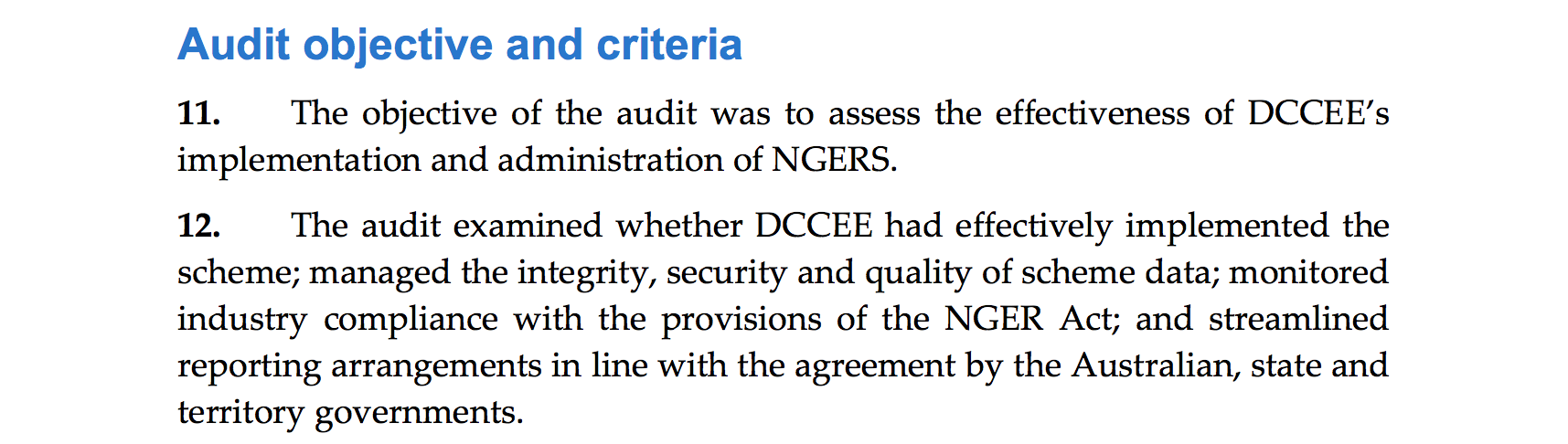
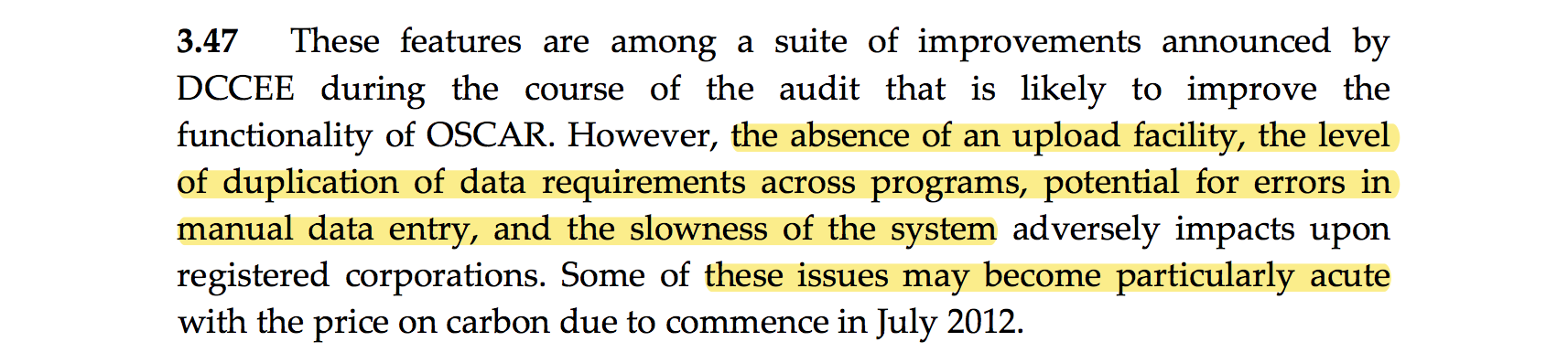
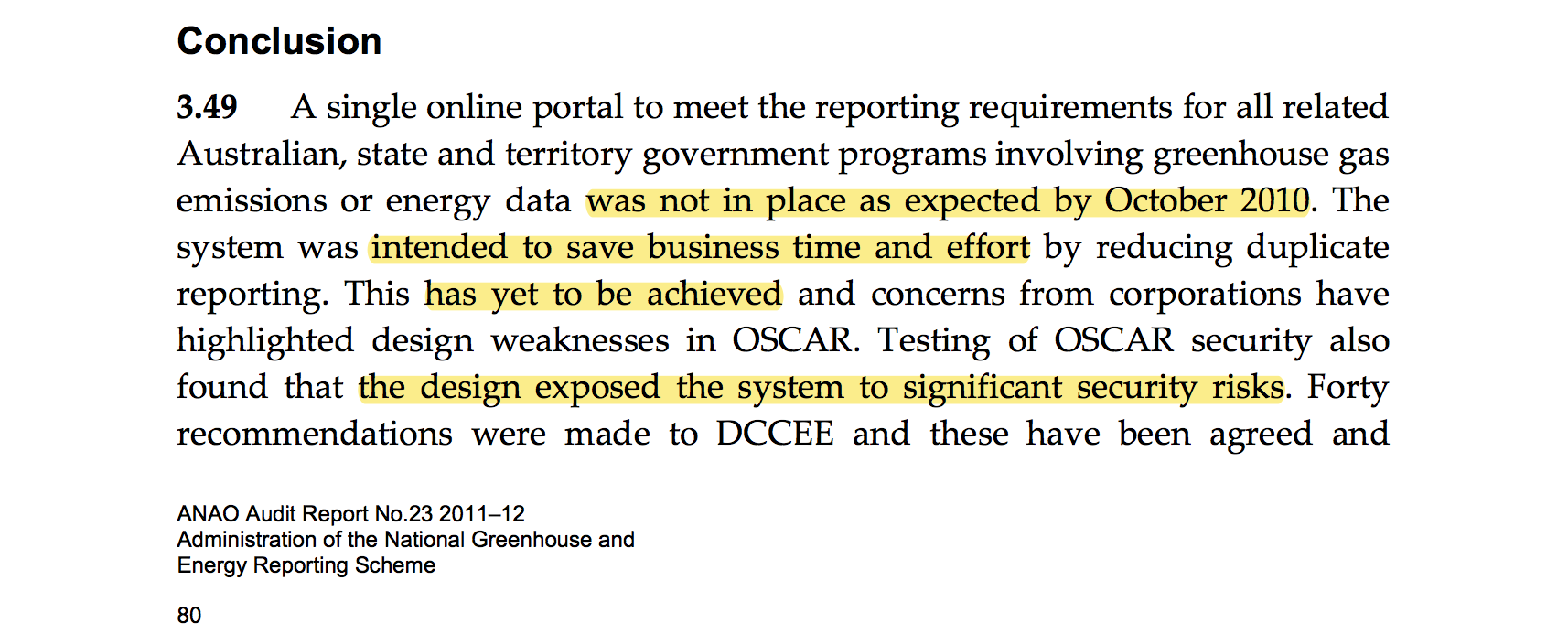
The key, mission-critical system used by the Department of Climate Change and Energy Efficiency for reporting and calculation of “emissions” by the “biggest polluters”, is called OSCAR.

And now, with just over 4 months till the carbon ‘tax’ begins, the “science” is in.

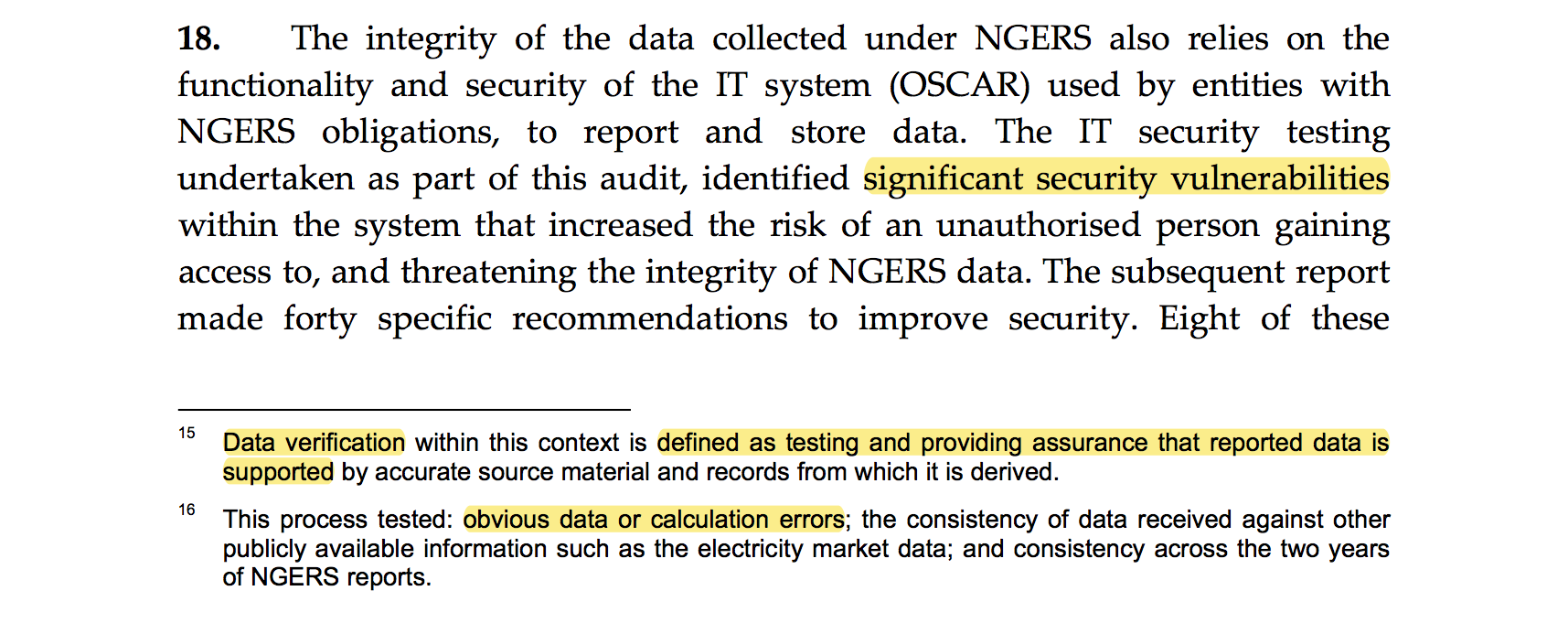
OSCAR is trash.

As indeed was the government’s $20 million taxpayer-funded advertising campaign for the carbon “tax”, which according to the Auditor-General:

“.. contained facts which were not properly sourced and seven breaches of financial management regulations.”

Last year, we closely followed the unfolding story … fairytale … of the Green-Labor Clean Energy Future legislation.

Regular readers know that close examination of the legislation, and the government’s ever-changing claims about the number of “biggest polluters”, and the comments from the bankster industry, and the comments from the banksters’ “expert” talking head economists, clearly show what the Clean Energy Future really is.

An unconstitutional, bankster-designed, CO2 derivatives scam.

With a ticking time bomb carefully hidden inside.

They also know that the government released a Regulatory Impact Statement (RIS). It tacitly conceded that Government emissions audits are nothing more than a propaganda exercise, to maintain “public confidence” in the scheme. Because without public con-fidence that the scheme is actually monitoring emissions accurately, and that companies are actually complying with the scheme, then the whole charade would collapse –

“If there was a perception of widespread non-compliance, community support for the scheme would be much harder to maintain (in the absence of community acceptance and support, the long term future of the scheme could be called into question).”

Indeed, the Government’s RIS actually admitted that “perceptions” of the scheme’s effectiveness are more important than whether or not it actually is effective:

“In closing, it is important to note that, in considering impacts on the credibility of the scheme, perceptions of non-compliance can be more important than the actual level of non-compliance.”

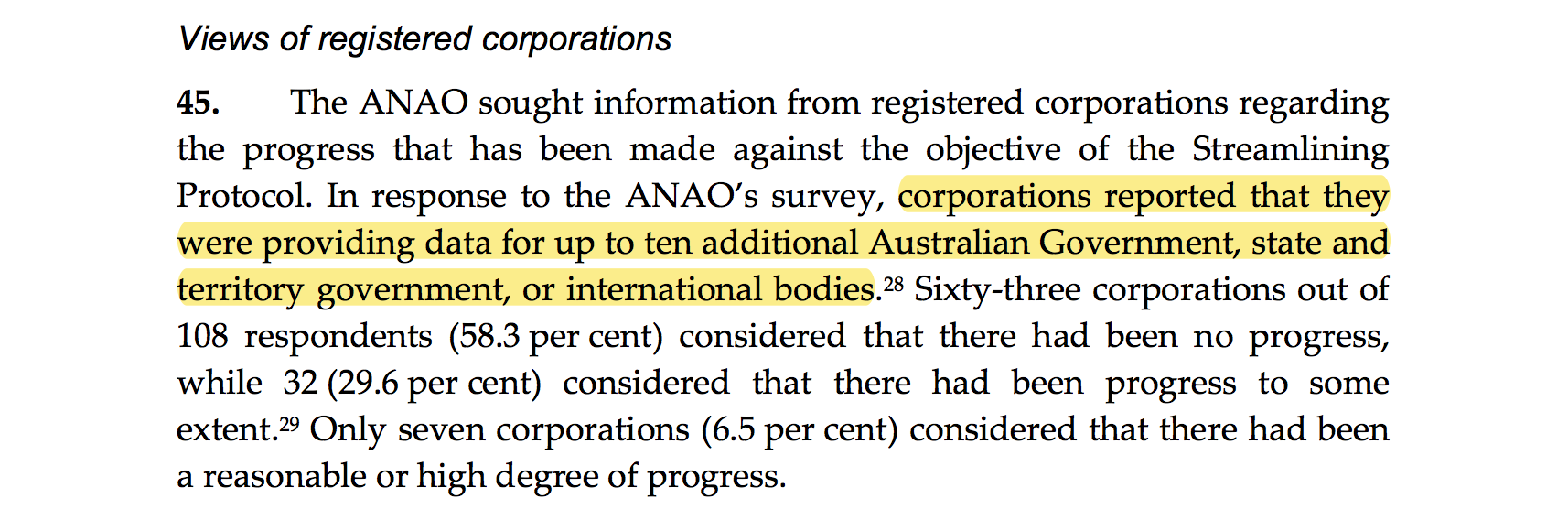
Last week, the Auditor-General released an “independent performance audit” by the Australian National Audit Office (ANAO), into the Department of Climate Change and Energy Efficiency. The report is titled “Administration of the National Greenhouse and Energy Reporting Scheme”.

It is a fascinating read.

Now for lazy “give me the headline” readers, you can see the lamestream media’s lazy summary in The Age here – Audit Finds Errors on Emissions.

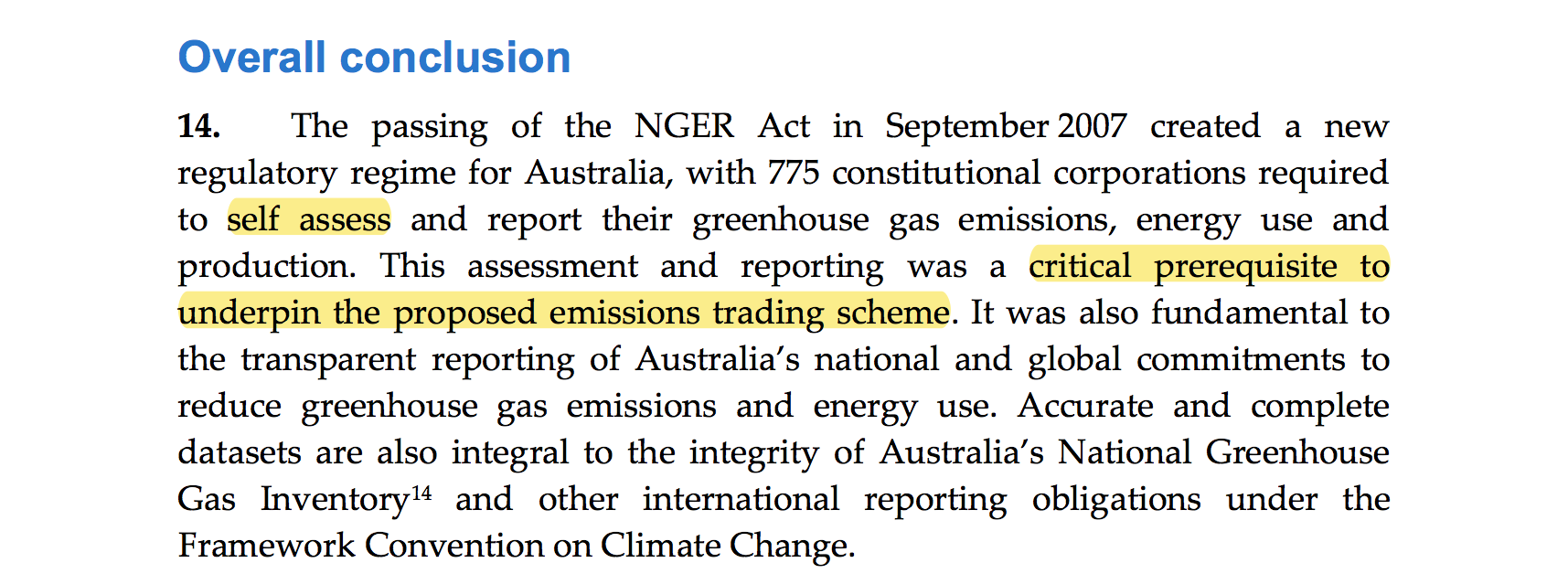
For more intelligent readers, or for those passionately and sincerely deluded folk who are placing their (blind) faith in the Government’s “carbon tax” to save the world from Warmageddon, you may find the following excerpts discomforting.

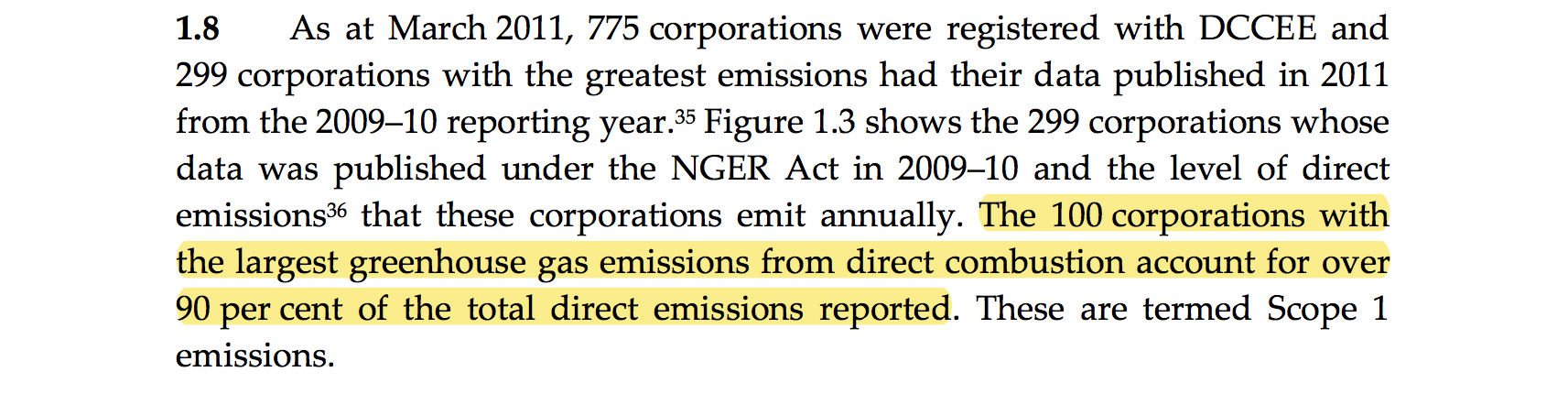
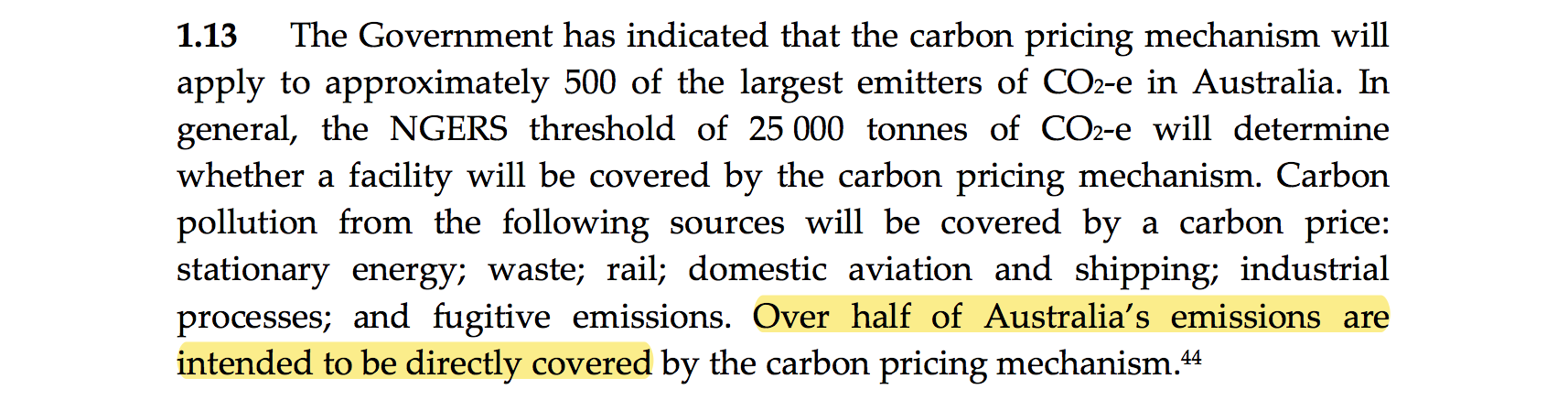
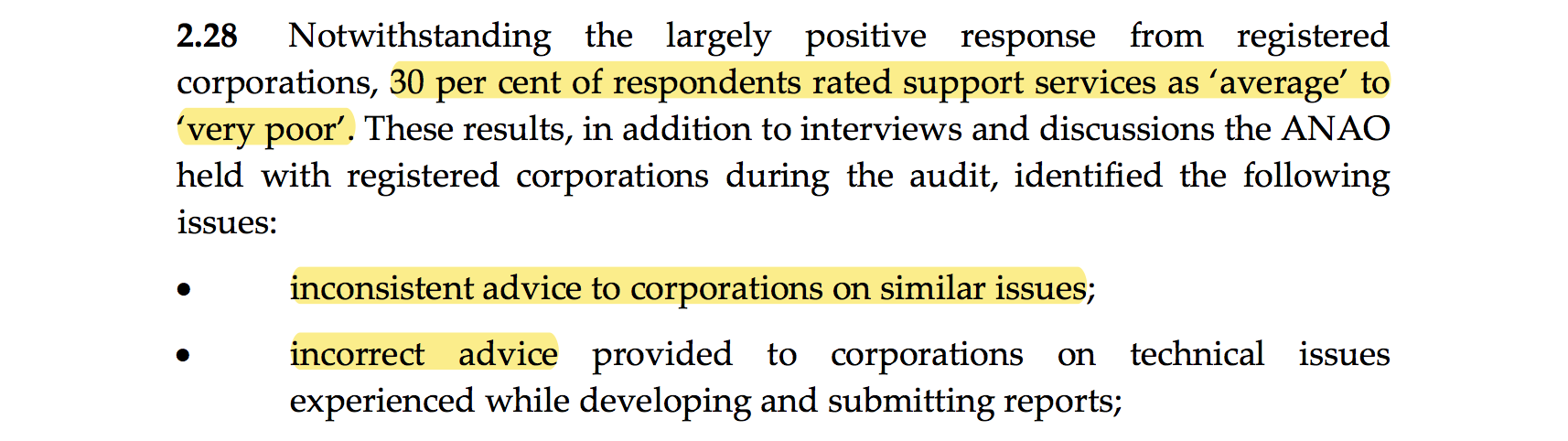
A forewarning – there are quite a few excerpts here. The Auditor-General’s report is 124 pages long. I’ve stripped out only the most interesting items, and highlighted them in yellow.

Rest assured, it is well worth your time to go through this. Especially if you wish to have a much clearer understanding of just what a total farce … and money-sucking fraud … the Clean Energy Future regime and its government department actually are.

I’ve done the tedious work.

And to make it a little more entertaining for you, I’ve sprinkled comments throughout.

Enjoy:

Click to enlarge

Click to enlarge

Click to enlarge

Click to enlarge

Click to enlarge

Click to enlarge

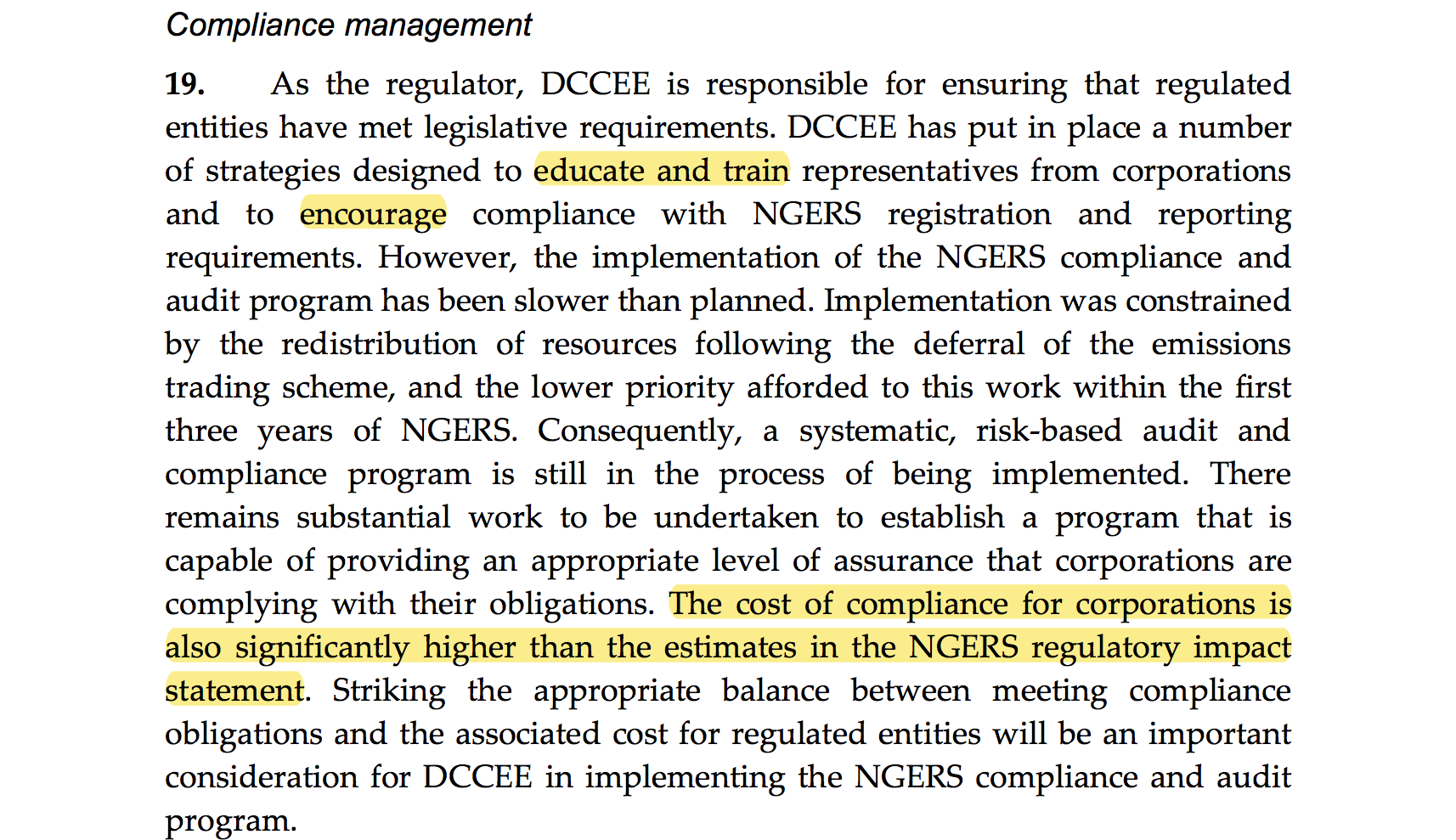
To “encourage” compliance is code for, “Pleeeease go along with our scheme … pretty please?” At least this thinly-veiled begging makes a change from, say, The Goose’s impotent posturing towards the banks.

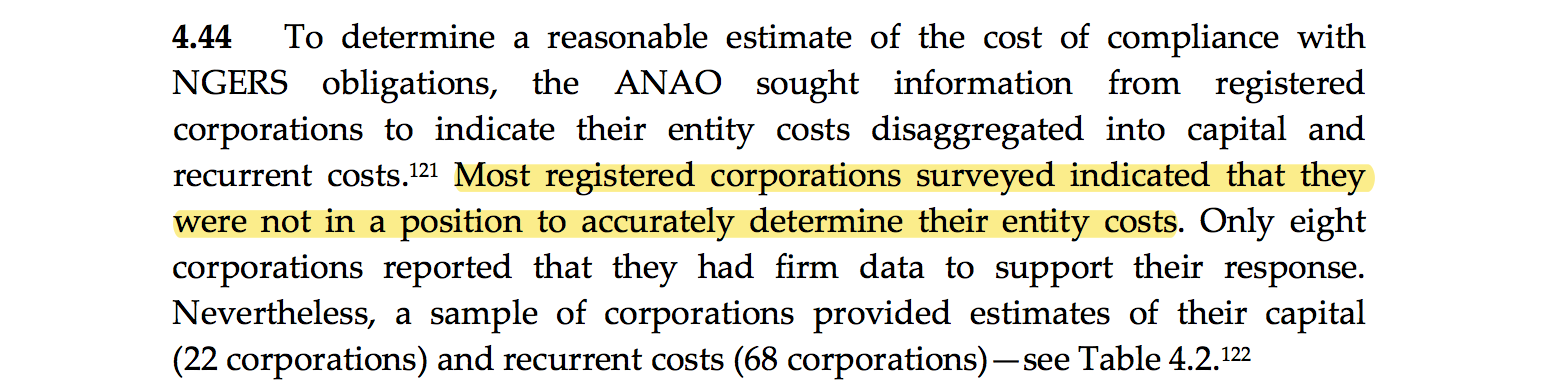
“Significantly higher” costs for compliance by business, ‘eh?

Hmmmm. How much higher?

Patience, dear reader. Remember, this is just the ‘Summary’ at the beginning. The ugly details come later.

Click to enlarge

Click to enlarge

Click to enlarge

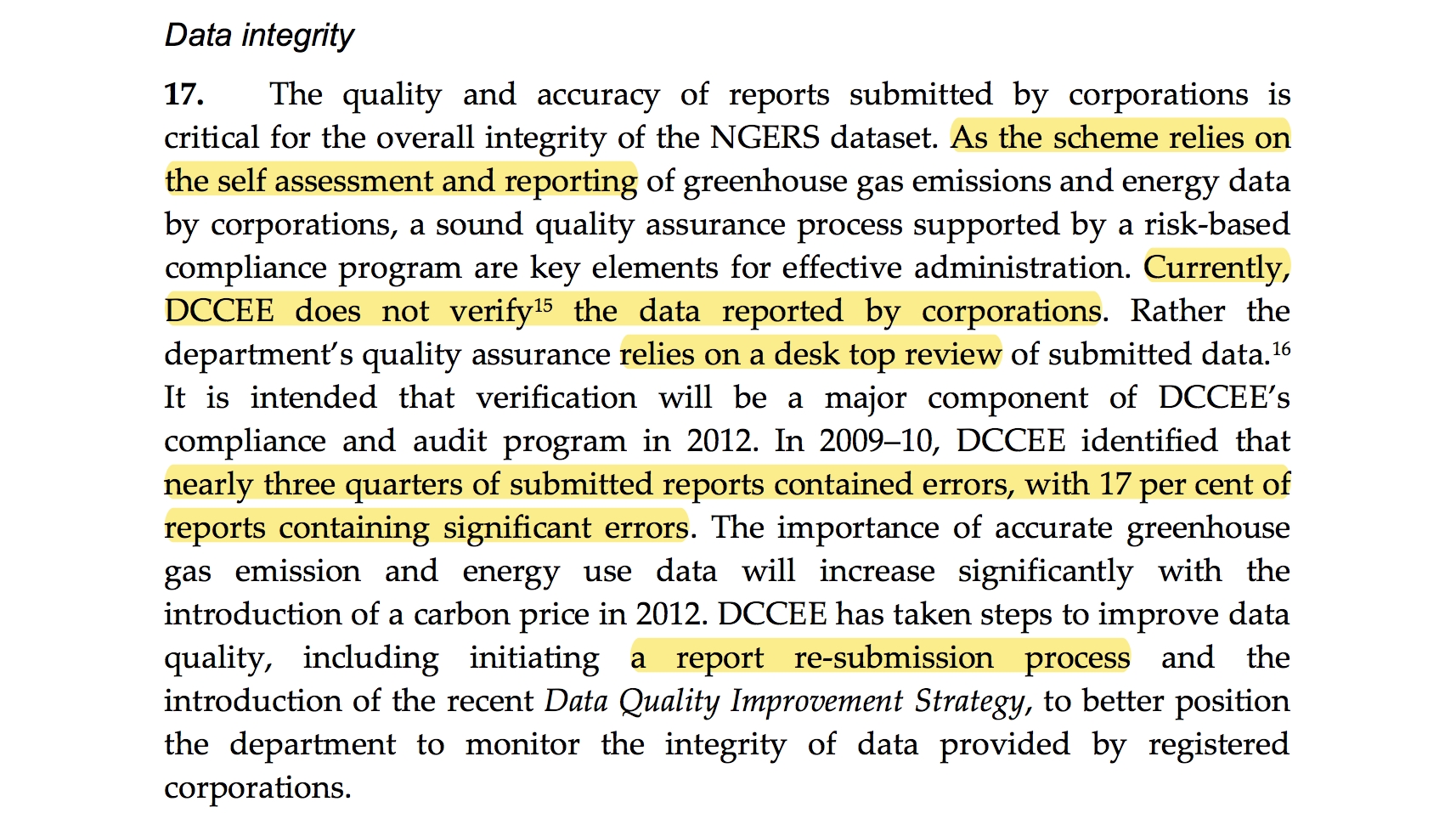
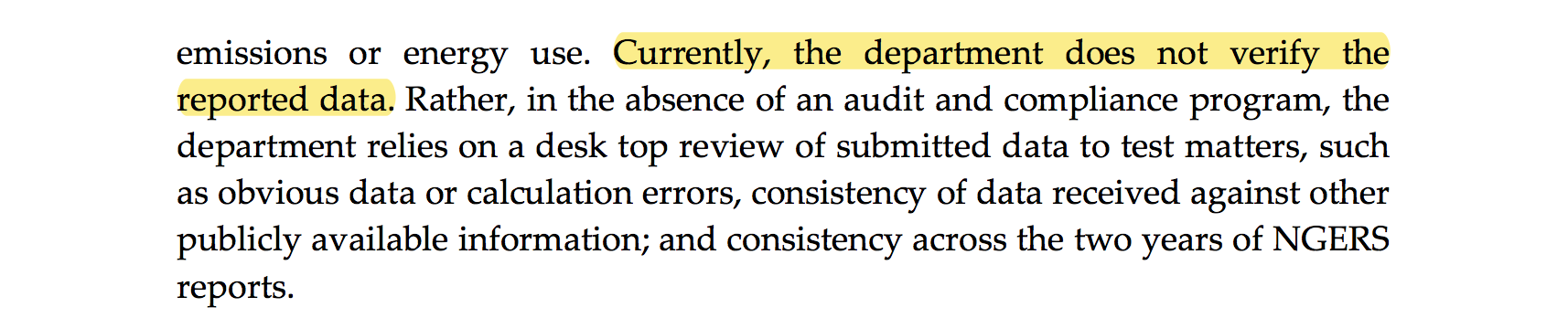
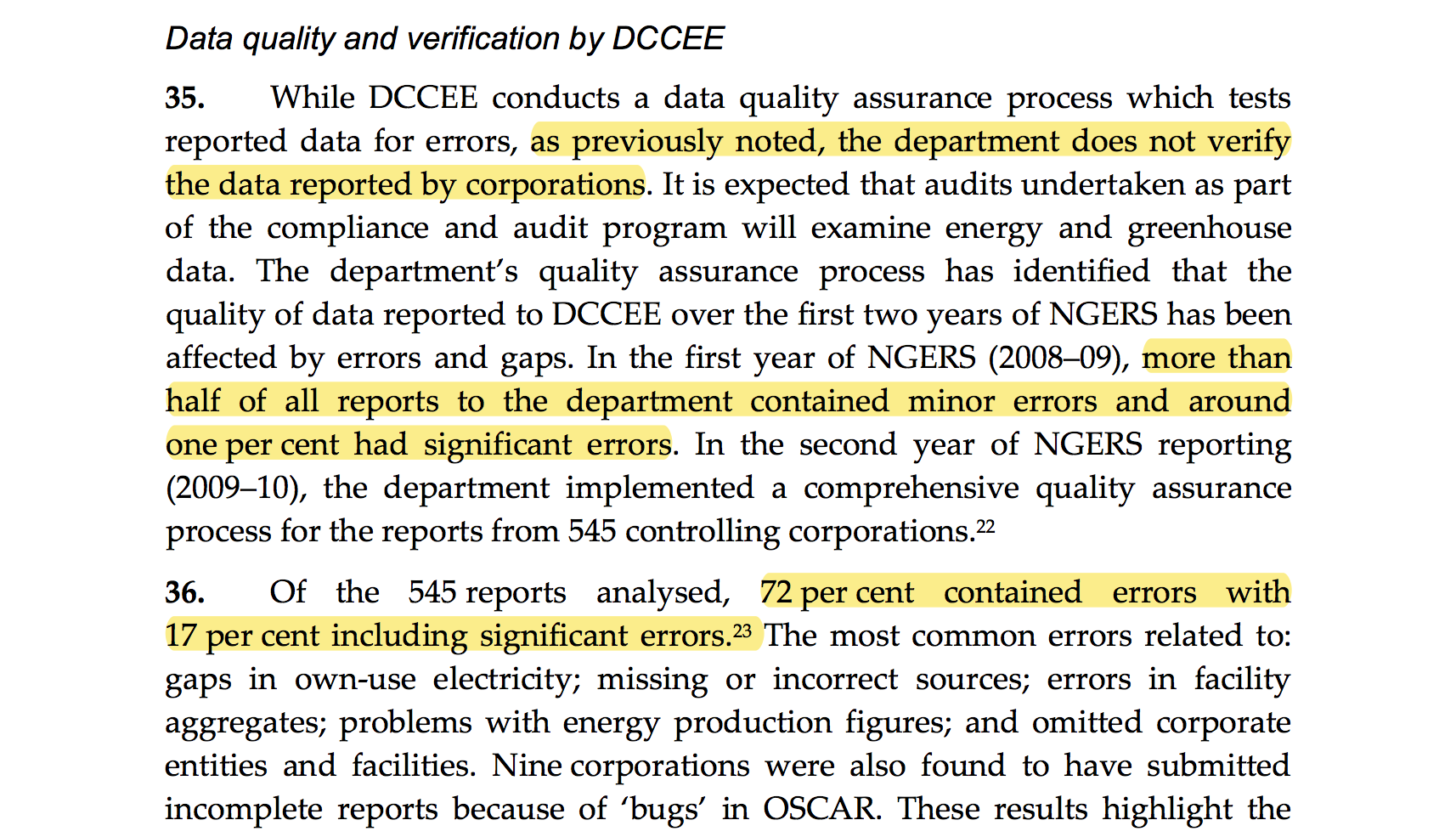
“Currently, the department does not verify the reported data”.

Ummmm … so it could all be total crap.

Or at the very least, riddled with even more errors than the ANAO audit discovered.

Remember, these (self) reported emissions by the “biggest polluters” are the basic, critical data relied upon by Treasury to “model” the impacts of the carbon “tax”.

How apropos was the title of my July 2011 blog post just days before the announcement of the draft legislation – A Disturbance In The Farce

Click to enlarge

Hmmmmm.

Just how big is a “significant error”?

Naturally, we have to look in the fine print for that:

Click to enlarge

So in the Clean Energy Future, a “biggest polluter” has only made a “significant error” if it is “greater than 40%” of the total annual emissions that qualified you as being a “biggest polluter” in the first place.

Would that we all could cruise through life with such a generous standard for (in)accuracy in our work.

Click to enlarge

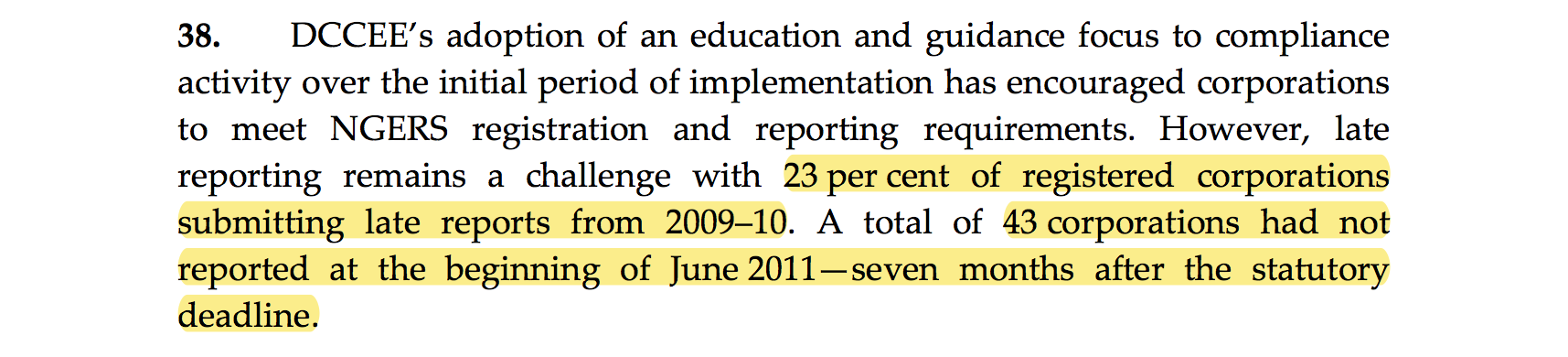
She’ll be right mate. We’ll get around to submitting a report of our self-assessed “emissions” … eventually.

Click to enlarge

Hark!

Hear that sound?

That’s the sound of Treasury’s “modelling” on the impacts of the carbon “tax” losing any remaining vestige of credibility.

It’s also the sound of your wallet getting emptied at an even faster rate than you thought, as corporations pass on “significantly higher” costs than Treasury had “modelled”.

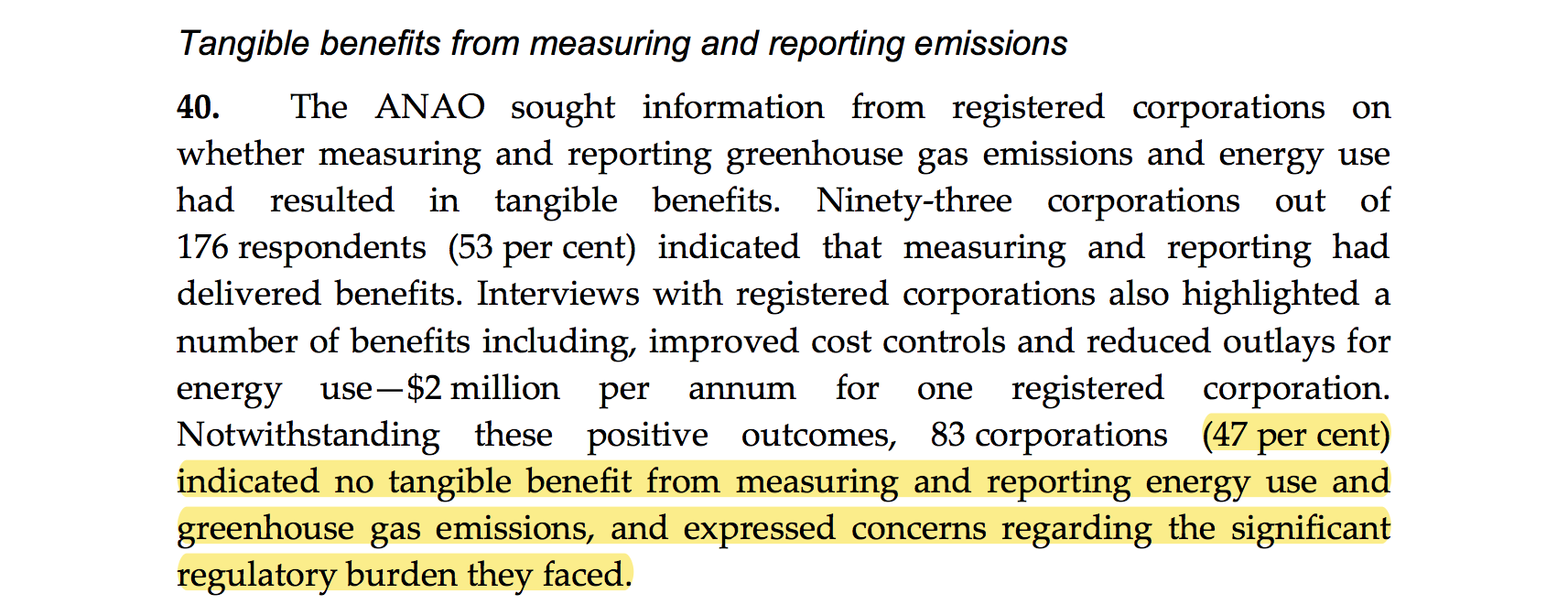
Click to enlarge

Great big new “tax”.

No tangible benefit.

Quelle surprise!

Click to enlarge

Funny how there is such a lack of “progress” under a new global tax regime being instituted by … progressives.

Ok, that’s enough from the “Summary”. Yes, all 31 pages of the “Summary”.

It’s probably more than enough for anyone with an IQ above room temperature to get the picture.

That even according to the Auditor-General, the government’s scheme for monitoring and reporting the emissions of the “biggest polluters” is a farce.

But if you want more … and the really good stuff is yet to come, because as every Yes Minister fan knows, the Summary is for the gormless ministers and the media, and you always hide the stuff you don’t want people to know in the endless pages of tedious detail  … then here’s selected excerpts from the remaining 93 pages of detailed subject areas:

Click to enlarge

Click to enlarge

And thus, dear reader, we have official confirmation – from the Auditor-General, no less – that your humble blogger was right throughout 2011, in his numerous blogs exposing Gillard’s “1,000 biggest … 500 biggest … more in the order of more like 400” “biggest polluters” lies.

Click to enlarge

Meaning … if you believe in the accuracy of the government’s data, which of course, as we have seen, you can’t … almost half of Australia’s total “emissions” won’t be directly covered.

Hmmmm … bushfire season coming up again.

Pushing on a string, anyone?

Click to enlarge

Sheesh!

$472 grand to tell us that the emissions reporting regime is a farce?

Great use of taxpayer dollars.

I’d have told you that for one one-hundredth of the price.

Indeed, I have been telling you that … for free.

Click to enlarge

Click to enlarge

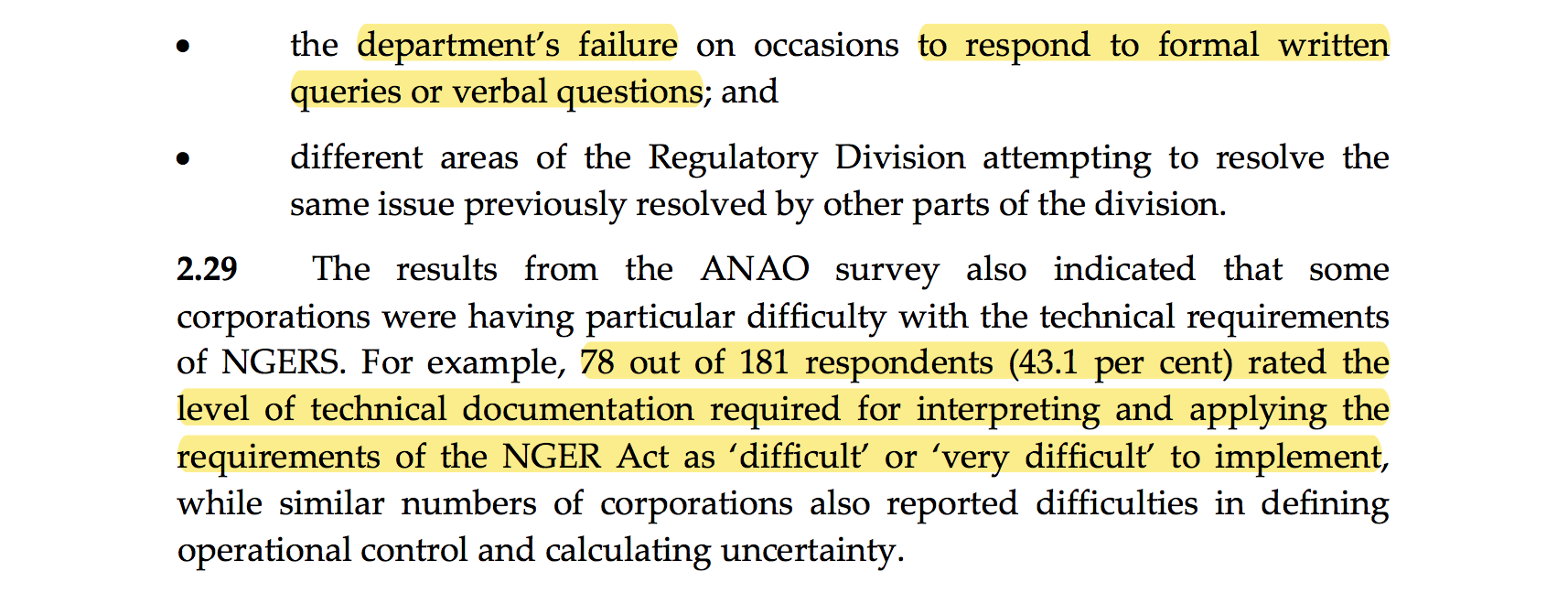
Translation: The technical requirements being asked of corporations in order to report emissions are too bloody difficult.

Doubtless explaining why so many have either (a) failed to report, (b) reported months late, or (c) screwed up their report.

Click to enlarge

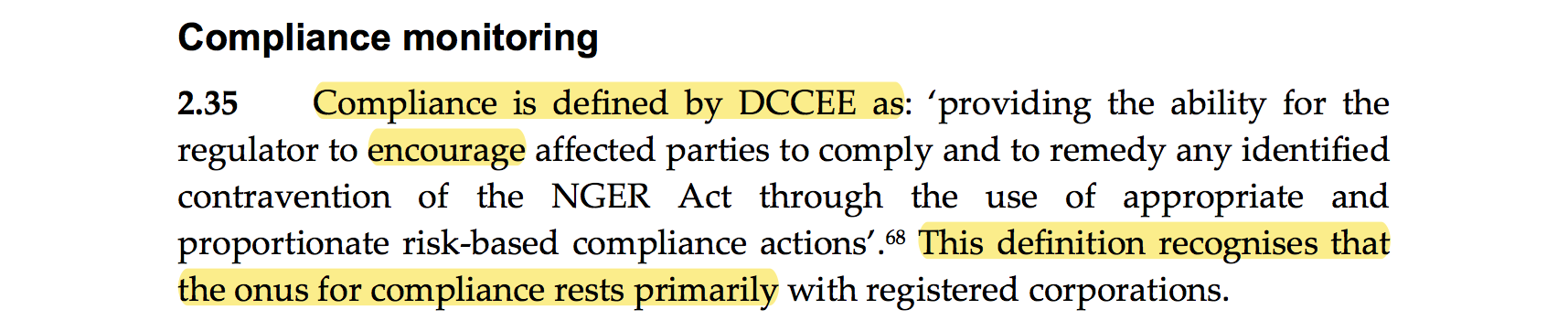
Arguably the most amusing quote in the entire audit.

The Department of Climate Change and Energy Efficiency (DCCEE) actually defines “compliance” with the scheme as the ability to “encourage” corporations to comply. Its own definition recognises that the onus for compliance “rests primarily” with the corporations.

Oh yes, dear reader … I have no doubt whatsoever that corporations are very much “encouraged” to comply with the Clean Energy Future regime … particularly when they can see how impotent and farcical the DCCEE and its systems actually are.

Click to enlarge

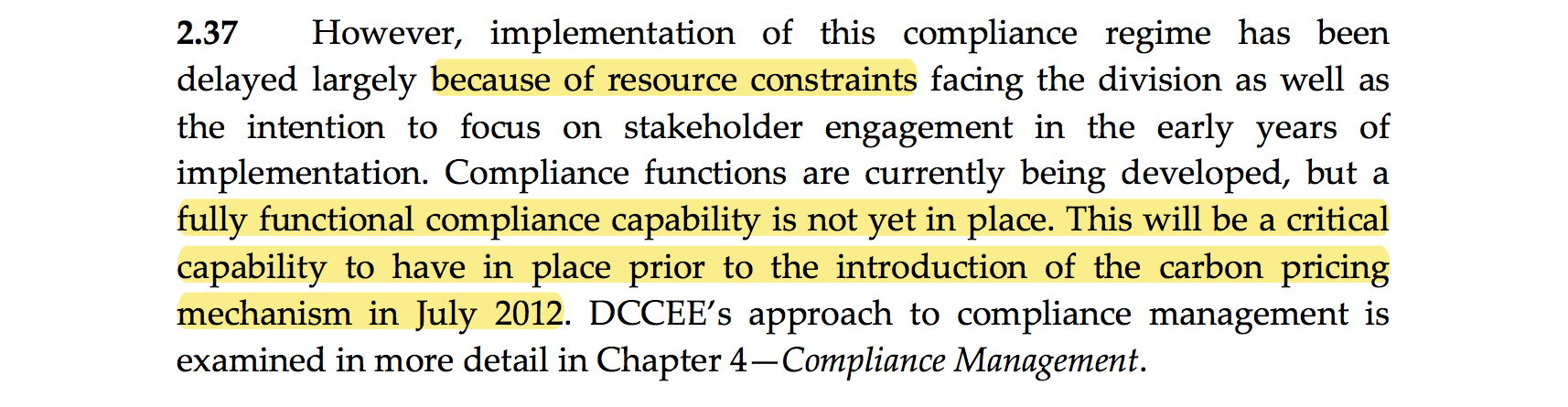
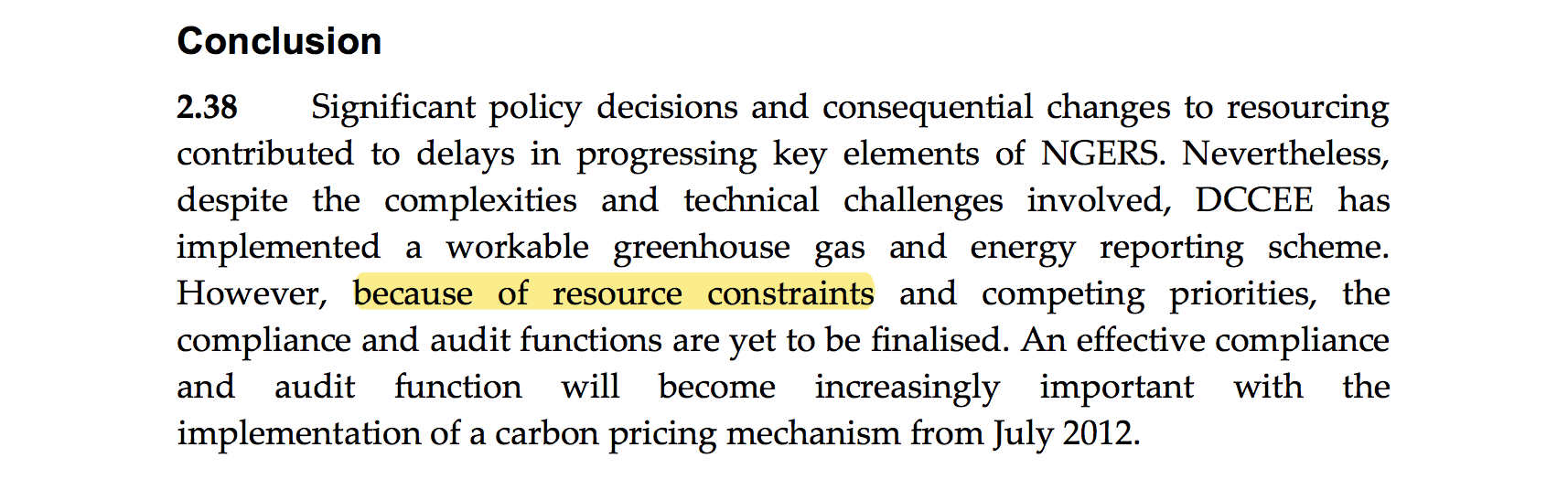
“because of resource constraints”.

Public ‘service’ (vomit) code for “give us more money”. Sir Humphrey Appleby would be proud of this report.

“a fully functional compliance capability is not yet in place”“a critical capability to have in place prior to .. July 2012”

Better get a wriggle on then, fellas. You’ve got about 18 weeks.

Oh that’s right. Silly me.

That’s just the coded threat underlying the appeal for more taxpayer money.

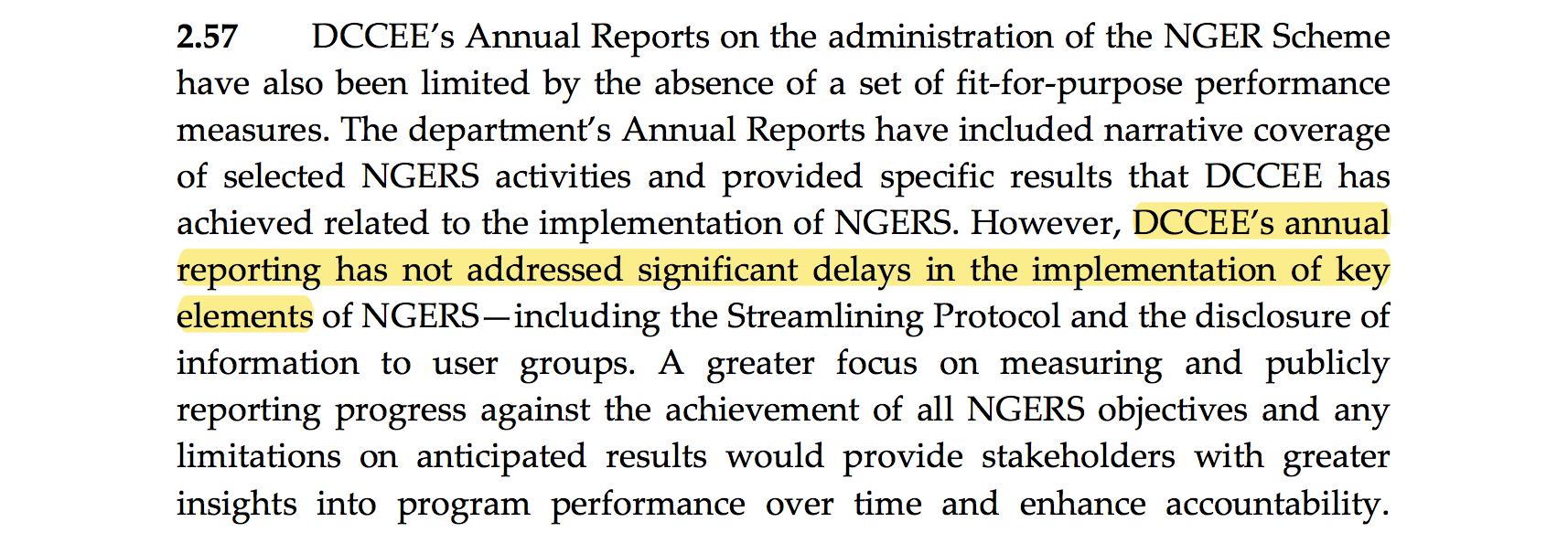
“Quick quick La Gillardine, give us another few billion, or we won’t be ready to ‘encourage’ corporations to ‘comply’ in time.”

Click to enlarge

Just in case you missed our department’s appeal/threat for more funding the first time.

Click to enlarge

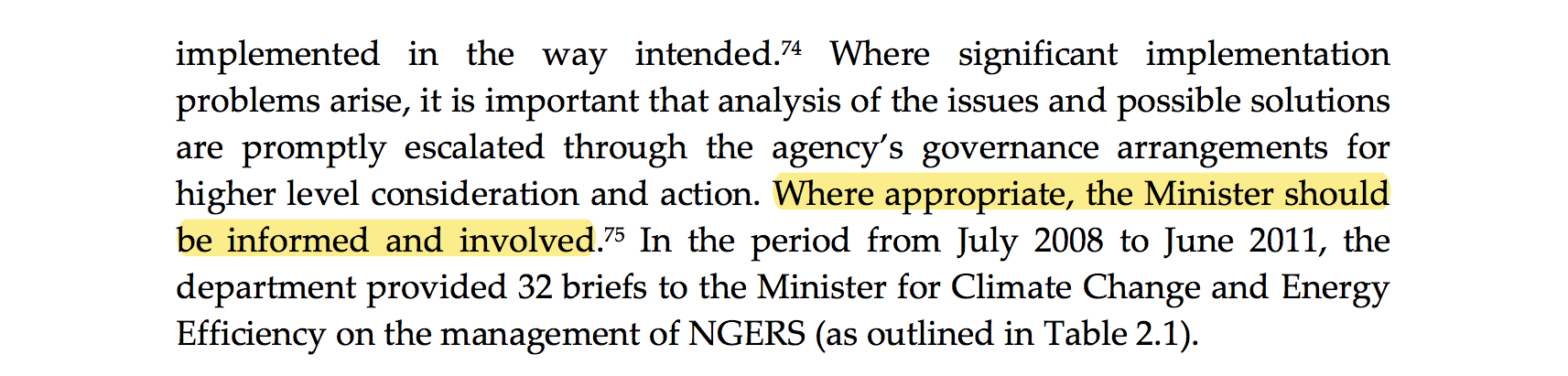
Translation: the DCCEE will only tell the responsible Minister what the department heads decide that he “needs to know”.

Don’t believe that’s what they mean?

Click to enlarge

Translation: The DCCEE has not been telling the responsible Minister (Combet) that the department is waaaaaaaaaay behind the eight-ball in implementing the basic (and critical) emissions reporting bureaucracy.

Sir Humphrey Appleby would be so proud of this department.

Click to enlarge

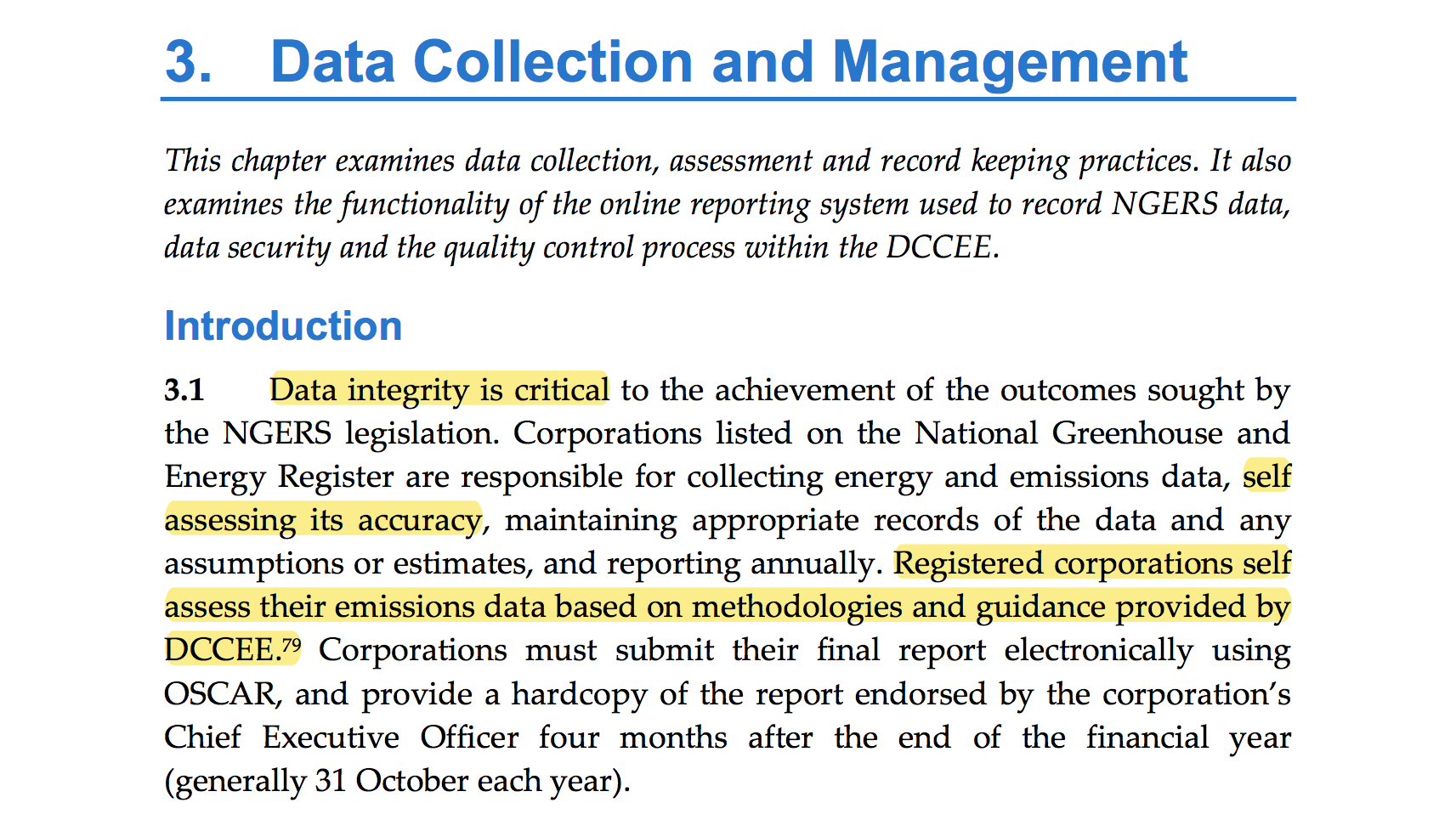
Data integrity is critical.

And yet, how exactly are emissions determined?

Well now, that’s in the fine print, of course:

Click to enlarge

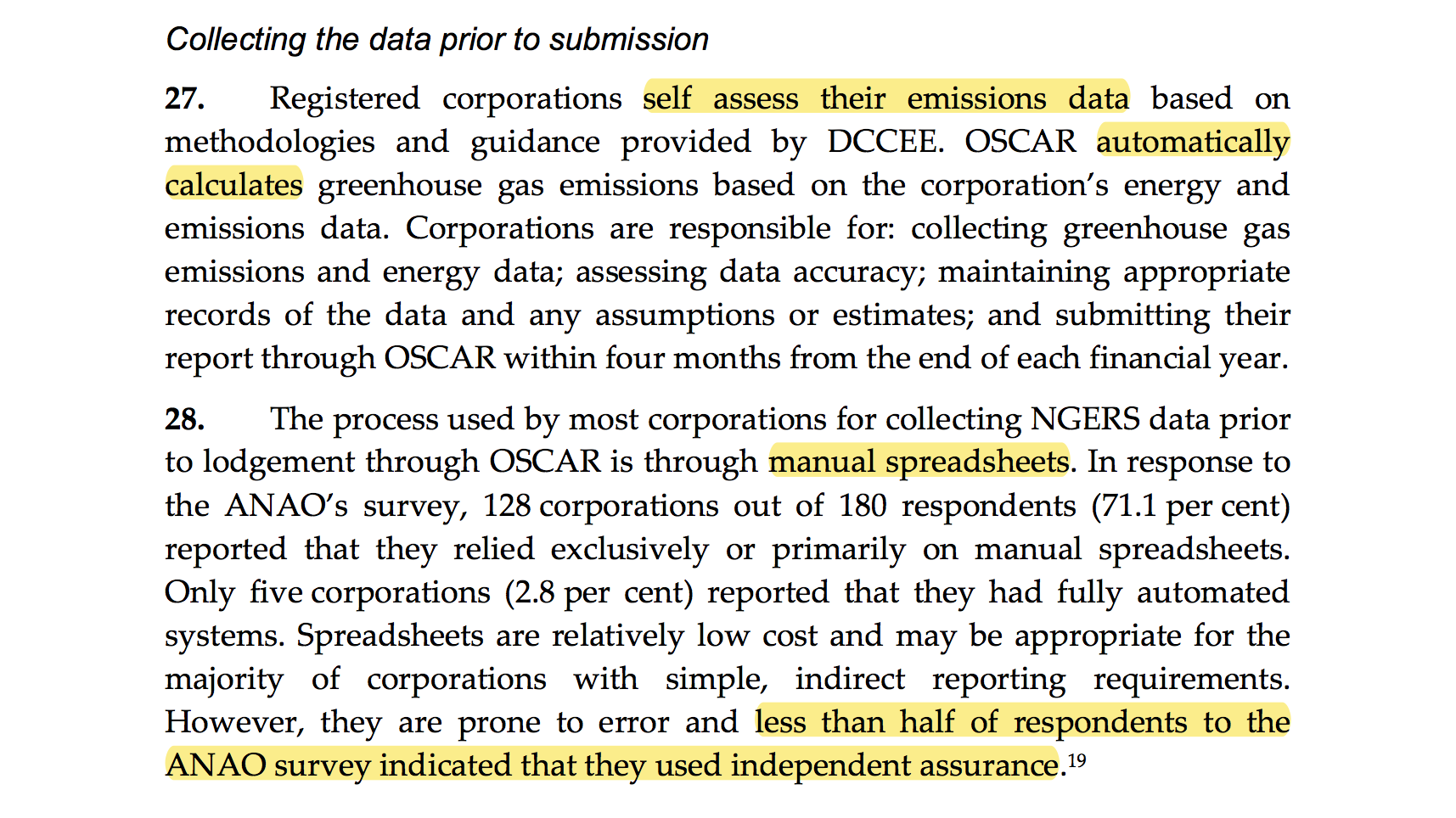
Translation: The corporation tells us how much electricity they used, or generated, and/or how many tonnes of dirt they dug up. And our special black box called OSCAR “automatically calculates” the number of tonnes of “emissions”.

Sounds like a Great Big New FUDGE FACTOR to this humble blogger.

And since the audit also goes on to demonstrate just how appallingly agricultural (pun intended) the OSCAR software system is, one would have to be wilfully ignorant (or a vested interest) to believe that this system will actually generate and report accurate emissions data.

Don’t believe me?

Click to enlarge

Click to enlarge

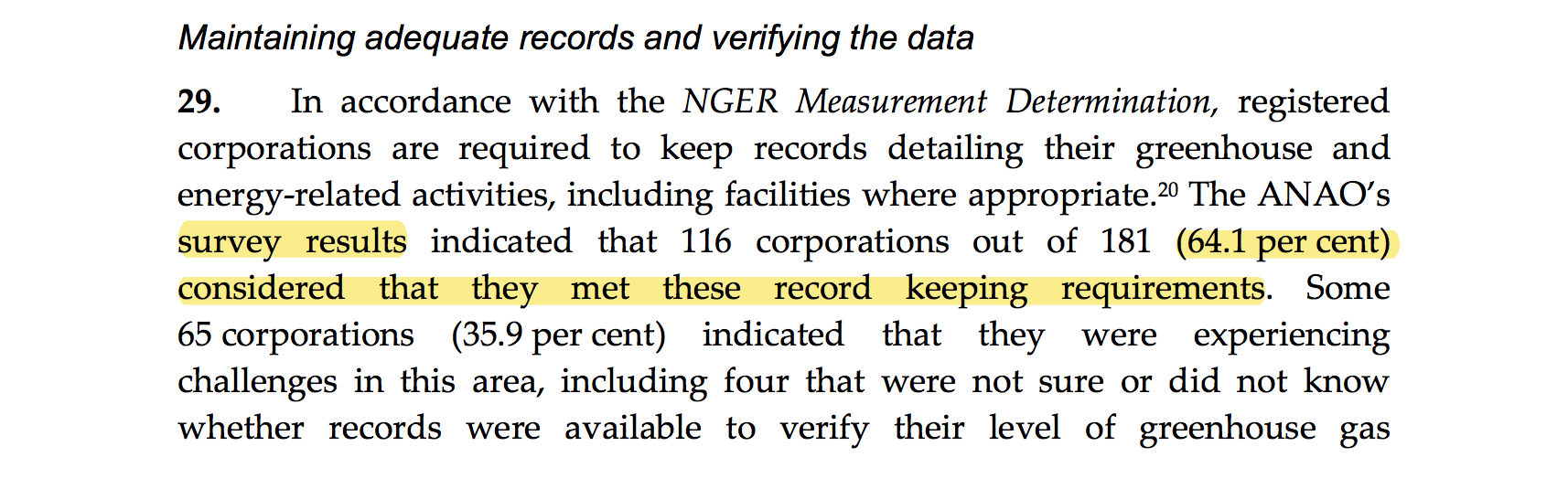
The “biggest polluters” own record-keeping is not up to par. Indeed, some corporations admit that they are passing this task off to junior staff or “third party providers” (read: the accountant).

But it gets worse, because …

Click to enlarge

… even the DCCEE doesn’t actually know how poor the “biggest polluters” record-keeping is, because the department’s own auditing program still isn’t finished, and so they didn’t have any documentation to show the Auditor-General, aside from their own “guidelines” handed out to corporations!

Click to enlarge

Click to enlarge

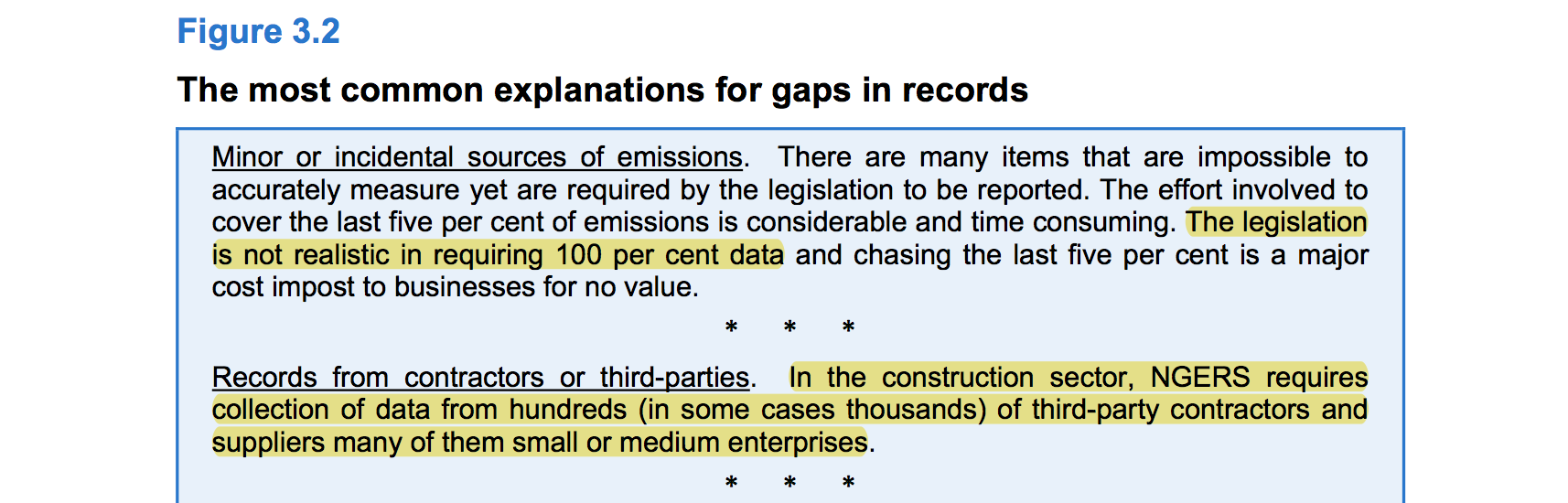
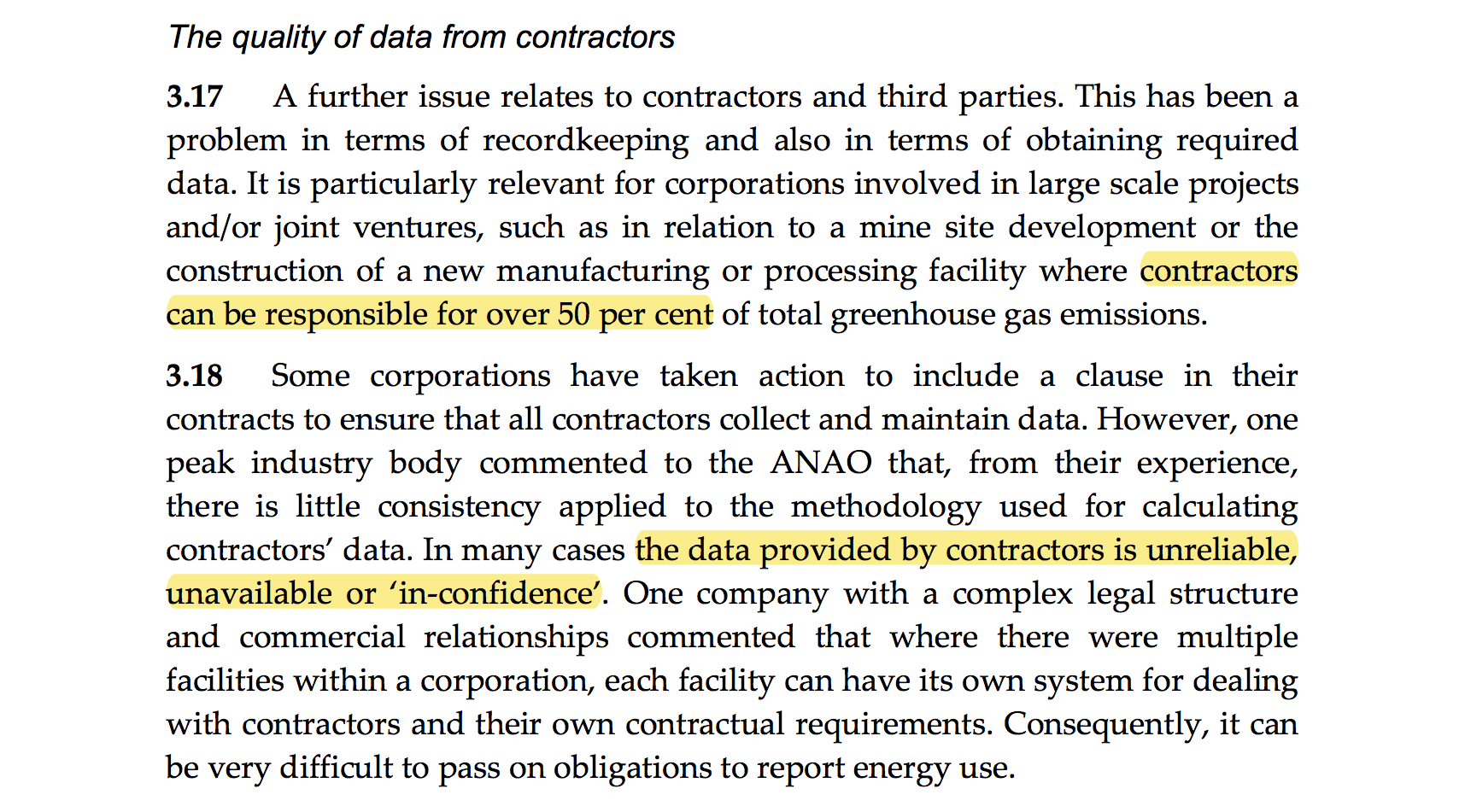
Difficult for the construction sector to get the necessary records to report emissions, you say?

Contractors, you say?

I can smell a RORT-A-THON coming on.

Click to enlarge

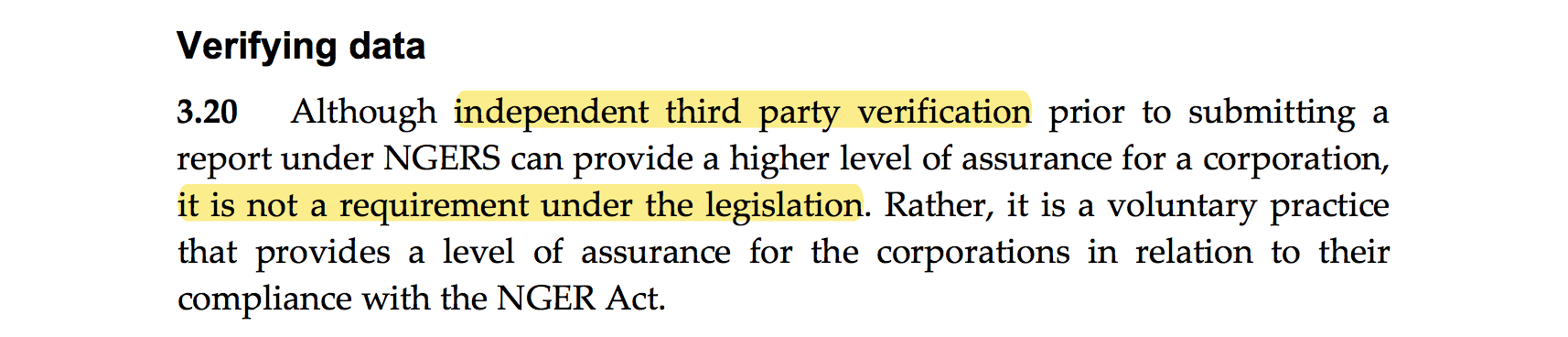
Independent third party verification of the “biggest polluters” annual reports?

Never mind. We’ll take your word for it.

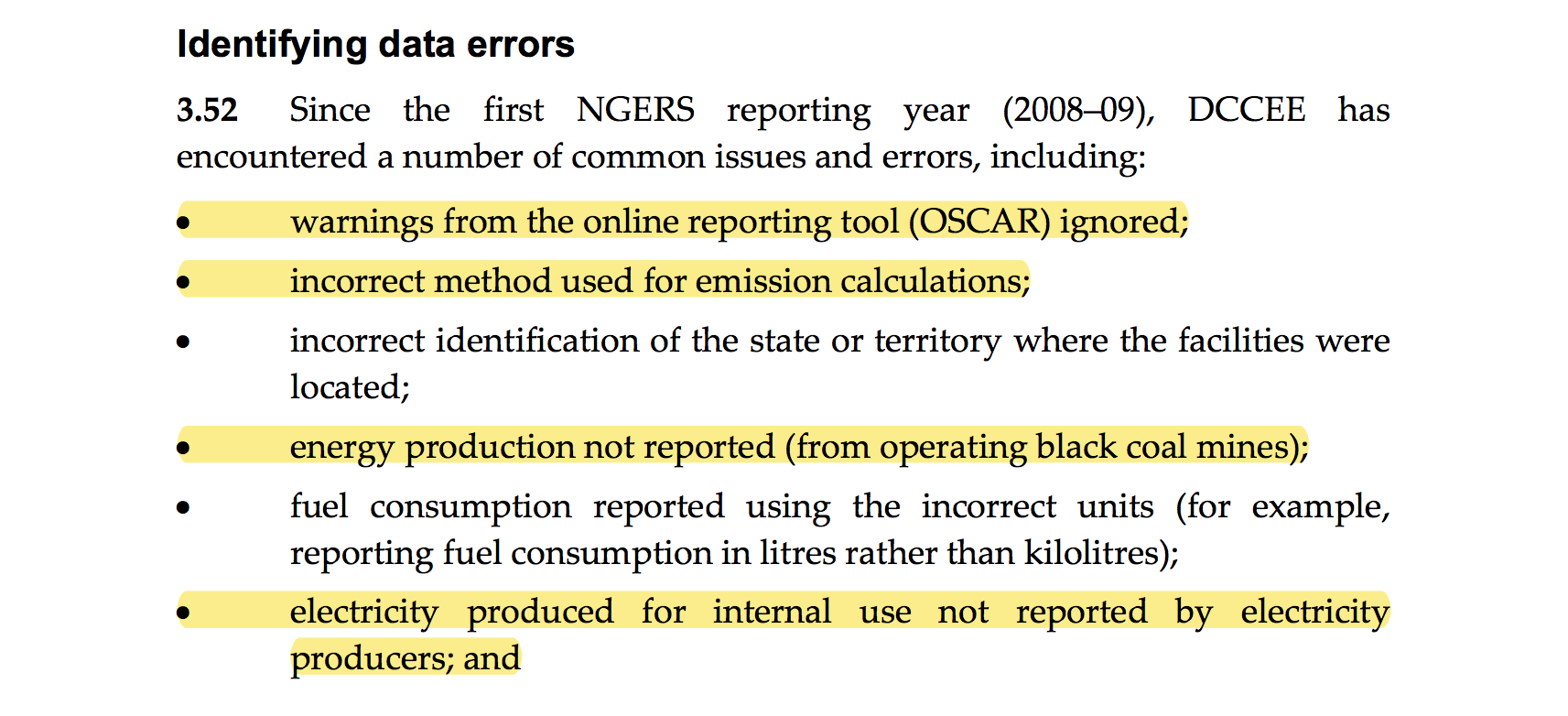
Click to enlarge

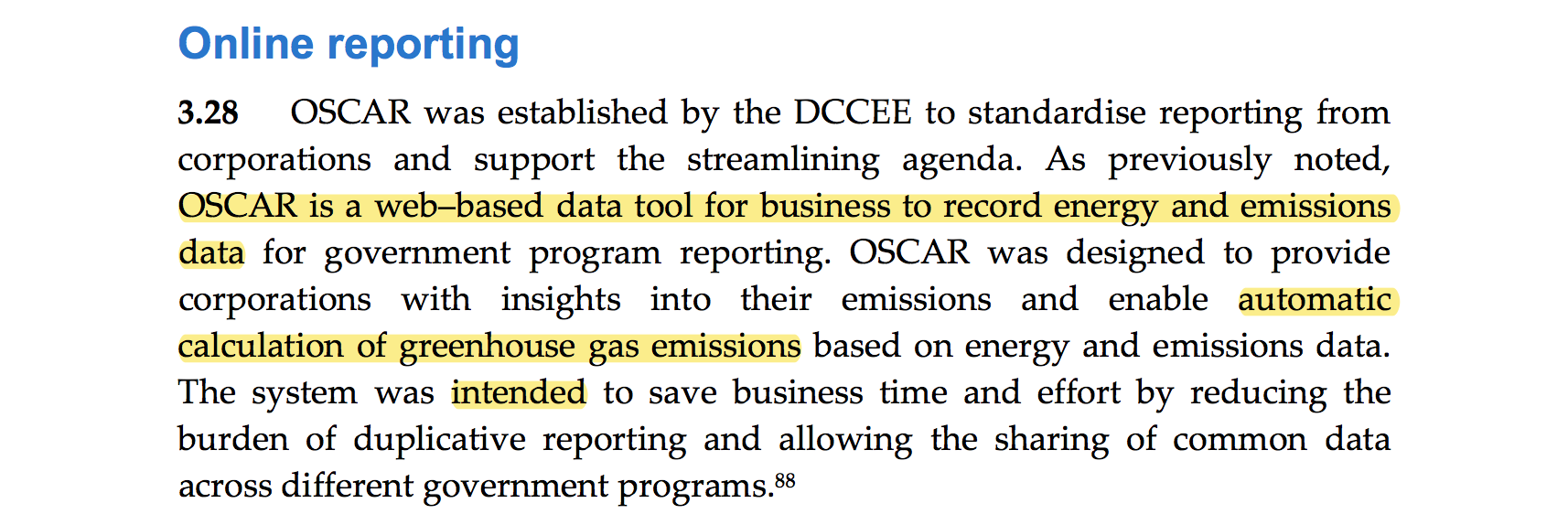
OSCAR, ‘eh?

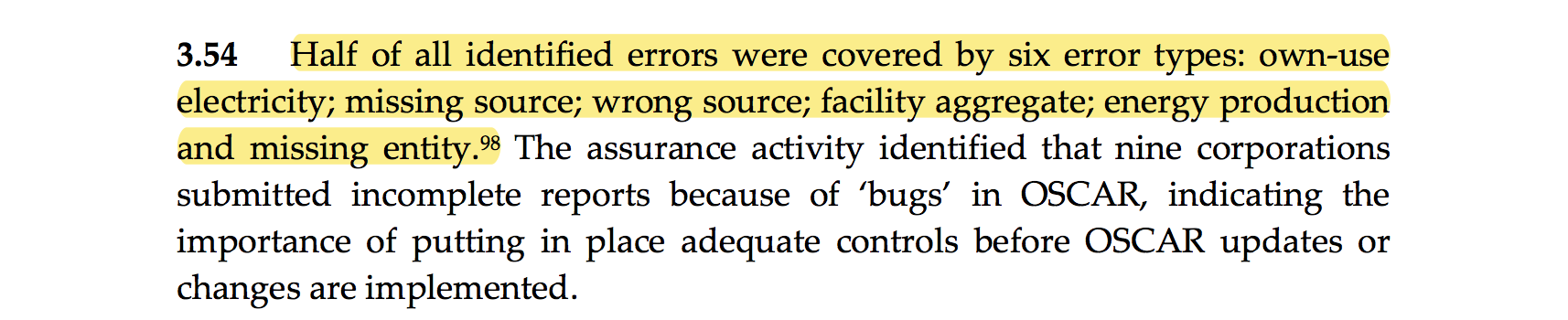
Given the quality of data going into, and out of this system, one wonders if some nerdish wag in the DCCEE wasn’t thinking of this Oscar when they chose the name:

Click to enlarge

Click to enlarge

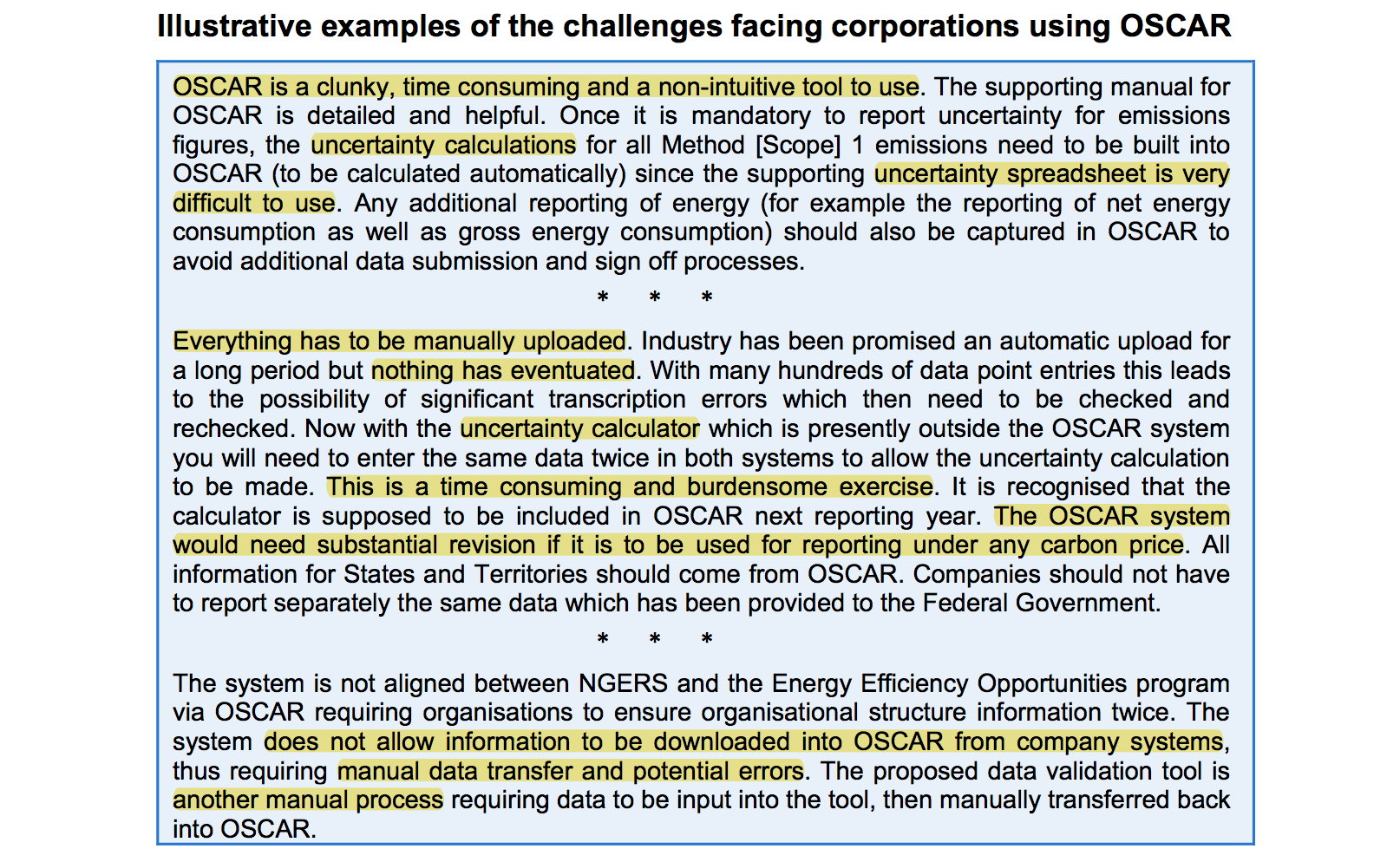
Someone left the lid off the trash can.

Click to enlarge

Click to enlarge

Click to enlarge

Click to enlarge

Click to enlarge

Click to enlarge

And the trash can is full of holes.

So, what do we do when the trash is leaking out of the trash can?

Why but of course … we stuff it back in again:

Click to enlarge

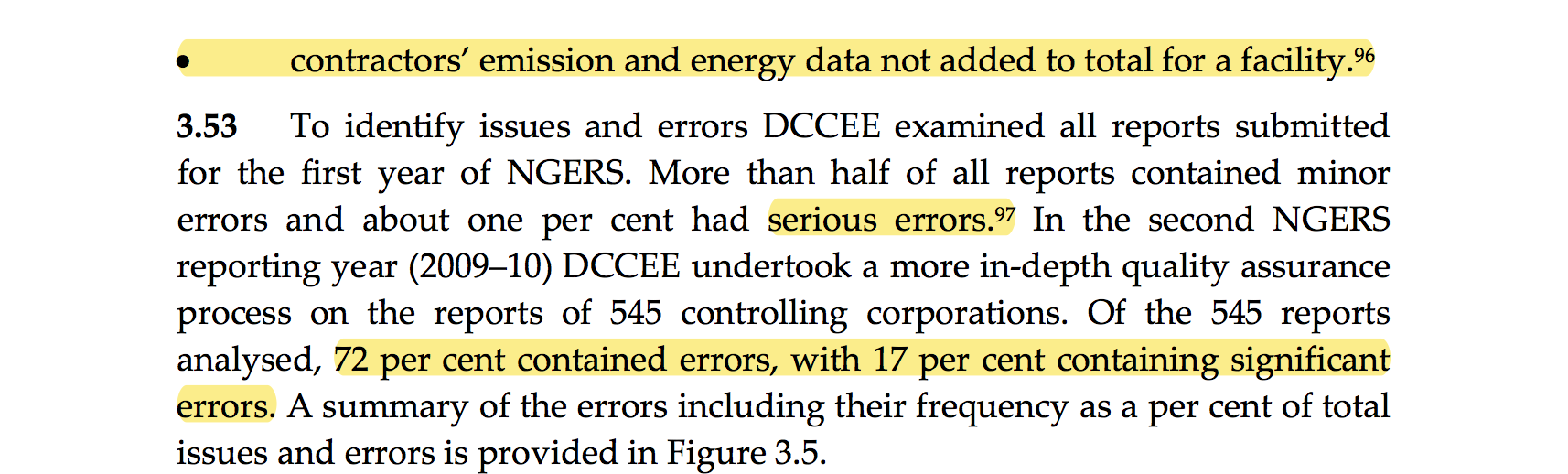
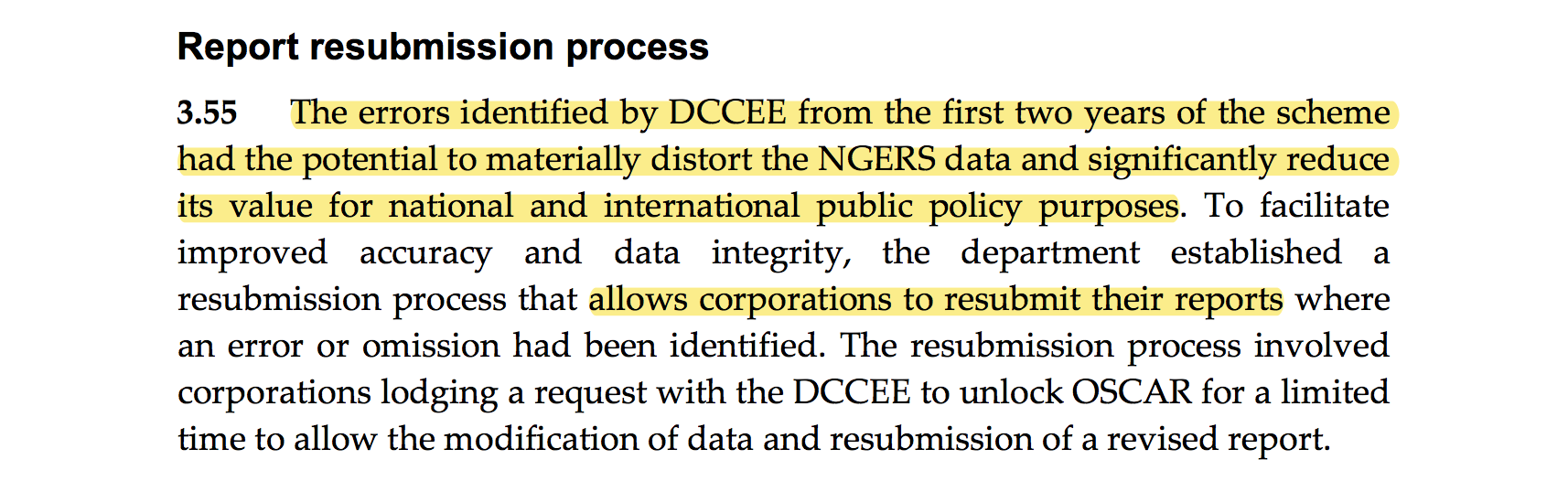
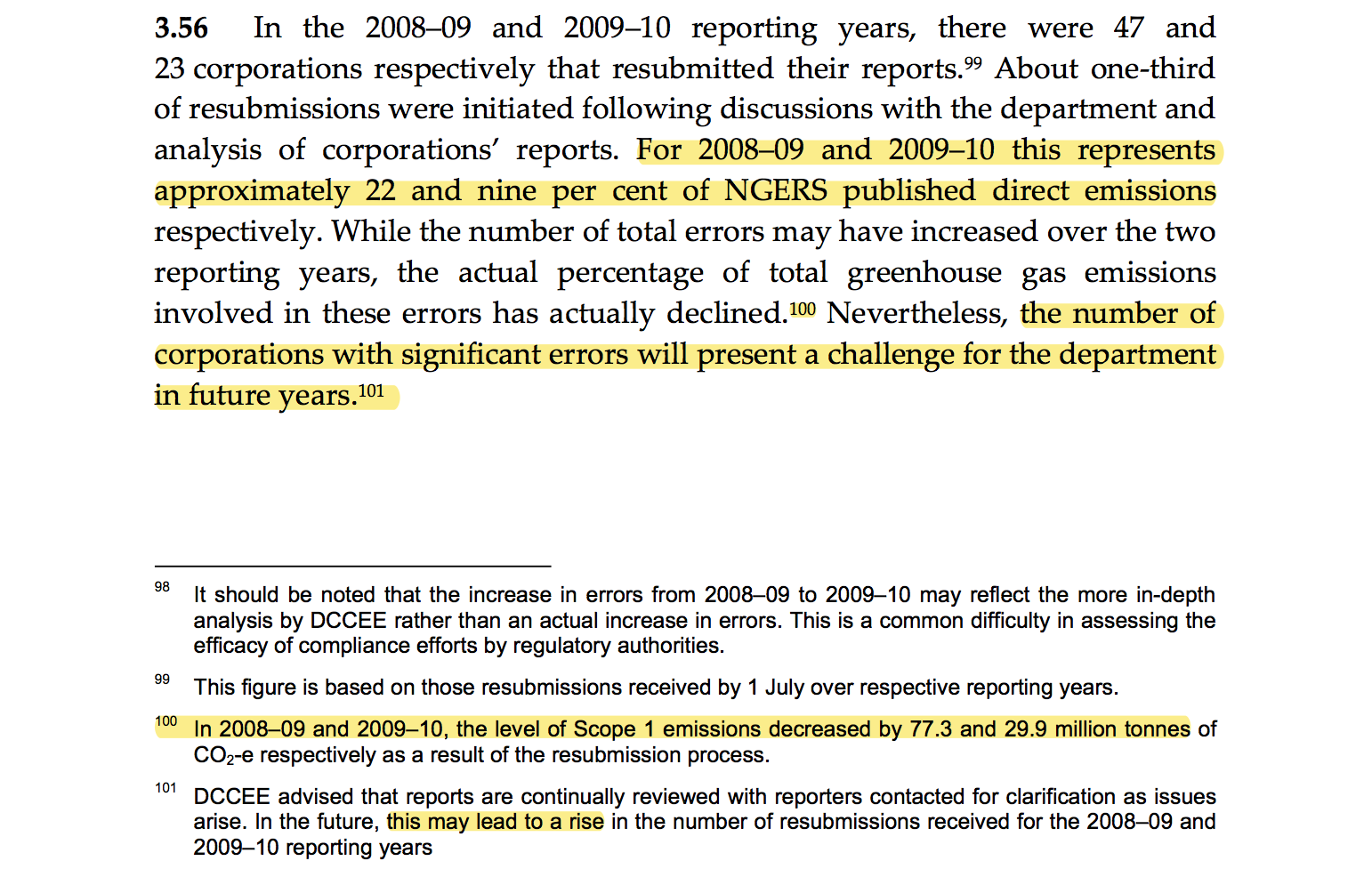
How much trash is leaking out … that we know of so far?

Click to enlarge

Oh, only 22% and 9% of total reported emissions for 2008-09 and 2009-10.

Or, about 77 million and 30 million tonnes of CO2-e.

At $23 tonne, that’s only about $1.7 Billion and $900 million dollars worth of “carbon credits” in error.

And let’s not forget the fine print caveat at 101 , telling us that there may yet be a further rise in resubmissions for those years … so, we can’t even rely on the DCCEE regarding error rates!

Billions of dollars for a massive department of sloth and gross ineptitude … money very well spent.

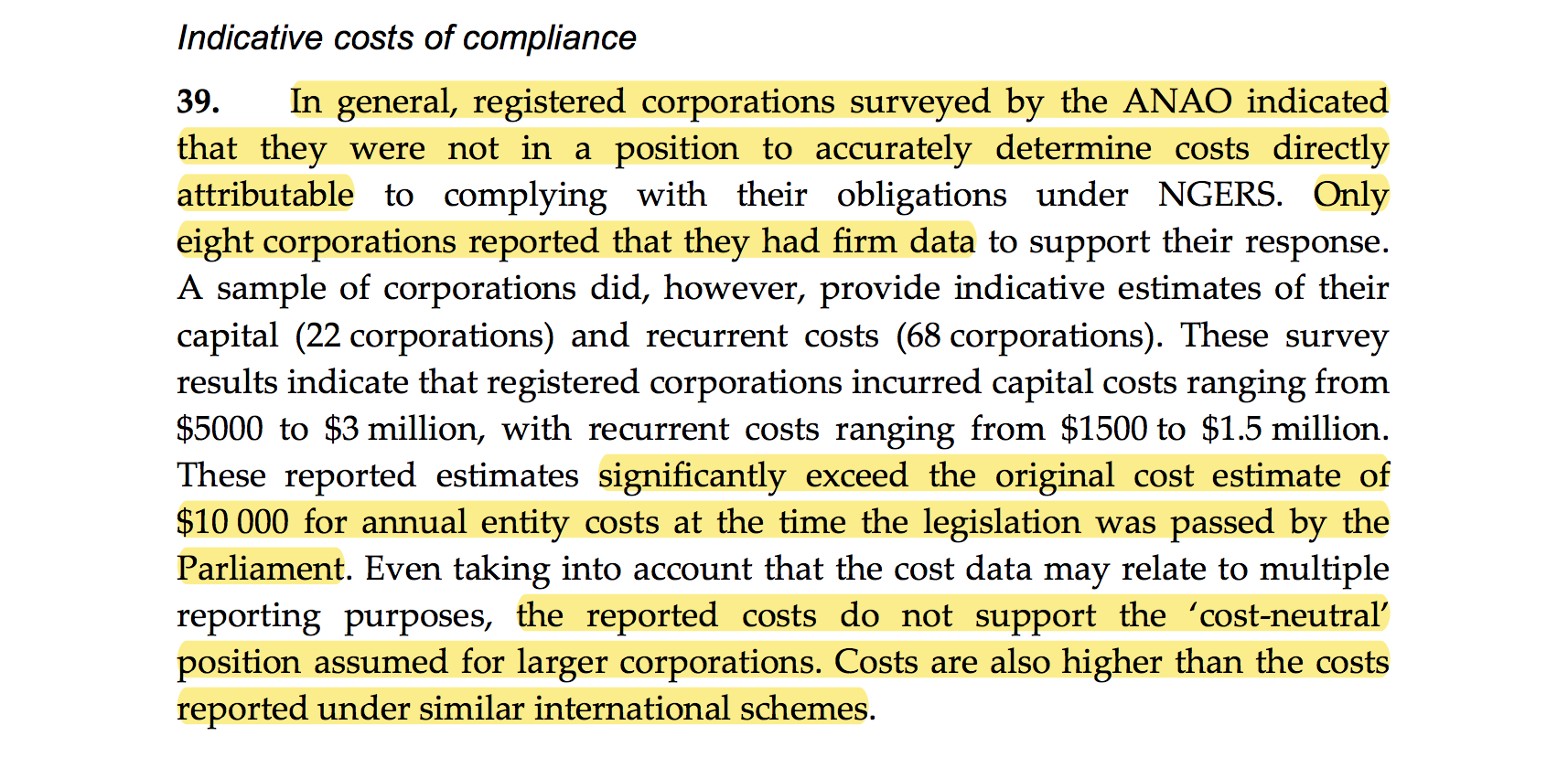
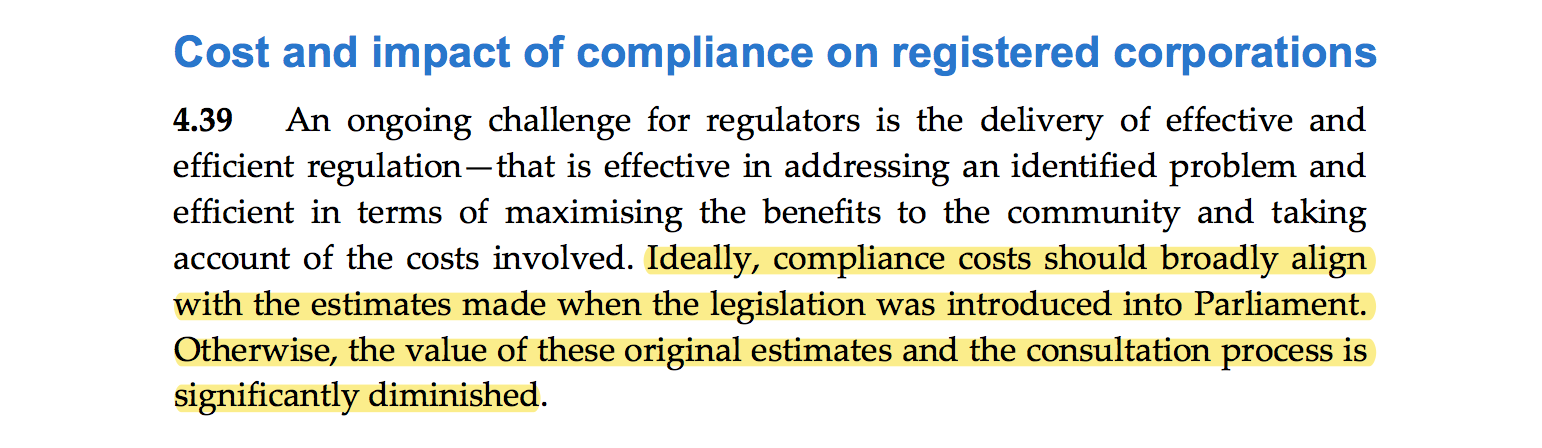
And speaking of costs, now we get to the Auditor-General’s assessment of costs of compliance with the Clean Energy Future scam:

Click to enlarge

Fair enough.

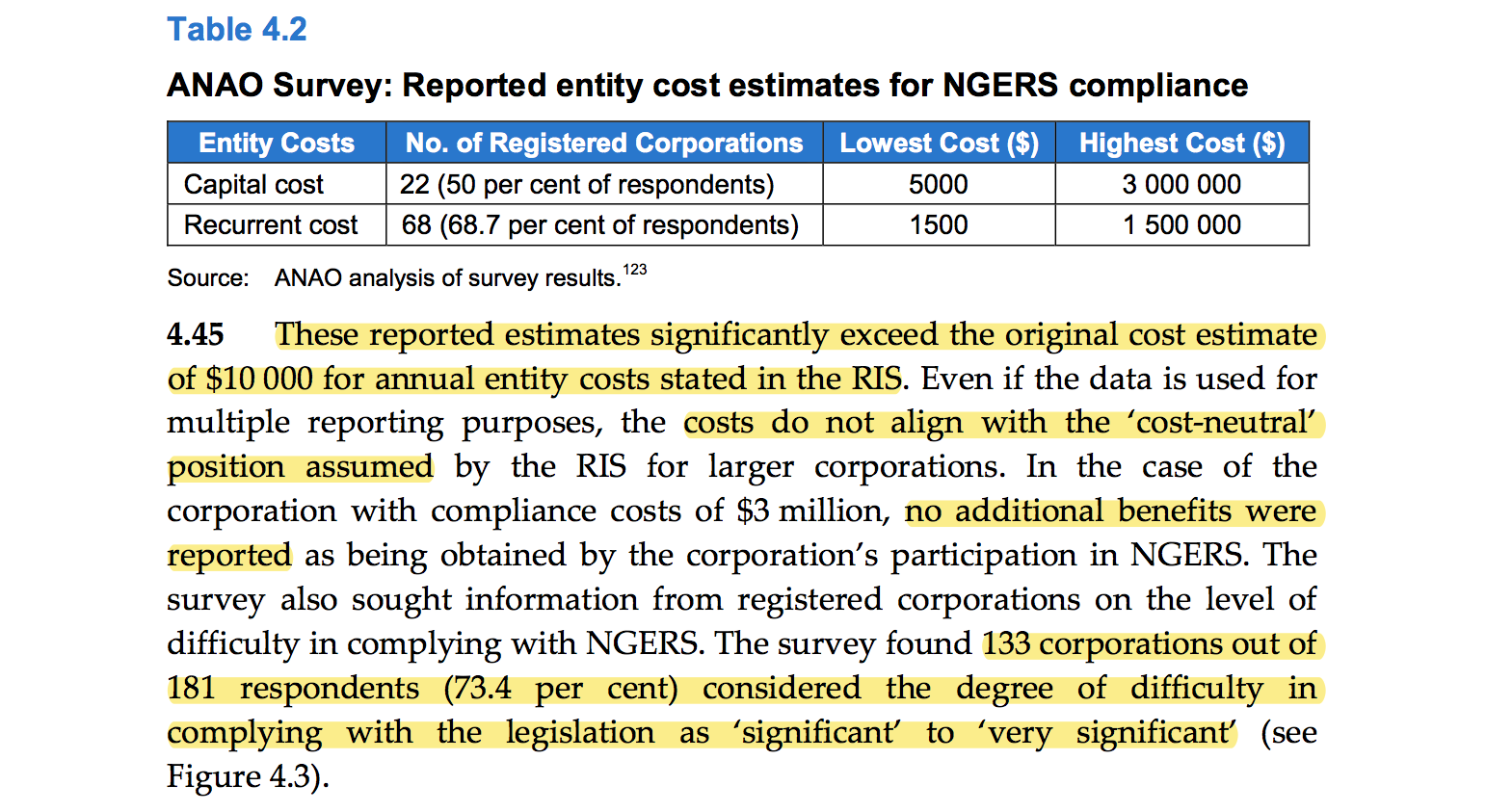
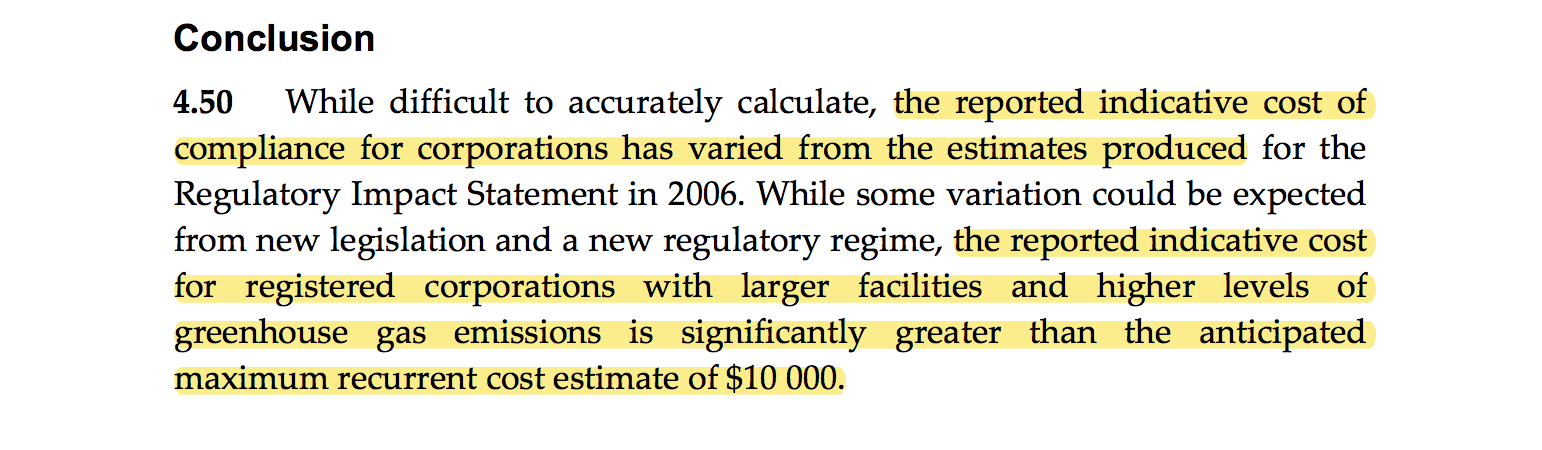
If the actual compliance costs are not similar to those estimated when the legislation was passed through Parliament, then “Houston, we have a problem.”

And indeed, we most definitely do.

For those readers who have not yet been enlightened to the woeful record of Treasury “modelling” (see Why Would Any Sane Person Believe Treasury’s Carbon Tax Modelling When Its Budget Forecasting Record Is This Bad? ), then now might be a good time to close your eyes:

Click to enlarge

Click to enlarge

And of course, as always, it’s vital to check the fine print:

Click to enlarge

Translation: we did our best to make the cost of compliance for corporations appear as low as possible, by ignoring the “outliers”. But sadly, we couldn’t fudge the headline “result” any more than this.

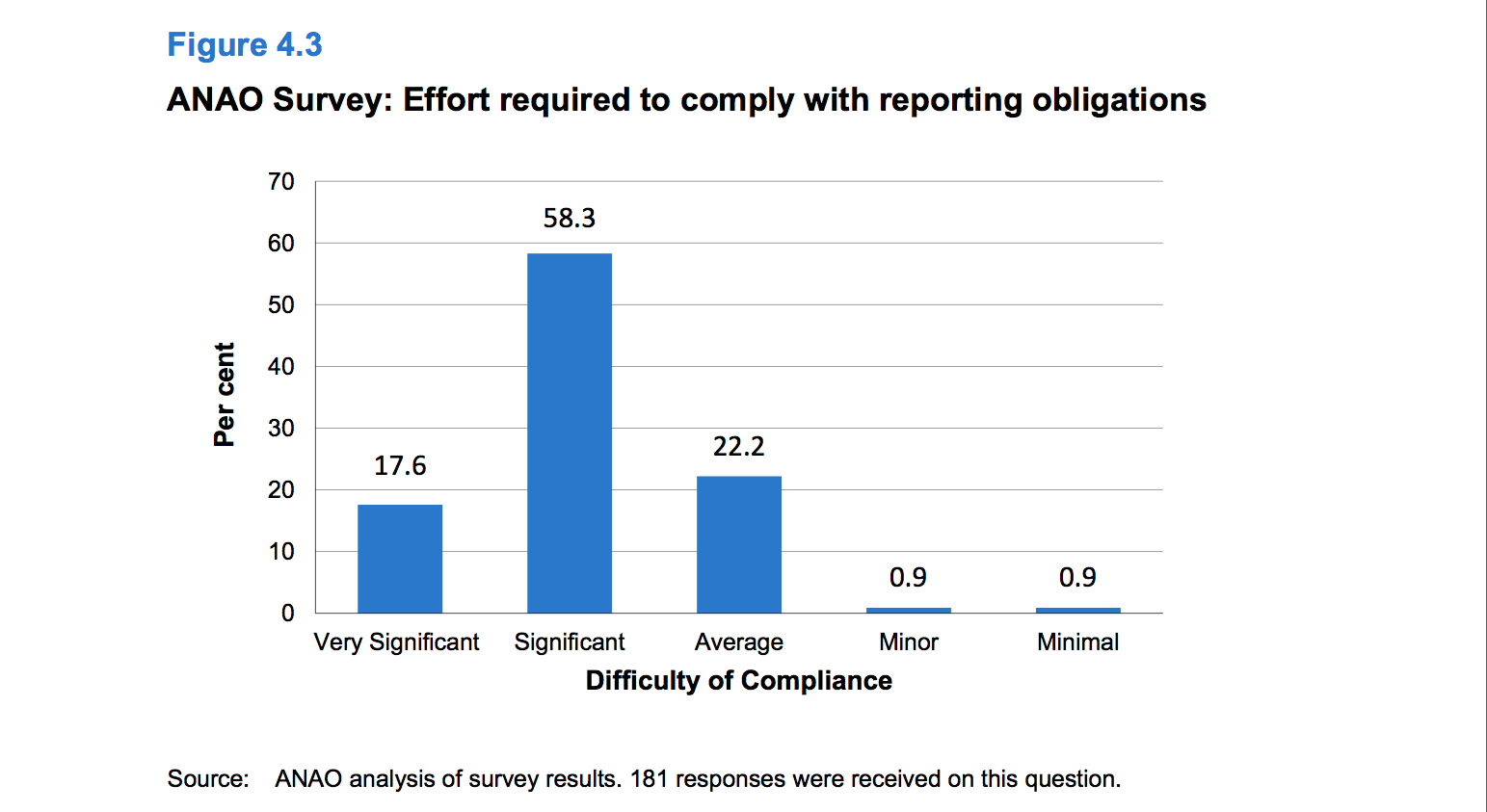
And the reason why the costs for corporations is so high, is because complying with the reporting requirements is a major pain in the arse:

Click to enlarge

Click to enlarge

Thank you, Mr Auditor-General.

That’s another $472K of borrowed money well spent by the government.

To check up on the (lack of) progress of … the government.

I wonder just how much more money the DCCEE will insist that they “need”, in order to get their “self-assessment” emissions reporting system ready by July 1st?

And I wonder how long it will take the government’s propaganda unit to prepare their next “education” campaign, to ensure that those oh so critical “perceptions of compliance” in the community are favourable?

After all, if we the people begin to have doubts that “big polluters” are fully complying with the scheme, then the “long term future of the scheme could be called into question”.

Wouldn’t that be terrible.

As the inimitable Senator Joyce said recently:

“The carbon tax is the biggest scam since … a pyramid scheme that if I mention its name I’ll get a suit”

Barnaby is right.


A Man In Touch With What’s Real

9 Feb

Senator Joyce writes from his flood-besieged home town of St George, for the Canberra Times:

Muddy waters sets the real tone

I am at a friend’s place staring out at the peak of the flood. In my town, St George, the hydraulic pressure of the river is forcing its way back up the storm water drains into the centre of town creating menacing pools of brown water inside the levy bank. The water trucks normally used for dust suppression are sucking up the water and taking it to the edge of the levy. Outside the levy bank is the bitter frustration of yet another flood, the third in two years.

It is the awesome spectacle of the energy required to lift billions of tonnes of water thousands of kilometres inland for which only a fraction ends up in the flooded river. The energy that is required is beyond comprehension. The temper of the town oscillates between community fervour to an understandable silent brooding, frustration and anger. The juxtaposition is stark between a house on a lawn, and just down the street, a house in the water.

The Local Disaster Management Group finds its own rhythm. They call for a mandated evacuation, and most go, but those with a job to do stay and some who are more scared of going than staying hide while others just completely ignore the order. The day for me starts with a quick look around town, public meetings and media and then either sandbagging, getting on the phone and chasing issues through or heading out to where help is required. The smaller towns feel they are forgotten in the shadow of the larger ones while the people on the farms feel they are forgotten by both.

All know that sympathy is usually temporary as the world moves on and the logistical exercise of repairs, insurance and getting the cash back into the house to bring back balance is a task that is self reliant with the support of a few friends as other issues will be on the news.

However, support during the crisis is overwhelming and genuine. Help just turns up as neighbours see people needing help, neighbours being anybody who see it in their heart to help. Teams of people swarm around houses to try and protect them from the fact that they know that the level of the house is below the oncoming flood. Miraculously some endeavours against all the odds succeed while others stand testament to a forlorn struggle.

The media look for the picture or the line that sells the story and we are happy, generally, to deliver it in the belief that it raises the prospect of public support. The media look for the hero or the rogue and if they cannot find it they will create one for you. Public figures, such as myself, have to show their wares of public service as you will be more noticed by your absence than by your participation, and of course this leads to a symbiotic, sometimes parasitic, relationship with those that hold the keys to the nightly news.

The most incongruous issue during the flood was watching the opening of Federal Parliament. It could have been happening on the moon, as it was so totally irrelevant to what was going on in the diluvium landscape that currently surrounds us. It is sobering to sit with others on their lounge in front of their TV and see how they see us. They giggle, laugh, frown and then say in the middle of the scripted punch line, ”Oh I better serve dinner; want a beer?”

Surely they should have more respect; don’t they realise we are vastly more important than curried sausages? All those media advisers and news producers being bumped by curried sausages. I am listening to a cacophony; the river, ominously loud at the window, Chris Uhlmann throwing to Heather Hewitt on TV and the clang of cutlery in the kitchen as my host and other flood refugees have left the TV to an empty lounge and all have moved to talk about other things in the kitchen.

The Balonne River will hit 14m overnight and houses will sit silently in the moonlight with the river running through them. Ladies will cry with frustration and sit with their husbands and partners and ask where the money will come from this time to repair the damage and bring back balance. Wayne Swan is talking in the background, something about the NBN.

A Twitter friend this evening described your humble blogger as “pensive”:

pen·sive/ˈpensiv/

Adjective: Engaged in, involving, or reflecting deep or serious thought.

Synonyms: thoughtful – reflective – wistful – meditative

I would suggest that the above essay demonstrates this to be an attribute clearly shared by the good … and eloquent … Senator Joyce.

A man who, after sending his own family on to safety, has stayed behind to help his townsfolk, and opened his own home as a refuge for emergency services and those in need:

On watch: Senator Barnaby Joyce keeps an eye on a temporary levee at the flood waters in his home town of St George, missing the start of the political year in Canberra. | Source: Weekly Times Now

The out-of-control kindergarten we call “Parliament” resumed this week, did it?

Parliament be damned!

Barnaby for PM.

It’s Barnaby With A Bullet

4 Feb

Senator Joyce has been ranked No. 19 … and rising … in The Australian newspaper’s 2012 Top 50 list of Most Influential People In Politics (story behind paywall; my emphasis added):

Shadow Minister for Regional Development, Local Government and Water Reform, Leader of the Nationals in the Senate

Joyce holds a minor portfolio in the opposition, has been in politics less than seven years, yet is one of just a handful of politicians known simply by their first name.

Joyce’s sway inside the Coalition and his access to Tony Abbott can be measured by the resentment he causes to senior Liberals and his fellow Nationals, which is considerable.

Other senior Coalition figures, like frontbencher Christopher Pyne, have considerable influence over their leader. But none are admired by him to the same extent as Barnaby Joyce.

Abbott branded Joyce the nation’s best retail politician. Perhaps he sees something of himself in the fast talking bush accountant from St George.

The once floor-crossing Joyce is an unreconstructed nationalist, a populist and trenchant opponent of monopolistic big business and debt.

His views give shadow Treasurer Joe Hockey heartburn. Hockey does not so much fear Joyce, he worries more that Abbott is too easily persuaded by Joyce’s arguments.

Along with Cory Bernardi in the Liberals, Joyce led the rearguard action for the Coalition to drop its support for a carbon emissions trading scheme, permitting Abbott to abandon the policy and precipitating the end of Malcolm Turnbull’s leadership.

Global warming skeptic, master of the mangled metaphor and practiced in the art of “Joh (Bjelke-Petersen) speak”, Joyce makes for good television. He is a contrast from his scripted and media-trained peers.

However, his folksy image discredits a well-read mind, a politician with an intimate understanding of small business, and a keen historian.

Dropped from the shadow finance portfolio because of his supposed wild rhetoric including foretelling the possibility of the US defaulting on its debt, Joyce is now a folk hero east of the divide in his new lower profile water reform role.

Nationalist.

Trenchant opponent of monopolistic big business … and debt.

Led action to drop support for carbon emissions trading.

Global warming skeptic.

Well-read mind.

Intimate understanding of small business.

Keen historian.

Sound like fine qualities for a national leader. Especially in these troubled economic times.

How does our current PM compare?

Lawyer.

Liar (but I repeat myself).

Communist.

Globalist.

Clueless.

Barnaby for PM.

Barnaby: Debt One Day, High Taxes The Next

4 Feb

Senator Joyce writes for the Canberra Times:

The Queensland Labor Government has been ahead of its time. It lost our AAA credit rating long before many others, before the United States, before France and before Australia. In 10 years, Labor has increased Queensland’s public debt by $45 billion. That is $10,000 of extra debt for every Queenslander.

Remember when Peter Beattie said we would be the ”smart state”. Well it doesn’t seem too smart to be racing towards $85 billion in debt. We have seen what too much debt can do to other countries and we would be mad to replicate that approach here. The fact always remains the same; if you can’t manage debt, debt will manage you.

What has Queensland seen for this reckless spending? The traffic is worse, housing is less available and we are paying more for essential services such as electricity and water. A lot more. Electricity prices are up 38 per cent and water prices are up 46 per cent in just four years. Labor spent $10 billion on a water plan to take infrastructure from local councils and is now giving some of those assets back.

It spent billions on a desalination plant that was beset by cost overruns and so many delays that while we were waiting for it, it rained. The plant has barely been used but Queenslanders are paying for it through their water bills.

Now Premier Anna Bligh thinks Queenslanders aren’t paying enough for basic services and supports the Gillard Government’s moves to introduce a carbon tax. Under the carbon tax, households will pay an extra 10 per cent for their electricity and businesses will pay up to 20 per cent more.

Nowhere will be hit harder by a carbon tax than Queensland. Even the Labor government’s own modelling finds that under a carbon tax there will be 41,000 fewer jobs in Queensland over time. The worst hit areas form an arc from Mackay to Gladstone, where so many of the state’s mining industry resides. Hundreds more jobs based in Brisbane and elsewhere are linked to the mining boom.

Labor has simply stopped standing up for Queensland. Anna Bligh promised to ”put Queensland first” when assessing whether to support the carbon tax, but she gave her support anyway despite achieving no concessions from her federal Labor counterparts. No Queensland government that stood up for Queensland would support a tax that cost Queenslanders jobs.

Over the past four years Queensland’s unemployment rate has increased from 3.4 per cent to 5.4 per cent and 60,000 more Queenslanders have joined the unemployed queue. Lucky we are winning the State of Origin because we are getting the wooden spoon on economic performance despite the mining boom. Queensland was once the engine room of the Australian economy. We were also the low tax state.

Now we seem to better other states at nothing except bureaucracy. Sometimes it seems like this is a government driving via the rear vision mirror. They are constantly reacting to events. By their own admission they failed to invest in infrastructure for years. They can’t pay nurses on time, coordinate the labyrinth of water departments and agencies they created or stop a claimed Tahitian prince from ripping off millions of dollars from Queensland taxpayers.

This is a soap opera of a government and for the benefit of Queensland it has to stop. Many Queenslanders are young enough to remember the last Coalition government, a government that balanced the books, electrified the rail lines, built the Gold Coast, constructed dams and the international airport in Cairns. Queensland can have that economic management again but it’s going to get more of the same from more spending and more debt from Labor.

Design a site like this with WordPress.com
Get started