Tag Archives: China bubble

Barnaby: “God help you when the prices go down”

18 May

Senator Joyce rips into the government’s economic “plan” this morning:

Opposition frontbencher Barnaby Joyce has taken a swipe at the Gillard government’s approach to the economy, saying it had an unbounded belief in Asia’s demand for Australia’s resources.

“God help you when the prices go down,” he told reporters in Canberra on Wednesday.

The government’s approach to economics was “a clever ability to charge people to dig up red and black rocks“.

“They (government) have an unbounded belief that the people in South-East Asia will have an eternal gratitude to pay an excessive price for red rocks and black rocks.”

Swan Hides Budget Risk

17 May

Well done Michael Stutchbury.

But you’re not forgiven until you retract the smear. And join the chorus now recognising that Barnaby was right about the risk of US debt default.

From The Australian:

The confused reaction to Wayne Swan’s budget stems from its refusal to properly spell out the risks of relying on Australia’s China-fuelled terms of trade remaining close to their 60-year or even 140-year highs.

This commodity price bonanza has delivered eight years of tax cuts, a big expansion in middle-class welfare, billions of dollars of wasteful spending – and this year’s $50 billion budget deficit.

Yet all our previous commodity export price spikes have swiftly reversed, typically ending in double-digit inflation and recession.

A must read.

Bloomberg: ‘Down Under Hypocrites Bet All On China’s Boom’

13 May

Bloomberg savages the hypocrisy and incompetence of Labor’s budget:

All in.

That’s essentially the message Treasurer Wayne Swan is sending about Australia’s odds-defying bet on Chinese growth. The government’s latest budget pledges to deliver the quickest improvement in the nation’s finances on record — without specifics about how that will happen.

The absence of such detail is telling and can be boiled down to one thing: an even bigger gamble on China’s 10 percent growth and its voracious appetite for Australia’s resources. It’s risky to so fully hitch the hopes of 23 million people to a single nation that’s still developing.

Hypocrisy was in the room last month when Australia rejected a Singaporean offer for its stock exchange. Swan called slapping down Singapore Exchange Ltd. (SGX)’s $8.8 billion bid for ASX Ltd. a “no brainer.” The whole shareholders-come-first vibe that pervaded before the global crisis lost its oomph among voters.

The debate distracted attention from a far bigger takeover happening by stealth: China’s designs on all things down under. Down under the ground, that is.

Costello: Wayne’s World A Parallel Reality

28 Apr

Peter Costello has stepped up with some hard facts and figures to debunk the Goose’s latest myth-making efforts.

From the Sydney Morning Herald:

Five years ago the prices of Australia’s exports began rising sharply. The price of iron ore hit about $US30 a tonne and thermal coal about $US50. Australia had not seen export prices like that in a very long time.

The federal government was running budget surpluses. It had paid off its debt so it established a sovereign wealth fund – the Future Fund – to save for the future. This was to prepare for a time when things were more normal and to cover the costs of the ageing population. About $60 billion was deposited into it.


This year the iron ore price is nudging $US170 a tonne (about five times what it was when the Coalition was ”wasting” the boom) and the coal price is about $US130 (nearly three times the price of five years ago). If you look at a graph of historical prices, we are at the peak of Mount Everest. The rise of 2006 looks like Monticello – a small rise visible only because conditions were quite depressed before it.
The Reserve Bank’s index of commodity prices shows an all-time high in March 2011. The index is nearly double where it was in 2006 and triple the levels of the late 1990s. Adjusting back into Australian dollars it rose 32 per cent in the past year.

And mining profits are super strong. In 2006, BHP’s profit after abnormals was a massive $10 billion. This year it reported that profit for just the first half-year.

Since it was apparently wasteful to run budget surpluses, build a savings fund and cut tax in 2006, Swan could show us how things should be done now we are in a real boom. He could, but apparently he will not, because last week he gave a pre-budget speech lamenting how hard everything had become and saying that we should not expect too much, not even a balanced budget in May, let alone a substantial contribution to the Future Fund. And although he has found a way of sharing the pain of the Queensland floods with a flood levy, we should not expect to share the prosperity of the mining boom through any tax cuts.

There is reality. And then there is Wayne’s world.

In Wayne’s world a boom is something that happens to others, not to him. In his world, others find rivers of gold, but for him the river never rises.

In Wayne’s world, Labor is a superior economic manager which runs into bad luck all the time, while Liberals are poor financial managers who waste opportunities and somehow get good outcomes when the dice fall their way. It’s a weird place inside Wayne’s world.

Costello’s depiction of Wayne Swan as living in a “Wayne’s World” parallel universe has some rather interesting and ironic … parallels.

In the movie Wayne’s World, our hero Wayne falls in love with Cassandra Wong, a Chinese-American lead singer for a heavy metal band.

In our real-life version of Wayne’s World, our hero Wayne has fallen in love with “Cassandra Wong”, the Chinese-American buyer/s of 73% of our 189+ Billion sovereign debt.  This “Cassandra” has sung a tune about an endless China boom, promising decades of heavy metal-fuelled prosperity for Australia as a result.

And Wayne has fallen for her siren song.

Is China Bankrupt?

3 Aug

From MSNBC:

All governments lie about their finances. At worst, as in Greece and the United States, the lies are bold and transparent. Everybody knows the emperor has no clothes, but no one want to say so. At best, as in Canada and China, the lies are more subtle – more like a magician’s misdirection than a viking raider’s ax. Look at these great numbers, the lie goes, but don’t look at those up my sleeve.

There’s a good argument to be made that if you look at all the numbers, instead of just the ones the budget magicians want you to see, China is indeed broke

… China has a history of taking debt off its books and burying it, which should prompt us to poke and prod its numbers.

A must-read article. Poke and prod China’s numbers here.

Joyce: Rudd Expects Miners To Pay Off The Debt

20 May

Media Release – Senator Barnaby Joyce, 19 May 2010:

Senator Barnaby Joyce, whilst on his “Straight Talking Tour” in Deniliquin said, “It was interesting to read the answer given yesterday to a question I asked on notice at the Senate Standing Committee on Economics in February as to what our debt position is.”

In 2008, there were six countries in the OECD that had higher net foreign debt as a proportion of GDP than Australia. These countries are Iceland (355 per cent of GDP), Portugal (72 per cent of GDP), Hungary (72 per cent of GDP), Greece (68 per cent of GDP), Spain (66 per cent of GDP) and New Zealand (60 per cent of GDP). In the same year, Australia’s net foreign debt amounted to 56 per cent of GDP. Around 10 per cent of Australia’s net foreign debt is held by the public sector. In the US, around 64 per cent of its net foreign debt is held by the public sector while in Greece, the public sector holds more than 100 per cent of the stock of net foreign debt.

“I also note that our Commonwealth gross public debt has gone from $139.182 billion to $141.282 billion in the last week. In addition to this is the fact that the aggregate borrowing of the states’ non-financial public sectors is expected to be $164 billion in 2009-10. There is also the money owed by entities such as utility companies that have borrowed money to pay state so-called ‘dividends’. As these debts do not come under the government sector financial reporting, who knows how much they owe.

Are we to believe that this government with their current track record has the capacity to fix things up over the next three years?

The Labor government solution is to go to the only section of the community that is making good money and to impede them on the capacity to pay off the debt. Australia has to maintain the vibrant integrity of its mining sector especially if the global economy starts to peel off through the ructions that are currently being seen in Europe. A resource tax would have to be the most foolish decision that a government could make at this point of time in global economics.

The Labor Party members have to ask themselves one question. If the mining sector is not bringing in money to our nation, and the agricultural sector, which they have managed to tie up with green and red tape, is not bringing in the money, then where exactly are our export dollars going to come from? Export dollars underpin the service industry where the vast majority of Australians work. You may not work in an export industry, but your pay depends on them.

In simple terms, if no money turns up on the table from export dollars, there is no money to pass around the table to reflect our GDP and ultimately to pay the debt on what is one on the most indebted nations on earth.”

More Information- Jenny Swan 0746 251500 / 0438 578 402

China Brakes, Australia Breaks

14 May

From Business Spectator:

In an ominous sign for Australia, the Chinese sharemarket is slumping on worries that the Chinese government will soon lift interest rates in response to rising inflation and surging property prices. Such a move would slam the brakes on Chinese growth, and deal a cruel blow to Australia, which is counting on Chinese growth to keep commodity prices high.

Although it rebounded by 2 per cent yesterday, China’s Shanghai Composite Index is down more than 20 per cent from its peak in August 2009, which means that it is still technically in a ‘bear’ market.

The market’s gloom has been deepened by signs of mounting inflationary pressures in the Chinese economy. Inflation figures released this week showed consumer prices rose by 2.8 per cent in April from the year before, an increase from the 2.4 per cent rise in March. Meanwhile, home prices in 70 large and medium-sized Chinese cities rose by 12.8 per cent from a year earlier in April, picking up pace from the 11.7 per cent rise in March. There are also worrying signs that the property price bubble is spreading beyond the major cities and into the country-side.

So far, the Chinese government has held off raising interest rates – which are currently negative after allowing for inflation – in order to cool the super-charged economy. Instead, its ordered banks to hold more deposits on reserve, as well as lifting the minimum deposits that home buyers require to make to get access to home loans, and raising mortgage rates for second and third home buyers.

But there are intense worries that these steps won’t prove sufficient. Earlier this week, the Chinese central bank reported that banks lent 774 billion renminbi ($113 billion) in April, which is about 30 per cent more than in the same month last year. Lending for the first four months of 2010 has now reached 45 per cent of the total quota of loans for the year.

This explosion in Chinese bank lending has led to worries that the country will eventually be saddled with a mountain of bad loans. These concerns were heightened after China’s National Audit Office reported that it had uncovered lending irregularities amounting to tens of billions of renminbi in its latest audit of the Agricultural Bank of China.

Is The China Bubble Starting To Burst?

14 May

We’ve just seen the Rudd Government present a truly fantastical budget.  One that relies completely on the hopeful fantasy that the Chinese building boom will continue for a decade to come, and so, a “great big new tax” on the “super profits” of mining companies can return the budget to surplus.

A lovely story.

But what do professional strategists on the China economy have to say about China’s prospects?

From MarketWatch:

China’s economy is teetering on the edge of a major slowdown … according to a noted China strategist.

David Roche, an economic and political analyst who manages the Hong Kong-based hedge fund Independent Strategy, says the world’s third-largest economy is now on the brink, faced with the inevitable reckoning that follows an extended bank-lending binge.

“We’ve got the beginnings of a credit-bubble collapse in China,” said Roche, predicting the economy will likely cool from its stellar double-digit growth rate to a 6% annual expansion as a result.

While that may not sound bad, Roche believes the collateral damage from the cooling will be anything but mild, as the banking sector comes under pressure from cumulative years of bad investment and mispriced capital.

The emerging picture is one of a substantial contraction in credit growth and infrastructure expenditure, he says.

The shrinkage is grim news for an economy heavily dependent on such outlays. China managed to escape recession during the global crisis mainly because of bridges, railways and other infrastructure-project spending, estimated to have accounted for about 90% of economic growth last year, according to Roche.

About 85% of the funding for these projects was arranged by local government financing vehicles “borrowing money they can never repay” from state-owned banks, says Roche. Nearly 3 trillion yuan ($440 billion) of the 11 trillion yuan extended to these entities has been wasted or stolen, he estimated.

***

More worryingly, as bank lending dries up, there won’t be the firepower to sustain new investments in infrastructure, eroding a core pillar of China’s growth model, he said.

Much of the focus on potential asset bubbles in China has been on the property sector, but Roche suggested that housing-price inflation is intertwined with unsustainable gains in other areas.

***

A slowing Chinese economy could also have ramifications for the resource sector.

A scaling back of the infrastructure-building binge is negative for industrial commodity prices such as copper and iron ore, with the latter potentially slumping 50%, he said.

“I would not own resource stocks,” Roche said.

Iron ore prices to fall by 50%?

Hmmmmm… any guesses what that would do to the “super profits” of mining companies? And to the “great big new tax” that Rudd Labor is relying on to get the budget back to surplus?

UPDATE:

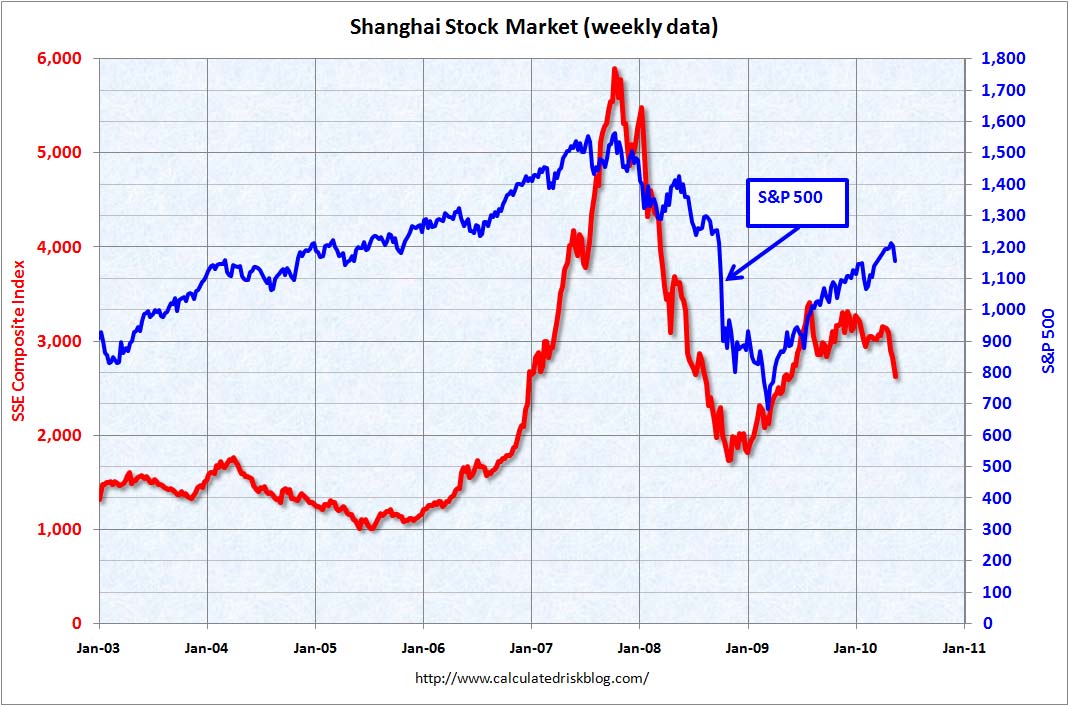
Calculated Risk notes that the Shanghai Composite Index is falling already –

Keep an eye on the Shanghai index (in red). It appears China’s economy is slowing.

Shanghai SSE in red (click to enlarge)

Don’t Bet The House On China

4 May

An excellent and timely article by Karen Maley in today’s Business Spectator (reproduced here in full):

Kevin Rudd’s resource super profits tax has one massive risk – that commodity prices collapse before he gets to collect one cent of it.

Yesterday, the influential forecaster, Marc Faber joined those warning of problems ahead in China. “The market is telling you that something is not quite right”, he said in an interview on Bloomberg television. “The Chinese economy is going to slow down regardless. It is more likely that we will even have a crash sometime in the next nine to 12 months.”

On Sunday – as Kevin Rudd and Wayne Swan were announcing their new resources tax – China’s central bank made another attempt to dampen property market speculation. It lifted its reserve requirement ratio by a further half a percentage point, so that most Chinese banks will now have to hold 17 per cent of their deposits on reserve.

But this latest increase in the reserve ratio will likely prove as ineffective as the two previous rises in January and February this year. Many believe the Chinese property bubble will continue to expand for as long as the Chinese government maintains interest rates below the rate of inflation.

And that’s the core of the problem. The Chinese government is reluctant to increase interest rates because it risks exposing the huge fault lines that exist in the economy.

Over the past decade, China has built factories and expanded its manufacturing capacity in the expectation that the United States and Europe would continue to demonstrate a robust appetite for Chinese-produced goods. But western demand for Chinese products slowed in the wake of the financial crisis, leaving the Chinese economy with substantial overcapacity in manufacturing.

The problem was exacerbated during the financial crisis. With Chinese exports plunging, the Chinese government launched a massive economic stimulus program, equivalent to around 14 per cent of the country’s GDP. It also ordered Chinese banks to lend, and instructed Chinese state-owned companies to borrow.

The program had the desired result. The Chinese economy grew at an 11.9 per cent annual clip in the first three months of the year, the fastest pace since 2007. And we benefited too, because this strong Chinese growth pushed up the prices of our commodity exports, such as iron ore and coal.

But there are huge concerns over how the Chinese stimulus money was spent. Provincial governments, under instructions from Beijing to reach specified growth targets, undertook massive construction projects that have resulted in a glut of commercial office space, and huge shopping malls that are near-vacant. And much of the increase in bank lending was funnelled into property market speculation, pushing up housing prices to astronomic levels.

The Chinese government has tinkered with various measures to contain its property bubble – increasing the reserve requirement, lifting the minimum deposit that home buyers must have before they’re allowed to borrow, and urging banks to monitor their risks.

But it is loathe to raise interest rates for fear that it will cause mass defaults among manufacturers and property developers, leading to huge problem loans in the banking system.

Eventually, however, an end-point will be reached. Either the Chinese government will raise interest rates, or the property market bubble will collapse under its own weight. At that point, commodity prices will plummet, slashing the profits of the big mining companies.

And if this happens before 1 July 2012 when the new tax regime for the miners comes into effect, Rudd is unlikely to ever see a cent of his new resource super profits tax.

Betting the house on China is exactly what the numbskulls in the Rudd Labor government, the Treasury, and the RBA are doing.

Please take some time to review some of the many earlier articles in this blog, showing how the likes of Treasury secretary Ken Henry and RBA Governor Glenn Stevens have declared that the GFC is ‘over’, and forecast that (thanks to China) we are all set for a ‘period of unprecedented prosperity’ lasting until 2050.

What is vital to bear in mind always, is that these are the very same incompetents who all completely and utterly failed to foresee the onrushing Global Financial Crisis in 2008… even though its first wave had already broken in the USA and on global share markets during 2007!

China May ‘Crash’ In 9-12 Months

4 May

Noted investor and publisher of the fabled “Gloom, Boom and Doom” report, Dr Marc Faber, warns that the Chinese economy may crash within the next 9 to 12 months.

From Bloomberg:

Investor Marc Faber said China’s economy will slow and possibly “crash” within a year as declines in stock and commodity prices signal the nation’s property bubble is set to burst.

The Shanghai Composite Index has failed to regain its 2009 high while industrial commodities and shares of Australian resource exporters are acting “heavy,” Faber said. The opening of the World Expo in Shanghai last week is “not a particularly good omen,” he said, citing a property bust and depression that followed the 1873 World Exhibition in Vienna.

“The market is telling you that something is not quite right,” Faber, the publisher of the Gloom, Boom & Doom report, said in a Bloomberg Television interview in Hong Kong today. “The Chinese economy is going to slow down regardless. It is more likely that we will even have a crash sometime in the next nine to 12 months.”

Faber joins hedge fund manager Jim Chanos and Harvard University’s Kenneth Rogoff in warning of a crash in China.

China is “on a treadmill to hell” because it’s hooked on property development for driving growth, Chanos said in an interview last month. As much as 60 percent of the country’s gross domestic product relies on construction, he said. Rogoff said in February a debt-fueled bubble in China may trigger a regional recession within a decade.

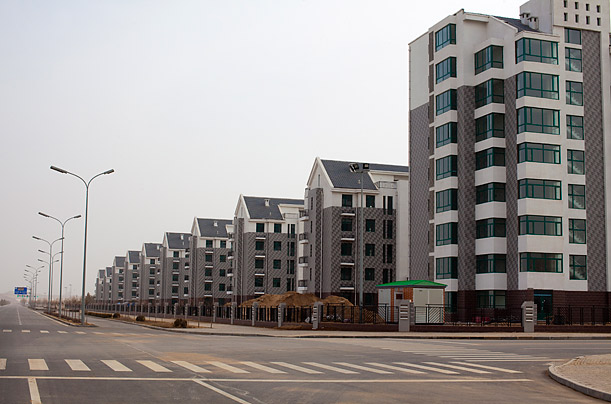
For those who doubt that China is currently experiencing the global mother of all real estate bubbles, take a look at these pictures from Time magazine, showing just how massive speculative over-investment in property construction has left China with literal ‘ghost cities’.

Design a site like this with WordPress.com
Get started