Tag Archives: fractional reserve banking

Carbon Permits Do Not Even Exist

2 Aug

Are the government’s carbon dioxide permits really just “bits of paper” for banksters and assorted financial parasites to shuffle around for fees and commissions?

Are the government’s carbon dioxide permits really just “bits of paper” for banksters to reference as the basis for creating new derivatives products for their long-sought carbon derivatives casino?

No.

As I have said all along, the carbon permits will not even be printed on physical paper.

They will be electronic bookkeeping entries.

Electronic digits.  In a computer.

It is yet another similarity with the completely farcical EU system, where over 3 million of these “permits” – which only exist as numbers in a “Registry” computer – were stolen between November 2010 and January 2011.

From our government’s exposure draft Clean Energy Bill 2011, Part 4, Division 2 (emphasis added):

Division 2—Issue of carbon units

94 Issue of carbon units

The Regulator may, on behalf of the Commonwealth, issue units, to be known as carbon units.

95 Identification number

A carbon unit is to be identified by a unique number, to be known as the identification number of the unit.

98 How carbon units are to be issued

(1) The Regulator is to issue a carbon unit to a person by making an entry for the unit in a Registry account kept by the person.

(2) An entry for a carbon unit in a Registry account is to consist of the identification number of the unit.

(3) The Regulator must not issue a carbon unit to a person unless the person has a Registry account.

Too easy.

Left click, left click on the mouse button.

Tap tap, tap tap on the keyboard.

Voila!

A new “carbon permit” has been created.

With a government-decreed purchasing power, of AUD $23 (in 2012).

In other words, exactly the same way that “money” is created under modern banking.

Wheeeeeeeeeeeeeeeeeee!

This bankster-designed evolution of the old medieval-era hoax called “alchemy” – formerly known as “turning lead into gold” –  is really easy.

You just have to be the one making the rules.

Which is why I say this.

Again.

There is only one way that common humanity can ever truly be free.

And stay free.

By taking unto ourselves – each and every one of us – those powers long held exclusively by a tiny minority of malevolent modern-day central banking “alchemists”, who create “money” out of thin air.

See my essay – The People’s NWO: Every Man His Own Central Banker.

“There are a thousand hacking at the branches of evil to one who is striking at the root” – Henry David Thoreau

The People’s NWO: Every Man His Own Central Banker

7 Jul

** 7 October 2014:  The concept described in the following essay has since been developed further — visit beta website deror.org for more information.
“To radically shift regime behavior we must think clearly and boldly for if we have learned anything, it is that regimes do not want to be changed. We must think beyond those who have gone before us and discover technological changes that embolden us with ways to act in which our forebears could not.”

– Julian Assange, Conspiracy As Governance (2006)

There is nothing more dangerous than personal initiative: if it has genius behind it, such initiative can do more than can be done by millions of people among whom we have sown discord.

– Protocol V

Are you seeking profit, or protection from the storm?  This is not for you.  Are you here because misery loves company, or to impress with wit?  This is not for you.

This is written for those who have moved to a place beyond fear, and preservation.  Beyond greed, and accumulation.  This is for those who have moved beyond, to a place the Sovereign Man knows not of.

It is the place where un-selfish thoughts roam freely; where the forces of greed and fear are “not of this world”.

If you are seeking comfort in confirmation of existing ideas and beliefs, then I encourage you to look elsewhere.  Here you may be challenged to reconsider.  To research and study.  To think outside the square.  And to take uncommon action.

In the introduction to the movie V For Vendetta, we are reminded that “an idea can still change the world”.  I will share my idea to change the world with you today.  I hope you may have an even better one.

First, an apology.  The basis of my idea challenges common precepts that you may hold as gospel truth.  In the interests of brevity I cannot author a supporting thesis.  So I encourage you to simply adopt a certain mind-flex; to entertain the underlying rationale for the moment, in order to consider the main idea in context.

My idea will particularly challenge those who conflate the concept of a “currency” with a “store of value”.  We have been trained to do this.  We have been taught to identify both of these different concepts, with the singular label of “money”.  This is the first and greatest delusion to be overcome.  If “money” is ever to be made a servant of mankind, and not continue to be his master, then we must begin by taking great care to distinguish clearly between “money” as “store of value”, and “money” as “currency”.

A “store of value” can be anything real, tangible, and (in relative, human lifetime terms) lasting.  Gold, silver, some art, property, gemstones, all these and more may be considered a store of value.

A “currency”, by contrast, should serve only as oil for the wheels of the economy.  To aid the proper, efficient, and right moral function of commerce and industry, in its pivotal role within civilised human society.  To achieve this, our chosen form of currency should have no intrinsic value whatsoever.  Moreover, in the interests of true social justice, the ideal form of currency should be destroyed at a modest, fixed annual rate.  Why?

For an in-depth understanding of the answer, I encourage you to read up on the concept of Freigeld (“Free Money”), as elaborated in the Natural Economic Order by Silvio Gesell.  Before rushing to dismiss this little known genius as some kind of crackpot, you may first wish to consider carefully the profound success of Gesell’s demurrage currency concept during the Great Depression.  The Miracle of Wörgl, Austria is an excellent example.  You will also discover how this alternative monetary “experiment” was promptly shut down; tellingly, at the behest of the Austrian Central Bank.  And how American economist Irving Fisher unsuccessfully petitioned Roosevelt to implement a similar monetary system, as a solution to America’s woes in the Great Depression.

The reason why a demurrage currency is essential for true social justice is this:  The product of labour – the sweat and effort of ordinary people – is subject to the natural laws of entropy.  The farmer’s produce spoils. The manufacturer’s product too has a “shelf life”.  It deteriorates, or is superseded.  The product of labour is compelled by the natural laws of entropy to find a buyer promptly.  If it does not, the producer – who has no personal use for surplus – inevitably suffers loss.  He wears the “carrying cost” of deteriorating product if it remains unsold.

The possessor of currency, by contrast, has an unfair advantage, if his currency is not likewise subject to entropy.  Simply by means of the unspoken threat to “shut his wallet” and withdraw temporarily from the marketplace, taking his non-deteriorating currency with him, he may force the producer – compelled as he is by the law of entropy – to lower the price of his ever-deteriorating goods.

This is the inevitable – and inequitable – consequence of adopting a form of currency that can also be perceived as a “store of value”.  The Supplier of currency (the buyer) is granted an unjust and unfair power over the Demander of currency (the producer/seller).  The very form of currency itself naturally encourages its possessor to mistreat and humiliate his fellow man, by taking advantage of the relative weakness of his bargaining position.  And arguably worst of all, the one who is disadvantaged is the producer of goods.  The engine, the very heart and soul of commerce and industry.  Simply by virtue of the possessor choosing to “save” his currency – since he also perceives it as a “store of value” – the  producer is forced by necessity to continually and ever more urgently lower the asking price for his goods, until the point at which the possessor becomes willing to enter the marketplace and buy.  While many may see this as “good business” or “driving a hard bargain”, it is hardly “to love thy neighbour as thyself”.

In the people’s NWO economy, there will never be a shortage of oil for the wheels of commerce.  Neither will there be an excess.  As with your car, too little and too much oil both are highly damaging.  One starves the engine of lubricant until the mechanism seizes.  The other causes a build up of excessive pressures, until the weakest part blows.

If you will accept this basic premise concerning a “natural currency” – even just for entertainment purposes for now – then the rationale for my idea will follow.

Before introducing it however, a disclaimer for context.  I am vehemently anti debt, and anti usury.  Since early this century, a significant proportion of my own modest material net “worth” has been in physical gold and silver bullion.  Stored beyond the reach of the banking system.  Yet, this choice is predicated by external circumstance, and not by ideology.  My research leads me to conclude that gold and silver “bugs”, “sound money” advocates, and “Constitutional money” proponents, are all most subtly, yet most profoundly, deceived.  There is a very logical and ancient reason why ancient occult (secret) society symbology is a persistent feature of the founding relics of the USA, of Washington DC, and indeed, of the Federal Reserve Note.  To return to a precious metal standard would achieve nothing more than to take one small step backwards – straight into the previous stage of the monetary trap laid for humanity by “the powers that be” (TPTB) over many centuries.

I believe that the current system will collapse.  By accident, or by design.  Waiting for it, and scheming/hoping to profit during or after the collapse, is a fool’s game.  Those who pull all the monetary strings, who have this exclusive “money issuance” power over us now, will have it then too.  Only more so.  Because whatever system is suggested by the authorities to replace the present one, you may rest assured that it will be their system.  Of their design.  For their benefit.  Ordo ab chaoOrder out of Chaos.

Unless We The People beat them to it.  By introducing our own monetary system.  Not by waiting on “democracy” so-called.  By exercising our “dangerous” personal initiative.

My idea for a new monetary system, to undermine and ultimately take over from the collapsing present order, is simple.  Build a complementary currency system.  Starting right now.  One where you, me, and every participant assumes the basic human right to become their own central banker.

After all, if it’s ok for a tiny minority to create their own currency out of thin air – and then enslave us for the privilege of using it – then what is to stop all of us – the great majority – from simply going out and doing exactly the same thing … but with un-selfish intentions?

Here’s how I picture NEO – a Natural Economic Order for the digital age, and a true people’s currency.  Imagine some genius has exercised personal initiative, and created an encrypted software program that you can download.  It functions using peer-to-peer networks (thus, that much more difficult for TPTB to close down).  Let’s imagine that it is called “Jubileeus”.

The Creator.

And the Deliverer from debt slavery.

Using this program, you can create your own digital currency, right out of thin air.  Just like the central banksters.  There’s no cost.  No fees.  No interest charged.  Ever.  But (unlike the banksters’ system) there are encrypted, pre-programmed limits and conditions.  To ensure the system is functionally stable, and socially just.  And most importantly, to encourage right behaviours that are conducive to a stable, just, and equitable society.

You choose the initial amount you wish to create.  This will be your positive bank balance, denominated in “Jubileeus” currency.  When you create new currency, you will automatically have a second, linked account too – showing a negative balance, in the same amount.  That’s because you have taken up the solemn privilege – a future Human Right – of creating your own “credit” for yourself.  In other words, you “borrowed” currency out of thin air, to aid your dealings in the marketplace.  But that’s ok.  Everyone should have appropriate access to (not free “money” but) free currency.  So that everyone is empowered to contribute equally to oiling the wheels of commerce and industry.

In most respects, this currency system functions just like the familiar cash transaction (ie, positive credit) and loan accounts that you might have with your local bank.  Spending your Jubileeus to purchase goods and services will decrease your positive bank balance towards zero, just as you would expect.  When you sell something, or otherwise earn more Jubileeus, there is a subtle difference though.  You do not have a choice to not pay down your negative (“loan”) balance first.  Why?  The system designer believed it best to encourage people to learn to reduce their negatives, before giving thought to increasing their positives.  So any Jubileeus received automatically pays down your negative balance first, reducing it towards zero, rather than simply increasing your positive balance.  Having any income automatically applied in full to your “loan” account first, will create no hardship for anyone – if you are ever short of currency in your positive (“credit”) balance to pay the bills or buy groceries, you simply “borrow” (ie, create) some more currency.

I suspect that there are “sound money” advocates screaming about now, that such a system is ignorant, insane, and doomed to failure.  For many there will be an automatic negative emotive response, because even this kernel of the idea instantly evokes the spectre of free, unlimited “money” supply, and fears of hyperinflation.  Doubtless some will be recalling the many historical incidents of excessive currency issuance by spendthrift dictators and politicians, and recoiling in horror or laughing in derision.  Patience, friend.  Your fears will be addressed by the end.

Two points to consider.  First, the fact of excessive currency issuance in the past does not logically necessitate tying currency issuance to physical commodities (eg, gold/silver).  In point of fact, doing precisely this has been the first stage tactic employed by TPTB over many centuries for gaining control over kings and peoples.  Linking currency issuance to a physical commodity does not limit your ability to expand or contract the total of available currency, if you already control the stocks, and/or the supply, and/or the  public reporting of reserves of that particular commodity.  On the contrary, encouraging, coercing, and/or bribing kings and politicians to pass laws linking currency issuance to a commodity that you already control, actually increases your ability to manipulate the currency irresponsibly, fraudulently, or indeed, nefariously.  It provides another layer of deception. Another curtain behind which to hide, while you pull the levers of power.

Secondly, you are quite correct.  Excessive currency issuance is indeed a real danger to be avoided.  Too much oil in the car eventually blows up the engine. The question is, How to avoid it?  Historical precedent suggests that the real challenge lies not only in the form of currency chosen, but also in the matter of Who has power to control its issuance.

Our “people’s currency” could address this danger simply and effectively, by way of a built-in, automated Honour rating system.  Don’t laugh.  I’m serious.

Let’s imagine again.  You’ve downloaded the Jubileeus software.  You decide to create an initial “loan” to yourself of 50,000 Jubileeus.  You now have a positive “credit” balance of 50,000, and a negative “loan” balance of 50,000.  The system automatically flags your account with a publicly visible Honour rating.  Of just 50%.

Every time you conduct a peer-to-peer transaction with another participant, they can see your Honour rating before proceeding.  And just as with eBay’s feedback system, some will decline to trade with you if they have doubts about your character, integrity, and indeed, your honour, as implied by your Honour rating.  In the people’s NWO of the future, in light of our experiences of the terrible outcome of permissive attitudes to financial corruption, immorality, selfishness and fraud, I suspect that any question mark over your financial “honour” will weigh far more heavily on others’ thoughts and social consciences than we have seen in recent decades.  Having an Honour rating of xx% or worse may result in your becoming a pariah in a society that has, through great pain and suffering, come to see the value of a strong social conscience.

The automated Honour rating system therefore encourages you to carefully consider whether you really need 50,000 Jubileeus.  After all, are you really going to spend it all now?  Since you can create currency for yourself whenever you need it, perhaps it is wiser to just create an initial balance of 5,000 Jubileeus.  And have a 95% Honour rating instead.

How do you improve your Honour rating?  Go out and work.  Create something.  Build something.  Sell something.  Ask for payment in Jubileeus.  After all, every other guy can also create new Jubileeus to pay you with.  (Just as in Wörgl, Austria, how rapidly might Depression-level unemployment rates fall towards zero, if everyone had access to a free people’s currency such as this?)  As you earn more “money” currency, your negative balance is automatically reduced, ever nearer to that perfect zero point.  And your Honour rating improves accordingly.

The zero point is perfect?  Yes.  Having zero represents the perfect moral and social position on personal use of free currency.  And the only way to have a 100% Honour rating, is to have a zero bank balance.

Just because you may completely pay down your previous (interest-free) “loan” balance – or, perhaps you never needed one – this does not mean that it is ok to start hoarding currency.  It is the oil on the wheels of commerce, and is supposed to constantly circulate, remember?  By hoarding currency, you are indulging in anti-social behaviours.  You could and should be passing currency ever onwards, in exchange for the fruits of others labour, thus doing your part to provide employment and opportunity for all your fellow men.  If you truly have no need or desire for more of others products or services right now, then you could and should be investing for the longer term. Perhaps in dividend-paying shares in a sound and ethical public (or private) company.  Or, perhaps simply in a true “store of value”.

So in the same manner as a negative balance, a positive balance is also penalised automatically with a reduced Honour rating.  Should there be a difference between your positive (“credit”) balance and negative (“loan”) balance, then the Honour rating is based on the larger – thus the “worst” – of the two balances.  For example, if you have 10,000 in positive, along with a 5,000 negative balance, your Honour rating will be 90%.  Not 95%.  But pay off your 5,000 negative “loan” balance with 5,000 from your positive “credit” balance, and you will be rewarded with that 95% Honour rating.

Finally, what about the demurrage aspect?  Recall that our basic premise is that the ideal “people’s currency” should be designed to automatically deteriorate if not used to conduct transactions.  Gesell’s original innovation of applying a “carrying cost” to currency – hence Stamp Scrip – is the primary means to encourage proactive circulation of currency rather than hoarding.  (My Honour rating idea is supplemental, but importantly, it also serves to discourage greed in the initial act of creating new currency by appealing directly to our sense of public reputation, personal integrity, and self-worth).

How do you make a purely electronic currency deteriorate?  I imagine some genius out there could simply pre-programme the software to automatically reduce all account balances – positive and negative – towards zero by a fixed percentage, calculated weekly and summed since last log-on.  How much should this fixed percentage be?  Gesell advocated an annual “carrying cost” rate for currency of 5.2%, or 1/10th of 1% per week.  I have no idea if this is an appropriate figure – though it would appear that it certainly worked a treat in Austria until the banksters had it shut down.  Perhaps some free-thinking economist (oxymoron?) will read this, and be interested enough to research and offer advice.

Once again, the system encourages you to use your Jubileeus.  If you have it and don’t use it, it slowly but surely fades away.  Back towards the zero point.

Such a system not only encourages productivity (ie, hard work).  It encourages creativity and innovation (ie, what new product can I make? what new service can I offer?).

It eliminates poverty. No one need ever again have insufficient “money” to purchase the basic necessities of life, when every person is their own central banker.

It also applies natural limits to global “growth”.  And thus, to the impacts on our environment and natural resources.

Under a Jubileeus system, no longer are there cabals of greedy banksters’ creating endless “credit” – at interest – in order to finance the Ponzi scheme of “capitalist” perpetual economic growth. And enslaving humanity to debt servitude in the process.

Instead, Jubileeus means that “growth” is naturally limited by the total number of human beings on the planet, multiplied by the sum of their collective willingness to “Honour” each others’ Jubileeus. Not only are there pre-programmed rules on the amount of currency that an individual can create. There is also a natural limit on how much public “disHonour” that people are willing to take upon themselves by creating more currency than they actually need at any time. And, there is a natural limit on how much “disHonour” that people are willing to accept in others, when choosing whether or not to buy or sell with other individuals.

Jubileeus means a true declaration of individual independence from those who control each and every one of us, through their exclusive control over the creation, and issuance, of  “money”.

Jubileeus means that every day, is independents’ day.

There you have it.  That’s my Big Idea.  I hope it inspires you to think about what is really happening to us all, and what (if anything) you are going to do about it.

For my part, I look forward to reading your thoughts, constructive criticisms, and insights.  Because I’d like to do something more than just ponder all this.  I’d welcome contacts from any who may be of like mind, and wish to get involved in a real project to bring this idea – or something better – to fruition.  Truth be told, I have the time and motivation, but lack the necessary technical skills to realise this alone.

I’d also welcome feedback from anyone who may be inspired to independently try something similar.

There’s plenty of alternative currency ideas out there – the Ripple Project, and more prominently Bitcoin, are two that spring to mind.

There’s also free-spirited genius software developers such as “Jaromil“, who has developed a tool that allows you to connect your computer with your neighbours – essentially bypassing the telecomms infrastructure – using the wireless card in computers and creating an effective “new net.”

Just imagine the revolutionary power of such brilliantly simple low-technology – combined with any number of possible hardware solutions such as One Laptop Per Child, or even just reuse of abundant, “redundant”, discarded-but-functional Western consumer PC hardware – in helping every human being worldwide, especially in developing nations, to each become their own central banker too.

Imagine too, the effect of such a system on human relations and solidarity. In Jaromil’s Dyne:Bolic example, you become reliant on your neighbour to break out into the network.  Inherent in this system is the expression of “love thy neighbour” – we must share, before we can benefit. Imagine how we would all feel about our neighbours, if they were the only way we could connect to (and buy-sell with) the rest of the world.

There’s also the grassroots network of hackers at ‘digital foundry’ dyne.org, and the researchers and developers at dyndy.net. These are all doing sterling work as they “Imagine the Future of Money”.

Unfortunately, in the words of Henry David Thoreau, “There are a thousand hacking at the branches of evil for every one striking at the root”.  My research suggests to me that all the complementary currency systems currently out there are flawed in key aspects, and so represent a less-than-ideal solution if we are to have a sustainable, tamper-proof, boom-and-bust proof, truly egalitarian system of free “money” to serve the human race.  But that’s just my viewpoint, and I wish everyone the best who may have a mind to try setting up a new and better currency in competition with TPTB.

The system that I have proposed here, a “mutual company” so to speak, or a “commonwealth of stewardship”,  represents a singular threat to the #1 weapon which those who would continue to reign over us possess.

Fear.

Their current plan to address the fear of global systemic banking risk – a fear which they have created through control of the boom-and-bust “cycle”, of which the GFC is only the most recent example – is to divorce the transactional currency system from the store of wealth system.

This is precisely what my idea would achieve … without the centralised control.

Mervyn King, Governor of the Bank of England, gave a speech at the Buttonwood Gathering in New York on October 25, 2010. His speech was titled “Banking: From Bagehot to Basel, and Back Again.”

Here’s an excerpt from the speech (emphasis added)*:

Another avenue of reform is some form of functional separation. The Volcker Rule is one example. Another, more fundamental, example would be to divorce the payment system from risky lending activity – that is to prevent fractional reserve banking (for example, as proposed by Fisher, 1936, Friedman, 1960, Tobin, 1987 and more recently by Kay, 2009).

In essence these proposals recognise that if banks undertake risky activities then it is highly dangerous to allow such “gambling” to take place on the same balance sheet as is used to support the payments system, and other crucial parts of the financial infrastructure. And eliminating fractional reserve banking explicitly recognises that the pretence that risk-free deposits can be supported by risky assets is alchemy. If there is a need for genuinely safe deposits the only way they can be provided, while ensuring costs and benefits are fully aligned, is to insist such deposits do not coexist with risky assets.

Straight from the mouth of Bank of England Governor, Mervyn King. Separating the “store of value” system, from the “currency” system. In its effect, precisely what the system I propose would achieve.

But with the banksters still in control of both systems.

Unless We The People beat them to it.

But first, we need to wake up.

We need to understand the true and proper nature of “money”, and “currency”. So that we are not hoodwinked by the next stage of the global bankster scam.

Many are aware of the evils of “fractional reserve banking”. And it is these who will be the first to sing “Hallelujah!” and fall for the trap, when TPTB suggest doing away with fractional reserve banking as a “solution” to the global systemic banking crisis that they have created.

The only way that “money” can truly be rendered a servant to mankind, is with a decentralised system.

One that no one controls. And every one shares.

A “Natural Economic Order”.

With the writing on the wall ever clearer, and financial doomsday drawing nearer, I honestly reckon that we all have little to lose – and everything to gain – by trying to exercise some “dangerous” personal initiative.

Will yours be the one with genius behind it?

Our integrity sells for so little, but it is all we really have.  It is the very last inch of us, but within that inch, we are free.

Valerie

Beneath this mask there is more than flesh.  Beneath this mask there is an idea, Mr Creedy.  And ideas are bulletproof!

– V

* Acknowledgement – reference to Mervyn King speech originally cited and brought to this author’s attention by Dave Harrison http://tradewithdave.com/?p=5310

Our Banking System Operates With Zero Reserves

24 Jun

At one stage, the Reserve Bank was forced to order another $4.6 billion in $100 notes. Picture: Luzio Grossi Source: The Australian

According to the US Federal Reserve’s Divisions of Research & Statistics and Monetary Affairs, Australia’s banking system has no monetary reserves.

None.

In a Finance and Economic Discussion Series paper titled “Reserve Requirement Systems in OECD Countries”, researcher Yueh-Yun C. OBrien explains (emphasis added):

Abstract: This paper compares the reserve requirements of OECD countries. Reserve requirements are the minimum percentages or amounts of liabilities that depository institutions are required to keep in cash or as deposits with their central banks. To facilitate monetary policy implementation, twenty-four of the thirty OECD countries impose reserve requirements to influence their banking systems’ demand for liquidity.

Note that well. Only “twenty-four of the thirty OECD countries impose reserve requirements”.

Introduction: Central banks by definition are the sole issuers of “central bank money,” which consists of banknotes and deposit balances held by depository institutions at central banks. This feature provides them the power to implement monetary policy by influencing liquidity in their banking systems in order to achieve their policy (interest rate) targets and thus promote their long-term objectives.

That’s very important to note. Our central bank has ultimate power over the issuance of “central bank money” – the only “money” permitted – in our nation. Discussion of which is to open Pandora’s Box, so we’ll return to that topic another day.

Reserve requirements are the minimum percentages or amounts of liabilities that depository institutions are required to keep on hand in cash (vault cash) or as deposits with their central banks (required reserve balances).

Ok so far?

Twenty-four of the thirty countries that belong to the Organization for Economic Co- operation and Development (OECD) employ reserve requirement systems…

The remaining six OECD countries implement monetary policy without reserve requirements.4

Footnote 4 goes on to explain who those six countries are …

4 The six countries consist of Australia, Canada, Denmark, New Zealand, Norway, and Sweden.

… and then explains how our banking system operates, vis-a-vis the absence of any monetary reserves:

The central banks of these six countries make interbank payment settlement accounts available to depository institutions subject to certain rules. They provide standing facilities with interest charges and the lending interest rate sets an upper bound on the market interest rate. These central banks also pay interest on end-of-day account surpluses, and that interest rate forms a lower bound on the market rate Thus, lending and deposit rates form a corridor for the target overnight interest rate.

In addition to imposing rules for settlement accounts and providing standing facilities, most of these central banks influence the aggregated settlement balances in the banking systems mainly through open market operations.

Here’s a flow chart helpfully provided by the researcher. It shows (on the left) the monetary Reserve Requirement system used in 24 of 30 OECD countries.

Australia’s “no monetary reserves” banking system is circled on the right (click to enlarge):

Source: US Federal Reserve, FEDS, Reserve Requirement Systems in OECD Countries

Now, it’s very important to make a clear distinction here.  We need to remember that there are actually two basic concepts of what a banking “reserve” actually is.

One is “monetary reserves” … that’s what the US Fed’s paper we are discussing is all about.

The other is “capital reserves”.

Now, Australia’s banking system does have capital reserves.  It is a condition of Australia’s decision (January 2008) to adopt the Basel II Capital Adequacy framework. It is regulated in Australia by the Australian Prudential Regulation Authority (APRA), under Prudential Standard APS 110 Capital Adequacy.

So if our banks have capital reserves, does that mean everything is ok?

Not if you are a customer with a cash deposit in the bank.

The problem here is this.

Capital reserves relate to the question of the banks’ capacity to absorb investment losses.  It is a kind of reserve that is meant to protect shareholders in the bank, against the bank making losses on its investments. That is why the capital reserve requirement is essentially composed of a % of shareholder funds, that are held against the value of the banks’ “risk-weighted assets”.

Monetary reserves, on the other hand, relate more directly to the question of the banking system’s capacity to absorb a run on customer deposits.  That is, a good old fashioned bank run, where people lose confidence in the safety of the bank/s, and try to withdraw their cash … en masse.

In the twenty-four OECD countries that do have monetary Reserve Requirements, the banks are required to hold a certain amount of their customers’ cash deposits as reserves against customers’ withdrawals.

In the six countries – including Australia – that have zero monetary Reserve Requirements, essentially the central bank is the ultimate backstop.

Meaning?

If too many of us decide to go to the bank at the same time, and ask for our money on deposit – they don’t have it.

This helps to explain why, during the GFC’s Peak Fear period in late 2008, the Reserve Bank of Australia had to supply billions in extra cash to our banks.

The following quotation is slightly lengthy, but truly a must-read if you wish to gain a rare insight into what really went on behind the scenes during the GFC.

From Shitstorm, edited extract via The Australian (emphasis added):

Ian Harper, one of Australia’s leading financial economists, spent much of the weekend of October 11-12, 2008, reassuring journalists that Australian banks were safe.

Harper was an expert: he had been a member of the Stan Wallis financial inquiry in the mid-1990s, which had designed the system of banking regulation.

He explained that the Australian Prudential Regulation Authority already required banks to keep enough capital to cover any likely level of bad debts*. More importantly, the banking legislation provided that, if a bank failed, depositors would rank ahead of all other creditors. There was absolutely no reason for concern.

[*Note carefully what we observed above – the Basel II rules for “capital reserves” are to cover bad debts – investments gone bad. Not a bank run by customers wanting their cash deposits.]

But there was something about the calls Harper was getting from reporters over that weekend that worried him.

“There was a whiff of panic,” he recalls. It had been building all week. He had no doubt that the government and the Reserve Bank would be able to manage a run on cash, but it might take days to arrest. Panic has been an unpredictable force in the history of banking. And the instant world of electronic banking had never been tested with a full-scale crisis of confidence.

He talked about media calls with his wife. “Come Monday morning and they tell us one of the banks is in strife and internet banking is down, I can’t look you in the eye and say you can pay this week’s grocery bills.”

The man who had just been reassuring everyone there was nothing to worry about went down the street to the ATM and made a sizeable withdrawal to make sure his wife would have enough cash.

All around the country, banks were facing unusual demands for cash. Small businesses in Queensland and Western Australia were switching their deposits from regional banks to accounts with the big four banks.

An elderly woman turned up in the branch of one bank in Queensland with a suitcase and asked to withdraw her term deposits of $100,000 or more. Once filled, she took the suitcase down to the other end of the counter and asked that it be kept in the bank’s safe.

A story did the rounds of the regulators about a customer who wanted to withdraw his six-figure savings. The branch manager said he did not have that quantity of cash on hand, but offered a bank cheque, which the customer accepted, apparently unaware that the cheque was no safer than the bank writing it.

It was a silent run, unnoticed by the media. Across the country, at least tens and possibly hundreds of thousands of depositors were withdrawing their funds. Left unchecked, there would soon be queues in the street with police managing crowd control, as occurred in London at the Golders Green branch of Northern Rock a year earlier.

“With a bank run, or any rumour of a bank run, you can’t play games with that,” says Treasury Secretary Ken Henry.

“You can’t pussyfoot around that stuff. It’s a long time since Australia has had a serious run on a financial institution, but it’s all about confidence, and you cannot allow an impression to develop generally in the public that there is any risk.”

[In other words, when it comes to our savings, the notion of bank “safety” is a con-fidence trick. It is as simple, and as shocking, as that.]

The private banks keep reserves of cash distributed in 60 storerooms across the country with an average of about $35 million in each. They get topped up by the Reserve Bank before Christmas, when demand for cash typically rises by about 6 per cent, and at Easter, when there is a smaller increase.

But in early October, the Reserve Bank started getting calls from the cash centres for more, especially in denominations of $50 and $100.

The Reserve Bank has its own cash stash. It is coy about exactly how much it holds, but it is understood to be in the region of $4 billion to $5bn.

As the Armaguard vans worked overtime ferrying bundles of $10,000 out to the cash centres, the Reserve Bank’s strategic reserve holdings of $50 and $100 notes started to run low and the call went out to the printer for more. The Reserve Bank ordered another $4.6bn in $100s and another $6bn in $50s…

Households pulled about $5.5bn out of their banks in the 10 weeks between US financial house Lehman Brothers going broke – the onset of the global financial crisis – and the beginning of December. That is roughly 80 tonnes of cash salted away in people’s homes. Mattress Bank is doing well, was the view at the Reserve. A year later, only $1.5bn had been put back.

Think about those numbers for a moment.

Very carefully.

Households pulled “about $5.5bn out of their banks” in 10 weeks.

According to the ABS, at December 2008 there were 10.916 million employed persons in Australia.

So, our quiet run on the banks, a silent mass withdrawal demand amounting to a mere $504 cash per employed Aussie, was more than our banks actually had.

Forcing the Reserve Bank to print up an extra $10.6bn – that’s $971 per employed person – to keep our banks liquid and able to feed the ATM’s.

Really think about that for a moment.

Our banks did not have enough cash money to give every employed Australian a mere $504 in cash, on demand.

And yet, lemming-like, we accept their making multi-billion profits for executives and shareholders, every year.

If that’s not enough to crease your brow with concern, then consider this.

The fact that our banking system operates with zero monetary reserves may also help to explain why the RBA secretly borrowed US$53bn (around AU$88bn at the time) from the US Federal Reserve during the GFC panic (emphasis added):

National Australia Bank Ltd, Westpac Banking Corp Ltd and the Reserve Bank of Australia (RBA) were all recipients of emergency funds from the US Federal Reserve during the global financial crisis, according to media reports.

Data released by the Fed shows the RBA borrowed $US53 billion in 10 separate transactions during the financial crisis, which compares to the European Central Bank’s 271 transactions, according to a report in The Australian Financial Review.

NAB borrowed $US4.5 billion, and a New York-based entity owned by Westpac borrowed $US1 billion, according to The Age.

The RBA is all too aware of this critical danger to our financial system.

Consider this, from The Australian in July 2008, a couple of months before the GFC peaked (emphasis added):

The Reserve Bank of Australia has a dark worry about our banks: they get 90 per cent of their cash from each other. If one bank gets into trouble, the Australian financial system could be snap-frozen overnight.

This concern was laid out by the RBA’s assistant governor for the financial system, Philip Lowe, and the chief manager of domestic markets, Jonathan Kearns, to a private RBA gathering at Kirribilli House in Sydney last week.

Banking systems of other countries do not have the same level of mutual dependency, they claim, and it was not the case in Australia until about eight years ago…

Australia’s banks are, as the RBA governor Glenn Stevens tirelessly says, in great shape. Stockbrokers agree, even as they field the sell orders from overseas clients.

“The banks are trading at 12 or 13-year lows in terms of their price-to-earnings ratios,” UBS equities strategist David Cassidy says.

“Given what is happening in the US, they can always trade more cheaply. But since our economy still looks on track for a soft landing, it looks like they’ve been way oversold.”

But it does not look that way from abroad. At a recent conference held by one of the world’s largest banks, the Australian banking system was identified as one of the best investment opportunities, for going short.

The argument is that Australia’s banks hold more of their assets in mortgages than banks elsewhere and Australia’s housing is more overvalued relative to average earnings than the US housing market at its peak, or the British, Irish or Spanish markets.

This will ring alarm bells for regular readers.  All this was said – in a private RBA gathering – before the GFC really hit.  And yet, nothing has changed regarding our banking systemic risk.

We have seen previously that Australia’s banks (allegedly) hold some $2.66 Trillion in On-Balance Sheet “Assets” between them.

But, 66% of those “assets” are actually loans.  And the highest proportion of those loans are for mortgages.  In a property market where house prices “are the most overvalued in the world” – and where those prices have just had their biggest quarterly slump in 12 years. And where arrears on mortgages have recently exceeded their GFC highs.

A fall in the property market, or a rise in unemployment putting even more mortgage-holders into arrears, are real risks that could wipe out the value of the banks’ “assets” – our loans, and the “collateral” backing those loans (our houses).

In fact, that is just what happened – very briefly – during the GFC.  Mortgage arrears began to rise as the RBA kept increasing interest rates into the teeth of the storm.  Our property market began to fall.  Unemployment began to rise.  The banks’ usual lifeblood – borrowing money from overseas to lend to Australians at a profit – had already begun to freeze up due to the dark woes abroad.  And so, our banks had to borrow tens of billions from the RBA using what are called “repos” – short term cash loans from the RBA, secured against banks’ collateral.

Estimable blogger Houses and Holes documented this in a September 2010 post aptly titled “Invisopower!”. The following chart is his work. It graphs the value of repos borrowed by our banks from 2004 through 2010. You can clearly see that our banks were regularly borrowing over $15 Billion per month throughout 2008, with a peak of almost $50 Billion per month during the height of the GFC in late 2008.  Just to stay solvent. This massive liquidity support from the RBA only ended when the Government put taxpayers on the hook by introducing the government (taxpayer) guarantee to prop up our banking system:

Now, some may try to argue that Australia’s banks having “capital reserves” under the Basel II banking concord means that our banks have plenty of cash, and so retail customers with bank deposits – you and me – have nothing to worry about.

As we have seen, the real world events of late 2008 decry any such attempts at reassurance, as pure and utter nonsense.

A Big Lie.

More tellingly, there is evidence to show that the bankers themselves do not consider their APRA-regulated “capital reserves” as being available to provide retail customers with their own cash back, in the event of a bank run.

Following is a quote taken from a letter to the Australian Treasury, from the Australian Bankers Association in December 2006.  The letter relates to new “draft regulation 7.602AAA designed to reach a balance between consumer protection and the cost to businesses in relation to mandatory compensation arrangements under Chapter 7 of the Corporations Act 2001” (emphasis added):

Regulation for Compensation for loss in the Financial Services Sector

For related entities that are not APRA regulated entities it should be noted that APRA supervises the capital adequacy of a locally incorporated ADI on both a stand-alone and consolidated group basis (see AGN 110.1 – Consolidated Group, paragraph 1). It follows that account has been taken of the ADIs related entities for the purposes of the capitalisation of the ADI. Whilst these capital reserves are not available for use in a related entity’s compensating a retail customer for loss, their mere existence mitigates the risk that the related entity within the conglomerate would lack the capacity to meet that compensation claim. It is understood that these rules do not apply to all other APRA regulated bodies suggesting that a distinction should be made in the case of ADIs by removing the requirement for a guarantee in their case.

The context here is the issue of banks and their “related entities”.  A draft regulation proposed a requirement for banks to guarantee their related entities.  In lobbying to change this (!?!), the Bankers Association stated that “the requirement for the parent to provide its guarantee of the related entity’s obligations should be removed” or “clarified to confine the limit of the propose guarantee.”

In other words, we do not want to guarantee our “related entities” against losses.

And the basis for the Bankers Association argument was truly astonishing.  And very revealing.

In essence, their argument was that, even though capital reserves “are not available for use” in compensating retail customers for loss, “their mere existence mitigates the risk that the related entity… would lack the capacity to meet a claim”.

This is no different to saying, “We have money that can not be used to compensate retail customers, but you should just pretend that it can.”

Banking is a pea-and-thimble trick.  “Our” cash, that we are led to believe is really there under the banksters’ thimble, just isn’t.

The claim that Australia’s banks are “the safest in the world” is quite simply, a monstrous lie.

Like all government-approved banking systems, Australia’s banking system too is nothing more than a Ponzi scheme.

A huge con-fidence trick.

Backstopped by the so-called “independent” Reserve Bank of Australia.

And, by the taxpayers of Australia … thanks to the Labor government’s Guarantee Scheme for Large Deposits and Wholesale Funding.

Just as in the USA, UK, Ireland, Spain, and elsewhere in Europe, when our housing market collapses – taking our banks solvency with it – you already know what is going to happen.

The banks will be bailed out. By our government, who will borrow the “necessary” bailout billions against ours and our children’s children’s future taxes.

In the good times, banks profits are privatised – massive salaries, bonuses, perks and parties.

And when it all goes bad – as every Ponzi scheme must – their losses are socialised.

In my firm view, the concept of “banking” and “money” as practiced by government decree throughout the world, is arguably the greatest evil afflicting the entire human race, and impeding human progress.

Banking is a vile parasite on the human host. It must be abolished, and replaced with something better. A system whereby “money” is rendered a true servant of humanity … never again to be our master.

I know how this can be achieved. But that vision must wait for another day, and another post.

For now, just remember the Moral of the Story today.

Ignore all the “con-fidence” building reassurances spruiked to the public by our politicians, regulators, and so-called banking “experts”.

Instead, use your commonsense, and follow the advice that Australian banking system design “expert” Ian Harper gave to his own wife in the GFC:

“Come Monday morning and they tell us one of the banks is in strife and internet banking is down, I can’t look you in the eye and say you can pay this week’s grocery bills.”

The man who had just been reassuring everyone there was nothing to worry about went down the street to the ATM and made a sizeable withdrawal to make sure his wife would have enough cash.

Tick Tick Tick – Aussie Banks’ $15 Trillion Time Bomb

6 May

*This post follows up on my August 2010 post, “Aussie Banks’ $14.2Trillion Time Bomb”. Please read the article for detailed background to this update.

How safe are Australia’s banks?

Previously we saw that our “safe as houses” banks have a massive disconnect between their On-Balance Sheet Assets, and their Off-Balance Sheet “Business” (specifically, OTC derivatives).  Last time we checked, they held $2.62 Trillion in Assets, and a new record $14.2 Trillion in Off-Balance Sheet “Business”.

The disconnect has widened even further.

First, let’s take a look at a chart of their “Assets”.

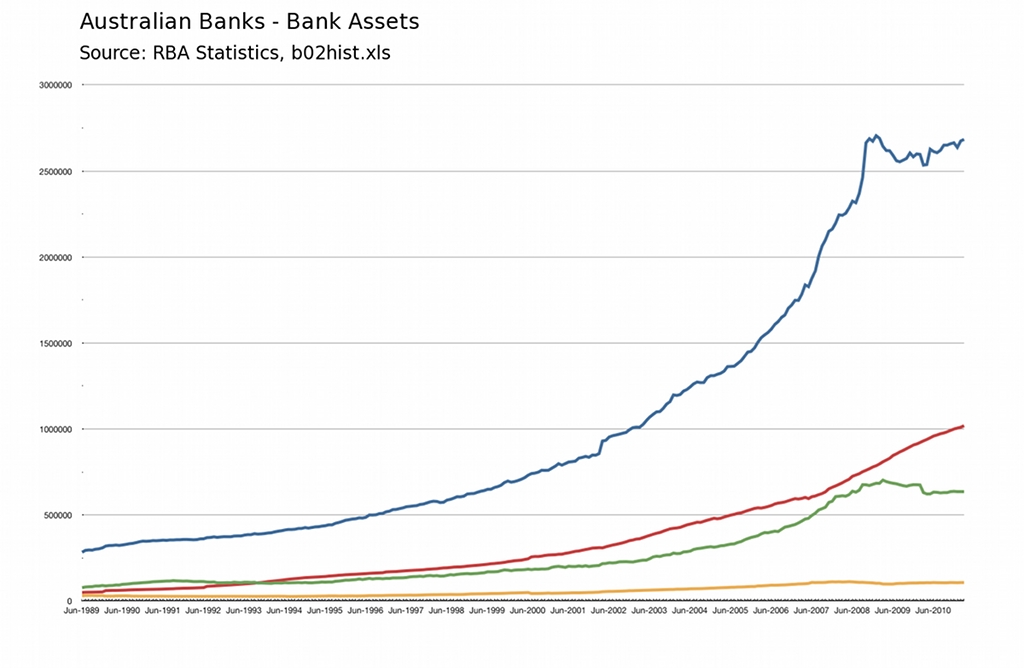
In the chart below, the yellow line represents the total value of Personal Loans. The green line represents Commercial Loans.  The red line represents Residential Loans.  And the blue line represents the grand Total of Bank Assets (click to enlarge):

$1.77 Trillion of Total "Assets" = Loans

The total value of Bank Assets has barely moved – $2.66 Trillion. It has still to regain the peak of $2.67 Trillion in Dec 2008.

It’s worth noting that $1.77 Trillion (66%) of the banks’ $2.66 Trillion in “Assets”, is the value of Loans – personal, commercial, and residential.  That’s right.  Your debt to the bank is considered their “Asset”.  Slavery is still a thriving business in the 21st Century.  It’s how bank(ster)ing works.

What about their Off-Balance Sheet “Business”?

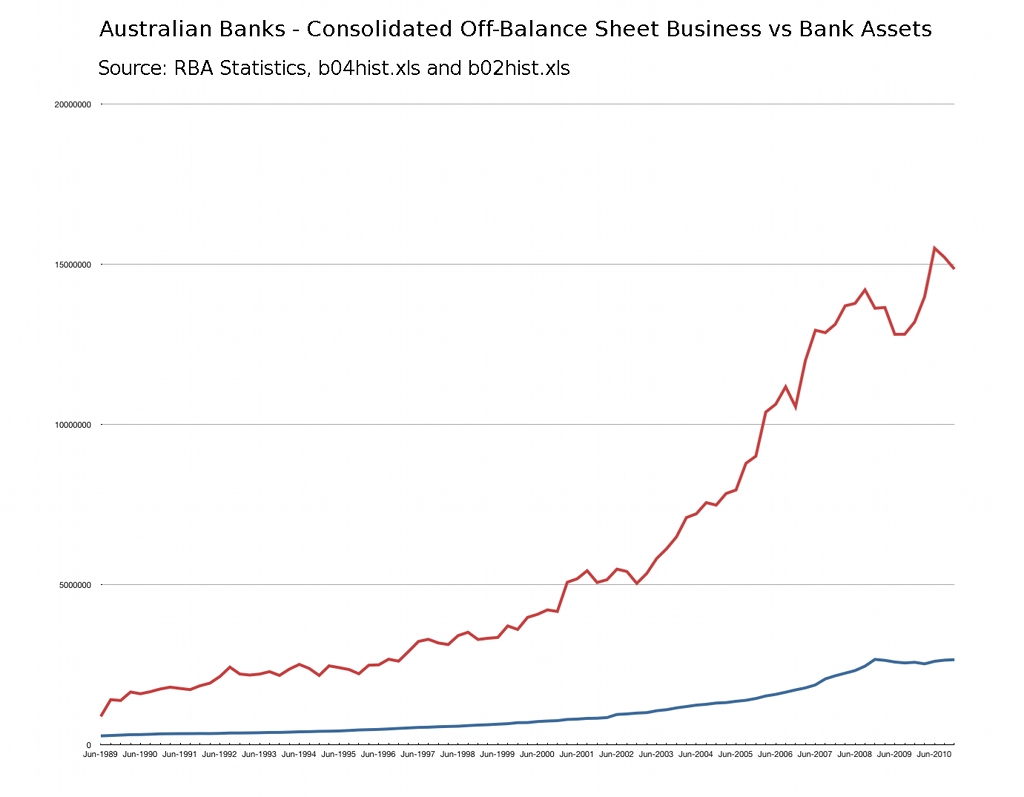
It has blown out by another $1.3 Trillion at its recent peak ($15.5 Trillion), and as at December 2010 sits at just under $15 Trillion.

To give an idea of the vast disconnect between our banks’ “Assets” (66% of which are loans), and their exposure to OTC derivatives, the following chart shows their total Assets – blue line from the above chart – versus a red line of total Off-Balance Sheet “business” (click to enlarge):

$2.66 Trillion in "Assets" versus $15 Trillion in Off-Balance Sheet "Business"

What are derivatives?

Derivatives are the exotic financial instruments at the very heart of the GFC.

Back in 2003, the world’s most famous investor, Warren Buffet, famously called derivatives “a mega-catastrophic risk”, “financial weapons of mass destruction”, and a “time bomb”.

Take note of the sharp dip in the near-parabolic rise in the red line on the chart. This coincides precisely with the late 2008 / early 2009 impact of the GFC on our banking system.

Our banks reduced a little of their exposure to OTC derivatives at that time (down $1.4 Trillion from Sep ’08 to Jun ’09) but quickly resumed their old ways.

At least, until September last year.  Again we see a sharp dip forming through the December quarter of 2010.

A final thought to consider.

If our banks were really so safe, why did two of our Big 4 (Westpac and NAB) both quietly borrow billions of dollars directly from the US Federal Reserve during the GFC?  And never advised shareholders, the prudential regulatory authority (APRA), the RBA, or the public?

An even bigger question – why did the RBA borrow $53 billion from the Federal Reserve without informing anyone?

National Australia Bank Ltd, Westpac Banking Corp Ltd and the Reserve Bank of Australia (RBA) were all recipients of emergency funds from the US Federal Reserve during the global financial crisis, according to media reports.

Data released by the Fed shows the RBA borrowed $US53 billion in 10 separate transactions during the financial crisis, which compares to the European Central Bank’s 271 transactions, according to a report in The Australian Financial Review.

NAB borrowed $US4.5 billion, and a New York-based entity owned by Westpac borrowed $US1 billion, according to The Age.

All is clearly not as safe as we are told in our “safe-as-houses” banking system.

UPDATE:

Still have confidence in our banks – especially the two that had to borrow from the US Federal Reserve?

Westpac, Australia’s second-largest bank, suffered a catastrophic IT meltdown yesterday when its entire banking system collapsed after an air-conditioning failure.

The bank’s ATM and eftpos facilities were useless for about six hours and its internet banking website was offline for 10 hours.

Customers reacted with fury over the system collapse, which came days after Westpac reported a record $3.96 billion net profit, up 38 per cent for the first half of the year…

Many Westpac customers flocked to Twitter to vent their anger, but the bank’s outage pales in comparison to the National Australia Bank‘s recent IT problems.

In late November, software issues at NAB lasted for more than a week and brought other financial institutions to their knees. The incident forced chief executive Cameron Clyne to issue an unprecedented public apology in major newspapers.

Three weeks ago, workers could not access their pay when a 24-hour IT failure affected employers who used NAB for their payroll processing.

The Commonwealth Bank has also had its share of IT glitches, from its internet banking going offline to ATMs discharging incorrect amounts of cash.

Clinton: US Deficit A National Security Risk

27 Feb

US Secretary of State Hillary Clinton says that “outrageous” advice from former Federal Reserve Chairman Alan Greenspan helped create record U.S. budget deficits that put national security at risk:

“We have to address this deficit and the debt of the United States as a matter of national security not only as a matter of economics,” Clinton said. “I do not like to be in a position where the United States is a debtor nation to the extent that we are.”

Having to rely on foreign creditors hit “our ability to protect our security, to manage difficult problems and to show the leadership that we deserve,” she said.

The moment of reckoning cannot be put off forever,” she said. “I really honestly wish I could turn the clock back.”

Barnaby Joyce has been pilloried mercilessly for daring to voice concerns about the USA and its massive debts. Even though many acclaimed international economists agree with his concerns.

In light of Secretary of State Clinton’s testimony, will Rudd Labor and the Australian mainstream media now apologise for their smears, abuse, and ridicule of Senator Joyce?

More importantly, will Lindsay Tanner, Wayne Swan, Ken Henry, Glenn Stevens, and the media now pause to properly consider Barnaby’s prescient warnings about an impending Day of Reckoning for Australia?

Design a site like this with WordPress.com
Get started