Tag Archives: GFC

IMF: US Faces Western World’s Biggest Crunch

18 May

From the UK’s Telegraph:

Earlier this week, the Bank of England Governor, Mervyn King, irked US authorities by pointing out that even the world’s economic superpower has a major fiscal problem –“even the United States, the world’s largest economy, has a very large fiscal deficit” were his words. They were rather vague, but by happy coincidence the International Monetary Fund has chosen to flesh out the issue today. Unfortunately this is a rather long post with a few chunky tables, but it is worth spending a bit of time with – the IMF analysis is fascinating.

Its cross-country Fiscal Monitor is not easy reading and is a VERY big pdf (17mb), so I’ve collected a few of the key points. The idea behind the document is to set out how much different countries around the world need to cut their deficits by in the next few years, and the bottom line is it’s going to be big and hard (ie 8.7pc of GDP in deficit cuts around the world, which works out at, gulp, about $4 trillion).

But the really interesting stuff is the detail, and what leaps out again and again is how much of a hill the US has to climb. Exhibit a is the fact that under the Obama administration’s current fiscal plans, the national debt in the US (on a gross basis) will climb to above 100pc of GDP by 2015 – a far steeper increase than almost any other country.

Another issue is that, according to the IMF, the cost of extra healthcare and pensions will increase by a further 5.8pc over the next 20 years. This is the biggest increase of any other country in the G20 apart from Russia, and comes despite America having far more favourable demographics.

But level of debt isn’t the only problem. Then there’s the fact that the US has a far shorter maturity of government debt than most other countries, meaning that even if it weren’t borrowing any extra cash it would have to issue a large chunk of new stuff each year as things are.

What does this mean? Basically with a large financing need, you are particularly vulnerable if the market suddenly decides it doesn’t want your debt, since those extra interest rates they charge you mount much more quickly. Japan, by the way, is the one with a real problem on this front. It could hardly be any more vulnerable to a sudden drop in investor demand, and many over there fear that the moment domestic savers stop buying JGBs, the country is doomed to Greek-style collapse…

Read the entire article (including IMF charts) here.
Europe Faces Gravest Challenge Since WWII

17 May

From AAP (via The Australian):

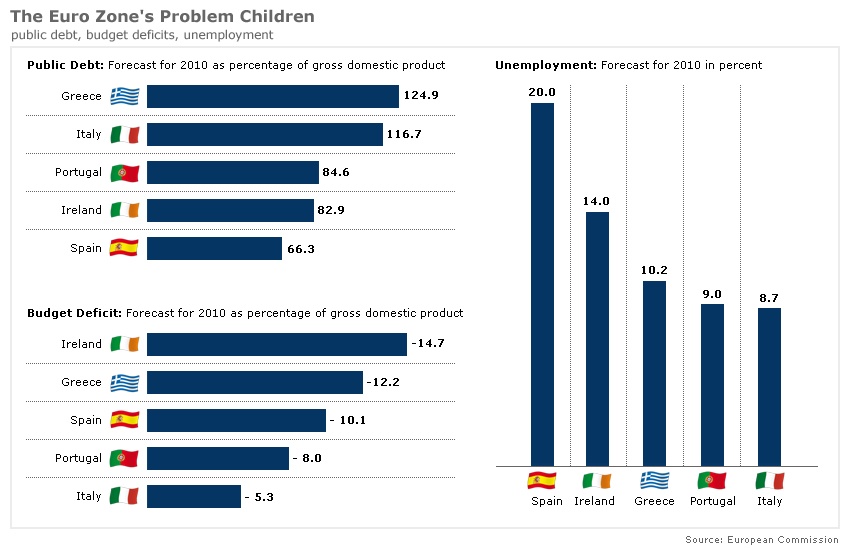
Warnings that Europe faces its gravest challenge since World War II and that the “contagion” from troubled states such as Greece could quickly spread have heightened anxiety in global markets after a steep plunge on Friday reversed much of the week’s gains.

The optimism that followed last week’s E750 billion ($1.05 trillion) European bailout evaporated late on Friday, with markets across the continent plunging and Wall Street closing sharply lower.

The euro tripped to its lowest level against the US dollar in 18 months on Friday on fears of years of weak economic growth in the 16-nation European bloc. The euro is at a record low against the Australian dollar, buying just $1.3974, down from more than $2 early last year.

The euro was not helped by comments by US President Barack Obama’s top economic adviser Paul Volcker, who spoke on Friday of the potential “disintegration” of the 16 nations that share the euro currency. And Paris has had to deny reports that President Nicolas Sarkozy threatened to pull France out of the euro to force German Chancellor Angela Merkel to bail out Greece.

European Central Bank president Jean-Claude Trichet at the weekend called for more action by euro-zone governments to improve fiscal governance.

“We are now experiencing extreme tensions,” he said in an interview with Germany’s Der Spiegel magazine. “In the market, there is always a danger of contagion — like the contagion we saw among the private institutions in 2008.”

And from Business Spectator:

Yesterday, Angela Merkel, German chancellor, warned that the $1 trillion rescue package had only bought Europe time, and that further steps were needed to address the differences in competitiveness and budget deficits between the member countries.

In a speech to the annual German trade union conference, Merkel emphasised that speculation against the euro was only possible because of the huge differences in economic strength and the levels of debt between individual eurozone members.

Meanwhile, the head of the European Central Bank, Jean-Claude Trichet, emphasised that it was urgent that eurozone countries rectify their budget deficits.

In an interview with the German magazine, Der Spiegel, Trichet said that the world was now facing “the most difficult situation since the Second World War – perhaps even since the First World War. We have experienced – and are experiencing – truly dramatic times.”

He said that after the events of 2007-8, “private institutions and markets were about to collapse completely”. That triggered governments to step in with very bold and comprehensive financial support.

The problem was that markets were now questioning whether some governments could afford to repay their debts.

Click here for 9 simple charts that show why a collapse of the Eurozone is inevitable.

BIS: Western World Spending Its Way To Disaster

13 May

From the UK’s Globe and Mail:

The Swiss-based Bank of International Settlements (BIS), the oldest international financial institution in the world, has functioned as the central bank of central bankers for 80 years. In a working paper written by three senior staff economists (“The future of public debt: prospects and implications”), released in March, BIS warns that Greece isn’t the only Western economy with hazard lights flashing.

Indeed, it names 11 more: Austria, France, Germany, Ireland, Italy, Japan, the Netherlands, Portugal, Spain, Britain – and the United States. Without “drastic measures,” BIS says, all of these countries will hit a wall of debt.

When the senior economists at BIS warn 12 of the richest countries on Earth that they must take drastic action to reduce debt, you know that it’s time to check the air bags. The only thing you don’t know, that you need to know, is the precise time of the crash. The lesson is already obvious: Governments can’t drive recklessly, use only the accelerator for braking and not eventually crash.

By the end of 2011, the BIS economists calculate, U.S. government debt will have risen from 62 per cent of GDP in 2007, not quite three years ago, to 100 per cent. Britain’s debt will have risen from 47 per cent of GDP to 94 per cent. Italy’s debt will have risen from 112 per cent of GDP to 130 per cent. All together, the public debt of the 12 countries will have risen from 73 per cent of combined GDP to 105 per cent.

At this debt level, the risk of sovereign default rises rapidly. But the BIS analysis says this unprecedented debt level will itself increase “precipitously” in coming years. It will not, as each of these countries separately insists, fall.

For one thing, the BIS report says, countries that proclaim spending restraint generally do not actually do it. Normally, they hold the line – temporarily. Normally, they slow the rate of increase – temporarily. All pronouncements aside, the BIS report says, these 12 countries have made such grandiose spending commitments that they are predestined for higher debt. The U.S. debt-GDP ratio will hit 150 per cent in the next decade. Britain’s debt-GDP ratio will hit 200 per cent. Japan’s debt-GDP ratio will hit 300 per cent.

These increases in debt, the BIS report says, are untenable. The financial markets, of course, won’t permit them. The only mystery, the BIS report says, is exactly when the markets will intervene. History shows, the report says, that when the markets do rebel, they often do so instantaneously and decisively – often without much warning.

9 Charts Show Why Eurozone Collapse Is Inevitable

10 May

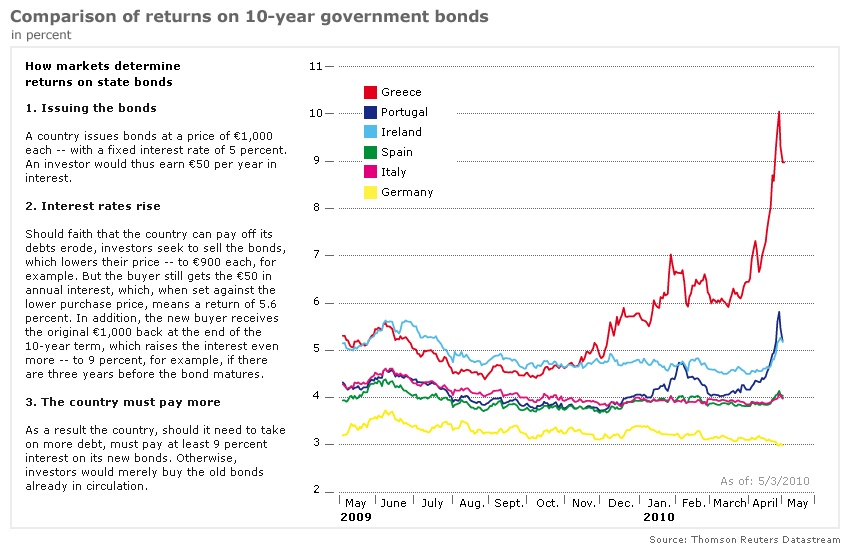
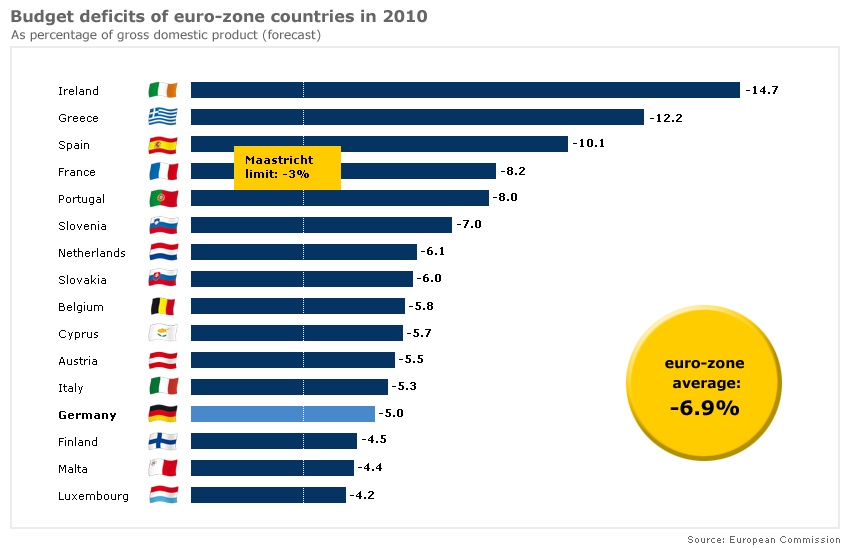
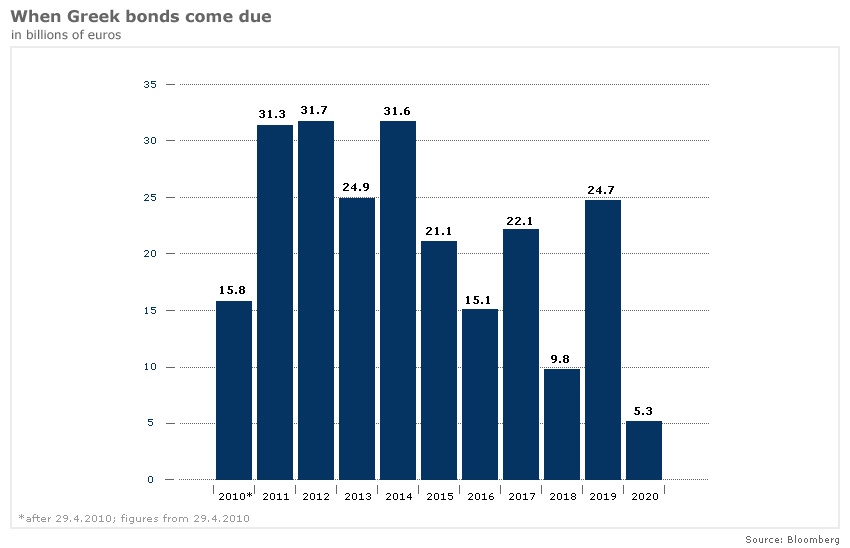
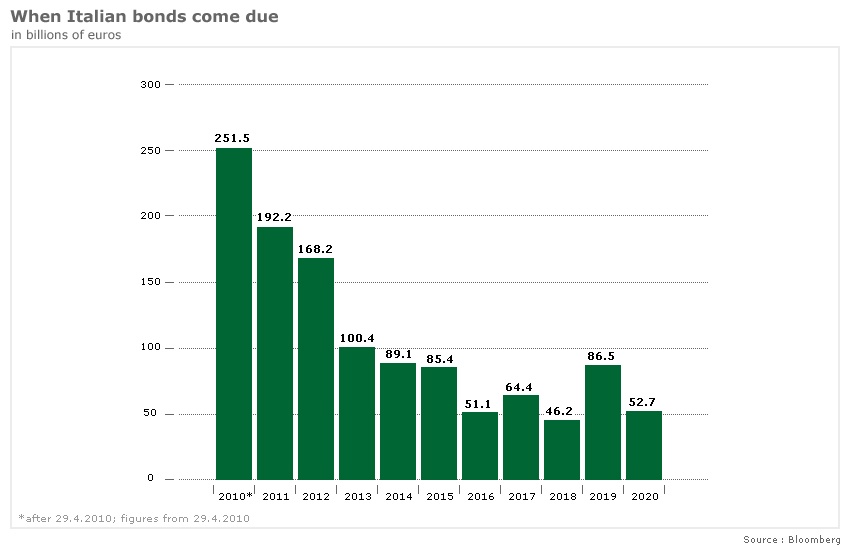
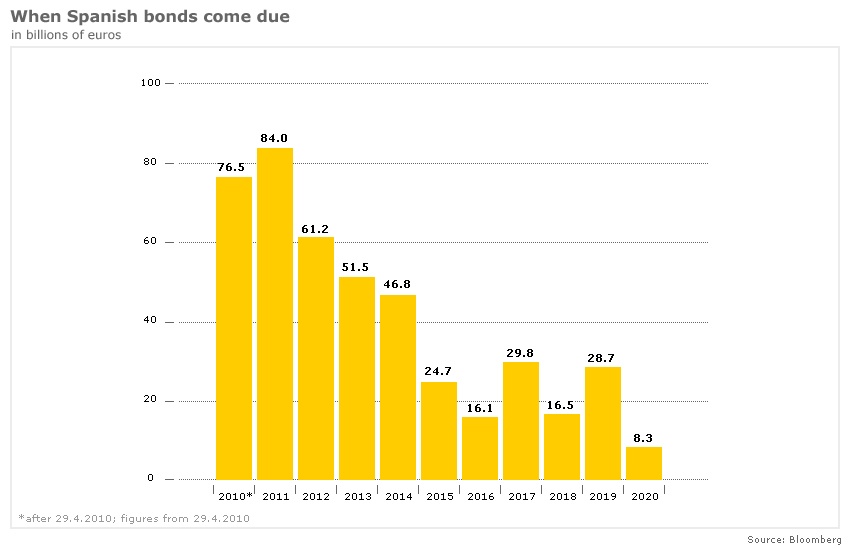
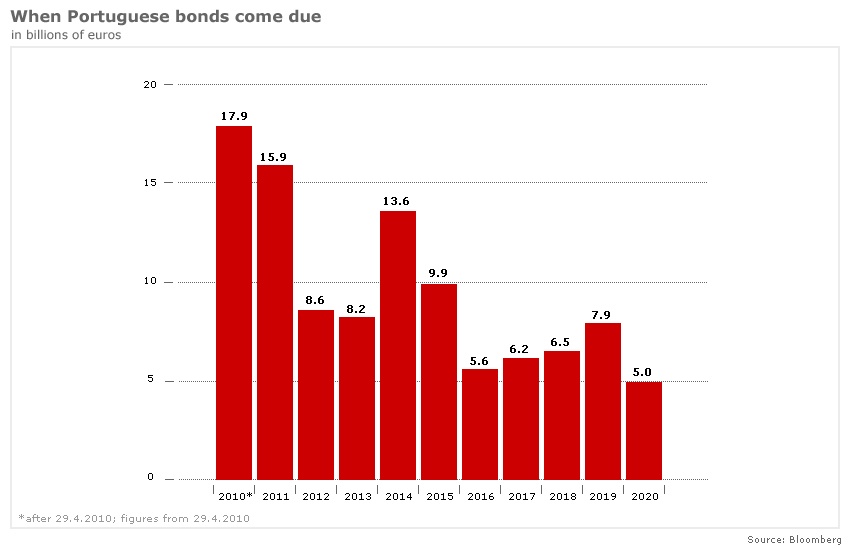
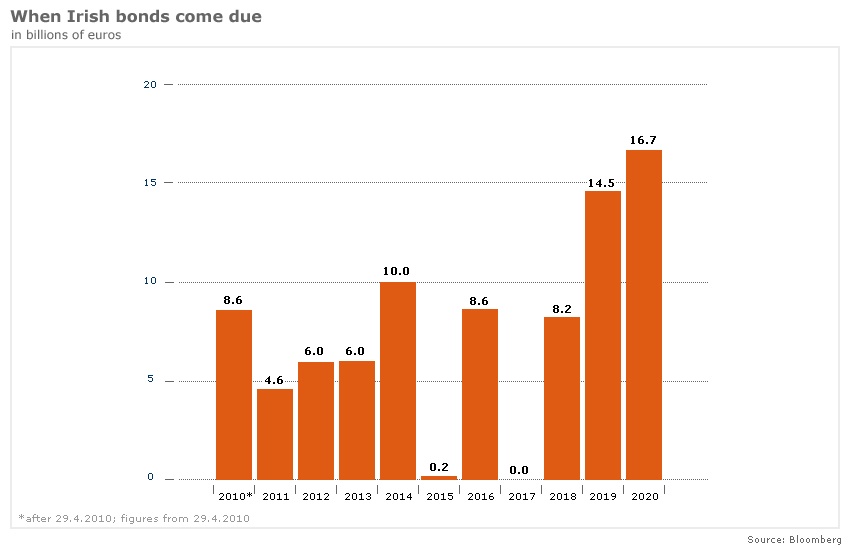
Here are some simple charts that demonstrate why anything and everything that the EU, ECB and/or the IMF can do now, is simply to delay the inevitable disintegration of the Eurozone.

From Der Spiegel: (click on images to enlarge)

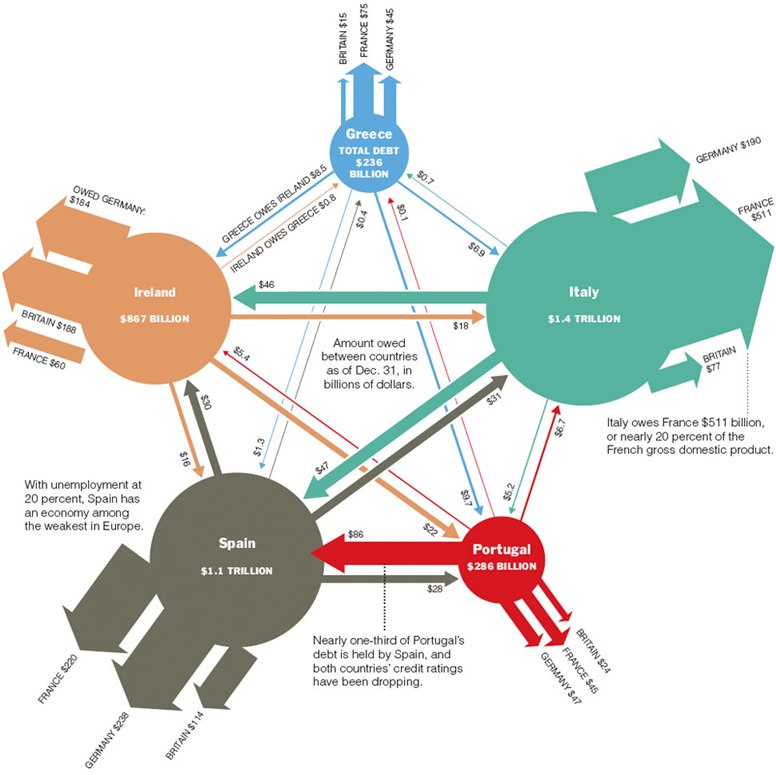
And finally, one more chart showing how interconnected (thus vulnerable) the Eurozone countries are, due to the enormous sums of money owed by member countries just to each other: (click on image to enlarge)

Eurozone Faces Bankruptcy, Disintegration

10 May

Could the Eurozone go bankrupt? One of Germany’s leading newspapers believes so.

From an excellent major article in Der Spiegel:

Huge National Debts Could Push Eurozone Into Bankruptcy

Greece is only the beginning. The world’s leading economies have long lived beyond their means, and the financial crisis caused government debt to swell dramatically. Now the bill is coming due, but not all countries will be able to pay it.

The euro zone is pinning its hopes on (IMF negotiator) Thomsen and his team. His goal is to achieve what Europe’s politicians are not confident they can do on their own, namely to bring discipline to a country that, through manipulation and financial inefficiency, has plunged the European single currency into its worst-ever crisis.

If the emergency surgery isn’t successful, there will be much more at stake than the fate of the euro. Indeed, Europe could begin to erode politically as a result. The historic project of a united continent, promoted by an entire generation of politicians, could suffer irreparable damage, and European integration would suffer a serious setback — perhaps even permanently.

And the global financial world would be faced with a new Lehman Brothers, the American investment bank that collapsed in September 2008, taking the global economy to the brink of the abyss. It was only through massive government bailout packages that a collapse of the entire financial system was averted at the time.

A similar scenario could unfold once again, except that this time it would be happening at a higher level, on the meta-level of exorbitant government debt. This fear has had Europe’s politicians worried for weeks, but their crisis management efforts have failed. For months, they have been unable to contain the Greek crisis.

There are, in fact, striking similarities to the Lehman bankruptcy. This isn’t exactly surprising. The financial crisis isn’t over by a long shot, but has only entered a new phase. Today, the world is no longer threatened by the debts of banks but by the debts of governments, including debts which were run up rescuing banks just a year ago.

The banking crisis has turned into a crisis of entire nations, and the subprime mortgage bubble into a government debt bubble. This is why precisely the same questions are being asked today, now that entire countries are at risk of collapse, as were being asked in the fall of 2008 when the banks were on the brink: How can the calamity be prevented without laying the ground for an even bigger disaster? Can a crisis based on debt be solved with even more debt? And who will actually rescue the rescuers in the end, the ones who overreached?

So, the GFC is ‘over’, is it Ken?

The GFC Is ‘Over’, Ken?

8 May

From The Australian:

Debt and taxes a recipe for economic chaos

The Australian sharemarket lost a massive $95 billion in a five-session horror streak this week, as the European debt crisis and the proposed resources super profits tax severely dented investor confidence.

It was the worst run for local equities since the peak of the global financial crisis, and the meltdown appears far from over, as the second phase of the global financial crisis takes hold.

Wait a minute?!  A “second phase”?  As recently as February this year, the Treasury secretary Ken Henry – architect of Rudd Labor’s massive “economic stimulus” spending, and the Henry Review with its resources super-profits tax that this week resulted in billions wiped off the value of Australian mining companies – publicly declared that the GFC was ‘over’:

“What people have called the global financial crisis, that has passed, I think it’s safe to say,” Dr Henry said. “But that isn’t to say that there will not be further adverse shocks for financial markets down the track and some of those shocks … could be of some significance for individual countries, but I don’t imagine (they would be) shocks of the sort that would be globally significant.”

Really Ken? You clearly do have a disturbing lack of “imagination”:

The local market tumbled a further 2 per cent yesterday, taking its loss for the week to 6.8 per cent, leaving the benchmark S&P ASX 200 index at its lowest point in 17 months.

Yesterday’s sell-off came after an extraordinary lead from Wall Street, where the Dow Jones sent shudders through the world, experiencing its biggest intraday move in history after another drubbing on European markets.

Asian markets also tumbled, with Tokyo’s Nikkei falling another 3 per cent, forcing the Bank of Japan to mount its biggest one-day injection of cash since 2008.

There was no sign of a let-up in Europe last night, with major markets opening as much as 2 per cent lower.

CMC Markets analyst David Taylor said markets were fearful the Greek debt crisis would spread globally and jeopardise growth.

“The sheer fact there is a possibility of a second global financial crisis or a second massive credit crunch inspired by a sovereign debt default, markets are . . . terrified about that,” he said.

Ken Henry completely and utterly failed to foresee the onrushing first wave of the GFC in 2007-08.

His “go early, go hard, go households” economic stimulus advice to Rudd Labor has resulted in massive wasteful spending, rorts, fraud, house fires, deaths, and a Budget thrown into an unprecedentedly huge hole.

He preemptively declared that the GFC is ‘over’.

And as recently as February, he could not even imagine any further “shocks of the sort that would be globally significant”.

How much is this arrogant, demonstrably incompetent clown receiving from MY taxes?

Sack Ken Henry now!

Rudd Ruins Businesses

7 May

Media Release – Senator Barnaby Joyce, 7 May 2010:

“I still have a distinct vision of Mr Rudd earnestly going to the front of Parliament House with a brand new note book and pen as props for the media grab at the one-on-one with the ceiling insulation industry representatives and the press gallery. He said something about fixing it all up himself, before zipping off. The news our office is getting is that this mess is far from being fixed,” says Senator Barnaby Joyce.

“Not happy with upsetting the resources sector in Australia and slashing millions of dollars off the share market, the Rudd Labor government has not just upset, but sent to the wall, hundreds of legitimate insulation companies. Yes, there needs to be recourse against shonky companies, who, let’s face it, took advantage of a sloppy government scheme, but where is the compassion for the “working Families” Mr Rudd likes to be seen to champion?”

“We have been contacted by many of these honest people who are beginning to have telephones disconnected, locked out of businesses premises, losing motor vehicles to finance companies and some have had mortgagee possession notices on their family homes, because the government will not pay them what is legitimately owed. Minister Combet’s media release on the 20th of April 2010 stated GST deferral was to be made available to insulation companies, yet the Australian Taxation office has sent debt collectors after these same debts. According to industry sources, you Mr Rudd, Mr Combet and Mr Garrett, have ruined a whole industry. So much for the stimulus package sent to save us.”

“Come on Mr Rudd. Where is the fair play you claim to have for “working families”? Why is this insulation program continuing to be such a debacle? Fix it now!”

More Information- Jenny Swan 0746 251500

Cracks Multiply In Europe

7 May

From Business Spectator:

Global share markets plunged overnight as panicked investors worried that the eurozone could fragment as a result of the escalating European financial crisis.

The European banking system is under huge strain* as banks are increasingly reluctant to lend to each other. The European banks are worried about how much other banks have lent to the weaker eurozone countries – the so-called PIIGS (Portugal, Ireland, Italy, Greece and Spain) – and the catastrophic losses that could ensue if any of these countries defaulted on their debt.

At the same time, there’s been a flight of capital out of the eurozone as investors have worried the common currency might crumble as a result of the problems in the vulnerable economies of the PIIGS (Portugal, Ireland, Italy, Greece and Spain).

The huge question mark over the eurozone’s survival is causing the euro to plummet. Increasingly, market analysts are predicting that the currency, which broke through the $US1.30 earlier this week for the first tine since April 2009, is set to hit parity with the US dollar.

There is an increasing consensus that the $US145 billion European Union-IMF rescue package for Greece is not sufficient to solve Greece’s basic problem – that it is simply unable to service its colossal debts. There are also questions as to whether Greece will be able to implement the punitive austerity measures it is being forced to adopt in exchange for the bailout.

At the same time, there are increasing signs that even if it bails out Greece, Germany will not be prepared to write the huge cheques required to help other vulnerable PIIGS.

German taxpayers are already outraged at having to pick up a large chunk of the cost of the Greek bail-out, and Germany’s largest opposition party, the centre-left SPD, has said that it will not vote in favour of the bill.

Predictions that the cascading PIIGS debt crisis will cause the eurozone to collapse are becoming more widespread.

* That the European banking system is “under huge strain” and is beginning to freeze up (again) has profound implications for our economy. Why?

As explained in this post a few days ago, even the heads of our major banks quietly admit that our banking system has an “achilles heel” – it is desperately dependent on the international wholesale capital markets for funding.  If/when the banking system abroad seizes up again, our banks will be in deep trouble.

Watch out for the emergency reinstalment of the government’s Bank Guarantee, hoping to again prop up international confidence in our banks so that they can continue to attract funding in a second credit crunch.

Watch out also for higher interest rates charged by the banks – irrespective of the RBA cash rate – due to their having to pay ever higher interest rates in order to get that international funding in the first place.

GFC Wave II Coming?

7 May

From headline news around the globe (in this case, The Australian):

Wall Street Plunges On Eurozone Contagion Fears

US stocks plunged today in a flashback to the panicked trading of 2008 and at one stage the Dow was down almost 1000 points — its biggest intraday fall in history.

Investors fled everything from stocks and risky corporate bonds to commodities and poured money into safe assets such as US Treasuries and gold.

The US stockmarket fell for a third-straight session, as jittery investors grew even more restless over southern Europe’s festering sovereign-debt woes.

The sell-off turned ugly quickly, with Bank of America, Procter & Gamble and 3M among the big decliners, as potentially erroneous trades accelerated the drop.

The Dow Jones Industrial Average ended the session down 347.80 points, or 3.20 per cent, to 10,520.32, its biggest point drop since February 2009. The average at one point fell as much as 998.50 points, or 9.2 per cent, the biggest intraday drop in its history.

Credit Contraction Heralds Recession

5 May

Does a contraction in the growth of Broad Money Supply say that recession is looming?  Australia’s most recent history responds with a resounding ‘Yes’.

Take a look at the following chart, showing the 12 month percentage change in Broad Money Supply. Note in particular the time frame of Australia’s last recession – Paul Keating’s “recession we had to have” – back in the early 1990’s. See how Broad Money Supply growth peaked in June/July 1989, before falling sharply and eventually turning negative in Nov ’91 – Mar ’92  (click image to enlarge):

Now, consider the dates of the most recent peak (and fall), coinciding with the onset of the Global Financial Crisis.  Broad Money Supply growth peaked again in December 2007 – coincident with the peak in the Australian (and global) stock markets:


Broad Money Supply in Australia has been falling ever since December 2007.

According to John Williams of ShadowStats (commenting on the US economy) –

Money supply and credit are now generally contracting. We’re going to see an intensified downturn in the near future. I specialize in looking at leading indicators that have very successful track records in terms of predicting economic or financial turns. One such indicator is the broad money supply. Whenever the broad money supply–adjusted for inflation–has turned negative year over year, the economy has gone into recession, or if it already was in a recession, the downturn intensified. It’s happened four times before now, in modern reporting. You saw it in the terrible downturn of ‘73 to ‘75, the early ’80s and again in the early ’90s.

Design a site like this with WordPress.com
Get started