Tag Archives: housing bubble

Guest Post – The ‘Moneyness’ Of Debt

27 May

Submitted by reader JMD.

I will express a view here that is, as far as I can tell, being laid out by few others. I can’t claim the idea as my own, rather I have put this together based on the thoughts of Doug Noland, my favourite economic analyst by a country mile, who publishes the Credit Bubble Bulletin. I have taken the liberty of lifting quotes directly from his articles, they are in italics throughout my article, though I may have changed his wording just a little to fit in with the flow.

Readers of the Gold Standard Institute know that money is what extinguishes all debt, nevertheless, credit1 can be considered a monetary equivalent or ‘money good’, take for example, Real Bills that mature into gold. Inextinguishable debt, as in irredeemable dollars and dollar denominated debt, are not money since they are, well… inextinguishable debt. Despite this contemporary irredeemability, credit is still considered to be in a dynamic state of ‘moneyness’, driven by the marketplace’s perception of safety and liquidity, and any meaningful definition of contemporary ‘money’ must include government debt instruments.

The situation prevailing today is that key developed economies are locked into a perilous cycle of massive non-productive government debt expansion. Rather than the global money markets being composed of Real Bills, generated through the drawing of short term bills against consumer goods actually required by consumers, we have money markets where for nine quarters now, government finance has completely dominated system credit creation. These ‘marketable’ debt securities now absolutely dominate the world.

Just how massive has this increase in government debt issuance been? I draw your attention to the charts below.

As you can see, government debt issuance has reached levels never heretofore imagined. UST issuance reached almost $1.5 trillion in 2009. While the dollar amount of Australian government debt issuance is small in comparison to the US, the pattern of expansion is the same. I have included Australian government debt issuance back to 1985 to give some perspective of historical issuance. I don’t have figures pre 1996 for UST’s, nor 2010. Nevertheless, you get the picture.

Why the fuss? Because it is the ‘moneyness’ nature of government obligations that they enjoy special treatment in the marketplace. Readers of the Gold Standard Institute also know that when it comes to the ‘moneyness’ of credit it’s not just quantity but quality that counts. I think it safe to presume that government debt has not improved in quality since 2008, yet issuance has exploded with little perception that government debt is being mispriced, over-issued, and misdirected. There is an ever expanding gulf between market perceptions of ‘moneyness’ and the true underlying state of government credit. In simpler terms, government credit is a bubble, a precarious Credit Bubble at the heart of our monetary system. Just as the US financial system doubled total mortgage debt in just over six years during the mortgage/Wall Street finance bubble with little perception of the underlying quality of U.S. mortgage credit, the financial system is now on track to double federal debt in about four years. The situation is no different in Australia and I doubt it would be different in most other ‘developed’ countries.

There is only one true arbiter of the value of government debt, its only extinguisher… gold. Irredeemable dollars, being the obligation of the central bank – not money, cannot extinguish government debt. Is gold reflecting the expanding gulf between perceptions of moneyness and the true quality of government credit? Should holders be loaning their money – gold – for irredeemable government obligations, as if ‘buying’ mortgage credit at the height of the Wall Street bubble? Should the dollar price of gold be falling?

I think not. And we all know what happens to bubbles.

Note: 1. Remember, one person’s debt is another’s credit. I use the terms interchangeably.

Source - Australian Office of Financial Management (AOFM)

Source - Prudent Bear (prudentbear.com)

Disclaimer: The views expressed in the above article are the author’s own. They should not be interpreted as reflecting any views held by Senator Barnaby Joyce, The Nationals, or by the barnabyisright.com blog author.

* Stay tuned for JMD’s follow up post, on the Reserve Bank of Australia’s sale of 2/3rd’s of Australia’s gold during the Asian Financial Crisis of the late nineties.
Fitch’s: Residential Mortgage-Backed Securities “Negative”, Threat To Banks

21 May

Uh-oh.

Haven’t we already had enough worrying announcements over this past week?

To top things off, Fitch’s ratings agency has reclassified 54 tranches of Australian residential mortgage-backed securities (RMBS) from ratings watch “stable”, to “negative”:

Cash-strapped borrowers and tight-fisted mortgage insurers are a greater threat to Australian banks than previously thought, says a major ratings agency.

New information shows that Australian mortgage insurers, which secure loans for banks and other lenders, do not always pay the full outstanding amount of mortgages when they fall over which can leave banks out of pocket, according to ratings agency Fitch.

Based on its findings, Fitch moved 54 tranches of residential mortgage backed securities (RMBS) from ratings watch “stable” to “negative”. Mortgage backed securities are home loans which are bundled together and sold to institutional investors by banks and mortgage lenders.

Banks fund mortgages through issuing RMBS, which are rated by credit ratings agencies like Fitch, Moody’s and Standard & Poor’s for their quality and likelihood of being repaid. RMBS lay at the heart of the subprime crisis in the US, when major banks and investors poured billions of dollars into mortgage debt which turned out to be lower quality than thought.

The new ratings account for about half of Australia’s national securitised mortgage market. Each transaction is made up of multiple tranches that attract a different rating based on their underlying credit quality.

“Rating watches indicate that there is a heightened probability of a rating change and the likely direction of such a change,” according to data from Fitch’s website, with “negative” denoting a potential downgrade.

Commonwealth Bank chief executive Ralph Norris recently noted a 11 per cent increased in delayed payments on mortgages in the March quarter following the big rise in lending for first home buyers around the time of the financial crisis. ANZ Bank and Westpac have reported similar upticks.

We have been covering the other, even greater risks to Australia’s banks in recent posts (here, here, and here).

What concerns most about this announcement, is the implications for the $20 Billion worth of RMBS’ that the Labor government has purchased, and continues to purchase, in their efforts to keep propping up our housing bubble.

It’s been quite a week.

How Australia Will Look When The SHTF

15 May

Want a glimpse of Australia’s future?

Watch this shocking story from America’s 60 Minutes:

http://www.youtube.com/watch?v=QwrO6jhtC5E

Pretty distressing, right?

It was exotic “mortgage-backed investments” that triggered the GFC in America. And as you just saw, they are still very much at the heart of their terrible ongoing crisis, where 1 in 7 (44 million) are now living on food stamps.

Just as in the USA and other countries, our Labor government responded to the GFC by “stimulus”.  And, by propping up our “safe as houses” bankstering system.

This is the same “best in the world” bankstering system that has just $2.67 Billion in On-Balance Sheet Assets, versus $15 TRILLION in Off-Balance Sheet “business”.  The bulk of that off-the-books “business” is exotic “derivatives” bets on interest rates, and foreign exchange rates.

How exactly did Labor prop up our bankstering system?

Amongst other things, by using taxpayer’s money to “invest” billions in … yep, Residential Mortgage-Backed Securities (RMBS).

$16 Billion, to be precise.

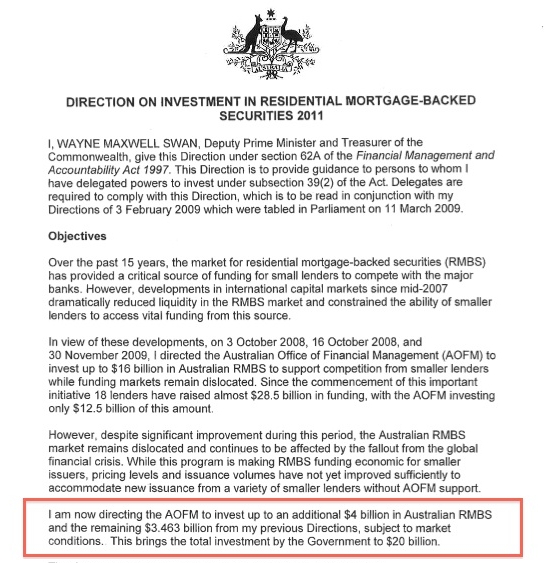
But $16 Billion wasn’t enough. Just last month, Wayne Swan authorised the AOFM to “invest” another $4 Billion in these “mortgage backed investments”:

Click to enlarge

According to numerous sources including The Economist magazine, Australia has the most overvalued housing in the world.

And earlier this month, we learned that house prices fell by the most in 12 years in the March quarter.

That $20 Billion pumped into Residential Mortgage-Backed Securities is not looking such a great “investment” now, ‘eh Wayne.

Let there be no mistake.

Rudd/Gillard Labor did not “save us” from the GFC.

They simply kicked the can down the road a couple of years.

And in doing so, all they have achieved is to dramatically weaken our government’s financial position.

Nearly $200 Billion in gross debt.

$20 Billion in “mortgage-backed investments”.

A $50 Billion budget deficit – that’s for this year alone.

A $50 Billion increase in our national debt ceiling, to $250 Billion.

And borrowing more than $2 Billion a week.

But look on the bright side.

When GFC 2.0 strikes, we’ll not need to worry about what’s hitting the fan.

Because thanks to Labor … and the banksters … we’re already in the ____ right up to our necks.

Barnaby is right.

UPDATE:

For more shocking revelations on this story of bankstering corruption of the mortgage finance markets – and now even the courts of law – see this exposé by Rolling Stone’s Matt Taibbi:

The foreclosure lawyers down in Jacksonville had warned me, but I was skeptical. They told me the state of Florida had created a special super-high-speed housing court with a specific mandate to rubber-stamp the legally dicey foreclosures by corporate mortgage pushers like Deutsche Bank and JP Morgan Chase. This “rocket docket,” as it is called in town, is presided over by retired judges who seem to have no clue about the insanely complex financial instruments they are ruling on — securitized mortgages and laby­rinthine derivative deals of a type that didn’t even exist when most of them were active members of the bench. Their stated mission isn’t to decide right and wrong, but to clear cases and blast human beings out of their homes with ultimate velocity. They certainly have no incentive to penetrate the profound criminal mysteries of the great American mortgage bubble of the 2000s, perhaps the most complex Ponzi scheme in human history …

And if you missed it, check out Matt’s infamous exposé of one of the big banks at the heart of the ongoing mega-fraud, Goldman Sachs:

The first thing you need to know about Goldman Sachs is that it’s everywhere. The world’s most powerful investment bank is a great vampire squid wrapped around the face of humanity, relentlessly jamming its blood funnel into anything that smells like money. In fact, the history of the recent financial crisis, which doubles as a history of the rapid decline and fall of the suddenly swindled dry American empire, reads like a Who’s Who of Goldman Sachs graduates …

What you need to know is the big picture: If America is circling the drain, Goldman Sachs has found a way to be that drain — an extremely unfortunate loophole in the system of Western democratic capitalism, which never foresaw that in a society governed passively by free markets and free elections, organized greed always defeats disorganized democracy

Goldman Sachs is the puppeteer of our very own Emissions Trading Scheme leading proponent, former GS Australia chairman Malcolm Turnbull MP.

Is China Bankrupt?

3 Aug

From MSNBC:

All governments lie about their finances. At worst, as in Greece and the United States, the lies are bold and transparent. Everybody knows the emperor has no clothes, but no one want to say so. At best, as in Canada and China, the lies are more subtle – more like a magician’s misdirection than a viking raider’s ax. Look at these great numbers, the lie goes, but don’t look at those up my sleeve.

There’s a good argument to be made that if you look at all the numbers, instead of just the ones the budget magicians want you to see, China is indeed broke

… China has a history of taking debt off its books and burying it, which should prompt us to poke and prod its numbers.

A must-read article. Poke and prod China’s numbers here.

China Brakes, Australia Breaks

14 May

From Business Spectator:

In an ominous sign for Australia, the Chinese sharemarket is slumping on worries that the Chinese government will soon lift interest rates in response to rising inflation and surging property prices. Such a move would slam the brakes on Chinese growth, and deal a cruel blow to Australia, which is counting on Chinese growth to keep commodity prices high.

Although it rebounded by 2 per cent yesterday, China’s Shanghai Composite Index is down more than 20 per cent from its peak in August 2009, which means that it is still technically in a ‘bear’ market.

The market’s gloom has been deepened by signs of mounting inflationary pressures in the Chinese economy. Inflation figures released this week showed consumer prices rose by 2.8 per cent in April from the year before, an increase from the 2.4 per cent rise in March. Meanwhile, home prices in 70 large and medium-sized Chinese cities rose by 12.8 per cent from a year earlier in April, picking up pace from the 11.7 per cent rise in March. There are also worrying signs that the property price bubble is spreading beyond the major cities and into the country-side.

So far, the Chinese government has held off raising interest rates – which are currently negative after allowing for inflation – in order to cool the super-charged economy. Instead, its ordered banks to hold more deposits on reserve, as well as lifting the minimum deposits that home buyers require to make to get access to home loans, and raising mortgage rates for second and third home buyers.

But there are intense worries that these steps won’t prove sufficient. Earlier this week, the Chinese central bank reported that banks lent 774 billion renminbi ($113 billion) in April, which is about 30 per cent more than in the same month last year. Lending for the first four months of 2010 has now reached 45 per cent of the total quota of loans for the year.

This explosion in Chinese bank lending has led to worries that the country will eventually be saddled with a mountain of bad loans. These concerns were heightened after China’s National Audit Office reported that it had uncovered lending irregularities amounting to tens of billions of renminbi in its latest audit of the Agricultural Bank of China.

Is The China Bubble Starting To Burst?

14 May

We’ve just seen the Rudd Government present a truly fantastical budget.  One that relies completely on the hopeful fantasy that the Chinese building boom will continue for a decade to come, and so, a “great big new tax” on the “super profits” of mining companies can return the budget to surplus.

A lovely story.

But what do professional strategists on the China economy have to say about China’s prospects?

From MarketWatch:

China’s economy is teetering on the edge of a major slowdown … according to a noted China strategist.

David Roche, an economic and political analyst who manages the Hong Kong-based hedge fund Independent Strategy, says the world’s third-largest economy is now on the brink, faced with the inevitable reckoning that follows an extended bank-lending binge.

“We’ve got the beginnings of a credit-bubble collapse in China,” said Roche, predicting the economy will likely cool from its stellar double-digit growth rate to a 6% annual expansion as a result.

While that may not sound bad, Roche believes the collateral damage from the cooling will be anything but mild, as the banking sector comes under pressure from cumulative years of bad investment and mispriced capital.

The emerging picture is one of a substantial contraction in credit growth and infrastructure expenditure, he says.

The shrinkage is grim news for an economy heavily dependent on such outlays. China managed to escape recession during the global crisis mainly because of bridges, railways and other infrastructure-project spending, estimated to have accounted for about 90% of economic growth last year, according to Roche.

About 85% of the funding for these projects was arranged by local government financing vehicles “borrowing money they can never repay” from state-owned banks, says Roche. Nearly 3 trillion yuan ($440 billion) of the 11 trillion yuan extended to these entities has been wasted or stolen, he estimated.

***

More worryingly, as bank lending dries up, there won’t be the firepower to sustain new investments in infrastructure, eroding a core pillar of China’s growth model, he said.

Much of the focus on potential asset bubbles in China has been on the property sector, but Roche suggested that housing-price inflation is intertwined with unsustainable gains in other areas.

***

A slowing Chinese economy could also have ramifications for the resource sector.

A scaling back of the infrastructure-building binge is negative for industrial commodity prices such as copper and iron ore, with the latter potentially slumping 50%, he said.

“I would not own resource stocks,” Roche said.

Iron ore prices to fall by 50%?

Hmmmmm… any guesses what that would do to the “super profits” of mining companies? And to the “great big new tax” that Rudd Labor is relying on to get the budget back to surplus?

UPDATE:

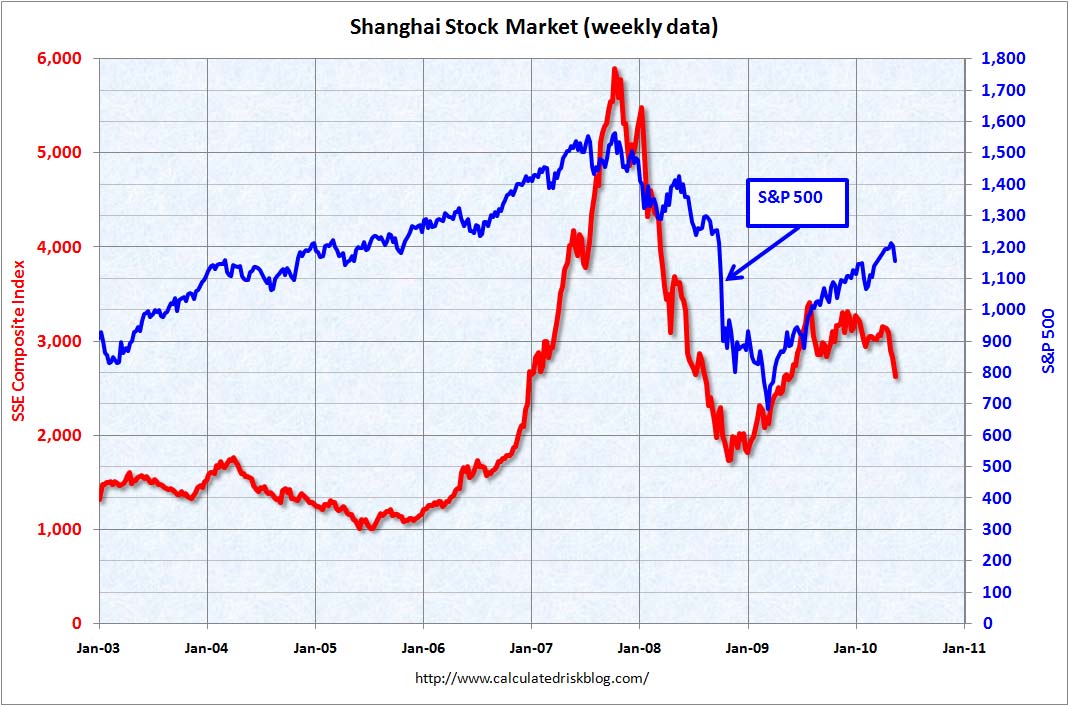
Calculated Risk notes that the Shanghai Composite Index is falling already –

Keep an eye on the Shanghai index (in red). It appears China’s economy is slowing.

Shanghai SSE in red (click to enlarge)

Don’t Bet The House On China

4 May

An excellent and timely article by Karen Maley in today’s Business Spectator (reproduced here in full):

Kevin Rudd’s resource super profits tax has one massive risk – that commodity prices collapse before he gets to collect one cent of it.

Yesterday, the influential forecaster, Marc Faber joined those warning of problems ahead in China. “The market is telling you that something is not quite right”, he said in an interview on Bloomberg television. “The Chinese economy is going to slow down regardless. It is more likely that we will even have a crash sometime in the next nine to 12 months.”

On Sunday – as Kevin Rudd and Wayne Swan were announcing their new resources tax – China’s central bank made another attempt to dampen property market speculation. It lifted its reserve requirement ratio by a further half a percentage point, so that most Chinese banks will now have to hold 17 per cent of their deposits on reserve.

But this latest increase in the reserve ratio will likely prove as ineffective as the two previous rises in January and February this year. Many believe the Chinese property bubble will continue to expand for as long as the Chinese government maintains interest rates below the rate of inflation.

And that’s the core of the problem. The Chinese government is reluctant to increase interest rates because it risks exposing the huge fault lines that exist in the economy.

Over the past decade, China has built factories and expanded its manufacturing capacity in the expectation that the United States and Europe would continue to demonstrate a robust appetite for Chinese-produced goods. But western demand for Chinese products slowed in the wake of the financial crisis, leaving the Chinese economy with substantial overcapacity in manufacturing.

The problem was exacerbated during the financial crisis. With Chinese exports plunging, the Chinese government launched a massive economic stimulus program, equivalent to around 14 per cent of the country’s GDP. It also ordered Chinese banks to lend, and instructed Chinese state-owned companies to borrow.

The program had the desired result. The Chinese economy grew at an 11.9 per cent annual clip in the first three months of the year, the fastest pace since 2007. And we benefited too, because this strong Chinese growth pushed up the prices of our commodity exports, such as iron ore and coal.

But there are huge concerns over how the Chinese stimulus money was spent. Provincial governments, under instructions from Beijing to reach specified growth targets, undertook massive construction projects that have resulted in a glut of commercial office space, and huge shopping malls that are near-vacant. And much of the increase in bank lending was funnelled into property market speculation, pushing up housing prices to astronomic levels.

The Chinese government has tinkered with various measures to contain its property bubble – increasing the reserve requirement, lifting the minimum deposit that home buyers must have before they’re allowed to borrow, and urging banks to monitor their risks.

But it is loathe to raise interest rates for fear that it will cause mass defaults among manufacturers and property developers, leading to huge problem loans in the banking system.

Eventually, however, an end-point will be reached. Either the Chinese government will raise interest rates, or the property market bubble will collapse under its own weight. At that point, commodity prices will plummet, slashing the profits of the big mining companies.

And if this happens before 1 July 2012 when the new tax regime for the miners comes into effect, Rudd is unlikely to ever see a cent of his new resource super profits tax.

Betting the house on China is exactly what the numbskulls in the Rudd Labor government, the Treasury, and the RBA are doing.

Please take some time to review some of the many earlier articles in this blog, showing how the likes of Treasury secretary Ken Henry and RBA Governor Glenn Stevens have declared that the GFC is ‘over’, and forecast that (thanks to China) we are all set for a ‘period of unprecedented prosperity’ lasting until 2050.

What is vital to bear in mind always, is that these are the very same incompetents who all completely and utterly failed to foresee the onrushing Global Financial Crisis in 2008… even though its first wave had already broken in the USA and on global share markets during 2007!

China May ‘Crash’ In 9-12 Months

4 May

Noted investor and publisher of the fabled “Gloom, Boom and Doom” report, Dr Marc Faber, warns that the Chinese economy may crash within the next 9 to 12 months.

From Bloomberg:

Investor Marc Faber said China’s economy will slow and possibly “crash” within a year as declines in stock and commodity prices signal the nation’s property bubble is set to burst.

The Shanghai Composite Index has failed to regain its 2009 high while industrial commodities and shares of Australian resource exporters are acting “heavy,” Faber said. The opening of the World Expo in Shanghai last week is “not a particularly good omen,” he said, citing a property bust and depression that followed the 1873 World Exhibition in Vienna.

“The market is telling you that something is not quite right,” Faber, the publisher of the Gloom, Boom & Doom report, said in a Bloomberg Television interview in Hong Kong today. “The Chinese economy is going to slow down regardless. It is more likely that we will even have a crash sometime in the next nine to 12 months.”

Faber joins hedge fund manager Jim Chanos and Harvard University’s Kenneth Rogoff in warning of a crash in China.

China is “on a treadmill to hell” because it’s hooked on property development for driving growth, Chanos said in an interview last month. As much as 60 percent of the country’s gross domestic product relies on construction, he said. Rogoff said in February a debt-fueled bubble in China may trigger a regional recession within a decade.

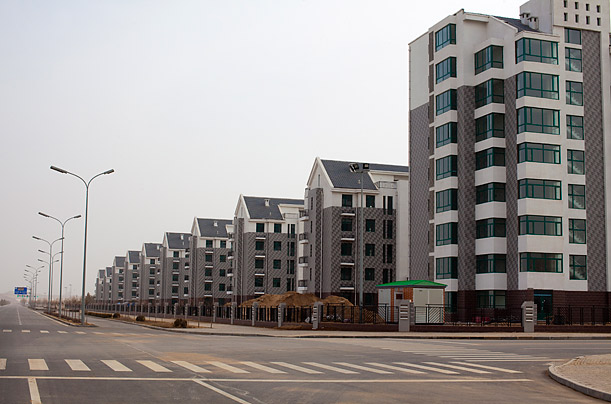
For those who doubt that China is currently experiencing the global mother of all real estate bubbles, take a look at these pictures from Time magazine, showing just how massive speculative over-investment in property construction has left China with literal ‘ghost cities’.

Bubble Proof: Chinese Maids Buying Houses

3 May

Unsure about the conflicting arguments in the ‘expert’ commentariat about whether China is in a massive real estate bubble?  Consider real-world anecdotes like those following, related by former Morgan Stanley chief economist and now independent Hong Kong-based economist Andy Xie, who has predicted that an overwhelming “get rich quick” mentality has doomed the Chinese economy.

From a must-read article in BusinessWeek:

“My maid just asked for leave,” a friend in Beijing told me recently. “She’s rushing home to buy property. I suggested she borrow 70 percent, so she could cap the loss.”

It wasn’t the first time I had heard such a story in China. Some friends in Shanghai have told me similar ones. It seems all the housemaids are rushing into the market at the same time.

There are benefits to housekeeping for fund managers. China’s housemaids may be Asia’s answer to the shoeshine boy whose stock tips prompted Joseph Kennedy to sell his shares before the Wall Street Crash of 1929.

Another friend recently vacationed in the southern island- resort city of Sanya in Hainan province and felt compelled to visit a development sales office. Everyone she knew had bought there already. It’s either buy or be unsocial.

“You should buy two,” the sharp sales girl suggested. “In three years, the price will have doubled. You could sell one and get one free.”

How could anyone resist an offer like that?

The evidence in official-corruption cases no longer involves cash stashed in refrigerators or starlet mistresses in Versace clothing. The evidence is now apartments. One mid-level official in Shanghai was caught with 24 of them.

China is in the throes of a vast property mania. First, let me make it perfectly clear that calling China’s real-estate market a “bubble” isn’t denying China’s development success. As optimism is an essential ingredient in a bubble, economic success is a necessary condition. Nor am I saying that prices will drop tomorrow. A bubble evolves and bursts in its own time.

House Prices Tipped To Implode

3 May

While Barnaby may not have spoken about private debt, it is arguably the great threat to Australia’s economy.  The first to suffer from excessive debt burdens are the thousands of overextended First Home Buyers.

From The Australian:

Australia is in the midst of an unsustainable housing bubble that could burst at any time, warns the man who predicted the global credit bust of 2007.

Edward Chancellor, of US investment bank GMO, says the Australian economy is yet to emerge from the global financial crisis, despite the widespread belief it has escaped the worst of it ahead of the rest of the world.

Mr Chancellor, whose Crunch Time for Credit? was published in 2005, estimates Australian house prices are more than 50 per cent above their fair value – a once in 40-year event. “If house prices were to revert to their historic long-term average (ratio of average price to average income) they would fall quite considerably,” he told The Australian.

He described Australia’s banking system as a “cartel” and said luck rather than skill had allowed the Australian economy to fare better in the global financial crisis than other developed economies.

“My view is Australia had a private sector credit boom just like the US and the UK and it had a real estate boom,” he said.

“Those are the facts and you can’t paper over them.

“In this environment, house prices rose last year and that seems to me to actually have exacerbated the problem.

“The problem is the bubble and that hasn’t gone away.”

A key area of concern for Mr Chancellor was first-home buyers. As interest rates rose, the ratio of their mortgage repayments to their income would rise to very high levels, he said.

“It’s the rising interest rates, particularly with real estate bubbles, that tend to generate the collapse,” he said.

Another potential trigger was China, particularly if the demand for iron ore, coal and liquefied natural gas were to collapse.

“We would see the Chinese demand for Australian commodities as being potentially vulnerable,” Mr Chancellor said.

UPDATE:

The latest housing data says that our housing bubble – fuelled by years of easy credit, the First Home Owners Grant, and propped up during the GFC by Rudd Labor’s doubling of the FHOG – is now running out of control.

From The Australian:

Australia’s established house prices soared 20 per cent in the 12 months to March, deepening fears that a house-price bubble would emerge, and at the same time clearing the decks for a further rise in interest rates tomorrow.

The annual rise in house prices was the fastest ever recorded by the Australian Bureau of Statistics data series, which began in mid-2002. A rise of 4.8 per cent over the fourth quarter of 2009 was the second-biggest quarterly increase.

“This is a shocker,” said Rob Henderson, head of Australian economics at National Australia Bank. He added that the Reserve Bank of Australia now needed to get more aggressive, and acknowledge the need for a restrictive policy stance.

Design a site like this with WordPress.com
Get started