Tag Archives: housing bubble

Australia’s Property Bubble: It’s Here

27 Mar

From the Sydney Morning Herald:

It’s official: 60 per cent of investors believe Australia has a property bubble. A confluence of housing shortages, low interest rates, speculative fervour and last year’s move by the Rudd Government to relax foreign ownership rules on real estate have turbo-charged house prices.

This is all scary stuff.  Investors played a key role in expanding the property bubble through the late 90s. In 1990 investment loans represented 16 per cent of Australian mortgages at $13 billion. By 2008 that figure had ballooned 2400 per cent to $310 billion, or 31 per cent of total mortgages. Investor attitudes matter.

The survey revealed, however, that moral hazard may be much larger than investors themselves admit, with 42 per cent expecting the Rudd Government to introduce another round of first home buyer grants if the current boom shows signs of ending.

The increase in foreign purchases also cannot be under estimated, following the decision last March by the federal government to relax its rules on property ownership. This abolished mandatory reporting of such acquisitions in a bid to ”enhance flexibility in the market”.

Before the change, foreign investment in Australian residential property had already started increasing, up 33 per cent to $20.4 billion. It is not known what the figures stand at in 2010 but there are suggestions that more than 30 per cent of homes auctioned are purchased by foreign speculators. If this is the case, it will dramatically add to the property bubble.

It is a potential political time bomb. Numerous readers have written in complaining that they are being priced out of the market by overseas bidders…

Another Investor Pulse reader wrote: “So much for Rudd’s ‘working families’. Australians should get priority over foreign investors for what limited housing we have. How can Australians compete when Chinese borrow at home at 1 per cent? The Australian property market is strong and doesn’t need to be propped up. The Government should act now to stop this misguided and UN-Australian policy. Shame on you, Mr Rudd, for selling out on Working Families.”

Barnaby Joyce is the only Australian politician who has been brave enough to endure smears and criticism, by daring to question the Rudd Government’s relaxing policies on foreign investment.

Here’s just one of Senator Joyce’s press releases on the topic from last year,  “FIRB Changes – Australia’s Sovereignty At Risk“:

Senator Joyce today called on Treasurer Wayne Swan to re think his undermining of the present system of reviewing foreign investments and takeovers.

Mr Swan’s announcement should sound very loud alarm bells to anyone concerned with maintaining Australia’s sovereignty over its resources and business interests given that  Mr Swan plans to remove  Foreign Investment Review Board supervision of over 20 percent of all business applications currently reviewed by the board.

This effective sidelining of the FIRB relating to a substantial number of applications is deeply troubling as it removes a long standing and much needed level of accountability and transparency of foreign investment in Australia particularly by individual investors from countries such as the Peoples Republic of China.

It is astounding Mr Swan would seek to punch such a big hole in Australia’s foreign review processes, leaving the back door wide open for foreign interests to buy Australia paddock by paddock, business by business without any accountability to the Australian people.

Unfortunately for Australia each of the announced measures will allow that hole to get bigger to the detriment of Australia’s sovereignty and its national interest.

Yet again, Barnaby is the only one who is on the ball.

UPDATE:

From The Age:

Foreign buyers inflating market

Reserve Bank governor Glenn Stevens says foreign buyers are a factor in rising house prices.

Mr Stevens said the bank was monitoring how much the federal government’s decision last March to relax its rules on foreigners owning property had contributed to surging prices for housing.

He said the role of foreign purchases was ”an important one and it’s one we’re giving some attention to”.
China Bubble Ready To Pop

26 Mar

From the Financial Post (Canada):

The Chinese economy is a financial bubble that will inevitably pop, says Edward Chancellor, author of the classic text on financial manias, Devil Take the Hindmost. In a new report for GMO, the Boston-based money manager Mr. Chancellor lists 10 signs of a bubble in progress. They range from “blind faith in the competence of the authorities” to “a surge in corruption” to “inappropriately low interest rates.”

He figures the Chinese economy meets all 10 of the criteria. And he has harsh words for some of the cheerleaders for China: “Wall Street … tends to downplay the darker aspects of the Chinese demographic story,” he writes.

“China’s population is set to decline in 2015. The worker participation rate will peak this year. It’s anticipated that the number of people joining the workforce will fall off quite rapidly. Yet it’s this section of the population that tends to move to cities and has provided China with an apparently limitless supply of cheap labor.”

Mr. Chancellor figures that if China’s economy slows below Beijing’s 8% growth target, calamity will ensue. Excess capacity will stifle new investment, the real estate bubble will burst and non-performing loans will bring down the banking system.

Ten Ways To Spot A Bubble In China

26 Mar

From SeekingAlpha:

Edward Chancellor, author of the seminal book on financial speculation and manias “Devil Take The Hindmost,” is now turning his eyes to China. He sees a number of red flags which point to excess in China.

Chancellor writes:

“In the aftermath of the credit crunch, the outlook for most developed economies appears pretty bleak. Households need to deleverage. Western governments will have to tighten their purse strings. Faced with such grim prospects at home, many investors are turning their attention toward China. It’s easy to see why they are excited. China combines size – 1.3 billion inhabitants – with tremendous growth prospects. Current income per capita is roughly one-tenth of U.S. levels. The People’s Republic also has a great track record. Over the past thirty years, China’s Gross Domestic Product has increased sixteen-fold.

So what’s the catch? The trouble is that China today exhibits many of the characteristics of great speculative manias

  1. “Great investment debacles generally start out with a compelling growth story.” 100% yes. Check.
  2. “Blind faith in the competence of the authorities.” See Roach’s comments above or read Goldilocks is not sleeping in America anymore; she’s now in China. Check.
  3. “A general increase in investment is another leading indicator of financial distress. Capital is generally misspent during periods of euphoria. Only during the bust does the extent of the misallocation become clear.” See my posts China’s present growth story is built on malinvestment and Jim Chanos still bearish on China, talks malinvestment for evidence that China is misallocating resources. Check.
  4. “Great booms are invariably accompanied by a surge in corruption.” Remember this post “I want to be a corrupt official when I grow up”? That’s exactly what Chancellor is talking about. Check.
  5. “Strong growth in the money supply is another robust leading indicator of financial fragility. Easy money lies behind all great episodes of speculation from the Tulip Mania of the 1630s – which was funded with IOUs – onward.” Andy Xie: Chinese monetary policy has to be tightened Check.
  6. “Fixed currency regimes often produce inappropriately low interest rates, which are liable to feed booms and end in busts.” Think Latvia or Argentina. Are the Baltics the new Argentina? And we know China’s peg is creating problems because that’s a bone of contention right now. Check.
  7. “Crises generally follow a period of rampant credit growth.” “Enron-Esque Characteristics” Hiding An Even More Explosive Credit Growth In China. Check.
  8. “Moral hazard is another common feature of great speculative manias. Credit booms are often taken to extremes due to a prevailing belief that the authorities won’t let bad things happen to the financial system. Irresponsibility is condoned.” See Stephen Roach’s comments again. Check.
  9. “A rising stock of debt is not the only cause for concern. The economist Hyman Minsky observed that during periods of prosperity, financial structures become precarious.” See #7 again. Check.
  10. “Dodgy loans are generally secured against collateral, most commonly real estate.” The Andy Xie story shows you this. Check.

It looks like China is ten for ten. Is China in a bubble blow-off top like Japan post-Plaza accord? I say yes. Anyone who thinks this will not end badly is in for a rude awakening.

China Facing “Boom, Bubble, Bust”

26 Mar

From BusinessWeek:

China appears on track for an “asset boom, bubble and bust” that may take three years to play out and probably won’t be thwarted by tighter economic policy, Citigroup Inc. economists said.

Citigroup joins hedge fund manager Jim Chanos, Gloom, Boom & Doom publisher Marc Faber and Harvard University professor Kenneth Rogoff in warning of a potential crash in China.

“What is policy in China doing about the threat of overheating in the financial and real economy?” Buiter and Shen said. “The short answer is: not much, and not enough to prevent the creation of what could become a major asset boom, bubble and bust.”

Household Finances Deteriorate

20 Mar

From the Sydney Morning Herald:

The Australian economy is set to grow further in 2010, but household financial conditions are deteriorating to the extent the nation could experience a W shaped economic recovery, a report shows.

Melbourne Institute bulletin of economic trends shows the domestic economy is set to grow by 0.8 per cent in the March quarter and by 0.6 per cent in the June, September and December quarters.

But the report’s household financial conditions index fell 16.6 per cent to 28.8 index points in the March quarter of 2010.

It was the first fall in the index after four consecutive quarters of improvement.

More than half of the 14.4 per cent households who consider themselves to be financially stressed, are employed while employed people with a household income of over $80,000 are the most financially stressed out of all income groups.

The report said part of the deterioration in financial conditions was due to the increased need to service household debt, in particular mortgage debt.

This report indirectly highlights the very real danger of Australia’s unprecedented level of private debt. And in particular, mortgage debt.

Economist Steve Keen, who predicted the GFC in 2005, is Australia’s leading proponent of the argument warning against high private debt levels, and against government policies which have dangerously inflated Australia’s private debt, such as the First Home Owers Boost.

Visit Professor Keen’s ‘Debtwatch‘ website to learn more.

Special Note:

On April 15th through 23rd, I will be joining Professor Keen in his 230km “Keenwalk” from Parliament House to Mount Kosciuszko, in protest against Australia’s property (and debt) mania that has been driven directly by Federal Government and RBA policies.

Please consider joining us, for the whole trek or even just for an afternoon section of the walk.

If you’d care to assist a genuinely worthy cause, then please consider sponsoring Professor Keen, or indeed myself. Funds raised will support the wonderful charity Swags For Homeless.

Thanks!

Japan: ‘Extremely Little’ Room For Stimulus

20 Mar

From Bloomberg:

National Strategy Minister Yoshito Sengoku said Japan has “extremely little” room for further stimulus spending because of the country’s financial condition.

“From a fiscal point of view, there’s extremely little room for such a thing,” Sengoku said in an interview in Tokyo yesterday when asked about the prospects for another spending plan. “We need to carefully watch whether the situation would go to such lengths.”

His remarks contrast with comments made this week by Financial Services Minister Shizuka Kamei, who urged the government to compile a stimulus package to bolster the deflation-plagued economy. Prime Minister Yukio Hatoyama said on March 17 that he hadn’t discussed such a proposal.

Standard & Poor’s cut its outlook on Japan’s AA sovereign rating to “negative” in January, a move Sengoku described at the time as a “wake-up call” to repair the nation’s finances. Japan’s ratio of debt to gross domestic product is approaching 200 percent, the highest among developed nations, according to the Organization for Economic Cooperation and Development.

Japan is closer to the edge than any other major economy,” said Julian Jessop, chief international economist at Capital Economics Ltd. in London. “There is the risk that the higher the debt numbers are, the more another stimulus package is going to backfire by pushing up interest rates or by making people worry about the need for even bigger fiscal tightening in the future.”

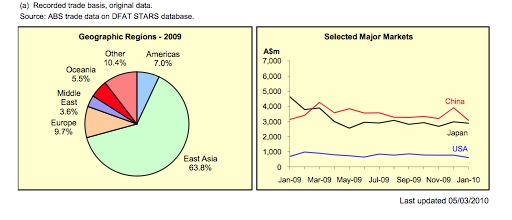
Japan is Australia’s second largest trading partner.

While China has become our largest trading partner in recent times, it is interesting to note the latest trade figures from the Department of Foreign Affairs and Trade

It seems our export trade with China has fallen sharply from Dec ’09 to Jan ’10.  And has been in slow decline since March 2009. That is a trend to watch closely.

There are many grave questions being raised about the sustainability of the China boom. And Japan’s economy is clearly in very deep trouble indeed.

So it is gross incompetence for our financial authorities – such as RBA Governor Glenn Stevens and Treasury Secretary Ken Henry – to continue to plan on our two largest trading partners being able to sustain our economy and get us out of debt in the years ahead.

China ‘Greatest Bubble In History’

18 Mar

From BusinessWeek:

China is in the midst of “the greatest bubble in history,” said James Rickards, former general counsel of hedge fund Long-Term Capital Management LP.

The Chinese central bank’s balance sheet resembles that of a hedge fund buying dollars and short-selling the yuan, said Rickards, now the senior managing director for market intelligence at McLean, Virginia-based consulting firm Omnis Inc.

“As I see it, it is the greatest bubble in history with the most massive misallocation of wealth,” Rickards said at the Asset Allocation Summit Asia 2010 organized by Terrapinn Pte in Hong Kong yesterday. China “is a bubble waiting to burst.”

Rickards joins hedge fund manager Jim Chanos, Gloom, Boom & Doom publisher Marc Faber and Harvard University professor Kenneth Rogoff in warning of a potential crash in China’s economy.

And yet, RBA Governor Glenn Stevens, Treasury Secretary Ken Henry, and their many cheerleaders in the Australian media still believe that we are all set for another China-fueled mining boom, this time to 2050.

They failed to predict the GFC (see the many links in this blog for background).  That epic failure has cost Australians literally hundreds of billions of dollars in lost retirement savings and investments in 2007-2009.

So why should we trust their judgement now?

China Biggest Worry For Markets

17 Mar

Fromt the Wall Street Journal:

Nervousness is growing in the financial markets about China, which might seem odd when there are so many other places to worry about.

There’s still Greece, for example, which is likely to be the focus of this week’s meetings of European finance ministers. There’s Germany, and its trade surplus. And there’s the U.S., the U.K. and all the other places with triple-A-rated debt that may not be rated triple-A for much longer.

So why the focus on China, where shares closed Monday at their lowest in five weeks, with the benchmark Shanghai Composite ending below 3000 at its weakest since Feb. 9? Well, as one bank put it on Monday: “Are we facing a ‘growth miracle’ or will China be the next bubble to burst?

Even the markets are more cautious on China than Australia’s financial powers, the RBA and the Treasury department. They still believe we are headed for 40 years of “unprecedented prosperity” on the back of a new China-fueled mining boom.

Europe’s Banks Brace For UK Debt Crisis

14 Mar

From the UK’s Telegraph:

UniCredit has alerted investors in a client note that Britain is at serious risk of a bond market and sterling debacle and faces even more intractable budget woes than Greece.

“I am becoming convinced that Great Britain is the next country that is going to be pummelled by investors,” said Kornelius Purps, Unicredit’s fixed income director and a leading analyst in Germany.

Mr Purps said the UK had been cushioned at first by low debt levels but the pace of deterioration has been so extreme that the country can no longer count on market tolerance.

Sound familiar?

Our economy too, was once cushioned by low debt levels. Not any more.

In my view, the only really fundamental difference between the UK’s dire economic situation and Australia’s, is this: as happens so often, with so much in Australia, we are simply running a couple of years behind on the major international trend.

The UK property bubble has already burst. Ours hasn’t … yet.  Only because the Government had cash in the bank to prop up our property bubble – and thus, our banking sector – by doubling the First Home Owners Boost.

When another wave of the GFC rolls in, we no longer have a “low debt” position to cushion the blow.

The only question seems to be, from which direction will the next wave come?  From Europe?  From the UK? From the USA? Or, from China?

China Facing ‘Massive’ Bank Bailouts

14 Mar

From Bloomberg:

China may be forced to bail out banks that made loans for local-government projects under the unprecedented stimulus program unleashed in 2008, according to Citigroup Inc. and Northwestern University’s Victor Shih.

In a “worst-case scenario,” the non-performing loans of local-government investment vehicles could climb to 2.4 trillion yuan ($350 billion) by 2011, Shen Minggao, Citigroup’s Hong Kong-based chief economist for greater China, said yesterday.

“The most likely case is that the Chinese government will engineer a massive financial bailout of the financial sector,” said Shih, a professor who spent months researching borrowing by about 8,000 local government entities.

More on the growing concerns about China’s property bubble and risks to its economy here, and here.

Design a site like this with WordPress.com
Get started