Tag Archives: RBA

RBA Says Our Banks Are Stuffed … In Other Words

29 Jun

Yesterday, RBA Assistant Governor Guy Debelle indulged in some MOPE.

Management Of Perceptions Economics.

Lies, deceit, and propaganda, in other words.

But for those with an ear to hear, and an inclination to check the “authorities'” claims, what he really did – unintentionally – was to give us a heads up.

That our Too Big To Fail banks (TBTF) are going to get bailed out, sooner rather than later.

Go grab a modest quantity of your favourite beverage, and settle in.  You are about to learn – in detail – why we cannot trust a word the banksters say.

Ready?

Now as expected, the mainstream press all lazily parrotted the “everything’s fine, move along, nothing to see here” headline that Mr Debelle wanted. Here’s a good example, from the nations’ “premier” newspaper:

Australian banks safeguarded from Greek debt crisis, says Guy Debelle

Our standards are more rigorous here at Barnaby Is Right.

Let’s critically examine what Mr Debelle actually had to say in his official Address to Conference on Systemic Risk, Basel III, Financial Stability and Regulation (emphasis added):

Today I am going to talk about a few interrelated issues concerning the banking system: collateral, funding and liquidity.

The financial crisis brought into sharp relief the liabilities side of a financial institution’s balance sheet, that is, the funding structure. This had previously been somewhat neglected, but the fates of Northern Rock, Bear and Lehmans were clearly affected by the nature of their funding. While their funding structure played a significant part in the downfall of those institutions, I would argue the ultimate concern was about the quality of their assets. The funding problems were symptomatic of concerns about asset quality.

The solvency of any bank first and foremost is a function of the quality and value of its assets. This is, of course, true of any entity, but it is particularly true for banks because of the implications asset quality has for liquidity and because of the leveraged nature of financial institutions.

The crux of my argument today is this: if I am a creditor of a bank, my due diligence should be spent mostly on assessing the asset side of the bank’s balance sheet in determining whether or not I will get repaid in full.

Exactly.

Now, in the classic British political satire Yes Minister, master of obfuscation and manipulation Sir Humphrey Appleby said that it is always best to “dispose of the difficult bit in the title; it does less harm there than in the text.”

And by beginning his speech with this quite correct and valid talk of asset quality – and then not examining those “assets” in any detail – this is the clever game that Mr Debelle has played here.

No doubt he expected that no one would actually bother to check the banks’ asset quality.  They’d just take it on presumption, and Mr Debelle’s inference, that they’re fine.  And indeed, none in the mainstream press have bothered to check.

So let us do just that, shall we? Let us assess our Australian banks’ all-important “asset quality”.

Just two days ago ( “Our Banks Racing Towards A ‘Bigger Armageddon'” ), we saw that our banks held a combined $2.68 Trillion in On-Balance Sheet “Assets” at March 2011. So $2.68 Trillion is the claimed “value” of their Assets.

Now, about Mr Debelle’s “ultimate concern”.  The all-important “quality” of those Assets.

What exactly are these bank “Assets”?

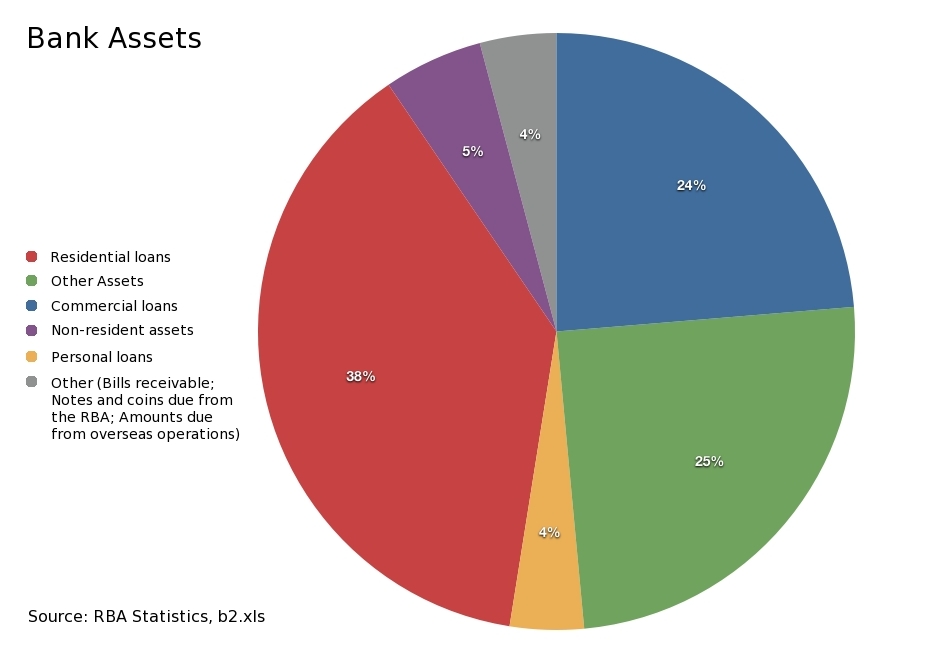
$1.76 Trillion (65.56%) of these “assets” are actually loans.

That’s right – your loan is considered the bank’s “Asset”. They own you, as their debt slave.

$1.018 Trillion (57.84%) of those loans, are Residential loans.

That’s right – fully 38% of our banks’ Total “Assets” is the notional value of their loans given as mortgages.

Here’s a chart sourced from the RBA’s own data, showing the % breakdown of our banks so-called “Assets”:
Click to enlarge

Now, in light of the recent housing-triggered banking and debt crises in the USA, UK, Ireland, Spain, and many other nations throughout the Western world; and in light of the fact that our property market is widely considered “the most overvalued in the world”; and in light of the fact that our property market has recently suffered its biggest quarterly fall in 12 years; and in light of the fact that arrears on mortgage payments have spiked to a record high, in the same quarter as house prices had a record fall … do you really think that having over 65% of your “Assets” in the form of loans, with 38% in the form of home loans, could be considered as high “asset quality”?

In light of the fact that business failures have risen 25%, with more than 10,000 going under in 2010; and in light of the fact that a leading Australian businessman has said that Eastern Australia is in “deep recession” and NSW and Victorian manufacturing is “stuffed”; and in light of the fact that the only Australian economist to predict the GFC has recently said that we will “almost certainly” be in recession in the second half of 2011 … do you really think that having 24% of your “Assets” in the form of commercial (business) loans, and 4% in the form of personal loans, could be considered as high “asset quality”?

In other words, do you really think that having over 65% of your Total “Assets” in the form of loans to households and businesses, who are all increasingly vulnerable to (eg) cost-of-living pressures, loss of employment, house price falls, and/or a recession, could be considered as having high “asset quality”?

Don’t answer that yet.

There’s more to consider.

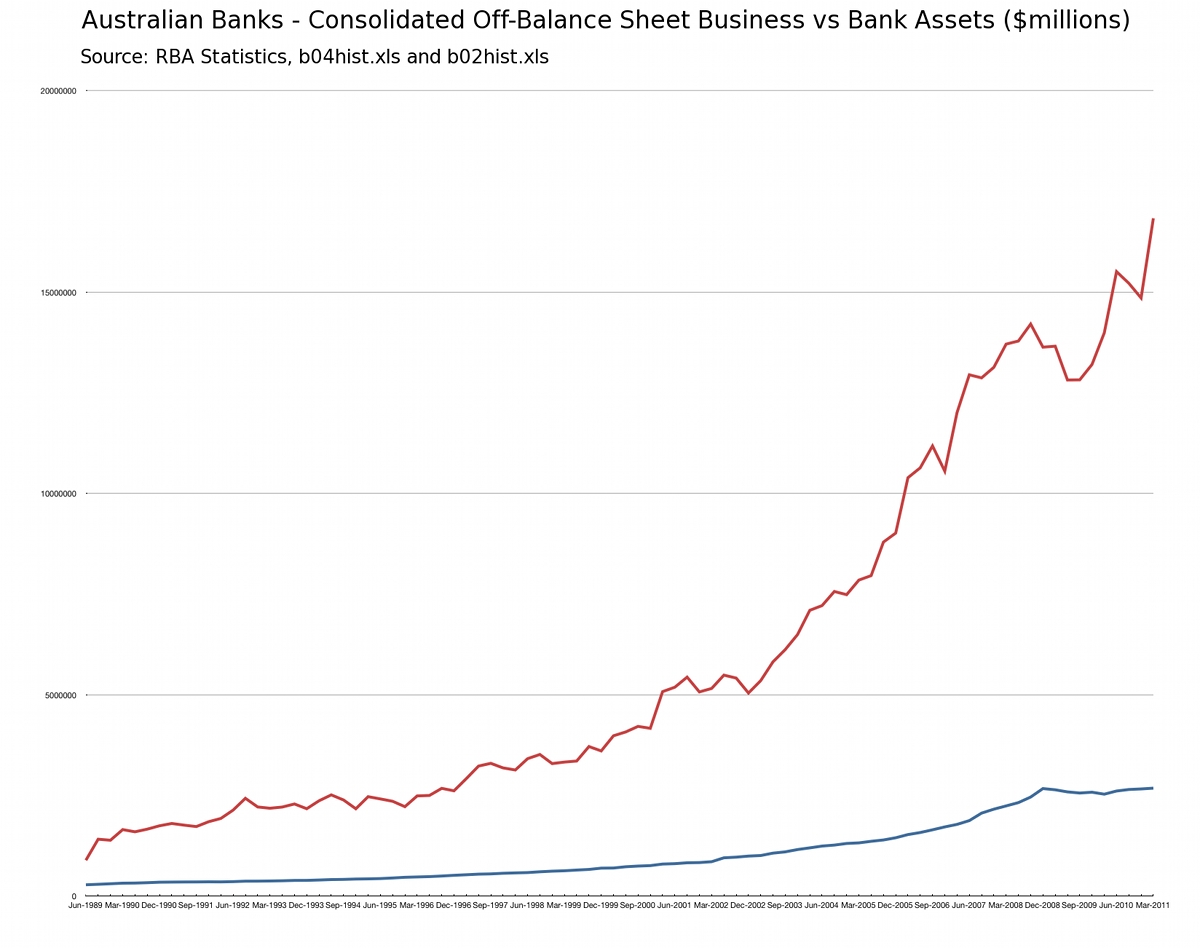
Our banks presently hold a staggering $16.83 Trillion in Off-Balance Sheet “Business”.  That’s around 15 times the value of Australia’s entire annual GDP.  And most of that Off-Balance Sheet Business, is in derivatives. The exotic financial instruments at the very heart of the GFC.  These are the instruments of intergalactic-scale gambling that the world’s most famous investor, Warren Buffet, famously called “a mega-catastrophic risk”, “financial weapons of mass destruction”, and a “time bomb”.

(They are also the reason why it is the banking industry that is pushing so hard for a CO2 trading scheme. Because for banks, it means trading in a juicy new mega-market casino, with a whole new type of “derivative” – carbon permits).

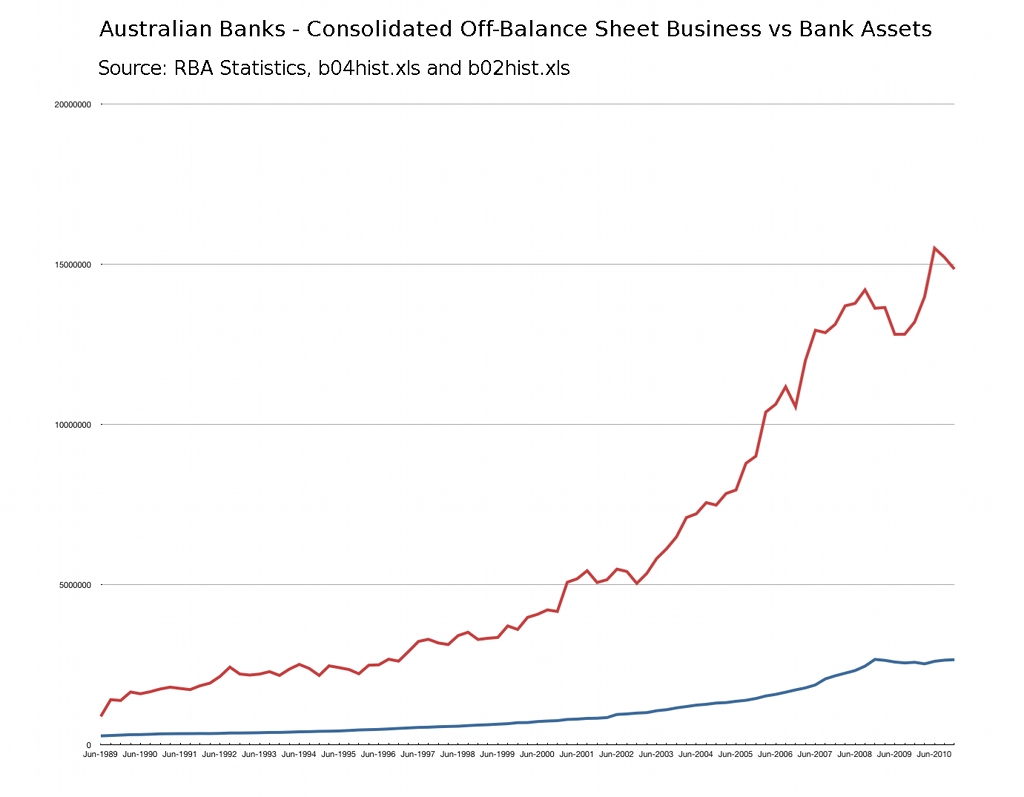
Here’s a chart of our banks’ On-Balance Sheet “Assets” (blue line), compared to their Off-Balance Sheet derivatives “Business” (red line):
Click to enlarge

But wait, there’s still more!

Just 6 days ago, we saw the global head of HSBC’s foreign exchange division warn of “a bigger Armageddon out there”, in foreign exchange markets.

And just 5 days ago, we saw a warning given by Fitch Ratings that Australia’s banks are the “most vulnerable” to Europe’s debt crisis, due to their heavy reliance on wholesale funding from abroad.

In other words, whether it be Greece, Portugal, Spain, Italy, Belgium, or any of the other massively indebted EU nations embroiled in a debt crisis, when one (or more) of them finally does go under – an inevitability – our “safe as houses” banks will go under with them:

Now, yesterday Mr Debelle contradicted the HSBC and Fitch Ratings’ warnings. While admitting that Australian banks’ reliance on funding from overseas does represent a foreign exchange risk, he argued that there is nothing to worry about.

Why? Because, quoth he, our banks’ foreign currency exposures are “fully hedged” into Australian dollars (emphasis added):

If a liquidity issue were to arise around this funding, it is of critical importance that the foreign-currency denominated funding is fully hedged into Australian dollars, which indeed it is.

Now, that critical claim is one we should all take with a crate of salt.

Here’s why.

In supposed proof of his claim that our banks’ foreign exchange exposure is “fully hedged” into Australian dollars, Mr Debelle referred (in his speech’s footnote #9) to a paper that appeared in the RBA Bulletin, December 2009.

Doubtless no one in attendance bothered to check that old paper. Certainly, not a single journalist who reported on Mr Debelle’s comments in the mainstream press bothered to check first, and then report the truth.

But I did.

In that old paper, we see that the authors did claim that our banks had their foreign exchange exposure fully hedged.

Well … sort of.

Here is what they actually wrote.  Note carefully the all-important weasel words (my emphasis added):

Summary

The 2009 survey of foreign currency exposure indicates that Australian institutions remain well hedged against the risk of sharp movements in the exchange rate. Australia’s foreign currency debt liabilities are essentially fully hedged into Australian dollars using derivative instruments…

Hardly a categoric affirmation.

And here’s the really crucial point. Mr Debelle’s referencing this paper in support of his claim is a nonsense – and thus, suspicious – simply because the data in that old paper is (obviously) now completely out-of-date!

Mr Debelle must know this.  Because the RBA publishes its own statistical data for our banks’ derivatives exposure – and their most recent data is current to 31 March 2011.

Moreover, the data used in that old paper was sourced via an ABS survey – that is, it relied on the banks honestly reporting their true positions (!?!).  And, the data was only current to 31 March 2009 – more than two years ago.

At that time, the banks’ admitted to holding a notional value of foreign exchange derivatives positions, allegedly for “hedging” purposes, totalling gross $2.802 Trillion:

Table 2: Residents’ Gross Outstanding Foreign Exchange Derivative Positions By counterparty, notional value, A$ billion, as at 31 March 2009(a)
Counterparty Long foreign currency/short AUD positions Short foreign currency/long AUD positions Net positions
(a) Positive values represent derivative positions under which the holder will receive foreign currency in exchange for Australian dollars at a predetermined exchange rate (that is, a long foreign currency/short AUD position). Negative values represent derivative positions under which the holder will receive Australian dollars in exchange for foreign currency at a predetermined exchange rate (that is, a short foreign currency/long AUD position).
Source: ABS
Resident 554 −554 0
Non-resident 991 −703 288
Total 1,545 −1,257 288

As you can see, the breakdown of our banks’ foreign exchange derivatives “positions” at March 2009, was Long foreign currency $1.545 Trillion, and Short foreign currency $1.257 Trillion.  For a net Long position of $288 Billion.

And the counterparty to that $288 Billion Long “position” (ie, gamble) was … “Non-resident”.

Now, a few important points to consider.

Firstly, these 2 year old figures did not represent solid proof of a “fully hedged” foreign exchange position.  And it certainly is not proof of that claim being true now, 27 months later, in June 2011!  Instead, what it represented was a $288 Billion Long foreign currency position, at 31 March 2009. A net $288 Billion bet that foreign currencies would improve in value, compared to the Aussie Dollar.

Secondly, why do you think Mr Debelle would seek to reassure us that our banks’ foreign exchange risk is “fully hedged”, and back his claim by reference (in the footnotes) to a 2 year old, redundant paper – just 4 days after Fitch Ratings warned of the vulnerability of our banks to foreign exchange volatility, and 5 days after the global head of HSBC foreign exchange warned of “a bigger Armageddon out there” in foreign exchange markets?

[Hint: These days it’s euphemistically – and deceitfully – called “spin”, or a “smokescreen”]

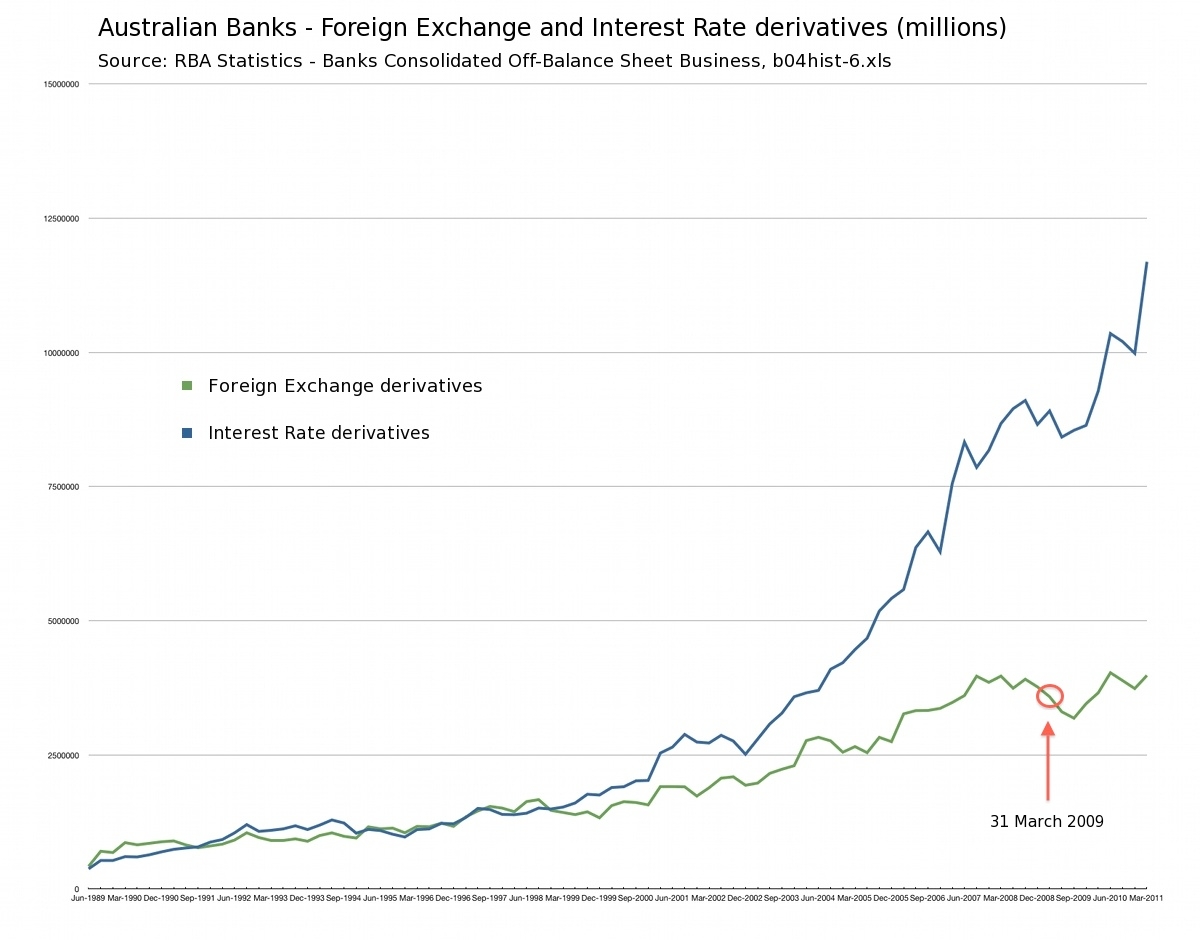
Thirdly – and perhaps most importantly – as we saw just 2 days ago, at 31 March 2011 our banks’ gross foreign exchange derivatives position has grown (blown?) from the claimed $2.80 Trillion … to $3.98 Trillion:
Click to enlarge

Let us not even bother going into the huge question marks over this.

Including very basic questions.  Such as, why did the banks report a $2.80 Trillion FX derivatives exposure to the ABS survey … when the RBA’s own statistics report that they had a $3.58 Trillion exposure at that date (see highlight in chart above). Or, the basic question of why did Mr Debelle fail to reference the current, and much larger, foreign exchange derivatives exposure of our banks.

And let us not bother going into the even bigger questions (and dire implications) over our banks’ $11.68 Trillion exposure to Interest Rate derivatives – that’s the going-parabolic blue line on the above chart.

We’ve seen more than enough to know that Mr Debelle’s belated assurances about our banks are a sham.

It is my view that Fitch Ratings’ and HSBC’s warnings are most likely closer to the real truth.

And the reality of our banks’ extreme vulnerability, due to their off-shore funding reliance, their truly staggering derivatives exposure, and perhaps above all, their poor “asset” quality, is the real reason why Mr Debelle gave the speech that he gave yesterday.

Whether he meant to or not, the simple message for the wise and prudent to take away from (the inconsistencies, lies, and deceptions in) his speech is this.

He is essentially saying, “Don’t worry folks … our banks are going to fail … but the RBA can just print money to bail them out”.

Don’t believe that printing money is what Mr Debelle was saying?

Here it is in his own words:

As I discussed earlier, an Australian dollar liquidity issue can be addressed by the Reserve Bank. The Reserve Bank can meet a temporary liquidity shortfall by lending Australian dollars against the stressed bank’s assets denominated in Australian dollars.

Where does the RBA get its dollars from, in order to “lend” support to our soon-to-be-insolvent, imploding banks?

It creates them. Out of thin air.

Click click on the mouse button. Tap tap on the keyboard.

Just like all “independent” central banks.

And then lends those dollars, at interest.

As we have seen previously ( “Our Banking System Operates With Zero Reserves” ), thanks to the way our banking system is designed, printing more money is the only thing that the RBA can do in response to a bank insolvency crisis.

And as we also saw previously, that is exactly what they did do, in the GFC.

Welcome to the Grand Opening of our Zimbabwe Experience, dear reader.

Brought to you by your friendly “independent” RBA banksters, and their Big Four cronies.

A final thought.

It is particularly interesting that Mr Debelle was effectively reassuring everyone that the RBA is able to provide “liquidity support” (ie, money) for our banks in the event of their running into trouble with their wholesale funding from abroad.

What he did not mention, is that our government – that is, we the taxpayers – has provided both explicit and implicit support for the banks through the Government Guarantee Scheme For Large Deposits And Wholesale Funding.

(Indeed, when Moody’s recently downgraded the credit rating of our Big Four banks, they made it quite clear that if these taxpayer guarantees were not there, our banks’ credit ratings would be slashed by at least another two ‘notches’)

So, if Mr Debelle is arguing/reassuring that the RBA is able to provide liquidity support for our banking system, then why is the Australian taxpayer on the hook to backstop the banks?

And why did Mr Debelle not mention this very important fact in his speech?

SNAFU.

As with anything involving the “unholy alliance of politicians and bankers versus ordinary people”, everything about this stinks to high heaven.
Our Banks Racing Towards A “Bigger Armageddon”

27 Jun

Many economists and commentators are focussed on the ongoing debt crises affecting the USA, UK, Europe, Japan, and indeed, virtually the entire globe.

But David Bloom of HSBC Foreign Exchange suggests that there is “a bigger Armageddon out there”.

And the latest RBA data shows that our banks are racing headlong into it.

From CNBC:

Investors are afraid of “Armageddon” in foreign exchange markets due to concerns beyond the Greek debt crisis and sluggish US growth, David Bloom global head of foreign exchange at HSBC told CNBC Thursday.

Bloom described the Greek sovereign debt crisis as “yesterday’s news” for foreign exchange markets, adding fresh worries were spooking investors following Federal Reserve chairman Ben Bernanke’s downgrade of US economic growth prospects for the year and his silence over further fiscal stimulus measures.

“Today’s news is will (the US) do (Quantitative Easing) and then is the UK falling apart? This is the problem that we’ve got… this is the problem that I’ve got with currencies, there’s no doubt about it that (the euro zone) is trying to cause a delay and people honestly believe in their hearts that at some stage they’re going to have to take a haircut on Greece, but is there a bigger Armageddon out there?” Bloom asked.

He added that in addition to persistent worries over the Greek crisis and the US economy, China was a fresh cause for concern.

“We’ve got the possibility of QE in the UK, there’s massive change in growth numbers in the US and now people are starting to worry about China,” he explained.

“You saw PMI numbers showing some weakness and actually Chinese interbank interest rates are going up quite substantially, so people are starting to get quite worried,” he added.

An “Armageddon” in foreign exchange markets – indeed, even just a serious bout of volatility – would spell doom for Australia’s banking system. And in turn, for our economy, given that our Government has guaranteed our banks using taxpayers future earnings as collateral.

There are a number of reasons why a forex “Armageddon” poses a critical threat to our banks.  Perhaps the primary one, is their staggeringly large exposure to Foreign Exchange and Interest Rate derivatives.

Derivatives are the exotic financial instruments at the very heart of the GFC.

Back in 2003, the world’s most well-known investor, Warren Buffet, famously called derivatives “a mega-catastrophic risk”, “financial weapons of mass destruction”, and a “time bomb”.

In essence, the type of derivatives held Off-Balance Sheet by our banks, are financial instruments used for “hedging” and betting on the direction of Interest rates, and Foreign Exchange rates. A large or unanticipated change in those rates, and our banks stand to lose.

And lose big time.

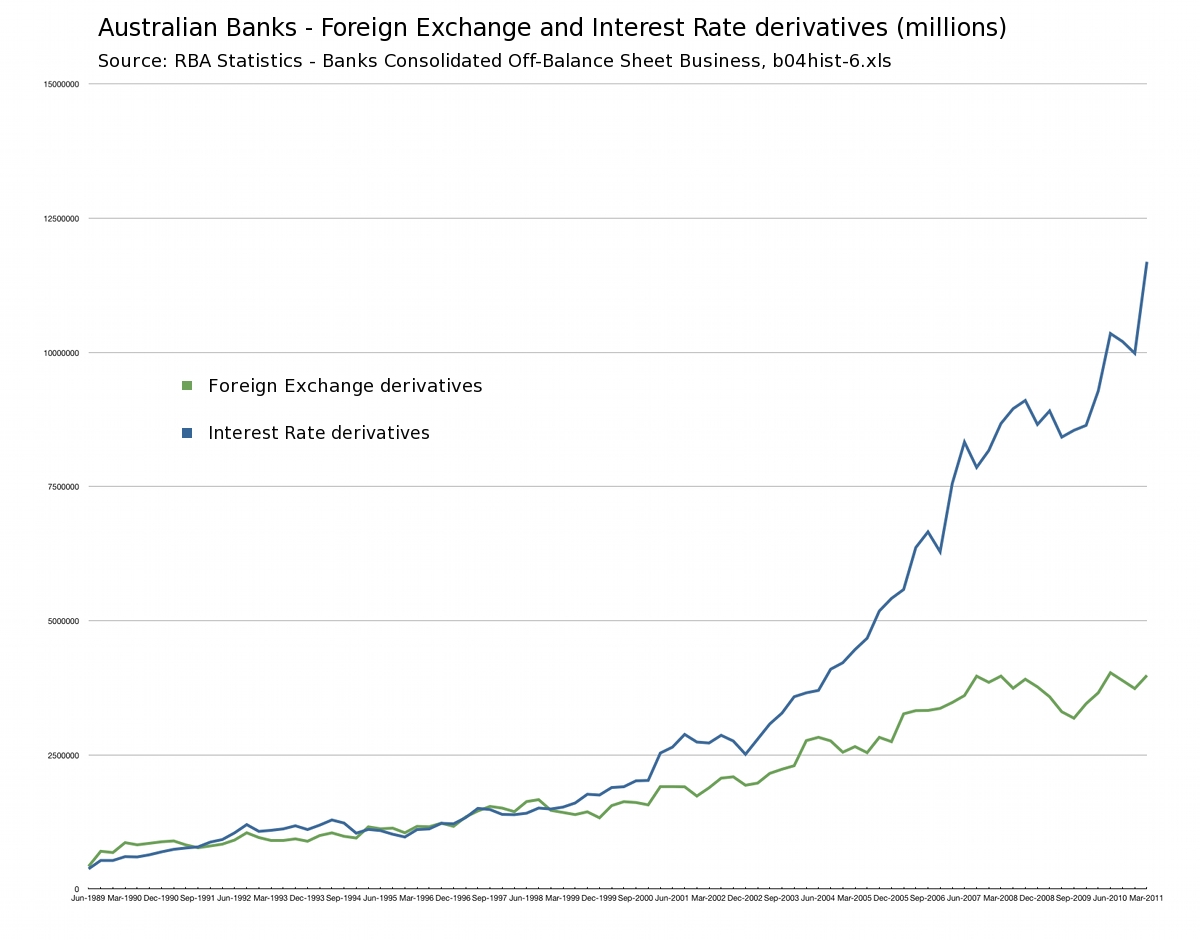
According to the RBA, our banks hold a combined $3.98 Trillion in Foreign Exchange derivatives. And a whopping $11.68 Trillion in Interest Rate derivatives.

To put that in some perspective, it is almost 15 times more than the value of Australia’s entire annual GDP:

Click to enlarge

In May ( “Tick Tick Tick – Aussie Banks’ $15 Trillion Time Bomb” ) we saw that Australia’s banks held almost $15 Trillion in Off-Balance Sheet “Business” (mostly derivatives) at December 2010.

The latest RBA figures are out, current to March 2011.

In just 3 months from December to March, our banks’ exposure to Off-Balance Sheet derivatives “Business” has blown out by a whopping $1.99 Trillion, to a new all-time record total of $16.83 Trillion.  That’s the biggest 3-month increase in our banks’ history.

By comparison, at March 2011 the banks have “only” $2.68 Trillion in On-Balance Sheet Assets. That’s an increase of “only” $19.9 Billion. In the same 3 months, their Off-Balance Sheet derivatives exposure blew out by 100 times that much ($1.99 Trillion):

Click to enlarge

You may be wondering how the banks could possibly manage to increase their “Assets” by $19.9 Billion in just 3 months. The answer? 96.4% of that increase ($19.19 Billion) is in new Residential loans.  That’s right – your loan is considered the bank’s “Asset”. Which really means, you are their asset.  Your signature on that loan document means they literally “own” you, your daily sweat and toil, for the next 30 years.

Now, does this suggest to you that our banks are becoming even more reckless? That near-parabolic rise in the chart of their derivatives exposure is approaching what looks just like the classic “blow off” phase of every trading bubble.

Certainly there is clear evidence of their becoming even more reckless when it comes to mortgage lending standards.  We saw this in data released just a couple of weeks ago – “Fresh Evidence Our Banks In ‘Race To The Bottom’ Means You Can Kiss Your Super Goodbye” (a must-read).

This is a classic sign of the near-end of a Ponzi scheme, a sign that was also seen near the end of the real estate bubbles that blew up in the USA, UK, Ireland, and Europe. The last mad rush by greedy banksters to rake in profits, before the bubble bursts.

And their losses are “socialised” by the government, on to the backs of the next X generations of taxpayers.

Now that we have learned that “Our Banking System Operates With Zero Reserves”, that Fitch Ratings considers “Australian Banks Most Vulnerable To Europe’s Debt Crisis”, and that our banks have just taken on an all-time record $1.99 Trillion in additional derivatives exposure in just 3 months, this new warning about “a bigger Armageddon” in foreign exchange markets should be considered another clear harbinger of an epic disaster to come Down Under.

Our Banking System Operates With Zero Reserves

24 Jun

At one stage, the Reserve Bank was forced to order another $4.6 billion in $100 notes. Picture: Luzio Grossi Source: The Australian

According to the US Federal Reserve’s Divisions of Research & Statistics and Monetary Affairs, Australia’s banking system has no monetary reserves.

None.

In a Finance and Economic Discussion Series paper titled “Reserve Requirement Systems in OECD Countries”, researcher Yueh-Yun C. OBrien explains (emphasis added):

Abstract: This paper compares the reserve requirements of OECD countries. Reserve requirements are the minimum percentages or amounts of liabilities that depository institutions are required to keep in cash or as deposits with their central banks. To facilitate monetary policy implementation, twenty-four of the thirty OECD countries impose reserve requirements to influence their banking systems’ demand for liquidity.

Note that well. Only “twenty-four of the thirty OECD countries impose reserve requirements”.

Introduction: Central banks by definition are the sole issuers of “central bank money,” which consists of banknotes and deposit balances held by depository institutions at central banks. This feature provides them the power to implement monetary policy by influencing liquidity in their banking systems in order to achieve their policy (interest rate) targets and thus promote their long-term objectives.

That’s very important to note. Our central bank has ultimate power over the issuance of “central bank money” – the only “money” permitted – in our nation. Discussion of which is to open Pandora’s Box, so we’ll return to that topic another day.

Reserve requirements are the minimum percentages or amounts of liabilities that depository institutions are required to keep on hand in cash (vault cash) or as deposits with their central banks (required reserve balances).

Ok so far?

Twenty-four of the thirty countries that belong to the Organization for Economic Co- operation and Development (OECD) employ reserve requirement systems…

The remaining six OECD countries implement monetary policy without reserve requirements.4

Footnote 4 goes on to explain who those six countries are …

4 The six countries consist of Australia, Canada, Denmark, New Zealand, Norway, and Sweden.

… and then explains how our banking system operates, vis-a-vis the absence of any monetary reserves:

The central banks of these six countries make interbank payment settlement accounts available to depository institutions subject to certain rules. They provide standing facilities with interest charges and the lending interest rate sets an upper bound on the market interest rate. These central banks also pay interest on end-of-day account surpluses, and that interest rate forms a lower bound on the market rate Thus, lending and deposit rates form a corridor for the target overnight interest rate.

In addition to imposing rules for settlement accounts and providing standing facilities, most of these central banks influence the aggregated settlement balances in the banking systems mainly through open market operations.

Here’s a flow chart helpfully provided by the researcher. It shows (on the left) the monetary Reserve Requirement system used in 24 of 30 OECD countries.

Australia’s “no monetary reserves” banking system is circled on the right (click to enlarge):

Source: US Federal Reserve, FEDS, Reserve Requirement Systems in OECD Countries

Now, it’s very important to make a clear distinction here.  We need to remember that there are actually two basic concepts of what a banking “reserve” actually is.

One is “monetary reserves” … that’s what the US Fed’s paper we are discussing is all about.

The other is “capital reserves”.

Now, Australia’s banking system does have capital reserves.  It is a condition of Australia’s decision (January 2008) to adopt the Basel II Capital Adequacy framework. It is regulated in Australia by the Australian Prudential Regulation Authority (APRA), under Prudential Standard APS 110 Capital Adequacy.

So if our banks have capital reserves, does that mean everything is ok?

Not if you are a customer with a cash deposit in the bank.

The problem here is this.

Capital reserves relate to the question of the banks’ capacity to absorb investment losses.  It is a kind of reserve that is meant to protect shareholders in the bank, against the bank making losses on its investments. That is why the capital reserve requirement is essentially composed of a % of shareholder funds, that are held against the value of the banks’ “risk-weighted assets”.

Monetary reserves, on the other hand, relate more directly to the question of the banking system’s capacity to absorb a run on customer deposits.  That is, a good old fashioned bank run, where people lose confidence in the safety of the bank/s, and try to withdraw their cash … en masse.

In the twenty-four OECD countries that do have monetary Reserve Requirements, the banks are required to hold a certain amount of their customers’ cash deposits as reserves against customers’ withdrawals.

In the six countries – including Australia – that have zero monetary Reserve Requirements, essentially the central bank is the ultimate backstop.

Meaning?

If too many of us decide to go to the bank at the same time, and ask for our money on deposit – they don’t have it.

This helps to explain why, during the GFC’s Peak Fear period in late 2008, the Reserve Bank of Australia had to supply billions in extra cash to our banks.

The following quotation is slightly lengthy, but truly a must-read if you wish to gain a rare insight into what really went on behind the scenes during the GFC.

From Shitstorm, edited extract via The Australian (emphasis added):

Ian Harper, one of Australia’s leading financial economists, spent much of the weekend of October 11-12, 2008, reassuring journalists that Australian banks were safe.

Harper was an expert: he had been a member of the Stan Wallis financial inquiry in the mid-1990s, which had designed the system of banking regulation.

He explained that the Australian Prudential Regulation Authority already required banks to keep enough capital to cover any likely level of bad debts*. More importantly, the banking legislation provided that, if a bank failed, depositors would rank ahead of all other creditors. There was absolutely no reason for concern.

[*Note carefully what we observed above – the Basel II rules for “capital reserves” are to cover bad debts – investments gone bad. Not a bank run by customers wanting their cash deposits.]

But there was something about the calls Harper was getting from reporters over that weekend that worried him.

“There was a whiff of panic,” he recalls. It had been building all week. He had no doubt that the government and the Reserve Bank would be able to manage a run on cash, but it might take days to arrest. Panic has been an unpredictable force in the history of banking. And the instant world of electronic banking had never been tested with a full-scale crisis of confidence.

He talked about media calls with his wife. “Come Monday morning and they tell us one of the banks is in strife and internet banking is down, I can’t look you in the eye and say you can pay this week’s grocery bills.”

The man who had just been reassuring everyone there was nothing to worry about went down the street to the ATM and made a sizeable withdrawal to make sure his wife would have enough cash.

All around the country, banks were facing unusual demands for cash. Small businesses in Queensland and Western Australia were switching their deposits from regional banks to accounts with the big four banks.

An elderly woman turned up in the branch of one bank in Queensland with a suitcase and asked to withdraw her term deposits of $100,000 or more. Once filled, she took the suitcase down to the other end of the counter and asked that it be kept in the bank’s safe.

A story did the rounds of the regulators about a customer who wanted to withdraw his six-figure savings. The branch manager said he did not have that quantity of cash on hand, but offered a bank cheque, which the customer accepted, apparently unaware that the cheque was no safer than the bank writing it.

It was a silent run, unnoticed by the media. Across the country, at least tens and possibly hundreds of thousands of depositors were withdrawing their funds. Left unchecked, there would soon be queues in the street with police managing crowd control, as occurred in London at the Golders Green branch of Northern Rock a year earlier.

“With a bank run, or any rumour of a bank run, you can’t play games with that,” says Treasury Secretary Ken Henry.

“You can’t pussyfoot around that stuff. It’s a long time since Australia has had a serious run on a financial institution, but it’s all about confidence, and you cannot allow an impression to develop generally in the public that there is any risk.”

[In other words, when it comes to our savings, the notion of bank “safety” is a con-fidence trick. It is as simple, and as shocking, as that.]

The private banks keep reserves of cash distributed in 60 storerooms across the country with an average of about $35 million in each. They get topped up by the Reserve Bank before Christmas, when demand for cash typically rises by about 6 per cent, and at Easter, when there is a smaller increase.

But in early October, the Reserve Bank started getting calls from the cash centres for more, especially in denominations of $50 and $100.

The Reserve Bank has its own cash stash. It is coy about exactly how much it holds, but it is understood to be in the region of $4 billion to $5bn.

As the Armaguard vans worked overtime ferrying bundles of $10,000 out to the cash centres, the Reserve Bank’s strategic reserve holdings of $50 and $100 notes started to run low and the call went out to the printer for more. The Reserve Bank ordered another $4.6bn in $100s and another $6bn in $50s…

Households pulled about $5.5bn out of their banks in the 10 weeks between US financial house Lehman Brothers going broke – the onset of the global financial crisis – and the beginning of December. That is roughly 80 tonnes of cash salted away in people’s homes. Mattress Bank is doing well, was the view at the Reserve. A year later, only $1.5bn had been put back.

Think about those numbers for a moment.

Very carefully.

Households pulled “about $5.5bn out of their banks” in 10 weeks.

According to the ABS, at December 2008 there were 10.916 million employed persons in Australia.

So, our quiet run on the banks, a silent mass withdrawal demand amounting to a mere $504 cash per employed Aussie, was more than our banks actually had.

Forcing the Reserve Bank to print up an extra $10.6bn – that’s $971 per employed person – to keep our banks liquid and able to feed the ATM’s.

Really think about that for a moment.

Our banks did not have enough cash money to give every employed Australian a mere $504 in cash, on demand.

And yet, lemming-like, we accept their making multi-billion profits for executives and shareholders, every year.

If that’s not enough to crease your brow with concern, then consider this.

The fact that our banking system operates with zero monetary reserves may also help to explain why the RBA secretly borrowed US$53bn (around AU$88bn at the time) from the US Federal Reserve during the GFC panic (emphasis added):

National Australia Bank Ltd, Westpac Banking Corp Ltd and the Reserve Bank of Australia (RBA) were all recipients of emergency funds from the US Federal Reserve during the global financial crisis, according to media reports.

Data released by the Fed shows the RBA borrowed $US53 billion in 10 separate transactions during the financial crisis, which compares to the European Central Bank’s 271 transactions, according to a report in The Australian Financial Review.

NAB borrowed $US4.5 billion, and a New York-based entity owned by Westpac borrowed $US1 billion, according to The Age.

The RBA is all too aware of this critical danger to our financial system.

Consider this, from The Australian in July 2008, a couple of months before the GFC peaked (emphasis added):

The Reserve Bank of Australia has a dark worry about our banks: they get 90 per cent of their cash from each other. If one bank gets into trouble, the Australian financial system could be snap-frozen overnight.

This concern was laid out by the RBA’s assistant governor for the financial system, Philip Lowe, and the chief manager of domestic markets, Jonathan Kearns, to a private RBA gathering at Kirribilli House in Sydney last week.

Banking systems of other countries do not have the same level of mutual dependency, they claim, and it was not the case in Australia until about eight years ago…

Australia’s banks are, as the RBA governor Glenn Stevens tirelessly says, in great shape. Stockbrokers agree, even as they field the sell orders from overseas clients.

“The banks are trading at 12 or 13-year lows in terms of their price-to-earnings ratios,” UBS equities strategist David Cassidy says.

“Given what is happening in the US, they can always trade more cheaply. But since our economy still looks on track for a soft landing, it looks like they’ve been way oversold.”

But it does not look that way from abroad. At a recent conference held by one of the world’s largest banks, the Australian banking system was identified as one of the best investment opportunities, for going short.

The argument is that Australia’s banks hold more of their assets in mortgages than banks elsewhere and Australia’s housing is more overvalued relative to average earnings than the US housing market at its peak, or the British, Irish or Spanish markets.

This will ring alarm bells for regular readers.  All this was said – in a private RBA gathering – before the GFC really hit.  And yet, nothing has changed regarding our banking systemic risk.

We have seen previously that Australia’s banks (allegedly) hold some $2.66 Trillion in On-Balance Sheet “Assets” between them.

But, 66% of those “assets” are actually loans.  And the highest proportion of those loans are for mortgages.  In a property market where house prices “are the most overvalued in the world” – and where those prices have just had their biggest quarterly slump in 12 years. And where arrears on mortgages have recently exceeded their GFC highs.

A fall in the property market, or a rise in unemployment putting even more mortgage-holders into arrears, are real risks that could wipe out the value of the banks’ “assets” – our loans, and the “collateral” backing those loans (our houses).

In fact, that is just what happened – very briefly – during the GFC.  Mortgage arrears began to rise as the RBA kept increasing interest rates into the teeth of the storm.  Our property market began to fall.  Unemployment began to rise.  The banks’ usual lifeblood – borrowing money from overseas to lend to Australians at a profit – had already begun to freeze up due to the dark woes abroad.  And so, our banks had to borrow tens of billions from the RBA using what are called “repos” – short term cash loans from the RBA, secured against banks’ collateral.

Estimable blogger Houses and Holes documented this in a September 2010 post aptly titled “Invisopower!”. The following chart is his work. It graphs the value of repos borrowed by our banks from 2004 through 2010. You can clearly see that our banks were regularly borrowing over $15 Billion per month throughout 2008, with a peak of almost $50 Billion per month during the height of the GFC in late 2008.  Just to stay solvent. This massive liquidity support from the RBA only ended when the Government put taxpayers on the hook by introducing the government (taxpayer) guarantee to prop up our banking system:

Now, some may try to argue that Australia’s banks having “capital reserves” under the Basel II banking concord means that our banks have plenty of cash, and so retail customers with bank deposits – you and me – have nothing to worry about.

As we have seen, the real world events of late 2008 decry any such attempts at reassurance, as pure and utter nonsense.

A Big Lie.

More tellingly, there is evidence to show that the bankers themselves do not consider their APRA-regulated “capital reserves” as being available to provide retail customers with their own cash back, in the event of a bank run.

Following is a quote taken from a letter to the Australian Treasury, from the Australian Bankers Association in December 2006.  The letter relates to new “draft regulation 7.602AAA designed to reach a balance between consumer protection and the cost to businesses in relation to mandatory compensation arrangements under Chapter 7 of the Corporations Act 2001” (emphasis added):

Regulation for Compensation for loss in the Financial Services Sector

For related entities that are not APRA regulated entities it should be noted that APRA supervises the capital adequacy of a locally incorporated ADI on both a stand-alone and consolidated group basis (see AGN 110.1 – Consolidated Group, paragraph 1). It follows that account has been taken of the ADIs related entities for the purposes of the capitalisation of the ADI. Whilst these capital reserves are not available for use in a related entity’s compensating a retail customer for loss, their mere existence mitigates the risk that the related entity within the conglomerate would lack the capacity to meet that compensation claim. It is understood that these rules do not apply to all other APRA regulated bodies suggesting that a distinction should be made in the case of ADIs by removing the requirement for a guarantee in their case.

The context here is the issue of banks and their “related entities”.  A draft regulation proposed a requirement for banks to guarantee their related entities.  In lobbying to change this (!?!), the Bankers Association stated that “the requirement for the parent to provide its guarantee of the related entity’s obligations should be removed” or “clarified to confine the limit of the propose guarantee.”

In other words, we do not want to guarantee our “related entities” against losses.

And the basis for the Bankers Association argument was truly astonishing.  And very revealing.

In essence, their argument was that, even though capital reserves “are not available for use” in compensating retail customers for loss, “their mere existence mitigates the risk that the related entity… would lack the capacity to meet a claim”.

This is no different to saying, “We have money that can not be used to compensate retail customers, but you should just pretend that it can.”

Banking is a pea-and-thimble trick.  “Our” cash, that we are led to believe is really there under the banksters’ thimble, just isn’t.

The claim that Australia’s banks are “the safest in the world” is quite simply, a monstrous lie.

Like all government-approved banking systems, Australia’s banking system too is nothing more than a Ponzi scheme.

A huge con-fidence trick.

Backstopped by the so-called “independent” Reserve Bank of Australia.

And, by the taxpayers of Australia … thanks to the Labor government’s Guarantee Scheme for Large Deposits and Wholesale Funding.

Just as in the USA, UK, Ireland, Spain, and elsewhere in Europe, when our housing market collapses – taking our banks solvency with it – you already know what is going to happen.

The banks will be bailed out. By our government, who will borrow the “necessary” bailout billions against ours and our children’s children’s future taxes.

In the good times, banks profits are privatised – massive salaries, bonuses, perks and parties.

And when it all goes bad – as every Ponzi scheme must – their losses are socialised.

In my firm view, the concept of “banking” and “money” as practiced by government decree throughout the world, is arguably the greatest evil afflicting the entire human race, and impeding human progress.

Banking is a vile parasite on the human host. It must be abolished, and replaced with something better. A system whereby “money” is rendered a true servant of humanity … never again to be our master.

I know how this can be achieved. But that vision must wait for another day, and another post.

For now, just remember the Moral of the Story today.

Ignore all the “con-fidence” building reassurances spruiked to the public by our politicians, regulators, and so-called banking “experts”.

Instead, use your commonsense, and follow the advice that Australian banking system design “expert” Ian Harper gave to his own wife in the GFC:

“Come Monday morning and they tell us one of the banks is in strife and internet banking is down, I can’t look you in the eye and say you can pay this week’s grocery bills.”

The man who had just been reassuring everyone there was nothing to worry about went down the street to the ATM and made a sizeable withdrawal to make sure his wife would have enough cash.

RBA Officials Have Vested Interest In Fate Of Aussie Real Estate

23 Jun

From Business Spectator, September 20, 2010:

According to a recent report by Goldman Sachs chief economist, Tim Toohey, household debt levels in Australia now stand at an elevated level, both in relation to historic norms, and compared to other countries. For instance, Australia’s debt to household income ratio is higher than in the United States and Spain, and stands at a similar level to the United Kingdom.

Toohey has written a perceptive report on the Australian housing market, in which he argues that housing prices are between 25-35 per cent overvalued. As a result, he says, we run the risk that Australia’s house prices could drop sharply if a sharp decline in Chinese growth prompted a steep drop in our export earnings.

Interestingly, it appears that Reserve Bank officials are the keenest investors in rental properties. “We are not sure whether to be relieved or concerned that of the five central bankers who were brave enough to note their occupation on their tax form, all five had an investment property!”, the report says. “Of the 200 occupations classified by the Australian Tax Office, the employees at the Reserve Bank topped the list with respect to their investment property exposure.”

There’s more than one way to look at this very interesting revelation.

1. The “independent” RBA has a vested interest in fuelling Australia’s property bubble – which helps to explain the low interest rate policies of the early 2000’s that so helped to encourage excessive borrowing and real estate speculation.

2. The “independent” RBA has a vested interest in keeping the property bubble afloat – so that RBA officials do not suffer capital losses on their existing property portfolios.

3. My favourite.  The “independent” RBA has a vested interest in first fuelling a property bubble with low interest rates – meaning officials make profits on the way up – and then, collapsing the property bubble at a time of their choosing (by raising interest rates), so that officials can buy in to the property market again (and buy up even more), after prices have fallen dramatically.

One can only wonder about the investments of “independent” RBA Governor, Glenn “$234k Pay Rise At GFC Peak” Stevens.  Has he profited from his Board’s decisions on interest rates? Will he personally profit by (again) raising interest rates into the teeth of an onrushing GFC 2.0?

Next time you hear an RBA official like Stevens talking about interest rates, or the housing market, just remember this article.

And remember that, whatever happens to the housing market, it is those same “independent” RBA officials who know what is going to happen… before you do.

Guest Post – Our Government Debt Crisis Is Already Here

21 Jun

Submitted by reader JMD.
A follow up to “Why The RBA Sold Our Gold

In my previous article I expressed the view that the RBA gold sales in 1997 were to extinguish a portion of the large amount of Australian government debt outstanding at the time of the Asian Financial Crisis.

The government was forced to extinguish debt rather than roll it over – (ie) issue new debt – or suffer significant devaluation of the Australian dollar, a ‘sovereign debt crisis’ if you will, as occurred in several nations to our north at the time.

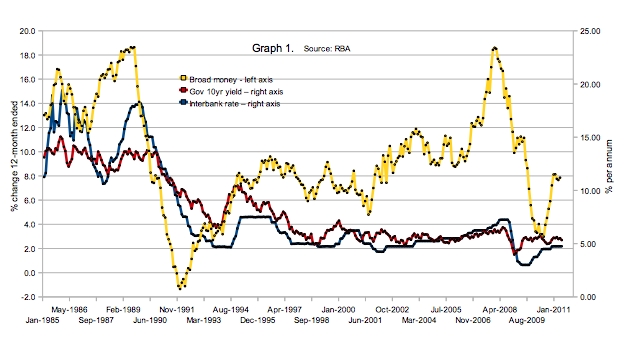
Graph 1. shows how the central bank moves the interbank rate with the growth, or lack thereof, Broad Money, the broadest measure of financial system credit. A falling trend in Broad Money is generally equivalent to widening credit spreads, a falling (or flailing) stockmarket, higher government bond prices, bankruptcies…. in other words, a debt crisis or economic recession.

Click to enlarge

As credit spreads widen the central bank lowers its ‘target’ rate in an attempt to bring rates down across the spectrum, from junk to ‘AA’ bank debt. Government debt of longer duration is moving along with the shorter term debt. I’m speculating here but the long term trend in the 10yr yield may be an arbitrage or ‘risk free’ profit for those borrowing short & lending long. In keeping short term rates low, central banks provide all the ‘liquidity’ the financial system requires and this ‘liquidity’ is used to ‘bid up’ longer term debt, thus long term yields are generally falling in tandem with short term yields. The ‘profit’ is the spread between short and long term yields.

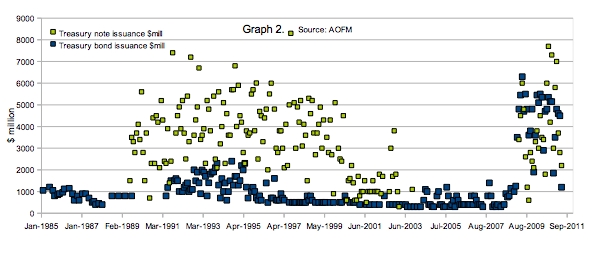
Graph 2. is the monthly issuance of Treasury notes1 and bonds, to show the response of government to debt crises. If you read my previous article you know the end result of government responses and I am gobsmacked at the current level of debt outstanding, it’s not as if it is any more likely to be repaid than in 1997.

Click to enlarge

One thing to note is the 10yr yield around the time of the Asian Financial Crisis in 1997. There is nothing that would indicate problems in the government bond market, in fact just the opposite, the 10yr yield was more or less falling throughout that period.

I think that those looking for a rise in interest rates to signify the beginning of a crisis are looking in the wrong direction. The crisis is already here, has been for some time & is reflected in the price of the only extinguisher, thus arbiter, of all (including if not especially, government) debt……gold.

Note: 1. Data for Treasury note issuance is not available pre June 1989.

Disclaimer: The views expressed in the above article are the author’s own. They should not be interpreted as reflecting any views held by Senator Barnaby Joyce, The Nationals, or by the barnabyisright.com blog author.

Final Proof That RBA Governor Glenn Stevens Is Either A Liar, Or A Blithering Idiot

13 Jun

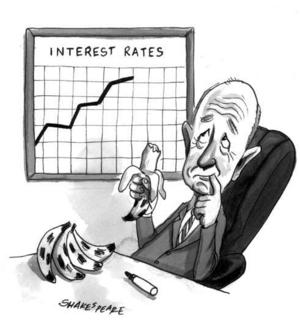
Illustration - John Shakespeare

Reserve Bank of Australia Governor Glenn Stevens has been criticised at this blog previously:

Stevens’ Nonchalance ‘Stunning’

Stevens: ‘Risk Of Serious Contraction’ Passed

Stevens’ Australia’s Most Useless?

Now, conclusive proof that our Guv’na … who earns $1.05 million per annum, including a $234,000 pay rise at the peak of the GFC … is an ignorant, incompetent, ivory-towered #JAFA who should be sacked immediately, if not sooner.

From the RBA’s own website, behold! Stevens’ official speech to the Australian Business Economists Annual Dinner, Sydney, 9 December 2008.  That’s right around the time that you, dear reader, were cr@pping yourself about the imploding global sharemarket … and he was enjoying a $234,000 pay rise.

Let’s see what he had to say about the Global Financial Crisis, and the events leading to it (emphasis added):

Many people have said to me recently that the times are ‘interesting’. My response has been that they are, perhaps, a little too interesting. I need not remind this audience of the international financial turmoil through which we have lived over the past almost year and a half, nor of the intensity of the events since mid September this year, in particular.

I do not know anyone who predicted this course of events. This should give us cause to reflect on how hard a job it is to make genuinely useful forecasts. What we have seen is truly a ‘tail’ outcome – the kind of outcome that the routine forecasting process never predicts.

Mr Stevens, you are either a liar.

Or, you are a blithering idiot.

Here’s a paper referencing more than a dozen international economists who all predicted and forewarned of the GFC for years in advance, and propounded cogent analyses as to why a GFC was coming. One of them, Australia’s own Dr Steve Keen, won an award voted on by his international economic peers for having done so:

This paper presents evidence that accounting (or flow-of-fund) macroeconomic models helped anticipate the credit crisis and economic recession. Equilibrium models ubiquitous in mainstream policy and research did not.

[* So is it any wonder then, that our much-ridiculed accountant in the Parliament, Senator Barnaby Joyce, is always the only one on the ball when it comes to correctly predicting the risks of what is coming?]

Indeed, here’s Dr Keen on our national broadcaster’s premier political program, The 7:30 Report, way back in November 2007 – 10 months before the Lehman Bro’s collapse kicked off the GFC main event – talking about the RBA’s latest interest rate increase, and warning of the dangers of high household debt levels:

So right there is one prominent Australian economist, who was loudly and very publicly forewarning of a coming GFC. For 3 years prior!

Indeed, lots of other, ordinary people like me saw the GFC coming too, and so were able to protect themselves from the financial devastation.

Devastation that you, Mr Stevens, somehow could not see coming.

You say, “I do not know anyone who predicted this course of events”.

Well mate, our taxes say it’s your #&^%! $1.05 million job to know!

Millions of good, decent, trusting Aussies lost hundreds of billions from their retirement savings, thanks to a GFC that jumped-up, mainstream-theory-blinkered imbeciles like you couldn’t see coming.  When so many others – little people, with simple commonsense – did.

You are a national disgrace. And your Million Dollar Man salary, a despicable waste of taxpayers money.

Sack Glenn Stevens now.

Guest Post – Why The RBA Sold Our Gold

31 May

Submitted by reader JMD.
A follow up to “The ‘Moneyness’ Of Debt

During 1997 the Australian government, through the central bank (RBA), ‘sold’ some two-thirds of Australia’s gold reserves. The official version of events goes that since gold is no longer important to the international monetary system, the central bank no longer needs to hold it as an asset against its liabilities, there are much better assets to hold, ones that even pay interest!1  And certainly, gold is not money now, even if it was in the olden days.

On the other hand there are many who believe that central bank gold sales – not just Australia’s – were the deliberate policy of faceless bankers to suppress the price of gold. I think that the reality is better described by applying the central tenet of the Gold Standard Institute, that money is what extinguishes all debt, which, owing to the fact that governments’ and their central bank obligations are irredeemable debt, they cannot possibly extinguish debt, which makes gold the only true money. Which means that central bank gold sales were nothing more than extinguishing debt.

Who’s debt? Ours.

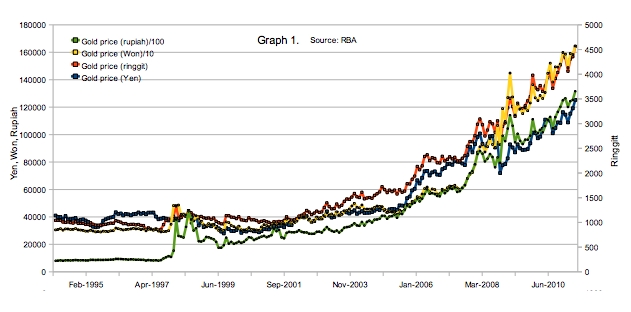
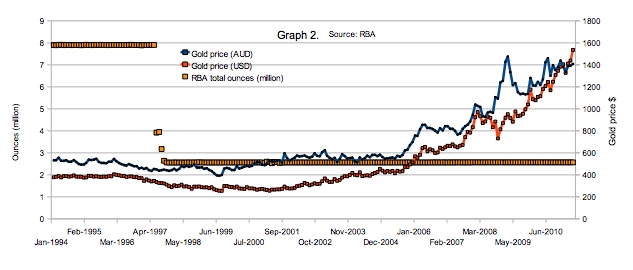
As graphs 1. & 2. show, RBA gold sales were about the time of the Asian Financial Crisis.

Coincidence? Maybe but I doubt it (click images to enlarge):

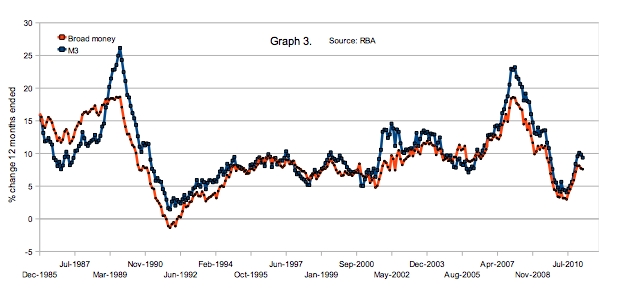
Graph 3. gives the percentage change 12 months ended of M3 and Broad Money, two measures of the growth of system credit, or, the money market. From graph 4. it is clear that the increased issuance of government debt2 is a response to rapidly declining credit growth, or, economic recession. Note the peak in total holdings of government debt in 1997, about the time of the Asian Financial Crisis.

During the crisis, governments’ of the nations affected were unable to simply issue more irredeemable obligations to assuage their creditors. At its low point the Indonesian rupiah had fallen by 86% against the US dollar3 and civil strife was prevalent throughout the archipelago. In desperation Thailand even encouraged people to hand over their gold jewellery to be melted down to boost the central banks’ reserves3. In in least one case – the Solomon Islands – the no doubt weaker credit of the government failed entirely. The Solomon Islands descended into a state of murder and mayhem from – you guessed it – 1997 through to 2003. The Solomon Islands dollar was devalued by 20% in December 1997 alone.

Considering the outstanding level of Australian government debt at the time, I think it likely that the Australian government was forced to extinguish a portion of its debt, rather than roll it over – issue new debt – or face a significant devaluation of the Australian dollar (AUD), with any attendant social consequences. It did this with the only commodity that can extinguish government debt, true money…. gold. Like many Asian currencies, the AUD did depreciate against the USD from….1997. So the government did not ‘sell’ its gold at all, rather it redeemed part of its financial obligations.

The USD gold price did not rise in 1997 but rather fell, albeit slowly, until 2001. There was no financial crisis in the US in 1997 thus no pressing need to extinguish US government debt. Instead the US financial crisis began a few years later in 2001 and continues to this day, along with every other nation. In fact only the other day I read of civil strife in Indonesia, reminiscent of 1997 onwards.

Looking at the current level of outstanding government debt, it seems the Treasury has forgotten any lessons given by the Asian Financial Crisis and looking at the current gold reserves of the RBA, I have to ask, where’s the gold going to come from next time?

Notes:

1. This explanation conveniently ignores the fact that the RBA had been loaning its gold reserves, according to the Australian Bureau of Statistics, since 1986. These gold loans of course accrue interest.

2. Data for Treasury note issuance is not available pre June 1989.

3. From The Economist

Disclaimer: The views expressed in the above article are the author’s own. They should not be interpreted as reflecting any views held by Senator Barnaby Joyce, The Nationals, or by the barnabyisright.com blog author.

RBA Screws Up Again, Loses $6bn

19 May

From The Australian:

The RBA faces losses of $6 billion due to the strength of the dollar and will not pay dividends to the government for several years.

The value of the bank’s foreign exchange reserves has plunged since the end of the last financial year as the Australian dollar has emerged as one of the strongest currencies in the world.

The losses threaten to wipe out the bank’s $6.1bn reserve fund, which the board said last year was already below a level they thought “desirable”.

Although government sources indicated yesterday that Treasury did not expect it would be required to make a capital injection, the losses will slash more than half the bank’s capital base.

The commonwealth budget has traditionally relied upon about $1.4bn a year in dividend payments from the Reserve Bank.

The Reserve Bank flagged that after it made a $2.2bn loss last year, dividends would be reduced while its reserve fund was rebuilt, but it is unlikely now that there will be any dividends across the budget forward estimates.

Great.

Another multi-billion dollar black hole in the government’s “forward estimates”.

This time, thanks to the RBA’s incompetence.

This latest news follows another revelation recently, that the RBA needed US$53bn in emergency loans from the US Federal Reserve during the GFC.

Now consider.

The “independent” RBA is worshipped by our politicians and the media – and thus, by average Australians too – as some kind of ultimate authority on our economy. In particular, the RBA is regarded as the final authority on what is the “right setting” for interest rates.

The reality is, the RBA robs us by stealth.  For decades, the RBA has utterly failed to achieve their very first legal duty to the Australian people.

Their own data proves it.

In addition, RBA Governor Glenn Stevens failed to foresee the on-rushing GFC during 2008.

The RBA kept raising interest rates month after month in 2007-08.  Right into the teeth of the GFC storm.  Despite clear warning signs out of the USA for well over a year prior.

It could also be argued that the RBA’s actions directly contributed to a change of government, thanks to an unprecedented interest rate rise in the middle of the 2007 election campaign.

Stevens is by far the highest paid “public servant” in Australia.  Conveniently for him, the RBA Board has the power to decide their own salaries:

The Remuneration Committee is a committee of the Reserve Bank Board. Its membership is drawn from the non-executive members of the Reserve Bank Board.

Which helps explain why Stevens is pulling over $1 million per annum.  And why he was able to get away with taking a $234,000 pay rise in the middle of the GFC.

The RBA’s failures are manifest.

So, why do we continue to prostrate ourselves at the Altar of the Reserve Bank?

The RBA has been robbing Australia blind for decades.

They have proven themselves unable to foresee clear economic warning signs.

They did not disclose to anyone that they borrowed US$53 Billion from the Federal Reserve.  It took a US Supreme Court action forcing the US Fed to reveal information about its actions during the GFC, for us to learn about the RBA’s secret emergency loans.

And despite being supposed “experts” on interest rates and currencies, they’ve now managed to blow $6 billion in foreign exchange losses.

How is this possible?

Our main street banks manage to hedge against foreign exchange rate volatility through purchasing Foreign Exchange Swaps & Forwards. Is the RBA too incompetent to manage FX risk, in the same way the Big 4 banks manage to do?

The RBA Board of “experts” are hugely overpaid, demonstrated failures.

Worse, as an “independent” body, they are effectively unaccountable to the Australian people for anything they do.

Now, we have the green lobby arguing for an “independent” Carbon Bank modelled along similar lines to the RBA.  With the power to borrow against the future earnings of taxpayers!

Given the RBA’s track record, this is clearly a very bad idea.

Our “Squeeze Pop” Carbon Bank

17 May

Big bubbles, no troubles:

An independent carbon bank, similar to the Reserve Bank, should be set up to oversee a carbon price and investment in clean technology, the peak renewable energy lobby says.

The Clean Energy Council will today release a discussion paper proposing the carbon bank, which it says could be allowed to borrow money to invest in renewable energy projects against the future revenue of Labor’s proposed carbon tax and emissions trading scheme.

Hmmmmm.

An “independent” carbon bank.

Trading in … what you breathe out.

Borrowing … and “investing” … against the future government tax revenue.

In other words, the government … meaning taxpayers … the guarantor for any losses on those “investments”.

In a bankster-designed, multi-trillion dollar, global air-trading derivatives market:

What could possibly go wrong?

National Australia Bank Ltd, Westpac Banking Corp Ltd and the Reserve Bank of Australia (RBA) were all recipients of emergency funds from the US Federal Reserve during the global financial crisis, according to media reports.

Data released by the Fed shows the RBA borrowed $US53 billion in 10 separate transactions during the financial crisis…

The “independent” Reserve Bank is a great model to follow then.

Its track record certainly inspires con-fidence:

Why do we tolerate an “independent” Reserve Bank, whose first legal duty is to maintain a “stable” currency, when it is so clear that they have always utterly failed to do so.

And derivatives, well, they’re safe-as-houses too.

After all, the mortgage-backed derivatives market that blew up America is only a tiddling little market.

So there’s clearly no cause for concern about yet another bankster-driven scheme, to blow up a global, air-backed derivatives bubble:

To give an idea of the vast disconnect between our banks’ “Assets” (66% of which are loans), and their exposure to OTC derivatives, the following chart shows their total Assets – blue line – versus a red line of total Off-Balance Sheet “business” (click to enlarge):

$2.66 Trillion in "Assets" versus $15 Trillion in Off-Balance Sheet "Business"


They say that the main gimmick used to promote Hubba Bubba is that it is less sticky than other brands of bubble gum, and so burst bubbles are easier to peel from your skin.

No worries then.

Sure, we are going to get squeezed dry.

But there’ll be no needing to go shave our heads or rend our clothes when the biggest bubble ever goes POP!

I wonder which flavour we will get.

Raspberry?

Watermelon?

Squeeze Pop?

Or, will it be another new flavour …

Carbon Tax.

Emissions Trading.

“Independent” Carbon Bank.

Behave … debt slave.

Ka-Ching!

What The Senate Ignored: Banks Make The Most Profits On Fees To Get At Our Own Money

7 May

The Senate Economics Reference Committee released its report on Competition within the Australian banking sector yesterday.

The media has immediately focussed on one of the recommendations – that the Gillard government should “reconsider its decision to ban exit fees” on mortgages, “with a view to allowing enough time for the effectiveness of the existing ban on unfair and unconscionable exit fees …to be assessed”.

Controversy.  Wow-wee.

I’m much more interested in why both the Senate Committee, and the media, have ignored the far more obvious (and costly) example of banks gouging customers with “unfair and unconscionable” fees.

Their fees to access our own money.

Evidence from the RBA showed that the banks make far more profits from charging you to get at your own money, than they do from fees charged on credit cards.  Personal loans.  Even more than the profits from their fees on housing loans:

Economics Reference Committee | Competition in the Australian banking sector - Bank Fees 4.65

It gets worse.

The Committee also received evidence suggesting that bank fees hurt the poorest in our community the most.  And, that these poorest customers are effectively subsidising wealthier customers:

Economics Reference Committee | Competition in the Australian banking sector - Bank Fees 4.69

The Senate Committee made 39 recommendations concerning the banking sector. Did any of their recommendations try to tackle the fact that banks make the most profits on their fees charged simply to get at our own money? Or, the fact that bank fees hurt the poorest in our community the most?

Only if you think the following recommendation would actually achieve anything:

Economics Reference Committee | Competition in the Australian banking sector - Recomm. 31

Or, if you think that spending taxpayers money to set up special ATM’s in remote indigenous communities with low fees – rather than forcing banks to pull their greedy heads in – is a practical and just recommendation:

Economics Reference Committee | Competition in the Australian banking sector - Recomm. 32

This Senate Committee report leaves what is clearly the most “unfair and unconscionable” example of bank gouging effectively untouched.

It is the bank(ster)s most profitable rort.  Billions and billions and billions of little “transaction” and “service” fees.

The price of permission.

To get some of our own money.

Senators … for shame!

UPDATE:

Twitter user Yagu4Pm comments –

@BarnabyisRight banks never put ATMs in to help customers. It was to reduce labor costs & make huge profits by charging usage fees.
Design a site like this with WordPress.com
Get started