
Tag Archives: sovereign debt

Debt Bubble Has To Burst

10 Mar

From Business Spectator:

This week is the one-year anniversary of the historic stock market rally which has seen US shares climb by almost 70 per cent – and we’re getting set to celebrate in style…

After all, what’s to worry about? Governments across the world are continuing to run massive budget deficits and interest rates are close to zero. The markets aren’t worried about the massive explosion in government debt, because they figure it’ll just mean that governments will have to keep interest rates at historic lows while they continue to pour liquidity into the system.

But while the markets continue to party, one dark thought presents itself. What happens if someone looks outside and sees that the real US economy is still in deep trouble? It is plagued by high unemployment, continuing weakness in the housing market, and faces mounting problems in commercial real estate that threaten to further destabilise the banking system.

What happens when the penny drops that massive government spending packages, combined with unprecedented money printing by central banks, have not produced a sustainable economic recovery?

As RBS strategist Bob Janjuah points out in his latest newsletter, the “gap between the fantasy in markets…versus the reality of the real economy/private sector, is already worryingly large, but risks becoming dangerously large.”

Janjuah says that there hasn’t been any sustainable recovery in private sector demand, and there won’t be for some years to come. Furthermore, there is nothing that can be done about it. Major economies can not generate growth by devaluing their currencies and trying to export their way out of trouble, because this is a strategy that everyone is using. All the big economies are trying to devalue and every country is looking to export. The problem is that there’s no obvious candidate to buy all these exports.

Janjuah also takes aim at those who believe that the massive build-up in government debt isn’t a problem because governments can simply erode the value of the debt through higher inflation. This strategy, he says, only works when inflation is unanticipated. When the market is expecting higher inflation, it pre-emptively prices in this risk of inflation in the form of higher interest rates. And already half the market is expecting to see governments try to inflate away their debts.

The other massive delusion that is buoying markets is that governments can keep pumping/printing/borrowing for long enough to compensate for the slump in demand from the private sector as it cuts back spending and tries to pay back debt. According to Janjuah, the time limits on this strategy are drawing nigh. “Those limits are pretty much already with us (Greece), or are soon to be with us, give or take a few months (in the United Kingdom), or at best, give or take a few quarters (in the case of the United States).”

The conclusion is inevitable; the bubble must burst. And Janjuah fervently hopes that that this happens sooner, rather than later. “The longer we are forced to wait, the bigger the bubble will be and the more horribly damaging the bursting process will be. And if we are forced to wait and the bubble gets anywhere like the one that went pop in late 2007 I have zero idea who will credibly be able to bail us all out the next time round. Certainly not our governments.”
Soros: Euro ‘May Not Survive’

8 Mar

From Bloomberg:

The euro is being “severely tested” and “may not survive” the Greek deficit crisis, billionaire investor George Soros said.

The European currency’s construction is “flawed” because there is “a common central bank, but you don’t have a common treasury,” Soros said on CNN’s “Fareed Zacharia GPS” program.

“The exchange rate is fixed. If a country gets into difficulty, it can’t depreciate its currency, which would be the normal way,” Soros said.

The sovereign debt crisis in the Eurozone is far more serious than Australia’s economic authorities at Treasury and the Reserve Bank are admitting. A collapse of the Euro – and the European Monetary Union – would clearly have huge impacts for the global economy, including Australia.

Barnaby is right.

Rudd’s Interest Bill – $48.49bn to 2013

6 Mar

How much will Rudd’s spending spree cost Australian taxpayers… just in Interest-only?

$48.488 Billion to 2013. With more to come.

That’s enough to buy a No-business-plan-No-cost/benefit-analysis National Broadband Network.  With $5.5 Billion left over in loose change for, let’s say, a disastrous home insulation scheme plus the costs of fixing it afterwards.

Need proof?

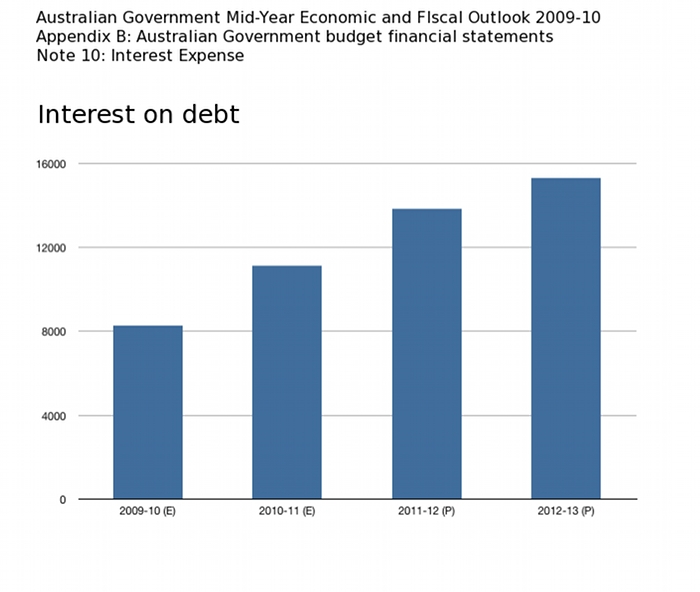
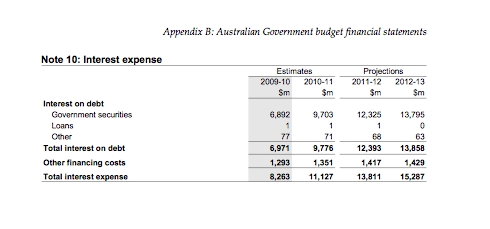
I made the chart below using the data from the Government’s Mid-Year Economic and Fiscal Outlook (MYEFO) 2009-10 Budget statements. It shows the government’s projections of Interest on debt for this financial year, and the following three years. These are the Total Interest* (not principal) repayments that Kevin Rudd has incurred, and we-the-taxpayers must pay back –

Interest on debt - Total $48.488 Billion

Interest Expense - MYEFO 2009-10, Appendix B, Note 10

Note:  This is only the “Estimates” (2009-10, 2010-11) and “Projections” (2011-12, 2012-13) for Interest-on-debt, as at November 2009 when the MYEFO was published. With the Rudd Government still borrowing well over $1 billion a week, who knows just how big the Interest-only bill is now.

One thing we do know.  We cannot pay it back.

* Total Interest includes $5.49 Billion in ‘Other financing costs’ – What exactly is that, and who gets it?

$127.68 Billion and Rising

6 Mar

From the Australian Office of Financial Management:

Total Commonwealth Government Securities on Issue – $127,682m

*As at 5 March 2010
Updated weekly
Face value amounts rounded to the nearest million

How much further into debt will Rudd Labor take us next week?

Forthcoming AOFM Tenders

Treasury Bonds
On Wednesday, 10 March 2010 a tender for the issue of $700 million of the June 2014 Bond line is planned to be held.

Treasury Notes
A tender for the issue of $600 million of Treasury Notes maturing on 11 June 2010 and $300 million of Treasury Notes maturing on 23 July 2010 is planned to be held on Thursday, 11 March 2010.

That’s right. Another $1.6 Billion in debt, next week alone.

These are the debt numbers that Finance Minister Lindsay Tanner does not trouble himself to know.

Britain Grapples With Debt of Greek Proportions

5 Mar

From the New York Times:

Suddenly, investors are asking if Britain may soon face its own sovereign debt crisis if the government fails to slash its growing budget deficits quickly enough to escape the contagious fears of financial markets.

“If you really want a fiscal problem, look at the U.K.,” said Mark Schofield, a fixed-income strategist at Citigroup. “In Europe, the average deficit is about 6 percent of G.D.P. and in the U.K. it’s 12 percent. It is only just beginning.”

Since the Labour government’s intense fiscal intervention in 2008 and 2009, yields on British government debt have soared to among the highest in Europe. And on a broader scale, which includes the borrowing of households and companies, the overall level of debt in Britain is the second-largest in the world, after Japan’s, at 380 percent of the country’s gross domestic product, according to a recent report by the consulting company McKinsey.

Britain is not in the 16-nation euro zone and, unlike Greece and other struggling countries that use the currency, it retains control over its monetary policy. As a result, it has benefited so far from a huge bond-buying program undertaken by the Bank of England — proportionally, the largest in the world — that has kept mortgage rates and gilt yields at unusually low levels.

That means the government and its citizens have been able to continue to borrow at interest rates that do not reflect their true financial situation.

Indeed, the increase in private and government debt here contrasts sharply with the deleveraging that has been going on in the United States.

British household debt is now 170 percent of overall annual income, compared with 130 percent in the United States. In an echo of the United States’ rush into subprime mortgages with low teaser rates, millions of homeowners in Britain have piled into variable-rate mortgages that are linked to the rock-bottom base rate.

As for the British government, it has been able to finance a budget deficit of 12.5 percent of G.D.P. — equal to Greece’s — at an interest rate more than two full percentage points lower only because the Bank of England bought the majority of the bonds it issued last year.

Sound familiar?

In Australia, household debt is over 150 per cent of income. And in an echo of the British rush into US-style sub-prime mortgages with low teaser rates, some 250,000 homeowners in Australia have piled into variable-rate mortgages that are linked to the rock-bottom base rate, until recently the lowest in 50 years. Many highly ‘marginal’ borrowers who could not previously even raise a deposit, were lured into mortgage debt by the Rudd Government’s First Home Owners Boost, plus additional state-based grants.

Markets Chief: No Escape For Australia

4 Mar

From the Sydney Morning Herald:

Australia is unlikely to avoid an imminent economic downturn caused by excessive government debt, a top European markets regulator says.

”Prepare for a very difficult economic time, which you will not be able to escape,” Netherlands Authority for Financial Markets chairman Hans Hoogervorsttold the Australian Securities and Investment Commission summer school yesterday.

The debt taken on by governments around the world to bail out banks and stimulate domestic economies would take ”a tremendous toll on the world economy for a long time to come”, he said.

”The problem is that there is now too much on the shoulders of government. They have basically taken on all the problems caused by the financial crisis, with the effect that most of them are in really, truly horrible budgetary shape.”

He said the only way out was for the public and private sectors to tighten spending and repay the debt.

”The problems are so serious there are no easy ways out any more,” he said. ”It is simply inevitable that economic growth for a long period will be very meagre.” And Australia’s economic luck during the financial crisis would run out, he said, because the stimulus programs running in Asian countries, which had fuelled demand for Australian resources, could not last forever.

IOU Australia: Debt Clock

3 Mar

How much is YOUR share of Australia’s national debt?

Labor Borrowing A Billion A Week

2 Mar

Abbott tells it how it is:

QUESTION:

Interest rates are expected to go up again, um… Who would you blame?

TONY ABBOTT:

Well, if you’ve got the government out there borrowing more than a billion dollars a week that puts a lot of pressure on interest rates. Now, plainly interest rates will always be higher than they otherwise would be when you’ve got the government out there in the market borrowing as dramatically as this government is.

Keep informed of Australia’s sovereign debt level… unlike Finance Minister Lindsay Tanner, who doesn’t bother.

See for yourself just how much this wastrel Government is borrowing every week, by clicking here. To see how much they intend to borrow in the next few days, click here.

Already, you are better informed about Australia’s debt than the Finance Minister.

Greek Debt Crisis Reflects Global Problem

1 Mar

The Greek debt crisis represents a threat to the entire Eurozone, and ultimately, the global economy:

Simon Tilford, chief economist at the Center for European Reform in London, says the Greek crisis reflects a larger economic problem in Europe. EU members like the Netherlands and Germany have spent too little and their economies are driven by exports. Meanwhile, southern economies like Greece and Portugal have spent too much and amassed debts as a result.

Now that sounds familiar – “…economies are driven by exports… spent too much and amassed debts as a result”. One could be forgiven for drawing a logical conclusion – that the Australian economy, far from being a shining beacon of fiscal prudence, actually encapsulates the worst of the Eurozone’s economic dilemma.

Greece’s problems are also spilling beyond Europe’s borders. The value of the euro currency has plunged for example, which makes American exports – key to the U.S. economic recovery – less competitive.

Ultimately, Tilford says, the Greek problem reflects a world economic problem.

“The eurozone s really just a microcosm of the global problems we see. So unless we see the big countries in East Asia rebalancing away from exports and toward domestic demand, we are not going to generate a self-sustaining global economic recovery,” he said.

But Tilford does not believe Europe is ready, or willing, yet to undertake fundamental economic reforms he thinks are needed to right these imbalances. The region may rescue Greece, he says, but it will only be putting a bandage on a far bigger problem.

Could it be that, as with every other global trend, Down Under Australia has not “escaped” the GFC at all, but is simply running a few years behind everyone else?

Barnaby is right.

OECD Economist: Double-Dip Recession Looms

28 Feb

One can only wonder if Treasury Secretary Ken Henry watched the ABC’s “Inside Business” this morning:

One of the OECD’s leading economists says there is a strong chance that the world’s leading economies could quickly slide back into recession.

The deputy director of the OECD’s financial and enterprise affairs, Dr Adrian Blundell-Wignall, has told ABC1’s Inside Business program that the threat of a double dip recession remained because problems in the banking system have not been solved.

“There are many icebergs the ship has to negotiate before we’re out of jail here. This is going to be a 10 year process, not a one year process,” he said.

Dr Blundell-Wignall says many of the banks’ problems have been hidden by changes to accounting rules and their most toxic assets have been shifted to the balance sheets of the big central banks in the US and Europe.

Dr Henry recently stated that the GFC is “over”:

“What people have called the global financial crisis, that has passed“.

Dr Henry went on to predict a “period of unprecedented prosperity” for Australia, one that could “stretch to 2050”.

Dr Henry failed to predict the GFC.

Design a site like this with WordPress.com
Get started