Tag Archives: sovereign debt

‘Til Debt Do Tear Us Apart

11 May

Senator Barnaby Joyce writing for The Punch yesterday:

Well, I hope you all feel comfortable that you now owe $140 billion. If you take our population as approximately 22 million, that means you owe in excess of $6300 for each man, woman and child in Australia.

I will keep talking about debt until people realise the dangerous position it puts us in. We are borrowing in excess of $1 billion each week. We see every night on the news the problems of other countries that have not dealt with their debt but have waited for the inevitable when the debt deals with you. How could we be so foolish as a nation to be mounting up debt the way we are?

Then, to all intents and purposes, nationalise half of the sector of our economy which has actually kept us from the jaws of recession – the mining sector. This is something that would be more appropriate for Hugo Chavez or Evo Morales or Castro in Cuba. Australia hasn’t experienced this sort of insanity since the failed approach by the Labor party when they decided to nationalise the banking industry in 1949.

The actions of our Government of late have been quiet bizarre – ceiling insulation, resource tax, BER, 2020 summit, fuel watch, grocery watch, war on obesity and the response to the Henry tax review that only accepted a few of the 138 recommendations.

The government has labelled these measures as a “revolution” or a “war” but really, it’s just been pandemonium.

People are genuinely getting worried that the Government has gone rogue and lost the plot.

Anyway, back to the debt. When will the Government come to the conclusion that as it keeps borrowing in excess of $1 billion a week that inevitably something is going to go “snap”?

The Government no doubt will tell us we should say “hip hip hooray” that our record deficit is not quite as big as they thought it was going to be.

Then they are going to tell us that at sometime in the future, when they cannot be pinned down, it will all get better, like the child who is going to clean up their room in three years’ time.

If there is one thing that Australians can do for themselves, it is not to get into excessive debt. There are no tricks in how you pay it off – it is just very hard work and lots of sacrifices and pain, where pain never needed to happen.

It’s always the same – the pain of paying it off is five times the joy of getting it and when you look at what the Labor Party has got us, they’ve really got us nothing, except for getting us into a lot of trouble. The resource profit tax looks like the last pill of insanity after a huge night on the town.

This budget will determine that either the Labor Party are going to start turning around the debt or it is going to confirm our worst fears about them. I clearly spelled these out at my National Press Club speech where I stated that the Labor Party has no respect for money, no capacity to handle money, and no knowledge of money.

All these fears have crystallised in their inability to grasp the nettle and immediately start turning around the debt – not in two or three years’ time, but now.

Barnaby Is Right.
Australian CDS Spreads Worsen

11 May

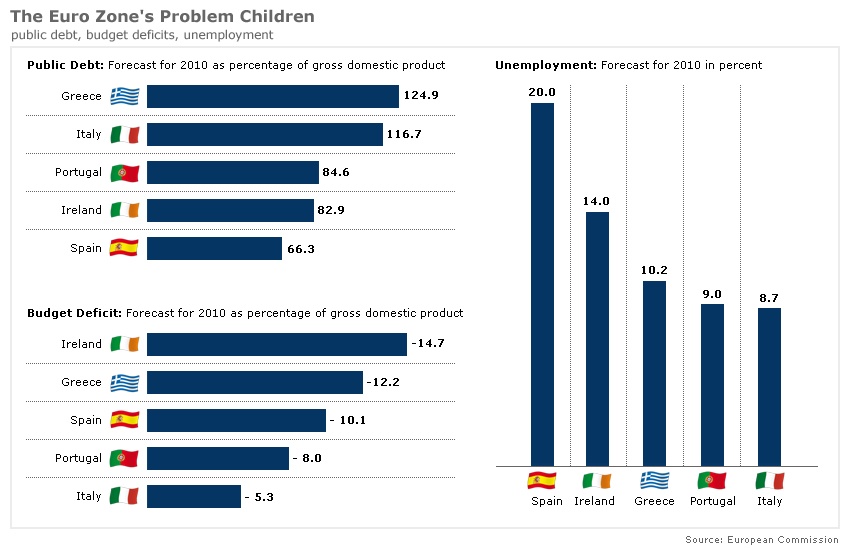
Amid all the anxiety over debt-laden European countries and their banks, few seem to have noticed ominous signs for Australia.  Late last week, as fears really began to rise about the Eurozone, spreads on credit default swaps (CDS) for Australia’s sovereign debt widened the most of all countries in the world except New Zealand.

What does that mean?  Simply, as fears rose about European countries defaulting on their debts, the cost of taking out “insurance” against Australia defaulting on its sovereign debt increased by more than almost every other country.

From CMA Market Data‘s “Sovereign Risk Monitor”:

Friday, 7 May 2010 — 23:30

Sovereign Wideners
Entity Name 5 Yr Mid Change (%) Change (bps) CPD (%)
New Zealand 68.27 +13.91 +8.34 5.80
Australia 54.14 +12.35 +5.95 4.64
Chile 98.64 +11.01 +9.78 6.74
Korea, Republic of 129.84 +10.59 +12.43 10.86
Japan 89.39 +10.32 +8.37 7.73
United Kingdom of Great Britain & Northern Ireland 99.50 +9.26 +8.44 8.44
Qatar 103.29 +8.14 +7.78 7.02
South Africa 190.42 +6.88 +12.26 12.59

Could this reflect the markets losing confidence in Rudd Labor’s ability to manage the economy?  After all, this dramatic deterioration in the markets’ perception of our ability to repay our Rudd-spent sovereign debts also coincides with the government’s announcement of their new Resources Super-Profits Tax –  a tax on our only remaining productive sector (apart from agriculture).

It also comes just days before the next Budget… one which few could seriously believe will genuinely rein in Rudd Labor’s massively wasteful spending and set a determined course for a return to budget surplus.

When it comes to Rudd Labor’s economic (mis)management, it seems the markets are speaking loud and clear.

Is anyone listening?

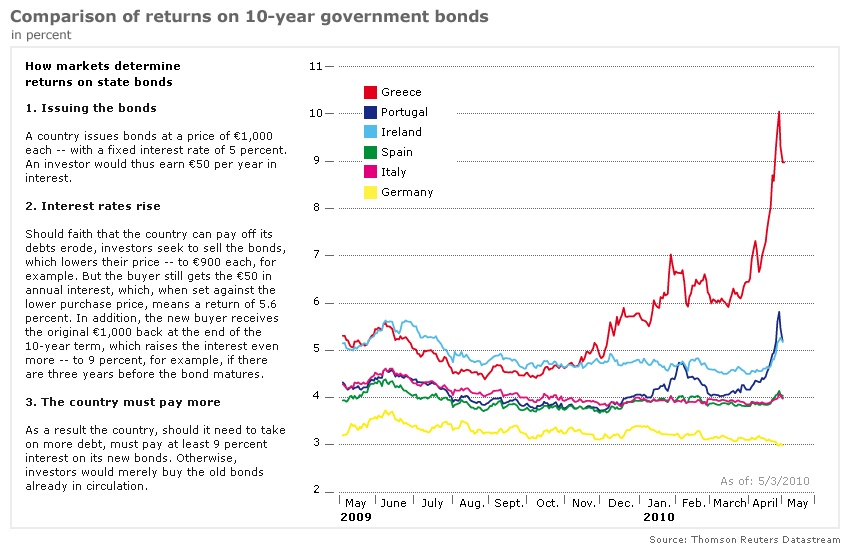
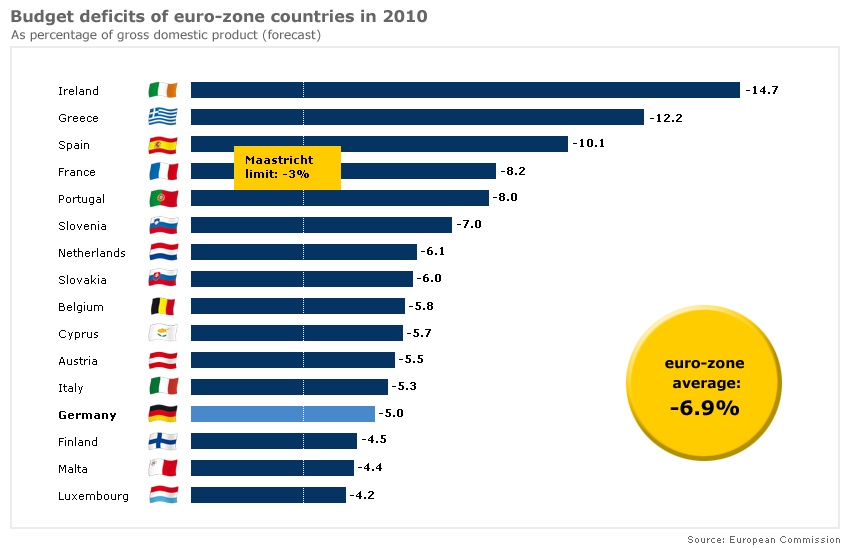
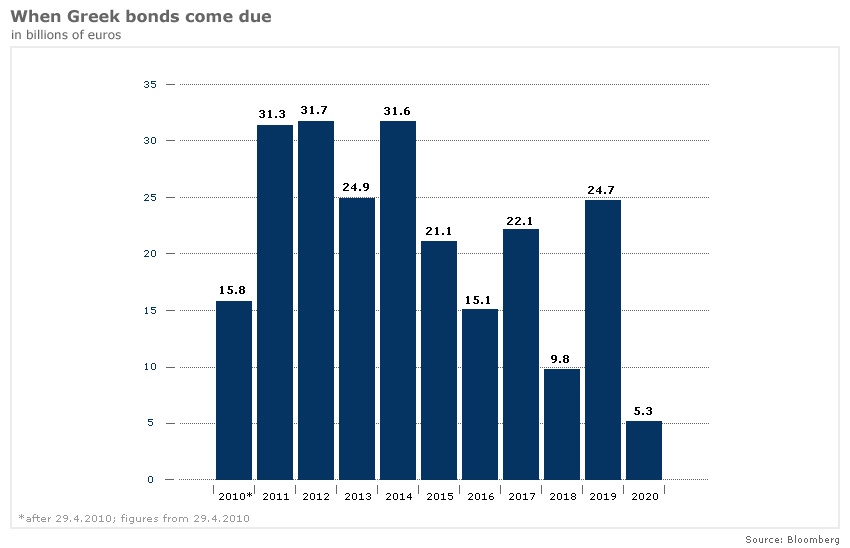
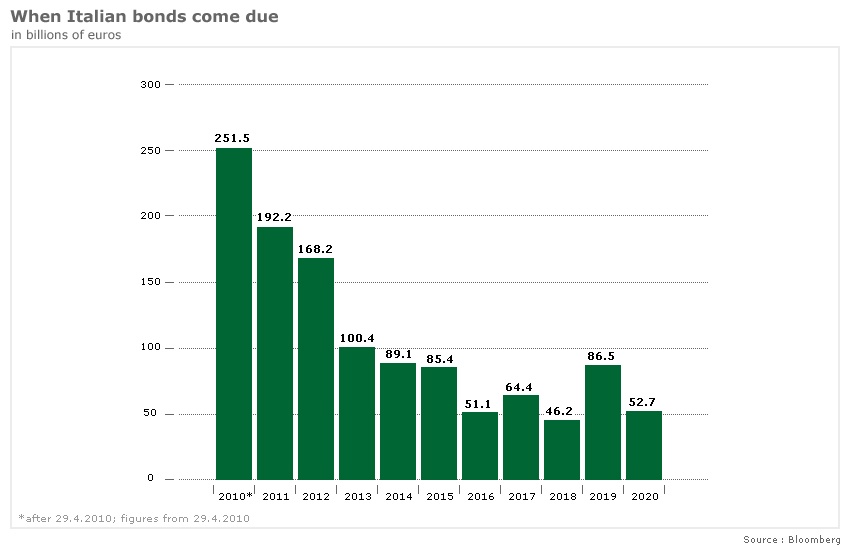
9 Charts Show Why Eurozone Collapse Is Inevitable

10 May

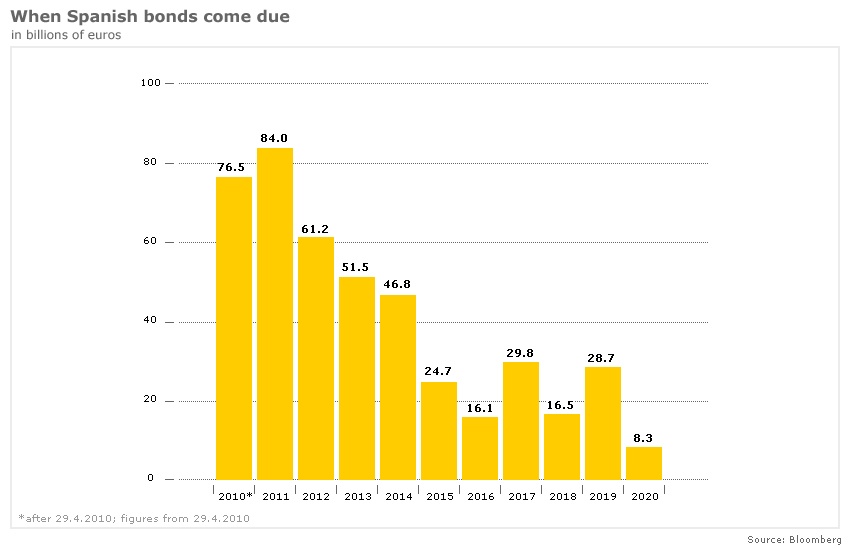
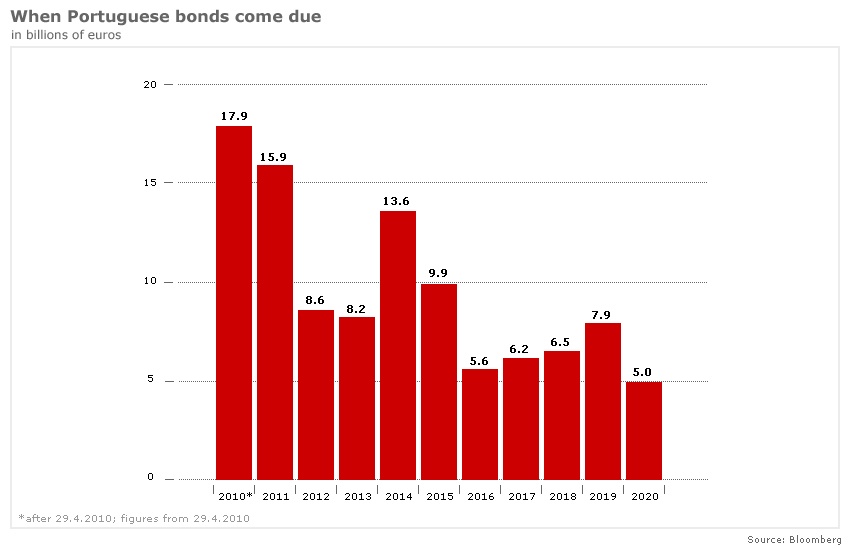
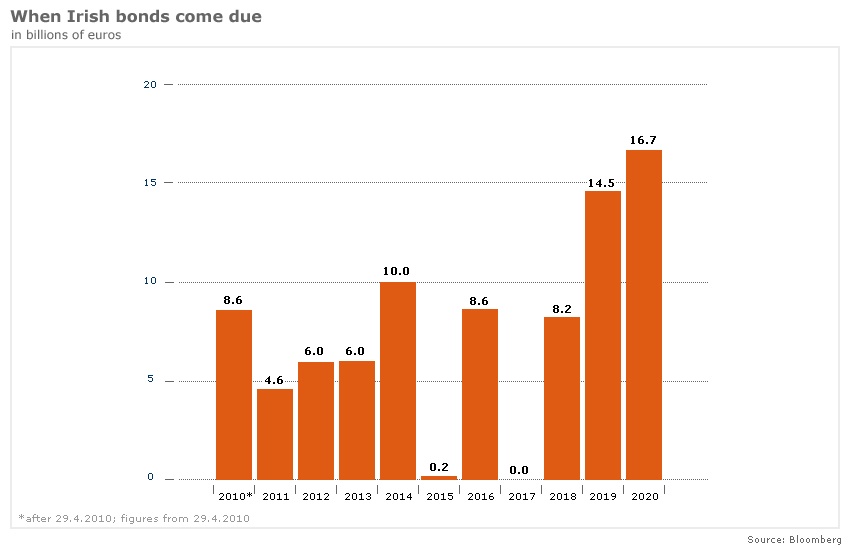
Here are some simple charts that demonstrate why anything and everything that the EU, ECB and/or the IMF can do now, is simply to delay the inevitable disintegration of the Eurozone.

From Der Spiegel: (click on images to enlarge)

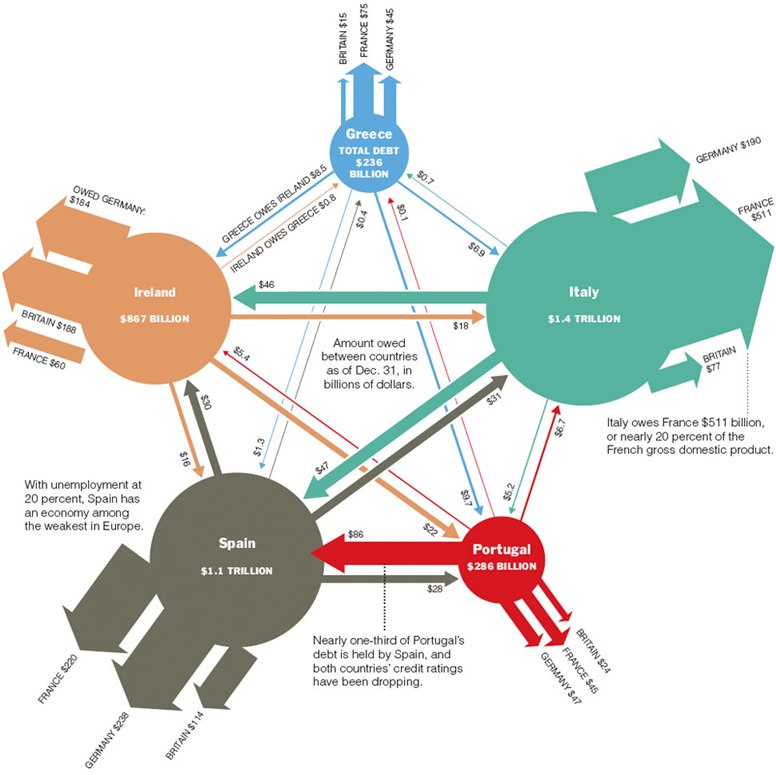
And finally, one more chart showing how interconnected (thus vulnerable) the Eurozone countries are, due to the enormous sums of money owed by member countries just to each other: (click on image to enlarge)

Eurozone Faces Bankruptcy, Disintegration

10 May

Could the Eurozone go bankrupt? One of Germany’s leading newspapers believes so.

From an excellent major article in Der Spiegel:

Huge National Debts Could Push Eurozone Into Bankruptcy

Greece is only the beginning. The world’s leading economies have long lived beyond their means, and the financial crisis caused government debt to swell dramatically. Now the bill is coming due, but not all countries will be able to pay it.

The euro zone is pinning its hopes on (IMF negotiator) Thomsen and his team. His goal is to achieve what Europe’s politicians are not confident they can do on their own, namely to bring discipline to a country that, through manipulation and financial inefficiency, has plunged the European single currency into its worst-ever crisis.

If the emergency surgery isn’t successful, there will be much more at stake than the fate of the euro. Indeed, Europe could begin to erode politically as a result. The historic project of a united continent, promoted by an entire generation of politicians, could suffer irreparable damage, and European integration would suffer a serious setback — perhaps even permanently.

And the global financial world would be faced with a new Lehman Brothers, the American investment bank that collapsed in September 2008, taking the global economy to the brink of the abyss. It was only through massive government bailout packages that a collapse of the entire financial system was averted at the time.

A similar scenario could unfold once again, except that this time it would be happening at a higher level, on the meta-level of exorbitant government debt. This fear has had Europe’s politicians worried for weeks, but their crisis management efforts have failed. For months, they have been unable to contain the Greek crisis.

There are, in fact, striking similarities to the Lehman bankruptcy. This isn’t exactly surprising. The financial crisis isn’t over by a long shot, but has only entered a new phase. Today, the world is no longer threatened by the debts of banks but by the debts of governments, including debts which were run up rescuing banks just a year ago.

The banking crisis has turned into a crisis of entire nations, and the subprime mortgage bubble into a government debt bubble. This is why precisely the same questions are being asked today, now that entire countries are at risk of collapse, as were being asked in the fall of 2008 when the banks were on the brink: How can the calamity be prevented without laying the ground for an even bigger disaster? Can a crisis based on debt be solved with even more debt? And who will actually rescue the rescuers in the end, the ones who overreached?

So, the GFC is ‘over’, is it Ken?

The GFC Is ‘Over’, Ken?

8 May

From The Australian:

Debt and taxes a recipe for economic chaos

The Australian sharemarket lost a massive $95 billion in a five-session horror streak this week, as the European debt crisis and the proposed resources super profits tax severely dented investor confidence.

It was the worst run for local equities since the peak of the global financial crisis, and the meltdown appears far from over, as the second phase of the global financial crisis takes hold.

Wait a minute?!  A “second phase”?  As recently as February this year, the Treasury secretary Ken Henry – architect of Rudd Labor’s massive “economic stimulus” spending, and the Henry Review with its resources super-profits tax that this week resulted in billions wiped off the value of Australian mining companies – publicly declared that the GFC was ‘over’:

“What people have called the global financial crisis, that has passed, I think it’s safe to say,” Dr Henry said. “But that isn’t to say that there will not be further adverse shocks for financial markets down the track and some of those shocks … could be of some significance for individual countries, but I don’t imagine (they would be) shocks of the sort that would be globally significant.”

Really Ken? You clearly do have a disturbing lack of “imagination”:

The local market tumbled a further 2 per cent yesterday, taking its loss for the week to 6.8 per cent, leaving the benchmark S&P ASX 200 index at its lowest point in 17 months.

Yesterday’s sell-off came after an extraordinary lead from Wall Street, where the Dow Jones sent shudders through the world, experiencing its biggest intraday move in history after another drubbing on European markets.

Asian markets also tumbled, with Tokyo’s Nikkei falling another 3 per cent, forcing the Bank of Japan to mount its biggest one-day injection of cash since 2008.

There was no sign of a let-up in Europe last night, with major markets opening as much as 2 per cent lower.

CMC Markets analyst David Taylor said markets were fearful the Greek debt crisis would spread globally and jeopardise growth.

“The sheer fact there is a possibility of a second global financial crisis or a second massive credit crunch inspired by a sovereign debt default, markets are . . . terrified about that,” he said.

Ken Henry completely and utterly failed to foresee the onrushing first wave of the GFC in 2007-08.

His “go early, go hard, go households” economic stimulus advice to Rudd Labor has resulted in massive wasteful spending, rorts, fraud, house fires, deaths, and a Budget thrown into an unprecedentedly huge hole.

He preemptively declared that the GFC is ‘over’.

And as recently as February, he could not even imagine any further “shocks of the sort that would be globally significant”.

How much is this arrogant, demonstrably incompetent clown receiving from MY taxes?

Sack Ken Henry now!

Cracks Multiply In Europe

7 May

From Business Spectator:

Global share markets plunged overnight as panicked investors worried that the eurozone could fragment as a result of the escalating European financial crisis.

The European banking system is under huge strain* as banks are increasingly reluctant to lend to each other. The European banks are worried about how much other banks have lent to the weaker eurozone countries – the so-called PIIGS (Portugal, Ireland, Italy, Greece and Spain) – and the catastrophic losses that could ensue if any of these countries defaulted on their debt.

At the same time, there’s been a flight of capital out of the eurozone as investors have worried the common currency might crumble as a result of the problems in the vulnerable economies of the PIIGS (Portugal, Ireland, Italy, Greece and Spain).

The huge question mark over the eurozone’s survival is causing the euro to plummet. Increasingly, market analysts are predicting that the currency, which broke through the $US1.30 earlier this week for the first tine since April 2009, is set to hit parity with the US dollar.

There is an increasing consensus that the $US145 billion European Union-IMF rescue package for Greece is not sufficient to solve Greece’s basic problem – that it is simply unable to service its colossal debts. There are also questions as to whether Greece will be able to implement the punitive austerity measures it is being forced to adopt in exchange for the bailout.

At the same time, there are increasing signs that even if it bails out Greece, Germany will not be prepared to write the huge cheques required to help other vulnerable PIIGS.

German taxpayers are already outraged at having to pick up a large chunk of the cost of the Greek bail-out, and Germany’s largest opposition party, the centre-left SPD, has said that it will not vote in favour of the bill.

Predictions that the cascading PIIGS debt crisis will cause the eurozone to collapse are becoming more widespread.

* That the European banking system is “under huge strain” and is beginning to freeze up (again) has profound implications for our economy. Why?

As explained in this post a few days ago, even the heads of our major banks quietly admit that our banking system has an “achilles heel” – it is desperately dependent on the international wholesale capital markets for funding.  If/when the banking system abroad seizes up again, our banks will be in deep trouble.

Watch out for the emergency reinstalment of the government’s Bank Guarantee, hoping to again prop up international confidence in our banks so that they can continue to attract funding in a second credit crunch.

Watch out also for higher interest rates charged by the banks – irrespective of the RBA cash rate – due to their having to pay ever higher interest rates in order to get that international funding in the first place.

GFC Wave II Coming?

7 May

From headline news around the globe (in this case, The Australian):

Wall Street Plunges On Eurozone Contagion Fears

US stocks plunged today in a flashback to the panicked trading of 2008 and at one stage the Dow was down almost 1000 points — its biggest intraday fall in history.

Investors fled everything from stocks and risky corporate bonds to commodities and poured money into safe assets such as US Treasuries and gold.

The US stockmarket fell for a third-straight session, as jittery investors grew even more restless over southern Europe’s festering sovereign-debt woes.

The sell-off turned ugly quickly, with Bank of America, Procter & Gamble and 3M among the big decliners, as potentially erroneous trades accelerated the drop.

The Dow Jones Industrial Average ended the session down 347.80 points, or 3.20 per cent, to 10,520.32, its biggest point drop since February 2009. The average at one point fell as much as 998.50 points, or 9.2 per cent, the biggest intraday drop in its history.

History Repeating

5 May

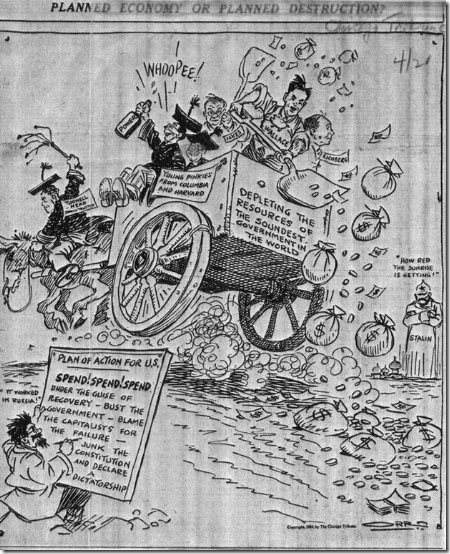
From the Chicago Tribune, 1934:

Note carefully the title at top, and the ‘plan of action’ in the lower left corner.

Rudd’s borrow-and-spendathon – playing straight from the old Marxist playbook.

Another Week, Another $1.8Bn In Debt

3 May

The Rudd borrowed-money spendathon continues.

Already $138.5bn in the hole, this week alone the Australian Office of Financial Management (AOFM) reports that another $1.8bn in Commonwealth securities and Treasury notes will be auctioned off, to raise money for yet more wasteful spending.

Meanwhile, the interest rates that the government must offer to pay to attract buyers for our sovereign bonds continues to steadily rise.

From The Australian:

The government is facing a battle to keep costs under its self-imposed 2 per cent growth cap, with blowouts in some programs and higher interest payments adding to the deficit.

Roubini: Rising Sovereign Debt Leads to Defaults

30 Apr

Nouriel Roubini, one of just a dozen economists who publicly forecast the GFC, and who recently declared that ‘risky rich’ countries are in greatest danger of default, comments again on the rapidly spreading sovereign debt crisis (from Bloomberg):

Nouriel Roubini, the New York University professor who forecast the U.S. recession more than a year before it began, said sovereign debt from the U.S. to Japan and Greece will lead to higher inflation or government defaults.

“The bond vigilantes are walking out on Greece, Spain, Portugal, the U.K. and Iceland,” Roubini, 52, said yesterday during a panel discussion on financial markets at the Milken Institute Global Conference in Beverly Hills, California. “Unfortunately in the U.S., the bond-market vigilantes are not walking out.”

“The thing I worry about is the buildup of sovereign debt,” said Roubini, a former adviser to the U.S. Treasury and IMF consultant, who in August 2006 predicted a “painful” U.S. recession that came to fruition in December 2007. If the problem isn’t addressed, he said, nations will either fail to meet obligations or see faster inflation as officials “monetize” their debts, or print money to tackle the shortfalls.

Roubini, who teaches at NYU’s Stern School of Business, told attendees at the Beverly Hilton hotel that “Greece is just the tip of the iceberg, or the canary in the coal mine for a much broader range of fiscal problems.”

“Eventually, the fiscal problems of the U.S. will also come to the fore,” Roubini said during the panel discussion. “The risk of something serious happening in the U.S. in the next two or three years is going to be significant” because there’s “no willingness in Washington to do anything” unless forced by the bond markets.

Barnaby Joyce began trying to draw attention to the dangers of growing sovereign debt – warning of a coming day of reckoning in the USA and Europe and here in Australia – as far back as October 2009. As I have shown in countless posts on this blog, many leading economists, financiers, and informed commentators in other countries have been raising almost exactly the same concerns as Barnaby.

Few in Australia chose to listen.

Instead, Barnaby was ridiculed by the government and the media for every minor gaffe or slip of the tongue, his every statement misquoted or twisted out of context. With the ultimate result that he lost his position as opposition Finance spokesman thanks to the relentless attacks on his economic credibility. Despite his being better qualified to comment on finance than the entire Rudd Government economic team.

Only weeks later, those who do choose to look and listen can see ever more clearly… Barnaby Is Right.

Design a site like this with WordPress.com
Get started