Tag Archives: sovereign debt

US, UK To Lose AAA Credit Ratings

16 Mar

From Bloomberg:

The U.S. and the U.K. have moved “substantially” closer to losing their AAA credit ratings as the cost of servicing their debt rose, according to Moody’s Investors Service.

“Those economies have been caught in a crisis while they are highly leveraged,” (Moody’s managing director sovereign risk in London, Pierre) Cailleteau said, referring to the level of private and public debt as a percentage of gross domestic product.

Visit the website of Australian Professor Steve Keen, to learn why unprecedented private debt is huge threat to the Australian economy. Even greater than the Rudd government’s ever-growing public debt.

* On April 15th through 23rd, I will be joining Professor Keen in his 230km “Keenwalk” from Parliament House to Mount Kosciuszko, in protest against Australia’s property mania that has been driven directly by insane – and in my personal opinion, immoral – Federal Government and RBA policies, that have enticed hundreds of thousands of financially vulnerable Australians to take on large mortgage debts.

Please consider joining us, for the whole trek or even just for an afternoon section of the walk.

If you’d care to assist a genuinely worthy cause, then please consider sponsoring Professor Keen, or indeed myself. Funds raised will support the wonderful charity Swags For Homeless.

Thanks!

Batten The Hatches

16 Mar

From the Sydney Morning Herald:

The ominous word ”boom” appeared last week, in large type, on the front page of the local newspaper. Given the nature of this paper, the word could only refer to one thing: property. While the signals from the property market are mixed, it appears we are springing back to normalcy without absorbing the reality: the global financial crisis is far from over. All the elements are in place for a second crash.

The world has become an economically unstable place, with enormous unresolved issues. Australia’s economy is fundamentally sound, but the global economy is fundamentally unsound. Even a good boat can be swamped by a bad sea and Australia, as a middling economy, will be buffeted by forces beyond its control unfolding in the United States, the European Community and Asia.

The Bank for International Settlements, the central bank for central banks, is warning of ”unstable dynamics”. Ominous language. The International Monetary Fund estimates the world’s 20 largest economies, the G20, will have a combined debt equal to 118 per cent of their combined gross domestic product by 2014, meaning debt will have exploded by 50 per cent in just seven years. To fund what? In Australia, debt is being used for expansion of the mining sector, which is good, but also for the ill-disciplined spending of the Rudd government and the chronically overpriced housing sector. As a result, Australia’s economy is more vulnerable to economic stress from abroad…

While the obvious and prudent response of government in a financial crisis is to provide social and economic shock absorbers by increased spending and borrowing, it is also important not to overreact. If you believe the global financial crisis is still unfolding, the key is not to overshoot, but to conserve resources and policy options.

The Rudd government, as it has proved in every area of major policy, overspent. It threw money around with undisciplined panic when faced with the global economic crisis.

A must read article.

Perhaps Mr Sheehan might like to point all this out to the overpaid, short-sighted, know-it-all idiots in the Treasury department, and at the Reserve Bank of Australia.

They all failed to see and forewarn of the GFC.  So, thanks to their incompetence, millions of Australian citizens lost literally billions in retirement savings and investments during late 2007 through to early 2009.

Now they are saying that the GFC is “over”, and that we are set for a multi-decade China-fueled mining boom that will provide a “period of unprecedented prosperity”.

Sack Ken Henry. Sack Glenn Stevens.

And abolish the RBA.

Eurozone Faces ‘Sovereign Debt Explosion’

15 Mar

From the UK’s Telegraph:

Europe’s governments are at increasing risk of an interest rate shock this year as the lingering effects of the Great Recession drive debt issuance to record levels and saturate bond markets, according to Standard & Poor’s.

The warning comes as bond giant PIMCO spoke of a “sovereign debt explosion” that has taken the world into uncharted waters and poses a major threat to economic stability. “Our sense is that the importance of the shock to public finances in advanced economies is not yet sufficiently appreciated and understood,” said Mohamed El-Erian, the group’s chief executive.

Mr El-Erian said most analysts are still using “backward-looking models” that fail to grasp the full magnitude of what has taken place in world affairs since the crisis. Some 40pc of the global economy is in countries where governments are running deficits above 10pc of GDP, with no easy way out.

Australia too, is issuing government debt at record levels – $1.6bn last week, another $2.1bn scheduled for this week.

See the Australian Office of Financial Management’s website.

Who Owns Our Debt?

14 Mar

Yesterday I wrote an article commenting on the SMH economics editor Ross Gittins’ column about Australia’s foreign debt.

Something else Mr Gittins claimed in his article caught my notice and bugged me overnight:

What’s that you say? You thought the pollies had done little else but spar about deficits and debt? Sorry, different debt. They’ve been arguing about the public debt – the amount the federal government owes (mainly to Australians).

Mr Gittins is apparently claiming that when the Australian Government issues Commonwealth Securities to raise money, that these are mainly bought by Australians – investors, super funds, banks, big companies, etc.

But is that true?  Is our public debt “mainly” owed to Australians?

I decided it might be nice to know for sure.  Not just take Ross Gittins’ word for it.

In the RBA’s Statistics section, spreadsheet “E9.xls” – Commonwealth Government Securities Classified By Holder as at June 30, I found something interesting…

Continue reading ‘Who Owns Our Debt?’

Europe’s Banks Brace For UK Debt Crisis

14 Mar

From the UK’s Telegraph:

UniCredit has alerted investors in a client note that Britain is at serious risk of a bond market and sterling debacle and faces even more intractable budget woes than Greece.

“I am becoming convinced that Great Britain is the next country that is going to be pummelled by investors,” said Kornelius Purps, Unicredit’s fixed income director and a leading analyst in Germany.

Mr Purps said the UK had been cushioned at first by low debt levels but the pace of deterioration has been so extreme that the country can no longer count on market tolerance.

Sound familiar?

Our economy too, was once cushioned by low debt levels. Not any more.

In my view, the only really fundamental difference between the UK’s dire economic situation and Australia’s, is this: as happens so often, with so much in Australia, we are simply running a couple of years behind on the major international trend.

The UK property bubble has already burst. Ours hasn’t … yet.  Only because the Government had cash in the bank to prop up our property bubble – and thus, our banking sector – by doubling the First Home Owners Boost.

When another wave of the GFC rolls in, we no longer have a “low debt” position to cushion the blow.

The only question seems to be, from which direction will the next wave come?  From Europe?  From the UK? From the USA? Or, from China?

Is Barnaby Really An Idiot?

13 Mar

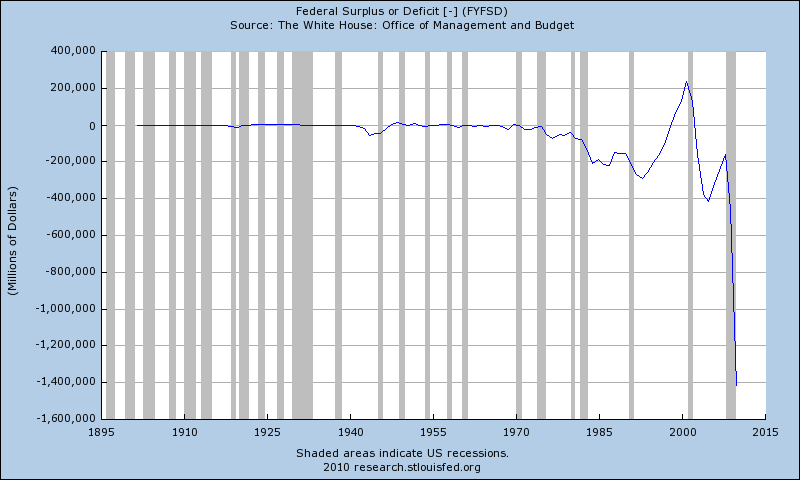
Take a look at this chart, and then think very carefully about your answer (click to enlarge) –

USA - Federal Surplus / Deficit since 1901

That chart is from the US Federal Reserve, St Louis branch.  For the last 108 years.

And it’s not bang up to date.  It only goes up to end September 2009. Hard to believe, but the US government has gone much, much deeper into the negative in the 5.5 months since then. In February alone, the US went another US$221bn into the hole. That’s a one month record.

Do you remember how the Rudd Labor and mainstream media’s assault on Barnaby Joyce’s economic credibility began?  When he publicly questioned whether the US could default on its debt.

Well… what do you reckon?  Look at that chart.  Think about it.  Use your own commonsense.

Barnaby is right.

And there are plenty of esteemed international economists … including the current chairman of the US Federal Reserve… who agree.

As does US Secretary of State, Hillary Clinton, who called the US deficit a ‘national security risk’ just 2 weeks ago.

Worrier Joyce Gains Traction

13 Mar

A must read article in today’s Sydney Morning Herald:

Why Our Foreign Debt Is A Taboo Subject

It’s become deeply unfashionable to talk about Australia’s foreign debt. Neither the government nor the opposition wants to mention it and the same goes for most economists. In the Reserve Bank’s 60-page quarterly review of the economy it doesn’t crack a mention.

Predictably, however, the subject holds no terror for Barnaby Joyce. As best I can make out, his celebrated mention of ”our net debt gross public and private” was a reference to our foreign debt.

What’s that you say? You thought the pollies had done little else but spar about deficits and debt? Sorry, different debt. They’ve been arguing about the public debt – the amount the federal government owes (mainly to Australians).

On the latest estimates (which are probably too high), the federal budget’s return to deficit is projected to cause the net public debt to peak at $153 billion in June 2014, before falling back.

But as Crocodile Dundee might say, that’s not a debt, this is a debt: according to figures we got from the Bureau of Statistics last week, in December Australia’s net foreign debt reached $648 billion.

And if you enjoy a good worry, as Joyce clearly does, why not quote the gross foreign debt? It stands at a cool $1219 billion.

How on earth did we get to owe all that money? Just who owes it? What’s the difference between gross and net? And why does no one but Bushwhacked Barnaby think there’s much to get excited about?

Perhaps it’s because Barnaby is the only politician in Australia who truly cares about protecting Australians.  And not just his own taxpayer-funded lurks and perks.

There is one serious quibble I have with Ross Gittins’ column. He writes:

Since we’ve run a deficit on the current account almost every year since the year dot, and since we also have to borrow to cover the interest we pay on earlier debt, our total debt to foreigners stands at $1219 billion.

Fortunately, it’s not quite that bad. That’s the gross amount we owe. But while some Australians were borrowing from foreigners, others (mainly our super funds) were lending money to foreigners. As at December, foreigners owed us $571 billion.

So that’s why the net amount we owe to foreigners is $648 billion and that’s the more meaningful figure to focus on.

I disagree completely. With so much evidence emerging almost daily about the growing debt crises in countries all over the world – just see the dozens of articles referenced and linked in this blog –  why should we sit back comfortably and count our chickens before they’re hatched?

If foreigners owe us $571 billion, what makes us think that they can pay us back? What good reason is there to believe we can count on that $571 billion owed back to us?

I applaud Mr Gittins’ story overall. At least he’s bringing attention to the great taboo subject of foreign debt. But I fear that, like so many mainstream economists, he fails to see these simple, logical flaws in the “popular” wisdom.

The exact same flawed argument is made by the government, Treasury, the RBA, and all their many cheerleaders in the mainstream media, when it comes to Gross vs Net public debt.  And, gross vs net Interest on Debt.  Again, they always argue that it is only the Net figure that matters. Because they believe that we can count on the amounts owed back to us as a sure thing.

Morons. Blinded by “conventional wisdom”, and too much time staring into the crystal balls of economic “theory”. Even Gittins manages to concede as much, in a butt-covering final paragraph:

Of course, the conventional wisdom among economists could be wrong. It has been known.

Indeed.

Not one “conventional” economist predicted the GFC.  Many – like the Rudd Labor team of economic illiterates – were still shrieking about “the inflation genie” in the middle of 2008.  Even though the GFC tsunami had already started to wash over the USA back in the middle of 2007!

The “conventional wisdom” is BS.

Barnaby is right.

France Next On Debt Watch

13 Mar

From the Globe and Mail (UK), via Reuters:

French debt looks set to come under pressure in the near future with investors battered by the Greek crisis arguing it is pricey and does not reflect France’s growing indebtedness.

As a result, other euro zone paper, including Germany’s and — perhaps surprisingly — Italy’s, could be in for a filip.

The gist is not that France’s economy is under any immediate Greece-like default stress, but the cost of its bonds — and the cost of insuring them — does not properly reflect what stress is actually there.

“France has been lumped as a core euro zone economy. To our mind the budgetary situation is not as good as the pricing suggests,” said Richard Batty, an investment director at Britain’s Standard Life Investments.

“It is being priced as though there isn’t a budget problem,” he said.

In it latest note, Mr. Batty’s firm said it was being put off French debt because its fiscal problems and the true cost to euro zone economies of any bailout of peripheral economies are not fully priced in to its debt.

This echoes the view of a number of other fund managers and bank analysts.

Less than a week ago, famous international financier George Soros warned that the Euro currency ‘may not survive’ the Greek debt crisis contagion in the Eurozone.

Others fear that the UK will be the next to fall thanks to its enormous debt levels.

Meanwhile, in Australia our financial authorities remain seemingly oblivious to the dangers from every quarter of the globe. They are still advising the government that we will simply sail out of the Rudd Government’s massive debt, on the back of a multi-decade China-fueled mining boom.

More evidence emerges almost daily, that this new China boom is no more than a hopeful fantasy, that will collapse possibly as soon as 2012.

The Net Debt Picture

12 Mar

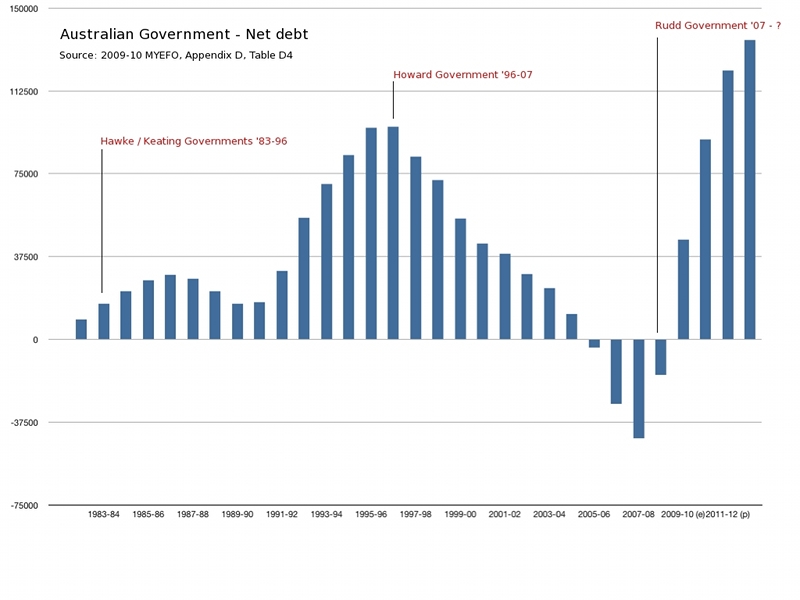
Here’s a picture that speaks volumes.

From the government’s 2009-10 Mid-Year Fiscal and Economic Outlook, Appendix D, Table D4, I’ve made the following chart tracking official ‘net debt’ since 1982 (click on chart to enlarge) –

Australian Government - Net Debt

I’ve marked the first full budget year for each successive government, from Labor’s Bob Hawke through to Labor’s Kevin Rudd.

See that steep fall in government net debt on the chart?  The one that took the nation from $96.2bn in net debt, down down down to negative $44.82bn in net debt?

Yes. That was a Coalition government.

See the rocket-like launch back UP to unprecedented levels of net debt?  Yes, that’s the Rudd Government’s panicked, totally unnecessary spending binge for you. The one they’ve been lying about.

With much more debt still to come.

After all, they borrowed another $1.6bn just this week. See the AOFM website, and click on the links under ‘Recent Tender Results”.

And next week, they’re planning to borrow another $2.1bn.

The massive, multi-billion dollar cockups in every single “stimulus” spending program, will only add to their… OUR… huge and unpayable debts.

Tanner Lies About Budget, GFC

11 Mar

Finance Minister Lindsay Tanner has demonstrated yet again that he is a liar and a fraud:

Lindsay Tanner today accused the Opposition of punching a $2 billion hole in the budget after it helped defeat a means test on the private health insurance rebate last night.

“Tony Abbott and the Liberal Party are blocking almost all the government’s major initiatives in the Senate these days,” Mr Tanner told ABC radio.

“We faced a huge budget problem as a result of the global financial crisis. We have to repair the damage to the budget and we have to get the budget back into surplus as quickly as possible.”

“Yet he’s punched a huge hole in our savings initiatives that are designed to get the budget back into surplus quickly.”

In a recent column for the Sydney Morning Herald, ironically and hypocritically titled “Dishonesty in the debt debate”, Lindsay Tanner wrote:

Why are we going into debt?  Because the global financial crisis punched a huge hole in our projected revenues, and forced us to act to support the economy and to sustain jobs.  Had we just sat back and watched, as our opponents seem to suggest, we would have seen unemployment rise dramatically.  That would have reduced tax revenues even further, and thus pushed us into deficit anyway… The Rudd government had no choice but to intervene to protect Australian working people from the ravages of the crisis.  The dishonest campaign about debt being prosecuted by our opponents should be seen for the fraud it is.

Tanner’s claim that the GFC “punched a huge hole” in the government’s projected revenues, is an outright lie. And I will prove it to you, from the government’s own Budget documents.

The real reason that Rudd Labor faces a “huge budget problem” is not a result of the global financial crisis. Instead, it is entirely a result of their panicked, monumentally incompetent response to the idea of a GFC.

The simple fact is this: Contrary to Tanner’s recent claim, and Labor’s shrill proclamations throughout 2009, the GFC barely affected Australian government revenues at all. The “huge budget problem” is entirely of the Rudd Government’s own making. Because their team of uneducated economic illiterates panicked, and went on a massive, unnecessary spending binge. And now they are lying to cover up that fact.

Want proof?

Take a look at the Government’s 2009-10 Budget, Statement 10, released in May 2009.  It shows that Government income (“Receipts”) was estimated to be down by just $7.8bn (2.7%) on the previous year –

Continue reading ‘Tanner Lies About Budget, GFC’

Design a site like this with WordPress.com
Get started