It is rather bemusing to browse around the economic commentaries on Wayne’s MYEFO (Mid Year Economic and Fiscal Outlook) announced yesterday. In particular, the commentaries from those with a leftist bent.
By and large, from these folk we hear the same refrain as that parrotted on down the line from Treasury via their talking head (Wayne Swan). To wit, “strongest economy in the developed world”, “envy of the developed world”, “lower debt-to-GDP than other advanced economies”, “nothing to see here, move along folks”.
Here’s some good examples that caught my eye:
Secondly, let’s tackle the Opposition canard – gleefully recycled by some media outlets – that somehow we are drowning in debt. It doesn’t take much – like five minutes on the Internet – to show that total government liabilities at around around 22 per cent of GDP are the lowest in the OECD and compare extremely favourably to just about every other developed economy.
It appears rather obvious from The Failed Estate’s analysis, that he did indeed spend “like 5 minutes on the internet” researching his momentous piece of groupthink.
And then there was New Matilda’s Ben Eltham. See if you can spot the drive-a-truck-through-it hole in his effusion (hint, emphasis added):
Unemployment is expected to peak at 5.5 per cent next year, and remain at the level into 2013. Inflation will be 3.25 per cent. Wages will grow at 4 per cent. Consumer spending will grow at 3 per cent, and the economy as a whole at 3.25 per cent.
These are figures that would make finance ministers in Europe weep. The Australian economy is growing. We’re adding jobs and keeping unemployment low, consumers are still spending, and inflation is modest. And yes, the budget will return to surplus.
Note to Mr Eltham: These are “estimates” and “projections”. Not outcomes. “Expected” does not equal “will”.
Indeed, as regular readers know, both the budget and MYEFO are all about “estimates” and “projections”. And the Treasury department has a sterling record of abject failure when it comes to getting within a bulls roar of accurately predicting the final budget outcomes. Indeed, in less than 6 months, their “truly extraordinary” growth forecasts underpinning the May 2011 budget “estimates” and “projections”, are already shot to hell.
But our purpose today, dear reader, is not to dissect the ignorant parrotry of “leftist” journalists and bloggers.
Or “rightists”, for that matter.
Our purpose is to identify the key economic point that they are all missing.
One that even respected mainstream economic commentators like Access Economics’ Chris Richardson, here implying that it may not be wise for the government to be cutting spending at this time, have universally overlooked:
Deloitte Access Economics director Chris Richardson said the government planned to cut spending when the Reserve Bank of Australia (RBA) had cut its cash rate in early November.
The RBA cut the cash rate from 4.75 per cent to 4.5 per cent to provide some stimulus for a slowing economy.
“What the government is doing here is actually taking money back out again solely to get a surplus next year,” Mr Richardson told ABC Radio on Tuesday.
“It is not clear that it is smart to have the Reserve Bank tipping money but the government then taking it back out when the outlook especially with Europe is somewhat fraught.”
Let’s help out Messr’s Denmore, Eltham, and Richardson, with a brief guide on how to miss the key economic point.
For dummies:
1. Focus on the Federal government public debt figure.
2. Emphasise comparison of Federal government public debt-to-GDP versus other “developed” countries, praise Labor government for comparatively “low debt-to-GDP”.
3. Downplay importance of return to balanced annual budget / budget surplus. Cite 2. as primary justification.
4. Belittle any who express concern over ever rising government debt trajectory. Cite 2. as primary justification.
Commonwealth Government Securities On Issue | Source: Australian Office of Financial Management (AOFM)
5. Ignore the fact that while Federal Government public debt is “only” relatively small, our total Net Foreign Debt at June 2011 was almost $675 Billion, or over 50% of GDP (RBA Statistics, H5).
6. Ignore the fact that our banking system (thus, economy) relies on international money markets for some 40% of its “wholesale funding”.
7. Ignore the fact that in May 2011, Moody’s downgraded our Big Four banks’ credit ratings, cited their wholesale funding dependence as a key concern, and tacitly threatened the government that without the government’s explicit and implicit Guarantees propping them up, our Big Four banks would have their credit ratings slashed by at least two more ‘notches’.
9. Ignore the fact that the spread on bond yields for Australia’s Big Four banks (versus non-financial institutions) have just hit record highs (from Bloomberg via SMH):
Lenders including Commonwealth Bank, Westpac, ANZ and National Australia Bank Ltd., may need to sell about $144 billion of bonds in the 12 months ended June, 2012, according to a July research report from Deutsche Bank …
Trading conditions in the euro area have deteriorated this month as the region’s sovereign debt crisis deepens. Germany failed to get bids for 35 per cent of the 10-year bonds offered for sale on November 23 and traders were left seeking prices in the aftermath of a Spanish debt sale on November 17.
10. Ignore the fact that due to the very real vulnerability of our banking system, it is near-inevitable that the government will need to reinstate the Government (taxpayer) Wholesale Funding Guarantee to prop up our Too Big To Fail banks.
11. Ignore the fact that the government’s present “low” public debt comparison versus other countries is largely rendered a moot point, because the credit ratings agencies have already effectively served notice that they will have a lower tolerance for anything less than pristine government finances – and thus, a genuinely convincing case for return to surplus – due to the compulsion upon the Australian Government to (continue to) prop up a highly vulnerable banking system.
12. Blithely skip merrily through cherry-strewn intellectual fields, hand-in-hand with fellow groupthinkers, picking fruit and singing la la la la, wilfully ignoring the reality that (in the words of Senator Joyce) …
You may or may not be aware that a big reason behind the current market turmoil, is Europe’s banks. French and Italian banks in particular have been the focus of attention in the past fortnight.
But the problems with banks are not confined to Europe. Consider what one of the best financial blogs in the world had to say recently about the banks of a nation whose economy is disturbingly similar to ours (from Zero Hedge):
While two short months ago, “nobody” had any idea that Italy’s banks were on the verge of insolvency, despite that the information was staring them in the face (or was being explicitly cautioned at by Zero Hedge days before Italian CDS blew out and Intesa became the whipping boy of the evil shorts), by now this is common knowledge and is the direct reason for why the FTSE MIB has two choices on a daily basis: break… or halt constituent stocks indefinitely. That this weakness is now spreading to France and other European countries is also all too clear. After all, if one were to be told that a bank has a Tangible Common Equity ratio of under 2%, the logical response would be that said bank is a goner. Yet both Credit Agricole and Deutsche Bank are precisely there (1.41% and 1.92% respectively), and both happen to have total “assets” which amount to roughly the size of their host country GDPs, ergo why Europe can not allow its insolvent banks to face reality or the world would end (at least in the immortal stuttered words of one Hank Paulson). So yes, we know that both French and soon German CDS will be far, far wider as the idiotic market finally grasps what we have been saying for two years: that you can’t have your cake and eat it, or said otherwise, that when you onboard corporate risk to the sovereign, someone has to pay the piper. Yet there is one place where that has not happened so far; there is one place that has been very much insulated from the whipping of the market, and one place where banks are potentially in just as bad a shape as anywhere else in Europe. That place is…. Canada.
As the chart below shows, which is a ranking of global banks by tangible common equity, lowest first, of the banks with a TCE ratio of under ~4% a whopping 30% are those situated in Canada, the same place where nobody thinks anything can go wrong, and which has been completely spared from the retribution of the bond vigilantes. Something tells us Canadian sovereign CDS, not to mention Canadian bank CDS, are both about to go quite a bit wider.
How do Australia’s banks rate on the Tangible Common Equity (TCE) scale?
Better.
But not that much better.
Take note, dear reader. Here we are about to see a classic example of how our Treasurer wilfully cherry-picks from International Monetary Fund reports.
Here’s what The Goose recently had to say about the IMF’s latest report:
The IMF has just completed a regular review of Australia’s finances.
He said the IMF had noted “our resilient financial system.”
“Australia’s banks are well capitalised, prudently managed, and among the highest-rated in the world,” Mr Swan said.
“The IMF notes that banks have improved their capital positions and reduced their reliance on short-term foreign funding, and that they are well placed to ride out any future financial turbulence in offshore markets,” he added.
Wayne has, as usual, gilded the lily, and put words in the mouth of the “authorities” he quotes.
And, he just “happened” to conveniently forget what else the IMF wrote (emphasis added):
17. Bank profits have recovered and the return on equity for the major banks is now around pre-crisis levels. Capital adequacy has improved, driven both by increases in capital and declines in risk-weighted assets. Common equity as a share of tangible assets has also risen to nearly 5 percent for the four large banks…
Oops.
A TCE of “nearly 5%” is not exactly streets ahead of the Canadian banks. Moreover, “nearly 5%” is actually worse than the 5.42% TCE of Italian bank Intesa Sanpaolo (see ZH chart above), whose shares have been under attack and subject to multiple trading halts in the last fortnight to save it from collapse.
18. Challenges remain, however. Banks may be tempted to take on riskier strategies in an environment of structurally lower credit growth. Household debt remains high (150 percent of disposable income) and a rise in mortgage rates could lead to an increase in bad loans, although current arrears are modest. While we recognize improvements in the composition of banks’ funding structure, their sizable short-term external borrowing still remains a risk. In addition, concentration in the banking sector has increased in the wake of the crisis with the assets of the four large banks now comprising about 75 percent of total bank assets…
21. While banks have reduced their reliance on short-term external borrowing, disruptions in global capital markets could still put pressure on their funding. Therefore, banks should be encouraged to further reduce their short-term borrowing.
Oops.
This reliance on short-term funding is a key reason why Moodys ratings agency downgraded our banks’ credit ratings in May, and warned the govrnment that it must maintain the government guarantee else they will be downgraded further.
In response to a question I put in Senate estimates, Treasury revealed that $64 billion of the difference between our gross debt and our net debt is made up of the cash and non-equity investments of the Future Fund. The Future Fund is there to cover the otherwise unfunded costs of public servants’ superannuation.
Geithner, who has already suspended a program that helps state and local government manage their finances, will begin to borrow from retirement funds for federal workers.
I dare you to ignore the fact that the US Government has been planning to steal their private citizens’ super too, since at least February 2010:
The plan, as sketched in the 43-page document, calls for the creation of something called “Guaranteed Retirement Accounts” (GRAs). Biden slyly shifts the onus for the idea through weasel words typical of the federal government: “Some have suggested the creation of Guaranteed Retirement Accounts (GRAs), which would give workers a simple way to invest a portion of their retirement savings in an account that was free of inflation and market risk, and in some versions under discussion, would guarantee a specified real return above the rate of inflation.”
Economy Minister Gyorgy Matolcsy announced the policy yesterday, escalating a government drive to bring 3 trillion forint ($14.6 billion) of privately managed pension assets under state control to reduce the budget deficit and public debt. Workers who opt against returning to the state system stand to lose 70 percent of their pension claim.
I dare you to ignore the fact that France began stealing their citizens’ super in late 2010 as well:
I dare you to ignore the fact that “Europe’s economic superstar”, the one EU nation that (like Australia) came through GFC1 with positive economic growth, began stealing their citizens’ super in May this year:
It appears moving backwards on pension reforms has become the thing to do on both sides of the Atlantic.
I dare you to ignore the fact that the Liberal Party of Australia quietly announced a new policy on June 3 this year – sneakily disguised as a helpful “reform” – that should make your hair stand on end:
Further relief for small business
The Coalition will relieve the red tape burden from Australia’s small businesses by giving them the option to remit the compulsory superannuation payments made on behalf of workers, directly to the ATO.
Small business will be given the option to remit superannuation payments to the ATO at the same time as they remit their PAYG payments.
I dare you to ignore the fact that an “option”, can very easily become a “non-option”.
I dare you to ignore the fact that our Green-Labor Government announced plans in the May Budget that should also make your hair stand on end:
The Gillard government’s 2011-12 budget has proposed a raft of initiatives aimed at encouraging superannuation fund and private investment in infrastructure projects.
I dare you to ignore the fact that “encouraging”, can very easily become “enforcing”.
I dare you to ignore the botched “school halls” program, and the white elephant NBN, as you ponder whether or not you really trust this government to wisely and prudently invest your super in Government infrastructure projects, and achieve a reasonable return on your money, when even so-called “experts” have doubts:
The government’s plan to use tax incentives to encourage superannuation funds to invest in new infrastructure could be thwarted by inadequate returns on projects and a reluctance by the states to take on project risk, experts say.
I dare you to ignore the fact that the government’s white elephant NBN is a(nother) Green-Labor thought bubble, drawn up on the back of Kevin Rudd’s in-flight napkin, with no cost/benefit analysis:
I dare you to ignore the fact that Bill Shorten, the Minister for Financial Services and Superannuation, already thinks of your super as a “significant national asset” … a kind of “sovereign wealth fund”:
This week marks 12 months exactly since the government announced plans to take compulsory superannuation from 9 per cent to 12 per cent.
… our superannuation savings place Australia fourth in the world. Its $1.3 trillion in funds under management through superannuation significantly boosts national savings and provides greater retirement security for millions of Australians. Superannuation is also a significant national asset because it strengthens our financial sector.
I dare you to ignore the fact that our government has guaranteed our banking sector using the promise of your future earnings as collateral, and that Moody’s ratings agency has put our government on notice that our banks are Too Big To Fail – just like in the USA, UK, and Europe:
Heavens to Betsy. It’s finally out in the open. The big four are too big to fail and Moody’s rates the Australian government’s implicit guarantee of the banks’ wholesale debt (as well as the explicit deposit guarantee) as worth two ratings notches. Moreover, by phrasing it this way, Moody’s has essentially put the Australian government on notice that if it dares back away from that guarantee then it can count on the result. The further implication is that the Budget had better remain shipshape to provide the guarantee.
I dare you to ignore the fact that the government’s carbon pricing scheme scam includes a new “independent” Clean Energy Finance Corporation (carbon bank) that will be permitted to borrow against future government revenue – your future tax dollars – in order to invest in “green” energy projects:
The $10 billion Clean Energy Finance Corporation will invest in businesses seeking funds to get innovative clean energy proposals and technologies off the ground. These Government-backed investments will deliver the financial capital needed to transform our economy.
…
A variety of funding tools will be used to support projects, including loans on commercial or concessional terms and equity investments.
…
The Corporation will be independent from the Government. The Government will appoint an independent Chair who will have appropriate banking or investment management experience.
I dare you to ignore international banking’s core philosophy, now rendered infamous by GFC1: “Privatise the profits … socialise the losses”.
I dare you to ignore the fact that another sharemarket collapse – like in 2008 – would be a perfect pretext for nanny-state, “Big Brother knows best” governments everywhere to step in and “safeguard your retirement”, by taking and “investing” your super in Government-approved “safe investments” … just like the US Government’s planned, doublespeak-titled “Guaranteed Retirement Accounts”.
I dare you to ignore the fact that this blog has documented in detail the wave of super confiscations that is already rolling around the Western world, and the clear evidence that both sides of Australian politics already have their own quiet, sneaky plans to do the same.
I dare you to not bother reading any of my many articles on this topic –
About three in every five mortgage products now enable home buyers to borrow up to 97 per cent of the value of their property, according to financial research group RateCity.
RateCity chief Damian Smith said the rise in loan-to-value ratios (LVR) indicated that lenders wanted to kick-start growth in the sluggish home loan market.
“We haven’t seen this level of money offered to mortgage borrowers since the start of 2009,” Mr Smith said.
He warned that change in lending criteria was putting borrowers at risk.
“There is a concern for some borrowers who take on too much debt, because it makes them more susceptible to risk if rates increase or property values fall.”
It’s not just borrowers that are put at risk.
What this means is that the day is drawing nearer when the Government proclaims “No Super For You!!”
How’s that, you say?
Bear with me on this. All will become clear:
High loan-to-value ratios also place banks at greater risk, with the likelihood of a lender absorbing a loss in the foreclosure process increasing as the amount of equity decreases.
Similar borrowing practices were behind the collapse of the US housing sector when people with a higher chance of defaulting on on their payments were provided loans at higher-than-normal interest rates.
Indeed.
It places banks at greater risk.
On 18 May 2011, Fitch’s Ratings credit rating agency offered this ominous warning about Australia’s banks’ lending standards (from Business Week):
… Australian banks could have their credit ratings cut if they lower standards to boost mortgage sales as demand for home loans slumps.
12. Banks’ credit ratings downgraded even further.
13. Rinse and Repeat, from 5.
14. Bank/s cannot borrow (a “credit squeeze”).
15. Short-sellers smell blood in the water; Banks’ share prices collapse.
16. Banks fail … just as in the USA, UK, and the EU.
17. Government pilfers your super to prop up our government-guaranteed, Too Big Too Fail banks.
Think it can’t happen here?
It can.
And it will.
Both parties are already planning for it.
The Government has effectively guaranteed it (How? By guaranteeing the banking system; a guarantee underwritten by you, the taxpayer).
And Senator Joyce has specifically forewarned of it. Just as he (correctly) forewarned of the US debt default that is happening right now.
Labor has introduced legislation moving in that direction in the May budget.
And the Liberal Party has just announced a new policy – disguised as a “reform” to “help” business – that is aimed squarely at getting the ATO‘s hands on your super … before it even gets to your super fund.
Learn all about the wave of superannuation confiscations rolling across the Western world, and our own super theft to come, here.
UPDATE:
h/t reader and GuestPoster “JMD”, in Comments below.
Want to try and access your super early, and beat the government to it?
No can do.
Not unless you’re underwater on your mortgage. Then you can … to pay out the banksters:
“You can however access your super early, ‘to prevent your home being sold by the mortgage lender as a result of non payment on your home loan’. It would be interesting to find out when that rule was slipped in, allowing the banks to access your super but not you.”
From the Liberal Party’s website, Latest News, 3 June 2011:
The Coalition will relieve the red tape burden from Australia’s small businesses by giving them the option to remit the compulsory superannuation payments made on behalf of workers, directly to the ATO.
Small business will be given the option to remit superannuation payments to the ATO at the same time as they remit their PAYG payments.
Senator Barnaby Joyce writing for The Punch, 13 May 2011:
On Tuesday night’s budget, Labor sneaked in an Amendment of the Commonwealth Inscribed Stock Act 1911. Here is the most telling statement for where our nation is going under this Green-Labor-Independent Alliance. Under Part 5 Section 18 subsection 1 “omitting ‘$75’ and substituting ‘250’ ”.
Now that is in billions ladies and gentlemen and it is real money that really has to be paid back. If we have all this money stashed away under the lower net debt figure that is always quoted by Labor, then why not use some of this mystery money to pay off what we owe to the Chinese and others who we are hocked up to the eyeballs to.
The reason why we can’t is at least $70 billion that makes up ‘net’ debt is tied up in the Future Fund and student loans.
Labor has already introduced legislation in the 2011-12 Budget that aims to grab your super too.
In fact, Labor’s Minister for Financial Services and Superannuation, Bill Shorten, published an op-ed a month ago stating that he views your super as “our sovereign wealth fund”.
There is a wave of government confiscations of private retirement savings rolling around the Western world right now. The first ripples have quietly rolled onto our shores already.
Treasury Secretary Timothy F. Geithner has warned for months that the government would soon hit the $14.3 trillion debt ceiling — a legal limit on how much it can borrow. With that limit reached Monday, Geithner is undertaking special measures in an effort to postpone the day when he will no longer have enough funds to pay all of the government’s bills.
Geithner, who has already suspended a program that helps state and local government manage their finances, will begin to borrow from retirement funds for federal workers.
The USA is taking public servants’ pension funds, to pay government bills.
Note that well.
Because just over 3 weeks ago – and 4 days before that Washington Post story hit the wires – our own Senator Barnaby Joyce made a very disturbing revelation (below).
Economy Minister Gyorgy Matolcsy announced the policy yesterday, escalating a government drive to bring 3 trillion forint ($14.6 billion) of privately managed pension assets under state control to reduce the budget deficit and public debt. Workers who opt against returning to the state system stand to lose 70 percent of their pension claim.
“This is effectively a nationalization of private pension funds,” David Nemeth, an economist at ING Groep NV in Budapest, said in a phone interview. “It’s the nightmare scenario.”
But Argentina and Hungary are not like us, right? That couldn’t ever happen in a Western economy like ours, could it?
Oh, but that’s France. They’ve got hangover problems from the Global Financial Crisis, right? That couldn’t happen in a really strong economy like ours, one that sailed through the GFC without even having a recession … right?
… another recent reversal we’ve seen has come from Latin America. In the 1990s, Bolivia’s decision to move its pension assets from the state to private managers placed it among the most advanced pension systems in the region. However, the current government has decided to nationalise the assets once more claiming it is creating a pension system that is equal for all.
Oh yes, but Poland is really just a Central European economy, not long removed from communism. Something like that couldn’t ever happen in a mid-level, “advanced Western economy” like ours … right?
From Business Insider, 10 May 2011:
Irish Bombshell: Government Raids PRIVATE Pensions To Pay For Spending
Capital city dwelling values fell by a seasonally adjusted 2.1 per cent in the first quarter of the year, according to the latest RP Data-Rismark Home Value Index.
The quarterly change was the steepest since the index series began in June 1999, RP Data research director Tim Lawless said.
And from the Sydney Morning Herald, 17 May 2011:
Real estate slump will leave banks in pain too
Australian real estate, long the subject of global concern, bears all the symptoms of a market that simply has run out of puff.
About that $20 billion in RMBS that Wayne Swan purchased. With borrowed money. Just how safe is that $20 billion “investment” looking?
From the Sydney Morning Herald, 26 May 2011:
Arrears on mortgage repayments spiked to a record high in the first three months of 2011, as more Australians struggle with rising costs, Fitch ratings agency says.
Arrears on prime residential mortgage-backed securities (RMBS) of 30 days or more hit a record high of 1.79 per cent in the first quarter, from 1.37 in the final quarter of 2010, the group said, as Christmas spending and the Queensland floods forced more Australians to struggle in repaying their mortgages.
The increase in arrears for the most fragile band of mortgage borrowers, low-doc loans, with payment delays of 30 days or more hit 6.74 per cent in the first quarter, up from 5.7 per cent in the final quarter of 2010, a higher level than December 2008 quarter, when the financial crisis hit and the Reserve Bank began rapidly lowering rates.
Low-doc mortgages are written for riskier borrowers than prime mortgages, which are written for customers who have a reasonably safe ability to borrow.
Delinquencies of three months or more on conforming low-doc mortgages, which are used by people who are self-employed for example, soared past 5 per cent in the March quarter, from about 3 per cent the December 2010 quarter.
Would our Wayne have “invested” any of that borrowed $20 billion in low-doc RMBS? Or, did he stick with prime RMBS?
From the Australian Office Of Financial Management website:
$20 billion worth of RMBS. With low-doc loans included. A brilliant government “investment” in keeping our property bubble inflated. And now that investment too, is failing, with record-high arrears on the mortgages backing those “securities”.
But there’s nothing really to worry about, because we’ve got the “strongest banking system in the world”, right? Even if the property bubble does pop, our government would never need to go looking for even more money, to bail out our banks … right?
Moody’s Investors Service has downgraded the long-term debt ratings of Australia’s big four banks to Aa2 from Aa1, citing their relatively high reliance on overseas funds rather than local deposits.
Moody’s explanatory paper effectively stated that our banks are Too Big Too Fail. That the Big Four’s liabilities must continue to be supported by the Australian Government Guarantee For Large Deposits And Wholesale Funding that Labor “decisively” introduced (like Ireland) in response to the GFC. And if the guarantee is removed, Moody’s indicated that the Big Four’s long-term debt ratings will be downgraded by at least two further ‘notches’.
Meaning?
Moody’s has just placed our government on notice. Australian taxpayers are now effectively on the hook – permanently – to bail out our banks when our housing bubble bursts.
Exactly the same thing that happened in the USA, UK, Ireland, Spain et al.
Don’t believe that we have a housing bubble? Think the nightmare housing-driven bank collapse scenario that is throttling the rest of the Western world won’t ever happen here?
Fine.
If the housing-collapse trigger event is not enough to bother you, then take a moment to think about derivatives.
Those “exotic” financial instruments that were at the heart of the Global Financial Crisis. The ones that famously prudent investor Warren Buffet referred to as “a mega-catastrophic risk”, “financial weapons of mass destruction”, and a “time bomb”, way back in 2003.
The same kind of exotic instruments that lauded economist Saul Eslake also referred to just a few days ago, in an argument with me on my blog over my criticism of his public lobbying for a carbon dioxide “pricing” scheme (emphasis added):
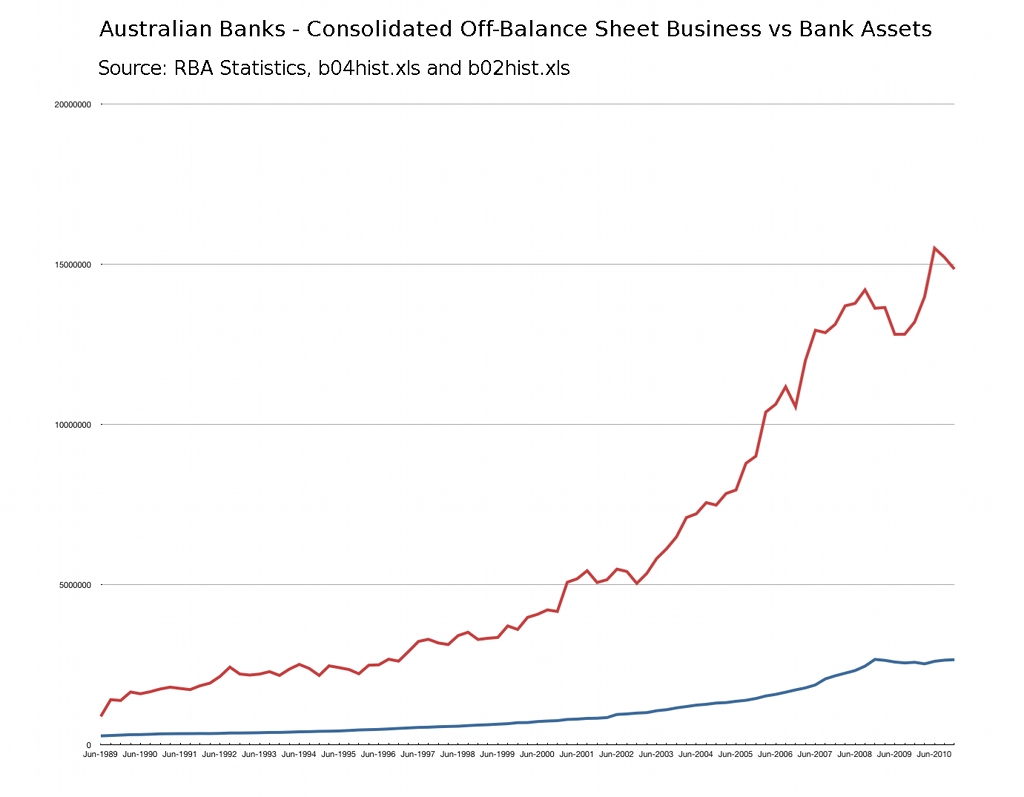
And exactly what kind of “business” makes up 92.3% of that “Off-Balance Sheet” $15 Trillion – more than 10 times our nation’s annual GDP?
You guessed it. Derivatives. Those “financial weapons of mass destruction” which so nearly blew up the whole world in 2008-09.
Finding it a bit difficult to get your head around these huge numbers? Pictures often help.
Take a look at this simple chart comparing our “safe as houses” banks’ On-Balance Sheet “Assets” (blue line) – which are 66% loans – versus their Off-Balance Sheet “Business”, 92.3% of which is derivatives (click to enlarge):
$2.66 Trillion in "Assets" versus $15 Trillion in Off-Balance Sheet "Business"
Still feeling confident about our banking system?
There’s more.
Australia’s banking system only just dodged a bullet in 2008-09, thanks almost entirely to the government (taxpayer) guarantee which is still in place today.
“Almost” entirely thanks to the government guarantee, you say?
That’s right. Something else helped save our banking system too.
The Australian public remains blissfully unaware that during the GFC, two of our Big Four banks, and our very own central bank, the RBA, all obtained secret emergency loans from the US Federal Reserve – which is simply printing new money, Zimbabwe-style.
Data released by the Fed shows the RBA borrowed $US53 billion in 10 separate transactions during the financial crisis… according to a report in The Australian Financial Review.
NAB borrowed $US4.5 billion, and a New York-based entity owned by Westpac borrowed $US1 billion, according to The Age.
If you think “it could never happen here”, if you think that our government would never take away your super to pay for its massively wasteful spending, its crappy “investments”, or to bail out our Too Big Too Fail, very recently downgraded, multi-Trillion derivatives-laden banking system, then it’s time for you to think again.
Were you one of the many who ridiculed Barnaby Joyce’s warnings in late 2009, about the possibility of a US debt default (“Barnaby Warns Of Bigger GFC“)?
That’s coming to pass right now. Trying desperately to avoid a default is the reason why the US Treasury has now resorted to stealing federal workers’ retirement savings, to pay government bills.
On Tuesday night’s budget, Labor sneaked in an Amendment of the Commonwealth Inscribed Stock Act 1911. Here is the most telling statement for where our nation is going under this Green-Labor-Independent Alliance. Under Part 5 Section 18 subsection 1 “omitting ‘$75’ and substituting ‘250’ ”.
Now that is in billions ladies and gentlemen and it is real money that really has to be paid back. If we have all this money stashed away under the lower net debt figure that is always quoted by Labor, then why not use some of this mystery money to pay off what we owe to the Chinese and others who we are hocked up to the eyeballs to.
The reason why we can’t is at least $70 billion that makes up ‘net’ debt is tied up in the Future Fund and student loans.
That is exactly what is happening in America. Right now.
And Barnaby is warning that it could happen here too.
The first steps in that direction have already begun.
From Global Custodian (Australia edition), 11 May 2011:
The Gillard government’s 2011-12 budget has proposed a raft of initiatives aimed at encouraging superannuation fund and private investment in infrastructure projects.
In light of the botched “school halls” program, and the stalled white elephant NBN – which so far has only achieved a 12% takeup rate, versus their predicted 58% – would you really trust this government to wisely and prudently invest your super in Government infrastructure projects?
Others have their doubts.
From The Australian, 12 May 2011:
The government’s plan to use tax incentives to encourage superannuation funds to invest in new infrastructure could be thwarted by inadequate returns on projects and a reluctance by the states to take on project risk, experts say.
First, a little “encouragement” for super funds to invest in government spending programs.
Then, when the costs blow out, or when the government debt becomes unmanageable … or when the banks need bailing?
And, he is the only politician in Australia with the honesty, decency, and courage, to (once again) try to forewarn the public about the risks of debt, and where this debt train is taking us.
Still not convinced there’s anything to worry about?
Then consider the words of Labor’s PM-in-waiting, the Minister for Financial Services and Superannuation, Bill Shorten. He already thinks of your super as a “significant national asset” … a kind of “sovereign wealth fund”.
From Shorten’s op-ed published in The Australian, 4 May 2011:
This week marks 12 months exactly since the government announced plans to take compulsory superannuation from 9 per cent to 12 per cent.
… our superannuation savings place Australia fourth in the world. Its $1.3 trillion in funds under management through superannuation significantly boosts national savings and provides greater retirement security for millions of Australians. Superannuation is also a significant national asset because it strengthens our financial sector.
Superannuation “strengthens our financial sector”? Can you see where this is going?
Shorten and his cohorts already have their eyes on our $1.3 Trillion in super savings. In Labor’s view, your retirement savings are “our sovereign wealth fund”.
When our Too Big Too Fail, derivative-laden banks inevitably run into trouble again – as indeed they are right now with a falling housing market – you should have no doubt that our government will follow the lead of the USA, France, Ireland, Poland, and all the rest, and simply take your super to prop up our “financial sector”.
After all, they have “guaranteed” our banks. Your future taxes … and if necessary, your super … are the collateral for those guarantees.
But if the Coalition wins government everything will be fine, right? They’re far better economic managers, right? We can all trust the Liberal Party not to put their hands on our super, to pay down Labor-incurred debts … right?
Wrong.
Just this past Friday 3 June 2011, the Liberal Party announced a new policy that they will take to the next election. Loaded with weasel words, it is yet another harbinger of the super theft to come, sneakily disguised as a helpful “reform”.
From the Liberal Party website:
Further relief for small business
The Coalition will relieve the red tape burden from Australia’s small businesses by giving them the option to remit the compulsory superannuation payments made on behalf of workers, directly to the ATO.
Small business will be given the option to remit superannuation payments to the ATO at the same time as they remit their PAYG payments.
Billions and billions of dollars in compulsory superannuation payments, going directly from our employers’ bank accounts to the government’s tax department , every 3 months. And we have to simply trust the government of the day, that every cent of it will immediately be passed on to our private super funds. Not siphoned off into special “investments”, or government accounts. Or simply “sat on” for a month or so, in order to prop up the government’s weekly cashflow needs.
Oh, but not to worry … it will just be an “option” for “small” businesses to do this, of course.
Right. If you believe that, then I’ve got an air-backed derivative called a “carbon permit” to sell you. Ever heard the old saying, “It’s the thin end of the wedge”?
A final thought.
Our government is presently considering the Garnaut proposal for introduction of a carbon dioxide “pricing mechanism”. A key part of this proposal that has (surprise surprise) drawn strong public support from economists employed by the banking sector, is the suggestion that the billions of dollars raised should be administered by an “independent” Carbon Bank. One that …
In other words, a Carbon Bank run by unelected, unaccountable parasites – chosen from the banking sector, no doubt – with the government … meaning taxpayers … acting as the final guarantor for any losses made on their “green” “investments”.
Does that prospect concern you?
Can you see where this is all heading?
We have a government that has already racked up nearly $200 billion in gross debt.
Is running a “forecast” $50 billion annual budget deficit.
And – like an America’s “Mini-me” – has now moved to raise our debt ceiling by another $50 billion (ie, a 25% increase), to a new record quarter of a Trillion dollars.
This is the same government of completely unqualified economic incompetents behind a string of costly disasters – killer ceiling insulation, overpriced school halls, “green scheme” rorts, subsidised Toyota hybrids (that noone except government is buying), the problem-plagued Nation Bankrupting Network … and their latest rort-ridden debacle, “free” set-top boxes.
Do you honestly believe that this government would not end up burying taxpayers with even bigger losses from their carbon dioxide “air tax” scheme too?
Do you honestly believe that this government would never follow the lead of Argentina, Hungary, Bolivia, France, Poland, Ireland, and now the superpower USA … and steal your super to pay for massive debts that they have racked up?
These are just some of the many sound reasons why Senator Joyce has persistently tried to raise public awareness of the real and grave peril of ever-increasing government debt and deficit, in a (supposedly) post-GFC world.
Your retirement savings depend upon your taking notice of his warnings.
Barnaby is right.
If like me you are under 50 years old – indeed, if you are under 60 years old – then I’m willing to bet you all of my super that you will never see all of yours.
And unlike our bank(st)ers and government … I never bet.
Australia’s Big Four banks have all just received a credit rating downgrade by ratings agency Moody’s.
From the Sydney Morning Herald:
Moody’s Investors Service has downgraded the long-term debt ratings of Australia’s big four banks to Aa2 from Aa1, citing their relatively high reliance on overseas funds rather than local deposits.
For a closer analysis of what this really means for Australia’s economic future, we turn to a man far more knowledgeable on this topic than I.
Moody’s analysis of the Australian banks’ vulnerability is pointed. In fact, it’s right on the money as it were, capturing both the past vulnerability and potential future problems, as well as solutions.
For well over a decade, Australia’s banks have funded huge swathes of the current account deficit. As well, over the past two commodities booms, much of the export income has been leveraged up and blown on housing and fancy living. Moody’s is effectively calling the risks of this model to account. And they’re still not finished:
At Aa2, the major banks’ ratings continue to incorporate 2 notches of uplift from systemic support. Moody’s views bank supervisors and the government in Australia to be supportive by global comparison and the banks to have high systemic importance, as implicitly recognized by the government’s “Four Pillars” policy (which restricts M&A among the banks).
Moody’s also notes that creditor-unfriendly initiatives — such as bail-in legislation — are not on the policy agenda in Australia.
Heavens to Betsy. It’s finally out in the open. The big four are too big to fail and Moody’s rates the Australian government’s implicit guarantee of the banks’ wholesale debt (as well as the explicit deposit guarantee) as worth two ratings notches. Moreover, by phrasing it this way, Moody’s has essentially put the Australian government on notice that if it dares back away from that guarantee then it can count on the result. The further implication is that the Budget had better remain shipshape to provide the guarantee.
Moody’s is rightly concerned about our banks’ heavy reliance on borrowing from off-shore, in order to lend into our housing bubble.
The exotic financial instruments at the very heart of the GFC, that the world’s most famous investor, Warren Buffet, famously called “a mega-catastrophic risk”, “financial weapons of mass destruction”, and a “time bomb”.
It shows our banks’ combined total Assets – blue line – versus a red line of total Off-Balance Sheet “business” (click to enlarge):
$2.66 Trillion in "Assets" versus $15 Trillion in Off-Balance Sheet "Business"
Never mind the risk of wholesale funding liabilities. What happens when our banks’ $15 Trillion worth of Off-Balance Sheet “financial weapons of mass destruction” blow up – just as they did in the USA? That’s more than 10x the entire value of this country’s annual GDP!
Now you know the answer.
The takeout from the Moody’s downgrade is very simple.
Moody’s has effectively just warned the Australian government that it MUST continue to guarantee the liabilities of our entire banking system. Or else the Big Four banks’ credit ratings will be downgraded even further.
Meaning much higher interest rates. And, the real risk of off-shore funding drying up completely.
Australian taxpayers are now firmly on the hook … to bail out the crooks.
Because – just like in America – they are now considered Too Big To Fail.
"Everyone has the right to freedom of opinion and expression; this right includes freedom to hold opinions without interference and to seek, receive and impart information and ideas through any media and regardless of frontiers."



 Barnaby Is Right
Comments