Tag Archives: wayne swan

ABC’s Alan Kohler Mauls Wayne’s MYEFO

30 Nov

In my opinion, ABCTV News ‘Finance’ and ‘Inside Business’ presenter, and Editor-in-Chief of Business Spectator Alan Kohler has increasingly shone as a rare beacon of (usually subtly hinted) truth in the mainstream economic commentariat over recent months. His excellent, pull-no-punches article today is very well worth reading. As Business Spectator viewing requires (free) registration, it is reproduced below in full. Suggest registering for his articles alone, and do follow @AlanKohler on Twitter.

Read on, dear reader (my emphasis added):

Wake up and smell a budget stinker

As everyone in business knows, a forecast is just a forecast. In times like these, it’s not even that; it’s a guess that you hope won’t look too stupid.

The World’s Best Treasurer has had to redo his budget because the one he did six months ago has turned out to be wrong. We told him at the time it would be, and so it was, but the new one looks worse – a shocker.

The forecast for GDP growth this financial year has been cut from 4 to 3.25 per cent, or by 19 per cent; the revenue forecast has been reduced by just 1.7 per cent.

Economic growth for 2012-13, about which nobody has the faintest clue, has been reduced by 13 per cent to 3.25 per cent. Revenue for that year has been trimmed by only 1 per cent.

Total tax receipts in 2010-11 were $280.8 billion (that’s the actual outcome, not a forecast).

In the current financial year receipts are forecast to be $315.3 billion – a rise of $34.5 billion, or 12.3 per cent. In 2012-13 they are now forecast to be $374.5 billion – $93.7 billion greater than the outcome for 2010-11, which is an increase of exactly a third.

Do these forecasts pass the smell test, Mr Chairman? No way Swanny, go back and try again.

In fact, what would happen if revenues for some reason turned to be flat for a couple of years? What would that do to our bottom line in 2013? Er, well, if that happened the 2012-13 deficit would be, um, $50 billion.

OK, how about this Wayne… given we’re facing the most uncertain economic outlook in our lifetime, with the prospect of a severe recession in Europe, possibly one in the US and a slowdown in China, and the probability of much lower commodity prices, the board will allow you to forecast revenue growth of no more than 5 per cent a year for the next two years. That would seem prudent, wouldn’t you say?

Now, as you know Wayne, we do need to run this business at a surplus in 2012-13 because we are facing a takeover from those bastards at Abbott & Co, so what would we have to do with expenses between now and then to report a surplus in 2012-13 under that scenario?

Well, um, that would mean revenue in 2012-13 of $308.7 billion. Actual expenses were $346.1 billion in 2010-11, so that’s a spending cut of $37.4 billion over two years, Mr Chairman. Right Wayne – the board thinks you should implement that.

That just illustrates the political importance of having implausible revenue forecasts that no one can disprove: $37.4 billion is a lot of welfare programs and/or a lot of public servants. Shadow Treasurer Joe Hockey says the Labor government has hired an additional 20,000 staff since 2007; sacking them all would only save less than $2 billion in salary and on-costs.

Will government revenues grow by 10 per cent between 2010-11 and 2012-13 or by 33 per cent, as forecast in yesterday’s MYEFO? Absolutely no one knows, least of all the bozos running Treasury’s macroeconomic models downstairs in Langton Crescent. But does 33 per cent revenue growth feel right, given everything we know about the world at the moment? Nah, it feels ridiculous.

But the wonderful thing about politics, as opposed to business, is that your board consists of executives who want spending cuts even less than you do, and you get to have a press conference at which you announce forecasts and guesses as if they have happened already. No wonder the world is a mess.

Bravo Mr Kohler!

Bravo!!

Now, please note that the above recommendation is not to say that I agree with everything Mr Kohler says. On the contrary, I still find him guilty of occasionally (and hopefully, inadvertently) perpetuating many of the various myths and falsehoods underpinning our Great Australian Housing Bubble, as just one major point of difference.  However, I have been sufficiently impressed with Mr Kohler’s subtle (and sometimes not so subtle) hinting at the truth about both the Australian and more particularly the global financial situation over recent months, that I am happy to give a firm-yet-guarded recommendation.

Given that Mr Kohler is not only “mainstream”, but also a presenter on Their ABC, that is high praise indeed.

(h/t Twitter follower @kawunnee for bringing this article to our attention)

Missing The Key Economic Point, For Dummies

30 Nov

It is rather bemusing to browse around the economic commentaries on Wayne’s MYEFO (Mid Year Economic and Fiscal Outlook) announced yesterday. In particular, the commentaries from those with a leftist bent.

By and large, from these folk we hear the same refrain as that parrotted on down the line from Treasury via their talking head (Wayne Swan). To wit, “strongest economy in the developed world”, “envy of the developed world”, “lower debt-to-GDP than other advanced economies”, “nothing to see here, move along folks”.

Here’s some good examples that caught my eye:

Secondly, let’s tackle the Opposition canard – gleefully recycled by some media outlets – that somehow we are drowning in debt. It doesn’t take much – like five minutes on the Internet – to show that total government liabilities at around around 22 per cent of GDP are the lowest in the OECD and compare extremely favourably to just about every other developed economy.

It appears rather obvious from The Failed Estate’s analysis, that he did indeed spend “like 5 minutes on the internet” researching his momentous piece of groupthink.

And then there was New Matilda’s Ben Eltham. See if you can spot the drive-a-truck-through-it hole in his effusion (hint, emphasis added):

Step back from all the sound and fury about budget surpluses and the European debt crisis for a moment, and have an unbiased look at the latest Treasury figures on the health of Australia’s economy.

Unemployment is expected to peak at 5.5 per cent next year, and remain at the level into 2013. Inflation will be 3.25 per cent. Wages will grow at 4 per cent. Consumer spending will grow at 3 per cent, and the economy as a whole at 3.25 per cent.

These are figures that would make finance ministers in Europe weep. The Australian economy is growing. We’re adding jobs and keeping unemployment low, consumers are still spending, and inflation is modest. And yes, the budget will return to surplus.

Note to Mr Eltham: These are “estimates” and “projections”. Not outcomes. “Expected” does not equal “will”.

Indeed, as regular readers know, both the budget and MYEFO are all about “estimates” and “projections”.  And the Treasury department has a sterling record of abject failure when it comes to getting within a bulls roar of accurately predicting the final budget outcomes. Indeed, in less than 6 months, their “truly extraordinary” growth forecasts underpinning the May 2011 budget “estimates” and “projections”, are already shot to hell.

But our purpose today, dear reader, is not to dissect the ignorant parrotry of “leftist” journalists and bloggers.

Or “rightists”, for that matter.

Our purpose is to identify the key economic point that they are all missing.

One that even respected mainstream economic commentators like Access Economics’ Chris Richardson, here implying that it may not be wise for the government to be cutting spending at this time, have universally overlooked:

Deloitte Access Economics director Chris Richardson said the government planned to cut spending when the Reserve Bank of Australia (RBA) had cut its cash rate in early November.

The RBA cut the cash rate from 4.75 per cent to 4.5 per cent to provide some stimulus for a slowing economy.

“What the government is doing here is actually taking money back out again solely to get a surplus next year,” Mr Richardson told ABC Radio on Tuesday.

“It is not clear that it is smart to have the Reserve Bank tipping money but the government then taking it back out when the outlook especially with Europe is somewhat fraught.”

Let’s help out Messr’s Denmore, Eltham, and Richardson, with a brief guide on how to miss the key economic point.

For dummies:

1. Focus on the Federal government public debt figure.

2. Emphasise comparison of Federal government public debt-to-GDP versus other “developed” countries, praise Labor government for comparatively “low debt-to-GDP”.

3. Downplay importance of return to balanced annual budget / budget surplus. Cite 2. as primary justification.

4. Belittle any who express concern over ever rising government debt trajectory. Cite 2. as primary justification.

Commonwealth Government Securities On Issue | Source: Australian Office of Financial Management (AOFM)

5. Ignore the fact that while Federal Government public debt is “only” relatively small, our total Net Foreign Debt at June 2011 was almost $675 Billion, or over 50% of GDP (RBA Statistics, H5).

6. Ignore the fact that our banking system (thus, economy) relies on international money markets for some 40% of its “wholesale funding”.

7. Ignore the fact that in May 2011, Moody’s downgraded our Big Four banks’ credit ratings, cited their wholesale funding dependence as a key concern, and tacitly threatened the government that without the government’s explicit and implicit Guarantees propping them up, our Big Four banks would have their credit ratings slashed by at least two more ‘notches’.

8. Ignore the fact that in late June 2011, Fitch Ratings warned that Australia’s banks are amongst the most vulnerable in the world to the EU debt crisis, due to their reliance on wholesale funding from international money markets.

9. Ignore the fact that the spread on bond yields for Australia’s Big Four banks (versus non-financial institutions) have just hit record highs (from Bloomberg via SMH):

 Yields on bonds of Australian banks reached a record high relative to debt of the nation’s nonfinancial borrowers as Europe’s debt crisis threatens to freeze credit markets

Lenders including Commonwealth Bank, Westpac, ANZ and National Australia Bank Ltd., may need to sell about $144 billion of bonds in the 12 months ended June, 2012, according to a July research report from Deutsche Bank …

Trading conditions in the euro area have deteriorated this month as the region’s sovereign debt crisis deepens. Germany failed to get bids for 35 per cent of the 10-year bonds offered for sale on November 23 and traders were left seeking prices in the aftermath of a Spanish debt sale on November 17.

10. Ignore the fact that due to the very real vulnerability of our banking system, it is near-inevitable that the government will need to reinstate the Government (taxpayer) Wholesale Funding Guarantee to prop up our Too Big To Fail banks.

11. Ignore the fact that the government’s present “low” public debt comparison versus other countries is largely rendered a moot point, because the credit ratings agencies have already effectively served notice that they will have a lower tolerance for anything less than pristine government finances – and thus, a genuinely convincing case for return to surplus – due to the compulsion upon the Australian Government to (continue to) prop up a highly vulnerable banking system.

12. Blithely skip merrily through cherry-strewn intellectual fields, hand-in-hand with fellow groupthinkers, picking fruit and singing la la la la, wilfully ignoring the reality that (in the words of Senator Joyce) …

… “If you do not manage debt, debt manages you.”

Tax Junkie Wayne Can’t Find A Vein For His $60m Hit

23 Nov

Yes dear reader. There really are impossibly boring folk out there like your humble blogger, who are actually looking forward to Treasurer Wayne’s Mid Year Economic and Fiscal Outlook (MYEFO) statement.

Not happily mind, but with a kind of morbid fascination.

As we saw recently, Wayne’s Budget Is Already Shot To Hell. Even though he only presented it 6 months ago.

Unsurprisingly, the “truly extraordinary” growth forecasts underpinning the predicted budget surplus in 2012-13, have already proven to be about as accurate as a spirit level minus its bubble.

The company tax growth prediction – shot.

The income tax growth prediction – shot

The superannuation tax growth prediction – shot.

The jobs growth prediction – shot.

But wait … there’s more!

China slowing.

EU collapsing.

USA drowning.

Iron ore and coal prices plummeting.

House prices leaking.

Now the chills and sweats are breaking out. And the panic is on for a quick fix.

No doubt the pushers from Treasury are with Wayne right now, desperately trying to keep the fantasy going, by massaging the numbers back up.

Like a junkie who’s shot so full of holes, he can’t find a sound vein anywhere.

And the MYEFO massaging will be only the more frantic, now that Wayne’s just scored another $60m hit:

A carbon price will add about $60million to the cost of the Federal Government’s operations, and agencies are unlikely to be compensated for it.

The Canberra Times analysed emissions from the bureaucracy and the military to estimate the budget hit they will face in 2012-13, when the price and its related fuel tax increases take effect.

The Government, which is Australia’s biggest energy user, has not yet prepared its own calculations.

The cost will grow each year as the carbon price rises and as fuel tax credits fall, unless government agencies cut their energy use significantly.

The Climate Change Department confirmed the military and the public service would ”incur a financial effect as a result of the changes”, but neither it nor Treasury could say what that effect would be.

The military will shoulder most of the burden, as it accounts for about two-thirds of government energy consumption.

Opposition environment spokesman Greg Hunt said yesterday the $60million estimate showed the ”real cost” of the carbon price remained hidden.

”Either the Government provides more taxpayer money to cover the carbon tax cost of these departments, or services will have to be cut. Or we see another budget blow-out as the Government fails to think through the consequences of the carbon tax on its own departments,” he said.

However, Greens deputy leader Christine Milne said there was no need to compensate the public service, which should instead focus on using less energy.

The estimated extra costs represented just 0.1 per cent of agency spending, she said, ”and will be dwarfed by fluctuations in the value of the dollar or the price of oil”.

Which comment only goes to prove what total and utter economic imbeciles the Greens are (or, they think we are). Consider: If it’s true that an extra $60m in govt costs for energy “will be dwarfed by fluctuations in the value of the dollar or the price of oil” … then how screwed will we be, when their “fixed” CO2 price is floated and thus exposed to the wild fluctuations of international carbon and currency markets?!  Indeed, how screwed will we be from Day 1, when our highest-in-the-world CO2 price is “fixed” in AUD for 3 years, and the backside inevitably falls out of a debt-swamped (take your pick) European / USA / Chinese economy, taking the FX rate of our speculator-preferred “risk on” Australian currency with it, a la 2008?!

”I hope that, just like companies and businesses across Australia, government agencies and the defence forces will be stimulated by the price on pollution to look for savings they can make through energy and fuel efficiency and improving their buildings and practices.”

Ms Milne added, ”Defence, in particular, should look to the Pentagon and note that the US military is one of the leaders in investing in alternative fuels and technologies.”

Treasurer Wayne Swan would not say if he would compensate agencies. ”Government departments will be, as always, adequately resourced in accordance with the Government’s commitment to strict fiscal discipline,” his spokesman said.

I would like to see the Government’s achievement of strict fiscal discipline, rather than merely a “commitment” to it.  On past and present form, Wayne’s “commitment” to strict discipline is about as believable as that of a heroin addict who’s been given charge of the keys to the methadone cabinet.

But I digress…

The federal bureaucracy is struggling to find savings after Labor’s decision earlier this year to increase the efficiency dividend, a 1.5 per cent annual cut to agencies’ administrative budgets. The Government initially planned to relieve agencies by reducing the dividend to 1 per cent, but the increase will instead cut their budgets by an extra $238.5million in 2012-13.

The fuel used in military operations was responsible for half of the Government’s total energy consumption in 2008-09, the latest year for which data is available.

However, the cost of electricity for light, air-conditioning and power to the bureaucracy’s offices will be most affected by a carbon price, with the Government’s power bills expected to jump $39.4 million next financial year. The second-largest increase will be due to higher aviation kerosene bills, with a reduced tax credit likely to cost the Government $9.9million.

Labor’s carbon-reduction plan involves taxing big polluters, such as electricity companies, $23 for each tonne of carbon dioxide they emit.

Businesses using heavy vehicles, such as trucks, are exempt from the carbon price until 2014, but the Government will gradually increase fuel taxes from July next year.

The Canberra Times’ cost estimate only includes air travel in planes that the Government owns or leases directly, as data on fuel used by public servants on commercial flights is unavailable.

Your humble blogger will be closely examining between the fingers and toes, under the arms and feet, and in the nether regions of Wayne’s MYEFO mini-budget.

Looking for track marks.

The telltale signs of where all the budget “hits” have been hidden from public view.

Wayne Wins Award – My Reaction

21 Sep

Congratulations Wayne –

‘Nuff said.

UPDATE:

Some say that there is more to be said –

Barnaby: Wayne’s Double Century Of Debt

26 Aug

Media Release – Senator Barnaby Joyce, 26 August 2011:

Nation’s debt tops $200 billion after Labor borrows $100 million per day

Congratulations Wayne on your double century. We knew if you stayed at the crease long enough you would get there. Actually it didn’t take you long at all; you have been doing a “fine job”.

I have always had “complete confidence” in your ability to give Australia its largest debt in history.

Today our nation’s debt went over $200 billion for the first time ever. We borrowed $3.2 billion over the last week.

Our debt ceiling was $75 billion when this crowd got into government. On 11 March 2009, Wayne Swan invoked “special circumstances” to increase it to a “temporary” level of $200 billion. In the last budget the government has increased it permanently to $250 billion.

If we keep borrowing money like we borrowed last week, we might be able to give this latest ceiling a nudge.

This fiasco that is masquerading as a government has got to end. This relationship cannot go on.

If you go to www.aofm.gov.au you will see that your nation’s “Total Commonwealth Government Securities on Issue” as of today sits at $200.242 billion.

The Labor party has increased our gross debt by $140 billion since they came to office in November 2007.

They have been in government for 1371 days and have therefore borrowed over $100 million per day.

There are 12.3 million taxpayers in Australia, so this government has borrowed an extra $11,000 on behalf of each of them.

“What have we got to show for this debt? Fluffy stuff in the ceiling which burned down 190 homes and billions of dollars on school halls which haven’t made our kids any smarter. The debt didn’t save us from a recession, record prices and record volumes of coal and iron ore exports did.”

More information – Matthew Canavan 0458 709433

And You Thought Europe’s Banks Were In Trouble

22 Aug

You may or may not be aware that a big reason behind the current market turmoil, is Europe’s banks. French and Italian banks in particular have been the focus of attention in the past fortnight.

But the problems with banks are not confined to Europe. Consider what one of the best financial blogs in the world had to say recently about the banks of a nation whose economy is disturbingly similar to ours (from Zero Hedge):

Is the next domino to fall … Canada?

While two short months ago, “nobody” had any idea that Italy’s banks were on the verge of insolvency, despite that the information was staring them in the face (or was being explicitly cautioned at by Zero Hedge days before Italian CDS blew out and Intesa became the whipping boy of the evil shorts), by now this is common knowledge and is the direct reason for why the FTSE MIB has two choices on a daily basis: break… or halt constituent stocks indefinitely. That this weakness is now spreading to France and other European countries is also all too clear. After all, if one were to be told that a bank has a Tangible Common Equity ratio of under 2%, the logical response would be that said bank is a goner. Yet both Credit Agricole and Deutsche Bank are precisely there (1.41% and 1.92% respectively), and both happen to have total “assets” which amount to roughly the size of their host country GDPs, ergo why Europe can not allow its insolvent banks to face reality or the world would end (at least in the immortal stuttered words of one Hank Paulson). So yes, we know that both French and soon German CDS will be far, far wider as the idiotic market finally grasps what we have been saying for two years: that you can’t have your cake and eat it, or said otherwise, that when you onboard corporate risk to the sovereign, someone has to pay the piper. Yet there is one place where that has not happened so far; there is one place that has been very much insulated from the whipping of the market, and one place where banks are potentially in just as bad a shape as anywhere else in Europe. That place is…. Canada.

As the chart below shows, which is a ranking of global banks by tangible common equity, lowest first, of the banks with a TCE ratio of under ~4% a whopping 30% are those situated in Canada, the same place where nobody thinks anything can go wrong, and which has been completely spared from the retribution of the bond vigilantes. Something tells us Canadian sovereign CDS, not to mention Canadian bank CDS, are both about to go quite a bit wider.

How do Australia’s banks rate on the Tangible Common Equity (TCE) scale?

Better.

But not that much better.

Take note, dear reader. Here we are about to see a classic example of how our Treasurer wilfully cherry-picks from International Monetary Fund reports.

Here’s what The Goose recently had to say about the IMF’s latest report:

The IMF has just completed a regular review of Australia’s finances.

The Treasurer, Wayne Swan, reported the results.

He said the IMF had noted “our resilient financial system.”

“Australia’s banks are well capitalised, prudently managed, and among the highest-rated in the world,” Mr Swan said.

“The IMF notes that banks have improved their capital positions and reduced their reliance on short-term foreign funding, and that they are well placed to ride out any future financial turbulence in offshore markets,” he added.

Wayne has, as usual, gilded the lily, and put words in the mouth of the “authorities” he quotes.

And, he just “happened” to conveniently forget what else the IMF wrote (emphasis added):

17. Bank profits have recovered and the return on equity for the major banks is now around pre-crisis levels. Capital adequacy has improved, driven both by increases in capital and declines in risk-weighted assets. Common equity as a share of tangible assets has also risen to nearly 5 percent for the four large banks

Oops.

A TCE of “nearly 5%” is not exactly streets ahead of the Canadian banks. Moreover, “nearly 5%” is actually worse than the 5.42% TCE of Italian bank Intesa Sanpaolo (see ZH chart above), whose shares have been under attack and subject to multiple trading halts in the last fortnight to save it from collapse.

18. Challenges remain, however. Banks may be tempted to take on riskier strategies in an environment of structurally lower credit growth. Household debt remains high (150 percent of disposable income) and a rise in mortgage rates could lead to an increase in bad loans, although current arrears are modest. While we recognize improvements in the composition of banks’ funding structure, their sizable short-term external borrowing still remains a risk. In addition, concentration in the banking sector has increased in the wake of the crisis with the assets of the four large banks now comprising about 75 percent of total bank assets…

Oops.

We have already seen recently, that “riskier trading strategies” is exactly what our banks have been engaged in ( “Fresh Evidence Our Banks In ‘Race To The Bottom’ Means You Can Kiss Your Super Goodbye” ).

21. While banks have reduced their reliance on short-term external borrowing, disruptions in global capital markets could still put pressure on their funding. Therefore, banks should be encouraged to further reduce their short-term borrowing.

Oops.

This reliance on short-term funding is a key reason why Moodys ratings agency downgraded our banks’ credit ratings in May, and warned the govrnment that it must maintain the government guarantee else they will be downgraded further.

And, it is why Fitch Ratings considers Australia’s banks “most exposed” to the European debt crisis.

Funny … I don’t recall hearing Wayne mention any of that.

Do you?

Swan Tells Parliament 5 Lies In 2 Short Sentences

19 Aug

Wayne “OOPS! I did it again” Swan has been “talking up” the economy lately.

But remind me, dear reader … aren’t there rules against lying to Parliament?

Consider this, from Swan’s Ministerial Statement on the Economy, from Hansard, Tuesday 16 August 2011:

MR SWAN:  As these global events buffet global markets we should bear two things in mind. First, we should remember that 2011 is not 2008. Households are not as highly leveraged

Lie #1.

The RBA Statistics, B21 Household Finances – Selected Ratios, shows that the ratio of Household Debt to Assets @ March 2011 was 19.3 (versus 19.3 @ September 2008).  And the ratio of Household Total Debt to Disposable Income @ March 2011 was 155.2 (versus 154.4 @ September 2008).

Households are more highly leveraged now, than at the peak of GFC1.

our banks’ balance sheets are stronger

Lie #2.

The RBA Statistics, B2 Banks – Assets, shows that our banks had $2.72 Trillion in Total Assets @ June 2011 (versus $2.46 Trillion @ September 2008). Importantly, it also shows that our banks’ total “assets” comprise 38.3% Residential Loans @ June 2011 (versus 30.5% @ September 2008), and that total Resident Loans (ie, Residential + Personal + Commercial loans) comprise 65.3% of their Total Assets @ June 2011 (versus 62.4% @ September 2008).  It also shows that the banks’ growth in total “assets” from September 2008 to June 2011 ($260.7 Billion), is comprised of a $291 Billion increase in housing loans, offset by decreases in Personal and Commercial loans.

In other words, (a) the so-called “assets” on our banks’ balance sheets are mostly loans, (b) their entire “asset” growth since GFC1 is 100% loans, and (c) they are now even more heavily leveraged to Residential Loans (ie, to our last-to-pop housing bubble) than at the peak of GFC1.

B5 Banks – Consolidated Group Impaired Assets, shows that our banks had $10.55 Billion in Specific Provisions For Bad And Doubtful Debts @ March 2011 (versus $4.1 Billion @ September 2008); $10.54 Billion in General Provisions For Bad And Doubtful Debts @ March 2011 (versus $7.4 Billion @ September 2008); and $30.1 Billion in Total Impaired Assets @ March 2011 (versus $13.2 Billion @ September 2008).

In other words, our banks now have 83% more Bad And Doubtful Debts, and 128% more Impaired Assets lurking on their balance sheets, than at the peak of GFC1.

B3 Banks – Liabilities, shows that our banks had $2.54 Trillion in Total Liabilities @ June 2011 (versus $2.33 Trillion @ September 2008).

In other words, our banks now have $210 Billion more in Liabilities, than at the peak of GFC1.

… and the emerging economies of Asia are still doing quite well.

Lie #3.

The latest RBA Chart Pack shows quite clearly that our “emerging economy” ASEAN economic partners (not including China, India, and Japan) all have sharply falling economic growth, currently at the levels of 5 years ago (2006):

Source: RBA Chart Pack, August 2011

And while global confidence and global markets have taken a battering in recent weeks, overall, global growth remains reasonably firm

Lie #4.

The latest RBA Chart Pack shows quite clearly that World economic growth is falling sharply, with global growth (and especially that of our major trading partners) currently at levels of 6 years ago (2005):

Source: RBA Chart Pack, August 2011

… supported by continuing strong growth in China and good growth elsewhere in our region.

Lie #5.

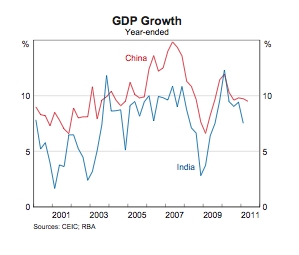
The latest RBA Chart Pack shows quite clearly that China’s economic growth is falling, and is now below the levels of six years ago (2005), while India’s economic growth is now at levels of 5 years ago (2006):

Source: RBA Chart Pack, August 2011

Could this be a new record for Treasurer Swan?

Five lies, in two short sentences.

Why do we all stand by and permit such criminal dishonesty, from the Treasurer of our taxes?

Any Financial Officer for a public corporation who performed their duties in this way, would receive a very long sentence.

The deceived shareholders would insist on it.

Shorten Stupid, Swanning Around On Debt

15 Aug

Not only is our Treasurer unquestionably The World’s Stupidest Treasurer (“Wayne: OOPS! I Did It Again”).

The Assistant Treasurer wants his title.

From ABC Insiders (note carefully the emphasis added):

BARRIE CASSIDY: Now what’s happened to the budget bottom line? This promise to reach a surplus by 2012-13, will that now happen?

BILL SHORTEN: Well as our Prime Minister said, getting to a budget surplus is our objective.

And just referring to your earlier questions about the stock market and Australia and how we’re going, when you look at our public sector finance position in Australia compared to the Americans, the Europeans, we are doing very well.

Our net public sector debt at the moment is 7.2 per cent. Or to put it in plain English, if you as the Australian economy were bringing in $100,000 our net public sector debt is $7,000. Our interest payments are 0.4 per cent or $400 off a base of $100,000.

Oh dear.

This is not only the Assistant Treasurer.

This is also the Minister for Financial Services and Superannuation ( “Stealing Our Super – I DARE You To Ignore This Now” ).

As we saw with the RBA Governor, Shorten is either a liar, or a blithering idiot.

Or more likely both.

His “plain english” analogy is manifestly false and stupid.

And whether by accident or intent, it is inexcusably deceptive.

He is of course, obliquely referring to the preferred “standard” measure of government debt – “as a percentage of GDP”.

Regular readers (and Twitter followers in particular) will know my strongly-held views on the politically-convenient falsity of this measure.  I maintain that it is a completely invalid (and deliberately deceptive) measure by which to assess government debt levels.

“GDP” stands for “Gross Domestic Product“, and is supposed to be a measure of the market value of all real “production” of the economy.

The reality is far different.

Rather than actually measuring the actual market value of what is actually produced and actually sold (that is, real products/services that are of real value), the methodologies used for measuring GDP are, to be blunt, fudges. Invented by ivory-towered #JAFA‘s, disconnected from reality, in high-minded belief that they are “approximating” the real world. In the end, what we find is that the “GDP” (and thus, the economic “growth”) figures that we are given, are really nothing more than the grand sum total value of transactions (ie, buying and selling) in the economy.

So, to use a simplistic example – Person A pays Person B $5 for something, and Person B uses that $5 to pay Person C for something; the “GDP” measure considers that to be $10 worth of “GDP”. Note well: nothing new has necessarily been “produced” here. The same $5 has simply churned from one person, to another, to another, in exchange for goods or services. But for the purposes of the false GDP measuring stick, that series of transactions is considered $10 worth of “GDP”.

[Importantly, if the bankstering system creates 5% more new money (credit, ie, debt) out of thin air this year, thus devaluing the buying power of the money already in the system, and as a result, next year the same transaction costs $5.25 from Person A to Person B, and $5.25 from Person B to Person C, then the total ($10.50, versus $10 last year) would be deemed notional “economic growth” of 5%. When in reality, there may still be no new real wealth “produced” in that example … just a churn of more (devalued) money.]

Now most of us would think it quite stupid for a household or a business to measure its debt against the grand sum total of all its buying + selling (or spending + earning).  Instead, for budget purposes we measure our debt versus our income (or for Household Balance Sheet purposes, against our liquid, convertible-to-cash assets)

Likewise, when it comes to the national Budget, the Government should not be permitted to blur over and hide the truth of the issue by talking about the debts it accrues (for the taxpayer to pay back) as a percentage of all the buying and selling in the economy. Instead, it should be required to discuss the debts it accrues, as a measure of government debt versus government income.

Let’s consider a real world example.

In the 2009-10 Final Budget Outcome, we see the following:

2009-10 Final Budget Outcome, Part 1, Table 1

As you can see, the government’s income (Revenue) was $292.8 Billion.

It claims this was 22.5% of GDP. Meaning that the GDP calculation for 2009-10 must have been 292.8 / 0.225 = $1.3 Trillion.

Now, to use Shorten’s false, misleading and deceptive analogy, he would have us all think that the government was “bringing in” $1.3 Trillion.

And so, he would have you focus on the totally irrelevant fact that the government’s net public debt was “only” 7.2% of that $1.3 Trillion churned in the economy (or approx. $94 Billion @ June 2010).

Convenient bit of perception management.

Because it doesn’t sound like very much, when stated that way.

But … what if you instead compare the actual public debt number, not to the $1.3 Trillion in transactions churned in the economy, but to actual government income?

Using the same 2009-10 example, $94 billion in net debt, versus $292.8 billion in total income (ie, 32%) sounds a lot worse, doesn’t it.

And most importantly of all, it is an honest way of expressing debt that is far easier for average voters to understand.

When you look at it this way, what you see is a very different picture of government debt.

Presented in these terms, it is like a householder who earns only $29,280 in income, with a net* debt of $9,400.

Once you pay for all your costs of living out of your $29,280 in income, that $9,400 debt is not such a “low” figure after all. Servicing the interest and paying off the debt principal is not so easy, as the deceitful politician would have you imagine.

Finally, did you notice the last sentence that Shorten uttered?

Our interest payments are 0.4 per cent or $400 off a base of $100,000.

By now I hope that you can see how false, misleading and deceptive that statement is.

You now know that his analogy is completely false – that the government is not “bringing in” $100,000 with which to pay interest on the debt.  And neither is the economy – because that “$100,000” is simply the grand sum total of all the buying and selling in the economy.  It is NOT a measure of income, or of available cash!

If Mr Shorten were honest – or, had a clue what he was talking about – then what he should have said is this –

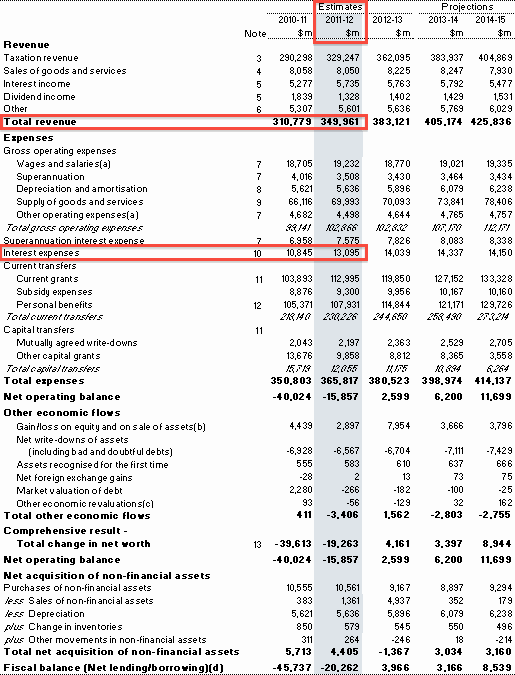
“Our interest payments are 3.74 per cent or $13,095 off a base of (an estimated) $349,961 in Income for 2011-12 alone”.
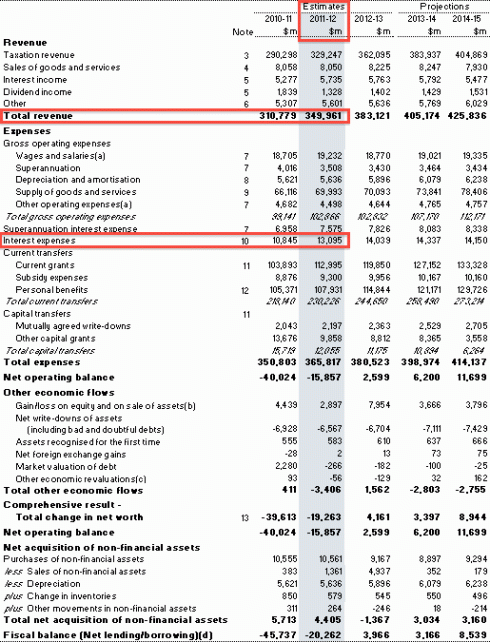
Source: 2011-12 Budget, Paper No. 1, Statement 9, Table 1

Swanning around with false, misleading, and deceptive statements about our economy typifies the gross dishonesty of our political “class”.

It’s not good enough.

I suggest that it is high time for fundamental changes to our system of governance.

A good starting point would be for us all to fully wake up to the reality of the kind of self-serving, short-sighted, dishonest and immature scumbags who populate our Parliament, and demand a change to the rules concerning eligibility for running for public office.

I vote for a Parliament of amateurs – regular people – with no one under retirement age allowed to stand for election –

No More Mañana Or Bananas In A Parliament Of Nanna’s

* “Net” debt” is another misleading and deceptive way in which all our politicians (except Barnaby Joyce) prefer to describe debt.

Referring to public debt in “net” terms (rather than “gross”) is another example of politicians wilfully ignoring reality, in order to gild the lily and make their own piss-poor performance seem better than it is.

“Net” debt is (simply stated) the total of debt actually owed by the government (ie, Gross debt), minus the value of “financial assets” held by the government. Australia uses the OECD definition (emphasis added):

Government net debt comprise all financial liabilities minus all financial assets of general government. Financial assets of the general government sector have a corresponding liability existing outside that sector. The exceptions are monetary gold and Special Drawing Rights, financial assets for which there is no counterpart liability.

Monetary gold and Special Drawing Rights may be included as assets of the general government sector or they may be classified as assets of the central bank, at the discretion of the government.

Source Publication:
The OECD Economic Outlook: Sources and Methods.

It’s important to note the bolded phrase in that definition.

Because in choosing to use “Net” debt as the preferred figure to talk about in public, the government (no matter the Party) is wilfully deceiving themselves, and the community.

Gross debt is what the government owes.

Net debt is gross debt, minus the government’s financial assets. And with the exception of gold and SDR’s, those “assets” are someone else’s liability.

To use the politically-convenient “net” debt figure (because it is lower thus sounds better than Gross debt), a politician must count their chickens before they’ve hatched. That is, by implication they are assuming that the counterparty who is liable for the “assets” they are counting on, can and will actually make good on their liability.

The GFC which never went away is a perfect example of why you can never bank on counterparties.

The only honest way to look at debt, is the simplest way.

What you owe to others, is what you owe. You cannot bank on what others owe to you before you get it, as a false justification for claiming that your own debt burden is less than it actually is.

End of story.

Barnaby: “Waiting For Swan Dude To Mutter The Word ‘Surplus'”

11 Aug

Senator Joyce writes for the Canberra Times (emphasis added):

Debt is now a long-term problem

In the mall outside the City Hall gathered the Socialist Action Alliance; speeches, placards, all fairly predictable, about 80 of them.

The zealot loud hailer core were looking a little tired, and a bit passe, but the students were revelling in experimenting with another illicit substance, communism.

Across from them was the Ban the Burka group. There were fewer of them, all in blue, special King Gee Ban the Burka shirts with a motif on them that looked like they wished to ban Pac Man.

Then there was just a cacophony of noise which, from where I was standing, while waiting for my wife and daughter to return from a shop, sounded something along the lines of “Bigot stoning Moslem ban”. The amalgam of the two mantras had led to a perfectly reasonable request.

Into the midst of this came another undergraduate dressed all in black with a cape and a black-winged motorbike helmet. “Bat Thief” was emblazoned across his chest.

He cut quite a dashing figure. Beside him stood plain clothes Boy Wonder with a placard on a stick offering “free hugs”. They were obviously a duo – it was outside City Hall after all.

Bat Thief stood beside me, observed the scene and muttered “racism”.

Which group he was referring to and exactly what he was going to do next shall remain a mystery.

Anyway it appeared to be either too much or too inconsequential for Bat Thief.

He and his coterie of skateboard super heroes exited behind the Ban Pac Man crowd.

The constabulary was also there and had managed to apprehend three felons; the charge, riding a push bike in the mall, mitigated by their combined ages being less than that of the youngest protester.

This was the day that Standard & Poor’s downgraded the US Government. The mall appeared oblivious to the fact that the world had changed. A fire that was lit by debt and had never gone out had come raging back over the horizon and could financially take all before it.

Australia has been distracted from the main issue. I have more faith in Bat Thief and the Free Hugs boy wonder than I do in Wayne and Julia to get us through this one.

If you put your face too close to the painting you can’t see the picture, and to see this picture you have to go back to 2008.

I remember reading some very prescient articles that formulated my belief that debt had gone from a transient problem to a long-term structural problem.

William White, from the Bank of International Settlements, started to raise serious concerns about interbank liquidity. Dr Paul Woolley and Eric Janszen argued that people had been borrowing money to gamble on derivatives. A very dangerous thing.

I remember when studying for my CPA, it was one of the first lessons taught, learning that Toyota once decided they could make more money trading options than selling cars and almost went broke. Unfortunately we had whole nations trying to do it.

It always amazed me that if a humble accountant from St George was reading this then why wasn’t the Treasurer? At the time he seemed too busy fighting a war on inflation, in an attempt to embarrass the previous government, rather than tackle the problems facing the world.

Now, the problem then was debt and the problem now is debt.

Southern Europe doesn’t want to pay their taxes but they want the social protections of a benevolent government. The problem for the Germans is that they are sick of bailing them out. They may no longer have a choice because the problem is becoming too big for anyone.

America’s debt is at a level that is beyond the human mind to actually fathom; it has become a form of mathematical metaphysics worthy of Donne or Dryden.

Here in Australia we are led by an apparently fiscally conservative government that has increased public debt by 150 per cent since 2007.

Only those other noted fiscal conservative governments in Iceland and Ireland have grown their debt at a faster rate.

Our Treasurer’s promise to deliver a surplus is as much of a show as Bat Thief’s cape and skateboard trick. I am waiting for Swan dude to mutter the word “surplus” and then disappear down the street with the Labor party on their skateboards.

Keating Was Right – US Treasury Secretary A “Gigantic Fool”

6 Aug

US Treasury Secretary Tim Geithner, in April 2011:

Interviewer (1st question): Is there a risk that the United States could lose its AAA credit rating? Yes or no?

Geithner: No risk of that.

Interviewer: No risk?

Geithner: No risk.

This is the chap who our own Paul Keating aptly described as a “gigantic fool” over his bungling of the Asian Crisis in the late 90’s in his then role as Treasury line officer at the genocidal bankster racketeers, the International Monetary Fund.

The same IMF that our Wayne likes to selectively quote … but only when what they say fits with his latest line of BS.

‘Nuff said about the competence of Geithner.

Who is our Treasury secretary, dear reader?

Be afraid.

Be very afraid.

Learn all about our new Treasury secretary, Martin Parkinson, here –

Our New Treasury Secretary Is America’s Mini-Me

By the way.

Keating’s no dummy.

Read what he predicted back in March 2010.

He was absolutely bang on the money –

Global Turmoil Looms: Keating

Design a site like this with WordPress.com
Get started