Archive by Author

Greek PM: Worst Fears Confirmed

27 Feb

Greek Prime Minister George Papandreou told parliament on Friday, after a visit by EU economic inspectors, that the worst fears about Greece’s economy had been confirmed:

“Everything that was revealed after the elections proved that New Democracy (the previous, conservative administration) fled from its responsibilities,” Papandreou said. “History confirmed our worst fears.”

“The damage is incalculable. It is not only financial or fiscal but also affects the position of the state …

“Our duty today is to forget about the political cost and think only about the survival of our country.”

“There is only one dilemma: Will we let the country go bankrupt or will we react? Will we let the speculators strangle us, or will we take our fate in our own hands?” Papandreou said.

“We must do whatever we can now to address the immediate dangers today. Tomorrow it will be too late, and the consequences will be much more dire,” he added.

Leading economists around the world have been warning of dire consequences for the international economy should the Greek debt crisis become a contagion that spreads around the globe.

Yet in Australia, Senator Barnaby Joyce is ridiculed by all and sundry, for daring to warn of the impacts on Australia from this looming international sovereign debt crisis.

A crisis that Barnaby’s esteemed critics cannot see coming. Again.

Henry Sees Cyclical Angel Descending

26 Feb

As recently as October 2009, Treasury Secretary Ken Henry predicted a Golden Age for the Australian economy, that will “stretch to 2050”:

“While the global financial crisis has taken some of the heat out of our export prices, we should get used to the idea that we could have structurally higher terms of trade for some time, possibly for several decades,” he said.

In a speech at the Brisbane University of Technology, Henry said Australia’s population will grow as the mining boom, fuelled by demand from China and India, will continue to bring in immigrant workers. Handled correctly, he said, this could provide a “period of unprecedented prosperity”.

Henry pointed to growth in several Asian countries, which he said will give a boost to the mining boom that will see it last for several more decades into 2050.

Just one week ago, RBA Governor Glenn Stevens‘ colleague, Assistant Governor Philip Lowe, also had a vision of the cyclical angel returning from the heavens:

I am quite optimistic that story has some decades to run and that underlies much of the positives for the Australian economy,” Lowe told an economic development forum in Sydney.

“It is going to be a good 20 years for China and us,” he said.

And only 3 days ago, RBA Deputy Governor Rick Battelino too, joined in the angel chorus:

Mr Battellino was uncertain about how long the current boom would last, but said past booms had lasted around 15 years.

“On this occasion, the growth potential of countries such as China and India suggests that the expansion in resource demand could continue for an extended period, though this will depend at least to some extent on the economic management skills of the authorities in these countries, not to mention our own,” he said.

Illustration - nicholsoncartoons.com.au

Reassuring stuff. Or is it?

Three days ago, former Morgan Stanley chief Asia economist Andy Xie and hedge fund manager James Chanos saw something rather different:

“There’s a monumental property bubble and fixed-asset investment bubble that China has underway right now,” Chanos said. “And deflating that gently will be difficult at best.”

A glut of factories in China is “wreaking far-reaching damage on the global economy,” stoking trade tensions and raising the risk of bad loans, the European Union Chamber of Commerce in China said in November.

The risks are so great that a decade of little or no growth, as Japan experienced in the 1990s, can’t be dismissed, said Patrick Chovanec, an associate professor in the School of Economics and Management at Beijing’s Tsinghua University.

And two days ago, the former chief economist of the International Monetary Fund, Professor Ken Rogoff, also failed to see a Chinese cyclical angel descending. He saw the angel of doom:

China’s economic growth will plunge to as low as 2 percent following the collapse of a “debt- fueled bubble” within 10 years, sparking a regional recession, according to Harvard University Professor Ken Rogoff.

“We would learn just how important China is when that happens. It would cause a recession everywhere surrounding” the country, including Japan and South Korea, and be “horrible” for Latin American commodity exporters, he said.

Rogoff was one of very few economists who predicted the GFC.

Ken Henry, and all the boffins at the RBA… did not.

No, We Cannot Pay Our Debt

26 Feb

Here’s another picture that tells a thousand words.

Yesterday Barnaby wrote in The Australian about the annual Budget surpluses needed to pay back Labor’s ever rising debt ($1 Billion more today alone; another $1.8 Billion next week):

Let’s talk about the abundance of faith exhibited by Labor when it tells us of the eight consecutive $19bn surpluses that are required to bring the budget back into orbit when the continued stresses on the international economy are clear and evident, especially in Europe.

On the ABC’s Q&A program on Feb 15th, Barnaby pointed out that Labor’s “plan” to return the Budget to surplus is pure fantasy:

We have always got the view that you should try and reduce tax but the first thing, without harping on it, we’ve got to deal with the debt and because they keep racking up debt, that takes away our capacity to reduce your tax and there’s no other way around it. You either increase your revenues, decrease your costs – they talk about productivity and sort of the cyclical angel descending from heaven and making everything better

Well, just what is the likelihood of that cyclical angel descending?  And even if it does, can it produce eight consecutive surpluses of $19 Billion?

Decide for yourself.

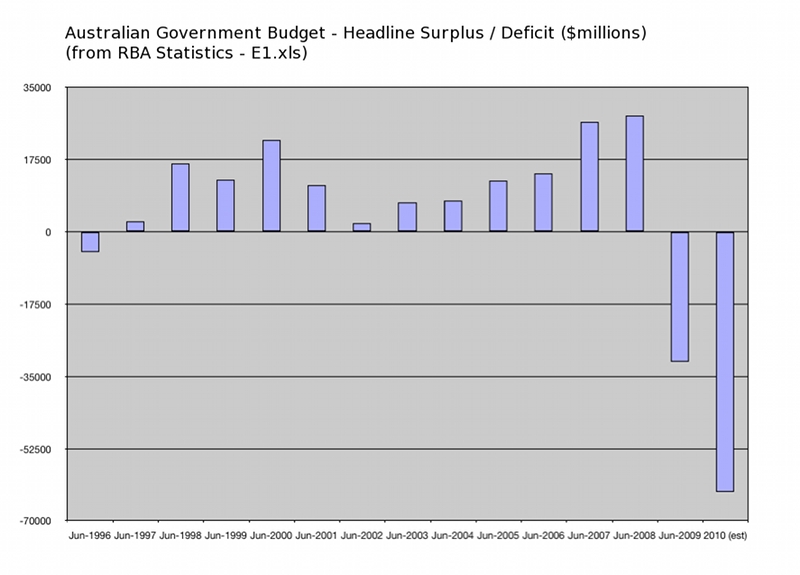
Below is a chart of Australian Government Budget surplus / deficits, dating back to the beginning of the Howard Government. Source is the Reserve Bank of Australia’s Statistics section. Click on the chart to enlarge –

This country has never seen anything like eight consecutive years of $19 Billion surpluses. In fact, the Howard Government achieved it just 3 times… in 12 years… during an unprecedented mining boom.

Barnaby is right.

Roubini: ‘Risky Rich’ Countries in Greatest Danger of Default

26 Feb

New York University Professor Nouriel Roubini – famous for having predicted the GFC in 2006 – again defies the so-called ‘conventional wisdom’ by warning that it is the “risky rich” countries who are in greatest danger of sovereign debt default:

Today’s swollen fiscal deficits and public debt are fueling concerns about sovereign risk in many advanced economies. Traditionally, sovereign risk has been concentrated in emerging-market economies. After all, in the last decade or so, Russia, Argentina, and Ecuador defaulted on their public debts, while Pakistan, Ukraine, and Uruguay coercively restructured their public debt under the threat of default.

But, in large part – and with a few exceptions in Central and Eastern Europe – emerging-market economies improved their fiscal performance by reducing overall deficits, running large primary surpluses, lowering their stock of public debt-to-GDP ratios, and reducing the currency and maturity mismatches in their public debt. As a result, sovereign risk today is a greater problem in advanced economies than in most emerging-market economies.

Is Greek Debt Contagious?

26 Feb

The Greek flu looks like it’s spreading through Europe. How contagious is it? How far will it spread?

Charles Wyplosz, Professor of International Economics at the Graduate Institute (Geneva), and one of the world’s leading experts on Eurozone monetary and financial matters, sets the record straight on the latest twist in the GFC:

A debt default by the Greek government, on its own, would be a non-event. Greece is a relatively small country (with 11 million people, its GDP amounts to less than 3% of Eurozone’s GDP). Contagion to Portugal, which is even smaller, would also be a non-event. Moving on to Spain and Italy is another matter…

The real worry is the banking system. Some European banks hold part of the Greek debt and, if still saddled with unrecognised losses from the subprime crisis, some might become bankrupt. Many governments have simply not pushed their banks to straighten up their accounts, and they are now discovering some of the unforeseen consequences of supervisory forbearance…

Contagious debt defaults, along with bank failures, could lead to a double-dip recession in Europe, possibly affecting the US as well. If that were to happen, with the interest rate at the zero lower bound and fiscal policy not available any more, we could face a terribly bad situation.

Greek Crisis Coming to America

26 Feb

Professor Niall Ferguson, recently seen on ABC TV in his acclaimed documentary series The Ascent of Money, writes for the Financial Times:

It began in Athens. It is spreading to Lisbon and Madrid. But it would be a grave mistake to assume that the sovereign debt crisis that is unfolding will remain confined to the weaker eurozone economies. For this is more than just a Mediterranean problem with a farmyard acronym. It is a fiscal crisis of the western world. Its ramifications are far more profound than most investors currently appreciate…

What we in the western world are about to learn is that there is no such thing as a Keynesian free lunch. Deficits did not “save” us half so much as monetary policy – zero interest rates plus quantitative easing – did. First, the impact of government spending (the hallowed “multiplier”) has been much less than the proponents of stimulus hoped. Second, there is a good deal of “leakage” from open economies in a globalised world. Last, crucially, explosions of public debt incur bills that fall due much sooner than we expect.

This Crisis Won’t Stop Moving

26 Feb

From the New York Times:

You know we’re in trouble when we’re told that the economic problems in Greece, Portugal and Spain, the most indebted countries in the euro zone, are likely to remain safely contained in those nations.

After all, we heard the same nonsense in 2007 from United States financial leaders talking about the subprime mortgage mess. Both Ben S. Bernanke, the chairman of the Federal Reserve Board, and Henry M. Paulson Jr., then the Treasury secretary, rolled out to reassure concerned investors that troubles in mortgage land wouldn’t permeate the rest of the economy.

As we all now know, mortgage woes were contained — to planet Earth. And so it may be with overleveraged nations in Europe.

Simply put, contagion is a fact of life in our interconnected global economy and financial markets. And that means investors must strap in for more gyrations in the stock and bond markets as the great and painful deleveraging that began in 2007 continues around the world.

Stevens – Australia’s Most Useless?

26 Feb

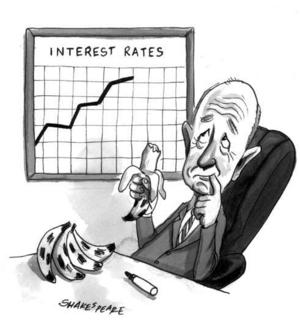
Illustration - John Shakespeare

In recent days the mainstream media have made much of Reserve Bank of Australia Governor Glenn Stevens’ response to comments made by Barnaby Joyce concerning Australia’s rising debt levels:

‘‘There has never been an event of sovereign default by Australia,’’ Mr Stevens told a parliamentary hearing in Canberra. ‘‘I very much doubt there ever will be.’’

Now, don’t you feel reassured? After all, if the esteemed Governor of the RBA is not worried, then why should you be?

Think again. This is the same “expert” who utterly failed to foresee any warning signs of the impending Global Financial Crisis. Indeed, Stevens kept raising interest rates right into the teeth of the GFC, prompting this scathing response from the Daily Telegraph:

The nation’s most powerful economic figure has committed a double betrayal of working families – urging big banks to ignore the RBA’s official interest rate and saying taxes could be increased.

For the second time in a fortnight, Reserve Bank Governor Glenn Stevens has gone public to encourage the biggest lenders to go beyond the current official interest rate and slug mortgagees at a higher rate.

His controversial comments effectively render him useless – because it is a key part of his job as Reserve Bank governor to use official interest rates as a guide for the major banks as to what they should charge on mortgages.

“I can’t tell you at what point rates will come down. I can’t promise they won’t rise. I can’t tell you that, mainly because I don’t know,” Mr Stevens said yesterday.

Note the date of those comments by Stevens. April 4, 2008. His last interest rate rise prior to the GFC, was on March 4, 2008, taking the official cash rate to 7.25%.

Less than 2 weeks after Stevens had again raised Australia’s interest rates, US banking giant Bear Stearns collapsed.

Less than 6 months later, all hell broke loose with the collapse of Lehman Brothers… the biggest corporate collapse in US history.

From September 2008, Stevens had to chainsaw 400 basis points (4%) off the cash rate, in a frantic bid to save the Australian economy from imploding.

Remember that, for next time you hear the media again twisting Stevens words into an alleged putdown of Barnaby Joyce’s concerns.

Hummel: The US Will Default On Its Debt

26 Feb

Barnaby warned about the possibility of US sovereign debt default. San Jose State University economist, Professor Jeffrey Rogers Hummel, makes a prediction:

It is not literally impossible that the Federal Reserve could unleash the Zimbabwe option and repudiate the national debt indirectly through hyperinflation, rather than have the Treasury repudiate it directly. But my guess is that, faced with the alternatives of seeing both the dollar and the debt become worthless or defaulting on the debt while saving the dollar, the U.S. government will choose the latter.

Magnus: Sovereign Default Threatens World

26 Feb

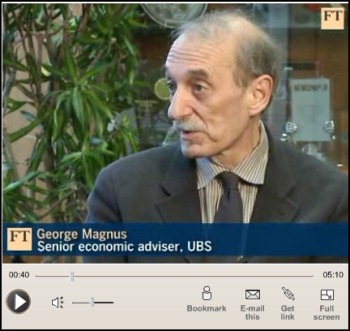
Respected UBS economist George Magnus says sovereign debt default now presents a grave risk to the global economy:

The sustainability of sovereign debt hangs heavily over bond markets, and the prospects for economic and financial stability…

There is no peacetime precedent for the current speed and scale of public debt accumulation and it is difficult to assess the social tolerance for high debt levels, and for the pain of protracted fiscal restraint. In several European Union member states, the threshold has already been breached. The spectre of sovereign default, therefore, has returned to the rich world.

Design a site like this with WordPress.com
Get started