
Tag Archives: Asia Crisis

China Crisis ‘A Lot Worse Than People Expect’

6 Apr

Robert J. Brenner, economic historian and professor of history at the University of California, offers a grim forecast of the future for China in a series titled, “Overproduction Not Financial Collapse Is The Heart Of The Crisis: The US, East Asia, and the World”:

I think the Chinese crisis is going to be a lot worse than people expect, and this is for two main reasons. The first is that the American crisis, and the global crisis more generally, is much more serious than people expected, and in the last analysis, the fate of the Chinese economy is inextricably dependent on the fate of the U.S. economy, the global economy. This is not only because China has depended to such a great extent on exports to the U.S. market. It is also because most of the rest of the world is also so dependent on the U.S., and that especially includes Europe. If I’m not mistaken, Europe recently became China’s biggest export market. But, as the crisis originating in the U.S. brings down Europe, Europe’s market for Chinese goods will also contract. So the situation for China is much worse than what people expected, because the economic crisis is much worse than people expected. Secondly, in people’s enthusiasm for what has been China’s truly spectacular economic growth, they have ignored the role of bubbles in driving the Chinese economy. China has grown, basically by way of exports and, particularly, a growing trade surplus with the U.S. Because of this surplus, the Chinese government has had to take political steps to keep the Chinese currency down and Chinese manufacturing competitive.

Specifically, it has bought up U.S. dollar-denominated assets on a titanic scale by printing titanic amounts of the renminbi, the Chinese currency. But the result has been to inject huge amounts of money into the Chinese economy, making for ever easier credit over a long period. On the one hand, enterprises and local governments have used this easy credit to finance massive investment. But this has made for ever greater overcapacity. On the other hand, they have used the easy credit to buy land, houses, shares, and other sorts of financial assets. But this has made for massive asset price bubbles, which have played a part, as in the U.S., in allowing for more borrowing and spending. As the Chinese bubbles bust, the depth of the overcapacity will be made clear. As the Chinese bubbles bust, you will also have, as across much of the rest of the world, a huge hit to consumer demand and disruptive financial crisis So, the bottom line is that the Chinese crisis is very serious, and could make the global crisis much more severe.
Global Turmoil Looms: Keating

27 Mar

From The Age:

Paul Keating has delivered a bearish assessment of the world economy, warning that another bout of global turmoil is possible if trade and capital imbalances go unaddressed.

The former prime minister and treasurer last night argued current account surplus nations such as China and Germany must urgently shrink their surpluses by lifting the role of domestic demand.

Failure to do so could trigger another sharp deterioration in global economic conditions, he said, damaging Australia’s growth prospects.

Mr Keating also casts doubt on China’s ability to continue growing at recent rates of near 10 per cent. He said this rate was being artificially supported by excessive investment and its pegged currency, which makes its exporters more competitive.

“Our biggest customer China is growing for the moment… but only on investment steroids,” he said.

The former prime minister also highlighted risks to foreign countries with large debts, such as the US and Europe.

In the event of a double-dip recession, Mr Keating said the developed world would not have the funding to support massive fiscal packages.

“If a financial crisis comes in the future there won’t be the method to deal with it as we’ve seen in this crisis,” he said.

Keating is correct.

Thanks to Rudd Labor’s panicked, massive “stimulus” spending – tens of billions of borrowed money wasted on pink batts, foil insulation, and Julia Gillard Memorial School Halls – Australia no longer has a safety net.

And despite the daily warnings of crisis dead ahead – now coming even from former “world’s greatest treasurer” Paul Keating – Rudd Labor is continuing to borrow well over $1bn a week.

When the next wave of the GFC comes, everyone will know that Barnaby is right.

China Bubble Ready To Pop

26 Mar

From the Financial Post (Canada):

The Chinese economy is a financial bubble that will inevitably pop, says Edward Chancellor, author of the classic text on financial manias, Devil Take the Hindmost. In a new report for GMO, the Boston-based money manager Mr. Chancellor lists 10 signs of a bubble in progress. They range from “blind faith in the competence of the authorities” to “a surge in corruption” to “inappropriately low interest rates.”

He figures the Chinese economy meets all 10 of the criteria. And he has harsh words for some of the cheerleaders for China: “Wall Street … tends to downplay the darker aspects of the Chinese demographic story,” he writes.

“China’s population is set to decline in 2015. The worker participation rate will peak this year. It’s anticipated that the number of people joining the workforce will fall off quite rapidly. Yet it’s this section of the population that tends to move to cities and has provided China with an apparently limitless supply of cheap labor.”

Mr. Chancellor figures that if China’s economy slows below Beijing’s 8% growth target, calamity will ensue. Excess capacity will stifle new investment, the real estate bubble will burst and non-performing loans will bring down the banking system.

China Says Greek Debt Crisis ‘Tip Of The Iceberg’

26 Mar

From the Sydney Morning Herald:

The euro slumped Thursday to a fresh 10-month low after a senior Chinese central bank official warned that the Greek debt crisis was just the “tip of the iceberg.”

Analysts said the comments, and a debt downgrade for Portugal on Wednesday, suggested the crisis was widening to take in the entire eurozone project.

“The fact that Zhu Min, the deputy governor of the People’s Bank of China, felt compelled … to call the Greek debt crisis ‘the tip of the iceberg,’ is as good an indication as any of how rapidly fundamental concerns are growing about the eurozone,” said analyst Neil Mellor at Bank of New York Mellon.

“Indeed, this comment might well signal the point that we stop talking about a ‘Greek debt crisis’ and start talking about a ‘Eurozone structural crisis’ instead,” Mellor said in a research note to clients.

Please take the time to browse the recent posts on this blog.

Our financial authorities – RBA Governor Glenn Stevens, Treasury Secretary Ken Henry, and the Labor Government – are all convinced that the global financial crisis is ‘over’.

They have publicly declared that Australia is all set for a new, multi-decade mining boom (thanks to China), that will provide us with a “period of unprecedented prosperity”.

They have ridiculed Barnaby Joyce, our only politician with the courage to publicly raise questions about the state of the rest of the world’s economies, and what calamity that might mean for Australia, since last October.

And, all of them (except Barnaby) completely failed to predict the GFC in the first place.

Yet, our media and the public believe that everything is fine.  That the Government can just keep right on borrowing around $2bn a fortnight, to continue squandering on a massive, rushed and bungled “stimulus”.

Barnaby is right.

Ten Ways To Spot A Bubble In China

26 Mar

From SeekingAlpha:

Edward Chancellor, author of the seminal book on financial speculation and manias “Devil Take The Hindmost,” is now turning his eyes to China. He sees a number of red flags which point to excess in China.

Chancellor writes:

“In the aftermath of the credit crunch, the outlook for most developed economies appears pretty bleak. Households need to deleverage. Western governments will have to tighten their purse strings. Faced with such grim prospects at home, many investors are turning their attention toward China. It’s easy to see why they are excited. China combines size – 1.3 billion inhabitants – with tremendous growth prospects. Current income per capita is roughly one-tenth of U.S. levels. The People’s Republic also has a great track record. Over the past thirty years, China’s Gross Domestic Product has increased sixteen-fold.

So what’s the catch? The trouble is that China today exhibits many of the characteristics of great speculative manias

  1. “Great investment debacles generally start out with a compelling growth story.” 100% yes. Check.
  2. “Blind faith in the competence of the authorities.” See Roach’s comments above or read Goldilocks is not sleeping in America anymore; she’s now in China. Check.
  3. “A general increase in investment is another leading indicator of financial distress. Capital is generally misspent during periods of euphoria. Only during the bust does the extent of the misallocation become clear.” See my posts China’s present growth story is built on malinvestment and Jim Chanos still bearish on China, talks malinvestment for evidence that China is misallocating resources. Check.
  4. “Great booms are invariably accompanied by a surge in corruption.” Remember this post “I want to be a corrupt official when I grow up”? That’s exactly what Chancellor is talking about. Check.
  5. “Strong growth in the money supply is another robust leading indicator of financial fragility. Easy money lies behind all great episodes of speculation from the Tulip Mania of the 1630s – which was funded with IOUs – onward.” Andy Xie: Chinese monetary policy has to be tightened Check.
  6. “Fixed currency regimes often produce inappropriately low interest rates, which are liable to feed booms and end in busts.” Think Latvia or Argentina. Are the Baltics the new Argentina? And we know China’s peg is creating problems because that’s a bone of contention right now. Check.
  7. “Crises generally follow a period of rampant credit growth.” “Enron-Esque Characteristics” Hiding An Even More Explosive Credit Growth In China. Check.
  8. “Moral hazard is another common feature of great speculative manias. Credit booms are often taken to extremes due to a prevailing belief that the authorities won’t let bad things happen to the financial system. Irresponsibility is condoned.” See Stephen Roach’s comments again. Check.
  9. “A rising stock of debt is not the only cause for concern. The economist Hyman Minsky observed that during periods of prosperity, financial structures become precarious.” See #7 again. Check.
  10. “Dodgy loans are generally secured against collateral, most commonly real estate.” The Andy Xie story shows you this. Check.

It looks like China is ten for ten. Is China in a bubble blow-off top like Japan post-Plaza accord? I say yes. Anyone who thinks this will not end badly is in for a rude awakening.

China Facing “Boom, Bubble, Bust”

26 Mar

From BusinessWeek:

China appears on track for an “asset boom, bubble and bust” that may take three years to play out and probably won’t be thwarted by tighter economic policy, Citigroup Inc. economists said.

Citigroup joins hedge fund manager Jim Chanos, Gloom, Boom & Doom publisher Marc Faber and Harvard University professor Kenneth Rogoff in warning of a potential crash in China.

“What is policy in China doing about the threat of overheating in the financial and real economy?” Buiter and Shen said. “The short answer is: not much, and not enough to prevent the creation of what could become a major asset boom, bubble and bust.”

Japan: ‘Extremely Little’ Room For Stimulus

20 Mar

From Bloomberg:

National Strategy Minister Yoshito Sengoku said Japan has “extremely little” room for further stimulus spending because of the country’s financial condition.

“From a fiscal point of view, there’s extremely little room for such a thing,” Sengoku said in an interview in Tokyo yesterday when asked about the prospects for another spending plan. “We need to carefully watch whether the situation would go to such lengths.”

His remarks contrast with comments made this week by Financial Services Minister Shizuka Kamei, who urged the government to compile a stimulus package to bolster the deflation-plagued economy. Prime Minister Yukio Hatoyama said on March 17 that he hadn’t discussed such a proposal.

Standard & Poor’s cut its outlook on Japan’s AA sovereign rating to “negative” in January, a move Sengoku described at the time as a “wake-up call” to repair the nation’s finances. Japan’s ratio of debt to gross domestic product is approaching 200 percent, the highest among developed nations, according to the Organization for Economic Cooperation and Development.

Japan is closer to the edge than any other major economy,” said Julian Jessop, chief international economist at Capital Economics Ltd. in London. “There is the risk that the higher the debt numbers are, the more another stimulus package is going to backfire by pushing up interest rates or by making people worry about the need for even bigger fiscal tightening in the future.”

Japan is Australia’s second largest trading partner.

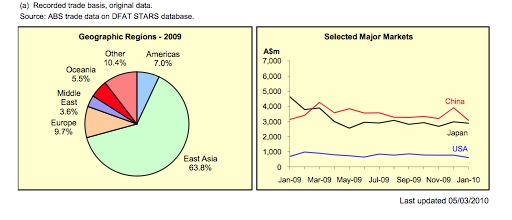
While China has become our largest trading partner in recent times, it is interesting to note the latest trade figures from the Department of Foreign Affairs and Trade

It seems our export trade with China has fallen sharply from Dec ’09 to Jan ’10.  And has been in slow decline since March 2009. That is a trend to watch closely.

There are many grave questions being raised about the sustainability of the China boom. And Japan’s economy is clearly in very deep trouble indeed.

So it is gross incompetence for our financial authorities – such as RBA Governor Glenn Stevens and Treasury Secretary Ken Henry – to continue to plan on our two largest trading partners being able to sustain our economy and get us out of debt in the years ahead.

China ‘Greatest Bubble In History’

18 Mar

From BusinessWeek:

China is in the midst of “the greatest bubble in history,” said James Rickards, former general counsel of hedge fund Long-Term Capital Management LP.

The Chinese central bank’s balance sheet resembles that of a hedge fund buying dollars and short-selling the yuan, said Rickards, now the senior managing director for market intelligence at McLean, Virginia-based consulting firm Omnis Inc.

“As I see it, it is the greatest bubble in history with the most massive misallocation of wealth,” Rickards said at the Asset Allocation Summit Asia 2010 organized by Terrapinn Pte in Hong Kong yesterday. China “is a bubble waiting to burst.”

Rickards joins hedge fund manager Jim Chanos, Gloom, Boom & Doom publisher Marc Faber and Harvard University professor Kenneth Rogoff in warning of a potential crash in China’s economy.

And yet, RBA Governor Glenn Stevens, Treasury Secretary Ken Henry, and their many cheerleaders in the Australian media still believe that we are all set for another China-fueled mining boom, this time to 2050.

They failed to predict the GFC (see the many links in this blog for background).  That epic failure has cost Australians literally hundreds of billions of dollars in lost retirement savings and investments in 2007-2009.

So why should we trust their judgement now?

China Biggest Worry For Markets

17 Mar

Fromt the Wall Street Journal:

Nervousness is growing in the financial markets about China, which might seem odd when there are so many other places to worry about.

There’s still Greece, for example, which is likely to be the focus of this week’s meetings of European finance ministers. There’s Germany, and its trade surplus. And there’s the U.S., the U.K. and all the other places with triple-A-rated debt that may not be rated triple-A for much longer.

So why the focus on China, where shares closed Monday at their lowest in five weeks, with the benchmark Shanghai Composite ending below 3000 at its weakest since Feb. 9? Well, as one bank put it on Monday: “Are we facing a ‘growth miracle’ or will China be the next bubble to burst?

Even the markets are more cautious on China than Australia’s financial powers, the RBA and the Treasury department. They still believe we are headed for 40 years of “unprecedented prosperity” on the back of a new China-fueled mining boom.

Is Mr Stutchbury Waking Up?

16 Mar

On February 28th I firmly criticised The Australian’s economics editor Michael Stutchbury’s column, “Chinese Can Fund Our Boom” (see my article here).

Well, it seems Mr Stutchbury may be (reluctantly) waking up to reality, if his column today is anything to go by. Though he cannot yet bring himself to let go of the fantasy entirely:

China Won’t Boom Forever

The big risk now is that, having escaped the global crisis, the Lucky Country thinks it’s bulletproof and the rebound in our iron ore and coal export prices means there is no penalty for bad policy.

The airbag of a US50c-US60c dollar cushioned the economy from the 1997 Asian financial crisis and the 2000 Wall Street tech-wreck. Our new China fortune pulled us out of last year’s global recession.

As a result, Australia is about to enter its 19th straight year of economic expansion, possibly the longest unbroken growth in our history. We appear to be heading into a bountiful decade or two of high commodity export prices driven by the rise of China and India.

But now, no doubt in reaction to Chinese Premier Wen Jiabao’s warning yesterday of a global double-dip recession, Stutchbury hedges just a little on his previous blind confidence:

But this new growth phase is bound to be volatile. And there is a smaller probability but higher impact risk that the mega China boom – like the 1980s Japanese bubble, the 90s Asian boom, the technology boom or the US housing bubble – could burst. We can’t count on being able to avoid a fair dinkum recession during the next decade.

Indeed. The fact is, many authorities around the world are predicting the China bubble may burst by 2012. Including some, like former chief economist for the IMF Ken Rogoff, who did predict the GFC in the first place.

I wonder how long it will take for Mr Stutchbury – and many others in the Australian mainstream economic media – to stop publishing reactions to the latest proclamation by an “authority”, and start researching widely in order to  think for themselves?

Perhaps he might take a lead from the Sydney Morning Herald’s Paul Sheehan, and his excellent and insightful article yesterday.

Design a site like this with WordPress.com
Get started