Tag Archives: barnaby joyce

Pfffffffftttt! That’s The Sound Of The China Bubble Deflating

20 Dec

From Bloomberg:

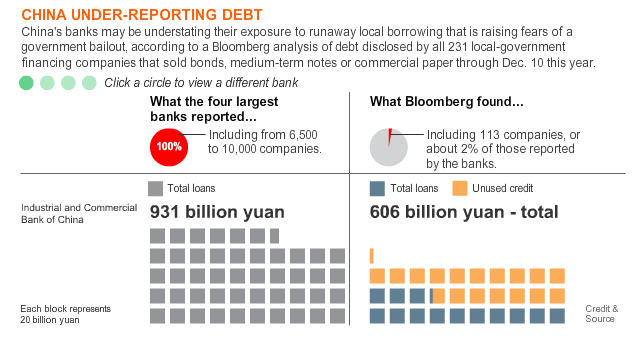
China Local Debts Dwarf Official Data Prompting Too-Big-to-Complete Alarm

Click to enlarge

A copy of Manhattan, complete with Rockefeller and Lincoln centers and what passes for the Hudson River, is under construction an hour’s train ride from Beijing. And like New York City in the 1970s, it may need a bailout.

Debt accumulated by companies financing local governments such as Tianjin, home to the New York lookalike project, is rising, a survey of Chinese-language bond prospectuses issued this year indicates. It also suggests the total owed by all such entities likely dwarfs the count by China’s national auditor and figures disclosed by banks.

Bloomberg News tallied the debt disclosed by all 231 local government financing companies that sold bonds, notes or commercial paper through Dec. 10 this year. The total amounted to 3.96 trillion yuan ($622 billion), mostly in bank loans, more than the current size of the European bailout fund.

There are 6,576 of such entities across China, according to a June count by the National Audit Office, which put their total debt at 4.97 trillion yuan. That means the 231 borrowers studied by Bloomberg have alone amassed more than three-quarters of the overall debt.

The fact so few of the companies have accumulated that much debt suggests a bigger problem, says Fraser Howie, the Singapore-based managing director of CLSA Asia-Pacific Markets who has written two books on China’s financial system.

“You should be more worried than you think,” he said of Bloomberg’s findings. “Certainly more worried than the banks will tell you.

“You know how this story ends — badly,” he said.

The findings suggest China is failing to curb borrowing that one central bank official has said will slow growth in the world’s second-largest economy if not controlled. With prices dropping in China’s real estate market, economists warn that local authorities won’t be able to repay their debt because of poor cash flow and falling revenue from land sales they rely on for much of their income.

Provinces and cities are going deeper into the red to finish projects, from the Manhattan on the east coast, to highways in northwestern Gansu and a stadium fronted by Olympic rings in Hunan, central China. Many were started as part of China’s stimulus program to beat the 2009 world recession. The financing companies accounted for almost half of the 10.7 trillion yuan in all local government debt tallied by the official audit.

The 231 borrowers whose public filings were reviewed by Bloomberg raised a combined 354.1 billion yuan by selling securities this year. They have credit lines from banks of at least 2.3 trillion yuan that have yet to be drawn down, the documents show.

And in other news from Bloomberg:

China’s November Home Prices Post Worst Performance This Year Amid Curbs

China’s home prices posted their worst performance this year with more than half of the 70 biggest cities monitored in November recording declines after the government reiterated plans to maintain property curbs.

New home prices dropped from the previous month in 49 of the cities monitored by the government, compared with 33 posting decreases in October, the national statistics bureau said in a statement on its website yesterday. Only five cities had gains in home prices, according to the statement.

“Home prices will fall further as the government’s tightening continues,” said Jinsong Du, a Hong Kong-based property analyst for Credit Suisse Group AG. “We’ll see more small developers file for bankruptcy or sell off their assets next year.”

Hmmmm. About Saxo Bank’s “Outrageous Prediction” #4 that we saw yesterday:

4 – AUSTRALIA GOES INTO RECESSION

The Chinese locomotive has been losing steam throughout 2011 as investment and real estate led growth becomes harder and harder to come by due to diminishing marginal returns. The effects of the slowing of the up-and-coming Asian giant ripple through Asia Pacific and push other countries into recession. If there ever was a country dependent on the well-being of China it is Australia with its heavy dependence on mining and natural resources. And as China’s demand for these goods weakens Australia is pushed into a recession, which is then exacerbated as the housing sector finally experiences its long overdue crash – a half decade after the rest of the developed world.

Not so outrageous, methinks.

Indeed, precisely what we have long been forewarning.

Labor Fails To Deliver On Two-Thirds Of Its Election Commitments

19 Dec

Media Release – Senator Barnaby Joyce, 19 December 2011:

Reports today in the Courier Mail, Herald Sun and Adelaide Advertiser confirm that over a year since the election, the Gillard government has failed to give the green light to over two-thirds of its election commitments. Answers to Senate estimates reveal that 54 of the government’s 80 election commitments made to local communities have yet to receive approval in a familiar story of excessive red tape and cost blowouts. *

Lucky for the Gillard government they don’t have a record of breaking promises, because otherwise this could be a real knockout blow for them.

Labor seems to be able to spend money on waste upon waste in record time but can’t seem to meet the simple commitments it made to local areas to get local votes at the last election. How can anyone believe Labor’s promises at the next election?

Julia Gillard told Parliament on 20 October 2010 that:

“I do commit to keeping the promises at a local level that Labor and Labor candidates made at the last election … The reason I am able to say that with confidence is that during the election campaign we had a proper process of costing, which means we understood the costs of the promises that we were making. We made proper provision for them in a context where the budget is coming back to surplus in 2012-13 and where across the election campaign our promises were matched by offsetting savings.” **

If the projects were all costed at the election, why has it taken over a year for these projects to get approval? If Labor truly understood the commitments they were making, why haven’t the projects been given approval? Did the Prime Minister really understand what she was saying when she said that proper provision was made for them?”

On 1 August 2011, Janelle Saffin promised the people of Page that Labor would fund an upgrade of the Ballina Lighthouse and Lismore Surf Lifesaving Club. They are still waiting for the funds.***

On 10 August 2011, Laura Smith promised the people of La Trobe that she would deliver $2 million to the Monbulk Soccer Centre. It hasn’t happened.****

On 14 August 2011, Peter Garrett promised to build the Springwood Centre. Two Christmases have almost passed and the people of Logan are still waiting.*****

These are just three of 54 other commitments made by local Labor members at the last election that are yet to be honoured.

The Government has allocated $165 million to the Community Infrastructure Fund to fund its election commitments made at the 2010 election. The clock is ticking on whether the next election will come before many of these projects.

Gillard’s Clean Energy Fund “Biggest Waste In History Of The Commonwealth”

19 Dec

Isn’t it interesting how invariably it is that the “outspoken”, “mad”, “fruit loop”, “loose cannon”, “extremist” public figures … are the ones who turn out to be right?

From the Australian:

OUTSPOKEN former Labor leader Mark Latham has warned that the Gillard government’s $10 billion Clean Energy Finance Corporation will become “the greatest waste of money in the history of the commonwealth”.

Speaking on Sky News’ Australian Agenda this morning, Mr Latham said the carbon tax the Gillard government negotiated with the Greens and the country independents was more about income redistribution than legislating a significant environmental measure.

But he said the $10 billion clean energy fund designed to boost private investment in clean energy technologies was “the forgotten element” of the debate.

“It’ll end up, I think, being the greatest waste of money in the history of the commonwealth, it’ll make the Building the Education Revolution and pink batts programs look like a Sunday picnic,” Mr Latham told the program.

The Clean Energy Finance Corporation was a key demand of the Greens in exchange for their support of the $23-a-tonne carbon tax to be paid by 500 big polluters from July 1 next year.

Nothing to add.

Ok, maybe this:

“Here’s to the crazy ones, the misfits, the rebels, the troublemakers, the round pegs in the square holes… the ones who see things differently — they’re not fond of rules… You can quote them, disagree with them, glorify or vilify them, but the only thing you can’t do is ignore them because they change things… they push the human race forward, and while some may see them as the crazy ones, we see genius, because the ones who are crazy enough to think that they can change the world, are the ones who do.”

– Steve Jobs, US computer engineer & industrialist

Latham is right.

As is Bob Katter.

And of course … Barnaby.

Australia’s Debt Dreamtime

18 Dec

Mark McGovern of the Queensland University of Technology’s Business School recently had a paper published in the peer-reviewed free online journal Economic Analysis and Policy.

It is entitled Beyond the Australian Debt Dreamtime: Recognising Imbalances, and is well worth a read. Only 24 pages.

For those not sufficiently motivated, here’s the Abstract (emphasis added)

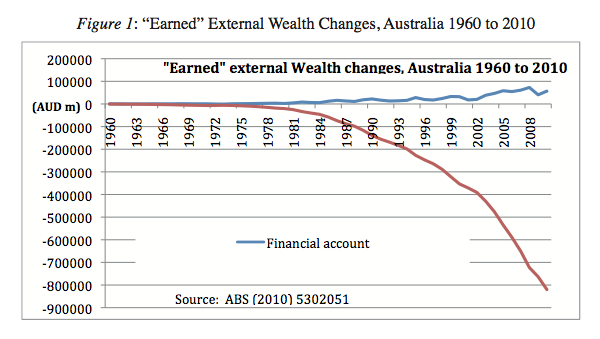
Sadly, all the efforts of a generation of Australian men and women have only made them more indebted to the rest of the world. Australia’s external net wealth is negative, soon passing minus $900b on an accelerating downward trajectory. This ongoing dissipation of national resources is unsustainable. Australians live in a debt dreamtime, one from which the rest of the world has been rudely awakened. After years of inadequate policies, the nation has a large external debt and significant government exposures. Servicing pressures are growing as rising uncertainties permeate global credit markets. Reserve Bank policies are worsening Australia’s external position and needlessly driving up internal costs. Major policy rethinking is warranted. Relevant issues are still little considered, crowded out of dialogues by comforting myths that accompany the Australian Debt Dreamtime. Imbalances need proper recognition with new approaches and strategies developed. Automatic corrections will not occur as history and current overseas experiences demonstrate. A real awakening, improved positioning and a touch of luck are required if Australians are to avoid being seriously impoverished by world events and their own confused Dreaming.

Got your attention now?

Good.

Here’s some more selected quotations (bold emphasis is mine, italics and underline in author’s original):

Rising problems have gone addressed because current preferences ignore them. Australians and their policy makers need to wake from their economic and financial dreams before they stumble into an economic crisis.

The net external wealth of Australia has deteriorated across the generation (McGovern 2010b, from which Figure 1 is drawn). Calculation of external wealth is based upon cumulative financial surpluses from an essentially zero basis in 1960. As is evident, Australia has been increasingly building external liabilities. A particularly marked decline has occurred over the last decade resulting in a total external exposure of $820b as at June 2010 with an annual deterioration of over $50b.
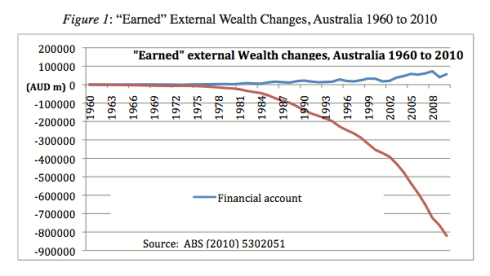
Click to enlarge

The central conclusion is stark: all the efforts of a generation of Australian men and women have only made them more obligated to the rest of the world. All that reform, all those industry and government initiatives, all those strategies, all that talk of productivity, all the promises of a previous boom in mining – all have come to naught. Today, we stride the world stage with external debts and other net liabilities above seventy percent of GDP, and increasing. Unaddressed, this is a precursor for crisis…

Manasse and Roubini (2005) empirically explore past crisis experiences to investigate “the set of economic and political conditions that are associated with a likely occurrence of a sovereign debt crisis”. They derive rules of thumb for likely default. Their schema is applied to Australia as shown in Figure 2. Importantly, Australian external obligations are largely held privately so at face value the sovereign appears little exposed externally. Importantly also, these are held in Australian dollars. However, the sheer bulk of obligations held by banks deemed “too big to fail” in the Australian context, the sizeable Commonwealth, State and local government debts (Section IV), the uncertainties of currency regimes, the indirect sourcing of some monies and the existence of various guarantees and understandings drive de facto and potential de jure exposures.

It is just this uncertainty about “who bears which risks” and “who guarantees whom” that has made resolution of existing crises so difficult, and the escalation of some crises so rapid and devastating. Just ask the Indonesians, Icelanders, Irish and Italians – amongst many. In the long history of defaults, there were 48 sovereign defaults between 1976 and 1989 and 16 more from 1998 to 2002 (Feenstra and Taylor 2011, p. 864) but virtually none between 1950 and 1970…

This is precisely what your humble blogger has long argued.

That for all the reassuring rhetoric from Goose (and assorted singing-for-their-supper, vested-interest economists) about how our debt is nothing to worry about, the truth is this. Their constant references to our “comparatively” “low” public debt “as a percentage of GDP”, is a red herring to distract our attention.  The real risk lies hidden just below the surface.

The real risk is in the liabilities of our banking system.

Which the Labor government has guaranteed.

From this perspective the Australian governments are currently not crisis prone. They do have three vulnerabilities. External financing and public external debt to revenue ratios currently appear well under posited trigger points but this could change rapidly with adverse global conditions, unsupportable interest positions or local bank fund-raising failures

Events in Europe have shown how quickly and broadly crises can build. It was only two years ago that the European Commission praised Italy, including its “greater resilience to external shocks”. Now Italy is under administration with no politician in the new cabinet (Squires 2011) as, in PM Monti’s words, this “will remove one ground for disagreement”. How the government of Italy is for Italy will be revealed in the days to come. There is much to ponder in current developments, and lessons for Australia.

Of particular interest to your humble blogger is the following excerpt concerning the long run effects of so-called trade “liberalisation” on Australia’s ever-deteriorating external wealth situation.

Mr McGovern’s words here, along with his chart above, should be slapped in the face of every “free trade” spruiking clown who arrogantly criticises Barnaby Joyce (and indeed, Bob Katter), for their so-called “protectionist” views on trade. In so doing, they act as blissfully ignorant mouthpieces and sloganeers for the internationalist banksters behind the “globalisation” movement:

… the stunning thing about Australian External Wealth (Figure 1) is that we have now being waiting for some thirty year for payoffs from hosting visiting funds and investments yet the position is, if anything, deteriorating more rapidly. More tellingly, the most optimistic figures about the current boom do not adequately address Australia’s External Wealth/Obligations problem… Dreaming of resurrecting Doha or of Trans-Pacific Partnerships introduces nothing new, and some fundamental changes are now of the essence. While political exaggerations from “delighted” and “excited” Ministers are understandable, the proper response by the governments of Australia is to demonstrate how mooted changes will be good for Australia, specifically in rectifying Australian external imbalances.

Put bluntly, Australia’s external position deteriorated as trade liberalisation advanced so any net opportunities that may have been on offer were not realised. Why should the impacts of any further liberalisations been any different? When Finance Ministers agree that across APEC “growth and job creation have weakened, inflation remains elevated [and] Capital flow volatility has intensified in response to heightened risk aversion” (APEC 2011), proponents need to demonstrate with convincing evidence how proposals will reduce risks and rectify problems in the current environment and going forward. More of the same is not an answer.

Indeed.

McGovern has an entire section devoted to interest rates, and their real impacts on investment, growth, and imbalances in our economy. It’s excellent.

In a nutshell, he demonstrates that compared with the rest of the world Australians are being shafted; that RBA interest rate policy not only does not achieve its purported aims (inflation targeting, stable currency) but actually contributes to the further impoverishing of Australians through their paying higher than necessary interest rates on loans, and, the encouragement of the international currency “carry trade” which results in windfall profits for bankers through financing asset bubbles here … like the housing bubble … which must eventually burst:

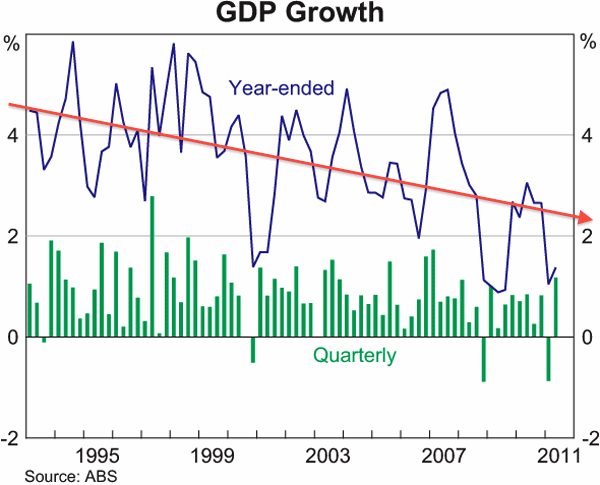
Australians have been paying historically high real interest rates for some decades now. The interest-only component of a 30-year loan has been steadily rising, from zero in real terms for loans terminating around 1980 to five-and-a-half percent for those terminating today (McGovern 2010a). Meanwhile, real growth rates in Australia and around the world have been declining.

Indeed … just as we saw in our recent debunking of Wayne’s/Treasury’s still ridiculous “growth” forecasts in the MYEFO:

Click to enlarge

Back to McGovern:

Arguably, in recent decades the reliance on interest rate movements in inflation targeting along with an insensitive allocation of rates across investment classes have compounded problems and raised investment risk while doing little for inflation objectives. Clearly this challenges current conventions in Australia, and elsewhere, but an argument needs to be had. Reserve Bank of Australia decisions of interest rates may be well be worsening not only Australian competitiveness (since investment becomes markedly more expensive and unattractive as next discussed) but also its external position (as then discussed).

High Australian interest rates also impact on Australia via the carry trade. While the potential profits from this are recognised (making even the textbooks, Feenstra and Taylor 2008), the impacts on domestic monies are less appreciated. Monies that flow into a nation’s currency pool may well be utilised within the nation by eager lenders sitting on these substantial deposits… there is a marked and little monitored (let alone regulated) increase in the quantity of money in circulation. It is then but a short step to an asset bubble, particularly in investments such as housing which are deemed “prime” by distant institutions.

The possibility that actions by the Reserve Bank in Australia may be worsening the external situation in a variety of ways needs to be investigated further.

I’ve said it before. It bears repeating.

Abolish the RBA!

And with it, the $1 million salaries of “public servants” like RBA Governor Stevens.

Moving on from trade and interest rates, what does McGovern have to say about The Situations Of Australian Governments? His opening paragraph is a beauty:

It is fascinating that Government financial situations were not assessed in either Henry (2010) or in the lead up to the Tax Forum (Commonwealth Treasury 2011). Instead the focus has essentially settled on who to tax more, and the purported efficiencies of different ways to do it. Why there is a need for governments to raise more tax goes unaddressed, as do other relevant considerations. Such myopia appears to be risky and, probably, dangerous.

Indeed. His comments about the state governments are particularly interesting:

The Commonwealth has a stated net exposure of $124b as at June 30 2010 (with an additional $67b in liabilities taken on in the following year). The States generally appear close to financial balance. However, those States using Treasury Corporation are on-lending to their various agencies with high interest repayments expected in return. Rising utility service prices, for example, appear influenced by high bond servicing costs, an issue not commonly recognized. Inflationary effects result.

There you have it folks. State government borrowings, on-lent at high interest rates to state government “agencies”, are driving up your electricity and water charges.

Again these figures need further elaboration but observations include:

•    the singularly high net exposure of the Commonwealth;
•    that bonds and notes totaled around $340b or over 25 percent of current GDP across all governments with an annual interest expense of $17.6b;
•    that the net exposure (Assets less Liabilities) is around 10 percent of GDP;
•    that the liquidity of underlying Assets is unclear, as is the appropriateness of booked valuations;
•    the stated interest repayments for Queensland and NSW are particularly high (with deducible interest rates of 6.9 and 5.3 percent respectively) compared to Victoria (around 4.7 percent) and the Commonwealth (4.0 percent);
•    Queensland has assets (and liabilities) valued markedly more than those of New South Wales and Victoria;
•    that more adequate, consistent and complete reports are needed.

Queensland which is not projecting a surplus (of $0.1b) across the general government sector until 2015- 16 increased its debt by $4.2b in the last year. It is planning to continue capital investments of over $10b annually for some years (Queensland Treasury Corporation 2011a). Why State debt more than doubled in four years, from $32.1b in 2006-07 to $73.1b in 2010-11, despite around $15b from asset sales (ibid) is an unexplained mystery, as is the lack of discussion of such a significant increase in exposure while global conditions were deteriorating markedly.

Queensland state debt only doubled in four years?

Amateurs.

Federal Labor have more than quadrupled Commonwealth government debt in four years.  From just over $50b when they came to office in Nov 2007, to over $223b today.

Back to McGovern:

Which of the challenges raised by Moody’s in 2009 have been adequately addressed, in Queensland and elsewhere?

The [Queensland] downgrade reflects the state’s deteriorating financial and debt performance and the absence of a medium-term strategy that would over time restore budgetary performance and financial flexibility… the state is expected to produce a series of very large, recurring deficits. The widening budget gaps and the resulting additional borrowing that is being projected place the state on a debt trajectory that is no longer consistent with Aaa debt metrics. Additional budgetary pressures could emerge should economic growth be slower than currently anticipated. Queensland’s financial performance is also expected to be challenged by the difficulties in reducing operating spending following a period of accelerated growth.” (Moody’s Investor Services 2009).

It is clear that not only are liabilities, specifically debts, high. In terms of the presented accounts, assets appear to reasonably match liabilities given current valuations. If so, any anticipated problems would be ones of liquidity rather than solvency. That is, the central problem is one of achieving appropriate flows of revenues and payments while maintaining (or perhaps improving upon) the stock situation.

If however, assets were not realizable at the stated values then solvency problems can arise. As evident in Europe, one response is partial or full default on obligations.

If interest rates rise (strongly), then liabilities may escalate (markedly) due to the exposures and linkages demonstrated earlier…

If a debt-deflation were to occur then the States could be quickly squeezed as asset values fall while liabilities at least remain.

Note that well.

What McGovern is arguing is that it is the state government balance sheets that pose a risk. That’s important, as you will see in a moment.

Finally, some pertinent remarks from the paper’s conclusion, entitled Up A Gumtree In A Bushfire? The Australian Dilemma:

As the fires feeding on years of lush credit growth rage in many parts of the world, Australia has been so far only a little affected. Significant exposures exist, however, and these need to be assessed and redressed. While no one can know just what blazes will break out next or where, prudence mandates risk assessments, readiness, firebreaks and controlled burns. Recovery is much more expensive after an unanticipated fire, and some losses are never really replaced. As even Kunbul knows, this is not a time to be dreaming up a gum tree.

Current external policies favour a major expansion of mining to lead export growth. However, the current mining sector would need to roughly double its exports for Australia to stand still externally. It is not only the trade balance that has to be rectified but also the net factor income outflows. Given that mining is focused in three States that already have high public liabilities, funding further infrastructure becomes even more problematic.

Superficially the Governments of Australia appear in a reasonable position when compared to much of the world. Servicing of obligations appear problematic, however, even under optimistic scenarios. Closer investigations of positions is clearly warranted. This initial review has revealed significant potential vulnerabilities. Adverse conditions externally could lead to a rapid deterioration due to refinancing risks while recession would reduce the ability to raise sufficient net revenues to service existing obligations.

Reduced ability to “service existing obligations”, eh?

What was it exactly that Senator Joyce warned of in 2009-10?

What was it that unleashed all the verbal fire and brimstone that cost Barnaby his new job?

What exactly did he say that so angered the Labor government, then Treasury secretary Ken Henry, and all the “leading” talking head economists in the land?

No, it was not just his warning about the dangers of the ever rising US debt level.

It was his warning about Australia, and the vulnerability of the state governments’ finances, that really fired them up.

From the Sydney Morning Herald, 11 December 2009:

Senator Joyce told the Herald yesterday he did not mean to alarm the public but there needed to be a debate about Australia’s ”contingency plan” for a sovereign debt default by the US or even by a local state government

He said the Federal Government’s debt would push up interest rates and predicted that some state Labor governments would not be able to repay their borrowings.

”The Federal Government has $115.7 billion in debt, Australian government securities, notes and bonds on issue, and the states have another $170 billion in debt.

We have to ask whether the states have the capacity to repay that. I would say in some instances they do not, particularly Queensland.”

And from The Age, 11 December 2009:

Senior government figures have taken aim at Barnaby Joyce’s dire warning about a global financial meltdown if the United States government defaults on its debt. Mr Joyce also came under fire for comments about the financial health of Australian states.

”That’s shooting from the lip, making it up on the run,” Prime Minister Kevin Rudd said of the new opposition finance spokesman’s comments.

Senator Joyce is concerned that demand for Australia’s resources would ”go through the floor” if the US was not able to pay off its burgeoning foreign debt.

Mr Rudd dismissed the senator’s comments, describing them as ”not responsible economic policy”.

Assistant Treasurer Chris Bowen went further saying Senator Joyce’s comments were extremist.

”His comments on the United States need to be taken with a grain of salt,” he said, adding the vast majority of economists believed US debt levels were manageable.

He accused Senator Joyce of engaging in a series of thought bubbles that were unbecoming of a senior economics spokesman from either government or opposition.

”Senator Joyce adopts very extreme positions, he is an extremist.”

States ‘rock solid’

Separately, Mr Rudd criticised comments made by Senator Joyce that some Australian state governments might not be able to repay billions of dollars in debt.

The states were carrying $170 billion in debt and rising interest rates were affecting their capacity to make repayments, Mr Joyce said.

”I would say in some instances they do not, particularly Queensland,” he told Fairfax Media.

The Prime Minister said such ”erratic and ill-considered” comments should not be made by a senior opposition spokesman.

Mr Rudd described as the ”most serious charge” the coalition’s view that state governments could default on their debt.

In light of Mr McGovern’s paper, and the reality of world events over the past 2 years, the truth is clear.

Barnaby was right.

None Castigate Their Peers So Well As The Well-Bred Englishman

16 Dec

The English language can be a beautiful weapon of truth when wielded by a master.

Witness Daniel Hannan, conservative MEP for the South East of England, speaking to the EU Parliament in response to the Eurocrats recent hatefest on Britain for refusing to join in their latest imbecilic “plan”, one amusingly dubbed by London mayor Boris Johnson as a “Supra National And Fiscal Union” (SNAFU):

“How’s that working out for you by the way, gentlemen” … ziiiiiiiiing.

Here’s Mr Hannan in March 2009, rising to international prominence with this truly epic smackdown of then PM Gordon Brown:

“You cannot spend your way out of recession or borrow your way out of debt”

He could almost be a beautifully-spoken Barnaby Joyce.

To quote The Merovingian from The Matrix Reloaded:

“Fantastic language, especially to curse with … It’s like wiping your arse with silk, I love it.”

And finally, wise words from Mr Hannan in summarising what all the global economic troubles are really about:

Yesterday, our own government took on another $3 billion of debt.

Adding to Australia’s unpredecented, world-beating increase in public debt, since the global debt crisis began.

So the last word inevitably must go to our own Senator Joyce:

“If you do not manage debt, debt manages you” – Feb 2010

Barnaby is right.

“We’ve Been Climatised, Mortgaged, And Granted A Minister For Disastrous Events”

16 Dec

Senator Joyce writes for the Canberra Times:

The end of the year is imminent but the orbit of eclectic and core issues keeps your city in that post-political glow. That glow attracts the belated return of the political moths. I am now sitting on a mini bus in Taiwan but it is hopeless, I am still engaged in it.

We have had our final shadow cabinet meeting, returning to the big white boarding school on the hill like penitent school children ordered back after school has risen for the year. Canberra is beautiful but that building is rather depressing when the electricity of sitting has left. You rattle around dodging the maintenance men, glancing at the locked doors of offices of colleagues who are all at home with their families.

Canberra’s trees are green, the shade is full and the water in the lake was like glass in the still evening as I drove in. Back at the boarding school Tony was in one room and Julia in the other. The latter desperately trying to reconfigure the batting line up, the former clearing up loose ends and trying to maintain the pace attack that has proven itself on a lively green wicket.

The year finished with more a fizzle than a thunderous bang. We have all been climatised, mortgaged and now we have been granted a Minister for Disastrous Events, the Hon. Robert McClelland. He will not have to travel too far for work; it is obvious why he needs to remain in cabinet.

I do not know what it takes to get kicked out of the current Labor Party cabinet but it would have to be horrendous. The get-out-of-jail card, at least for those lucky to live on the green carpet, is to threaten resignation. Former cabinet minister, Senator the Hon. Kim Carr, got the boot though, and now he is sulking around, wondering in his three-piece suit about how much time he can commit to campaign for the comeback of Kevin Rudd. Stephen Conroy has given an illuminating expansion of the Queen’s English in the daytime kiddies’ slot; quite an interesting expose of how the Minister for Communications uses old Saxon profanities when communicating.

A few weeks ago much political attention focused on a gay marriage convention held in Sydney, where apparently quite a number of ALP politicians and members turned up. It appeared rather incongruous to a country whose people are asking the serious cost of living questions about how they pay their power bill and how well prepared are we for possible global economic meltdown. The country is looking to where the ship is going not who the captain marries.

Back at St George, the ducks have lately taken up residence on the levy bank next to my house, rather ominous and unerring as the Balonne River once more starts its Christmas task of moving the benevolence and possible curse of the northern inclement weather to the flood plains of the south. The ultimate source of wealth, fresh water, sine qua non. It is renewable green wealth, which even in our own small western shire, will earn well in excess of half a billion dollars; something which I have always been proud of but many others apparently want to decry. The desire for an environmental utopia of pre-settlement without ever putting up an alternate source of income.

Somewhere was the silent force of Bob Brown, the greatest victor of the year, viewing his spoils of policy success. Success beyond his wildest dreams and all delivered to him by a third party chained to his request and impotent against his cunning and adroit ransoms so well tuned after years of practice.

I am looking forward to the time at home. The cattle work, sweat and swearing and a million miles from Parliament, the purification that comes from dealing with the honest and noble pursuit of creating food. I am looking forward to going to the beach with my family and swimming beyond the last break to float in the early morning sea then back for a coffee and paper with the boss, Natalie.

And Canberra, you are happy to be rid of the Z-sleds with those caustic ostentatious overpaid prima donnas otherwise known as your local Members and Senators.

Pedal To The Metal – Gillard Shows Rudd How To Drive Up Debt

13 Dec

As an avid motorcyclist and former GT Falcon owner, your humble blogger can certainly vouch for the thrilling adrenalin rush one experiences from serious acceleration.

But it seems I have a thing or two to learn from our flame-haired PM about getting thrust in the back.

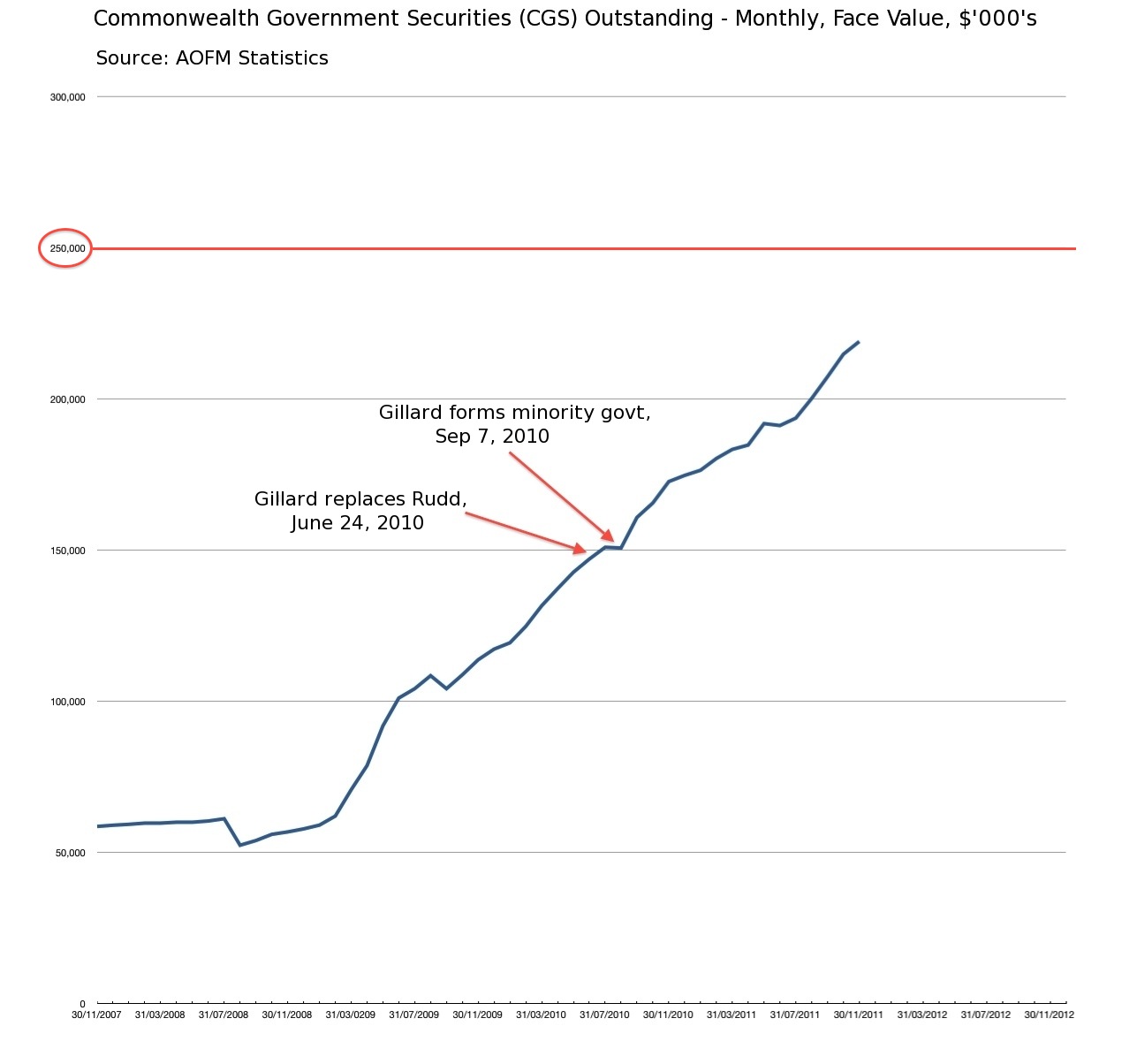
Former PM Kevin Rudd knows all about it, as the chart below demonstrates:

Click to enlarge

Interesting, is it not?

The epic acceleration in government debt under Kevin Rudd abruptly halted for two months, immediately after Gillard knifed him.

She was distracted, you see. Eyes off the road.

Too busy bending over trying to quickly tune in radio 1ETS and 2MRRT before the 2010 election.

Election over, and deal done with the Greens and “Independents” to form government … then instant pedal to the metal.

Given it was then 2 years since the first GFC peak had passed us by, one can only wonder just what Julia was accelerating away from.

It is certainly clear what we are now rapidly accelerating towards.

In case you were wondering, that little flat spot about $20 billion below the $200 billion line?

Yep … it’s the period around the May 2011 budget.

Can’t be racking up the debt at a rate of $1 – $2 billion per week when the big Budget night is coming up. Especially when you are trying to distract everyone’s attention from the upcoming record deficit announcement, by lying about jobs creation.

Budget passed, provisions to steal your super enacted, debt ceiling raised by 25%, financial year ended … and it’s pedal to the metal again.

On the fast track to hit the $250 billion debt wall by mid-2012.

The chart above shows monthly CGS outstanding up to end November 2011.

So far this month, Julia has added another $4.5 billion to the total – now $223.4 billion.

With another $3 billion to be added this Thursday 15th.

$7.5 billion in a fortnight.

Forget CO2 … I reckon she’s flicked on the N2O.

Otherwise known as “laughing gas”:

Global Cooling, Unemployment Rising, Government Lies Unravelling

10 Dec

The World’s Greatest Finance Minister, May 2nd, 2011:

“We created 750,000 jobs since we came to office when other nations shed millions of jobs, and we will create half a million more in the next two years.”

PM Julia Gillard, December 2nd, 2011:

“We are on track to create 300,000 new jobs over the next two years”

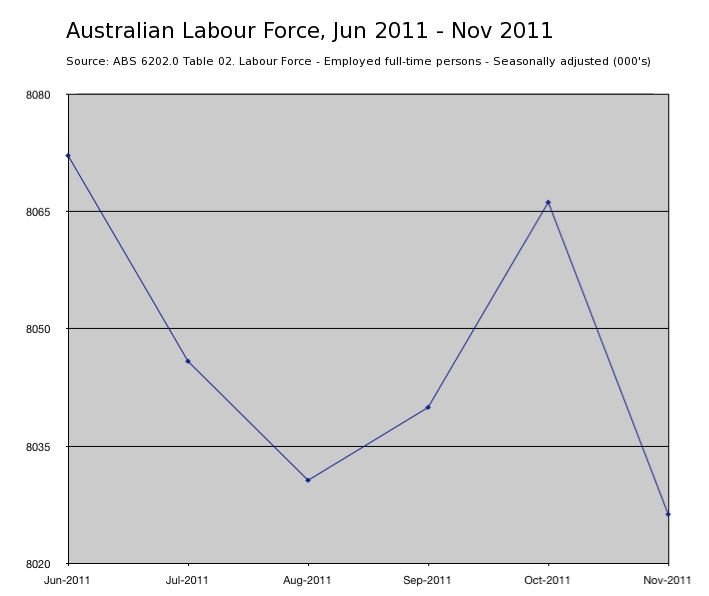
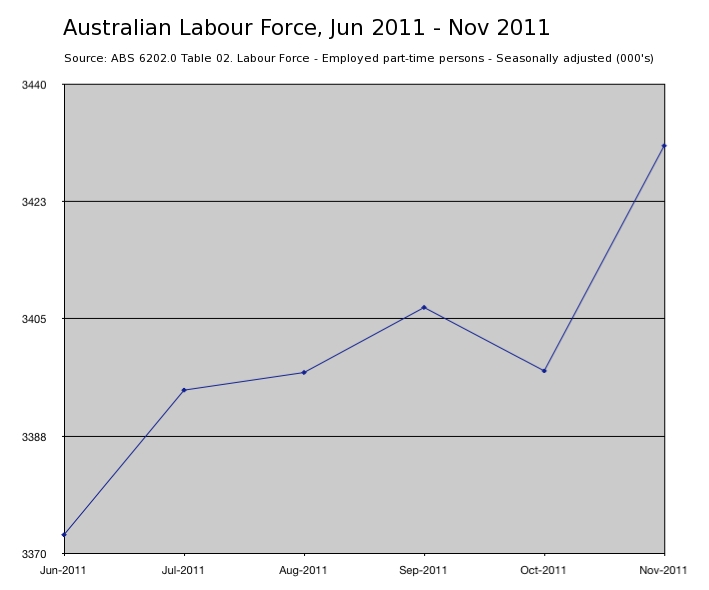
The latest Labour Force data from the Australian Bureau of Statistics:

Employed Full-time Persons | Click to enlarge

Employed Part-time persons | Click to enlarge

Employed Total persons | Click to enlarge

Number of Full-time employed? Down 45,900.

Number of Part-time employed? Up 58,000.

Number of Employed persons? Up 12,200 (with allowance for rounding).

Since June.

2,440 per month.

At that rate of part-time “jobs created” (to replace Full-time jobs lost), it will take over 10 years for Julia to achieve her “300,000” jobs created. Assuming you believe that the government creates all the new jobs, with zero from the private sector.

It will take 18 years to reach Wayne’s promised “half a million more”.

It’s also worth noting the ABS statistic for just how many are “Unemployed, looking for full-time work”.  That number has risen by 33,900 since June, the month following Wayne’s pre-budget promise.

And the number of persons in total who are “Unemployed” has risen by 38,100 over that time.

So essentially, part-time jobs are replacing full-time jobs. And at a rate way insufficient to meet the rise in total unemployed job-seekers (eg, retrenched full-time employees, school leavers, immigrants, refugees, retirees forced to look for work due having their superannuation “nest egg” decimated, etc).

Now, this is just the “seasonally adjusted fiddled” ABS data.

Some say that Australian government “official statistics” are about as believable as government statistics in other countries.

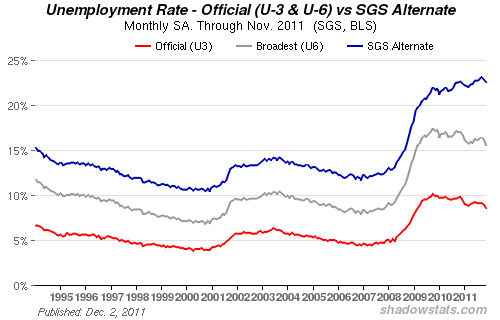
Like the USA, where “official” unemployment has allegedly just fallen to 8.6% … thanks to their simply not counting the millions of people who are unemployed but have given up looking.  Alternate statistics researchers such as the venerable ShadowStats claim US unemployment is more like 22.5%:

Source: ShadowStats.com

In Australia, Roy Morgan research publishes an alternate measure of unemployment. And surprise surprise, it too consistently shows unemployment rates significantly higher than our government’s “official” statistics.

Here’s the latest Roy Morgan stats (emphasis added):

# In November Australia’s total unemployment as measured by Roy Morgan was 1,044,000, or 8.6% (unchanged in percentage terms, but up 18,000) from October 2011 and up 229,000 (up 1.7%) since November 2010 — Australia’s equal highest unemployment rate since March 2004 (8.8%). It is also the highest number of unemployed Australians for nearly a decade — since January 2002 (1,075,000).

# The Roy Morgan November 2011 ‘underemployed’* estimate was 938,000 (7.7%), up 90,000 (0.6%) from October 2011, and up 126,000 (0.9%) since November 2010.

# In total in November 2011 an estimated 1,982,000 (16.3%) of Australians were unemployed or ‘underemployed.’ This is up 108,000 (0.6%) on October 2011 and up 355,000 (2.6%) since November 2010.

# The latest Roy Morgan unemployment estimate is 3.4% above the 5.2% currently quoted by the ABS for October 2011 — this is the equal largest gap since December 2005 (8.5% Roy Morgan cf. 5.1% ABS).

Who to believe?

You decide.

Just remember the indignant words of Sir Humphrey Appleby, in an episode of the classic BBC satire Yes Prime Minister titled “The Smoke Screen”:

“They’re government statis…. they’re facts”

UPDATE:

For any reader questioning the “Global Cooling” reference, I have no interest in pointing you to the many websites where you can find evidence that the world has experienced a slight cooling over the past decade. Instead, in keeping with Thursday’s reference to The Golden Rule (ie, “Follow The Money”), I give you instead the opening paragraph of the official press release for the 2010 Bilderberg Meeting of the world’s ‘elite’ … and suggest you think about it:

Click to enlarge

$26bn Till We Hit Debt Ceiling, At $2bn Per Week

9 Dec

Media release – Senator Barnaby Joyce, 9 December 2011:

CO2 Tax to hit H2O Prices

It’s the end of the week. I know it’s the end of the week because we just borrowed another $2.4 billion and Friday afternoon usually brings the news that we have borrowed another $2 billion.

Our gross debt is now over $223 billion, which means there is only $26 billion before we max out the nation’s credit card, which shouldn’t take too long at the rate we are borrowing.

We have borrowed $14 billion over the past two months, almost $200 million per day.

We have also found out today that a report from the New South Wales government’s independent regulatory agency, IPART, has found that the carbon tax will cause a substantial increase in water prices in New South Wales.

This is a fascinating tax we have put on the Australian people. It doesn’t matter whether you are washing your clothes or washing your car, it is going to cost you more money, and the climate will stay exactly the same regardless.

The IPART report shows that the Sydney Desalination Plant’s water prices will increase by 2 per cent next year and by almost 6 per cent over the next 5 years due to the carbon tax.

Water prices have already increased by 58 per cent since the Rudd-Gillard government came to power.

They don’t call desalination ‘bottled electricity’ for nothing. The carbon tax will increase the cost of everything that has to plug into the wall and desalinated water will be no different.

As the hopes for international action on climate change collapse around the beaches of Durban, Australian families can rightly ask why the government is making their living costs higher than they need to be in a futile attempt to change the climate.

If the government were not so focused on Bob Brown they might actually turn their attention to the real issues that face Australian families.

Where Are The “Banshees Screeching About Global Warming” Now?

9 Dec

Senator Joyce writes for the Canberra Times:

Feed the world or save the swamps?

The carbon tax must have done the trick. It has been considerably colder here in Queensland lately. In fact, Queensland has had its coolest maximum December daytime temperature, 13 degrees at Applethorpe, near Stanthorpe.

For many of the eastern states of Australia it is the coldest start to summer in decades. People have had to deal with the anomaly of turning on their heaters in summer. If instead of being cold it was hot, we would have these banshees screeching about global warming, imminent instantaneous human combustion, prior to catastrophic inundation from rising sea levels.

It would appear that we have proved that it merely takes the power of thought to cool the climate. The nation chanting ”Om”. It is the enlightened spirit working in conjunction with the passage of a new broad-based consumption tax collecting from the power point in your house. The alignment of these temporal and fiscal stars in this new age global astrology has delivered, quod erat demonstrandum, cold weather.

Many of the crops in eastern Australia are now being downgraded, not so much by global warming seawater, but by ”send it down, Hughie!” rainwater. I know this is slightly incongruous to the proclamations that it would never rain again and the place would be a desert.

It appears that the La Nina weather pattern has not been reading Professor Tim Flannery’s previous dire predictions that it is not going to rain any more unless we put up the price of power with a carbon tax.

We are now also currently investigating ways to put up the price of food. We are going to do this by reducing the amount of water available for irrigation needed to grow the food. In some areas, the requirements of frogs and swamps are superior to the needs of keeping the shopping trolley full of groceries within the affordability matrix of Australians to pay for them.

I was talking to tomato growers in southern NSW, and read and weep as you digest this; they get paid 11c a kilogram for the tomatoes they grow. I presume you may pay slightly more than that at your local supermarket, because of the power of over-excessive centralisation in the retail market.

In our national wisdom, however, we have decided that it is a lesser good to grow our own food in the Murray-Darling Basin and the righteous thing to do is to close down farming and import the food. The Greens literally want to close the whole show down. ”Green” is obviously not an abbreviation of ”green vegetables”.

The choice the Coalition has is to either to say no, or to try and catch and saddle this horse called ”Labor Incompetence” and get the Murray-Darling Basin Plan to a position where it does the least amount of damage to the economic and social fabric of the 2.1 million people who live in the basin.

I also have this naive, old-fashioned belief that an area of our nation which is responsible for 40per cent of our agricultural production, including the majority of fruit and vegetables, should be protected to do the job we have assigned to it, that is feeding us.

For many generations, the people in the towns such as Griffith, Deniliquin, Kyabram and Mildura, have done what the nation has asked them to do; ventured out into the countryside and gone without as they scratch a living from the dirt. These people brought up a family, built their community, fed their state, fed their nation and exported to the world. The rice production around Deniliquin, so I have been told, has the capacity to feed 30million people a day.

It is quite a noble thing to contribute to the global food task to stop children from starving. We must expand our moral horizon and realise that the trade off between environmental desires and a lesser standard of living is also a matter of life and death for those we have never met living on the edge of starvation in Southern Sudan, Uganda or the Thai-Burma border.

It really does become a trade-off between happiness for frogs and trees or the most noble of tasks, providing the sustenance for the human condition.

Design a site like this with WordPress.com
Get started