Tag Archives: barnaby joyce

Barnaby: Greens All About Politics On CSG

16 Mar

Media release – Senator Barnaby Joyce, 15 March 2012:

Greens party CSG inquiry about politics not action

The Greens party’s attempt to instigate another inquiry into coal seam gas is politically motivated and counterproductive. Another inquiry will simply delay the changes that are needed to deliver better outcomes for the environment and for landholders.

The Nationals were responsible for the instigation of the Senate inquiry into coal seam gas which reported in November last year. That report made comprehensive recommendations on establishing a national regulatory framework including cumulative and regional modelling, the regulation of chemicals, water licences, trust funds for make good expenses, prime agricultural land and access arrangements.

The Nationals also called for at least 1 per cent of the gross revenue from coal seam gas go towards providing a return to landowners.

The government has not responded to that inquiry. At this point in time having a further inquiry, to look into what has already been covered, is not of any assistance.

The inquiry seems to be more of a political advertising campaign for the Greens party than a genuine attempt to be part of the resolution.

The Nationals have been very clear about what needs to be resolved. Prime agricultural land must be protected, aquifers cannot be destroyed, the quiet enjoyment of residential areas must be respected and a fair return must go back to the landholders on whose land the drilling takes place.

What will a further inquiry achieve beyond delaying action on these issues? In essence, it would dilute the potency of the recommendations made last year because clearly the Greens party does not think that this inquiry was good enough and we need another one.

The Nationals don’t resile from future inquiries if they are needed but the Greens seem to want another one just because they were not responsible for the first Senate inquiry into this issue.

Barnaby Pings Wong On Carbon Tax Impacts

14 Mar

“The government stands by the Treasury modelling … the government stands by the Treasury modelling…” – Penny Wong

L.M.A.O.

Watch it all, and note in particular (a) Wong’s obfuscation, misdirection, and abject failure to answer, and (b) Bob Brown’s intervention, attempting to silence questioning of the Green-Labor CO2 derivatives scam:

Enjoy also Barnaby’s speech to the Senate yesterday:

“‘We are us’ … what exactly, what on earth does that mean? ‘We are us’ … I mean, who else could you be? We are somebody else? Somebody else is us?”

“In the last four weeks the Labor party have borrowed … an extra ten billion dollars, just in the last four weeks … that would buy about 20,000 houses in Brisbane”

“Treasurer Wayne Swan … is the Treasurer of the Millennium … we are so lucky to be blessed with him”

“What’s a Midas Touch backwards? … a Sadim, perhaps”

Australia Debt Ceiling Hit By June

13 Mar

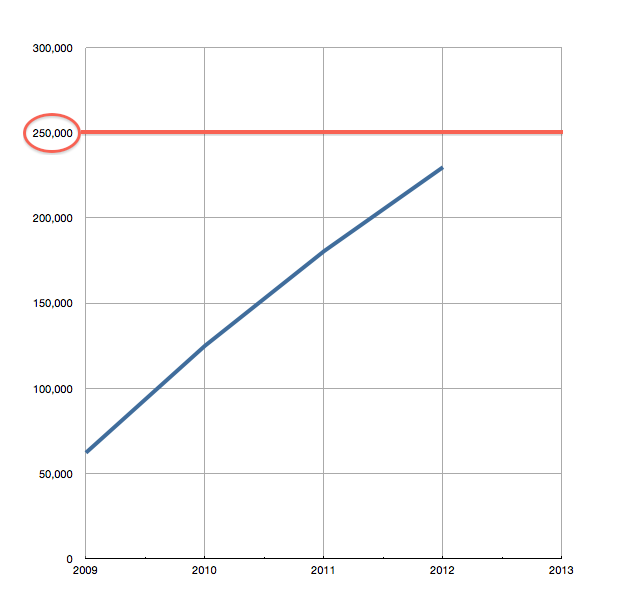
On 2 November 2011 your humble blogger showed that the Green-Labor government was on target to hit the debt ceiling by mid-2012.

4 months later, that approximation is looking good (well, very bad, actually … but you know what I mean):

Commonwealth Government Securities Outstanding at end February | Source: AOFM

That new, increased, $250,000 million dollar debt ceiling was only set last year. Slipped into the Budget papers by the government, hoping noone would notice.

Barnaby did, of course. He was the first (and only) to rail against the government quietly sneaking in a budget provision to raise Australia’s debt ceiling by a whopping 25%:

As Treasurer Wayne Swan was congratulated by colleagues after Tuesday’s budget speech, Assistant Treasurer Bill Shorten introduced draft laws allowing the government to increase the amount it can borrow from $200 billion to $250 billion.

The proposed legislation would also remove a requirement that the Treasurer explain why the extra money is needed.

Great, isn’t it?

The government changed the law, so that it could rack up tens of billions more debt … for other people to pay back, for decades to come … and not even have to explain themselves.

What’s the bet that Wayne and Co will slip another provision into the May budget this year, to lift the debt ceiling again.

For the fourth time in five years.

After all, based on their current trajectory, they will run out of money by around June.

Time to ask Parliament for another extension on the next generation of taxpayers’ credit limit.

Barnaby Calls For CSG Moratorium On Prime Ag Land

12 Mar

Take note, Green-inclined voters.

Barnaby is right.

Dam Fine Thinking By Robb And Joyce

11 Mar

It’s long past due time that we had some dam fine thinking from politicians, in this land of drought and flooding rains:

MINING companies would be asked to bankroll a host of new dams across the nation, some of which could be owned by taxpayers, under a Coalition bid to unlock private capital reserves and store the water needed for its goal of doubling Australia’s food production.

Water allocations for some projects could also be sold like off-the-plan apartments, where construction doesn’t start until at least 70 per cent of the water take has been pre-purchased by irrigators or miners.

The Sunday Age believes a range of financing options are being considered by the Coalition as it draws up a shortlist of viable dam projects it might sponsor in government.

The opposition dams taskforce is due to release its interim report in the next six weeks, with a list drawn from more than 100 proposed sites put to it.

Most of the projects will be across the rain-soaked north of the country, where miners might finance dams that could also be used for large-scale agriculture.

But dams taskforce chairman Andrew Robb has also visited at least one site in Victoria in the past six months, talking to locals and the Victorian government about the viability of a dam at Lake Buffalo and Lake William Hovell, and an aquifer project backed by Wangaratta Council.

In an interview with The Sunday Age, Mr Robb said a big challenge for an incoming Coalition government would be how to fund infrastructure with a cash-strapped federal budget. He tipped partnerships with the private sector would be optional.

”We won’t have money when we get there. We’re not going to borrow. So how do we unlock very large sums of money sitting on balance sheets in companies around Australia who are not investing because of the crisis of confidence?” he said.

”We have done a lot of work, there’s no one answer to this, but how do we involve the private sector more effectively in all sorts of infrastructure, social and economic?”

Asking mining companies to fund dam projects was one of the options being considered.

”For instance, some of the dam work we are looking at, we think we can get – instead of taxing the mining industry – suggest to them they can invest in a dam and then have access to water to wash their coal. And they’ll pay serious amounts of money, in fact they will pay for the construction of the dam,” he said.

”That is not going to apply in every situation, so it’s a suite of approaches that can be taken, which lead to productivity improving assets being built.”

Dams taskforce deputy chairman Barnaby Joyce said the floods had reinforced the need to store water, both to protect communities from flooding and to acquire reserves for droughts.

”Some of these dams wouldn’t need any public money,” he said. ”And you’d have an asset that might be owned by the government or in some instances it could be private.”

Barnaby Joyce has long been one of the leading proponents for building more dams in Australia.

Barnaby is right.

If It’s Good Enough For Barnaby, Why Not You?

10 Mar

Something got Barnaby fired up enough to write a Letter to the Editor:

GREAT article, Graham Richardson (“Water, water everywhere, none is saved”, 9/3).

Yes, it’s self-evident that above the baying of the never to be happy bio-degradable economics of the Greens, everyone is asking “how about we store some of this abundance for the obvious and imminent time of privation and drought?”.

Even before Dorothea Mackellar wrote about drought and flooding rains, Jacob was interpreting dreams of seven fat cows followed by seven skinny ones. Neither had heard of global warming nor Tim Flannery.

That’s why the Coalition set up a dams task group. We have travelled to every state and there are plenty of dam sites left, especially in the north. Australia uses just 6 per cent of its available water resources compared to a world average of 9 per cent.

By the way, a Mary River dam was a stupid idea because $4 billion for 150,000 megalitres stored in a glorified swamp was not a good investment. Let’s find the good sites and get going building real infrastructure.

Barnaby Joyce, opposition spokesman for water, Canberra, ACT

When was the last time you cared enough about the future of our country to do the same?

Indeed, when was the last time you stopped to think about whether you and your kids really want to end up drinking other people’s recycled piss during the next (inevitable) drought?

Your humble blogger never ceases to be amazed at the abject laziness and “She’ll be right mate, let someone else worry about it” apathy of his fellow Aussies.

If it’s good enough for Barnaby to sit down and write a letter to the editor, what is your problem?

Barnaby: People Want A Positive Future

8 Mar

Senator Joyce writes for the Canberra Times (my emphasis added):

One of the useful parts of the obligatory election trudge around the countryside is that meetings, functions and party events become a great barometer of what is worrying people.

Don’t go on the road if you are looking for self-affirmation; voters do not turn up to tell you what they like about government and politicians.

If a summary was given of what is making people talk at the mandatory Q and A session at the local hall/bowling club/RSL you would not be surprised that it is a thousand miles from what seems to be the concern on the ABC’s Q&A. There are four issues that are becoming constants: excessive market power in our retail industry; foreign ownership of strategic Australian assets; the carbon tax; and coal seam gas.

The businesses that go to functions ask, when will anyone seriously deal with excessive market concentration and the resultant exploitation of smaller market players? This was once seen disparagingly as a ”poor bugger farmer” issue by the more enlightened in the corridors of Canberra. Now senior corporates are also starting to ask the same question. The chief executive of Coca-Cola Amatil, Terry Davis, has highlighted his difficulty in finding a margin for Coca-Cola on a shelf controlled by two very dominant retailers and a second-tier wholesaler.

Foreign ownership of key agricultural assets and our ever increasing reliance on foreign borrowings by our government is a two-for-one package. People do not believe that Swan has the debt under control, and he hasn’t, he has borrowed an extra $11 billion over the past four weeks.

They believe that there is a naivety pervading the carte blanche approach to any investment to any area for any reason. They ask when does the government ever say no and the answer is that our Foreign Investment Review Board is like the Venus de Milo acting as wicket keeper for Australia: looks good but stops nothing.

People are surprised to learn that if a foreigner wants to buy any residential land then approval must be sought. However, you can buy any farm in the country without seeking approval if it is worth less than $244 million. There is probably only one farm in Australia over that threshold.

People have a pathological dislike of a policy called a carbon tax. Sections of the left hate it because it is seen as a mechanism to create commissions for major sections of the banking sector. The right hates it because it is a totem for the fallacy that government is better at spending money than you are and has wiser and more noble motives than you have. Everybody in between hates it because it is just so patently absurd. Government policies that make people poorer don’t cool the planet, they just make people very angry.

Rather than help the proponents of the global warming debate the carbon tax has been completely counter-productive for them. The reality is that there is now a strong majority who have a strong scepticism of the global warming narrative and a large number who just don’t believe at all. Many of those who do believe in it, don’t want to pay for it.

Finally, and it is the issue du jour: coal seam gas. This issue is politically remarkable as it has linked the far left and the far right. It is the powerless landholder against the miner and the expectation that the government should act for the powerless. It is the usurping of an individual’s property right, the under pinner of an individual’s security, the seedbed of the individual’s liberty. It is the green issue that links to the shopping trolley.

Unfortunately for the government, it is in so much debt that its political future, based on the delivery of services, cannot be met without the income stream from the royalties and the tax.

What then really angers people is that the topics they see discussed on their TVs, and from their government, do not match these concerns.

People want a more positive future where government talks about the delivery of substantial new infrastructure and a vision of a new horizon of economic opportunity in the north and other undeveloped parts of our nation.

Instead we have a Labor government obsessed with its own machinations and a Treasurer who seems to think his main job is to pick fights with Andrew Forrest, Gina Rinehart and Clive Palmer.

Damn!

He sure has his finger on the pulse.

Imagine such a man leading the nation.

The words of the great Chinese philosopher Lao Tzu spring readily to this blogger’s mind in picturing such a future:

“To lead the people, walk behind them.”

“A leader is best when people barely know he exists, when his work is done, his aim fulfilled, they will say: we did it ourselves.”

Barnaby: Carbon Tax To Hit Council Rates

1 Mar

Media Release – Senator Barnaby Joyce, 1 March 2012:

Carbon tax to hit local government rates too

The carbon tax is a broad-based consumption tax delivered to every household and business via their power points. If you own a toaster, you pay the tax. If you put out a garbage bin on a Tuesday night, you are going to pay the tax. If you have a street light out the front of your house, you are going to pay the tax.

Apparently, just the imminent introduction of the tax has had an impact, since they have announced it we have had one of our coldest summers on record and it hasn’t stopped raining. I imagine that once it has been introduced we will go into a diluvium freeze.

Local governments will be hit by the tax too through higher electricity prices and higher landfill costs, said Senator Barnaby Joyce, Shadow Minister for Local Government, today.

The Herald Sun reports today that ratepayers in Victoria will be hit with an increase in their rates of up to 3 per cent because of the carbon tax. Providing street lighting and removing rubbish and waste are core local government responsibilities and they will all be more expensive because of this tax.

Frankston Council is set to increase rates by 3.5 per cent due to the carbon tax and a small landfill levy, and the City of Whittlesea expects the tax to raise rates by 1.5 per cent.

The Brisbane City Council has already warned that rates will have to go up by 2%, the Dubbo City Council has estimated that its power bill alone will increase by $500,000, while the Tamworth Regional Council estimates an impact on their electricity bill of $300,000.

Just like any business, local governments will have to pass these costs on in the form of higher rates. I am sure everyone will be thankful for the carbon tax next time they get their rates notice.

Ratepayers across the country will be rightly demanding, why must we pay a tax that we didn’t vote for and that which won’t change the temperature outside?

More information – Matthew Canavan 0458 709433

Wayne’s Half-Year Earnings Report: $30 Billion Loss

1 Mar

Remember the Labor Government’s record $51.5 billion deficit in 2010-11?

They are on track to do it again this year too.

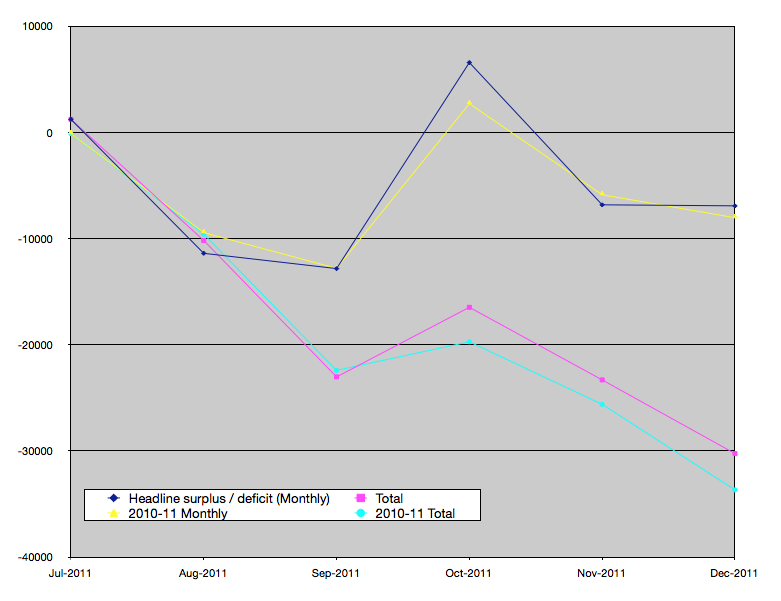
According to the RBA, Labor has racked up a $30.26 billion loss for the first half of 2011-12:

Source: RBA Statistics - E1 Australian Government Budget - Monthly | Click to enlarge

That’s just $3 billion less than the record deficit they racked up for the first half of 2010-11:

Budget Surplus/Deficit Compared - First half 2010-11 vs 2011-12 | Click to enlarge

Now, it is worth recalling that in the November MYEFO budget update, Wayne had to revise his original May budget “estimate” for a $22.6 billion deficit this year. He told us it would blow out to $37.1 billion.

Just four weeks after that new claim from the World’s Greatest Treasurer, RBA records show that he had already managed to achieve a $30 billion headline loss for the first half of this financial year.

But he is going to deliver a $1.5 billion surplus next financial year.

Honest he is.

New ‘Regional Australia Institute’ – Located In Canberra

28 Feb

Media Release – Senator Barnaby Joyce, 28 February 2012:

New ‘Regional Australia Institute’ – Located in Canberra!

“Minister Crean has finally launched the new ‘Regional Australia Institute’ today, over 18 months after it was promised.

“This is a great idea but it’s a bit of an issue when the so-called “Regional Australia” Institute has one office, located on Level 5 of 7 London Circuit, Canberra.

“When I think of Regional Australia, I think of dark, starry nights, long, lonely drives between towns and furry animals running across the road. I don’t think of Walter Burley Griffin, a man made fountain on a man-made lake and about 350,000 people living around it.

The Institute’s own website states that:

The term ‘Regional Australia’ refers to the non-metropolitan areas of the nation that lie beyond the major capital cities and their immediate surrounding suburbs’

“Why then is the Institute’s only office located in the heart of Australia’s capital city? How are they supposed to research ‘regional’ Australia from a desk in Canberra?

“I am sure the good people of Glenn Innes or Longreach would have loved a new taxpayer funded institute in their town. Not even Tamworth, Wagga or Orange got a look in.

“Ultimately what we have got is incongruous tokenism and no real outcomes for regional Australia.”

Design a site like this with WordPress.com
Get started