Tag Archives: barnaby joyce

Barnaby: “Julia Has Cooked Her Own Goose”

3 Feb

Barnaby Joyce was in cracking form today on radio MTR1377:

“The carbon tax is the biggest scam since … a pyramid scheme that if I mention its name I’ll get a suit”

And so much more. Unmissable.

If only we had many more plain-speaking, no BS, down-to-earth Aussies like Barnaby in Parliament.

Listen to The Man after the jump.

Economy Begins A Swan Dive

3 Feb

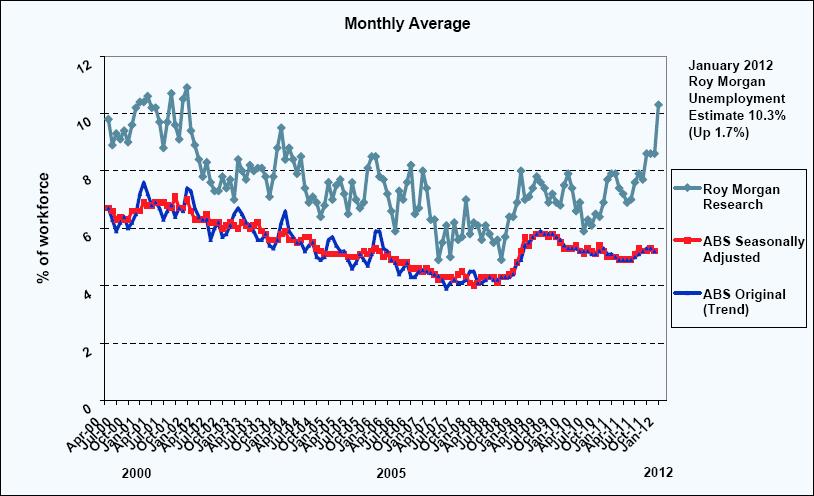
Unemployment data for January 2012 from Roy Morgan Research is out.

For those brave enough to peek between their fingers clasped over the eyes, here’s a chart to give you nightmares:

Click to enlarge

In Roy Morgan Research’s own words (emphasis added):

  • Unemployment was 10.3% (up 1.7% since December 2011) — an estimated 1,278,000 Australians were unemployed and looking for work. This is Australia’s highest ever number of unemployed as reported by Roy Morgan and is also Australia’s highest unemployment rate for a decade — since January 2002 (10.9% — 1,075,000).
  • A further 7.5% of the workforce* were working part-time looking for more work (underemployed) — 934,000 Australians.
  • In total a record 17.8% of the workforce, or 2.21 million Australians, were unemployed or underemployed.
  • The Australian workforce* in January was at a record high 12,429,000, up 383,000 since January 2011 — comprising 7,681,000 full-time workers (up 106,000); 3,470,000 part-time workers (down 53,000) and 1,278,000 looking for work (up 330,000).
  • The latest Roy Morgan unemployment estimate of 10.3% is now almost double the 5.2% currently quoted by the ABS for December 2011.

Now, you may be wondering why Roy Morgan stats are so much higher than the Australian Bureau of Statistics (ABS) data.

You know. The “official” statistics agency that is quoted exclusively by government politicians, and parroted by their PR agencies … ummmm, the media.

A few hints:

1. The ABS is a government agency.

2. See 1.

3. You have to run up and down the street naked, waving your hands wildly and shrieking “I don’t have a job!!” for weeks to be counted as unemployed by the ABS.

More seriously, academic economist Bill Mitchell has written a very lengthy, detailed article about the differences between ABS and Roy Morgan methodology here.

In a nutshell:

“...the real difference is that [Roy Morgan] do not apply an activity test as strictly as the ABS and thus include a number of workers which we might consider to be “hidden unemployed” as per the previous discussion.

The Roy Morgan method asks whether the person who is “not employed if they are actually looking for a paid job (regardless of whether they’ve looked in the last four weeks)” and so they include the ABS official unemployed plus some estimate of the hidden unemployed…

In other words, Roy Morgan Research data is a broader measure of employment (or lack thereof).

So which one to believe?

Here’s Bill Mitchell again (emphasis added):

“The broad rule of thumb that economists such as me use to provide an estimate of the state of the labour market is to double the official unemployment rate and then add some for hidden unemployment.”

Now you know why “word on the street” amongst we average folk has been that unemployment is on the rise, while the government continues to downplay ever increasing job losses.

About that budget surplus Wayne … Wayne?

*crickets*

Labor’s Budget Made Simple

31 Jan

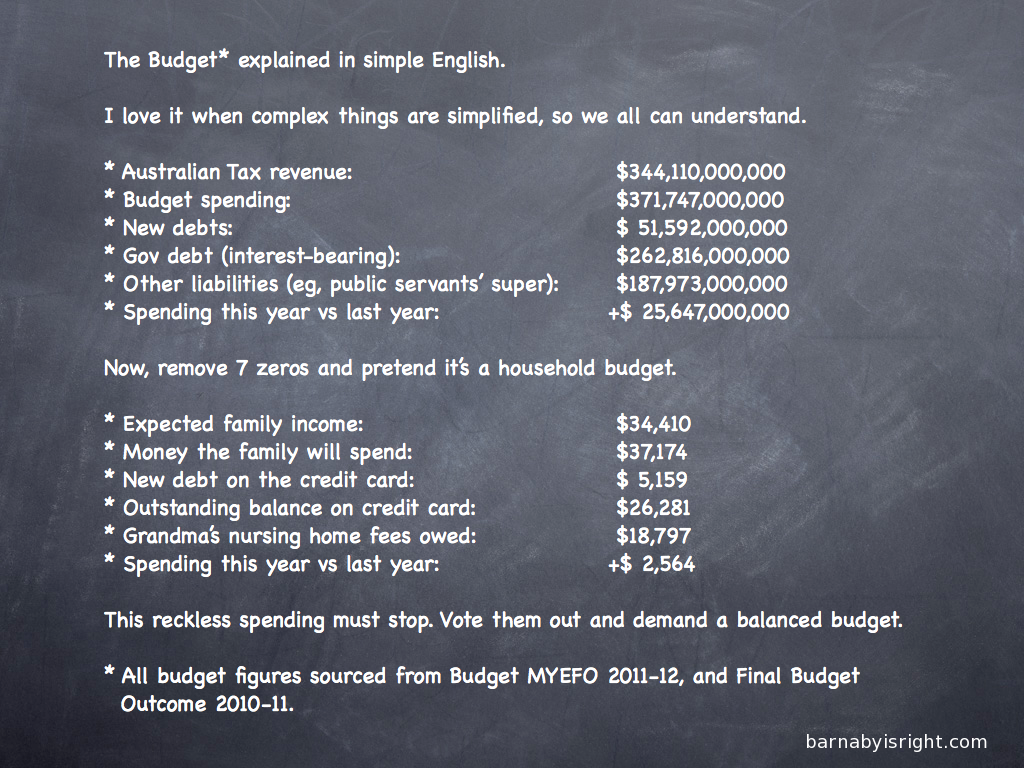
Twitter follower @cr0atz recently brought to my attention an interesting picture of the US budget made simple. He asked me to make an Aussie version.

Voila!

Click to enlarge

Now don’t let anyone tell you that debt and deficits don’t matter.

Or, that government and household budgets are “different”.

Just remember, dear reader.

Those spruiking such claims – their ideological Articles of Faith – are the same “experts” who didn’t see the GFC coming.

And now, can’t fix it either.

#JAFA’s, in other words.

Barnaby is right:

“If you do not manage debt, debt manages you” ~ Feb 2010

How Selfish Old People Ruined The Environment

17 Jan

Taking a break from blogging. But had to share this:

A Note From An 80 Year-Old About “Being Green”

Now that I’m 80 years young, I can tell all the younger people I know where to go with their “Being Green”.

At the checkout stand in the store, the cashier told an older woman that she should become more “Green” by bringing her own grocery bags because plastic bags weren’t good for the environment.

The woman apologized to him and explained, “We didn’t have the green thing back in my day.”

The clerk responded, “That’s our problem today. Your generation didn’t care enough to save our environment.”

She was right — our generation didn’t have the green thing in its day. Back then, we returned milk bottles, soda bottles and beer bottles to the store. The store sent them back to the plant to be washed and sterilized and refilled, so it could use the same bottles over and over. So they really were recycled. But we didn’t have the green thing back in our day.

We walked up stairs, because we didn’t have an energy consuming escalator or elevator in every store and office building. We walked to the grocery store and didn’t climb into a gas guzzling car, truck or SUV every time we had to go two blocks. But she was right. We didn’t have the green thing in our day.

Back then, we washed our baby’s diapers because we didn’t have the throw-away kind. We dried clothes on a line, not in an energy gobbling machine burning up 220 volts — wind and solar power really did dry the clothes. Kids got hand-me-down clothes from their brothers or sisters, not always brand-new clothing. But that old lady is right; we didn’t have the green thing back in our day.

Back then, we had one TV, or radio in the house — not a TV in every room. And the TV had a small screen the size of a handkerchief (remember them?), not a screen the size of the state of Montana. In the kitchen, we blended and stirred by hand because we didn’t have electric machines to do everything for us. When we packaged a fragile item to send in the mail, we used a wadded up old newspaper to cushion it, not Styrofoam or plastic bubble wrap. Back then, we didn’t fire up an engine and burn gasoline just to cut the lawn. We used a push mower that ran on human power. We exercised by working so we didn’t need to go to a health club to run on treadmills that operate on electricity. But she’s right; we didn’t have the green thing back then.

When away from home, we drank from a fountain when we were thirsty instead of using a disposable cup or a plastic bottle every time we had a drink of water. We refilled writing pens with ink instead of buying a new pen, and we replaced the razor blades in a razor instead of throwing away the whole razor just because the blade got dull. But we didn’t have the green thing back then.

Back then, people took the streetcar or a bus and kids rode their bikes to school or walked instead of turning their moms into a 24-hour gas burning taxi service. We had one electrical outlet in a room, not an entire bank of sockets to power a dozen appliances. And we didn’t need a computerized gadget to receive a signal beamed from satellites 2,000 miles out in space in order to find the nearest pizza joint.

But isn’t it sad the current generation laments how wasteful we old folks were just because we didn’t have the green thing back then?

Please forward this on to another selfish old person who needs a lesson in conservation from a smartass young person.

Remember: Don’t make old people mad. We don’t like being old in the first place, so it doesn’t take much to piss us off.

Simple wisdom. Borne of a lifetime of … life experience.

Which is why I wrote this last year – No More Mañana Or Bananas In A Parliament Of Nanna’s

This blogger longs for the day when we will all choose (once again) to properly esteem and value the wisdom of our elders:

Wisdom is a deep understanding and realization of people, things, events or situations, resulting in the ability to apply perceptions, judgements and actions in keeping with this understanding. It often requires control of one’s emotional reactions (the “passions”) so that universal principles, reason and knowledge prevail to determine one’s actions. Wisdom is also the comprehension of what is true or right coupled with optimum judgment as to action. Synonyms include: sagacity, discernment, or insight.

Our Second Biggest Market Slumps, “Fundamentally On A Downward Slope”

30 Dec

Started out, just drinkin’ beer
I didn’t know how or why
Or what I was doin’ there
Just a couple more
Made me feel a little better
Believe me when I tell you
It was nothin’ to do with the letter

Sometimes I wonder
What all these chemicals
Are doin’ to my brain
Doesn’t worry me enough
To stop me from doin’ it agai-ai-ain
Wipin’ out brain cells
By the millions but I don’t care
It doesn’t worry me
Even though
I ain’t got a lot to spare-are-are

– The Nips Are Getting Bigger, Mental As Anything

If Treasurer Swan had enough grey matter to comprehend what is happening in the global economy Ponzi, then he’d probably be turning to the drink by now.

Because Japan’s economy is getting smaller.

From Bloomberg:

Japan’s rebound from the March earthquake and tsunami sputtered in November as production and retail sales tumbled, deepening the nation’s return to the deflation that first took hold a decade ago.

Industrial output slumped 2.6 percent from October, more than all the forecasts in a Bloomberg News survey of 29 economists, a government report showed today in Tokyo. Retail sales slid 2.1 percent…

“Fundamentally, Japan’s economy is on a downward slope,” said Yoshimasa Maruyama, chief economist at Itochu Corp. “Exports are falling and negatively impacting Japan’s economy due to the global slowdown.”

“Industrial production is unlikely to recover to” levels seen before the 2008 global financial crisis, Junko Nishioka, chief Japan economist at RBS Securities Japan Ltd., said before today’s reports.

Other data also suggest Japan’s recovery may be stalling. Exports fell for the second straight month in November from a year earlier and capital spending in the third quarter dropped 9.8 percent.

Japan is our second biggest export market.

According to DFAT, as of October 2011 … before the November slump reported by Bloomberg … our exports to Japan were worth 62% of our exports to China:

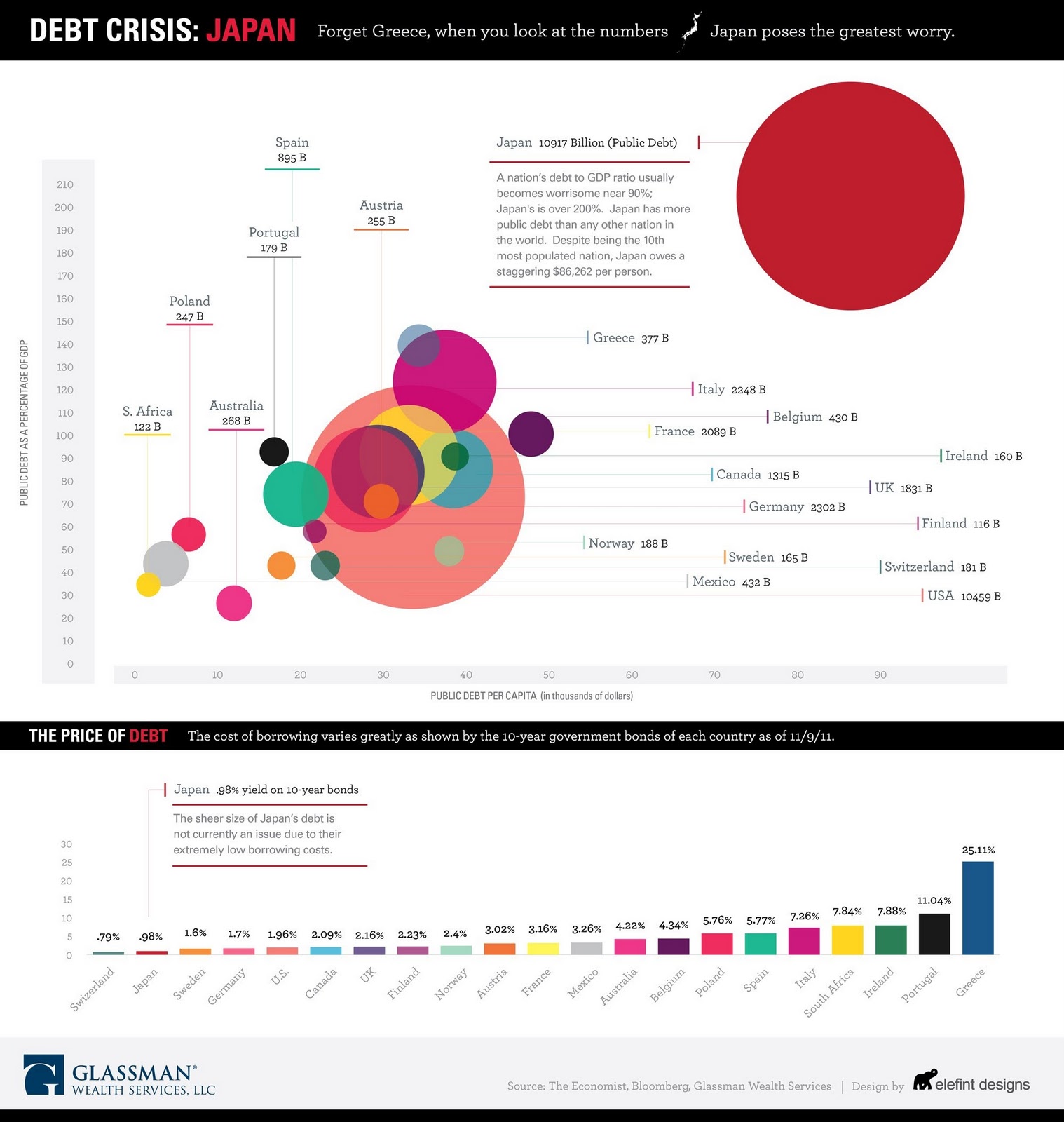
The world’s third largest economy is also the most debt-laden nation on the planet:

Click to enlarge

Back in June we brought you the warning that our biggest economic danger could be hiding in plain sight.

It’s worth recapping:

Buy a farm house in the middle of nowhere, pick up a gun or two, prepare for hyperinflation and brace for a catastrophic bankruptcy. Thirty minutes with hedge-fund manager J. Kyle Bass has you wanting to do all of the above.

The head of Dallas-based Hayman Advisors LP isn’t thinking about Greece or even Spain but Japan, the world’s third-biggest economy. He says his bet against Japanese government bonds is even “more compelling” than his gamble to sell short U.S. subprime-mortgage debt, which earned him $500 million in 2007.

Shorting Japan has been a losing proposition in recent years. But the earthquake, tsunami and nuclear crisis altered the outlook for a nation whose debt is more than double the size of the economy. Bass says a collapse is inevitable, making Japan’s 10-year bonds — they yield 1.3 percent, among the lowest in the world — a natural for a bear investor.

His argument is this: Japan now spends half of its central- government revenue on servicing debt. This task won’t get any easier as the country’s population ages and shrinks — provided rates stay the same. What’s more, the price tag for the earthquake and its effects will far exceed Japan’s initial $300 billion estimate, pushing the country over the edge. In Bass’s view, the biggest asset bubble ever is hiding in plain sight.

Feel like a drink?

It’s almost NYE after all.

Boom State Busts

29 Dec

The WA government has revised its 2011-12 budget forecast downwards … by more than 50%:

The West Australian government has slashed its projected surplus by more than $200 million because of risks in the global economy, weaker royalties, a weak housing market and the high Australian dollar.

WA is expected to record a $209 million surplus, making it the nation’s highest surplus for 2011-12.

But the projected surplus is significantly lower than the $442 million forecast at budget time.

The figure was released on Wednesday as part of the Liberal-National government’s mid-year review.

Reasons given?

Treasurer Christian Porter said there had been many changes to the global economy since the May state budget.

“There’s been one single unanticipated economic phenomena that has occurred since the time of delivering the budget in May, which has had a very significant impact on the WA state economy – that is the events that are unfolding in Europe.

“It is self-evident that what’s going on in Europe is very serious.”

Mr Porter said the European sovereign debt crisis and a slower than expected recovery in the US economy had been major factors in the revised estimates.

He said the royalty revenue had been revised downwards to $970 million over the budget and forward estimates period because of a higher $US/$A exchange rate and the impact of lower iron ore, oil and base metals prices.

Mr Porter said that while the European Union accounted for just six per cent of WA’s merchandise exports, it provided 20 per cent of China’s exports, which could affect WA.

He said that if conditions in Europe worsened and negatively affected the availability and cost of credit, major resource projects in WA could be delayed.

Anything else?

… the housing market remains weak with both house prices and sales volumes lower than the budget forecasts.

And the future beyond the next 6 months?

Budget surpluses are still forecast until 2013/14 though these too have been revised significantly downwards.

Why?

Softening iron ore prices over the last six months have hit the State Government’s revenue projections hard, with Treasurer Christian Porter forecasting an almost billion dollar drop in mining royalties in the state over the next four years.

Speaking to reporters today Mr Porter said the government has slashed $951 million from its projections of mining royalties, with almost $820 million coming off iron ore royalties alone over the next four years.

This is despite the State Government increasing royalty rates on fines iron ore from 5.25 per cent to 6.5 per cent from July next year, and up to 7.5 per cent from the following financial year.

The State Government’s mid year financial review forecast a steady fall in iron ore prices over the next four years, however, following sharp falls in spot prices earlier this year as uncertainty over European debt and the health of the Chinese economy hit markets.

So, our “boom” state is now expecting a bust.

Of 50%+.

What was it that Senator Joyce said in response to the Federal government’s “truly extraordinary” May budget forecast?

Opposition frontbencher Barnaby Joyce has taken a swipe at the Gillard government’s approach to the economy, saying it had an unbounded belief in Asia’s demand for Australia’s resources.

“God help you when the prices go down,” he told reporters in Canberra on Wednesday.

The government’s approach to economics was “a clever ability to charge people to dig up red and black rocks.”

“They (government) have an unbounded belief that the people in South-East Asia will have an eternal gratitude to pay an excessive price for red rocks and black rocks.”

And what did he say in September (a must-read)?

Australia avoided recession because of the export of red rocks (called iron ore) and black rocks (called coal) in record volumes at record prices, record shipments of wheat, a 425 basis point drop in interest rates and a comparatively low dollar.

Wayne Swan likes to regularly point to Australia’s $400 billion investment pipeline but he doesn’t control that. That is a promise of someone else’s benevolence. What he does control is the public sector debt and it is going through the roof.

Barnaby was right.

Again.

Now, about that revised fudged $1.5bn Federal government budget surplus, forecast for 18 months away.

Wayne? … Wayne?!?!

Oh, of course. Silly me. We don’t need to hear it again.

We all know the mantra by now:

“Our economy has blah blah strong fundamentals blah blah low debt blah blah trend growth blah blah a huge investment pipeline.”

Spirit Of Caring Has Lost Its Way

24 Dec

Senator Joyce writes for the Canberra Times … and succeeds marvellously in riling up all the usual humourless egocentric “pseudo-intellectual Gucci fleas”, as a quick search of the blogosphere will affirm:

Spirit of caring has lost its way

I like genuine agnostics. They don’t get bent out of shape by other religions; they are just thinking about it and them and how and whether they all stick together. Whatever blows your hair back is good to go for them. They may be ambivalent, but at least they live and let live.

My war is always against that religion called atheist extremism, that sneaky sect. Its advocates’ belief in nothing is more affirmed and uncompromising than just about anyone else’s belief in anything. Oh, they are all so proper and stuffy and impossible at drinks, which, at this time of year, revolve around an institution that apparently they are in mortal combat with. They say ”greetings for the season”, which has about the same warmth and credibility as ”greetings, earthling”.

They send Christmas cards but abhor the mentioning of Christmas in them. What is the point – as if there is any other time of the year that you arbitrarily send out dozens of cards. The purchase of their yuletide folded cardboard comes with the notation ”seasons greetings”, which is, as I have noted before in this column, the salutation to be given to stuffing inserted into the cloaca of the Christmas turkey. My office colleague now informs me of yet another cryptic politically correct annotation, ”happy holidays”. Surely they let something slip saying ”holidays”, which is derived, of course, from ”holy day”. Maybe ”happy days of pleasure” would be more politically correct and could come with a very interesting picture for the mantelpiece. They insist on changing BC and AD to BCE and CE, which is what? Banco Central del Ecuador and a Colonoscopy Endoscope?

Yes, this sect’s followers make their way on to your veranda then hold a righteous court of sneering indignation about the crib in the park. You can hear yourself muttering under your breath, ”I wish you would go drown yourself, you pseudo-intellectual Gucci flea.” They write letters to complain about the incorrectness of carols at the school and picket the Christmas tree. To not insult their religion, you must no longer follow yours. They yearn for the fallacy of a vacuum and they demand that you join them in that philosophical void.

The solution, of course, is that they should all just remain at work while the rest of us go on holidays, and we can double the pleasure by knowing that, when we return, they can go on theirs. This doubles the time away from each other.

I have recently returned from Taiwan, a trip paid for by the Taiwanese, and they appear, in a predominantly Buddhist country, to be more understanding and tolerant of Christmas than some sections of Australia. They also appeared to have no problems with Christ’s relevance to the notation BC or AD, Augustus Caesar’s relevance to August, Julius Caesar’s relevance to July or Thor’s relevance to Thursday, points which Christians have been dealing with for a millennia or so without too many revolutions.

The Taiwanese have probably come to the conclusion that a ceremony that celebrates a person who said such things as ”blessed are the peacemakers” and implored people to look after the poor and cured lepers is probably not too much of a threat to the corruption of children.

Anyway, Christmas is here and I hope we borrow a little from the person who kicked it off. The timing at the end of December has more to do with the celebration of the pagan festival of Saturnalia rather than when Christ was actually born. Those politically incorrect early Christians had the good sense to roll with the customs rather than to rage against them.

In borrowing from the ethos of the person from which the term Christmas was named, this time of year means more than drinking litres of Crownies with anyone you can tackle after 4pm every day for a week. Looking out for the lonely is always a good place to start, maybe even being brave enough to buy some newspapers, some glossy glamour magazines and stroll up to the hospital and see if you can find someone who is not surrounded by family and friends. That was the trick we used in Vinnies; if they wanted to talk, they did, if they didn’t they took the paper and said, ”Thanks, Merry Christmas.”

Yup.

“The timing … has more to do with the celebration of the pagan festival of Saturnalia rather than when Christ was actually born”

As your humble blogger pointed out to friends recently:

So you really think that shepherds were out in the fields at night … in the dead of winter in the Northern Hemisphere?

Happy Winter Solstice, dear reader 😉

Or in our case, Summer Solstice.

Don’t forget … our days just get darker from here.

But on the bright side … it’s always darkest before the dawn.

Mind your credit debt card now.

Bah, humbug.

For “Keeping It Real”, Barnaby Wins Personality Of The Year

23 Dec

The Weekly Times Now has announced its annual Personality of the Year award:

Barnaby once again delivered the most memorable quotes of 2011.

What can we say? There was no bigger personality this year than a black streak on four legs: Black Caviar.

Sixteen straight wins and comparisons with Phar Lap and the other greatest horses of all times.

But alas the rules state Personality of the Year must go to a two-legged star.

Honourable mentions include Julia and Tony of course – simply for just being there … every day … every hour …every minute.

But the winner is Barnaby Joyce for keeping it real in Canberra. When most politicians look like cardboard cutouts spouting platitudes and gobbledygook, Barnaby tells it like it is.

Barnaby’s one-man show kept us entertained with a string of quotable moments including this one: “so when your clock radio tells you to get out of bed, that little red light is to remind you that Julia has been taxing you through the night”.

His madcap antics, including writing off his government-issue four-wheel-drive in the floods and mangling his knee in a motorbike accident, were also memorable.

Well done Barnaby.

Motorbike accident?

I like the man even more.

UPDATE:

And it doesn’t get more real than this –

A recalcitrant calf and an ill-timed excursion off his motorbike to turn back the escapee has created plenty of discomfort for The Nationals’ Senator Barnaby Joyce.

Senator Joyce was in Tamworth Hospital yesterday recovering from an operation to remove bone chips and pieces of gravel from an infected wound in his knee while doing cattle work at his parents’ property near Danglemah, about an hour from Tamworth, on Monday.

“It was late in the day and we were pushing cattle across a creek below the yards and this calf kept on turning back,” the senator said.

“I jumped off my bike to stop it and I slipped onto this sharp rock.

“It pierced my jeans and the skin on my patella, driving right down to the bone.”

However, he kept working to finish the job, ignoring his discomfort.

“When I got home I washed it and saw I needed a stitch, so I drove myself into outpatients (at the Tamworth Hospital).

“They stitched me up, gave me some antibiotics and told me if I got a temperature to come back.”

Senator Joyce said an infection set in and he returned to the hospital to be informed he would need an operation.

“They took out 15 bone fragments and a couple of pieces of gravel,” he said.

“Now I’m in a kneebrace and on a course of IV antibiotics.”

He said he hoped to leave the hospital today as the family had cattle to sell at a store sale in Tamworth.

Senator Joyce said his excursion to hospital cost him an opportunity to catch up with the Pollie Pedal pelaton led by Opposition leader Tony Abbott, in Walcha on Wednesday night.

Barnaby: The Big NBN Con

22 Dec

Media Release – Senator Barnaby Joyce, 22 December 2011:

The Regional NBN spin, The NBN reality, The Big Con

Senator Conroy stated on 7th September that “the NBN will provide a massive economic boost for the Australian economy, particularly in regional and remote communities.”

Well if you are looking for remote Julia Creek with a population of 500 between Mt Isa and Townsville as your piece de resistance and the Labor Party’s NBN goes right under the town. Surely Senator Conroy would be mugged by logic and lobbied by his regional advocates, Windsor, Oakeshott and Co., to connect to J. C. for Christmas. The town even has the same first name as your boss Stephen! Nope – they bypassed logic and left Julia Creek just as they found it, waiting for wireless, with the vision of Windsor, Gillard and Conroy pushing the big regional telecommunications button in Armidale burning in their retina.

The stoic remote town of Julia Creek, because it has a population of 500, does not qualify for the fibre optic service, even though it runs right under the town. The amazing vision of the Labor Party.

The council has been told by NBN Co that it will cost them $1.14 million to connect and they should just wait for the wireless service.

But why is it that the Town of 1770 with a population of just 80 does qualify for the fibre connection? Why are 30 other towns, many with much less than the magic 500 population figure, getting access to the fibre optic service?

Senator Conroy also said “One of the great benefits provided by the NBN to rural communities will be important eHealth services that will mean people, especially the elderly, will be able to access high end medical support in their own homes and not have to travel great distances to large cities.”

Apparently not if you live in Julia Creek even though the optic fibre cable is just beneath them, so close, as they say, if it was a black snake it would bite you. So what was the point in making all those wonderful promises, only to deny people access when the cable turns up?

It is starting to look like a big con Stephen. There is not much point to a railway line without railway stations.

More information – Matthew Canavan 0458 709433

GilSwan Conned – Mining Tax The Greens’ Pit Of Despair

22 Dec

See those storm clouds gathering?

Over the Pit of Despair?

I wonder how Greens’ supporters will respond, when they wake up and discover the truth.

That their party’s deal with Labor on the mining tax will have the opposite result of what they were told.

I wonder what will they say, when they discover that the Minerals Resource Rent Tax (MRRT) will not result in the kind of wealth redistribution that was touted, a “fair share of our mineral wealth for all Australians”.

That instead, it will result in the Big 3 multinational mining companies … getting bigger. And richer. And more powerful.

And the government’s budget digging even deeper into the red.

When PM Gillard and Treasurer Swan went behind closed doors with the Big 3 miners to thrash out a hasty “fix” to former PM Rudd’s Resource Super Profits Tax (RSPT) debacle, thinking folks knew it would not end well.

Except for the big miners, that is.

Rather than scoring a vital goal for her “decisive” new leadership before the 2010 election, the secretive deal always looked more likely to result in yet another decisive Labor own goal.

And indeed it has.

Especially after Gillard and Swan again went behind closed doors, this time with the Independents and Greens, to thrash out a political deal to secure passage of the legislation in the parliament.

Late last month, after the new MRRT legislation passed the lower house, mining correspondent for The Australian Andrew Burrell belled the cat:

FEWER than one in 10 iron ore and coal miners operating in Australia will earn enough profit to start paying the $11.1 billion minerals resource rent tax from next year, according to Gillard government estimates.

A spokesman for Wayne Swan said yesterday he could not provide the names of the “estimated 20 to 30″ companies that were likely to pay the MRRT in 2012-13 because it was impossible to say how many companies would earn more than the annual profit threshold of $75 million.

“We haven’t got a precise list,” the spokesman said.

“But we have said the vast bulk of MRRT will be paid by the big three (BHP Billiton, Rio Tinto and Xstrata).”

Mr Burrell went on to reference the PM’s ever-changing claim for how many miners will be impacted under her revised grand design.

A claim most noteworthy not for its credibility.

But for its familiarity.

A remarkable familiarity to her “1,000 biggest” / “500 biggest” / “more like in the order of like, 400 biggest polluters” claim.

And the “half a million” / “300,000” jobs creation claim.

And the “4%” / “3.25%” projected GDP growth claim.

And the “3.5bn surplus” / “1.5bn surplus” projected budget outcome claim.

Big Labor government claims that are always being revised … downward:

Julia Gillard said last year that 320 iron ore and coal miners operating in Australia could be eligible to pay the MRRT — down from 2500 under the original resource super-profits tax that applied to all commodities.

In a deal with Tasmanian independent MP Andrew Wilkie on Monday, the government agreed to raise the profit threshold for the tax from $50m to $75m.

Mr Wilkie revealed the move would restrict the number of companies paying the MRRT to fewer than 30.

But this failed to quell criticism from junior miners, which claim the design of the tax still favours the established miners.

It remains unclear how the government will raise $11.1bn in the first three years of the MRRT.

Billionaire miner Andrew Forrest added to the confusion last week when he estimated that his iron ore company, Fortescue Metals Group, would largely avoid paying the tax for at least five years thanks to the substantial writeoffs available to all big producers.

Many in the industry also doubt whether BHP, Rio and Xstrata will face big MRRT liabilities, particularly in the early years of the mining tax.

This is because the design of the tax allows iron ore and coalminers with existing operations to price their assets using today’s inflated market values and claim potentially massive deductions…

Glyn Lawcock, a top-rated mining analyst at UBS, said it was impossible to predict with accuracy how much MRRT companies would pay from next financial year because it was difficult to calculate a company’s market value, which was used to determine MRRT liability.

When asked whether he believed the government could raise $11.1bn over three years, he said: “I scratch my head a little bit at that.”

It certainly is a head scratcher. Especially when one takes the time to carefully review the Treasury department’s Minerals Resource Rent Tax Bill 2011 document.

Recently a mining industry chief executive walked your humble blogger through this document. And explained that there is a very good reason why there has been little except “token noise” from the mining industry over the GilSwan MRRT, in stark contrast to the spirited fight put up against the original Rudd RSPT.

It is because in his words, “big miners will pay nothing for years, and small miners will pay nothing at all”.

But there’s more. In having the details explained to me, an even bigger flaw dawned.

A key insight, that mainstream economic commentators have not cottoned on to.

The clever accountants and lawyers for the Big 3 appear to have conned GilSwan into creating a tax mechanism that not only allows the Big 3 to defer paying any MRRT for years. It is a “tax” that acts as a financial incentive for the Big 3 to increase their monopoly, by gobbling up their smaller competitors and getting MRRT write-offs for doing so.

To understand how, let’s work through the details of the Treasury department’s document (emphasis added):

New investment will be given generous treatment in the form of immediate write‐off, rather than depreciation over a number of years.  This allows mining projects to access the deductions immediately, and means a project will not pay any MRRT until it has made enough profit to pay off its upfront investment.

Sounds good if you are a start-up miner or explorer, right?  No doubt this idea was sold to GilSwan by the Big 3 as being “necessary” to encourage future mining investment, given that the MRRT places Australia at a competitive disadvantage versus other nations that do not have an MRRT.

But it’s also an obvious loophole that immediately dawned on your humble blogger. One that favours the Big 3 miners, who have the deepest pockets.

Consider.

What happens if a big multinational miner such as BHP, Rio Tinto, or Xstrata buys out a smaller mining company, such as a junior explorer or a company with proven but unrealised in-ground reserves?  It would appear they can claim the cost of that “new investment” as an immediate tax write-off, thus offsetting any MRRT they might otherwise be obliged to pay with respect to their other mining projects.

As you will see in a moment, this is no mere speculation by a sceptical blogger with an eye for detail.

It is exactly what the mechanism allows.

But it gets better for the big miners.

What if that smaller miner or junior explorer that they have now bought out, is presently making losses? Remembering that all do, typically for the first 5-10 years of the mine’s life:

• The MRRT will carry forward unutilised losses at the government long term bond rate plus 7 per cent.

Buy up a smaller, loss-making mining company. And claim the value of their unutilised losses against your other MRRT obligations.

Can’t believe that GilSwan (and the “bozos” in Treasury) could be this stupid?

They are:

• The MRRT will provide transferability of deductions. This supports mine development because it means a taxpayer can use the deductions that flow from investments in the construction phase of a project to offset the MRRT liability from another of its projects that is in the production phase.

No use to a small mining company with only one project. But manna from heaven to a large multinational miner with multiple projects.

Buy up a junior explorer, or a mining company that has proven reserves but has not yet begun/completed construction on the project. Claim 100% of the costs against your MRRT liabilities from other, active producing projects.

Thanks to the MRRT, the initial ‘new investment’ in swallowing up a junior mining company, and the ‘unutilised losses’ of that junior mining company, and the construction costs of taking that newly-acquired mining company’s project to production stage, all these now become tax-minimising assets to a hungry Big 3 multinational looking to take over their smaller, up-and-coming (Australian-owned) competitors.

But there’s still more:

• The MRRT will recognise the particular characteristics of different commodities, by applying a taxing point close to the point of extraction, and using appropriate pricing arrangements to ensure only the value of the resources extracted is taxed.

The Big 3 miners were very clever indeed in negotiating this “deal” with GilSwan.

As my mining industry source pointed out to me, the point of extraction is the point of lowest value of the ore; the grade is far below “shipping grade”, and so its value is far below the actual market value. He cited the example of copper ore.

At the point of extraction, the ore may only comprise 1% copper. The value of the ore at this point is around $20 per tonne.

But when subsequently processed into a 25% copper concentrate, the value is around $1,387 per tonne.

And the cost to the mining company of processing the raw 1% copper ore into 25% copper concentrate?

“About $30 per tonne.”

When the Big Miners insisted on the tax being applied “close to the point of extraction”, they took advantage of GilSwan’s abject ignorance of real-world business.  An ignorance that has been all too often seen in their many other policy calamities – think ceiling insulation, school halls, computers in schools, subsidised Toyota hybrids, green schemes, set-top boxes, and the daddy of them all, the no cost/benefit analysis NBN.

You should not be surprised, dear reader.  Not when our World’s Greatest Treasurer has an Arts degree, zero business experience, and has never worked a real job in his life.

Which explains, of course, why we are paying him $262,000 per year. And why we are about to increase his salary by $84,000 per year. And why we have spent $75,440 in 6 months on empty RAAF VIP “ghost” flights to ferry him about.

This ignorance of how things work in the real world is borne out even more starkly however. Not only have GilSwan agreed to impose the mining tax “close to the point of extraction”, (ie) at the ore’s lowest value, far below its value-added market value. They have also agreed to a 25% extraction allowance:

• The MRRT will provide a 25 per cent extraction allowance to further shield from tax the important value add and capital that mining companies bring to mineral extraction.

Further shield” it?!  When they are already applying the tax “close to” the point of its lowest value?!

Ignore if you can all the other write-offs and deductions for a moment. What this “extraction allowance” really means is that GilSwan have not only agreed to tax the ore at or near its lowest value. They have also agreed to an effective tax rate of only 22.5%. Not the headline 30%.

In other words, this so-called “super profits tax” will be applied at 25% less than the standard company tax rate that even my own small business has to pay!

But where the now-familiar Labor descent into complete farce reaches its denouement, is when we get to the Treasury department’s modelling:

How the MRRT works

The following example is intended to illustrate how the MRRT will apply to iron ore and coal projects, commencing after 1 July  2012.

The example presents outcomes for a single project company with an equity financed mine that operates for 5 years.  The company is assumed to invest $1 billion in the first year of the project.  Over the life of the project the pre‐tax rate of return (revenue less operating and investment costs) is 50 per cent.

Click to enlarge

As my mining industry source assured, the modelled assumptions are beyond fantastic.

They are positively delusional.

The Treasury assumes this fairytale mining company begins to show “Revenue” of $520 million at Year 2 (see table). In the real world, a start-up mining project typically absorbs 5-10 years of losses before they even begin productive operations. My mining industry source pointed out that he has never heard of any mining company ever going from zero revenue to half a billion in a single year.

The Treasury also assumes this fairytale company has Year 2 operating expenses of 25% of revenue, and 25.5% at Year 6. Again … unheard of figures.

Back to the modelling:

The MRRT is levied at a rate of 30 per cent of the operating margin (revenue less operating and investment costs) less the MRRT allowance and the extraction allowance.  The MRRT allowance is calculated as the value of unused losses uplifted by an allowance rate equal to the long term government bond rate plus 7 per cent…

When we look at Year 4 in the example, the year in which Treasury has modelled the first MRRT “profit” (an inconceivable $436m), we find another problem. It is unclear whether Treasury has modelled “Revenue” as being Company revenue, or, as the “extraction point” value of the ore. If, as appears likely, the modelled “Revenue” figure is actually Company revenue, then on this point alone Treasury’s modelling is gravely flawed. Company revenue has nothing to do with the value of the ore at the “extraction point”. Meaning, the Treasury figures are nonsense.

Indeed, my mining industry source described them as “totally made up and have no resemblance to reality”.

Rather like Treasury’s modelling for “green jobs” (see one of 2011’s most popular posts, Barnaby Bamboozles Chief Of Climate Change Modelling Unit … Again).

Back to the MRRT modelling:

State royalties are assumed in this example to be equal to 7.5 per cent of sales revenue and are credited against the MRRT liability to produce the net MRRT liability. Where royalty payments exceed the MRRT liability in any one year, the balance is uplifted at the allowance rate to be offset against future MRRT liabilities…

We’ve left the issue of how the MRRT impacts on the payment of State mining royalties until now, to avoid complication. This is already a source of political angst between the governments of the mining states, and the Federal government. For the purposes of our look at the modelling, however, it’s pretty simple. The GilSwan grand plan grants a 100% credit for State mining royalties paid by the mining company.

In summary then, the MRRT is essentially calculated as follows:

MRRT 30% x Operating Margin (ie, Revenue calculated “close to Extraction Point”, less Operating costs)

less 100% write-off of construction costs

less write-off of unutilised losses

less 100% write-off of construction costs of acquired companies/projects

less write-off of unutilised losses of acquired companies/projects

less write-down of “market value” of existing assets over 25 years, OR

less write-down of “current written down book value” of existing assets (less the value of the resource) at an accelerated rate over 5 years

less Extraction Allowance (25%)

less 100% State Royalty credit

It all begs the question … from where is the government’s claimed $11.1bn in MRRT revenue ever going to come from?

Treasurer Swan has claimed that “the vast bulk of MRRT will be paid by the big three”.

But in reality, given all the write-offs and concessions, the big miners will pay nothing for many years. If ever.

As Fortescue’s Andrew Forrest has affirmed.

So then, of GilSwan’s originally alleged “2,500 mining companies” in Australia, just who exactly are these “estimated 20-30” (small) iron and coal miners who will be earning profits of $75m per annum from July 2012?

Especially given that the boom in commodity prices has now peaked … and plummeted?

Others are asking the same question:

“Is this for real?

“Firstly, what 2500 companies are mining in Australia? There is NO WAY the number is that high unless one counts every Pty Ltd quarry and sand pit and borrow pit. Even then, it is an extraordinary figure and I cannot believe for one minute that it is real.

“But secondly, Gillard says only 320 iron and coal companies were captured under the MRRT. Really? Are there really 300-plus coal companies? Because as far as I know, there are only about 14 iron ore companies. And if you believe those figures to be true (i.e 320 dropping to around 30) that means that there are 290 iron ore and coal mining companies that are operating at an annual profit of between $50m and $75m since that is the only difference between MRRT Mk 1 and MRRT Mk 2. This is patently absurd.”

The broader point here is that there is just not a whole lot in the sustaining rhetoric of the MRRT that stands a cold hard reality check. Yet the government continues to represent the tax as a great leap forward in the commonwealth’s chase for a fairer share of the resources boom.

It isn’t.

As colleague David Uren made clear in his insightful dismantling of a tax “so compromised by its bastard birth that it puts the commonwealth budget at risk and cannot be considered an economic reform”.

Uren observed that a 20 per cent fall in commodities prices would wipe out the government’s MRRT revenue and leave it stumping up for the $4.5bn of recurrent spending commitments that were supposed to be funded from the fairer share.

And folks I am here to tell you that this is exactly the scenario that the government is facing.

The sustained retreat of iron ore and coal prices means that big mining is now some months past peak cashflows.

Indeed.

With the China bubble deflating, iron ore and coking coal spot prices are currently trading around 30% below their 2011 peaks:

Source: RBA Chart Pack, Dec 2011 | Click to enlarge

At least the Coalition is aware of the budget risk. Even if they too appear not to have twigged to what is a blindingly obvious extension of logic – that the MRRT is designed to help the Big 3 multinationals increase their profits, and their monopoly:

“There are serious question marks over who will pay what and when under Labor’s mining tax deal,” Shadow Assistant Treasurer Mathias Cormann said.

“FMG says it won’t pay any MRRT for a number of years given the tax design features favouring larger miners,” he said.

“There are credible suggestions that the big three miners who had exclusive access to the Prime Minister and the Treasurer to design the mining tax behind closed doors won’t pay any MRRT for years either.

No wonder the big three say they are happy with the MRRT, while the smaller local miners are not.

“Wayne Swan has consistently refused to release the commodity price and production volume assumptions used to estimate MRRT revenue claiming that they’re based on commercial-in-confidence data provided by the big three miners.

“So not only are the big three miners allowed to design the tax to suit their needs, they’re also the only ones allowed to know the governments mining tax revenue assumptions. That’s just not good enough.

Even on the government’s own figures, the mining tax package is a fiscal train wreck in the making.

The Great Big Mining Tax … that isn’t.

As my kind mentor concluded:

“This bill was drafted BY miners, FOR miners”

“I think the miners and their accountants outsmarted Gillard and Swan, and bamboozled them with mining jargon”

The miners in reality love it.” 

Greens’ supporters … welcome to the Pit of Despair.

“What did this do to you? Tell me. And remember, this is for posterity so, be honest. How do you feel?”

Design a site like this with WordPress.com
Get started