Tag Archives: debt and deficit

Waking Up To Sovereign Debt

25 Mar

From Business Spectator:

The current Greek debt crisis is likely to be only the first of a series of disruptions this year, as global financial markets inevitably shift their attention to the sovereign debt problems of advanced economies.

These problems were magnified by the global financial crisis. Faced with a collapse in consumer spending, and the risk of widespread bank failures, governments opened their cheque books while central banks printed trillions of dollars.

This had the effect of stabilising the financial system, but we now have to deal with consequences of these actions, and particularly with the deterioration in the balance sheets of most advanced economies.

The sovereign debt problem is not confined to the so-called PIIGS of Europe (Portugal, Ireland, Italy, Greece and Spain). Markets are also unnerved by the massive build-up of government debt in the United Kingdom and Japan. And that’s without mentioning the huge budgetary problems facing debt-laden US states, such as California.

There are various doomsday scenarios as to how this situation will ultimately play out.

The first is that countries will start off by heading in the direction that Greece is currently taking. That is, governments will attempt to repair their balance sheets by slashing their spending, and pushing up tax rates.

But the worry is that such budgetary measures will prove counter-productive. The countries that follow this path will end up with their economies plunging into recession, and with an outbreak of social unrest. And as their economies shrink, their tax revenues will dry up, which means that they won’t be able to pay the interest bills on their massive debt.

Eventually the situation will become untenable, and central banks will be forced to respond to the situation by printing more and more money in order to create enough inflation to erode the value of the debt.

Under this scenario, massive central bank money printing means ending up with hyperinflation, along the lines of the Weimar Republic, or, more recently, Zimbabwe. In which case the price of gold explodes, with some predicting it could reach $5,000 an ounce. Prices for other commodities also soar, and stock prices are also likely to remain high, as it is assumed that central banks will always keep interest rates below the rate of inflation.

The alternative fear is that the world ends up looking a lot more like Japan than Zimbabwe, and the main struggle is against deflation.

Under this scenario, the determination of consumers to reduce their debt levels overwhelms government efforts to stimulate the economy. What’s more, the deleveraging process causes demand to collapse, and this puts pressure on labour costs. Households respond to this further deterioration in their earnings by tightening their belts even further, resulting in an ongoing deflationary cycle.

One of the main arguments of this camp is that even though central banks continue to print huge amounts of money, it won’t lead to inflation because the banks are not lending the money. Instead, total credit in the economy will contract as consumers, and businesses, try to repay their existing debts, rather than taking out new loans.

According to this view, the price of gold and other commodities will collapse. The drop in demand will also put pressure on the profit margins of businesses, and this will push global sharemarkets lower, even though interest rates will be kept close to zero.

Of course, it’s likely that neither of these two extreme views will play out in their entirety. But we are likely to see markets oscillate between these two opposing fears as worries about sovereign debt continue to climb this year.

Got to love that blind optimism in the final paragraph.

It’s interesting to observe how the power of denial encourages an otherwise rational and sensible commentator to set aside all the evidence of where things are clearly headed, simply because the end of this road looks calamitous –
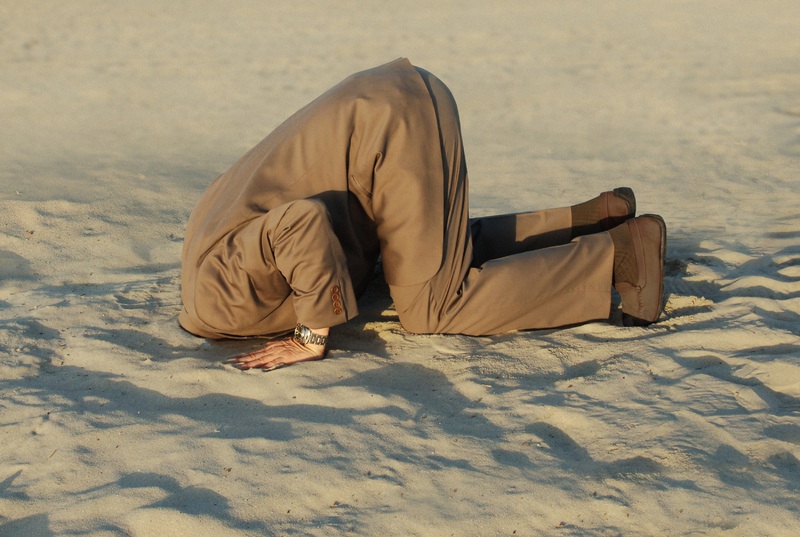
"She'll Be Right, Mate"
Everything Falls On Debt Concerns

25 Mar

From Bloomberg:

March 24 – Treasuries, the euro, stocks and commodities slid as a downgrade of Portugal’s debt and weaker- than-forecast demand in a U.S. bond auction added to concern governments will struggle to fund swelling deficits.

Greece “is going to default at some point,” and Europe’s failure to answer that challenge will hurt the common currency, UBS Investment Bank’s London-based deputy head of global economics, Paul Donovan, said in an interview on Bloomberg Radio. “If Europe can’t solve a small problem like this, how on earth is it going to solve the larger problem, which is the euro doesn’t work,” he said.

Taleb Concerned About Hyperinflation

23 Mar

From Bloomberg:

Rising public debt could lead governments to seek to eliminate it through inflation or even default if they fail to carry out fiscal measures in time, Mohamed A. El-Erian, co-chief investment officer at Pacific Investment Management Co. warned earlier this month. Nassim Nicholas Taleb, author of “The Black Swan,” a book arguing that unforeseen events can roil markets, said March 12 he is concerned about hyperinflation as governments around the world take on more debt and print money.

IMF Warns Wealthiest Nations About Debt

22 Mar

From the New York Times:

In a speech at the China Development Forum in Beijing, the I.M.F. official, John Lipsky, who is the deputy managing director, offered a grim prognosis for the world’s wealthiest nations, which are at a level of indebtedness not seen since the aftermath of World War II.

For the United States, “a higher public savings rate will be required to ensure long-term fiscal sustainability,” Mr. Lipsky said.

Mr. Lipsky said the average ratio of debt to gross domestic product in advanced economies was expected this year to reach the level that prevailed in 1950. Even assuming that fiscal stimulus programs are withdrawn in the next few years, that ratio is projected to rise to 110 percent by the end of 2014, from 75 percent at the end of 2007.

Indeed, the ratio is expected to be close to or to exceed 100 percent for five of the Group of 7 countries — excluding Canada and Germany — by 2014.

Mr. Lipsky warned governments not to try to inflate their way out of their debts.

More Labor Bad Accounting

20 Mar

Media Release – Senator Barnaby Joyce, 20 March 2010:

The Labor Party has added another $2.1 billion to our debt in the last fortnight which cracks the $130 billion mark. This is slightly less than the Clem 7 tunnel in Brisbane and would build 10,000 kilometres of sealed roads in regional Australia. They know they will never be responsible for paying it back.

Every week we find out more and more of what they have purchased with our credit card. The Building Education Revolution (BER) appears to be a very choice piece of work. Yet another brilliant example of the Labor Party not dotting the ‘i’s and crossing the ‘t’s, as Mr Tanner pointed out with regard to his input into the Ceiling Insulation Program.

The Labor Party cannot control costs. It appears they have never had experience in running a business and have now decided to experiment with the Australian economy as an economic crash test dummy with silly and dangerous ideas.

The cost overruns, inside deals for unions, burning houses and electrocution fatalities are just the start of understanding how the Labor Party manages the economy.

Today, what inspired this media release is that I have just walked out of a K Mart, after a buying a cheap pair of working trousers, and a mother with two children and an older couple were lined up to tell me about money that has been squandered in their district. They were concerned what the effect of going public with their story would have on their local school teacher but the story has grabbed my attention.

$250 000 has just been spent on a school hall in a local village/town. They could identify $110 000 worth of costs but $140 000 was for them “mystery money”. The school raised a complaint with the contractor and has since been refunded in excess of $30 000.This seems to be the story nearly everywhere you go and now is more widely ventilated with what we are reading in the papers.

Mr Tanner, Mr Swan and Mr Rudd are responsible for this. Their whole management critique is farcical. The ceiling insulation program has literally turned into a national crisis; the BER is the Big Education Rip off; the hidden Henry Tax Review; the $43 billion NBN project that was begun without a cost benefit analysis. To top it all off, is the Labor Party’s continued insane desire to re-jig the whole Australian economy based on a colourless, odourless gas that will apparently lead to Australia, single handedly, cooling the planet. On and on it goes, this rolling Greek tragedy, which is Labor Party management.

As an accountant, I have seen this form of management that the Labor Party indulges in.  It reminds me of the new arrival in the family business who is flash as a rat with a gold tooth and is quickly swindling away years of hard work.

They have the whole household on hire purchase, with the new car, the new boat, the new pool, the new stereo, multiple overseas trips to many and varied destinations but they have no new income and the result is a massive debt. You get this sinking feeling that just like they blew in, they are going to blow up then blow out.

More information- Jenny Swan 0438 578402

Next week, the Rudd Government has scheduled to take us another$2.1bn into debt.

Japan: ‘Extremely Little’ Room For Stimulus

20 Mar

From Bloomberg:

National Strategy Minister Yoshito Sengoku said Japan has “extremely little” room for further stimulus spending because of the country’s financial condition.

“From a fiscal point of view, there’s extremely little room for such a thing,” Sengoku said in an interview in Tokyo yesterday when asked about the prospects for another spending plan. “We need to carefully watch whether the situation would go to such lengths.”

His remarks contrast with comments made this week by Financial Services Minister Shizuka Kamei, who urged the government to compile a stimulus package to bolster the deflation-plagued economy. Prime Minister Yukio Hatoyama said on March 17 that he hadn’t discussed such a proposal.

Standard & Poor’s cut its outlook on Japan’s AA sovereign rating to “negative” in January, a move Sengoku described at the time as a “wake-up call” to repair the nation’s finances. Japan’s ratio of debt to gross domestic product is approaching 200 percent, the highest among developed nations, according to the Organization for Economic Cooperation and Development.

Japan is closer to the edge than any other major economy,” said Julian Jessop, chief international economist at Capital Economics Ltd. in London. “There is the risk that the higher the debt numbers are, the more another stimulus package is going to backfire by pushing up interest rates or by making people worry about the need for even bigger fiscal tightening in the future.”

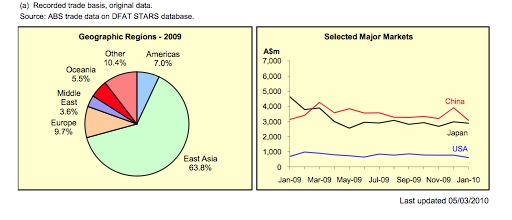
Japan is Australia’s second largest trading partner.

While China has become our largest trading partner in recent times, it is interesting to note the latest trade figures from the Department of Foreign Affairs and Trade

It seems our export trade with China has fallen sharply from Dec ’09 to Jan ’10.  And has been in slow decline since March 2009. That is a trend to watch closely.

There are many grave questions being raised about the sustainability of the China boom. And Japan’s economy is clearly in very deep trouble indeed.

So it is gross incompetence for our financial authorities – such as RBA Governor Glenn Stevens and Treasury Secretary Ken Henry – to continue to plan on our two largest trading partners being able to sustain our economy and get us out of debt in the years ahead.

ECB: Stark Warning of Eurozone Debt Crisis

17 Mar

From BusinessWeek:

European Central Bank Executive Board member Juergen Stark said the euro region may face a sovereign debt crisis unless governments reduce budget deficits.

There is “a clear risk that we will enter a third wave,” which is “a sovereign debt crisis in most advanced economies,” Stark told lawmakers in the European Parliament in Brussels today.

In Australia, our government is continuing to increase our budget deficit, by refusing to withdraw its woefully incompetent and wasteful “stimulus” spending.

Even though we had no recession, and RBA Governor Glenn Stevens recently referred to 2008-09 as “the mildest downturn” we have had since WW2.

US, UK To Lose AAA Credit Ratings

16 Mar

From Bloomberg:

The U.S. and the U.K. have moved “substantially” closer to losing their AAA credit ratings as the cost of servicing their debt rose, according to Moody’s Investors Service.

“Those economies have been caught in a crisis while they are highly leveraged,” (Moody’s managing director sovereign risk in London, Pierre) Cailleteau said, referring to the level of private and public debt as a percentage of gross domestic product.

Visit the website of Australian Professor Steve Keen, to learn why unprecedented private debt is huge threat to the Australian economy. Even greater than the Rudd government’s ever-growing public debt.

* On April 15th through 23rd, I will be joining Professor Keen in his 230km “Keenwalk” from Parliament House to Mount Kosciuszko, in protest against Australia’s property mania that has been driven directly by insane – and in my personal opinion, immoral – Federal Government and RBA policies, that have enticed hundreds of thousands of financially vulnerable Australians to take on large mortgage debts.

Please consider joining us, for the whole trek or even just for an afternoon section of the walk.

If you’d care to assist a genuinely worthy cause, then please consider sponsoring Professor Keen, or indeed myself. Funds raised will support the wonderful charity Swags For Homeless.

Thanks!

Is Mr Stutchbury Waking Up?

16 Mar

On February 28th I firmly criticised The Australian’s economics editor Michael Stutchbury’s column, “Chinese Can Fund Our Boom” (see my article here).

Well, it seems Mr Stutchbury may be (reluctantly) waking up to reality, if his column today is anything to go by. Though he cannot yet bring himself to let go of the fantasy entirely:

China Won’t Boom Forever

The big risk now is that, having escaped the global crisis, the Lucky Country thinks it’s bulletproof and the rebound in our iron ore and coal export prices means there is no penalty for bad policy.

The airbag of a US50c-US60c dollar cushioned the economy from the 1997 Asian financial crisis and the 2000 Wall Street tech-wreck. Our new China fortune pulled us out of last year’s global recession.

As a result, Australia is about to enter its 19th straight year of economic expansion, possibly the longest unbroken growth in our history. We appear to be heading into a bountiful decade or two of high commodity export prices driven by the rise of China and India.

But now, no doubt in reaction to Chinese Premier Wen Jiabao’s warning yesterday of a global double-dip recession, Stutchbury hedges just a little on his previous blind confidence:

But this new growth phase is bound to be volatile. And there is a smaller probability but higher impact risk that the mega China boom – like the 1980s Japanese bubble, the 90s Asian boom, the technology boom or the US housing bubble – could burst. We can’t count on being able to avoid a fair dinkum recession during the next decade.

Indeed. The fact is, many authorities around the world are predicting the China bubble may burst by 2012. Including some, like former chief economist for the IMF Ken Rogoff, who did predict the GFC in the first place.

I wonder how long it will take for Mr Stutchbury – and many others in the Australian mainstream economic media – to stop publishing reactions to the latest proclamation by an “authority”, and start researching widely in order to  think for themselves?

Perhaps he might take a lead from the Sydney Morning Herald’s Paul Sheehan, and his excellent and insightful article yesterday.

China Warns of Double-Dip Recession

15 Mar

From The Australian today:

China’s Premier, Wen Jiabao, has warned that the world risks sliding back into recession and says his country faces a difficult year trying to maintain economic growth and spur development.

“The unemployment rate of the world’s main economy is still high, some countries’ debt crises are still deepening, and the world’s commodity prices and exchange rates are not stable, which are most likely to become the cause of any setback in the economic recovery,” Mr Wen said yesterday in Beijing’s Great Hall of the People.

China’s and Australia’s economies have become more intertwined in recent years: the country is now our largest trading partner with two-way trade surging to $83 billion in the year ending last June 30, and in December it passed Japan as our largest export market.

Any trouble in China’s economy would quickly resonate in Australia.

Perhaps Treasury Secretary Ken Henry might care to revise his recent declaration that the GFC is ‘over’?

Perhaps Henry, along with RBA Governor Glenn Stevens, and all their many mindless cheerleaders in the media, might pause to reconsider their claims that ‘the risk of serious contraction‘ has passed, and that Australia is now set to enjoy a multi-decade China-fueled mining boom?  One that will fix the massive Rudd hole in the Budget, and provide a “period of unprecedented prosperity” for Australia?

Please… inform yourself.  Understand what is really going on in the financial world. Unlike the lazy, short-sighted economic illiterates who are running this country.

Please browse through the posts on this blog, and follow the links that catch your eye.

You will find references and links to literally dozens of articles from around the world.  You will see that international economists, investors, financiers, world leaders, and many others, have been increasingly warning of the many threats to the global economy. And thus, to Australia’s economy too.

Our Australian economic “authorities” are living in La la land.

Only Barnaby is on the ball.

Rudd Labor, Ken Henry, RBA and friends

Design a site like this with WordPress.com
Get started