Nouriel Roubini, one of the dozen or so economists who predicted the GFC, has just given an ominous warning for all those – like Wayne Swan, the Treasury department, former Treasury secretary (and now personal adviser to Gillard) Ken Henry, and the RBA – who are blindly banking on a never-ending China boom, with continuous record high terms-of-trade, to get us out of their $1.59 millionper hour Interest-only debt hole.
From Bloomberg, 11 June 2011:
China’s economy is at risk of a “hard landing” after 2013 as efforts to spur growth through investment cause excess capacity, said Nouriel Roubini, the New York University professor who predicted the financial crisis.
The nation faces a 60 percent chance of a banking crisis by mid-2013 in the aftermath of record lending and surging property prices, according to Fitch Ratings. A record $2.7 trillion of loans extended over two years has pushed property prices in China to all-time highs even as authorities set price ceilings, demanded higher deposits and limited second-home purchases.
Anything else?
There is increasing evidence of a potentially “excessive” slowdown in the world economy and crude prices may climb to as much as $150 per barrel if unrest in major oil-producing nations intensifies, Roubini said.
Roubini in July 2006 predicted a “catastrophic” global financial meltdown that central bankers would be unable to prevent. The collapse of Lehman Brothers Holdings Inc. in 2008 sparked turmoil that led to the worst financial crisis since the 1930s.
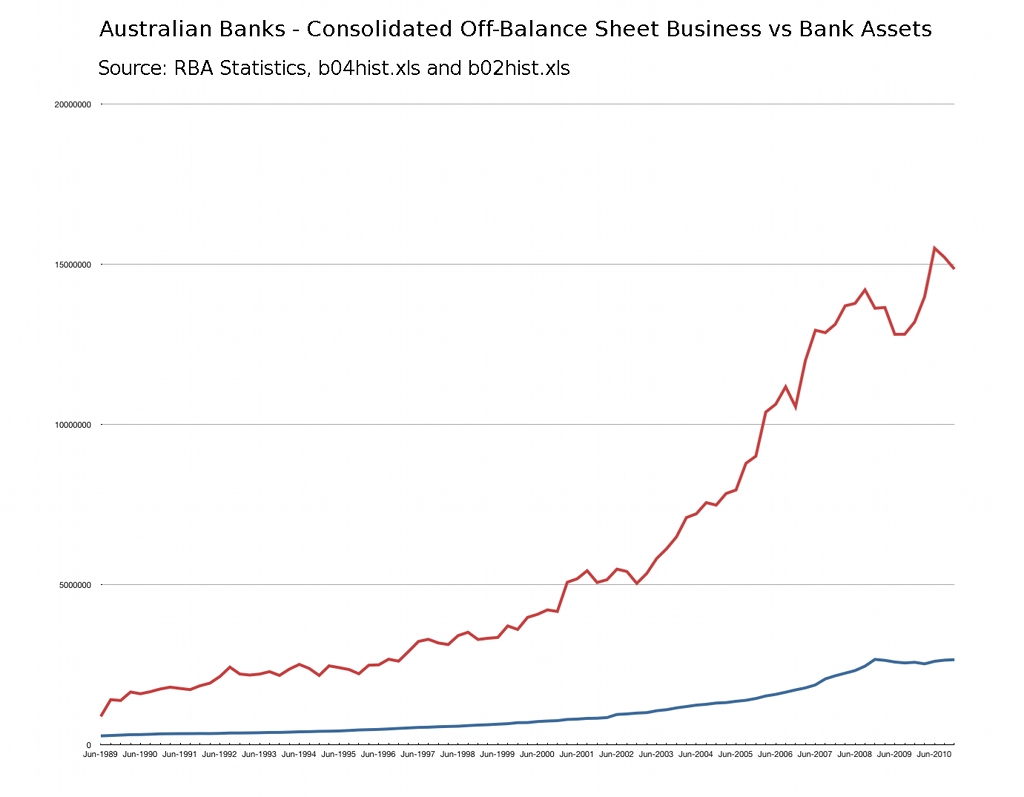
$2.66 Trillion in "Assets" versus $15 Trillion in Off-Balance Sheet "Business" (derivatives)
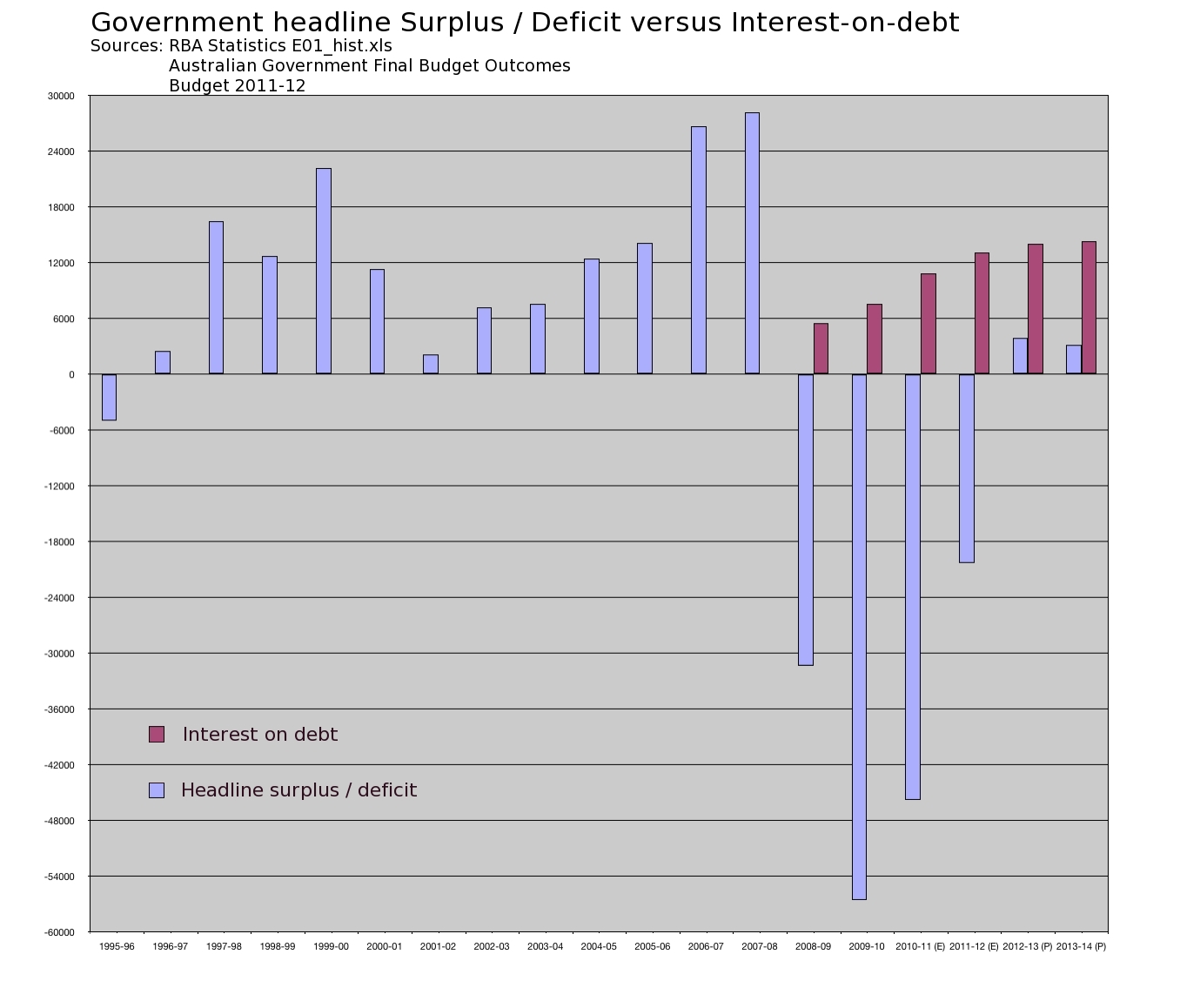
4. Interest-on-debt, versus government headline budget surplus/deficits –
Sources: RBA Statistics; Commonwealth Final Budget Outcomes; Budget 2011-12
A quick, important note about that last chart.
The last 4 sets of columns (year 2010-11 through 2013-14) are only Labor’s “Estimates” (E) and “Projections” (P).
Since Labor came to power, every year their official budget “estimates” and “projections” have ended up, in the Final Budget Outcome, worse than originally “estimated” and “projected”.
From the Liberal Party’s website, Latest News, 3 June 2011:
The Coalition will relieve the red tape burden from Australia’s small businesses by giving them the option to remit the compulsory superannuation payments made on behalf of workers, directly to the ATO.
Small business will be given the option to remit superannuation payments to the ATO at the same time as they remit their PAYG payments.
Senator Barnaby Joyce writing for The Punch, 13 May 2011:
On Tuesday night’s budget, Labor sneaked in an Amendment of the Commonwealth Inscribed Stock Act 1911. Here is the most telling statement for where our nation is going under this Green-Labor-Independent Alliance. Under Part 5 Section 18 subsection 1 “omitting ‘$75’ and substituting ‘250’ ”.
Now that is in billions ladies and gentlemen and it is real money that really has to be paid back. If we have all this money stashed away under the lower net debt figure that is always quoted by Labor, then why not use some of this mystery money to pay off what we owe to the Chinese and others who we are hocked up to the eyeballs to.
The reason why we can’t is at least $70 billion that makes up ‘net’ debt is tied up in the Future Fund and student loans.
Labor has already introduced legislation in the 2011-12 Budget that aims to grab your super too.
In fact, Labor’s Minister for Financial Services and Superannuation, Bill Shorten, published an op-ed a month ago stating that he views your super as “our sovereign wealth fund”.
There is a wave of government confiscations of private retirement savings rolling around the Western world right now. The first ripples have quietly rolled onto our shores already.
Treasury Secretary Timothy F. Geithner has warned for months that the government would soon hit the $14.3 trillion debt ceiling — a legal limit on how much it can borrow. With that limit reached Monday, Geithner is undertaking special measures in an effort to postpone the day when he will no longer have enough funds to pay all of the government’s bills.
Geithner, who has already suspended a program that helps state and local government manage their finances, will begin to borrow from retirement funds for federal workers.
The USA is taking public servants’ pension funds, to pay government bills.
Note that well.
Because just over 3 weeks ago – and 4 days before that Washington Post story hit the wires – our own Senator Barnaby Joyce made a very disturbing revelation (below).
Economy Minister Gyorgy Matolcsy announced the policy yesterday, escalating a government drive to bring 3 trillion forint ($14.6 billion) of privately managed pension assets under state control to reduce the budget deficit and public debt. Workers who opt against returning to the state system stand to lose 70 percent of their pension claim.
“This is effectively a nationalization of private pension funds,” David Nemeth, an economist at ING Groep NV in Budapest, said in a phone interview. “It’s the nightmare scenario.”
But Argentina and Hungary are not like us, right? That couldn’t ever happen in a Western economy like ours, could it?
Oh, but that’s France. They’ve got hangover problems from the Global Financial Crisis, right? That couldn’t happen in a really strong economy like ours, one that sailed through the GFC without even having a recession … right?
… another recent reversal we’ve seen has come from Latin America. In the 1990s, Bolivia’s decision to move its pension assets from the state to private managers placed it among the most advanced pension systems in the region. However, the current government has decided to nationalise the assets once more claiming it is creating a pension system that is equal for all.
Oh yes, but Poland is really just a Central European economy, not long removed from communism. Something like that couldn’t ever happen in a mid-level, “advanced Western economy” like ours … right?
From Business Insider, 10 May 2011:
Irish Bombshell: Government Raids PRIVATE Pensions To Pay For Spending
Capital city dwelling values fell by a seasonally adjusted 2.1 per cent in the first quarter of the year, according to the latest RP Data-Rismark Home Value Index.
The quarterly change was the steepest since the index series began in June 1999, RP Data research director Tim Lawless said.
And from the Sydney Morning Herald, 17 May 2011:
Real estate slump will leave banks in pain too
Australian real estate, long the subject of global concern, bears all the symptoms of a market that simply has run out of puff.
About that $20 billion in RMBS that Wayne Swan purchased. With borrowed money. Just how safe is that $20 billion “investment” looking?
From the Sydney Morning Herald, 26 May 2011:
Arrears on mortgage repayments spiked to a record high in the first three months of 2011, as more Australians struggle with rising costs, Fitch ratings agency says.
Arrears on prime residential mortgage-backed securities (RMBS) of 30 days or more hit a record high of 1.79 per cent in the first quarter, from 1.37 in the final quarter of 2010, the group said, as Christmas spending and the Queensland floods forced more Australians to struggle in repaying their mortgages.
The increase in arrears for the most fragile band of mortgage borrowers, low-doc loans, with payment delays of 30 days or more hit 6.74 per cent in the first quarter, up from 5.7 per cent in the final quarter of 2010, a higher level than December 2008 quarter, when the financial crisis hit and the Reserve Bank began rapidly lowering rates.
Low-doc mortgages are written for riskier borrowers than prime mortgages, which are written for customers who have a reasonably safe ability to borrow.
Delinquencies of three months or more on conforming low-doc mortgages, which are used by people who are self-employed for example, soared past 5 per cent in the March quarter, from about 3 per cent the December 2010 quarter.
Would our Wayne have “invested” any of that borrowed $20 billion in low-doc RMBS? Or, did he stick with prime RMBS?
From the Australian Office Of Financial Management website:
$20 billion worth of RMBS. With low-doc loans included. A brilliant government “investment” in keeping our property bubble inflated. And now that investment too, is failing, with record-high arrears on the mortgages backing those “securities”.
But there’s nothing really to worry about, because we’ve got the “strongest banking system in the world”, right? Even if the property bubble does pop, our government would never need to go looking for even more money, to bail out our banks … right?
Moody’s Investors Service has downgraded the long-term debt ratings of Australia’s big four banks to Aa2 from Aa1, citing their relatively high reliance on overseas funds rather than local deposits.
Moody’s explanatory paper effectively stated that our banks are Too Big Too Fail. That the Big Four’s liabilities must continue to be supported by the Australian Government Guarantee For Large Deposits And Wholesale Funding that Labor “decisively” introduced (like Ireland) in response to the GFC. And if the guarantee is removed, Moody’s indicated that the Big Four’s long-term debt ratings will be downgraded by at least two further ‘notches’.
Meaning?
Moody’s has just placed our government on notice. Australian taxpayers are now effectively on the hook – permanently – to bail out our banks when our housing bubble bursts.
Exactly the same thing that happened in the USA, UK, Ireland, Spain et al.
Don’t believe that we have a housing bubble? Think the nightmare housing-driven bank collapse scenario that is throttling the rest of the Western world won’t ever happen here?
Fine.
If the housing-collapse trigger event is not enough to bother you, then take a moment to think about derivatives.
Those “exotic” financial instruments that were at the heart of the Global Financial Crisis. The ones that famously prudent investor Warren Buffet referred to as “a mega-catastrophic risk”, “financial weapons of mass destruction”, and a “time bomb”, way back in 2003.
The same kind of exotic instruments that lauded economist Saul Eslake also referred to just a few days ago, in an argument with me on my blog over my criticism of his public lobbying for a carbon dioxide “pricing” scheme (emphasis added):
And exactly what kind of “business” makes up 92.3% of that “Off-Balance Sheet” $15 Trillion – more than 10 times our nation’s annual GDP?
You guessed it. Derivatives. Those “financial weapons of mass destruction” which so nearly blew up the whole world in 2008-09.
Finding it a bit difficult to get your head around these huge numbers? Pictures often help.
Take a look at this simple chart comparing our “safe as houses” banks’ On-Balance Sheet “Assets” (blue line) – which are 66% loans – versus their Off-Balance Sheet “Business”, 92.3% of which is derivatives (click to enlarge):
$2.66 Trillion in "Assets" versus $15 Trillion in Off-Balance Sheet "Business"
Still feeling confident about our banking system?
There’s more.
Australia’s banking system only just dodged a bullet in 2008-09, thanks almost entirely to the government (taxpayer) guarantee which is still in place today.
“Almost” entirely thanks to the government guarantee, you say?
That’s right. Something else helped save our banking system too.
The Australian public remains blissfully unaware that during the GFC, two of our Big Four banks, and our very own central bank, the RBA, all obtained secret emergency loans from the US Federal Reserve – which is simply printing new money, Zimbabwe-style.
Data released by the Fed shows the RBA borrowed $US53 billion in 10 separate transactions during the financial crisis… according to a report in The Australian Financial Review.
NAB borrowed $US4.5 billion, and a New York-based entity owned by Westpac borrowed $US1 billion, according to The Age.
If you think “it could never happen here”, if you think that our government would never take away your super to pay for its massively wasteful spending, its crappy “investments”, or to bail out our Too Big Too Fail, very recently downgraded, multi-Trillion derivatives-laden banking system, then it’s time for you to think again.
Were you one of the many who ridiculed Barnaby Joyce’s warnings in late 2009, about the possibility of a US debt default (“Barnaby Warns Of Bigger GFC“)?
That’s coming to pass right now. Trying desperately to avoid a default is the reason why the US Treasury has now resorted to stealing federal workers’ retirement savings, to pay government bills.
On Tuesday night’s budget, Labor sneaked in an Amendment of the Commonwealth Inscribed Stock Act 1911. Here is the most telling statement for where our nation is going under this Green-Labor-Independent Alliance. Under Part 5 Section 18 subsection 1 “omitting ‘$75’ and substituting ‘250’ ”.
Now that is in billions ladies and gentlemen and it is real money that really has to be paid back. If we have all this money stashed away under the lower net debt figure that is always quoted by Labor, then why not use some of this mystery money to pay off what we owe to the Chinese and others who we are hocked up to the eyeballs to.
The reason why we can’t is at least $70 billion that makes up ‘net’ debt is tied up in the Future Fund and student loans.
That is exactly what is happening in America. Right now.
And Barnaby is warning that it could happen here too.
The first steps in that direction have already begun.
From Global Custodian (Australia edition), 11 May 2011:
The Gillard government’s 2011-12 budget has proposed a raft of initiatives aimed at encouraging superannuation fund and private investment in infrastructure projects.
In light of the botched “school halls” program, and the stalled white elephant NBN – which so far has only achieved a 12% takeup rate, versus their predicted 58% – would you really trust this government to wisely and prudently invest your super in Government infrastructure projects?
Others have their doubts.
From The Australian, 12 May 2011:
The government’s plan to use tax incentives to encourage superannuation funds to invest in new infrastructure could be thwarted by inadequate returns on projects and a reluctance by the states to take on project risk, experts say.
First, a little “encouragement” for super funds to invest in government spending programs.
Then, when the costs blow out, or when the government debt becomes unmanageable … or when the banks need bailing?
And, he is the only politician in Australia with the honesty, decency, and courage, to (once again) try to forewarn the public about the risks of debt, and where this debt train is taking us.
Still not convinced there’s anything to worry about?
Then consider the words of Labor’s PM-in-waiting, the Minister for Financial Services and Superannuation, Bill Shorten. He already thinks of your super as a “significant national asset” … a kind of “sovereign wealth fund”.
From Shorten’s op-ed published in The Australian, 4 May 2011:
This week marks 12 months exactly since the government announced plans to take compulsory superannuation from 9 per cent to 12 per cent.
… our superannuation savings place Australia fourth in the world. Its $1.3 trillion in funds under management through superannuation significantly boosts national savings and provides greater retirement security for millions of Australians. Superannuation is also a significant national asset because it strengthens our financial sector.
Superannuation “strengthens our financial sector”? Can you see where this is going?
Shorten and his cohorts already have their eyes on our $1.3 Trillion in super savings. In Labor’s view, your retirement savings are “our sovereign wealth fund”.
When our Too Big Too Fail, derivative-laden banks inevitably run into trouble again – as indeed they are right now with a falling housing market – you should have no doubt that our government will follow the lead of the USA, France, Ireland, Poland, and all the rest, and simply take your super to prop up our “financial sector”.
After all, they have “guaranteed” our banks. Your future taxes … and if necessary, your super … are the collateral for those guarantees.
But if the Coalition wins government everything will be fine, right? They’re far better economic managers, right? We can all trust the Liberal Party not to put their hands on our super, to pay down Labor-incurred debts … right?
Wrong.
Just this past Friday 3 June 2011, the Liberal Party announced a new policy that they will take to the next election. Loaded with weasel words, it is yet another harbinger of the super theft to come, sneakily disguised as a helpful “reform”.
From the Liberal Party website:
Further relief for small business
The Coalition will relieve the red tape burden from Australia’s small businesses by giving them the option to remit the compulsory superannuation payments made on behalf of workers, directly to the ATO.
Small business will be given the option to remit superannuation payments to the ATO at the same time as they remit their PAYG payments.
Billions and billions of dollars in compulsory superannuation payments, going directly from our employers’ bank accounts to the government’s tax department , every 3 months. And we have to simply trust the government of the day, that every cent of it will immediately be passed on to our private super funds. Not siphoned off into special “investments”, or government accounts. Or simply “sat on” for a month or so, in order to prop up the government’s weekly cashflow needs.
Oh, but not to worry … it will just be an “option” for “small” businesses to do this, of course.
Right. If you believe that, then I’ve got an air-backed derivative called a “carbon permit” to sell you. Ever heard the old saying, “It’s the thin end of the wedge”?
A final thought.
Our government is presently considering the Garnaut proposal for introduction of a carbon dioxide “pricing mechanism”. A key part of this proposal that has (surprise surprise) drawn strong public support from economists employed by the banking sector, is the suggestion that the billions of dollars raised should be administered by an “independent” Carbon Bank. One that …
In other words, a Carbon Bank run by unelected, unaccountable parasites – chosen from the banking sector, no doubt – with the government … meaning taxpayers … acting as the final guarantor for any losses made on their “green” “investments”.
Does that prospect concern you?
Can you see where this is all heading?
We have a government that has already racked up nearly $200 billion in gross debt.
Is running a “forecast” $50 billion annual budget deficit.
And – like an America’s “Mini-me” – has now moved to raise our debt ceiling by another $50 billion (ie, a 25% increase), to a new record quarter of a Trillion dollars.
This is the same government of completely unqualified economic incompetents behind a string of costly disasters – killer ceiling insulation, overpriced school halls, “green scheme” rorts, subsidised Toyota hybrids (that noone except government is buying), the problem-plagued Nation Bankrupting Network … and their latest rort-ridden debacle, “free” set-top boxes.
Do you honestly believe that this government would not end up burying taxpayers with even bigger losses from their carbon dioxide “air tax” scheme too?
Do you honestly believe that this government would never follow the lead of Argentina, Hungary, Bolivia, France, Poland, Ireland, and now the superpower USA … and steal your super to pay for massive debts that they have racked up?
These are just some of the many sound reasons why Senator Joyce has persistently tried to raise public awareness of the real and grave peril of ever-increasing government debt and deficit, in a (supposedly) post-GFC world.
Your retirement savings depend upon your taking notice of his warnings.
Barnaby is right.
If like me you are under 50 years old – indeed, if you are under 60 years old – then I’m willing to bet you all of my super that you will never see all of yours.
And unlike our bank(st)ers and government … I never bet.
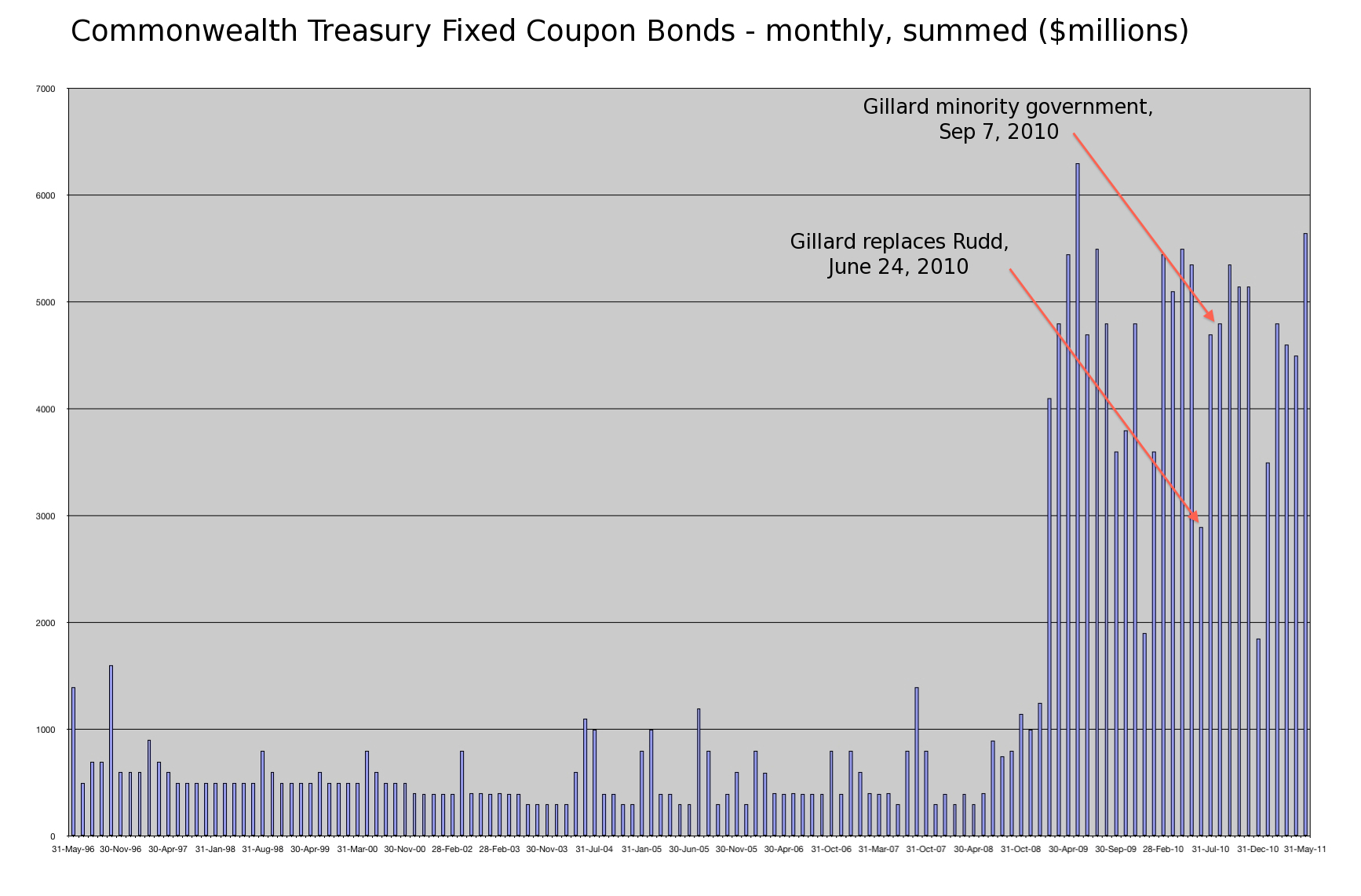
Over the past 6 weeks since I began tracking the AOFM’s government debt auctions, Wayne’s pack of lunatics have borrowed no less than $2 Billion, and as much as $2.75 Billion.
Every single week.
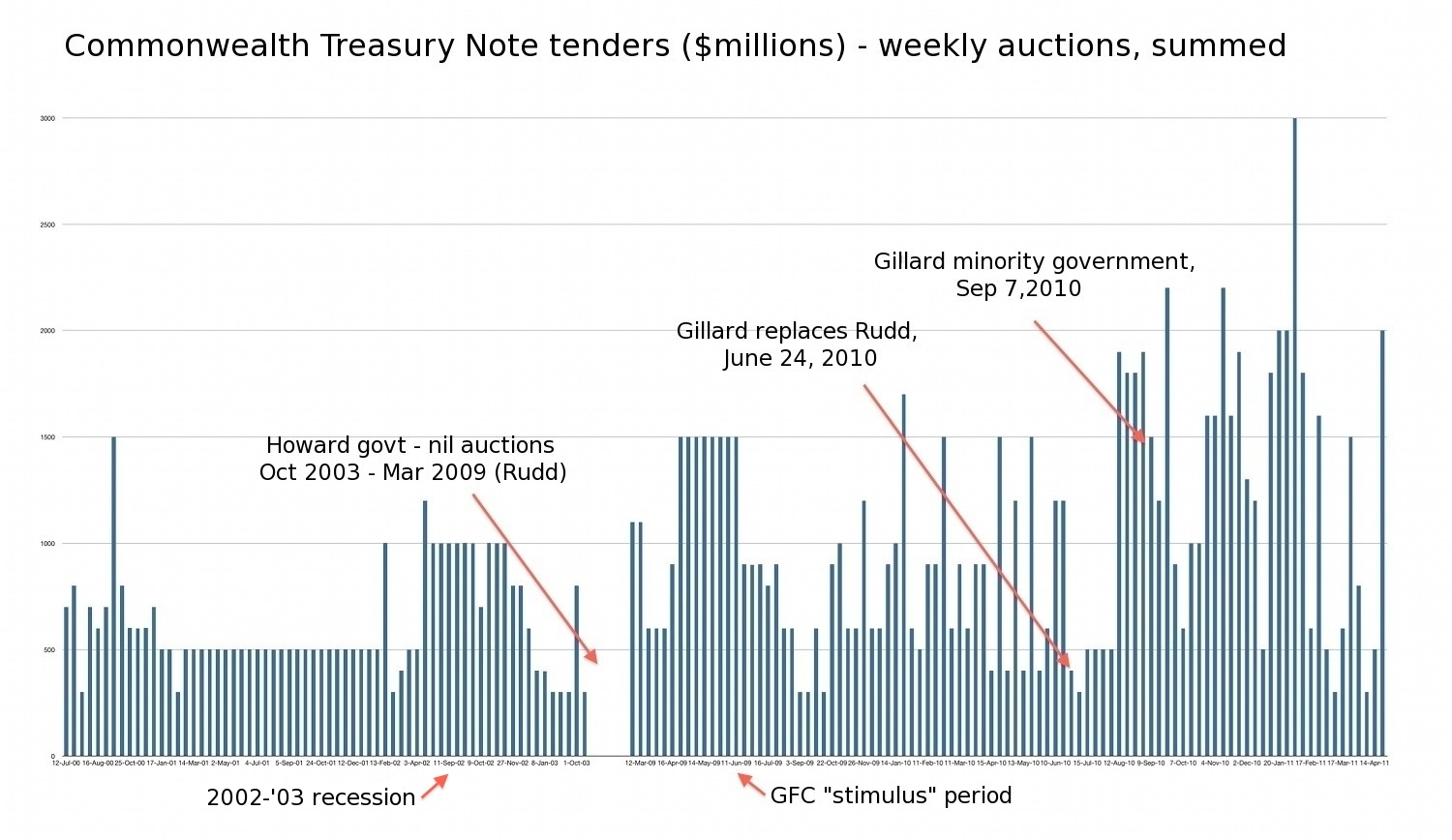
And we can see here, that ever since JuLIAR Gillard knifed KRudd, she has been on a borrow-and-spendathon that puts even the jet-setting Mr Stimulus to shame.
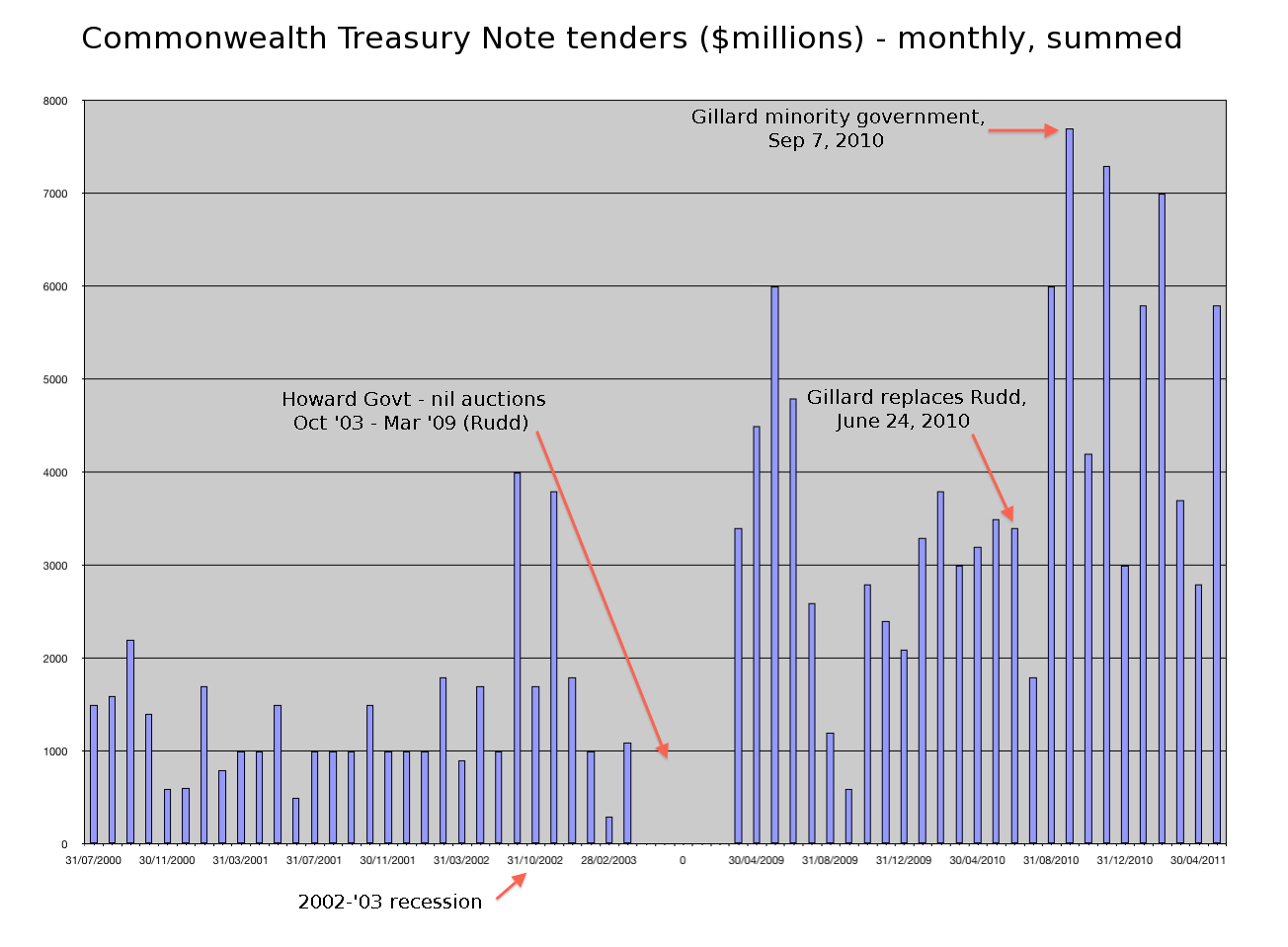
The following chart shows only the value of Treasury Notes auctioned by Labor. These are “short term” debt “instruments”, that typically must be repaid within 30-90 days. They are supposed to be issued only when necessary to “smooth” cashflow requirements of the government.
Most of the government’s primary funding comes, instead, from the auction of Treasury Bonds, which are longer term debt “instruments”, that must be repaid over durations of anything up to 20+ years.
We take particular interest in the blowout in borrowing using Treasury Notes, because it indicates a government that has completely lost the plot. An utterly incompetent government, that has no idea what it is doing. Has no planning. Cannot even manage to balance the weekly cashflow needs of government. And so is constantly going back to the international debt markets, to borrow $2+ billion per week on the “short term” national credit card (click to enlarge):
Source: Australian Office of Financial Management (AOFM) - to end April 2011
Note carefully that this chart only goes up to end of April this year. During May, the government borrowed another $5.8 Billion using Treasury Notes. To picture this – since I’m too lazy to update the chart right now – just imagine another blue line on the end of that chart, one that is double the height of the tallest blue line.
So far in June – a mere 3 days in – they have already borrowed another $500 million using T-Notes.
And next Thursday 9th June, they will borrow another $1 Billion using T-Notes.
With Congress showing little progress on a deal to raise the debt ceiling, some economists say the possibility of a default by the Treasury, once unimaginable, has now become a factor in investment decisions.
“It’s still extremely unlikely, but it is now something that can be talked about. That moves us into a different world,” said Mark Vitner, a senior economist at Wells Fargo. “It was unthinkable not too long ago.”
In the last couple months, investors have piled into bets that the Treasury will default. The cost of holding one-year credit default swaps on U.S. debt — insurance that pays out if the government misses a debt payment — has skyrocketed, more than tripling since the beginning of April, the Wall Street Journal reported this week.
Nervousness apparently isn’t limited to derivatives investors. Treasury securities held in custody at the Federal Reserve for foreign accounts this week experienced their biggest drop in four years, Zero Hedge noted Thursday. While the precise meaning of the drop isn’t clear, it could suggest foreign powers are scaling back investment in the U.S. government.
All these agree that when he forewarned of the risk of US debt default back in 2009 (“Barnaby Warns of Bigger GFC“) …
Barnaby Was Right.
It’s time for a BIG apology from Wayne Swan, former Treasury Secretary Ken Henry, RBA Governor Glen Stevens, and the Australian media, to the only political figure in this country with the foresight, wisdom, and courage to speak out and warn of this very real mega-threat to the global economy, and thus to Australia.
For all those budding double agents now is your time. Budget Estimates is on and the heads of all the public service departments are making their way through security with their minions, servants and sycophants. Just the thought: you can square the account with merely a call to my office and the appropriate question will be asked, whilst you watch the whole episode on APAC. “So Mr Head of Department Type Person did you on the 1st of the 4th let your government car be driven by your mistress to a family function at Nimbin?”
As a more noble gesture you may have a serious concern about an issue that really does have national implications. Serious problems cause serious expenditure of serious money. If that is the case we will then have to borrow serious money which has to be seriously repaid. Say nothing or speak up?
The management that has given us the debt is reflected in the government’s need to increase by $50 billion the extension on our credit card. Before this budget the Parliament had approved the government to borrow $200 billion. After this budget, the limit will be a quarter of a trillion dollars. That’s what the Treasurer calls ‘back in the black.’
If we do not get on top of the type of management that has given us the debt the so called efficiency dividend will mean permanent and ongoing closure and contraction in vital activities in Canberra.
So this is what the first harbinger of debt looks like to the Nation’s capital; cuts over the forward estimates, that is the next 4 years, of $2.133 million for The National Library, $1.762 million for The National Museum, $1.099 million for The National Film and Sound Archive, $1.373 million to The National Gallery and $1.632 million to The Australian War Memorial. There are others as well but I see most of you have just said well I am right, keep dancing.
Canberra should have an extensive interest in the Australian Office of Financial Management website noting Commonwealth Government Securities outstanding and whether you have a job in the future. Canberra more than anywhere else should be the most diligent in insisting that prudence is the order of the day and debt is to be repaid. The public service is the canary in the coal mine for excessive government debt.
In budget estimates, in the higher elevation of Parliament House, department after department talks about “tight fiscal times”. Maybe you work or own the restaurant that is a service to a city dependent on, in a substantial way, the public service. Maybe you build the house for the person who works in the restaurant that services the clientele for the public service.
Let us not beat around the bush if you live in Canberra you do not have to be convinced of the importance of the income of those who are employed by the taxpayer. It does not require a major leap in understanding that if you borrow a quarter of a trillion you are some day going to have to pay it back. This time of reckoning will have major implications in the way business is conducted in Canberra.
Canberra needs Australia to be a well oiled and profitable income earning entity. Canberra can not afford well meaning but quite foolish ideas such as recalibrating the nation’s economy on a colourless odourless gas tax.
The decision to go on that frolic has to be assessed against our current position. Australia makes money, over half its export dollars, by exporting carbon in the form of coal and gas. Likewise iron ore needs coal to make steel, I know I did not need to tell you that, and cattle produce methane, but white ants in Australia produce far more.
Where is that tax revenue going to come from to keep Canberra in a job noting we have major debts to finance? Wind farms supplying overpriced power to people who can barely afford it, is no substitute for hard currency earned from export dollars. If you look around your room now and realise how many of the items that are fundamental to your standard of living are imported then you have to acknowledge that we need to do all in our power to put product on the boat to pay for it.
Former US President Ronald Reagan’s budget director, David Stockman, appears on Bloomberg TV to discuss the USA’s debt crisis, and says that a “technical default is now a virtual certainty“:
According to Stockman, both major political parties are implicitly pushing for a US default. At the same time, thanks to their inability to reach a political compromise, each party is blaming each other for this inevitable outcome:
The real problem is the de facto policy of both parties is default. When the Republicans say no tax increases, they’re saying we want the U.S. government to default. Because there isn’t enough political will in this country to solve the problem even halfway on spending cuts. When the Democrats say you can’t touch Social Security, when you have Obama sponsoring a war budget for defense that is even bigger than Bush, then I say the policy of the White House is default as well…That is the question that really needs to be understood better and appraised by the bond market. Both parties are advocating default even as they point the finger at each other.
Add a former US budget director to the ever–growing list of those who now agree that Barnaby Was Right in 2009 when he warned about the risk of US debt default.
Think the government of a “strong” economy like ours – running big budget deficits – would never steal some of your superannuation?
Don’t be deceived. This is coming to Australia. Barnaby said so.
Just as Barnaby was right in 2009 when he warned of the possibility of the US defaulting on its debts, there is ever-mounting evidence from around the world that Barnaby is right about this too.
The changes mean that the state-controlled social security and pension fund, ZUS, will now receive 17.22 percent of workers’ salaries, a five percent increase on the previous amount of 12.2 percent.
Critics have said the changes were nothing more than some creative accounting by the government to shore up its budget deficit…
The critics include several respected economists, most notably Leszek Balcerowicz, the former finance minister and National Bank of Poland head.
Krzysztof Rybiński, a former vice president of the NBP, has gone even further and is collecting signatures for a class-action lawsuit against the government for “lost gains as a result of the changes in the pension system.”
Even the constitutionality of the law has been questioned. Jerzy Stępien, former head of the Constitutional Tribunal, said if he was still head of the court, he would question the constitutionality of the reform in its most important points.
Poland is far from being an isolated case.
More and more governments around the world have been enacting “reforms”, to get their hands on their citizens’ private retirement savings.
From Global Pensions:
It appears moving backwards on pension reforms has become the thing to do on both sides of the Atlantic.
Hungary last year moved much of its private pension assets to the state. Last month, new rules came into effect in Poland diverting 5% of the 7.3% of salary going to private pension funds to the state.
In both cases, the changes represented a step back from reforms that led to significant savings on the countries’ balance sheets.
But another recent reversal we’ve seen has come from Latin America. In the 1990s, Bolivia’s decision to move its pension assets from the state to private managers placed it among the most advanced pension systems in the region. However, the current government has decided to nationalise the assets once more claiming it is creating a pension system that is equal for all.
Last week we saw that heavily indebted governments in Argentina, Hungary, and Ireland have also resorted to super-stealing.
The most dramatic example of a government dipping into its citizens’ retirement savings is the once-mighty USA. Just last week, the U.S. Treasury began tapping the retirement savings of federal workers (public servants) to shore up government finances.
Barnaby Joyce has given early warning of the same thing happening right here in Australia:
"Everyone has the right to freedom of opinion and expression; this right includes freedom to hold opinions without interference and to seek, receive and impart information and ideas through any media and regardless of frontiers."

 Barnaby Is Right
Comments