Tag Archives: debt and deficit

Budget Blowout: Interest-On-Debt $1.59m Per Hour

11 May

Six months.

That’s all it has taken for Labor’s November 2010 MYEFO budget “estimate” for Interest-on-debt to blow out.

By $5.69 Billion to 2013-14.

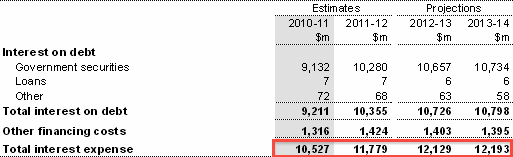
The November MYEFO 2010-11 “estimate”:

MYEFO 2010-11, Appendix B, Note 10: Interest Expense

The new Budget 2011-12 “estimate”:

Budget 2011-12 | Budget Paper No. 1, Statement 9, Note 10

In March last year (“Rudd’s Interest Bill – $48.49bn to 2013“), we saw that Labor expected to lump taxpayers with $48.49 billion in Interest-on-debt through 2013.

A year later, that’s blown out yet again.

Including this year’s (2010-11) $10.845 Billion, we’re talking an “estimated” and “projected” grand total of $66.466 Billion through 2015.

That’s $1,587,357 ($1.59 million) per hour*, over the next 4 years.

Interest-only.

* The calculation = Total (66.466bn) – 2010-2011 (10.845bn) / 4 years / 365 days / 24 hours.

I Was Right: Labor Hid The Increase

9 May

On 3rd March 2010 I published “Labor: Hide The Increase“, showing proof of exactly how Labor had changed accounting methods in order to fudge the 2009-10 Mid Year Economic and Fiscal Outlook (MYEFO) budget report.

Now, former Finance Minister Lindsay Tanner has openly admitted that this is precisely the kind of “dark art” that Labor practices.  To lie to the public, and cover up their financial mismanagement:

He became adept at “the dark arts”, he confesses, “using some of what are now the standard tricks employed to maximise political appearances”.

These included switching between different forms of accounting, choosing different indicators of spending “according to which . . . suited the argument better”, classifying annual spending as capital, and making commitments beyond the years of the budget period.

Why did Labor hide the increase in spending in 2009-10?

They had made a promise not to increase real spending growth by more than 2%.  They had broken that promise. Hence, a little “dark art” with the accounting method.  To present figures that would instead show that they had not broken their promise at all.

Read “Labor: Hide The Increase” for full background on how they fiddled the books.

For now though, take a look at how Labor’s own MYEFO numbers have again changed. Proving once again that “estimates” are a bad joke. And that Labor just can’t help but spend far more than even their own estimates.

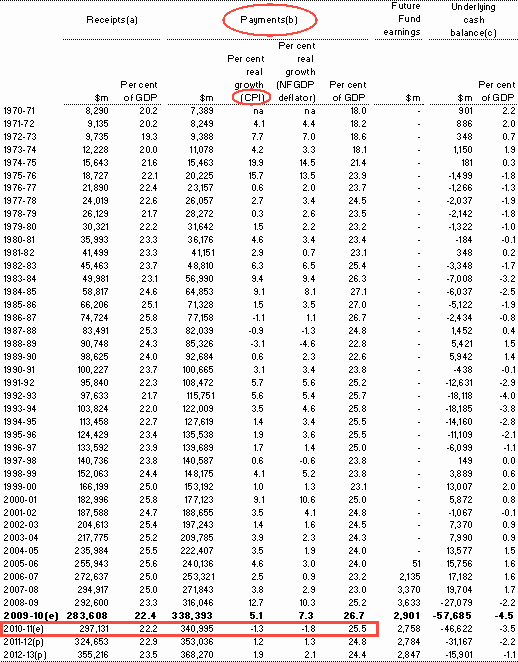
In the 2009-10 MYEFO, their “Estimate” for real spending growth as a % of GDP for this year (2010-11), using their new accounting method of “CPI” instead of “NFGDP”, was -1.3% (click to enlarge):

MYEFO 2009-10 | Appendix D, Table D1

Ok.  Sounds good right?  In November 2009, they “expected” to reduce government spending growth in 2010-11 by 1.3%.

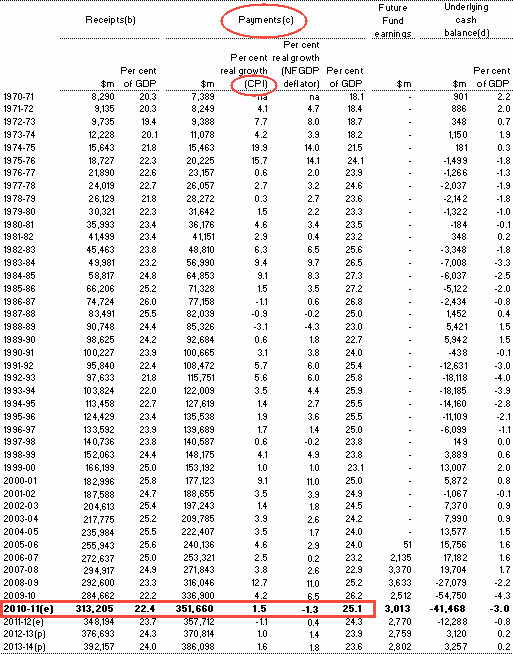
Now, what is their most recent “Estimate” for real spending growth in 2010-11, as updated in the November 2010 MYEFO?

+1.5%

MYEFO 2010-11 | Appendix D, Table D1

So, even using their new accounting method, Labor’s spending still blew out anyway.  Rather than cutting by 1.3%, their own budget mid-year updates show a spending increase of 1.5%.

What’s that in actual dollars?  Look at their tables under “Payments” and “$m”.  In 2009-10 they estimated government spending for 2010-11 of $340,995 million ($340 billion).  A year later, that estimate was revised up to $351,660 million ($351 billion).  A blowout in spending of $10.66 billion, over their own estimates.

What’s more, this comes on the back of an increase in government revenue. Not a decrease, as Labor are complaining loudly now, as an excuse for their massive budget deficit black hole.

Look at their own tables again.  In MYEFO 2009-10, their “estimate” for “Receipts” in 2010-11 was $297,131 million.

But in MYEFO 2010-11 – released just 6 months ago – their new “estimate” was $313,205 million.  An increase in revenue.  Not a decrease.  An increase of $16,000 million ($16 billion) over their own estimate a year earlier.

Labor’s promise not to increase spending by more than 2% came with eerily similar “tough talk” rhetoric before last year’s budget:

Tanner Warns of Austerity Budget

Finance Minister Lindsay Tanner has flagged that the 2010-11 budget will contain tough savings measures

The collapse of revenue caused by the global economic downturn would be compounded by the early effects of the ageing of the population, Mr Tanner told the Ten Network yesterday.

“There’s going to have to be tough decisions and ministers are aware of that,” he said.

Deja vu.

Again this year, we hear lots of tough talk about the coming budget.  Again we hear all the (same) excuses about why it has to be tough.

I have no doubt that tomorrow night, once again we will receive a Labor budget contrived by the “dark arts”.

What “standard tricks” will they use this time?

Labor’s $2.4 Billion Budget Spray

6 May

Thought $2.2 billion more debt this week was impressive?

The Labor party’s just getting started.

The AOFM has just announced next week’s Australian sovereign debt auctions.

A $600 million T-bond auction on Wednesday – to celebrate the myth-making record-deficit Budget Speech the night before, no doubt.

$1.2 billion (2 x $600 million) in T-note auctions on Thursday.

And another $600 million T-bond auction on Friday.

Labor’s $2.4 Billion Budget Spray.

How much more Interest-on-debt must we pay?

And how much will the “Estimates” and “Projections” for Interest-on-debt made in last year’s Budget be .. revised .. in this year’s Budget?

MYEFO 2010-11, Appendix B, Note 10: Interest Expense

According to their own “Estimate” just for this year 2010-11, we’re paying $1,201,712 ($1.2 million) per hour in Interest-on-debt.

Says It All Really

6 May

h/t Twitter users _AshleyPriest, Prronto, and LyndsayFarlow (click to enlarge):

Barnaby: You Can Count On Swan’s Debt Pile

5 May

Barnaby Joyce in the Canberra Times today:

Next week’s budget is shaping up as another rollicking frolic on the road to pandemonium.

Almost a year ago, Wayne Swan delivered a budget for 2010-11 with what he predicted would be a $40.8 billion deficit which is a massive loss on the nation’s books. Next week he will reveal that the financial morass is more than $50 billion out the back door.

We are getting used to this unfortunately, the 25% Swan-error factor, incompetence, massive deficits and now massive debt.

If Labor can not manage the nation’s business, balance income to expenditure, in the middle of a resources boom, how on earth will it do it when the boom comes to an end?

When the Government announced the $90 billion spree in response to the North Atlantic financial crisis, Treasury officials told me that our debt would reach its $200 billion ceiling in 2013-2014. We are already at $190 billion in debt and rising.

Australia never went into a recession because China never went into a recession. School halls did not put any coal on a boat, ceiling insulation did not sell one tonne of iron ore and $900 cheques did not plant one acre of wheat.

In the parallel universe of Wayne Swan hocking the Australian credit card up with rubbish increases demand for soft and hard commodities in south-east Asia. The same way, I imagine that buying a new Playstation helps you get a wage rise at work.

Half of Mr Swan’s life is a promise; the other half is an excuse. Next week we will get both.

The promise will be a surplus, not now, but later. Labor will start paying the debt back not now but later. The excuses will be the GFC, the Tsunami, Yasi, Swanny and trust me.

He will tell you about new jobs and you might need one as his profligate spending will start to put the screws on the capacity for expenditure on government services.

The Treasurer will promise to cool the planet from a room in Parliament House by reducing carbon dioxide usage domestically, while selling record amounts of coal overseas. He will take you on a guilt trip about the price of power in Australia. He will try to convince you that it is morally just that the fundamentals of life become prohibitive for the average Australian consumer and that the trade advantage of our industry, cheap power, is an evil that should be removed and sent overseas. This is the Green-Labor-Independent economic miracle, future alternate “green” jobs in their future alternate green universe.

Earlier this week, Wayne Swan had the temerity to accuse the previous Coalition government of wasting the mining boom. Remember that terrible time? It was when we had tens of billions of money in the bank. Wayne just has massive debts.

He will say that it is not the gross debt that matters but the net debt. Yet he has never explained the difference between the two. He has never explained it because I don’t think he knows the difference.

Now maybe he might not know but his department does. In response to a question I put in Senate estimates, Treasury revealed that $64 billion of the difference between our gross debt and our net debt is made up of the cash and non-equity investments of the Future Fund. The Future Fund is there to cover the otherwise unfunded costs of public servants’ superannuation.

That is a little fact that the people of Canberra might be interested in. When Wayne mentions net debt translate that to, I am going to pay his debt off with my retirement savings.

If you want to test the competency of Mr Swan then it is similar to how you test the competency of anyone in any field. Pay a little bit of attention to their promises but pay immense attention to their delivery.

The last Coalition government delivered 10 surpluses in 12 years. A Labor treasurer has not delivered a budget with a surplus in it since 1989.

In the 21 years since, Labor delivered 9 budgets and racked up a cumulative debt of $200 billion.

The Coalition delivered 12 budgets producing cumulative savings of $97 billion.

Labor borrows at double the rate that Coalition governments can save.

The Coalition left Labor with a $60 billion Future Fund and a $20 billion surplus. We are now racing towards $200 billion in gross debt.

Next week’s budget is shaping up as another rollicking frolic on the road to pandemonium.

Another $2.2bn In Debt This Week

5 May

Yesterday, the AOFM auctioned another $600 million in Treasury Bonds. Lumping the taxpayer with a (weighted-average) interest-burden of 5.35%.

Today, the AOFM will auction another $1 Billion in Treasury Notes.

Tomorrow, the AOFM will auction another $600 million in Treasury Bonds.

How much will this week’s national credit card binge add to last year’s “Estimates” and “Projections” of Interest-on-debt?

MYEFO 2010-11, Appendix B, Note 10: Interest Expense

According to their own “Estimate” just for this year 2010-11, we’re paying $1,201,712 per hour in Interest-on-debt.

UPDATE:

Today’s $1 Billion Treasury Notes auction completed.

Slug to taxpayers? 4.73% interest rate (weighted average yield).

How Gillard’s Use Of The Credit Card Makes Rudd’s GFC Spending Spree Look A Model Of Financial Prudence

5 May

A few days ago I wrote an article titled “The Real Reason Why Gillard’s A Spinster“.  It ruffled feathers.  Not for the intended reason, unfortunately.

Humourless critics were so rankled by my [insert self-righteous PC perjorative] that they did not see the point.

So here’s a follow up.  Without the creative literary device/s for decoration.

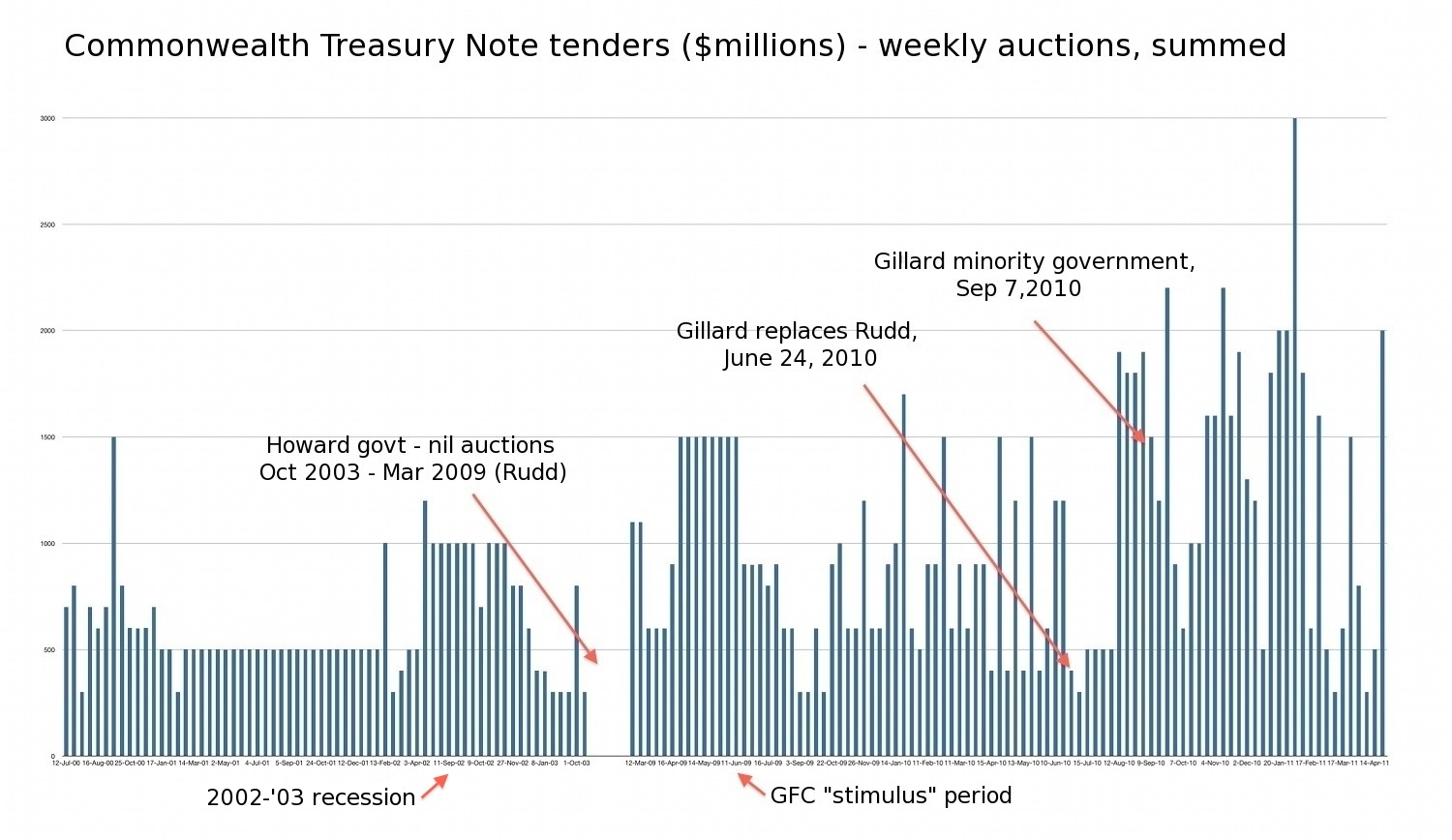
The following chart is an updated and extended version of the one used in the previous article.  This shows Treasury Note auctions from 2000 through to end April 2011 (the previous chart began at March 2009).

The other difference, is that the previous chart listed each individual auction separately.  It escaped my notice that there has been as many as 3 auctions p.w. in recent times.  So this new chart sums the total of all auctions of Treasury Notes in a given week into a single bar on the chart (click to enlarge):
Source: Australian Office of Financial Management (AOFM)

Some key points to note.

Firstly, there’s clearly quite a difference between how much the Howard Government relied on short-term debt (Treasury Notes), compared with the subsequent Labor Government.  The period when the largest block of Howard-era short term debt auctions occurred was through the year 2002 – coinciding with the 2002-03 global recession, which Australia largely avoided.

Secondly, for four (4) full years between October 2003 and the Rudd election win in November 2007, the Howard Government raised no short-term debt. Not one cent.

Neither did Kevin07.  For 16 months.  Until the GFC.

Thirdly, you can see clearly the period from March 2009 through around September 2009, during which the Rudd Government was regularly raising around $800m to $1,500m a week from short-term debt auctions. I assume that this reflects (at least in part) the government’s urgent need for cash to fund their “stimulus” response to the GFC.  Stimulus 1 – $10.4 billion in cash handouts in late 2008 (goodbye 50% of Howard surplus).  Stimulus 2 – another $42 billion in cash handouts and “nation-building”, beginning in … February/March 2009.

You remember. “Swift and decisive”. Rushed and bungled. $900 cheques to dead people. Electrifying foil insulation. Blazing pink batts. Rorted “green” schemes. Overpriced school halls. Literally billions more, to investigate and repair these Rudd-made disasters.

Finally, note the significant jump in both the frequency and the totals of short-term debt auctions, coinciding exactly with Ms Gillard’s rise to power. The fact is, she has presided over a $10.1bn (31.5%) increase in issuances of short-term debt in just 10 months, compared to the previous 12 months of the Rudd Government.

The big unanswered question that I have is this: WHY would a Gillard-led government suddenly need to bash the nation’s short-term credit card 31.5% harder than even the profligate Kevin Rudd did? After all, he had a GFC “stimulus” package or two to finance.

What is Ms Gillard’s excuse?

According to the government’s own budget records, we-the-taxpayers are already wearing an Interest-on-debt bill of more than $10 Billion per year:
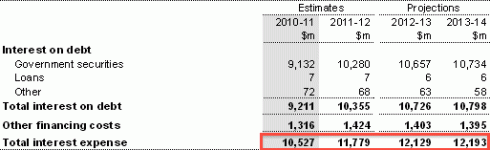
MYEFO 2010-11, Appendix B, Note 10: Interest Expense

According to the AOFM, short-term Treasury debt is supposed to be used for financing “within-year”, daily cashflow requirements of the Government. And then there’s this official prediction:

Treasury Notes are not expected to make a major contribution to overall funding for the 2010-11 financial year as a whole.

Why has the Gillard-led government apparently been so incapable of planning their week-to-week expenses, that since that statement was published they have resorted to bashing the national credit card more than 31.5% harder than Kevin Rudd “needed” to?

The data supports the increasingly widespread view that the Gillard minority government is a shambles.  They have no financial plan – even over the short-term.  And so, from Day 1, have had to pull out the national credit card 31.5% more than Kevin Rudd, just to manage the week-to-week cashflow requirements of government.

One can only wonder just how much Interest-on-debt we will end up paying in total over the coming years.

While Gillard and Co comfortably retire.  On mega-buck, index-linked, taxpayer-funded pensions.

Labor’s Date With Fate

3 May

On February 24th 2010, Barnaby wrote an article for The Australian (published 12:00am Feb 25th), wherein he uttered nine words that now serve as both the tagline for this blog, and a stark reminder to the nation of Barnaby’s wisdom and foresight:

If we keep borrowing at this rate Australia and all who rely on the government to provide a basic service of health, defence, subsidised medicine, childcare, unemployment benefits, pensions, are all going to arrive at a point of reckoning. Stresses will be placed on the government budget because we did not manage the debt at a point where it was manageable.

If you do not manage debt, debt manages you.

Prophetic.

Precisely 12 months to the day from when Barnaby penned those fateful words, Julia Gillard announced to the nation that the government she leads would introduce a carbon (dioxide) tax:

Yesterday Gillard announced the architecture of her pricing plan, but it was only foundations and scaffolding. Floorboards have yet to be laid or walls erected.

As Abbott quickly pointed out, her plan is a blatant breach of Gillard’s election promise not to introduce a carbon tax.

What would possess Labor to take such a huge political risk, on a policy that has (so far) cost the jobs of four political leaders?

Simple.

They have blown hundreds of billions on botched roof insulation.  Unwanted and overpriced school halls.  Rorted “green” schemes.  The Nation Bankrupting Network.  And many more EPIC FAIL thought bubble policies.  Now, with an Interest-on-debt cost of more than $10 billion per year, and no discipline to simply stop borrowing and spending, they need the billions in extra revenue that a carbon dioxide tax would raise:

MYEFO 2010-11, Appendix B, Note 10: Interest Expense

A week from today, the Goose will hand down his fourth budget.  His fourth unbalanced budget. And a new record budget deficit.

If pensioners are targeted, Family Tax benefits slashed, childcare rebates cut, or any other essential service that you rely on is affected, now you know why.

Labor’s debt is out of control.

If you do not manage debt, debt manages you.

Barnaby is right.

UPDATE:

Your business suffering thanks to the AUD exchange rate?  Michael Stutchbury says the deficit is driving up the dollar:

Wayne Swan complains that the soaring dollar is blowing out his budget deficit by crunching non-mining company profits.

But the more fundamental story is that Canberra’s structural budget weakness is helping to drive the Australian currency to its new post-float high of $US1.10…

Instead of being close to $50bn in the red, the budget already should be building up a solid surplus buffer to stabilise the mining boom economy.

Kohler Agrees – Barnaby Was Right

2 May

It’s getting embarrassing now.  Not only has Standard & Poors, CNBC, Deutsche Bank, and Barack Obama all agreed that Barnaby was right on US debt.  Now our very own ABC News Finance, ABC Inside Business, and Business Spectator heavyweight, Alan Kohler, has conceded it too.

From ABC’s The Drum, buried within comment about the impossibility of Labor achieving their promised surplus budget next year:

The revenue shortfall will be worsened by a rising exchange rate over the next two or three years as the United States approaches an inevitable fiscal crisis.

Barnaby is right.

Goose’s $2Bn Shock ‘N Awe Intervention

28 Apr

Just checking the AOFM website to confirm any changes to tomorrow’s scheduled $700M Treasury bond auction, and found this bombshell announcement:

(click to enlarge)

So, another $2 billion (that’s $2,000,000,000) in short-dated Treasury debt was auctioned off today.

Did anyone see that coming?  And why the shock ‘n awe of a previously-unannounced auction, to the tune of $2 billion?

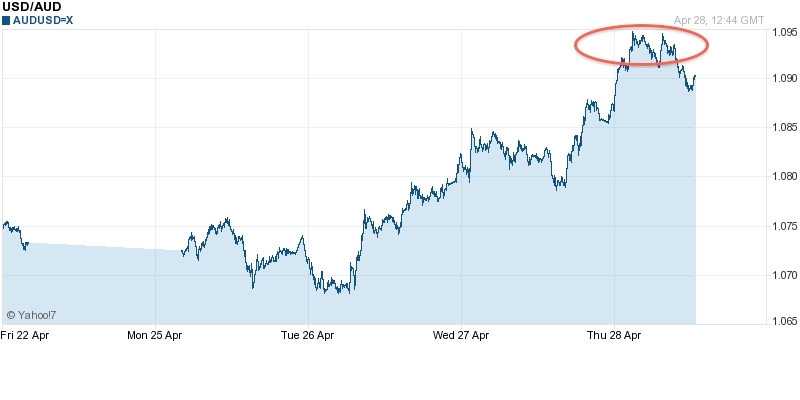
Could it be that the rapidly rising Aussie dollar, combined with fast-growing inflationary pressures, has forced this incompetent government into a “necessary” money markets intervention – (ie) selling extra AUD-denominated government debt, in an attempt to keep a lid on the AUD?

Yahoo! Finance - Charts - AUD/USD (click to enlarge)

If so, then when (if ever) will Goose and his fellow incompetents be held to account for driving those inflationary pressures in the first place, with their hundreds-of-billions in reckless and wasteful spending on overpriced school halls, ceiling insulation, the NBN, etc etc?

UPDATE:

If this was an intervention in money markets to cap the rapidly rising AUD, it seems to have worked. For now –

(click to enlarge)

For interest, here’s how the AOFM describes its Cash Management program:

Short-term funding needs can be met by increasing the volume of Treasury Notes on issue…

And here’s how they describe the Issuance Program for auctions of Treasury notes (as distinct from Treasury bonds):

Treasury Notes are short-term debt securities used primarily to meet within-year funding flows. Issuance decisions are made weekly and depend on the Government’s projected daily cash position for the weeks ahead. Treasury Notes are not expected to make a major contribution to overall funding for the 2010-11 financial year as a whole…

Tenders for the issue of Treasury Notes will be held on Thursdays, with details of the tenors (sic) and amounts to be offered announced at noon on the Friday of the preceding week.

Unless I missed something, the AOFM did not pre-announce today’s $2bn T-note auction at noon last Friday.  Granted, it was Good Friday. But I did not spot an announcement at any time during this week either.

Given the obvious immediate effect on the AUD this afternoon (see charts), and particularly in consideration of the media storm in recent days that followed the shock inflation figures, I smell a money market intervention – for pure political expediency.

With the public already concerned about rising cost of living, a growing revolt against the carbon tax, and plummeting polls for Labor, the last thing this government needs right now is the public spooked even further by the spectre of further rises in interest rates to hold back inflation.

So could it be that this government is going from bad, to worse, to calamitous, on fiscal management?  Could it be true that they are now compounding their first error of creating inflationary pressures by wanton borrowing-and-spending, by engaging in an ad hoc currency intervention – one that throws us into yet another $2bn of debt – solely in order to cap the rising AUD and calm inflation fears, a few days before the RBA meets to decide on interest rates, and, less than a fortnight out from the Budget?

UPDATE 2:

April 29, 9.14am –

From FXStreet:

AUD/USD Closing In On Yesterday’s High

Well now, that went well, didn’t it Wayne?  $2bn more debt just to save face before the Budget .. and the effect lasts less than 12 hours.

(click to enlarge)

Design a site like this with WordPress.com
Get started