Tag Archives: derivatives

Our “Squeeze Pop” Carbon Bank

17 May

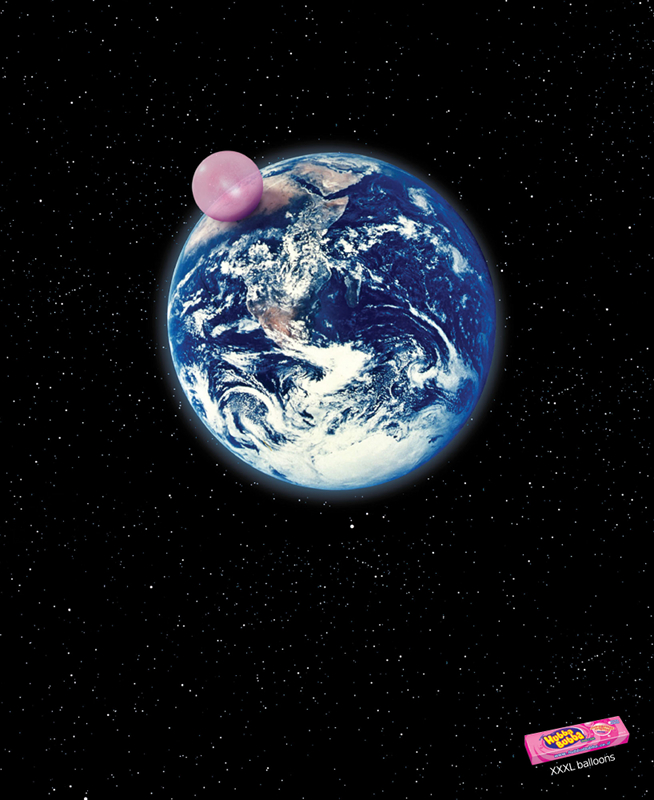
Big bubbles, no troubles:

An independent carbon bank, similar to the Reserve Bank, should be set up to oversee a carbon price and investment in clean technology, the peak renewable energy lobby says.

The Clean Energy Council will today release a discussion paper proposing the carbon bank, which it says could be allowed to borrow money to invest in renewable energy projects against the future revenue of Labor’s proposed carbon tax and emissions trading scheme.

Hmmmmm.

An “independent” carbon bank.

Trading in … what you breathe out.

Borrowing … and “investing” … against the future government tax revenue.

In other words, the government … meaning taxpayers … the guarantor for any losses on those “investments”.

In a bankster-designed, multi-trillion dollar, global air-trading derivatives market:

What could possibly go wrong?

National Australia Bank Ltd, Westpac Banking Corp Ltd and the Reserve Bank of Australia (RBA) were all recipients of emergency funds from the US Federal Reserve during the global financial crisis, according to media reports.

Data released by the Fed shows the RBA borrowed $US53 billion in 10 separate transactions during the financial crisis…

The “independent” Reserve Bank is a great model to follow then.

Its track record certainly inspires con-fidence:

Why do we tolerate an “independent” Reserve Bank, whose first legal duty is to maintain a “stable” currency, when it is so clear that they have always utterly failed to do so.

And derivatives, well, they’re safe-as-houses too.

After all, the mortgage-backed derivatives market that blew up America is only a tiddling little market.

So there’s clearly no cause for concern about yet another bankster-driven scheme, to blow up a global, air-backed derivatives bubble:

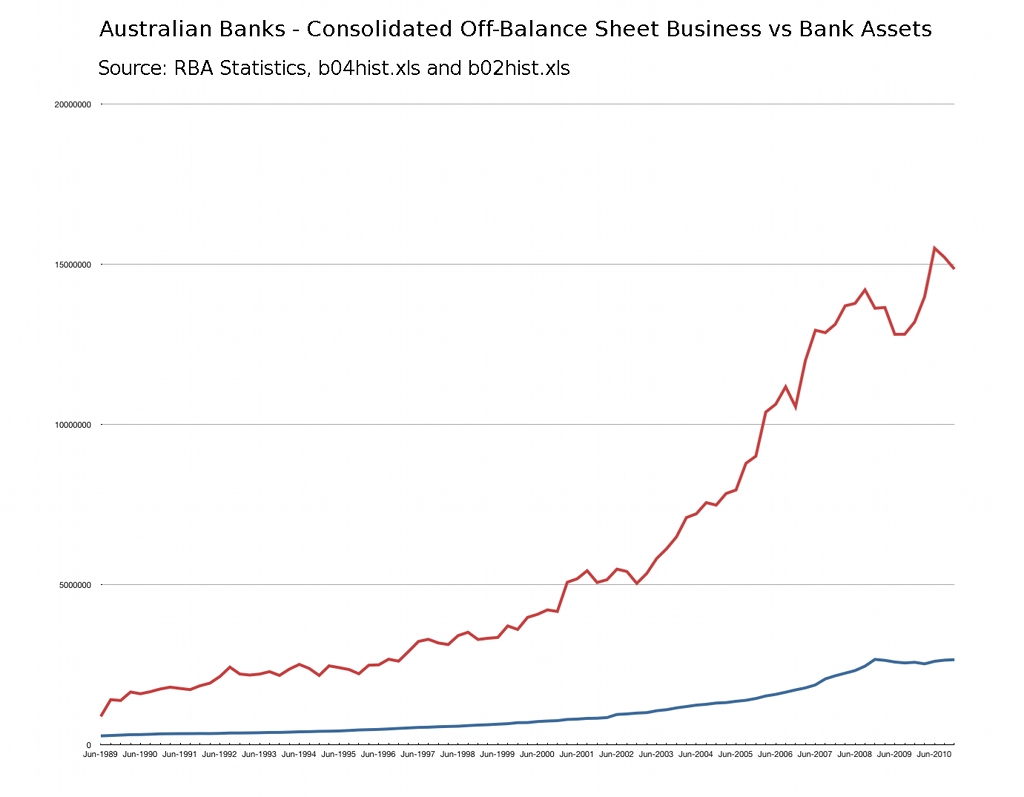
To give an idea of the vast disconnect between our banks’ “Assets” (66% of which are loans), and their exposure to OTC derivatives, the following chart shows their total Assets – blue line – versus a red line of total Off-Balance Sheet “business” (click to enlarge):

$2.66 Trillion in "Assets" versus $15 Trillion in Off-Balance Sheet "Business"


They say that the main gimmick used to promote Hubba Bubba is that it is less sticky than other brands of bubble gum, and so burst bubbles are easier to peel from your skin.

No worries then.

Sure, we are going to get squeezed dry.

But there’ll be no needing to go shave our heads or rend our clothes when the biggest bubble ever goes POP!

I wonder which flavour we will get.

Raspberry?

Watermelon?

Squeeze Pop?

Or, will it be another new flavour …

Carbon Tax.

Emissions Trading.

“Independent” Carbon Bank.

Behave … debt slave.

Ka-Ching!

How Australia Will Look When The SHTF

15 May

Want a glimpse of Australia’s future?

Watch this shocking story from America’s 60 Minutes:

http://www.youtube.com/watch?v=QwrO6jhtC5E

Pretty distressing, right?

It was exotic “mortgage-backed investments” that triggered the GFC in America. And as you just saw, they are still very much at the heart of their terrible ongoing crisis, where 1 in 7 (44 million) are now living on food stamps.

Just as in the USA and other countries, our Labor government responded to the GFC by “stimulus”.  And, by propping up our “safe as houses” bankstering system.

This is the same “best in the world” bankstering system that has just $2.67 Billion in On-Balance Sheet Assets, versus $15 TRILLION in Off-Balance Sheet “business”.  The bulk of that off-the-books “business” is exotic “derivatives” bets on interest rates, and foreign exchange rates.

How exactly did Labor prop up our bankstering system?

Amongst other things, by using taxpayer’s money to “invest” billions in … yep, Residential Mortgage-Backed Securities (RMBS).

$16 Billion, to be precise.

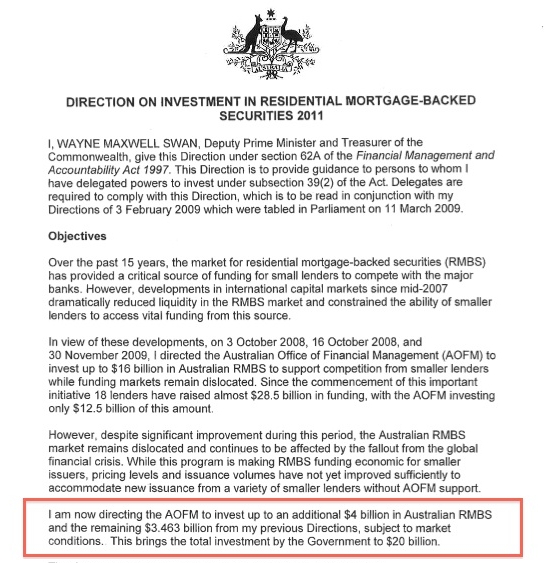
But $16 Billion wasn’t enough. Just last month, Wayne Swan authorised the AOFM to “invest” another $4 Billion in these “mortgage backed investments”:

Click to enlarge

According to numerous sources including The Economist magazine, Australia has the most overvalued housing in the world.

And earlier this month, we learned that house prices fell by the most in 12 years in the March quarter.

That $20 Billion pumped into Residential Mortgage-Backed Securities is not looking such a great “investment” now, ‘eh Wayne.

Let there be no mistake.

Rudd/Gillard Labor did not “save us” from the GFC.

They simply kicked the can down the road a couple of years.

And in doing so, all they have achieved is to dramatically weaken our government’s financial position.

Nearly $200 Billion in gross debt.

$20 Billion in “mortgage-backed investments”.

A $50 Billion budget deficit – that’s for this year alone.

A $50 Billion increase in our national debt ceiling, to $250 Billion.

And borrowing more than $2 Billion a week.

But look on the bright side.

When GFC 2.0 strikes, we’ll not need to worry about what’s hitting the fan.

Because thanks to Labor … and the banksters … we’re already in the ____ right up to our necks.

Barnaby is right.

UPDATE:

For more shocking revelations on this story of bankstering corruption of the mortgage finance markets – and now even the courts of law – see this exposé by Rolling Stone’s Matt Taibbi:

The foreclosure lawyers down in Jacksonville had warned me, but I was skeptical. They told me the state of Florida had created a special super-high-speed housing court with a specific mandate to rubber-stamp the legally dicey foreclosures by corporate mortgage pushers like Deutsche Bank and JP Morgan Chase. This “rocket docket,” as it is called in town, is presided over by retired judges who seem to have no clue about the insanely complex financial instruments they are ruling on — securitized mortgages and laby­rinthine derivative deals of a type that didn’t even exist when most of them were active members of the bench. Their stated mission isn’t to decide right and wrong, but to clear cases and blast human beings out of their homes with ultimate velocity. They certainly have no incentive to penetrate the profound criminal mysteries of the great American mortgage bubble of the 2000s, perhaps the most complex Ponzi scheme in human history …

And if you missed it, check out Matt’s infamous exposé of one of the big banks at the heart of the ongoing mega-fraud, Goldman Sachs:

The first thing you need to know about Goldman Sachs is that it’s everywhere. The world’s most powerful investment bank is a great vampire squid wrapped around the face of humanity, relentlessly jamming its blood funnel into anything that smells like money. In fact, the history of the recent financial crisis, which doubles as a history of the rapid decline and fall of the suddenly swindled dry American empire, reads like a Who’s Who of Goldman Sachs graduates …

What you need to know is the big picture: If America is circling the drain, Goldman Sachs has found a way to be that drain — an extremely unfortunate loophole in the system of Western democratic capitalism, which never foresaw that in a society governed passively by free markets and free elections, organized greed always defeats disorganized democracy

Goldman Sachs is the puppeteer of our very own Emissions Trading Scheme leading proponent, former GS Australia chairman Malcolm Turnbull MP.

Aussie Banks’ $14.2Trillion “Time Bomb”

16 Aug

With all the recent turmoil in Europe, and grave questions being asked over the solvency of the European banking system, perhaps it’s time to again ask the question – How safe are our Aussie banks?

Back on March 4th (“Aussie Banks Not So Safe“), we saw that Aussie banks were holding $13 Trillion .. yes, TRILLION .. in Off-Balance Sheet “business”.  By comparison, they were holding only $2.59 Trillion in on-balance sheet assets.

The latest RBA statistics show an interesting change.

Our banks’ Off-Balance Sheet “business” has blown out by a whopping $1.2 Trillion.  It now stands at $14.2 Trillion (RBA spreadsheet here).  That growth alone – in just months – is equivalent to the entire Australian economy.

By comparison, their on-balance sheet assets have only grown by $26.6 Billion, to  $2.62 Trillion (RBA spreadsheet here).

The chart below shows our banks’ assets in blue, with Off-Balance sheet business added on top in burgundy (click to enlarge):
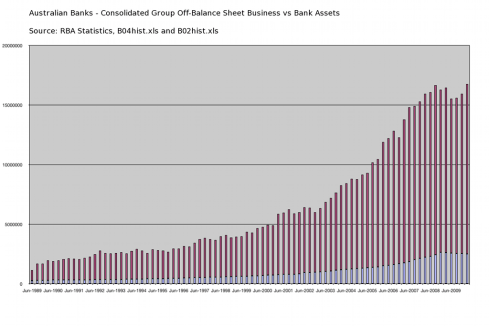
$14.2T in derivatives vs $2.6T in assets = MEGA-RISK

The vast bulk ($13.1 Trillion) of that $14.2 Trillion in “Off-Balance Sheet” business, is in the form of OTC derivatives.  Specifically, it is in the form of Interest Rate and Foreign Exchange “swaps” and “forwards”.

What are derivatives?

Derivatives are the exotic financial instruments at the very heart of the GFC.

Back in 2003, the world’s most famous investor, Warren Buffet, famously called derivatives “a mega-catastrophic risk”, “financial weapons of mass destruction“, and a “time bomb”.

Our “safe as houses” Aussie banks are buried up to their eyeballs in the things.

UPDATE:

Alarmingly, it seems Australians are increasingly inclined to trust their savings with the banks.

From today’s The Australian:

Banks sit on record holdings as wary consumers save

The war for deposits has prompted Australians to save more than ever, driving the money on call at banks to record levels.

Australian households have lodged $461.8 billion with banks in June, up 8.4 per cent on the same time last year. It’s a trend underscoring the risk aversion that still exists among investors.

The major banks are the biggest beneficiaries of consumers’ flight to cash.

June data published yesterday by the Australian Prudential Regulatory Authority shows there is $1.266 trillion in deposits at all of the banks in Australia.

The amount is almost the size of the Australian economy, and a 3 per cent increase compared with June last year.

Most of the savings come from households…

Few Australians know that we had the beginnings of a bank run in late 2008.  At the height of fear in the GFC, Australians quietly withdrew $5.5 Billion in savings to stash away under the mattress.  A year later, only $1.5 Billion had been redeposited.

From The Australian:

The private banks keep reserves of cash distributed in 60 storerooms across the country with an average of about $35 million in each. They get topped up by the Reserve Bank before Christmas, when demand for cash typically rises by about 6 per cent, and at Easter, when there is a smaller increase.

But in early October, the Reserve Bank started getting calls from the cash centres for more, especially in denominations of $50 and $100.

The Reserve Bank has its own cash stash. It is coy about exactly how much it holds, but it is understood to be in the region of $4 billion to $5bn.

As the Armaguard vans worked overtime ferrying bundles of $10,000 out to the cash centres, the Reserve Bank’s strategic reserve holdings of $50 and $100 notes started to run low and the call went out to the printer for more. The Reserve Bank ordered another $4.6bn in $100s and another $6bn in $50s. It was the first time it was forced to do this since the Y2K computer bug scare in 1999.

Households pulled about $5.5bn out of their banks in the 10 weeks between US financial house Lehman Brothers going broke – the onset of the global financial crisis – and the beginning of December. That is roughly 80 tonnes of cash salted away in people’s homes. Mattress Bank is doing well, was the view at the Reserve. A year later, only $1.5bn had been put back.

Could it be that Aussies are now feeling a little safer about the GFC, and are starting to put their money back in our banks … at the very time the banks are loading up even more rapidly than ever on derivatives – those “financial weapons of mass destruction”?

UPDATE 2:

16 August 2010

Greg Hoffman of The Intelligent Investor explains the significance of Aussie banks’ derivatives exposure.

From the The Age:

Bank headlines you won’t want to see

‘Australian banks in half trillion dollar derivatives scare” is a headline no-one wants to read. And while it’s unlikely to ever appear, it is possible. So forewarned might be forearmed.

In Monday’s column I showed how Australia’s banks have far more in loans outstanding than they have in deposits.

Now it’s time to explore how that situation came to be and how the banks deal with the risks it presents.

The RBA’s figures show that as at March 2009 ”around 20 per cent of banks’ total liabilities were denominated in foreign currencies.”

This percentage has remained relatively stable over time, but the raw numbers involved ballooned through the credit boom, to the point where the banks’ net foreign currency exposure is more than $300 billion.

If the banks simply borrowed these foreign funds without doing anything else, then they’d have direct exposure to the notoriously fickle Australian dollar exchange rate. Their profits would be violently thrown around (soaring when the currency rises and plunging when the Australian dollar dives).

Yet the banks have produced a string of comparatively smooth profits, at least until the past couple of years. The RBA explains; ”Despite this apparent on-balance sheet currency mismatch, the long-standing practice of swapping the associated foreign currency risk back into local currency terms ensures that fluctuations in the Australian dollar have little effect on domestic banks’ balance sheets.”

Derivative trick

The trick involves the banks entering into hundreds of billions* of dollars worth of derivative contracts known as ”swaps”. These contracts represent an agreement to exchange interest rate and/or currency exposures for a set period of time.

* [Ed:  Mr Hoffman badly underestimates here.  The latest RBA spreadsheet B04hist.xls shows not mere “hundreds of billions”, but rather $6.7 Trillion in Interest Rate swaps, and $1.57 Trillion in Foreign Exchange swaps.  So that’s $8.3 Trillion of the total $14.2 Trillion in off-balance sheet business]

Using such contracts, Australia’s banks can arrange a schedule of payments with another party that match off against their foreign currency-denominated debt. In this way, the banks know their exposure from day one.

Any gains or losses that arise on the loan due to currency movements are offset by an opposite result on the swap contract. That’s how a financial hedge is supposed to function and these contracts have worked nicely for our banks over the years.

Yet one of the expensive lessons taught so savagely by the crisis to financial institutions around the world is that arrangements that have worked smoothly in the past may not always do so in the future.

That lesson brought the business models of lenders dependent on securitisation to a screaming halt in 2007, when previously deep and liquid markets simply seized up. And at some point in the future, it might just pay Australian bank shareholders to have spent a few minutes today considering the risks they’re exposed to as a result of our banks’ reliance on offshore borrowings.

What’s the risk?

I suspect that few people fully understand how dependent our banks are on foreign debt and the mechanism by which they mitigate their exposure (through a series of swap contracts designed to insulate against currency and interest rate movements). And that brings us to the key issue.

Should future convulsions in the global financial markets send any of the institutions on the other side of these contracts to the wall, our banks would become more exposed to the harsh winds of the international financial markets.

This is the nature of ”counterparty risk”, a concept former customers of HIH Insurance came face to face with when that institution couldn’t make good on its financial contracts.

And if the past few years are any indication, the Australian dollar tends to fall in times of uncertainty. So the very conditions which might bring about the failure of the banks’ counterparties would be highly likely to coincide with a plunging Australian dollar: thus blowing out the repayments of foreign currency-denominated debts in local terms.

This is the nightmare scenario…

Indeed.

At the height of the GFC, the Aussie Dollar plummeted from a high of 98c (vs the USD) to just 60c.  In fact, the RBA had to step in on multiple occasions and buy the Aussie Dollar on the open markets, just to defend its exchange rate value at the 60c level.

Given Mr Hoffman has so woefully underestimated our banks’ massive exposure to Interest Rate and Foreign Exchange derivatives, perhaps he should have opened his article as follows:

“Australian banks in 8 trillion dollar derivatives scare” is a headline no-one wants to read.

Bankers – The Root Of Evil

11 May

Banking was conceived in iniquity and born in sin. The Bankers own the earth. Take it away from them, but leave them the power to create deposits, and with the flick of the pen they will create enough deposits to buy it back again. However, take away that power, and all the great fortunes like mine will disappear — as they ought to in order to make this a happier and better world to live in. But, if you wish to remain the slaves of Bankers and pay the cost of your own slavery, then let them continue to create deposits.

Sir Josiah Stamp (1880-1941), one time governor of the Bank of England, in his Commencement Address at the University of Texas in 1927. Reportedly he was the second wealthiest individual in Britain.

Bankers have become even more ‘sophisticated’ in the many decades since Sir Josiah Stamp let the cat out of the bag. Now, not only do they create ‘money’ out of thin air by signing you up to a loan – which is entered into a computer as a brand new “deposit” for you to spend – they also ‘manufacture’ all kinds of ‘synthetic’ money substitutes too.

They’re called “derivatives”. Or, as Warren Buffet called them, “Financial weapons of mass destruction”.

And bankers can create as many of them as they wish, because there is absolutely zero regulation of the derivatives markets. To give you some idea, at the peak of the first wave of the GFC in 2008, there was around 1.44 Quadrillion $USD worth of OTC (“Over The Counter”) derivatives in existence.

Why is this important?

Because the $1 Trillion funding to save the Eurozone announced yesterday is meaningless.  The Eurozone cannot be saved, no matter how much money the EU tries to beg, borrow, steal… or print.  Because banksters like Goldman Sachs can simply create ever greater mountains of ‘synthetic’ derivatives with which to attack debt-laden countries, one by one, starting with the weakest.

From ZeroHedge:

Jim Rickards: “Goldman Can Create Shorts Faster Than Europe Can Print Money”

Jim Rickards, who recently has gotten massive media exposure on everything from the JPM Silver manipulation scandal, to the Greek default, was back on CNBC earlier with one of the most fascinating insights we have yet heard from anyone, which demonstrates beyond a doubt why any attempt by Europe to print its way out of its current default is doomed: “Look at what Soros did to the Bank of England in 1992 – he went after them, they had a finite amount of dollars, he was selling sterling and taking the dollars, and they were buying the sterling and selling the dollars to defend the peg. All he had to do was sell more than they had and he wins. But he needed real money to do that. Today you can break a country, you don’t need money you just need synthetic euroshorts or CDS. A trillion dollar bailout: Goldman can create 10 trillion of euroshorts. So it just dominates whatever governments can do. So basically Goldman can create shorts faster than Europe can create money.

The world is not ruled by politicians.  It is ruled by banksters.  Most of us simply don’t quite understand that, because we don’t understand how they do it.

It is very simple.  Well before most of us were born, bankers were given the exclusive power to create ‘deposits’.  Which you and I know as ‘debt’.  And which is now called ‘credit’ … because it appeals to our Pride, and sounds so much nicer, to delude ourselves that we have been given ‘credit’.

When in reality, what we have been given is a Debt.  By accepting the offer of ‘credit’ (Debt), we sell ourselves as slaves to the bankers.

They know it.  They’ve always known it.

Now you do too.

Aussie Banks Not So Safe

4 Mar

From Money Morning:

We dropped the line yesterday about the banks having $13 trillion of off-balance sheet business. We’ve mentioned this number several times over the last year, but if you’re a new reader to Money Morning, here’s a link to the Reserve Bank of Australia spreadsheet that contains the awful truth.

To be precise, it currently runs to $13,058,814,195,842.70.

Just to put that in perspective, the banks have a total of $2.59 trillion of on-balance sheet assets. We’re sure the banks and the RBA will claim that all the off-balance sheet business is completely offset, so that losses are contained.

Personally, we don’t think you should believe a word of it. The number one risk with the off-balance sheet business is counterparty risk. As long as each counterparty can keep the ponzi scheme going then sure, everything will be tickety-boo.

But as we all know, that can’t happen. We’ve seen counterparties collapse before (Lehman, Bear Sterns, etc…) and they’ll collapse or need bailing out again.

There’s only so long that banks can keep the ponzi going. They’ve scraped through by the skin of their teeth thanks to an unprecedented bail-out by the taxpayer.

You see, $13 trillion is $13 trillion. It’s the big unspoken risk that the banks have created for themselves.

You can see the growth in off balance sheet business for yourself here:

$13 Trillion - AU Banks' Off Balance Sheet "assets"

$13 Trillion Off Balance Sheet Business = RISK

So let me make one thing clear. When you hear all the talk about banks deleveraging and de-risking, don’t believe a word of it. As you can see from the chart above, they’re in as deep as they’ve ever been.

The issue of counterparty risk is precisely why the Greek debt crisis is a threat to Australia – despite what Ken Henry and Glenn Stevens would have us believe.

Hummel: The US Will Default On Its Debt

26 Feb

Barnaby warned about the possibility of US sovereign debt default. San Jose State University economist, Professor Jeffrey Rogers Hummel, makes a prediction:

It is not literally impossible that the Federal Reserve could unleash the Zimbabwe option and repudiate the national debt indirectly through hyperinflation, rather than have the Treasury repudiate it directly. But my guess is that, faced with the alternatives of seeing both the dollar and the debt become worthless or defaulting on the debt while saving the dollar, the U.S. government will choose the latter.

Design a site like this with WordPress.com
Get started