Tag Archives: GFC

Another Financial Crisis Coming

4 Mar

From ABC News (America):

Even as many Americans still struggle to recover from the country’s worst economic downturn since the Great Depression, another crisis – one that will be even worse than the current one – is looming, according to a new report from a group of leading economists, financiers, and former federal regulators.

The report warns that the country is now immersed in a “doomsday cycle” wherein banks use borrowed money to take massive risks in an attempt to pay big dividends to shareholders and big bonuses to management – and when the risks go wrong, the banks receive taxpayer bailouts from the government.

“Risk-taking at banks,” the report cautions, “will soon be larger than ever.”

According to data from the Reserve Bank of Australia, the Australian banking system has $13 Trillion in Off Balance Sheet business, compared with only $2.59 Trillion in On Balance Sheet business.

Victory Declared At Half-Time

4 Mar

From Business Spectator:

‘Declaring victory at half-time’ is a syndrome which afflicts the entire debate over our current economic situation: optimists are of the opinion that the crisis is all over now, while pessimists think it’s only just begun. On this front, as always, I regard history as the best indicator of who may be right.

On this front, I can’t commend highly enough the site New from 1930, which from January 1 2009 began publishing summaries of the Wall Street Journal from January 1 1930. The last few entries include these pearls of wisdom from February 1931:

An Old-Timer believes the market rally “will do more to restore prosperity than anything else.” Total security values have increased over $20B since start of year; barring another dive in the market, this assures a recovery since the 10M-15M US owners of stock feel richer. Bulls say the ease with which considerable profit-taking has been absorbed recently is “the surest indication of a strong healthy market.” Market has rallied very substantially; “if it runs true to form, it will have one of those ‘healthy reactions’ that will, according to the bulls, strengthen its ‘technical position.’” “The buying power of the people and the corporations still is large … In other words, the country never was in a better position to stage a comeback after a depression … (Feb. 25)

One banker cites plenty of evidence that the backlog of consuming power is largest its been in years: corp. inventories are down 20 per cent from a year ago, and even more from 2 years ago; corps. are holding more cash; production of many products is below requirements; products have been wearing out for 18 months of deferred buying; security values up $20B since Jan. 1; easy credit; record-breaking savings deposits. Last year there were few rallies on which to sell; this year there have been few dips on which to buy. Public interest has grown this year, but is still small compared to 1928 and 1929; “a market with a growing public interest is a dangerous market to sell short.” (Feb. 26)

Yeah, right:  in both 1930 and 1931, the belief was widespread – at least in the financial community – that the Depression was over, and recovery was just around the corner. As Alan Kohler noted, at least early on during the Great Depression, people didn’t realise that they were in it. They too, were declaring victory at what turned out to be not even half-time.

A fascinating and highly detailed analysis follows, including a number of interesting charts that show just why Australia ‘appears’ to have done so well – up to half time.  And why the Debt-Deflation which causes depressions has not been solved, but instead, simply made even worse by government intervention.

Greece Now, UK Next

3 Mar

From Bloomberg:

While the eyes of the world focus on Greece’s debt crisis, investors in Edinburgh are busy preparing for the U.K. to be next.

Turcan Connell, which caters to rich families, expects the pound to lose between 20 percent and 30 percent against the dollar once investors turn their sights on Britain as the government sells a record amount of debt. Sterling slid to a 10- month low versus the U.S. currency today.

Alarm bells were ringing in Greece for a long time and when it happened, it happened very quickly,” Haig Bathgate, head of strategy at Turcan Connell, said at the company’s offices in the Scottish capital. “The U.K. is in a similar predicament. It could be hit very hard.”

The Rudd Labor government is currently borrowing more than a billion dollars a week.

And we can’t pay it back.

Stevens: ‘Risk of Serious Contraction’ Passed

2 Mar

The man who did not see trouble all around in 2008, continually raising interest rates right into the teeth of the GFC, has raised rates again today:

RBA governor Glenn Stevens said the “risk of serious economic contraction” had passed, and an economy that was growing faster than expected would warrant higher interest rates for the rest of the year.

Stevens clearly believes that the Australian economy is magically immune from the sovereign debt crises in the Eurozone, UK, USA, and Japan, and the massive speculative real estate bubble in China.

However, the Rudd Labor government no longer has a $20+ Billion budget buffer inherited from the previous government. Instead, they have put Australia into unprecedented debt that we can never pay back.

Stevens, allegedly a devout Baptist, had best start praying fervently that all the ongoing financial crises in the rest of the world somehow resolve themselves.  Else he will again be shown as a fool… at a terrible price to the Australian public.

Bernanke: US Debt Crisis

2 Mar

From The Washington Times:

With uncharacteristic bluntness, Federal Reserve Chairman Ben S. Bernanke warned Congress on Wednesday that the United States could soon face a debt crisis like the one in Greece, and declared that the central bank will not help legislators by printing money to pay for the ballooning federal debt.

Recent events in Europe, where Greece and other nations with large, unsustainable deficits like the United States are having increasing trouble selling their debt to investors, show that the U.S. is vulnerable to a sudden reversal of fortunes that would force taxpayers to pay higher interest rates on the debt, Mr. Bernanke said.

Australian banks source almost all their funding from the international capital markets. It is inevitable that a debt crisis in Europe, or America, will drive up funding costs for Australian banks too, who will (of course) put the squeeze on Australian borrowers.

Abbott: Low-Growth, High Inflation Future

1 Mar

Tony Abbott also sees the danger signs that so many are warning of:

The danger for Australia, as we enter what could turn out to be a long period of 70s-style low growth and high inflation, is not just that the Rudd government has saddled us with debt and deficits but that it’s undoing the reforms on which a golden age was built.

Rudd Labor have tried to smear Tony Abbott’s economic credentials too, trumpeting that he thinks “economics is boring”. Whether that is true or not is beside the point – just because a subject is boring, does not mean you do not understand it.

Tony Abbott is a Rhodes Scholar, with a degree in Economics.  The Rudd Labor economic team, by comparison, are all uneducated imbeciles. Compare their credentials here.

Barnaby is right. Tony Abbott is right as well.

Thank goodness that at least two people in our parliament are aware of the serious economic problem that lies ahead.

Greek Debt Crisis Reflects Global Problem

1 Mar

The Greek debt crisis represents a threat to the entire Eurozone, and ultimately, the global economy:

Simon Tilford, chief economist at the Center for European Reform in London, says the Greek crisis reflects a larger economic problem in Europe. EU members like the Netherlands and Germany have spent too little and their economies are driven by exports. Meanwhile, southern economies like Greece and Portugal have spent too much and amassed debts as a result.

Now that sounds familiar – “…economies are driven by exports… spent too much and amassed debts as a result”. One could be forgiven for drawing a logical conclusion – that the Australian economy, far from being a shining beacon of fiscal prudence, actually encapsulates the worst of the Eurozone’s economic dilemma.

Greece’s problems are also spilling beyond Europe’s borders. The value of the euro currency has plunged for example, which makes American exports – key to the U.S. economic recovery – less competitive.

Ultimately, Tilford says, the Greek problem reflects a world economic problem.

“The eurozone s really just a microcosm of the global problems we see. So unless we see the big countries in East Asia rebalancing away from exports and toward domestic demand, we are not going to generate a self-sustaining global economic recovery,” he said.

But Tilford does not believe Europe is ready, or willing, yet to undertake fundamental economic reforms he thinks are needed to right these imbalances. The region may rescue Greece, he says, but it will only be putting a bandage on a far bigger problem.

Could it be that, as with every other global trend, Down Under Australia has not “escaped” the GFC at all, but is simply running a few years behind everyone else?

Barnaby is right.

OECD Economist: Double-Dip Recession Looms

28 Feb

One can only wonder if Treasury Secretary Ken Henry watched the ABC’s “Inside Business” this morning:

One of the OECD’s leading economists says there is a strong chance that the world’s leading economies could quickly slide back into recession.

The deputy director of the OECD’s financial and enterprise affairs, Dr Adrian Blundell-Wignall, has told ABC1’s Inside Business program that the threat of a double dip recession remained because problems in the banking system have not been solved.

“There are many icebergs the ship has to negotiate before we’re out of jail here. This is going to be a 10 year process, not a one year process,” he said.

Dr Blundell-Wignall says many of the banks’ problems have been hidden by changes to accounting rules and their most toxic assets have been shifted to the balance sheets of the big central banks in the US and Europe.

Dr Henry recently stated that the GFC is “over”:

“What people have called the global financial crisis, that has passed“.

Dr Henry went on to predict a “period of unprecedented prosperity” for Australia, one that could “stretch to 2050”.

Dr Henry failed to predict the GFC.

Henry: GFC Is ‘Over’

28 Feb

Earlier this month, Treasury Secretary Ken Henry declared that the Global Financial Crisis is “over”:

“What people have called the global financial crisis, that has passed, I think it’s safe to say,” Dr Henry said. “But that isn’t to say that there will not be further adverse shocks for financial markets down the track and some of those shocks … could be of some significance for individual countries, but I don’t imagine (they would be) shocks of the sort that would be globally significant.”

Remember that claim.

Ken Henry did not see the GFC coming in the first place. He later claimed that “only extraordinarily good forecasters” would have predicted the GFC.

Well, that would be lots of extra-ordinary folk like me then, Ken. Even I could see it coming, from late 2005. And despite the ridicule (familiar story?) of “trained” “expert” financial advisers, I chose to pull all my superannuation out of the sharemarket into cash in May 2007, completely avoiding the global crash that has wiped out the investments and retirement savings of countless millions –
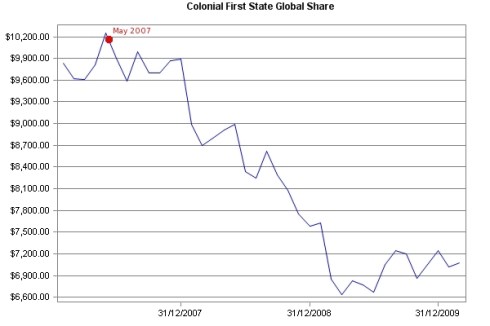
Historical performance chart assumptions: Performance is calculated on an initial investment of $10,000, using entry to exit prices, with distributions reinvested. A 4% contribution fee has also been applied. This information is general information only


And what about those international economists who publicly warned of a looming GFC, Ken?  Men such as professors Ken Rogoff and Nouriel Roubini, and our very own “Dr Doom”, Professor Steve Keen?

You’d think Henry might have learned a few lessons about wide-ranging research… and caution… given his utter failure to foresee what many others did.  So has he learned anything?

Clearly not.

Henry presently remains ignorant of, oblivious to, or (worse) rejects the numerous dire warnings coming daily from all around the world. Not just from Barnaby Joyce, but from many leading international economists – several of whom did predict the GFC – who are now genuinely concerned with multiple threats to the global economy. Everything from the European debt crisis, to the China property bubble.

Scarily, it has become increasingly obvious that Ken Henry is the man who really holds the reins of Australia’s economy, since PM Rudd, Treasurer Swan, and Finance Minister Tanner, are all totally unqualified economic imbeciles. Never forget, all of them were frantically talking up “the inflation genie” danger in 2008, even as the GFC tsunami was breaking over the world economy.

If (when) it all goes pear-shaped… again… Ken Henry must be sacked.

Roubini: ‘Risky Rich’ Countries in Greatest Danger of Default

26 Feb

New York University Professor Nouriel Roubini – famous for having predicted the GFC in 2006 – again defies the so-called ‘conventional wisdom’ by warning that it is the “risky rich” countries who are in greatest danger of sovereign debt default:

Today’s swollen fiscal deficits and public debt are fueling concerns about sovereign risk in many advanced economies. Traditionally, sovereign risk has been concentrated in emerging-market economies. After all, in the last decade or so, Russia, Argentina, and Ecuador defaulted on their public debts, while Pakistan, Ukraine, and Uruguay coercively restructured their public debt under the threat of default.

But, in large part – and with a few exceptions in Central and Eastern Europe – emerging-market economies improved their fiscal performance by reducing overall deficits, running large primary surpluses, lowering their stock of public debt-to-GDP ratios, and reducing the currency and maturity mismatches in their public debt. As a result, sovereign risk today is a greater problem in advanced economies than in most emerging-market economies.

Design a site like this with WordPress.com
Get started