Tag Archives: GFC

I Should Have Listened To Barnaby Joyce – Sure Beats Listening To The “Experts”

10 Aug

A really great article by journalist Jill Singer.

Filled with honesty.

Humility.

And humanity.

From the Herald Sun:

Experts did nothing to prevent fall

It’s not so very long ago that only the wealthy invested in shares.

Nowadays, though, it seems even the lowest-paid workers must monitor the All-Ordinaries Index if they want to know how their final years will play out.

Will their super funds provide them with enough to live out their allotted years without relying on the kindness of strangers or the vagaries of government largesse?

Or will they work for as long as their bodies and minds allow before succumbing to a lesser life of niggling poverty, insecurity and guilt over being a “burden” on others?

Little wonder that the world seems engulfed by fear and greed.

In this age of compulsory super and self-managed funds, life has become a terrifying gamble.

Having money tied up in superannuation has become akin to being caught in a high-rise building during a bomb scare.

You know that if everyone starts running for the lifts the odds are that people will get crushed. Then again, wouldn’t it be nice to be the first one out of the door?

If we earn an income, we have no choice but to invest in super. But how on earth are ordinary folk expected to manage it when we know that if you have two economists, you’ll get five opinions?

I was like most small investors when the proverbial hit the global economic fan yet again last week – torn between the squirrel-like urge to shift my rapidly dwindling super into cash or to swallow the Government’s line that we are a privileged and robust economy.

In the end I chose the path of least resistance and did nothing.

I’m just not going to look at the damage and will only uncover my eyes when the fire has finally passed …

There are lessons for us all in this.

I should have listened to Nationals senator Barnaby Joyce when, in 2009, he warned about the potential (and then unthinkable) dangers of the US coming close to defaulting on its debt.

I should also have listened to Kenny Rogers: “You’ve got to know when to hold them, know when to fold them. Know when to walk away and know when to run.”

Sure beats listening to the advice of “experts”.

UPDATE:

One wonders whether Jill might now begin to reconsider her murderous devotion to the “experts” of the global warming cargo cult:

Then there’s David Murray, chair of Australia’s $71 billion Future Fund and recipient of a $28 million golden parachute from his time running the Commonwealth Bank. Murray states there’s no link between global warming and carbon dioxide emissions because carbon dioxide is necessary for life, colourless and odourless – and therefore can’t be considered a pollutant. It’s a popularly held view.

Andy Semple of the Menzies Institute claims it’s “refreshing” for someone with Murray’s standing to take on the global warming “scam” by expressing such views.

Really? I’m prepared to keep an open mind and propose another stunt for climate sceptics – put your strong views to the test by exposing yourselves to high concentrations of either carbon dioxide or some other colourless, odourless gas – say, carbon monoxide.

You wouldn’t see or smell anything. Nor would your anti-science nonsense be heard of again. How very refreshing.

Barnaby: To Those Who Called Me Fool, Who’s Laughing Now?

8 Aug

Senator Joyce writes for the Australian.

Listen up this time!! –

The joy of vindication on the prospect of a US government default is bittersweet; I was right, Wayne was wrong. To those sucked in by the Treasurer, placing wishful romantic theory above clinical reality, then saying “you wouldn’t cut it with the Bloomsbury group if you talk like that at our soiree”, I suggest this, get real.

Do not confuse tackling a problem with delaying when it comes to debt. If while out on the tiles on a Friday night you discover a septic gash on your leg, and in response down another five jagermeisters, pain gone, problem gone, keep dancing, that is delay. Going to hospital to avoid amputation is dealing with the problem.

Tim Flannery said that the impact of climate change policies won’t be felt for at least a thousand years. The impact of a catastrophic default this time was avoided by a mere 10 hours. When prioritising threats I know which one I would be concentrating on.

Swan has given 25 speeches this year and mentioned climate change 24 times. Debt has only been mentioned 16 times, and eight of these in one speech made last month. A year and a half ago I implored the government to prepare contingency plans for the threat of a US default stating the prospect was “distant but real” but if it eventuated the fallout would be a financial Armageddon making the GFC look like a mere preamble. US President Barack Obama also used the term Armageddon in the past month, so if I’m mad, so is he.

When asked on ABC radio whether the government had prepared for a potential US default, our Treasurer could point to no specific actions taken. But we do have parts of Treasury modelling climate change. The Treasurer believes I have been captured by “Tea Partiers”. Disagree with him on climate change you’re a denier, disagree with him on economics you’re a Tea Partier.

Ken Rogoff, obviously another of Swan’s Tea Partiers, but also moonlighting as a professor of economics at Harvard University, has been warning about these problems since we were first introduced to the term sub-prime. The Global Financial Crisis involved ordinary people and silly governments taking on too much debt. There was nothing unique about it, the same process has been repeated over and over again with tulips, railroad stocks, Florida real estate, dot-com investments and our modern example, collateralised debt obligations.

A couple of years ago Rogoff wrote a book titled This Time Is Different, showing actually it’s almost always the same. Public debt crises are more common than economists tend to acknowledge and financial crises in particular place extreme stress on government finances.

Rogoff wrote a paper a couple of months ago titled A Decade of Debt in which he measured the increase in public debt in different countries since 2007, when we voted in these current economic luminaries. No surprises, Iceland and Ireland, are one and two but Swan got the bronze, Australia is third, with a 150 per cent increase in our public debt since 2007. As I previously said we can’t keep going on like this, but we are. We have just extended our debt ceiling to $250 billion.

In 2008, before the GFC’s nadir, Ireland’s net public debt was 12.5 per cent of GDP according to the OECD. The Treasurer boasts that our net public debt is low compared with others. The parliamentary library estimated last year our net public debt will be 12.3 per cent of GDP in 2012-13, the same year Swan predicts surplus.

In the political sphere the person who drives via the rear vision mirror, with a wonderful recitation about everywhere you have been and why, but not a clue where you are going, is dangerous. When, with a coterie of bureaucrats, they cannot keep the car on the black stuff but seem to be targeting the trees, you are in for the economic ride of your life.

Things changed for Ireland after it guaranteed the debt of its banks during the GFC. We have done that, too. Three years ago the Treasurer introduced the financial claims scheme which guarantees $730 billion in deposits. It’s up for review in October but there is barely a discussion about how we might mitigate the risks of such taxpayer exposure. We are too busy trying to cool the planet from a room in Canberra.

Barnaby is right.

Take very careful note of that last paragraph.

Moody’s ratings agency has already warned our government – when it downgraded the credit rating of all our banks in May – that the government’s guarantee was worth two ratings notches.

In other words, without the government guarantee – the our-future-earnings guarantee – our banks’ credit rating would be slashed even further.

Meaning higher interest rates for you.

The long overdue collapse of our housing bubble.

The collapse of our banks.

The bailout of our banks.

And Australia looking exactly like the rest of the Western world.

Oh yes …

And your super stolen by our government – both “sides” – to bail out the banks, and/or finance the floundering government.

Don’t believe me?

Fine.

Piss off then.

Or…

Read. And learn.

Start here –

Stealing Our Super – I DARE You To Ignore This Now

Fairfax Media: He Prophets Best Who Heeds Joyce

8 Aug

From Scott Rochfort at the Sydney Morning Herald:

Illustration: John Shakespeare

In these increasingly desperate times on global financial markets, faith in the ability of politicians to solve the world’s economic problems has been in short supply.

But after searching around for answers, CBD was relieved to find a website highlighting the past predictions (and warnings) of the Nationals leader in the Senate, Barnaby Joyce.

The founder of the blog barnabyisright.com, who asked not to be named, said the recent concerns that the US could default on its $14.3 trillion of national debt vindicated the comments made by Joyce to the Herald in late 2009.

”A default by the US means complete economic collapse around the world and the question we have got to ask ourselves is, where are we in that,” Joyce said at the time. The senator also raised the alarm about Australia’s government debt in the interview.

The S&P downgrade of the US government’s AAA credit rating at the weekend prompted barnabyisright.com to post the entry ”I Told You So”.

The creator of the blog, launched in February 2010, said it was driven by his anger over the treatment of Joyce during his brief tenure as Tony Abbott’s numbers man.

”Anger at the dishonest, and economically ignorant treatment that Senator Joyce was receiving as then newly promoted opposition finance spokesman, due to his courageous and prophetic voicing of concern over US (and Australian) debt levels, and the risks that these debts (foreign and domestic) pose to Australia’s future.”

WHO’S NAIVE?

When contacted by CBD yesterday, Joyce said he also felt his past warnings about US debt had been vindicated. ”I don’t get enjoyment out of it. There’s no joy out of the pain it’s going to cause,” he said about the world’s level of indebtedness.

Barnaby said he was annoyed at the economists who branded him as ”naive” and ”absurd”.

”You should Google search me for that period of time. And you should Google search them too,” he said.

It was only last month that the founder of barnabyisright.com said he was contemplating the future of the blog ”in that wonderful place where our latte-sipping, concrete-jungle-dwelling, holier-than-thou, ‘green’ totalitarian-wannabe paragons-of-hypocrisy never actually venture (the bush)”.

It seems the S&P downgrade has guaranteed the future of the Barnaby tribute site for some time yet.

Stealing Our Super – I DARE You To Ignore This Now

8 Aug

Caricature by Zeg | click to enlarge

My sincere apologies, dear reader.

I understand that you are probably a little concerned about the future for the economy right now.

If you own shares, then you are probably worried about last week’s bloodbath in global sharemarkets.

But I have a very important question to ask you.

It’s a bit of a reality check, I’m afraid.

Do you think your Superannuation “nest egg” is safe from the greedy hand of government?

If you answered “yes”, then …

I dare you.

I dare you to ignore the rest of this blog.

I dare you to ignore the fact that Senator Barnaby Joyce – the only Australian politician who foresaw and forewarned about America’s present debt nightmare – gave this warning on 5th May 2011:

In response to a question I put in Senate estimates, Treasury revealed that $64 billion of the difference between our gross debt and our net debt is made up of the cash and non-equity investments of the Future Fund. The Future Fund is there to cover the otherwise unfunded costs of public servants’ superannuation.

That is a little fact that the people of Canberra might be interested in. When Wayne mentions net debt translate that to, I am going to pay his debt off with my retirement savings.

I dare you to ignore the fact that Barnaby repeated his warning on May 13th, straight after the Budget:

Of course, the public servants will not be happy when we use their retirement savings, put aside in the Future Fund, to pay off some of Labor’s massive debt.

I dare you to ignore the fact that the US Government has been stealing federal workers pensions since May this year:

Treasury to tap pensions to help fund government

The Obama administration will begin to tap federal retiree programs to help fund operations after the government lost its ability Monday to borrow more money from the public, adding urgency to efforts in Washington to fashion a compromise over the debt…

Geithner, who has already suspended a program that helps state and local government manage their finances, will begin to borrow from retirement funds for federal workers.

I dare you to ignore the fact that the US Government has been planning to steal their private citizens’ super too, since at least February 2010:

The plan, as sketched in the 43-page document, calls for the creation of something called  “Guaranteed Retirement Accounts” (GRAs). Biden slyly shifts the onus for the idea through weasel words typical of the federal government: “Some have suggested the creation of Guaranteed Retirement Accounts (GRAs), which would give workers a simple way to invest a portion of their retirement savings in an account that was free of inflation and market risk, and in some versions under discussion, would guarantee a specified real return above the rate of inflation.”

These accounts would be “free of inflation and market risk” because they would be under the direct and absolute control of the federal bureaucracy.

I dare you to ignore the fact that Argentina’s government stole their citizens’ super in October 2008:

Argentina’s center-left President Cristina Fernandez on Tuesday signed a bill for a government takeover of the $30 billion private pension system in a daring and unexpected move that rocked domestic markets.

I dare you to ignore the fact that Hungary’s government nationalised stole their citizens’ super in November last year:

Hungary is giving its citizens an ultimatum: move your private-pension fund assets to the state or lose your state pension.

Economy Minister Gyorgy Matolcsy announced the policy yesterday, escalating a government drive to bring 3 trillion forint ($14.6 billion) of privately managed pension assets under state control to reduce the budget deficit and public debt. Workers who opt against returning to the state system stand to lose 70 percent of their pension claim.

I dare you to ignore the fact that France began stealing their citizens’ super in late 2010 as well:

France seizes €36bn of pension assets

Asset managers will have the chance to get billions of euros in mandates in the next few months for the €36bn Fonds de Réserve pour les Retraites (FRR), the French reserve pension fund, after the French parliament last week passed a law to use its assets to pay off the debts of France’s welfare system.

I dare you to ignore the fact that “Europe’s economic superstar”, the one EU nation that (like Australia) came through GFC1 with positive economic growth, began stealing their citizens’ super in May this year:

It appears moving backwards on pension reforms has become the thing to do on both sides of the Atlantic.

Hungary last year moved much of its private pension assets to the state. Last month, new rules came into effect in Poland diverting 5% of the 7.3% of salary going to private pension funds to the state.

I dare you to ignore the fact that Ireland too, began stealing their citizens’ super in May this year:

Irish Bombshell: Government Raids PRIVATE Pensions To Pay For Spending

“The various tax reduction and additional expenditure measures which I am announcing today will be funded by way of a temporary levy on funded pension schemes and personal pension plans.”

I dare you to ignore the fact that the UK Government announced plans to steal public sector workers’ pension entitlements in June this year:

Thousands of teachers, lecturers and civil servants joined a UK wide strike yesterday in a mass protest over pension reforms.

The government … wants to impose a 3%-of-pay levy on public sector workers’ contributions to help reduce the budget deficit. This amounts to a pay cut to follow on the heels of the current pay freeze.

I dare you to ignore the fact that the Liberal Party of Australia quietly announced a new policy on June 3 this year – sneakily disguised as a helpful “reform” – that should make your hair stand on end:

Further relief for small business

The Coalition will relieve the red tape burden from Australia’s small businesses by giving them the option to remit the compulsory superannuation payments made on behalf of workers, directly to the ATO.

Small business will be given the option to remit superannuation payments to the ATO at the same time as they remit their PAYG payments.

This will require only one payment to one agency – rather than multiple cheques to multiple superannuation funds. The ATO will be responsible for sending the money to superannuation funds directly.

I dare you to ignore the fact that an “option”, can very easily become a “non-option”.

I dare you to ignore the fact that our Green-Labor Government announced plans in the May Budget that should also make your hair stand on end:

The Gillard government’s 2011-12 budget has proposed a raft of initiatives aimed at encouraging superannuation fund and private investment in infrastructure projects.

I dare you to ignore the fact that “encouraging”, can very easily become “enforcing”.

I dare you to ignore the botched “school halls” program, and the white elephant NBN, as you ponder whether or not you really trust this government to wisely and prudently invest your super in Government infrastructure projects, and achieve a reasonable return on your money, when even so-called “experts” have doubts:

The government’s plan to use tax incentives to encourage superannuation funds to invest in new infrastructure could be thwarted by inadequate returns on projects and a reluctance by the states to take on project risk, experts say.

I dare you to ignore the fact that the government’s white elephant NBN is a(nother) Green-Labor thought bubble, drawn up on the back of Kevin Rudd’s in-flight napkin, with no cost/benefit analysis:

Trust us with the NBN; we’re politicians

I dare you to ignore the fact that Bill Shorten, the Minister for Financial Services and Superannuation, already thinks of your super as a “significant national asset” … a kind of “sovereign wealth fund”:

Superannuation is our sovereign wealth fund

This week marks 12 months exactly since the government announced plans to take compulsory superannuation from 9 per cent to 12 per cent.

… our superannuation savings place Australia fourth in the world. Its $1.3 trillion in funds under management through superannuation significantly boosts national savings and provides greater retirement security for millions of Australians. Superannuation is also a significant national asset because it strengthens our financial sector.

I dare you to ignore the fact that our government has guaranteed our banking sector using the promise of your future earnings as collateral, and that Moody’s ratings agency has put our government on notice that our banks are Too Big To Fail – just like in the USA, UK, and Europe:

Heavens to Betsy.  It’s finally out in the open. The big four are too big to fail and Moody’s rates the Australian government’s implicit guarantee of the banks’ wholesale debt (as well as the explicit deposit guarantee) as worth two ratings notches. Moreover, by phrasing it this way, Moody’s has essentially put the Australian government on notice that if it dares back away from that guarantee then it can count on the result. The further implication is that the Budget had better remain shipshape to provide the guarantee.

I dare you to ignore the fact that the government’s carbon pricing scheme scam includes a new “independent” Clean Energy Finance Corporation (carbon bank) that will be permitted to borrow against future government revenue – your future tax dollars – in order to invest in “green” energy projects:

The Clean Energy Council will today release a discussion paper proposing the carbon bank, which it says could be allowed to borrow money to invest in renewable energy projects against the future revenue of Labor’s proposed carbon tax and emissions trading scheme.

The Gillard government is examining the creation of a multi-billion-dollar carbon bank to drive renewable energy technologies as the Greens demand “complementary measures” to cut emissions in return for accepting a lower starting price for the carbon tax.

6.2.1 The Clean Energy Finance Corporation

The $10 billion Clean Energy Finance Corporation will invest in businesses seeking funds to get innovative clean energy proposals and technologies off the ground. These Government-backed investments will deliver the financial capital needed to transform our economy.

A variety of funding tools will be used to support projects, including loans on commercial or concessional terms and equity investments.

The Corporation will be independent from the Government. The Government will appoint an independent Chair who will have appropriate banking or investment management experience.

I dare you to ignore international banking’s core philosophy, now rendered infamous by GFC1: “Privatise the profits … socialise the losses”.

I dare you to ignore the fact that another sharemarket collapse – like in 2008 – would be a perfect pretext for nanny-state, “Big Brother knows best” governments everywhere to step in and “safeguard your retirement”, by taking and “investing” your super in Government-approved “safe investments” … just like the US Government’s planned, doublespeak-titled “Guaranteed Retirement Accounts”.

I dare you to ignore the fact that this blog has documented in detail the wave of super confiscations that is already rolling around the Western world, and the clear evidence that both sides of Australian politics already have their own quiet, sneaky plans to do the same.

I dare you to not bother reading any of my many articles on this topic –

No Super For You!!

US Treasury “Borrowing” Of Federal Pensions Brings Theft Of Private Pensions One Step Closer

Now The UK Government Is Stealing Super Too

Fresh Evidence Our Banks In “Race To The Bottom” Means You Can Kiss Your Super Goodbye

Fitch Ratings: Australian Banks Most Vulnerable To Europe’s Debt Crisis

Our Banks Racing Towards A “Bigger Armageddon”

Money Morning Agrees – Your Retirement Savings Under Threat

The Pricing Carbon Choir – Why Should *Any* Sane Person Trust Economists After The GFC?

Why Would Any Sane Person Believe Treasury’s Carbon Tax Modelling When Its Budget Forecasting Record Is This Bad?

How Wayne ‘Franked’ Another $20 Billion

Wayne: OOPS! I Did It Again

Liberal Party’s Sneaky Plan To Steal Your Super To Pay Labor’s Debt

Dear reader …

I dare you to ignore, mock, and ridicule Barnaby Joyce’s warnings … again.

I dare you to bend over … grab your ankles … bury your head in the sand … and keep telling yourself that “She’ll be right mate”.

I dare you to ignore the fact that …

Barnaby is right.

* A hearty “Thank You” to the inimitable Zeg for his brilliant cartoon drawn especially for this post, and at very short notice.

Please follow him on Twitter – @Zegcartoonist and subscribe to his blog – http://zegsyd.blogspot.com/

Better still … hire him!

Praying For Time

7 Aug

These are the days of the open hand
They will not be the last
Look around now
These are the days of the beggars and the choosers

This is the year of the hungry man
Whose place is in the past
Hand in hand with ignorance
And legitimate excuses

The rich declare themselves poor
And most of us are not sure
If we have too much
But we’ll take our chances
‘Cause God’s stopped keeping score
I guess somewhere along the way
He must have let us all out to play
Turned his back and all God’s children
Crept out the back door

And it’s hard to love, there’s so much to hate
Hanging on to hope
When there is no hope to speak of
And the wounded skies above say it’s much too much too late
Well maybe we should all be praying for time

These are the days of the empty hand
Oh you hold on to what you can
And charity is a coat you wear twice a year

This is the year of the guilty man
Your television takes a stand
And you find that what was over there is over here

So you scream from behind your door
Say what’s mine is mine and not yours
I may have too much but I’ll take my chances
‘Cause God’s stopped keeping score
And you cling to the things they sold you
Did you cover your eyes when they told you
That he can’t come back
‘Cause he has no children to come back for

It’s hard to love there’s so much to hate
Hanging on to hope
When there is no hope to speak of
And the wounded skies above say it’s much too late
So maybe we should all be praying for time

~ George Michael, Listen Without Prejudice, August 1990

“For the love of money is the root of all evil” ~ St Paul

Then why not make money freely available to all?

Why not create a new system where everyone can create money from nothing – subject to identical, unbreakable, pre-programmed rules?

It’s unusual to “love” that which comes effortlessly to all.

Like the air that we breathe, and all enjoy …

The People’s NWO: Every Man His Own Central Banker

“There are a thousand hacking at the branches of evil for one striking at the root” ~ Henry David Thoreau

Have a thought-ful day, dear reader.

Wayne: OOPS! I Did It Again

6 Aug

You see my problem is this:
I’m dreaming away;
Wishing that heroes, they truly exist.
I cry watching the days.
Can’t you see I’m a fool
In so many ways?
But to lose all my senses…
That is just so typically me.
Baby, oh.

Hands up all those who think yesterday’s bloodbath in global sharemarkets should inspire us with confidence that all is well here in the land of Oz?

Let’s see now … that’ll be Wayne … and his friend Glenn … oh yes, and their new mate Martin … noone else?

Interesting, is it not, how all the same clowns persist in repeating their same tired old lines.

Overwhelming weight of evidence to the contrary be damned.

Here’s our Treasurer Wayne Swan as quoted by AAP (via the Australian):

The Australian share market slumped around 4 per cent this morning following a similar drop on Wall Street over rising fears of another economic downturn and worries Europe’s debt problems will widen.

“Australians should never forget that our economic credentials are among the strongest in the developed world,” the treasurer said.

“Australia has a proven track record of dealing with global economic uncertainty.

Indeed we do.

But “a proven track record of dealing with global economic uncertainty”, and “a proven track record of dealing wisely with global economic uncertainty”, are two very different animals.

What is your track record, Wayne?

“The fact is the share market in Australia is not back to levels prior to the global financial crisis and now we’re being hit by another bout of uncertainty.”

Hold the phone!

I thought you’ve been tirelessly telling us just how well you brought Australia through the GFC?  Now you’re telling us the share market “is not back to levels prior to the GFC”? And it’s getting its a*** kicked again?

But but but … you had me believing that you were our Saviour, Wayne!

Please… say it ‘aint so!?

I think I did it again. I made you believe
We’re more than just friends.
Oh, baby;
It might seem like a crush,
But it doesn’t mean
That I’m serious.
‘Cause to lose all my senses…
That is just so typically me.
Oh, baby; baby.

I’m devastated!

Oh Wayne, I feel so used!!

What … what was that you said again?

Mr Swan insists Australia is in the right part of the world at the right time, as the Asia-Pacific economy remained strong.

Really?

Funny. That’s not what the latest RBA Chart Pack graphs suggest.

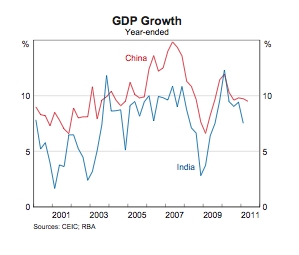
Here’s China and India:

Looks to me like Chindia’s GDP growth has been on a downward slide since late 2009 / early 2010, Wayne.  Ever since their GFC Mk1 “stimulus” money began to dry up.  Seems they didn’t get any sustainable bang-for-their-stimulus-bucks either. Both of their economies are now running at lower rates of growth than 6 years ago Wayne … that’s 2005.

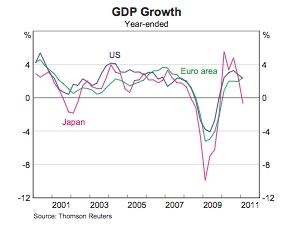
Oh look … here’s our second biggest trading partner, Japan:

Oops.

Looks like Japan’s GFC “stimulus” can-kicking exercise has stopped rolling up the road too, Wayne. They’re back to 2001-02 levels of growth.

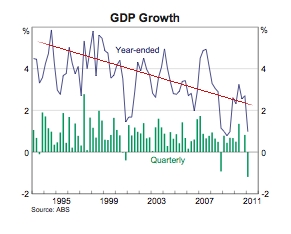
And our GDP growth chart looks even worse:

Ummmm … Wayne, ol’ son.

That approximate trendline I’ve added to the RBA’s GDP growth chart for the land of Oz looks suspiciously like a long term downward trend to me. And looking pretty ugly at the pointy end.

What was it your mate Glenn was saying just yesterday, about his RBA’s forecast tea-leaf prognostication for GDP growth?

The Reserve Bank has slashed its growth forecasts for the Australian economy while predicting inflation would remain high for longer than expected.

The August statement of monetary policy released today shows the central bank believes the economy will grow by just 2 per cent in 2011, on a yearly average, compared to its earlier call of 3.25 per cent.

The reduced forecasts are greater than economists had expected. It predicts this financial year growth will be 4 per cent down from 4. 5 per cent.

Ummmm.

Not bad.  If your revised prognostication turns out to be right this time – questionable, since you only made the first one a couple of months ago – then you’ll only have screwed up your first guesstimate by a measly 38.5%.

By the way.

A little tip Glenn.

Your own Chart Pack says our GDP is already sitting well below 2%. About half that, actually.

Expecting a surging “recovery” out of the blue red yonder, are we?

Got any other sage comments?

In the statement, the RBA said economic growth would be lower because of a range of domestic and overseas factors.

“Growth over 2011 has been revised downwards due to a slower than expected recovery in coal production and to a lesser extent a downward revision to consumer spending as domestic and international concerns have weighed on sentiment,” the RBA said.

Ruh roh!

The Greens want to shut down the coal industry. Preferably within 10 years, they say.

And you’re saying, Glenn, that the main reason why your original economic growth forecast has been revised within a couple of months by a whopping 38.5%, is due to a “slower than expected recovery in coal production”?!?

Anything else to add Glenn?

“The medium-term outlook continues to be characterised by the significant pipeline of resource sector investment with a number of large projects already underway and by strong growth in resource exports.”

Oh yes. That tired old line.

Sorry Glenn.

Macquarie Research tore that particular ass-umption underpinning all of your “forecasts” into lots of little shreds some time ago.

Back over to you Wayne:

[Swan] said Australia’s fundamentals – low unemployment, robust financial institutions and low public debt – would help protect the economy.

“Robust financial institutions”?!?!

Surely you jest.

“Low public debt”?!?!

Ahhhh … Wayne.

Something isn’t “low”, just because it may be less than others that are huge.

Your total tax revenues are only around $300 billion.

You’ve got us in debt to the tune of nearly $200 billion.

And don’t give me any of that “Net” debt crap.

“Net” debt might sound better (for you) when you’re spruiking, because it’s a lower number than the Gross figure that you really owe.

But presuming others will pay you back what they owe you, is counting your chickens before they’ve hatched.

We owe $200 billion in public debt.  End of story. Versus … at best … $300 billion in taxes this year.

By your own “estimates”, we’re paying $11+ billion per annum in Interest-only.

And you’ve got to run the country with the rest.

And another thing Wayne.

You’re always banging on trying to make out that our “public debt” is “low” compared to basket case “developed” economies abroad.

You remember.  Europe, the UK, the USA. Those “developed” economies.  Hardly a big claim to fame to say our public debt is lower than these paragons of fiscal prudence (/sarc).

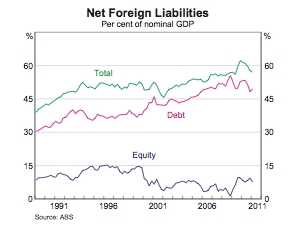
But what about our Net Foreign Liabilities, Wayne?

Ummmm.

Wayne.

Net Foreign Liabilities at nearly 60% of GDP?

I had a little look in the RBA’s data, Wayne.  Takes about 20 seconds.

Our Net Foreign Liabilities of nearly 60% of GDP?

In real numbers (not this “% of GDP” nonsense) … that’s $780.57 Billion at March 2011 (RBA Statistics, H5.xls).

Oops!

Wayne … you’ve done it again.

You’ve confirmed your official title, and your legacy for the history books.

World’s Stupidest Treasurer.

Why The US Is Doomed, And The Debt Ceiling “Crisis” Is Irrelevant

1 Aug

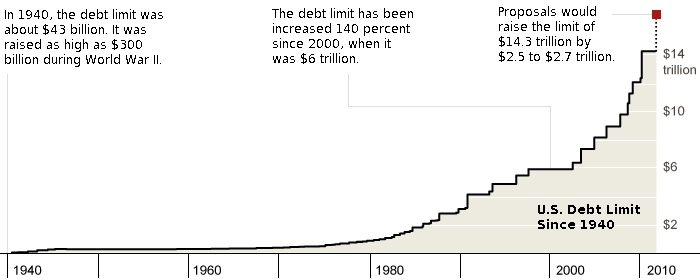
One chart from the New York Times explains why it no longer matters what US politicians decide to do about raising their debt ceiling even higher:

Exponential rise = unsustainable bubble.

Whether now, or later, the US economy is doomed.

One Chart Debunks Treasury’s Growth Forecasts

21 Jul

Our erstwhile Treasurer keeps insisting that our economy is strong, that the budget growth forecasts are sound, that he roolly roolly will get that one year of budget surplus in 2012-13, and go back to sleep children, everything’s fine.

Even Dear Leader Julia has been in on the act, trying to instill con-fidence … while flogging the dead horse called “carbon tax” to the public.

Now, recently we brought your attention to the Macquarie Economic Research debunking of the Treasury department’s growth forecasts. That is, the assumptions underpinning the May budget “estimates” and “projections”.

“Truly extraordinary” assumptions for “stratospheric” growth, were some of the bold words they used.

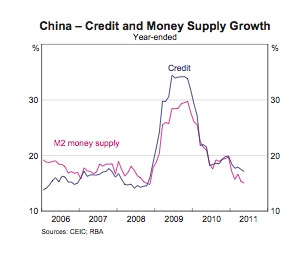
In the RBA’s latest release Chart Pack, there is one single chart that tells you all you need to know about the Treasury assumptions of a neverending China-fuelled “boom” in investment in Australia – the quarry to the world.

And what is that tell-all chart?

China’s credit and money supply growth:

Sorry Wayne.

The credit-fuelled China boom is already over.

It’s just a matter of time before reality hits.

Not quite convinced?

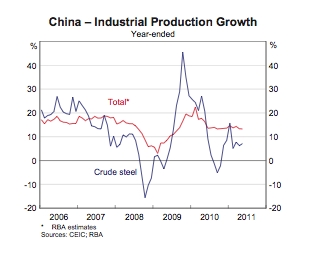
Ok then, here’s another. China’s industrial production.

Is China producing as much steel? Or making as much crap, as it was pre-GFC?

Nope.

The key China trends are all down.

It’s just a matter of time.

As we have been pointing out here for quite a while.

Bye bye Swanny.

Bye bye economy.

UPDATE:

Lo and behold! Maybe Treasury is reading barnabyisright.com?

From the Australian this morning:

Treasury’s warning on China as IMF fears Eurozone debt crisis will infect global economy

Treasury has warned the Gillard government about emerging threats to the Chinese economy, which shielded Australia from the global recession and continues to underpin its resilience in the face of global economic weakness.

The warning about China’s runaway inflation, contained in a working paper posted on Treasury’s website yesterday, could have ramifications for Australia’s resources-rich economy, which is dependent on the highest terms of trade in 140 years.

Although the paper is understood to have been prepared in May, the situation has worsened and China’s efforts to control inflation have become more urgent in the past two months.

The warning on China came as the International Monetary Fund cautioned that the debt contagion in Europe could infect the global economy, and the nation’s largest supermarket operator, Woolworths, warned that the year ahead would be one of the company’s most challenging as Australians spent less and tried to save more.

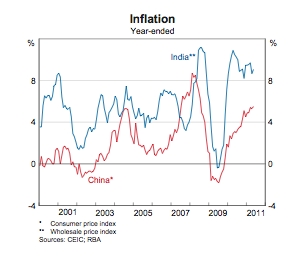
Would that be the same “inflation” concern that gave rise to this RBA chart, by any chance –

Clowns.

Treasury, that is.

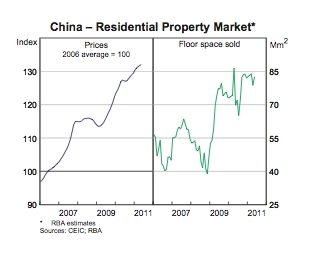
Banging on about “inflation” in China (which as the chart shows, has been worse). When the real problem in China is that the massive amount of “credit” (ie, debt) issued to prop up their economy through the GFC, has simply fuelled overinvestment / malinvestment and thus the world’s biggest bubble in real estate … as we see in this RBA chart –

Did you notice that the chart on the right – “Floor space sold” – looks to have pretty much topped out?

Hmmmm, what happens to a property bubble when the amount actually selling ceases to rise … anyone, anyone?

Buehller, Buehller?

And what did Wayne have to say about the warning from Treasury about China and Europe?

The comments prompted the Treasurer to urge Europe to get its house in order.

ROFL.

Here Comes Swan’s Black Swans – Chinese Bad Debt “Bigger Than Stated”

8 Jul

Remember our Wayne’s tireless refrain on the economy?

That investment (mostly from China) in our resources sector will ensure a budget back in surplus (for one year), and “lasting prosperity” via an endless “boom”?

Remember how he remains ignorant of all the many warnings about China?

(And, about our second largest trading partner, Japan?)

Including this one, just before the May budget:

“The market is telling you that something is not quite right,” Faber, the publisher of the Gloom, Boom & Doom report, said in a Bloomberg Television interview in Hong Kong today. “The Chinese economy is going to slow down regardless. It is more likely that we will even have a crash sometime in the next nine to 12 months.

Faber joins hedge fund manager Jim Chanos and Harvard University’s Kenneth Rogoff in warning of a crash in China.

China is “on a treadmill to hell” because it’s hooked on property development for driving growth, Chanos said in an interview last month. As much as 60 percent of the country’s gross domestic product relies on construction, he said. Rogoff said in February a debt-fueled bubble in China may trigger a regional recession within a decade.

Remember the devastating critique of the May budget by Macquarie Research? The one that said Wayne’s (ie, Treasury’s) forecasts for business investment – the key assumption underpinning all the budget projections – are “truly extraordinary”?

Upbeat growth forecasts from the Treasury and the Reserve Bank of Australia (RBA) are based on very optimistic forecasts for private sector business investment.

The RBA and Treasury forecasts for business investment over the next couple of years are truly extraordinary.

In our opinion, achieving such stratospheric growth would be extremely difficult.

By putting all their eggs in the mining investment basket, policymakers appear to have no Plan B for what will support the economy if investment disappoints. And this note provides three clear reasons why one should be cautious about counting those mining investment chickens before they are hatched.

Well, on July 4 the international ratings agency Moody’s – the same one that has downgraded our banks and effectively declared them “Too Big To Fail – dropped another bomb on Wayne’s parade.

It says that 10% or more of Chinese GDP is bad debt, and claims that the “China debt problem (is) bigger than stated”.

From Moody’s Investors Service, via ZeroHedge (emphasis added):

Moody’s Investors Service says that the potential scale of the problem loans at Chinese banks may be closer to its stress case than its base case, according to an assessment that the rating agency conducted following the release of new data by China’s National Audit Office (NAO).

Since these loans to local governments are not covered by the NAO report, this means they are not considered by the audit agency as real claims on local governments. This indicates that these loans are most likely poorly documented and may pose the greatest risk of delinquency,” the analyst adds.

Moody’s report estimates that the Chinese banking system’s economic non-performing loans could reach between 8% and 12% of total loans, compared to 5% to 8% in the rating agency’s base case, and 10% to 18% in its stress case.

But it’s not just Moody’s now warning about China’s banking system.

From MarketWatch (emphasis added):

China’s debt woes point to bank bailout

China’s banking system will require an eventual bailout by the central government, according to some analysts, who said figures released last week on the size of local-government borrowings point to the need for a rescue.

Credit Suisse economist Dong Tao said the numbers backed up concerns he’s been voicing for the past two years on China’s toxic loan problem.

“Ultimately, we believe that the central government will need to separate the local government’s bank debt from banks’ balance sheets and recapitalize the banks,” Tao said in a note following the release of data on China’s local-debt obligations by the National Audit Office.

Reuters reported last month that Beijing is considering a bailout that could see the central government accept to 2 trillion to 3 trillion yuan of local governments’ outstanding debt in an effort to ensure against a mass default, which could bring down the economy. See report on China’s initial bailout plans.

Stress is building within the system, Tao said, as local governments face a growing pile of debts coming due at a time of declining land sales, normally a key revenue stream for the provincial authorities.

Meanwhile, local governments are also having trouble finding new sources of lending as state-controlled banks grow increasingly wary of their deteriorating ability to service existing debt.

Standard Chartered said last week there were early signs of major financial distress building at the local government level.

Anecdotes of local-government investment vehicles in Shanghai and in Yunnan province struggling to meet loan payments “signal the beginning of the wave of difficulties,” Standard Chartered’s China economist Stephen Green said in a note Thursday.

And Bloomberg reports that both Fitch Ratings and Standard & Poors have also flagged serious concerns:

Fitch Ratings lowered its outlook on China’s AA- long-term, local-currency rating to negative from stable on April 12 because of the risk the government would have to bail out banks. As much as 30 percent of loans to local government entities may go bad, accounting for the biggest source of banks’ non- performing assets, Standard & Poor’s said that month.

Now, are you one of those who doubts that China’s “boom” is/was driven by massive borrowing by local (regional) Chinese banks to finance over-investment in “infrastructure” – the mother of all real estate bubbles world wide?

Then take a look at these pictures from Time magazine, showing just how massive speculative over-investment in property construction has left China with literal ‘ghost cities’:

Click to visit the complete Time photo series

If like many readers you have skimmed over this article and not bothered to click on … and carefully read … all of the links embedded in this article, then you are doing yourself and your loved ones a disservice.

Because you are about to leave this site … ignorant.

With only part of the story.

Do not be a Goose.

Like Swan.

Educate yourself.

Lots of labour has gone into collating all these news articles from around the world.

Over many, many months.

Do yourself a favour, and become better educated about reality than the buffoon who lives in Wayne’s World.

So that you too can see with crystal clarity the gaggle of Black Swans that are soon to blot out our Aussie sun.

Then you too can help to warn others.

Because rest assured – just as with the GFC – you will get no forewarnings from our “expert” economists when the SHTF.

Or from our “authorities”.

Or from their sycophants in the mainstream “business” media.

Your superannuation depends on your being properly informed.

Because both “sides” of politics are planning to steal itwhen the SHTF

Now The UK Government Is Stealing Super Too

5 Jul

From the Daily Post, 1 July 2011:

Thousands of teachers, lecturers and civil servants joined a UK wide strike yesterday in a mass protest over pension reforms.

[NB: other countries call their supernannuation “pensions”]

More than 200 schools were closed or partially shut, across the region with lectures cancelled at colleges and universities, and disruption at courts and Jobcentres.

An estimated 7,000 members from University and College Union (UCU), the Association of Teachers and Lecturers (ATL), the National Union of Teachers (NUT) and the Public and Commercial Service (PCS) were involved in the action in North Wales.

In Wrexham all four unions were represented at a mass rally involving well over 100 members in the town centre’s Queens Square, joining the other 750,000 across the UK.

They accused the Government of betraying promises to give public sector workers and teachers a fair pension and claimed they were siphoning off billions to pay the black hole left by the banking crisis.

And they warned this was just the beginning demanding the Government think again.

Shouting “Shame on you” at the Government, President of the NUT in Wrexham Ian Farquharson, a teacher at Rhosnesni High School, said: “The Government are stealing our pensions.

“If they tell us there is no other option, then publish the figures and let’s see them – but they wont.”

Steve Ryan who sits on the PCA Wales committee said: “The banks have been paid £7 billion in bonuses, there is £120 billion in uncollected taxes from the rich because they avoid paying them and the pension money is going to fund this. It’s a disgrace.”

From the Guardian, 30 June 2011:

The government … wants to impose a 3%-of-pay levy on public sector workers’ contributions to help reduce the budget deficit. This amounts to a pay cut to follow on the heels of the current pay freeze.

The UK Government’s plan is remarkably similar to that of Ireland.

As we saw only weeks ago, the Irish Government too has announced a raid on citizens’ super, to raise funds to pay for their budget black hole. The difference being, the Irish Government is imposing its “levy” on both public and private workers’ pensions:

Irish Bombshell: Government Raids PRIVATE Pensions To Pay For Spending

“The various tax reduction and additional expenditure measures which I am announcing today will be funded by way of a temporary levy on funded pension schemes and personal pension plans.”

There’s a clear trend developing here.

We have seen previously ( “No Super For You!!” ) that Argentina, Hungary, France, Poland, Bolivia, Ireland, and the USA have all either nationalised citizens’ super funds outright.

Or, imposed “levies” (ie, new taxes) on citizens’ super.

Or, as a more subtle beginning, simply reduced the amount that the government pays into government workers’ pension (ie, superannuation) funds. The equivalent to this in Australia would be if the government began setting aside (eg) only 5% of public servants’ salaries into the Future Fund for their retirement, compared to the compulsory 9% that private employers are required to pay for their workers.

We will not go into the issue of whether or not – just like the USA and many others – there really is money set aside for public servants’ retirement sufficient for the governments’ obligations (called “unfunded liabilities”). Indeed, there are very serious questions to be asked about this – and Barnaby Joyce has alluded to them – but we will leave that to another day.

In Western nations, the pattern of theft – the governments’ Modus Operandi (MO) – is disturbingly similar.

1. The country first sees its housing bubble burst – see USA, UK, Ireland.

2. Banks go bust, and are bailed out by the government (ie, by borrowing against the promise of taxpayers’ future earnings)

3. The cost of bank bailouts sends the government into deep, and unmanageable levels of sovereign debt (ie, private banksters debts, are socialised into higher public debt instead). The sovereign debt is made all the more unmanageable because the economy is badly damaged by the fallout from the housing bust. And, by hugely expensive, wasteful “green” public policy programs, in the lead up to the bust.

4. A “leftist” government is taken over by a “rightist” government.  Or, as with the USA, the “rightists'” regain the balance of power.

5. Prompted by the “fiscal conservative” rightists, new “reforms” are introduced. To “fix the budget”. Reforms that include raising the retirement age … and stealing citizens’ superannuation savings.

First, they come for the public servants’ super.

And then, they come for yours.

Now, what do we see happening right here in Australia?

Barnaby Joyce has already given at least two public warnings that the government is going to take public servants’ super in the Future Fund to pay down debt – pretty much exactly what the USA and UK are doing right now.

Already, the Green-Labor government has quietly introduced “incentives” in the latest budget, to “encourage” super funds to put your money into government “infrastructure projects”. You know, brilliant infrastructure schemes like overpriced school halls, and a technologically-redundant-before-its-finished, no cost/benefit analysis Nation Bankrupting Network (NBN).

And the Liberal Party – who if polls are any guide, will in all likelihood take power at the next election – have recently and quietly announced their own “reform” policy. One that even less subtlely aims to do the same thing – get the government’s hands on your super:

Further relief for small business

The Coalition will relieve the red tape burden from Australia’s small businesses by giving them the option to remit the compulsory superannuation payments made on behalf of workers, directly to the ATO.

Small business will be given the option to remit superannuation payments to the ATO at the same time as they remit their PAYG payments.

This will require only one payment to one agency – rather than multiple cheques to multiple superannuation funds. The ATO will be responsible for sending the money to superannuation funds directly.

In recent weeks we have seen countless evidences that:

1. Australia’s banking system is stuffed and ripe for collapse,

2. Our housing bubble is bursting, and

3. The economy is “stuffed”, with Eastern Australia in “deep recession” and the national economy “almost certainly” in recession in the second half of 2011.

The writing is on the wall.

I’ll now simply repeat the conclusion of my magnum opus article on the fate for our super:

If like me you are under 50 years old – indeed, if you are under 60 years old – then I’m willing to bet you all of my super that you will never see all of yours.

And unlike our bank(st)ers and government … I never bet.

First they came for the Yankees’ super.

Then, they came for the Pommies’ super.

And then last of all … they came for mine.

* For more information on this subject, please read –

No Super For You!!

Fresh Evidence Our Banks In “Race To The Bottom” Means You Can Kiss Your Super Goodbye

Why They Are Planning To Steal Our Super, Explained In 4 Simple Charts

Our Banks Racing Towards A “Bigger Armageddon”

Design a site like this with WordPress.com
Get started