WARNING: We all know that any warning to the effect that the following contains language that may offend some viewers, or is unsuitable for children, only guarantees that children and/or those who might be offended will definitely view the potentially offensive material. So, this warning is a warning that the following does NOT contain language unsuitable for children or that may be offensive to some viewers. And if you believe that, then there’s really no help for you, now is there.
Tag Archives: GFC
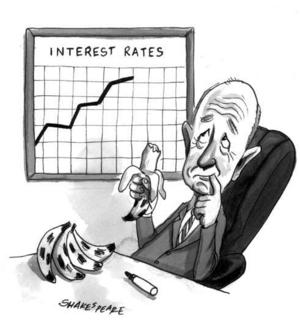
GFC2 Will Be Brought To You By “A Stupid F***in’ Government And Above All, Wankin’ F***in’ Bankers”
20 JunSwan: Not Drowning, Waving
19 JunNo, no … everything’s fine! Really it is! Just peachy!!
From AAP via Yahoo!7 News:
Economy strong despite global woes: Swan
Treasurer Wayne Swan says Australia’s economic prospects remain strong despite uncertainty about the recovery in the global economy.
Mr Swan said proximity to Asia would continue to fuel the national economy.
“Australia remains well positioned to benefit from robust growth in our region,” Mr Swan said in a statement on Saturday.
“Strong demand for our commodities is underpinning an unprecedented pipeline of business investment, with ABARES estimating a pipeline of $430 billion in resources alone.”
Australia’s economic prospects “remain strong”, ‘eh?
We are “well-positioned to benefit from robust growth in our region”, ‘eh?
An “unprecedented pipeline of business investment”, ‘eh?
Macquarie Bank begs to differ.
As does Michael Byrne, head of Linfox Logistics.
As does Nouriel Roubini, the economist made famous for predicting the GFC.
Ever reliable Wayne Swan. Nothing changes.
Same hot air, every time.
Just remember to bookmark this page.
For the day fast approaching, when Wayne’s waving turns to drowning.
Fitch Ratings Lists Australia’s 50 Most Delinquent Regions
15 Junh/t MacroBusiness.
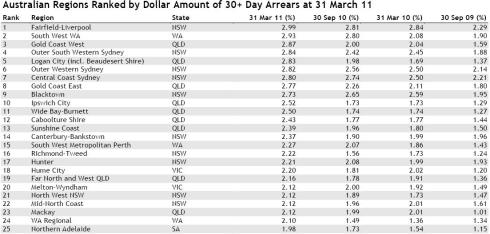
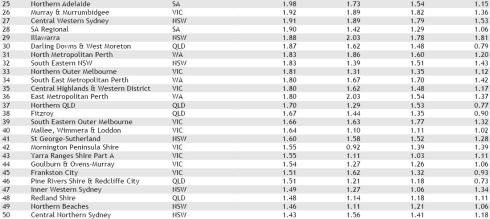
Does your area feature in the Top 50 list of regions with the highest rates of mortgage payment delinquency (click to enlarge):
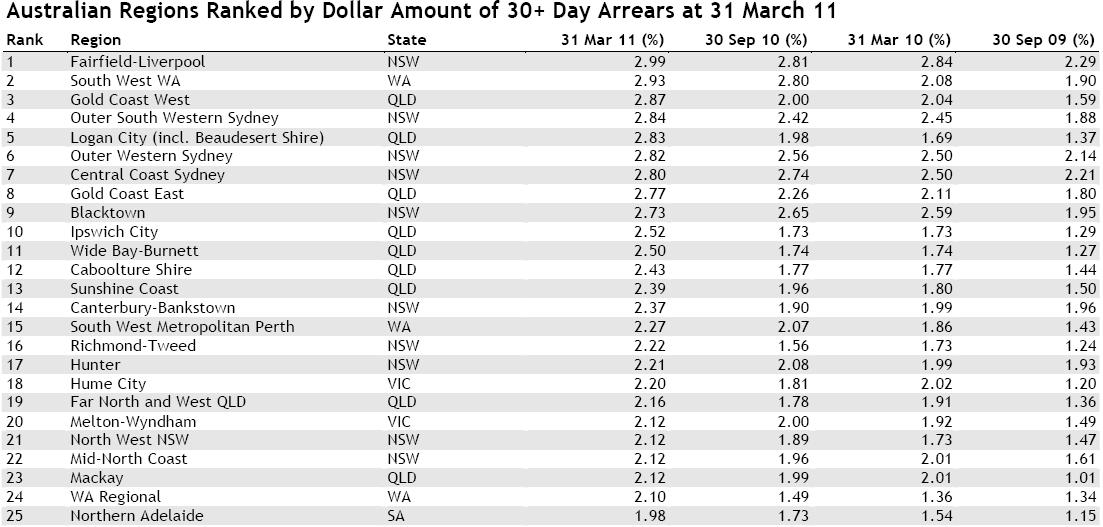
Source: Fitch Ratings
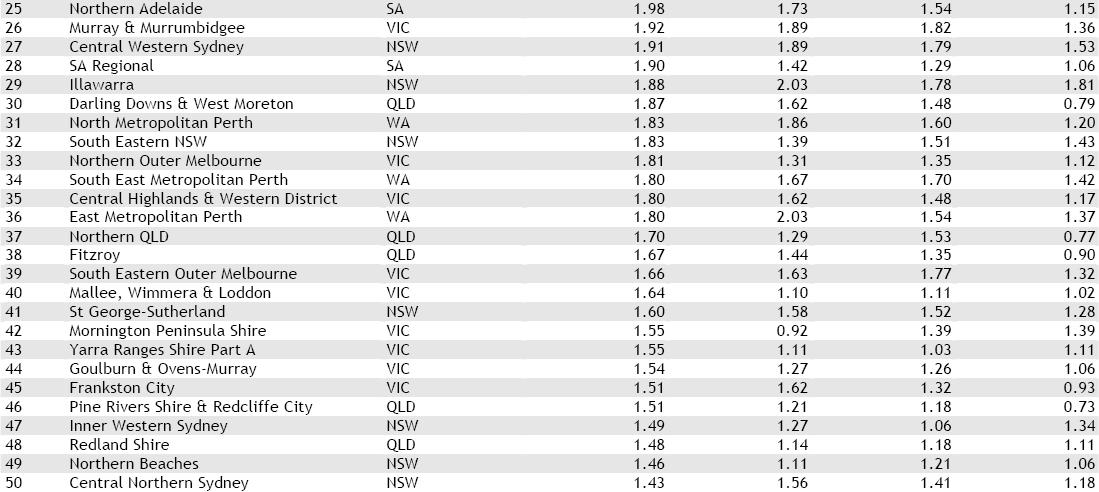
Source: Fitch Ratings
Mortgage arrears rising.
House prices falling.
Recently downgraded banking system with $15 Trillion in Off-Balance Sheet “Business” (derivatives) versus only $2.66 Trillion in On-Balance Sheet “Assets” … 66% of which “assets” are actually loans.
Australia “almost certainly” in recession in 2nd half of 2011. With eastern Australia already “in deep recession” and NSW/VIC manufacturing “stuffed”.
Warnings of a “perfect storm” of fiscal woe “by 2013 at the latest” from the man made famous for predicting the GFC.
Confirmation that the USA is defaulting on its debts (just as Barnaby warned in 2009).
Warnings that our biggest customer China is likely to experience a “hard landing”, with a 60% chance of the trigger being an internal banking crisis.
Warnings that China and our second biggest customer, Japan, are set to slow … or implode.
A blithering idiot RBA Governor who “does not know anyone” who predicted the GFC, but still in charge of setting interest rates. Having learned nothing from his screw up in raising rates into the teeth of the 2008 GFC. And keen to raise them again.
Our banks being warned for even more reckless lower lending standards, in trying to keep their property bubble-fuelled ponzi scheme from collapsing.
And both major parties planning to steal our super to pay down ever-rising, all-time record public debt.
Economist Who Predicted The GFC Warns Of “Perfect Storm”
15 Jun
From Bloomberg:
A “perfect storm” of fiscal woe in the U.S., a slowdown in China, European debt restructuring and stagnation in Japan may converge on the global economy, New York University professor Nouriel Roubini said.
“There are already elements of fragility,” he said. “Everybody’s kicking the can down the road of too much public and private debt. The can is becoming heavier and heavier, and bigger on debt, and all these problems may come to a head by 2013 at the latest.”
Nouriel Roubini is the New York University professor who came to fame as one of the dozen or so economists – including Australia’s own Dr Steve Keen – who predicted the GFC.
Mind you, he was running a little late. Dr Keen began publicly warning of a GFC in December 2005. Roubini issued his warnings from mid-late 2006.
Now he’s running a little late again, with this warning of a “perfect storm”.
Barnaby Joyce began warning of the risk of “economic Armageddon” nearly 18 months ago. And for exactly the same reasons – rising levels of public and private debt in the USA, and around the world.
It’s worth taking a minute or two to clearly recall just what Barnaby had to say.
From the Brisbane Times, October 23, 2009 (emphasis added):
The Nationals Senate leader Barnaby Joyce is openly canvassing an economic upheaval that would dwarf the current global financial crisis, triggered by the US defaulting on its sovereign debt within the next few years.
In unusually pessimistic comments for a senior political figure, Senator Joyce said the US Government was running such large deficits and building up so much debt that it was in a similar position to Iceland or Germany before World War II.
In a Senate estimates hearing on Wednesday night, he asked Treasury secretary Ken Henry what would be the implications of an American debt default for the Australian economy.
Dr Henry warned that canvassing extreme scenarios could alarm the community.
”I don’t mind discussing hypotheticals in general … [but] one has to be careful not to discuss publicly hypotheticals that are that extreme,” Dr Henry said.
”I don’t, myself, consider that outcome to be a high probability outcome, certainly not one that I would want to say much about in a public forum.”
”It is the elephant in the room,” Senator Joyce said. ”This is a huge risk that Australia faces. What is the game plan, what happens if it comes unstuck?
And from the Sydney Morning Herald, December 11, 2009 (emphasis added):
The Opposition finance spokesman, Barnaby Joyce, believes the United States government could default on its debt, triggering an ”economic Armageddon” which will make the recent global financial crisis pale into insignificance.
Senator Joyce told the Herald yesterday he did not mean to alarm the public but there needed to be a debate about Australia’s ”contingency plan” for a sovereign debt default by the US or even by a local state government.
”A default by the US means complete economic collapse around the world and the question we have got to ask ourselves is where are we in that,” Senator Joyce said.
His warning came as the Rudd Government ramped up its attack on Senator Joyce as an economic extremist…
Senator Joyce said the chances of a US debt default were distant but real and politicians were not doing the electorate a favour by refusing to acknowledge the risk.
Senator Joyce said that if the US recovered, global funds would flow back into North America. ”There will be only one way Australia will be able to keep funds here and that is by putting up interest rates, which will therefore bring real costs back to households,” he said.
”That is the first scenario, which is extremely bad for Australia. The worse scenario is where the US doesn’t repay its debt – the $2 trillion in debt it owes to the Chinese, the $1 trillion in debt it has to the Japanese and the $US1 trillion in debt to others – and then we are really nailed.
”The outcome is a shift away from the US dollar as the international trading currency and a shift to the Chinese yuan, and China becomes an immensely powerful player overnight.
”It’s the real financial crisis, and the real financial crisis will mean this preamble we have just had pales into insignificance.”
Asked what sort of contingency plan he would advocate, Senator Joyce said it was like trying to prepare for a tidal wave but the local economy should have more self-reliance.
”Things you look for in that economic Armageddon are the capacity to feed ourselves, the capacity to provide the fundamentals in medicines and basic fundamental requirements for our nation.”
Barnaby was right.
And noone took any notice. 18 months later, Australia has no contingency plan. Just a dramatically weakened government financial position.
This blog was created for the express purpose of sourcing and sharing information from around the world, in support of Barnaby’s prophetic warning.
If you browse the pages here, especially over the past month or so, you will find many news articles referencing the US debt default crisis.
Watch and listen to this interview just 8 days ago, where respected US congressman and 2012 Presidential Candidate Ron Paul, the Chairman of the House Financial Services Subcommittee on Domestic Monetary Policy, openly confirmed that the US is defaulting on its debts.
The big risk event that Barnaby predicted was “distant but real” in late 2009 … is happening right now.
Barnaby was mocked and ridiculed out of his new job as Opposition Finance spokesman, for daring to speak out. For daring to talk publicly about risks contrary to the “received wisdom” of the “experts”.
Who were those “experts”?
Let’s begin a Name ‘n Shame list of all the pompous, know-it-all cretins who now owe Barnaby a wimpering, grovelling apology.
Naturally, we’re talking about the likes of former Treasury secretary (and now unconstitutionally-appointed personal adviser to Gillard) Ken “The GFC is over” Henry.
RBA Governor Glenn “I don’t know anyone who predicted the GFC” Stevens.
Treasurer Wayne “Half a million new jobs” Swan.
And former Finance Minister Lindsay “dark arts” Tanner.
And, pretty much the entire Canberra press gallery.
They were all wrong. Totally, utterly, catastrophically wrong.
Time is proving our country accountant Senator from Queensland to be a veritable modern day prophet.
With more wisdom, commonsense, foresight, and courage, than the entire Labor Party, Treasury department, RBA Board of governors, and Canberra press pack of financial “journalists” combined.
So let us all pay close heed to his most recent warning – that the government plans to steal our super to pay down debt.
Barnaby is right.
Is Our Biggest Economic Danger Hiding In Plain Sight?
14 JunIn recent days we’ve looked at threats to Australia’s economic future from China and the USA. And, we’ve looked closely at the internal threats from our over-indebted government, massively risky banking sector, and housing market bubble.
Now, a genius short-seller who made $500 million betting against the US housing market in 2007 has pointed out what may be Australia’s biggest external economic threat of all.
From Bloomberg:
Buy a farm house in the middle of nowhere, pick up a gun or two, prepare for hyperinflation and brace for a catastrophic bankruptcy. Thirty minutes with hedge-fund manager J. Kyle Bass has you wanting to do all of the above.
The head of Dallas-based Hayman Advisors LP isn’t thinking about Greece or even Spain but Japan, the world’s third-biggest economy. He says his bet against Japanese government bonds is even “more compelling” than his gamble to sell short U.S. subprime-mortgage debt, which earned him $500 million in 2007.
Shorting Japan has been a losing proposition in recent years. But the earthquake, tsunami and nuclear crisis altered the outlook for a nation whose debt is more than double the size of the economy. Bass says a collapse is inevitable, making Japan’s 10-year bonds — they yield 1.3 percent, among the lowest in the world — a natural for a bear investor.
His argument is this: Japan now spends half of its central- government revenue on servicing debt. This task won’t get any easier as the country’s population ages and shrinks — provided rates stay the same. What’s more, the price tag for the earthquake and its effects will far exceed Japan’s initial $300 billion estimate, pushing the country over the edge. In Bass’s view, the biggest asset bubble ever is hiding in plain sight.
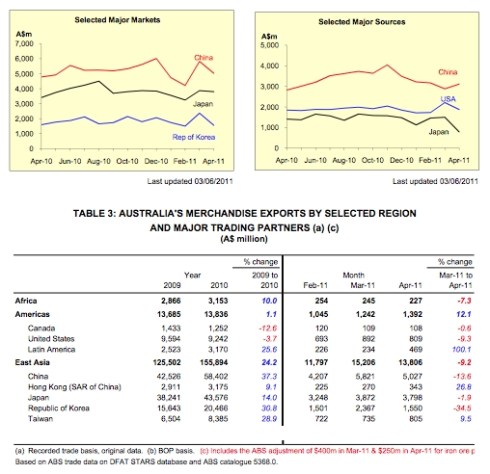
According to the Department of Foreign Affairs and Trade (DFAT), Japan is our second largest export market, and trading partner. Not far behind China:
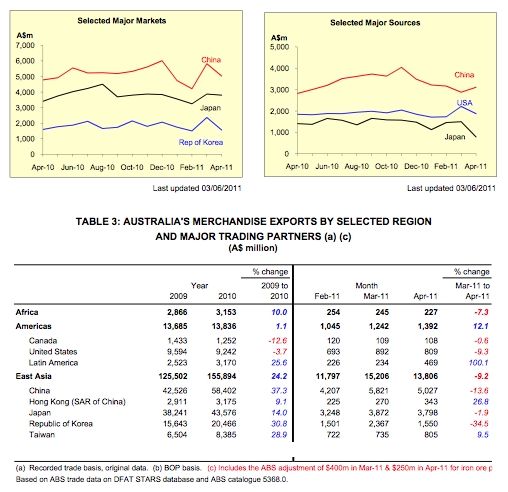
DFAT - Australia's Top Export markets and Trading Partners to April 2011
If J. Kyle Bass is right … and remember, he made a cool half a billion from correctly picking the weakest link back in 2007 … then we can chalk up Japan on our Ever-Present Threat board as well.
Possibly at the top of the list.
China Lending Tumbles, Signals Slowing Economy
14 JunFrom Bloomberg:
China’s lending tumbled in May and money supply grew at the slowest pace since 2008, adding to signs that the world’s second-biggest economy is cooling.
“This provides another data point highlighting the growth risk,” said Tao Dong, a Hong Kong-based economist for Credit Suisse Group AG. “I think the economy is heading to a soft landing in the second half of 2011, but the risk of a hard landing seems to be on the rise,” Tao said, adding that small companies are short of credit.
A moderating expansion in the Chinese economy is adding to concerns that global growth is faltering.
How’s that promised single year of budget “surplus” in 2013 looking, Wayne?
Final Proof That RBA Governor Glenn Stevens Is Either A Liar, Or A Blithering Idiot
13 Jun
Illustration - John Shakespeare
Reserve Bank of Australia Governor Glenn Stevens has been criticised at this blog previously:
Stevens’ Nonchalance ‘Stunning’
Stevens: ‘Risk Of Serious Contraction’ Passed
Stevens’ Australia’s Most Useless?
Now, conclusive proof that our Guv’na … who earns $1.05 million per annum, including a $234,000 pay rise at the peak of the GFC … is an ignorant, incompetent, ivory-towered #JAFA who should be sacked immediately, if not sooner.
From the RBA’s own website, behold! Stevens’ official speech to the Australian Business Economists Annual Dinner, Sydney, 9 December 2008. That’s right around the time that you, dear reader, were cr@pping yourself about the imploding global sharemarket … and he was enjoying a $234,000 pay rise.
Let’s see what he had to say about the Global Financial Crisis, and the events leading to it (emphasis added):
Many people have said to me recently that the times are ‘interesting’. My response has been that they are, perhaps, a little too interesting. I need not remind this audience of the international financial turmoil through which we have lived over the past almost year and a half, nor of the intensity of the events since mid September this year, in particular.
I do not know anyone who predicted this course of events. This should give us cause to reflect on how hard a job it is to make genuinely useful forecasts. What we have seen is truly a ‘tail’ outcome – the kind of outcome that the routine forecasting process never predicts.
Mr Stevens, you are either a liar.
Or, you are a blithering idiot.
Here’s a paper referencing more than a dozen international economists who all predicted and forewarned of the GFC for years in advance, and propounded cogent analyses as to why a GFC was coming. One of them, Australia’s own Dr Steve Keen, won an award voted on by his international economic peers for having done so:
This paper presents evidence that accounting (or flow-of-fund) macroeconomic models helped anticipate the credit crisis and economic recession. Equilibrium models ubiquitous in mainstream policy and research did not.
[* So is it any wonder then, that our much-ridiculed accountant in the Parliament, Senator Barnaby Joyce, is always the only one on the ball when it comes to correctly predicting the risks of what is coming?]
Indeed, here’s Dr Keen on our national broadcaster’s premier political program, The 7:30 Report, way back in November 2007 – 10 months before the Lehman Bro’s collapse kicked off the GFC main event – talking about the RBA’s latest interest rate increase, and warning of the dangers of high household debt levels:
So right there is one prominent Australian economist, who was loudly and very publicly forewarning of a coming GFC. For 3 years prior!
Indeed, lots of other, ordinary people like me saw the GFC coming too, and so were able to protect themselves from the financial devastation.
Devastation that you, Mr Stevens, somehow could not see coming.
You say, “I do not know anyone who predicted this course of events”.
Well mate, our taxes say it’s your #&^%! $1.05 million job to know!
Millions of good, decent, trusting Aussies lost hundreds of billions from their retirement savings, thanks to a GFC that jumped-up, mainstream-theory-blinkered imbeciles like you couldn’t see coming. When so many others – little people, with simple commonsense – did.
You are a national disgrace. And your Million Dollar Man salary, a despicable waste of taxpayers money.
Sack Glenn Stevens now.
McCrann: America Is Now Turning Darker, China Can Crash The Whole Economy
13 JunFrom the Daily Telegraph’s National Finance Writer, economist Terry McCrann:
The good news is that the Reserve Bank didn’t lift its official interest rate at its meeting on Tuesday and there’s now no prospect of a rise at its next meeting in July.
The bad news is that the RBA may – and I stress, may – have to turn to contemplating a rate CUT.
How’s that bad news? Just remember the circumstances when the RBA was last cutting – actually, slashing – rates in 2008. Your super was being shredded and we wondered whether we faced Great Depression Mark II.
How also does that square with my comments last week that Australia was in the middle of a boom? Albeit, a weird one, with many feeling it was more like a recession?
That’s the critical, connecting part. If we thought we were hostage to China for our future prosperity, we are now even more hostage to China to fend off chilling winds coming out of America and another potential meltdown.
We got a taste of that downside in the March quarter when the Queensland floods temporarily cut off coal exports and sent our economy diving at an annual rate of nearly 5 per cent. It is springing back now, right? Right?
Yes, of course. But what if it became a case of China not wanting to buy, rather than we not being able to ship the stuff out?
… America is now turning darker. The visible evidence of that is Wall St. It has now fallen for six weeks in a row – something it didn’t do even through the global financial meltdown.
While, the overall fall isn’t anywhere near as big, the problem is that the US Government and the US Fed have fired off all their anti-recession ammunition.
Worse, all the problems caused by, or just revealed by, the GFC are still festering.
The US is running a budget deficit of close to $US1.5 trillion. That would be the equivalent of about $100 billion down here – and we think $50 billion is huge. They have a zero official rate, ours is 4.75 per cent. And the Fed has just finished printing $US600 billion of paper money.
The one thing all that seemed to achieve was to put the stock market up and now it’s going down. And all Fed head Ben Bernanke can say is that economic recovery has been “frustratingly slow”.
That brings us back to China and Martin Place in Sydney. That’s where the RBA resides and your home loan rates are set.
Right now the RBA believes the China boom is the biggest thing in our future. On that basis it believes it’s going to be fighting an inflation problem through 2012 as the money pours in and demand for skilled labour threatens a wages-price breakout.
On that basis it believes it will have to raise rates by at least 50-100 points over the next year and a half. Even if that’s brutal to large parts of the economy.
The initial key will be the June quarter inflation date at the end of July.
A bad number would see it raise at its August meeting.
…
It will watch events out of the US – and Europe and Japan – very closely. If the US turned seriously dark, if Greece imploded, all rate bets would be off.
It will also be watching China very closely. The US can send our market down as it did in 2008.
China can do it to the whole economy.
We’re toast.
Terry McCrann is right to point to the USA … as Barnaby did nearly 18 months ago … and voice concern that an implosion in America may well mean that China stops buying raw materials from us.
But I fear Mr McCrann is missing the wider dangers in focussing on the USA. Because China may well fold up like a playing card pyramid, all on its own. Without any “help” from America at all.
As we saw yesterday, Nouriel Roubini, the economist who gained the most fame for having predicted the GFC – predictions that RBA Governor Glenn Stevens claims not to have known anything about – has now sounded the alarm bell on China. On the weekend he predicted a “hard landing” for the Chinese economy in 2013, just two years away. For reasons unrelated to America’s woes.
Moreover, we have our own internal risks to consider.
One could almost be forgiven for thinking that Mr McCrann’s fellow Finance Writer for the same paper, Nick Gardner, has been reading barnabyisright.com, in light of the following article published right above Mr McCrann’s column in The Sunday Telegraph yesterday (sorry, no link):
A bubble market
According to new data from RP-Data Rismark, the housing analysts, property prices have been declining in “real” terms since 2004 – in other words, they have been failing to keep up with inflation.
In terms of capital growth, you’d have been better off stashing your money in the bank than buying a home.
As The Sunday Telegraph reported last February, a quarter of people who bought and sold their properties within the past five years lost money.
The average shortfall was $54,000, but in some areas the losses reached almost $300,000, according to Residex, another property analyst.
Such statistics stand in sharp contrast to the broader public view that house prices have been consistently shooting up, and reveal signs of market weakness that, if continued, could undermine the entire economy.
Although experts are split about the outlook for property, it is clear the Reserve Bank needs to tread carefully.
… it is a delicate balancing act; a hike too far could cause the housing market to crash as it has in the USA and UK.
Shane Oliver, chief economist at AMP Capital, says the housing market is Australia’s “Achilles heel”.
“House prices here are overvalued by about 30 per cent, and it would not take too much to tip them over the edge.” Oliver says.
Overseas, many big institutional investors such as pension funds and hedge funds – which our banks rely on to borrow money which they lend out on mortgages – share Oliver’s concerns.
That’s one reason why the Big Four were downgraded by credit-ratings agency Moody’s from AA1 to AA2 last month.
Trevor Greetham, asset allocation director at Fidelity International in the UK, which has $3.4 Trillion under management, said: “If the global economy recovers strongly, that could push interest rates up a lot. That’s a real risk for Australia, because house prices are becoming an issue.”
The London-based Russell Investments fixed-income portfolio manager Gerard Fitzpatrick said he was more cautious about lending to Australian banks, citing the recent catastrophe in Ireland, where the house-price bubble effectively broke the banking system.
“I’m not saying Australia is the same as Ireland but there are definitely similarities.”
With such powerful voices becoming so worried, a credit crunch in which mortgages are rationed and buyers must put down much bigger deposits remains a possibility. The consequences could be disastrous.
That’s exactly what this blog has been arguing.
Basically, we’re screwed no matter what happens.
“Good” news or “bad” news, is all bad news for us.
If the global economy recovers, then we’re screwed because rising interest rates will crash the housing market (if it hasn’t already), and wipe out our banks. Meaning, the government will come after our super to prop them up.
If the global economy stalls, then we’re screwed because China will suffer the “chilling winds coming out of America”, and crash our economy. Meaning, the government will come after our super to prop up the economy through more ‘stimulus’.
Both sides of politics know they will do that. Both sides of politics are already implementing policies for it.
Barnaby has often warned that we cannot rely on a never-ending China boom to pay down Labor’s never-ending debt. Former Treasury secretary Ken Henry pompously disagreed. Labor and the mainstream media all climbed aboard the “Barnaby is wrong” train. And Barnaby lost his job as Shadow Finance spokesman
Once again … as always … Time tells.
Barnaby warned of a bigger GFC almost 18 months ago. He said that Australia needed to stop borrowing and wasting billions, and make a “contingency plan” against the very real risk of more trouble hitting our shores from abroad.
Barnaby was right.
 Barnaby Is Right
Comments