Tag Archives: GFC

RBA Screws Up Again, Loses $6bn

19 May

From The Australian:

The RBA faces losses of $6 billion due to the strength of the dollar and will not pay dividends to the government for several years.

The value of the bank’s foreign exchange reserves has plunged since the end of the last financial year as the Australian dollar has emerged as one of the strongest currencies in the world.

The losses threaten to wipe out the bank’s $6.1bn reserve fund, which the board said last year was already below a level they thought “desirable”.

Although government sources indicated yesterday that Treasury did not expect it would be required to make a capital injection, the losses will slash more than half the bank’s capital base.

The commonwealth budget has traditionally relied upon about $1.4bn a year in dividend payments from the Reserve Bank.

The Reserve Bank flagged that after it made a $2.2bn loss last year, dividends would be reduced while its reserve fund was rebuilt, but it is unlikely now that there will be any dividends across the budget forward estimates.

Great.

Another multi-billion dollar black hole in the government’s “forward estimates”.

This time, thanks to the RBA’s incompetence.

This latest news follows another revelation recently, that the RBA needed US$53bn in emergency loans from the US Federal Reserve during the GFC.

Now consider.

The “independent” RBA is worshipped by our politicians and the media – and thus, by average Australians too – as some kind of ultimate authority on our economy. In particular, the RBA is regarded as the final authority on what is the “right setting” for interest rates.

The reality is, the RBA robs us by stealth.  For decades, the RBA has utterly failed to achieve their very first legal duty to the Australian people.

Their own data proves it.

In addition, RBA Governor Glenn Stevens failed to foresee the on-rushing GFC during 2008.

The RBA kept raising interest rates month after month in 2007-08.  Right into the teeth of the GFC storm.  Despite clear warning signs out of the USA for well over a year prior.

It could also be argued that the RBA’s actions directly contributed to a change of government, thanks to an unprecedented interest rate rise in the middle of the 2007 election campaign.

Stevens is by far the highest paid “public servant” in Australia.  Conveniently for him, the RBA Board has the power to decide their own salaries:

The Remuneration Committee is a committee of the Reserve Bank Board. Its membership is drawn from the non-executive members of the Reserve Bank Board.

Which helps explain why Stevens is pulling over $1 million per annum.  And why he was able to get away with taking a $234,000 pay rise in the middle of the GFC.

The RBA’s failures are manifest.

So, why do we continue to prostrate ourselves at the Altar of the Reserve Bank?

The RBA has been robbing Australia blind for decades.

They have proven themselves unable to foresee clear economic warning signs.

They did not disclose to anyone that they borrowed US$53 Billion from the Federal Reserve.  It took a US Supreme Court action forcing the US Fed to reveal information about its actions during the GFC, for us to learn about the RBA’s secret emergency loans.

And despite being supposed “experts” on interest rates and currencies, they’ve now managed to blow $6 billion in foreign exchange losses.

How is this possible?

Our main street banks manage to hedge against foreign exchange rate volatility through purchasing Foreign Exchange Swaps & Forwards. Is the RBA too incompetent to manage FX risk, in the same way the Big 4 banks manage to do?

The RBA Board of “experts” are hugely overpaid, demonstrated failures.

Worse, as an “independent” body, they are effectively unaccountable to the Australian people for anything they do.

Now, we have the green lobby arguing for an “independent” Carbon Bank modelled along similar lines to the RBA.  With the power to borrow against the future earnings of taxpayers!

Given the RBA’s track record, this is clearly a very bad idea.

Our “Squeeze Pop” Carbon Bank

17 May

Big bubbles, no troubles:

An independent carbon bank, similar to the Reserve Bank, should be set up to oversee a carbon price and investment in clean technology, the peak renewable energy lobby says.

The Clean Energy Council will today release a discussion paper proposing the carbon bank, which it says could be allowed to borrow money to invest in renewable energy projects against the future revenue of Labor’s proposed carbon tax and emissions trading scheme.

Hmmmmm.

An “independent” carbon bank.

Trading in … what you breathe out.

Borrowing … and “investing” … against the future government tax revenue.

In other words, the government … meaning taxpayers … the guarantor for any losses on those “investments”.

In a bankster-designed, multi-trillion dollar, global air-trading derivatives market:

What could possibly go wrong?

National Australia Bank Ltd, Westpac Banking Corp Ltd and the Reserve Bank of Australia (RBA) were all recipients of emergency funds from the US Federal Reserve during the global financial crisis, according to media reports.

Data released by the Fed shows the RBA borrowed $US53 billion in 10 separate transactions during the financial crisis…

The “independent” Reserve Bank is a great model to follow then.

Its track record certainly inspires con-fidence:

Why do we tolerate an “independent” Reserve Bank, whose first legal duty is to maintain a “stable” currency, when it is so clear that they have always utterly failed to do so.

And derivatives, well, they’re safe-as-houses too.

After all, the mortgage-backed derivatives market that blew up America is only a tiddling little market.

So there’s clearly no cause for concern about yet another bankster-driven scheme, to blow up a global, air-backed derivatives bubble:

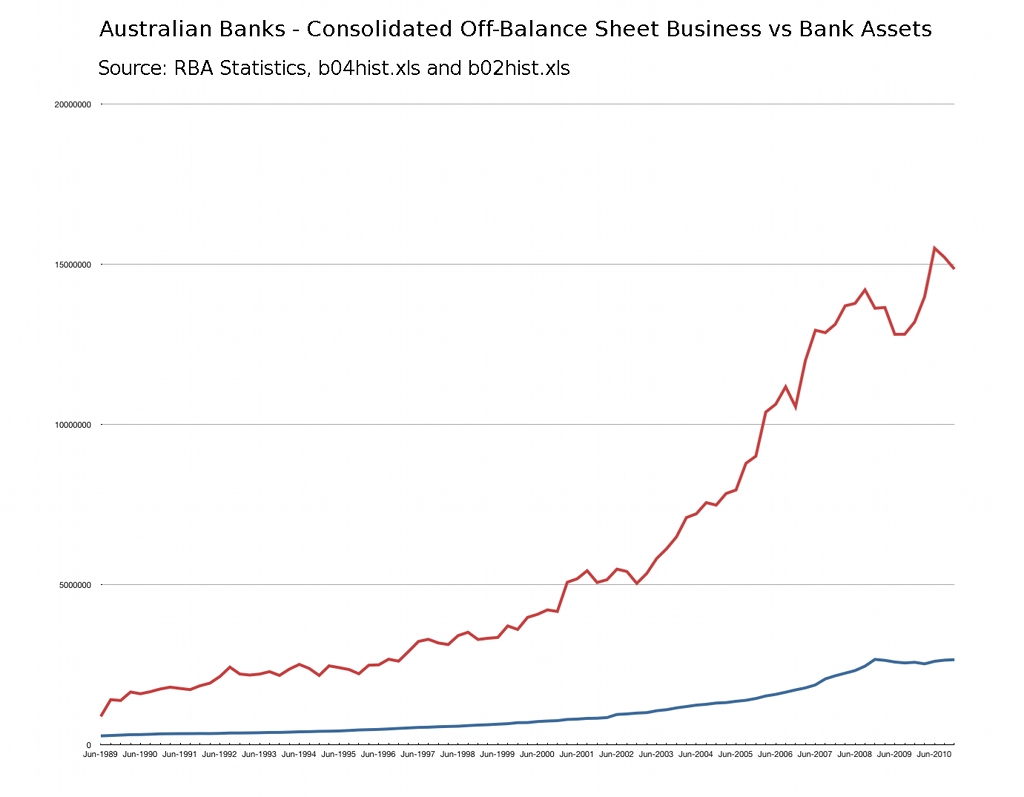
To give an idea of the vast disconnect between our banks’ “Assets” (66% of which are loans), and their exposure to OTC derivatives, the following chart shows their total Assets – blue line – versus a red line of total Off-Balance Sheet “business” (click to enlarge):

$2.66 Trillion in "Assets" versus $15 Trillion in Off-Balance Sheet "Business"


They say that the main gimmick used to promote Hubba Bubba is that it is less sticky than other brands of bubble gum, and so burst bubbles are easier to peel from your skin.

No worries then.

Sure, we are going to get squeezed dry.

But there’ll be no needing to go shave our heads or rend our clothes when the biggest bubble ever goes POP!

I wonder which flavour we will get.

Raspberry?

Watermelon?

Squeeze Pop?

Or, will it be another new flavour …

Carbon Tax.

Emissions Trading.

“Independent” Carbon Bank.

Behave … debt slave.

Ka-Ching!

How Australia Will Look When The SHTF

15 May

Want a glimpse of Australia’s future?

Watch this shocking story from America’s 60 Minutes:

http://www.youtube.com/watch?v=QwrO6jhtC5E

Pretty distressing, right?

It was exotic “mortgage-backed investments” that triggered the GFC in America. And as you just saw, they are still very much at the heart of their terrible ongoing crisis, where 1 in 7 (44 million) are now living on food stamps.

Just as in the USA and other countries, our Labor government responded to the GFC by “stimulus”.  And, by propping up our “safe as houses” bankstering system.

This is the same “best in the world” bankstering system that has just $2.67 Billion in On-Balance Sheet Assets, versus $15 TRILLION in Off-Balance Sheet “business”.  The bulk of that off-the-books “business” is exotic “derivatives” bets on interest rates, and foreign exchange rates.

How exactly did Labor prop up our bankstering system?

Amongst other things, by using taxpayer’s money to “invest” billions in … yep, Residential Mortgage-Backed Securities (RMBS).

$16 Billion, to be precise.

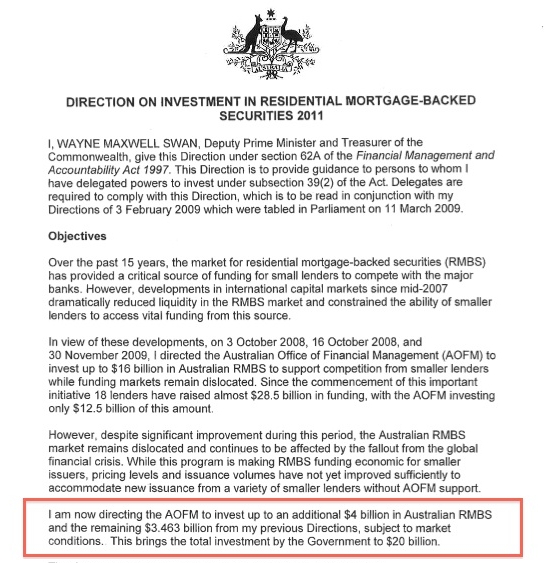
But $16 Billion wasn’t enough. Just last month, Wayne Swan authorised the AOFM to “invest” another $4 Billion in these “mortgage backed investments”:

Click to enlarge

According to numerous sources including The Economist magazine, Australia has the most overvalued housing in the world.

And earlier this month, we learned that house prices fell by the most in 12 years in the March quarter.

That $20 Billion pumped into Residential Mortgage-Backed Securities is not looking such a great “investment” now, ‘eh Wayne.

Let there be no mistake.

Rudd/Gillard Labor did not “save us” from the GFC.

They simply kicked the can down the road a couple of years.

And in doing so, all they have achieved is to dramatically weaken our government’s financial position.

Nearly $200 Billion in gross debt.

$20 Billion in “mortgage-backed investments”.

A $50 Billion budget deficit – that’s for this year alone.

A $50 Billion increase in our national debt ceiling, to $250 Billion.

And borrowing more than $2 Billion a week.

But look on the bright side.

When GFC 2.0 strikes, we’ll not need to worry about what’s hitting the fan.

Because thanks to Labor … and the banksters … we’re already in the ____ right up to our necks.

Barnaby is right.

UPDATE:

For more shocking revelations on this story of bankstering corruption of the mortgage finance markets – and now even the courts of law – see this exposé by Rolling Stone’s Matt Taibbi:

The foreclosure lawyers down in Jacksonville had warned me, but I was skeptical. They told me the state of Florida had created a special super-high-speed housing court with a specific mandate to rubber-stamp the legally dicey foreclosures by corporate mortgage pushers like Deutsche Bank and JP Morgan Chase. This “rocket docket,” as it is called in town, is presided over by retired judges who seem to have no clue about the insanely complex financial instruments they are ruling on — securitized mortgages and laby­rinthine derivative deals of a type that didn’t even exist when most of them were active members of the bench. Their stated mission isn’t to decide right and wrong, but to clear cases and blast human beings out of their homes with ultimate velocity. They certainly have no incentive to penetrate the profound criminal mysteries of the great American mortgage bubble of the 2000s, perhaps the most complex Ponzi scheme in human history …

And if you missed it, check out Matt’s infamous exposé of one of the big banks at the heart of the ongoing mega-fraud, Goldman Sachs:

The first thing you need to know about Goldman Sachs is that it’s everywhere. The world’s most powerful investment bank is a great vampire squid wrapped around the face of humanity, relentlessly jamming its blood funnel into anything that smells like money. In fact, the history of the recent financial crisis, which doubles as a history of the rapid decline and fall of the suddenly swindled dry American empire, reads like a Who’s Who of Goldman Sachs graduates …

What you need to know is the big picture: If America is circling the drain, Goldman Sachs has found a way to be that drain — an extremely unfortunate loophole in the system of Western democratic capitalism, which never foresaw that in a society governed passively by free markets and free elections, organized greed always defeats disorganized democracy

Goldman Sachs is the puppeteer of our very own Emissions Trading Scheme leading proponent, former GS Australia chairman Malcolm Turnbull MP.

Wall Street Journal: “What If The U.S. Treasury Defaults?”

15 May

The Wall Street Journal joins the chorus:

A financial crisis is surely going to happen as big or bigger than the one we had in 2008 if we continue to behave the way we’re behaving,” says Stanley Druckenmiller, the legendary investor and onetime fund manager for George Soros…

The grave danger he sees is that politicians might give the government authority to borrow beyond the current limit of $14.3 trillion without any conditions to control spending.

One of the world’s most successful money managers, the lanky, sandy-haired Mr. Druckenmiller is so concerned about the government’s ability to pay for its future obligations that he’s willing to accept a temporary delay in the interest payments he’s owed on his U.S. Treasury bonds—if the result is a Washington deal to restrain runaway entitlement costs.

The U.S. Treasury will hit that $14.3 Trillion debt ceiling on Monday.

And says that the U.S. only has until August 2nd to find a way to avoid default.

All together now …

Barnaby Was Right!

US Treasury: August 2 Deadline To Avoid Debt Default

14 May

This Monday, the US government will hit its $14.3 Trillion debt ceiling.  By August 2nd, it could default on its mindboggling debts. So says the US Treasury (below).

Remember when Barnaby was widely ridiculed for warning that the US could default on its debts, and for suggesting that Australia needed a contingency plan?

He lost his new job as Opposition Finance spokesman as a result.

October 2009 (emphasis added):

The Nationals Senate leader Barnaby Joyce is openly canvassing an economic upheaval that would dwarf the current global financial crisis, triggered by the US defaulting on its sovereign debt within the next few years.

In unusually pessimistic comments for a senior political figure, Senator Joyce said the US Government was running such large deficits and building up so much debt that it was in a similar position to Iceland or Germany before World War II.

… Senator Joyce insisted yesterday that the dangers to the global economy from the run-up in US private and public sector debt were real and should be debated.

“It is the elephant in the room,” Senator Joyce said.  “This is a huge risk that Australia faces. What is the game plan, what happens if it comes unstuck?”

December 2009 (emphasis added):

The opposition finance spokesman, Barnaby Joyce, believes the United States government could default on its debt, triggering an “economic Armageddon” which will make the recent global financial crisis pale into insignificance.

Senator Joyce told the Herald yesterday he did not mean to alarm the public but there needed to be a debate about Australia’s “contingency plan” for a sovereign debt default by the US or even by a local state government.

“A default by the US means complete economic collapse around the world and the question we have got to ask ourselves is where are we in that,” Senator Joyce said.

His warning came as the Rudd Government ramped up its attack on Senator Joyce as an economic extremist…

Senator Joyce said the chances of a US debt default were distant but real and politicians were not doing the electorate a favour by refusing to acknowledge the risk.

Tick.

Tick.

Tick.

From the New York Times, May 9, 2011 (emphasis added):

Speaker John A. Boehner said Monday that Republicans would insist on trillions of dollars in federal spending cuts in exchange for their support of an increase in the federal debt limit sought by the Obama administration to prevent a government default later this year

[Senate leader] Mr. Schumer and Roger C. Altman, an investment banker and former Clinton administration Treasury official, said the consequences for the nation’s economy could be dire if the government defaulted for the first time in its history or if the debt-ceiling talks were pushed to the brink.

If America were to default, even for 24 hours, that would have an unprecedented and a catastrophic impact on global financial markets and on American markets,” Mr. Altman said.

From Reuters yesterday, May 13 2011 (emphasis added):

The United States is set to reach its $14.3 trillion debt limit on Monday, and will only be able to avoid default until Aug. 2, according to the U.S. Treasury. Efforts to forge a bipartisan deficit-reduction package as a step towards Congress raising the borrowing limit are in turmoil.

A thicket of plans to cut the deficit, which is expected to hit $1.4 trillion this year, have emerged in recent days with virtually no chance of passage in Congress.

The US Treasury now joins Southern Cross Equities’ Charlie Aitken, ANZ chief Mike Smith, global currency expert Savvas Savouri, ABC’s Inside Business and Business Spectator Alan Kohler, credit rating agency Standard & Poors, CNBC, Deutsche Bank, and Barack Obama, in conceding that Barnaby Was Right.

Does Labor have a contingency plan for a US debt default?

Hardly.

They don’t even have a plan on how to achieve a single year of budget surplus.  Instead, they are increasing Australia’s debt ceiling by another $50 Billion to $250 Billion.

And counting their budget chickens way before they’re hatched.

The “surplus” that Labor are proudly talking about as though it is fact, is nothing more than a “forecast”.  One based on Labor “estimates” of years of continuous record-high minerals prices and record-high terms of trade … in other words, on a never-ending China boom.  Even the Americans are laughing at them!

This not going to end well.

Barnaby is right.

UPDATE:

Add American centrist think tank Third Way to the growing list.  They will release a study on Monday regarding the likely impacts of a US default.

From Reuters again:

The Treasury Department is expected to hit its $14.3 trillion borrowing limit on Monday, making it unable to access the bond markets again.

The Treasury Department says it can stave off default until August 2 by drawing on other pots of money to pay its bills.

Treasury officials have warned of “catastrophic” consequences if Congress does not approve a further debt-ceiling increase by then, but have declined to say exactly what would happen.

The Third Way report, based on a survey of existing economic research, spells out the details…

Defaulting on our debt is not an abstract idea that might affect a few institutions on Wall Street; it would harm tens of millions of Americans in profound and lasting ways,” the report says.

Leading Australian Stock-Picker: Barnaby Was Right

11 May

Southern Cross Equities’ Charlie Aitken tells his clients to get out of the stockmarket and into cash:

Aitken says anyone looking closely at the markets at the moment has to entertain the possibility of something they have not seen before. “[Nationals senator] Barnaby Joyce was ridiculed last year for saying this, but I’m prepared to say that some sort of US debt default is now on the table as a risk for investors. I never thought I would say that. You would have to say that is the biggest black swan of them all.”

The term black swan refers to a completely unexpected, utterly improbable event. In the investment market sense, a black swan is a scary prospect, with its connotations of a sudden market fall. The origin of the term is in the astonishment of the Dutch explorers who arrived at the Swan River in the 17th century and discovered that swans could be black, when to all European experience they were only white.

Aitken joins ANZ chief Mike Smith, Toscafund’s global currency expert Savvas Savouri, ABC’s Inside Business and Business Spectator‘s Alan Kohler, credit rating agency Standard and Poors, CNBC TV “First in business worldwide”, Deutsche Bank, and Barack Obama, in conceding that Barnaby Was Right about the risk of US debt default.

Barnaby forewarned of the dangers to the global economy – and Australia – back in late 2009 through early 2010.

The “experts” are slowly, and finally catching up with the only politician in the country who is always on the ball.

More from Charlie Aitken – and independent derivatives expert Satyajit Das – in this must-read article.

US$ To Hit A$0.58 – Currency Experts Agree, Barnaby Was Right

9 May

More experts line up with Alan KohlerStandard & Poors, CNBC, Deutsche Bank, and Barack Obama, in agreeing that Barnaby was right.

First, the head of ANZ:

ANZ chief Mike Smith said yesterday that the currency was likely to resume its climb above $US1.10, and one of the world’s leading foreign exchange experts predicted the dollar would continue to rise and could hit $US1.30 in 2013 and $US1.70 by 2014.

This spells bad news for non-resource sectors such as manufacturing and tourism…

“I can’t see that there is anything to knock it off its perch because it’s not only the strong Australian dollar, it’s also the weak US dollar,” Mr Smith said yesterday.

“And when you think about what is happening in the US, I can’t see them increasing rates for at least 18 months and that will have an impact.”

Next, a global currency expert:

Global currency expert Savvas Savouri, of the British-based Toscafund hedge fund, went a step further, predicting the greenback would be relegated to a “museum” …

Dr Savouri, in Sydney for a conference, predicts the dollar will reach $US1.30 by 2013 – and $US1.70 by 2014, as the greenback relinquishes its “exorbitant privilege” as the world’s default currency.

What the ‘experts’ aren’t telling you, is that the reason for the Aussie dollar’s rise is directly due to the slow-motion collapse of the US economy, and the unintended consequences caused by those trying to prop it up.

How’s that, you ask?

For several years, the US Federal Reserve has been creating literally trillions of US dollars out of thin air (“Quantitative Easing” 1 and 2).  By doing this, it believes it will achieve two things – (1) Keep interest rates in America extremely low (near zero), preventing further collapse in the housing market and broader economy; (2) pump up the stock market, creating public “confidence”. And it has achieved both those aims.

But what about the unintended consequences?

First, the immediate effect of printing money is to weaken the American currency.  That is the main reason why the Aussie dollar has risen against the USD.

It is not because our currency has strengthened.  It’s because the USD has been (deliberately) weakened.

Much of those trillions in near interest-free US money has been poured into speculation by international banks and hedge funds.  What are they speculating on?

Mostly on commodities – which our economy sells.

Hundreds of billions in “hot money” has been flowing from the Zero-Interest-Rate-Policy (ZIRP) United States into our currency, through speculation on our commodities.  Driving  up our currency’s apparent strength.

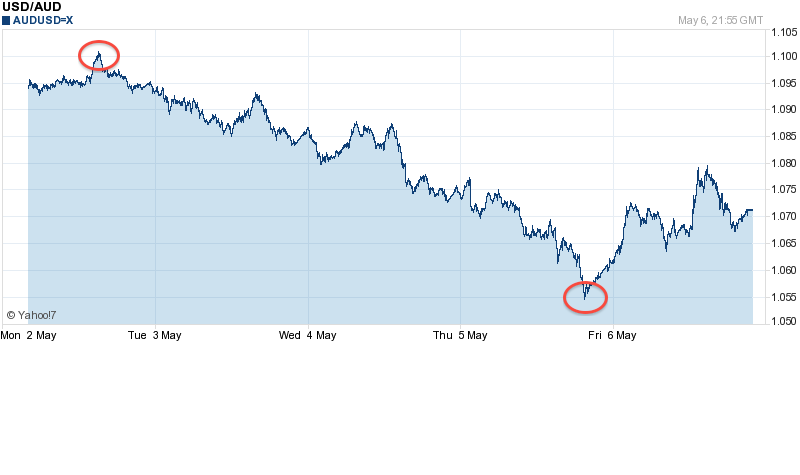
But “hot money” can flow out again just as fast.  As we saw in the GFC.  And again just last week, when the Aussie dollar hit US$1.10, and plummeted to US$1.05 in three days … due to a single bad economic news data release in the US:

Yahoo Finance - AUD/USD 1.10 to 1.05

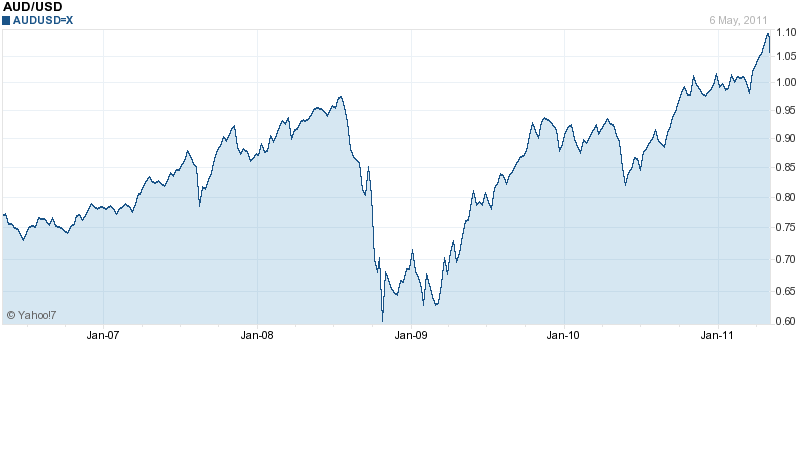
During the peak of GFC panic in Sep-Oct 2008, the Aussie dollar collapsed from US$0.98 to just US$0.60 in barely two months:

Yahoo Finance - AUD/USD

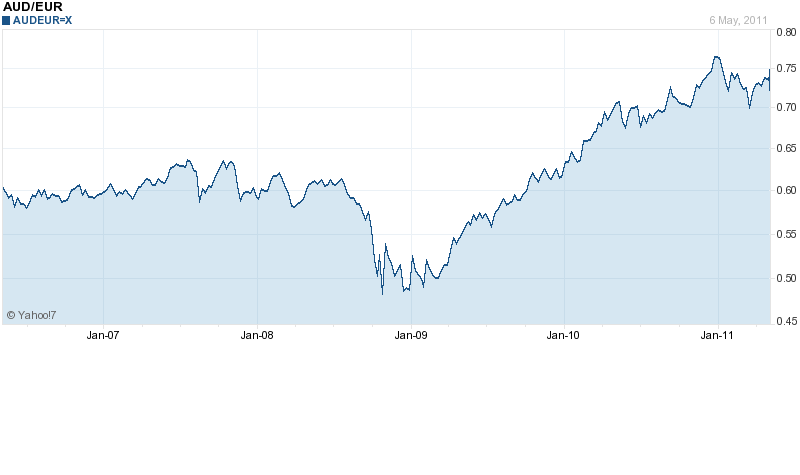
When you compare the Aussie dollar to the Euro, for example, it’s easy to see that our dollar only “appears” to be super strong when it is being compared – as usual – only to the ever-weakening USD.

Our dollar has risen against the Euro too. But by far less. And again, only after first falling significantly in the GFC.  Then rising only after the US Federal Reserve began seriously printing money, which has been poured into commodities and commodity currencies:

Yahoo Finance - AUD/EUR

Australia is a little cork floating on the ocean of other nations’ economic decisions.

As Barnaby forewarned in late 2009 / early 2010, the US is effectively defaulting on its debt right now.

By stealth.

Destroying the value of your currency by money printing, has always been the most common way in which nations have defaulted on their debts.

Barnaby was right.

Tick Tick Tick – Aussie Banks’ $15 Trillion Time Bomb

6 May

*This post follows up on my August 2010 post, “Aussie Banks’ $14.2Trillion Time Bomb”. Please read the article for detailed background to this update.

How safe are Australia’s banks?

Previously we saw that our “safe as houses” banks have a massive disconnect between their On-Balance Sheet Assets, and their Off-Balance Sheet “Business” (specifically, OTC derivatives).  Last time we checked, they held $2.62 Trillion in Assets, and a new record $14.2 Trillion in Off-Balance Sheet “Business”.

The disconnect has widened even further.

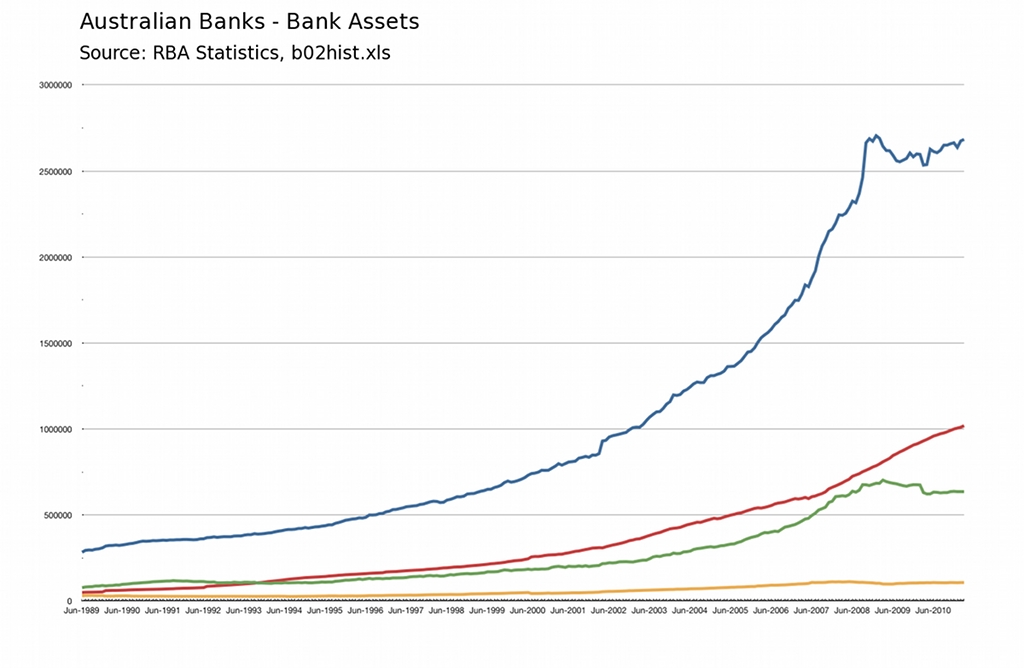
First, let’s take a look at a chart of their “Assets”.

In the chart below, the yellow line represents the total value of Personal Loans. The green line represents Commercial Loans.  The red line represents Residential Loans.  And the blue line represents the grand Total of Bank Assets (click to enlarge):

$1.77 Trillion of Total "Assets" = Loans

The total value of Bank Assets has barely moved – $2.66 Trillion. It has still to regain the peak of $2.67 Trillion in Dec 2008.

It’s worth noting that $1.77 Trillion (66%) of the banks’ $2.66 Trillion in “Assets”, is the value of Loans – personal, commercial, and residential.  That’s right.  Your debt to the bank is considered their “Asset”.  Slavery is still a thriving business in the 21st Century.  It’s how bank(ster)ing works.

What about their Off-Balance Sheet “Business”?

It has blown out by another $1.3 Trillion at its recent peak ($15.5 Trillion), and as at December 2010 sits at just under $15 Trillion.

To give an idea of the vast disconnect between our banks’ “Assets” (66% of which are loans), and their exposure to OTC derivatives, the following chart shows their total Assets – blue line from the above chart – versus a red line of total Off-Balance Sheet “business” (click to enlarge):

$2.66 Trillion in "Assets" versus $15 Trillion in Off-Balance Sheet "Business"

What are derivatives?

Derivatives are the exotic financial instruments at the very heart of the GFC.

Back in 2003, the world’s most famous investor, Warren Buffet, famously called derivatives “a mega-catastrophic risk”, “financial weapons of mass destruction”, and a “time bomb”.

Take note of the sharp dip in the near-parabolic rise in the red line on the chart. This coincides precisely with the late 2008 / early 2009 impact of the GFC on our banking system.

Our banks reduced a little of their exposure to OTC derivatives at that time (down $1.4 Trillion from Sep ’08 to Jun ’09) but quickly resumed their old ways.

At least, until September last year.  Again we see a sharp dip forming through the December quarter of 2010.

A final thought to consider.

If our banks were really so safe, why did two of our Big 4 (Westpac and NAB) both quietly borrow billions of dollars directly from the US Federal Reserve during the GFC?  And never advised shareholders, the prudential regulatory authority (APRA), the RBA, or the public?

An even bigger question – why did the RBA borrow $53 billion from the Federal Reserve without informing anyone?

National Australia Bank Ltd, Westpac Banking Corp Ltd and the Reserve Bank of Australia (RBA) were all recipients of emergency funds from the US Federal Reserve during the global financial crisis, according to media reports.

Data released by the Fed shows the RBA borrowed $US53 billion in 10 separate transactions during the financial crisis, which compares to the European Central Bank’s 271 transactions, according to a report in The Australian Financial Review.

NAB borrowed $US4.5 billion, and a New York-based entity owned by Westpac borrowed $US1 billion, according to The Age.

All is clearly not as safe as we are told in our “safe-as-houses” banking system.

UPDATE:

Still have confidence in our banks – especially the two that had to borrow from the US Federal Reserve?

Westpac, Australia’s second-largest bank, suffered a catastrophic IT meltdown yesterday when its entire banking system collapsed after an air-conditioning failure.

The bank’s ATM and eftpos facilities were useless for about six hours and its internet banking website was offline for 10 hours.

Customers reacted with fury over the system collapse, which came days after Westpac reported a record $3.96 billion net profit, up 38 per cent for the first half of the year…

Many Westpac customers flocked to Twitter to vent their anger, but the bank’s outage pales in comparison to the National Australia Bank‘s recent IT problems.

In late November, software issues at NAB lasted for more than a week and brought other financial institutions to their knees. The incident forced chief executive Cameron Clyne to issue an unprecedented public apology in major newspapers.

Three weeks ago, workers could not access their pay when a 24-hour IT failure affected employers who used NAB for their payroll processing.

The Commonwealth Bank has also had its share of IT glitches, from its internet banking going offline to ATMs discharging incorrect amounts of cash.

How Gillard’s Use Of The Credit Card Makes Rudd’s GFC Spending Spree Look A Model Of Financial Prudence

5 May

A few days ago I wrote an article titled “The Real Reason Why Gillard’s A Spinster“.  It ruffled feathers.  Not for the intended reason, unfortunately.

Humourless critics were so rankled by my [insert self-righteous PC perjorative] that they did not see the point.

So here’s a follow up.  Without the creative literary device/s for decoration.

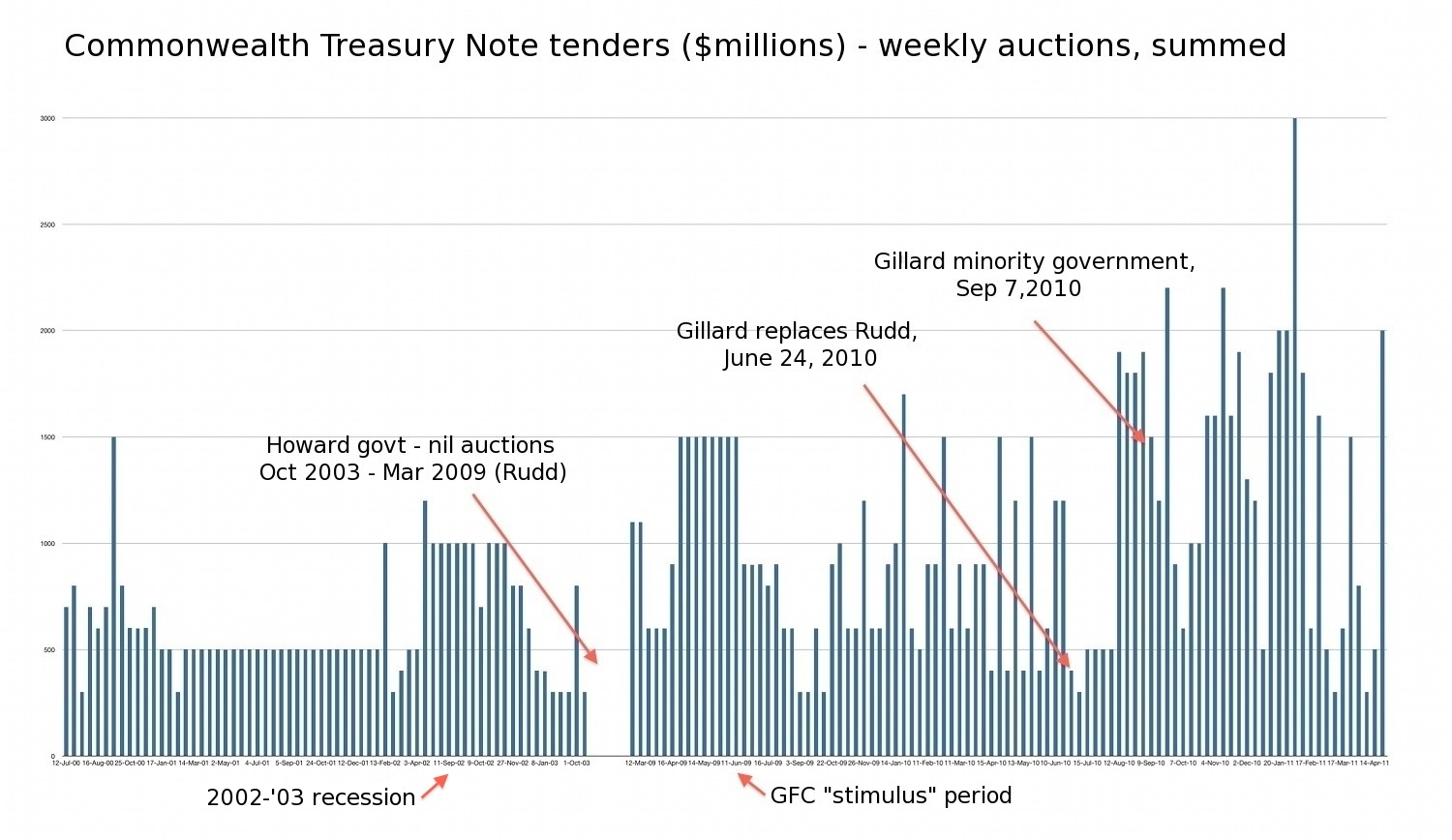
The following chart is an updated and extended version of the one used in the previous article.  This shows Treasury Note auctions from 2000 through to end April 2011 (the previous chart began at March 2009).

The other difference, is that the previous chart listed each individual auction separately.  It escaped my notice that there has been as many as 3 auctions p.w. in recent times.  So this new chart sums the total of all auctions of Treasury Notes in a given week into a single bar on the chart (click to enlarge):

Source: Australian Office of Financial Management (AOFM)

Some key points to note.

Firstly, there’s clearly quite a difference between how much the Howard Government relied on short-term debt (Treasury Notes), compared with the subsequent Labor Government.  The period when the largest block of Howard-era short term debt auctions occurred was through the year 2002 – coinciding with the 2002-03 global recession, which Australia largely avoided.

Secondly, for four (4) full years between October 2003 and the Rudd election win in November 2007, the Howard Government raised no short-term debt. Not one cent.

Neither did Kevin07.  For 16 months.  Until the GFC.

Thirdly, you can see clearly the period from March 2009 through around September 2009, during which the Rudd Government was regularly raising around $800m to $1,500m a week from short-term debt auctions. I assume that this reflects (at least in part) the government’s urgent need for cash to fund their “stimulus” response to the GFC.  Stimulus 1 – $10.4 billion in cash handouts in late 2008 (goodbye 50% of Howard surplus).  Stimulus 2 – another $42 billion in cash handouts and “nation-building”, beginning in … February/March 2009.

You remember. “Swift and decisive”. Rushed and bungled. $900 cheques to dead people. Electrifying foil insulation. Blazing pink batts. Rorted “green” schemes. Overpriced school halls. Literally billions more, to investigate and repair these Rudd-made disasters.

Finally, note the significant jump in both the frequency and the totals of short-term debt auctions, coinciding exactly with Ms Gillard’s rise to power. The fact is, she has presided over a $10.1bn (31.5%) increase in issuances of short-term debt in just 10 months, compared to the previous 12 months of the Rudd Government.

The big unanswered question that I have is this: WHY would a Gillard-led government suddenly need to bash the nation’s short-term credit card 31.5% harder than even the profligate Kevin Rudd did? After all, he had a GFC “stimulus” package or two to finance.

What is Ms Gillard’s excuse?

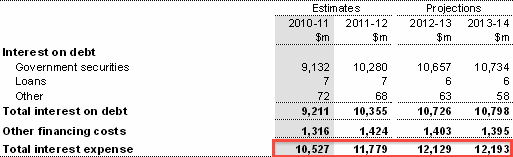
According to the government’s own budget records, we-the-taxpayers are already wearing an Interest-on-debt bill of more than $10 Billion per year:

MYEFO 2010-11, Appendix B, Note 10: Interest Expense

According to the AOFM, short-term Treasury debt is supposed to be used for financing “within-year”, daily cashflow requirements of the Government. And then there’s this official prediction:

Treasury Notes are not expected to make a major contribution to overall funding for the 2010-11 financial year as a whole.

Why has the Gillard-led government apparently been so incapable of planning their week-to-week expenses, that since that statement was published they have resorted to bashing the national credit card more than 31.5% harder than Kevin Rudd “needed” to?

The data supports the increasingly widespread view that the Gillard minority government is a shambles.  They have no financial plan – even over the short-term.  And so, from Day 1, have had to pull out the national credit card 31.5% more than Kevin Rudd, just to manage the week-to-week cashflow requirements of government.

One can only wonder just how much Interest-on-debt we will end up paying in total over the coming years.

While Gillard and Co comfortably retire.  On mega-buck, index-linked, taxpayer-funded pensions.

CNBC Agrees – Barnaby Was Right

26 Apr

And still more come out to admit that Barnaby’s 2009 warnings about the possibility of a US debt default were prescient.

From the USA’s own CNBC network, “First in business worldwide”:

The United States has never defaulted on its debt and Democrats and Republicans say they don’t want it to happen now. But with partisan acrimony running at fever pitch, and Democrats and Republicans so far apart on how to tame the deficit, the unthinkable is suddenly being pondered.

The government now borrows about 42 cents of every dollar it spends. Imagine that one day soon, the borrowing slams up against the current debt limit ceiling of $14.3 trillion and Congress fails to raise it. The damage would ripple across the entire economy, eventually affecting nearly every American, and rocking global markets in the process.

A default would come if the government actually failed to fulfill a financial obligation, including repaying a loan or interest on that loan.

The alternate view is that the US is already defaulting on its debts.  How?  By devaluing (weakening) the USD, through “printing” trillions of new dollars out of thin air .. deceitfully retitled as “Quantitative Easing” –

Design a site like this with WordPress.com
Get started