Tag Archives: GFC

Stevens $234K Pay Rise As GFC Peaked

24 Apr

Now that S&P and others have belled the cat on the US debt crisis, one wonders whether Glenn Stevens might apologise to Barnaby Joyce, for not taking his 2009 warnings seriously.

Better yet, perhaps Stevens might care to donate some of his $1.05 Million salary to the man who correctly predicted what he denied.

At the least, he should be forced to explain to the Australian public why any “public servant” deserves a $234,000 pay rise in the middle of a global financial crisis.  Such as the one he received, at the very peak of the GFC panic in October 2008 –

A pay increase of A$234,000 ($252,000) at the height of the global financial crisis made Reserve Bank of Australia Governor Glenn Stevens one of the world’s highly-compensated central bankers.

Stevens’s 2010 total compensation was A$1.05 million, with an A$805,000 base salary that was 61 percent more than European Central Bank President Jean-Claude Trichet’s and four times that of Federal Reserve Chairman Ben S. Bernanke

Spokesmen in the Reserve Bank and Treasurer’s office declined to comment … when contacted by Bloomberg News yesterday.

Stevens’ pay increase alone, is far more than Barnaby earns.  Even though Stevens was blind to the oncoming GFC, and the US (and European) debt situation.  And despite the fact that he has apparently learned nothing from his mistakes in the lead up to the GFC.  See here, here, and here.

The real public servant – Barnaby – is right.

UPDATE:

On a per capita basis, RBA Governor Glenn Stevens’ “base” salary alone ($805K) is 54 times bigger than that of the Governor of the US Federal Reserve, Ben Bernanke.

Hardly a surprise, when one considers that ‘our’ RBA has been given the power to set their own salaries

The Remuneration Committee is a committee of the Reserve Bank Board. Its membership is drawn from the non-executive members of the Reserve Bank Board.

This Little Goose Went To Market

21 Apr

This Little Goose Went To Market

With the Budget coming up, let’s take a look at how well the government has been managing our >$189 billion gross national debt “investment” portfolio.

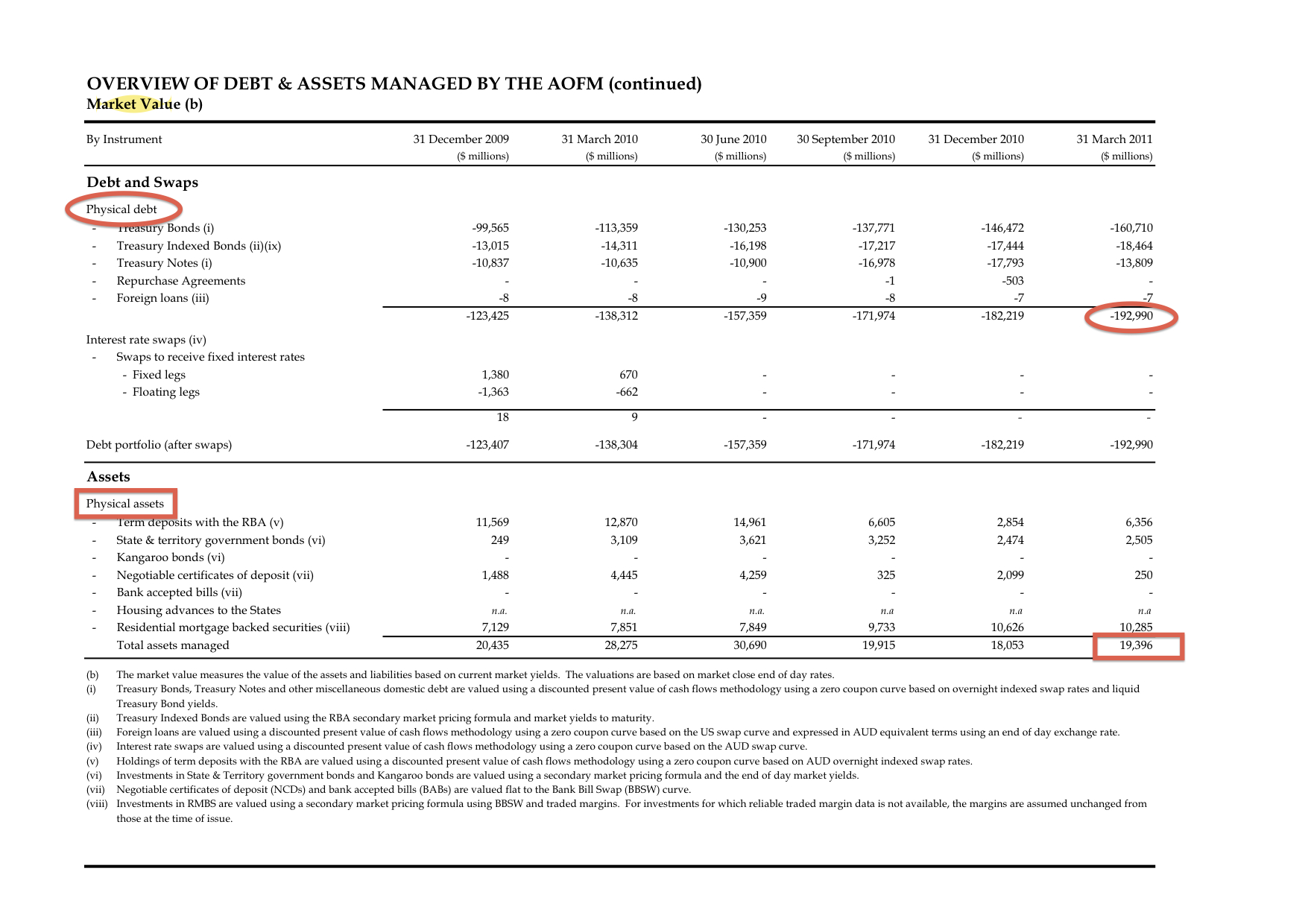
The Australian Office of Financial Management’s (AOFM) official Overview of the Portfolio document makes for interesting reading (click images to enlarge) –

AOFM Portfolio Overview - Face Value

AOFM Portfolio Overview - Market Value

Note the difference at 31 March 2011 between the Face Value, and the Market Value, of the “Physical debt” and the “Physical assets“, respectively.

The Market Value of the debt in “our” national portfolio is now greater than the Face Value, to the tune of $7.9 billion.  And the Market Value of the assets in our portfolio is now $3 billion less than the Face Value.

Notice also the standout feature – that our portfolio is being taken ever deeper into the red.  To the tune of $15 billion (15,000,000,000) every 3 months, through end September last year.  And by a further $23 billion (23,000,000,000), in just the last 6 months.

Seems someone forgot to tell Wayne Swan that the GFC peaked 31 months ago, in September 2008.  And, that there is an ongoing and worsening European debt crisis, the US has been placed on negative credit outlook for the first time in history, and the World Bank President has warned the global economy is “one shock away from a full-blown crisis”.

Wayne must be oblivious to all this.  Because this month he authorised the AOFM to “invest” up to $4 billion more in Residential Mortgage Backed Securities (RMBS) – yes, those things that blew up America’s financial system.  Read the detail at the AOFM website, and you’ll see our Swanny is even happy to “invest” more borrowed billions in RMBS’ that hold Low Doc loans exceeding 10% of the initial principal value of the security pool.  Seems he’s never heard of “sub-prime”.

Oh yes, and to pay for these – and the ongoing mega-billion NBN disaster – he’s all set to borrow even more hundreds of millions at the end of next week.

Would you want this Goose managing your investment portfolio?

Bring on an election!

Roast Goose

Barnaby Rips Into Swan On Live TV

23 Aug

The highlight of the election coverage.

Wayne ‘Goose’ Swan is torn to shreds by Michael Kroger during Channel Nine’s live election broadcast.

As he lays on the mat spitting out his teeth, Barnaby lays the boot in.

If only the Coalition had got stuck into Swan like this months earlier.

Highly entertaining viewing.

Aussie Banks’ $14.2Trillion “Time Bomb”

16 Aug

With all the recent turmoil in Europe, and grave questions being asked over the solvency of the European banking system, perhaps it’s time to again ask the question – How safe are our Aussie banks?

Back on March 4th (“Aussie Banks Not So Safe“), we saw that Aussie banks were holding $13 Trillion .. yes, TRILLION .. in Off-Balance Sheet “business”.  By comparison, they were holding only $2.59 Trillion in on-balance sheet assets.

The latest RBA statistics show an interesting change.

Our banks’ Off-Balance Sheet “business” has blown out by a whopping $1.2 Trillion.  It now stands at $14.2 Trillion (RBA spreadsheet here).  That growth alone – in just months – is equivalent to the entire Australian economy.

By comparison, their on-balance sheet assets have only grown by $26.6 Billion, to  $2.62 Trillion (RBA spreadsheet here).

The chart below shows our banks’ assets in blue, with Off-Balance sheet business added on top in burgundy (click to enlarge):
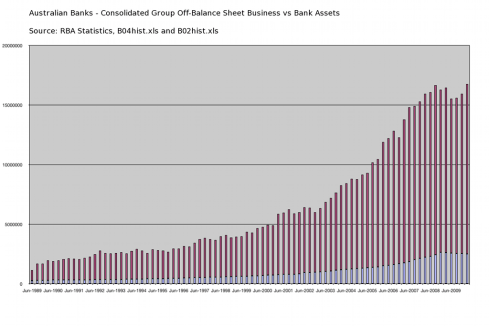
$14.2T in derivatives vs $2.6T in assets = MEGA-RISK

The vast bulk ($13.1 Trillion) of that $14.2 Trillion in “Off-Balance Sheet” business, is in the form of OTC derivatives.  Specifically, it is in the form of Interest Rate and Foreign Exchange “swaps” and “forwards”.

What are derivatives?

Derivatives are the exotic financial instruments at the very heart of the GFC.

Back in 2003, the world’s most famous investor, Warren Buffet, famously called derivatives “a mega-catastrophic risk”, “financial weapons of mass destruction“, and a “time bomb”.

Our “safe as houses” Aussie banks are buried up to their eyeballs in the things.

UPDATE:

Alarmingly, it seems Australians are increasingly inclined to trust their savings with the banks.

From today’s The Australian:

Banks sit on record holdings as wary consumers save

The war for deposits has prompted Australians to save more than ever, driving the money on call at banks to record levels.

Australian households have lodged $461.8 billion with banks in June, up 8.4 per cent on the same time last year. It’s a trend underscoring the risk aversion that still exists among investors.

The major banks are the biggest beneficiaries of consumers’ flight to cash.

June data published yesterday by the Australian Prudential Regulatory Authority shows there is $1.266 trillion in deposits at all of the banks in Australia.

The amount is almost the size of the Australian economy, and a 3 per cent increase compared with June last year.

Most of the savings come from households…

Few Australians know that we had the beginnings of a bank run in late 2008.  At the height of fear in the GFC, Australians quietly withdrew $5.5 Billion in savings to stash away under the mattress.  A year later, only $1.5 Billion had been redeposited.

From The Australian:

The private banks keep reserves of cash distributed in 60 storerooms across the country with an average of about $35 million in each. They get topped up by the Reserve Bank before Christmas, when demand for cash typically rises by about 6 per cent, and at Easter, when there is a smaller increase.

But in early October, the Reserve Bank started getting calls from the cash centres for more, especially in denominations of $50 and $100.

The Reserve Bank has its own cash stash. It is coy about exactly how much it holds, but it is understood to be in the region of $4 billion to $5bn.

As the Armaguard vans worked overtime ferrying bundles of $10,000 out to the cash centres, the Reserve Bank’s strategic reserve holdings of $50 and $100 notes started to run low and the call went out to the printer for more. The Reserve Bank ordered another $4.6bn in $100s and another $6bn in $50s. It was the first time it was forced to do this since the Y2K computer bug scare in 1999.

Households pulled about $5.5bn out of their banks in the 10 weeks between US financial house Lehman Brothers going broke – the onset of the global financial crisis – and the beginning of December. That is roughly 80 tonnes of cash salted away in people’s homes. Mattress Bank is doing well, was the view at the Reserve. A year later, only $1.5bn had been put back.

Could it be that Aussies are now feeling a little safer about the GFC, and are starting to put their money back in our banks … at the very time the banks are loading up even more rapidly than ever on derivatives – those “financial weapons of mass destruction”?

UPDATE 2:

16 August 2010

Greg Hoffman of The Intelligent Investor explains the significance of Aussie banks’ derivatives exposure.

From the The Age:

Bank headlines you won’t want to see

‘Australian banks in half trillion dollar derivatives scare” is a headline no-one wants to read. And while it’s unlikely to ever appear, it is possible. So forewarned might be forearmed.

In Monday’s column I showed how Australia’s banks have far more in loans outstanding than they have in deposits.

Now it’s time to explore how that situation came to be and how the banks deal with the risks it presents.

The RBA’s figures show that as at March 2009 ”around 20 per cent of banks’ total liabilities were denominated in foreign currencies.”

This percentage has remained relatively stable over time, but the raw numbers involved ballooned through the credit boom, to the point where the banks’ net foreign currency exposure is more than $300 billion.

If the banks simply borrowed these foreign funds without doing anything else, then they’d have direct exposure to the notoriously fickle Australian dollar exchange rate. Their profits would be violently thrown around (soaring when the currency rises and plunging when the Australian dollar dives).

Yet the banks have produced a string of comparatively smooth profits, at least until the past couple of years. The RBA explains; ”Despite this apparent on-balance sheet currency mismatch, the long-standing practice of swapping the associated foreign currency risk back into local currency terms ensures that fluctuations in the Australian dollar have little effect on domestic banks’ balance sheets.”

Derivative trick

The trick involves the banks entering into hundreds of billions* of dollars worth of derivative contracts known as ”swaps”. These contracts represent an agreement to exchange interest rate and/or currency exposures for a set period of time.

* [Ed:  Mr Hoffman badly underestimates here.  The latest RBA spreadsheet B04hist.xls shows not mere “hundreds of billions”, but rather $6.7 Trillion in Interest Rate swaps, and $1.57 Trillion in Foreign Exchange swaps.  So that’s $8.3 Trillion of the total $14.2 Trillion in off-balance sheet business]

Using such contracts, Australia’s banks can arrange a schedule of payments with another party that match off against their foreign currency-denominated debt. In this way, the banks know their exposure from day one.

Any gains or losses that arise on the loan due to currency movements are offset by an opposite result on the swap contract. That’s how a financial hedge is supposed to function and these contracts have worked nicely for our banks over the years.

Yet one of the expensive lessons taught so savagely by the crisis to financial institutions around the world is that arrangements that have worked smoothly in the past may not always do so in the future.

That lesson brought the business models of lenders dependent on securitisation to a screaming halt in 2007, when previously deep and liquid markets simply seized up. And at some point in the future, it might just pay Australian bank shareholders to have spent a few minutes today considering the risks they’re exposed to as a result of our banks’ reliance on offshore borrowings.

What’s the risk?

I suspect that few people fully understand how dependent our banks are on foreign debt and the mechanism by which they mitigate their exposure (through a series of swap contracts designed to insulate against currency and interest rate movements). And that brings us to the key issue.

Should future convulsions in the global financial markets send any of the institutions on the other side of these contracts to the wall, our banks would become more exposed to the harsh winds of the international financial markets.

This is the nature of ”counterparty risk”, a concept former customers of HIH Insurance came face to face with when that institution couldn’t make good on its financial contracts.

And if the past few years are any indication, the Australian dollar tends to fall in times of uncertainty. So the very conditions which might bring about the failure of the banks’ counterparties would be highly likely to coincide with a plunging Australian dollar: thus blowing out the repayments of foreign currency-denominated debts in local terms.

This is the nightmare scenario…

Indeed.

At the height of the GFC, the Aussie Dollar plummeted from a high of 98c (vs the USD) to just 60c.  In fact, the RBA had to step in on multiple occasions and buy the Aussie Dollar on the open markets, just to defend its exchange rate value at the 60c level.

Given Mr Hoffman has so woefully underestimated our banks’ massive exposure to Interest Rate and Foreign Exchange derivatives, perhaps he should have opened his article as follows:

“Australian banks in 8 trillion dollar derivatives scare” is a headline no-one wants to read.

Swan Admits Borrowing $100m-a-day

26 Jul

From the ABC:

Federal Treasurer Wayne Swan has conceded the Opposition is correct when it claims Labor is borrowing $100 million a day to pay back Government debt.

Of course, it takes only a few seconds to keep tabs on Labor’s borrowings.

Just visit the Australian Office of Financial Management (“AOFM”) website to see the current total borrowings – listed as $150.533 million presently.

Don’t forget to add to this total, the amount listed at each link under the “Recent Tender Results” title, on the right hand side of the page. These are the extra amounts borrowed last week, but not yet added to the total.  So that’s another $1,800 million in the past week, giving us a grand total of $152.133 million borrowed up till last weekend.

Then, to see how much the Government plans to borrow in the next week, click on the “Forthcoming tenders” link, also on the right hand side of the AOFM home page. As you can see, on Thursday and Friday this week, the Labor Government will borrow a total of another $1,000 million.

Gottliebsen: In The Eye Of GFC Storm

30 Jun

Highly respected business commentator Robert Gottliebsen appears to agree today with what Barnaby Joyce has been saying since October last year – that the GFC is far from over.

From Business Spectator:

Despite a late US Dow index rally, last night was among the more serious sharemarket falls we have experienced since global financial crisis plunged markets in 2009.

We are well above the dismally low levels witnessed on equities markets during the crisis, but last night you could see fear in almost every corner of the world. The forces that are behind each of the fears are probably manageable, but when they occur together, as what happened last night, they triggered waves of selling, including a savaging of the Australian dollar.

And of course Gillard’s mining tax dithering is rekindling global doubts about the sovereign risk of this country which threatens to put Australia and our high house prices in the eye of the storm.

And for most Australians, the global wave of selling will be reflected in our share prices levels at June 30, which means that the value of superannuation funds will be hit on balance day. Many retirees will have their income reduced for the year ahead…

Clearly China is slowing much more rapidly than expected, and as a result the bad property loans that are in its banking portfolios will weigh down future growth.

In the past China has always managed these issues and I think it will do it again, but the markets fear there will be much more pain than had been anticipated.

Meanwhile, in Europe the big banks have been playing the stupid game of borrowing from depositors and then investing in the sovereign debts of European countries that can’t pay.

Tomorrow the banks are supposed to repay €442 billion in emergency loans but they almost certainly will have to be bailed out again. Fears of bank collapses are rife. On top of this dire outlook, Europe’s austerity measures will bring on recessions in countries ranging from Greece to the UK which will make it even harder for the banks. And the strikes in Greece will be repeated in many countries, which could make the spending cuts impossible to deliver.

In the US they are helped because in a crisis money flows to the world currency, so the US dollar rises. Nevertheless, there are still chronic housing problems so consumer confidence is depressed and the US economy is still living on the old stimulus packages. Accordingly Wall Street’s earnings estimates look too optimistic.

Barnaby is right.

Complete And Definitive Guide To The Sovereign Debt Crisis

30 Jun

Professor Niall Ferguson, of the acclaimed book and ABC documentary series The Ascent of Money, has recently published a brilliant guide to the global sovereign debt crisis.  Click here to read it.

Back in February, Professor Ferguson had this to say in the Financial Times:

… it would be a grave mistake to assume that the sovereign debt crisis that is unfolding will remain confined to the weaker eurozone economies. For this is more than just a Mediterranean problem with a farmyard acronym. It is a fiscal crisis of the western world. Its ramifications are far more profound than most investors currently appreciate…

BIS: Global Economy “Vastly Worse” Than In GFC

29 Jun

The latest report from the Bank of International Settlements (BIS) – the central bank to the central banks – warns that the global financial system is in a “vastly worse” position than 3 years ago.

From the Associated Press:

An organization bringing together the world’s major central banks warned Monday that the global economy risks a replay of the 2008-2009 financial crisis, with massive public debt in Europe and the United States replacing the private debt that fueled the credit crunch two years ago.

“A shock of virtually any size risks a replay of the events we saw in late 2008 and early 2009,” the Basel, Switzerland-based organization said in its 206-page annual report.

In a stark warning to governments to clean up their finances, the central bankers noted that “macroeconomic policy is in a vastly worse position than it was three years ago, with little capacity to combat a new crisis.”

The report recommended winding down stimulus packages, raising interest rates in the long term and forcing through reforms of the financial system to prevent sudden shocks from causing market-wide collapse as they did two years ago.

46 US States In Debt Crisis

29 Jun

46 out of 50 US state governments are now technically bankrupt.  To understand how bad that is for the global economy – including Australia – consider the fact that California alone has an economy that is larger than that of Russia.

From Bloomberg:

California, tied with Illinois for the lowest credit rating of any state, is diverting a rising portion of tax revenue to service debt, Bloomberg Markets magazine reports in its August issue.

Far from rebounding, the Golden State, with a $1.8 trillion economy that’s larger than Russia’s, is sinking deeper into its financial funk. And it’s not alone.

Even as the U.S. appears to be on the mend — gross domestic product has climbed three straight quarters — finances in Arizona, Illinois, New Jersey, New York and other states show few signs of improvement. Forty-six states face budget shortfalls that add up to $112 billion for the fiscal year ending next June, according to the Center on Budget and Policy Priorities, a Washington research institution.

State budget woes are a worsening drag on growth as the federal government tries to wean the economy from two years of extraordinary support. By Jan. 1, funds from the $787 billion federal stimulus bill will dry up. That money from Washington has helped cushion state budgets as tax revenue has plunged.

State leaders won’t be able to ride out this cycle the way they have in the past. The budget holes are too large.

What will the US do when nearly every state government is facing Greek-style deficits?

According to an RBS note to its clients, prepare for unprecedented money printing.

From the UK’s Telegraph:

As recovery starts to stall in the US and Europe with echoes of mid-1931, bond experts are once again dusting off a speech by Ben Bernanke given eight years ago as a freshman governor at the Federal Reserve.

Andrew Roberts, credit chief at RBS, is advising clients to read the Bernanke text very closely because the Fed is soon going to have to the pull the lever on “monster” quantitative easing (QE)”.

We cannot stress enough how strongly we believe that a cliff-edge may be around the corner, for the global banking system (particularly in Europe) and for the global economy. Think the unthinkable,” he said in a note to investors.

Societe Generale’s uber-bear Albert Edwards said the Fed and other central banks will be forced to print more money whatever they now say, given the “stinking fiscal mess” across the developed world. “The response to the coming deflationary maelstrom will be additional money printing that will make the recent QE seem insignificant,” he said.

Barnaby Joyce began warning about a bigger GFC in October last year. No one wanted to listen.

He was roundly ridiculed by the “experts” – such as the genius academic who designed the controversial RSPT, Treasury secretary Ken Henry – for suggesting the possibility that the USA could default on its massive debts.

The simple fact is this.  The USA is defaulting on its debts.

Printing money (euphemistically called “Quantitative Easing”) is technically a form of sovereign default.  When you cannot pay your debts, printing money devalues your currency, and makes it easier to pay back your debts.

It also means high inflation.  Possibly hyperinflation.  Think Weimar Germany in the 1920’s.  Or Zimbabwe today.

Barnaby is right.

Smashed $A – Rudd’s Super Tax Blamed

21 May

Goldman Sachs’ Australian subsidiary, JBWere, has issued a note to clients highlighting the reasons for the ongoing rout in the Australian Dollar, which has nose-dived from USD93c to just USD81c (at time of writing) in just three weeks since April 30.

via ZeroHedge:

Despite our belief that relative growth and relative interest rates suggest some support for the A$ over coming months, it is hard to see a swift resolution to the major sources of risk aversion impacting Australia and its hard to build a compelling case for offshore investors to bid the A$ higher. In that environment it will be difficult for our long-standing 95c target for the A$ around mid-year to be met; however, we still think our 12 month 90c target is still feasible, albeit with the path to 90 now likely to be via near-term weakness. Whether an ongoing decline in the A$ is in prospect will partly hinge on whether the Treasury Secretary’s suggestions that the WACC for the resource sector will be lower are viewed by the market as valid arguments or not. In sum, it is not just risk aversion that is driving the A% lower at present, fundamental factors have also been very important (relative growth, shifting rate expectations, lower commodity prices and capital exit) and the path to lower risk aversion is less dependant on the typical ebb and flow of market sentiment and highly dependant upon the actions of policy makers in Australia and Europe. Our A$ forecasts are now under review.

(emphasis added)

So there you have it, from one of the world’s most powerful investment banks, in their advice to clients. “Fundamental factors” have been “very important” in the rapid sell-off of the Australian Dollar.  And a key factor blamed, is the Rudd government’s “Resource Super-Profits Tax” (RSPT), inspired by Treasury Secretary Ken Henry.

(This is the same Ken Henry who utterly failed to foresee the GFC coming in 2007-08.  The same Ken Henry who, in February this year, publicly announced that the GFC is ‘over’, and predicted that Australia is set for a period of “unprecedented prosperity” lasting to 2050)

The financial markets are now considering the AUD to be a high risk currency. And according to JBWere, the “path to lower risk aversion” is “highly dependant on the actions of policy makers in Australia…”.

Rudd’s proposed “super tax” on the mining industry is not just wiping tens of billions off the value of Australian mining company shares – and the value of your Superannuation account.  It has also pulled the floor out from under the Aussie Dollar.

Insulation program. School halls. Border protection. Computers in schools. Renewable energy. FuelWatch. GroceryWatch. “The greatest moral challenge of our time”.

Does everything this government does turn to $***?

Design a site like this with WordPress.com
Get started