Tag Archives: government bonds

Labor’s Debt Legacy

12 Mar

Media Release – Senator Barnaby Joyce, 12 March 2010

Senator Barnaby Joyce says that reports in The Australian today confirm what the Coalition has been saying for months on debt and interest rates. Simply put, the Rudd Government’s excessive and profligate spending is putting upward pressure on interest rates.

It is clear that the RBA have resorted to the fastest increases in interest rates among advanced economies in response to the effects of this spending. So while other countries enjoy modest rises, hard working Australians will be paying the price for Labor’s bad management.

There is still a major portion of the $42 billion Nation Building and Jobs Plan to spend and while the Government has almost $128 billion of debt on issue (almost $16,000 per household), this is less than half its projected peak of $270 billion in 2014-15.

Gross debt has risen from $126.183 billion two weeks ago to $127.982 billion today. In two weeks the debt has risen by $1.8 billion. Easy to throw these figures about, but remember, just this increase is enough to seal 9000 kilometres of 6 metre wide road in country Queensland. This would take us from Sydney to Perth and back again and still have money left over.

It is highly unlikely there will be many left of the current Labor members by the time this debt is repaid. In fact quite a few will have passed away, but the debt will still be with us.

More Information- Jenny Swan 0746 251500
Rudd’s Interest Bill – $48.49bn to 2013

6 Mar

How much will Rudd’s spending spree cost Australian taxpayers… just in Interest-only?

$48.488 Billion to 2013. With more to come.

That’s enough to buy a No-business-plan-No-cost/benefit-analysis National Broadband Network.  With $5.5 Billion left over in loose change for, let’s say, a disastrous home insulation scheme plus the costs of fixing it afterwards.

Need proof?

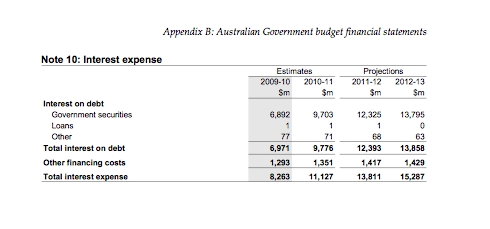
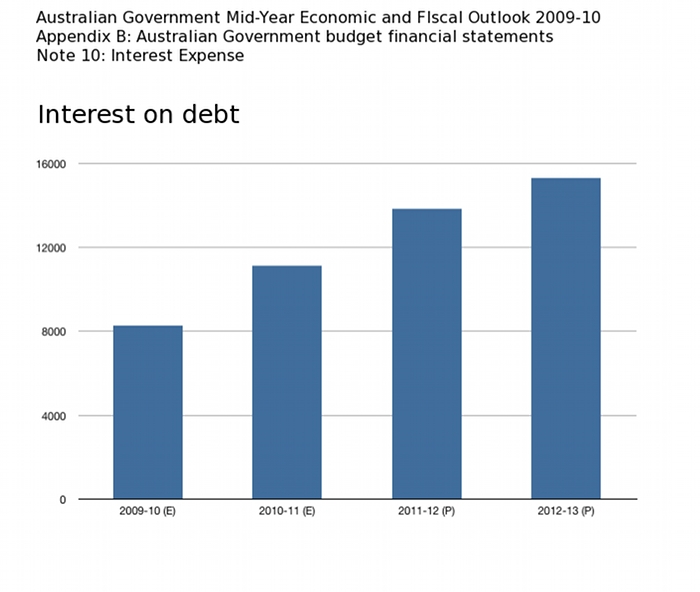
I made the chart below using the data from the Government’s Mid-Year Economic and Fiscal Outlook (MYEFO) 2009-10 Budget statements. It shows the government’s projections of Interest on debt for this financial year, and the following three years. These are the Total Interest* (not principal) repayments that Kevin Rudd has incurred, and we-the-taxpayers must pay back –

Interest on debt - Total $48.488 Billion

Interest Expense - MYEFO 2009-10, Appendix B, Note 10

Note:  This is only the “Estimates” (2009-10, 2010-11) and “Projections” (2011-12, 2012-13) for Interest-on-debt, as at November 2009 when the MYEFO was published. With the Rudd Government still borrowing well over $1 billion a week, who knows just how big the Interest-only bill is now.

One thing we do know.  We cannot pay it back.

* Total Interest includes $5.49 Billion in ‘Other financing costs’ – What exactly is that, and who gets it?

$127.68 Billion and Rising

6 Mar

From the Australian Office of Financial Management:

Total Commonwealth Government Securities on Issue – $127,682m

*As at 5 March 2010
Updated weekly
Face value amounts rounded to the nearest million

How much further into debt will Rudd Labor take us next week?

Forthcoming AOFM Tenders

Treasury Bonds
On Wednesday, 10 March 2010 a tender for the issue of $700 million of the June 2014 Bond line is planned to be held.

Treasury Notes
A tender for the issue of $600 million of Treasury Notes maturing on 11 June 2010 and $300 million of Treasury Notes maturing on 23 July 2010 is planned to be held on Thursday, 11 March 2010.

That’s right. Another $1.6 Billion in debt, next week alone.

These are the debt numbers that Finance Minister Lindsay Tanner does not trouble himself to know.

Labor Borrowing A Billion A Week

2 Mar

Abbott tells it how it is:

QUESTION:

Interest rates are expected to go up again, um… Who would you blame?

TONY ABBOTT:

Well, if you’ve got the government out there borrowing more than a billion dollars a week that puts a lot of pressure on interest rates. Now, plainly interest rates will always be higher than they otherwise would be when you’ve got the government out there in the market borrowing as dramatically as this government is.

Keep informed of Australia’s sovereign debt level… unlike Finance Minister Lindsay Tanner, who doesn’t bother.

See for yourself just how much this wastrel Government is borrowing every week, by clicking here. To see how much they intend to borrow in the next few days, click here.

Already, you are better informed about Australia’s debt than the Finance Minister.

Can We Even Pay The Interest?

27 Feb

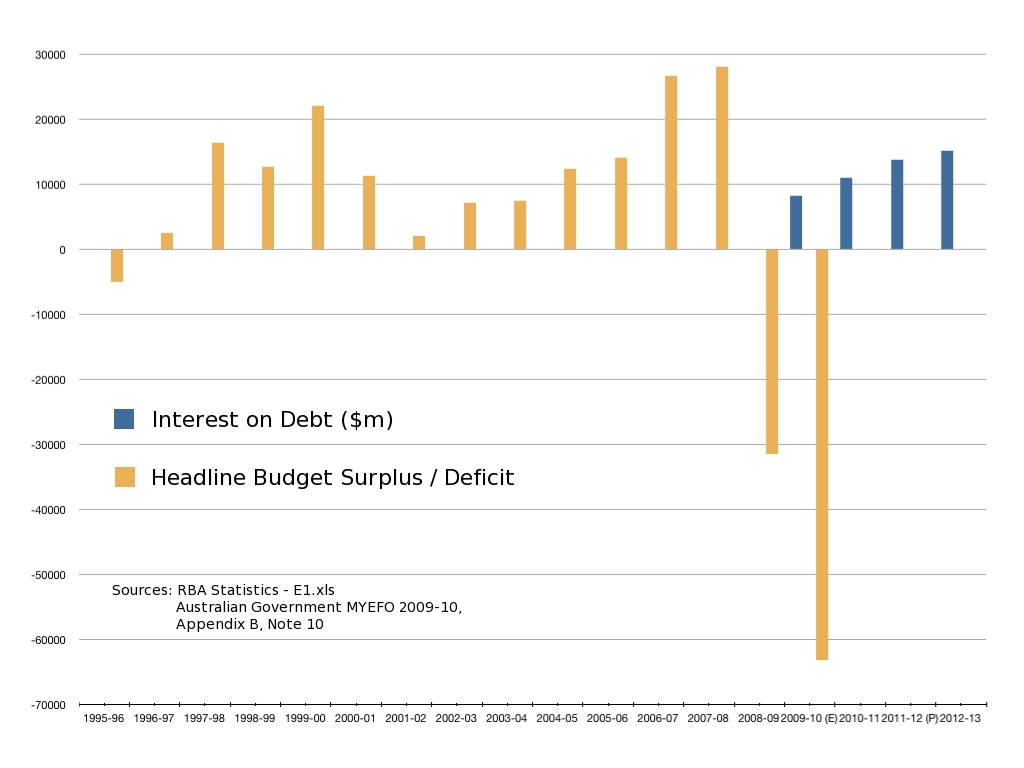
Estimated (E), Projected (P)

It seems that every man and his dog… except Barnaby Joyce… happily takes for granted the popular claim that Australia’s sovereign debt levels are nothing to worry about.  But have you ever stopped to think about whether we really can pay back the debt?

I made the chart above using the data from the Government’s Mid-Year Economic and Fiscal Outlook (MYEFO) 2009-10 Budget statements. It shows Treasury Secretary Ken Henry’s projected Interest on debt for this financial year, and the following three years. Those are interest-only repayments that Kevin Rudd incurred, and now we-the-taxpayers have to pay.

Doesn’t look too bad, you say?  An Interest bill starting at $8.26 Billion for 2009-10, rising to $15.28 Billion for 2012-13? Surely your $900 “bonus” cheque, and your dodgy roof insulation from the Fairy Ruddfather, make paying this Interest bill worthwhile?

To put it into perspective, I’ve put together another chart (below).  It shows the Australian Government headline Surplus / Deficits going back to 1996, and adds in the projected Interest on debt (in blue) from the above chart. Simply click on the chart to enlarge –

As you can see, Ken Henry’s projected Interest on debt alone is greater than many of the 12 years of Howard Government surpluses. And they came during an unprecedented mining boom.

One other thing. Can anyone really believe Ken Henry’s projections?  This is a man who could not see the GFC coming.  And even now, he is confidently predicting a “Golden Age” of “unprecedented prosperity” for Australia, one that could “stretch to 2050”. All thanks to his belief in a 4o year continuous boom in China.  He is clearly ignorant of the fact that more and more leading international economists… including some who did predict the GFC… are now predicting that China is a bubble that will bust within ten years.

Paying back the projected Interest-only will obviously be a big challenge. So try to imagine how we are ever going to pay back the principal too.

Barnaby Joyce has recently stated that it would take eight (8) consecutive years of $19 Billion surpluses to bring the budget back to earth.  As you can see from the chart above, the Howard Government achieved a budget surplus that big only 3 times… in 12 years.

It is easy to see why Barnaby is so concerned about our ever-rising debt under Rudd Labor.

Because quite simply, we can not pay it back.

No, We Cannot Pay Our Debt

26 Feb

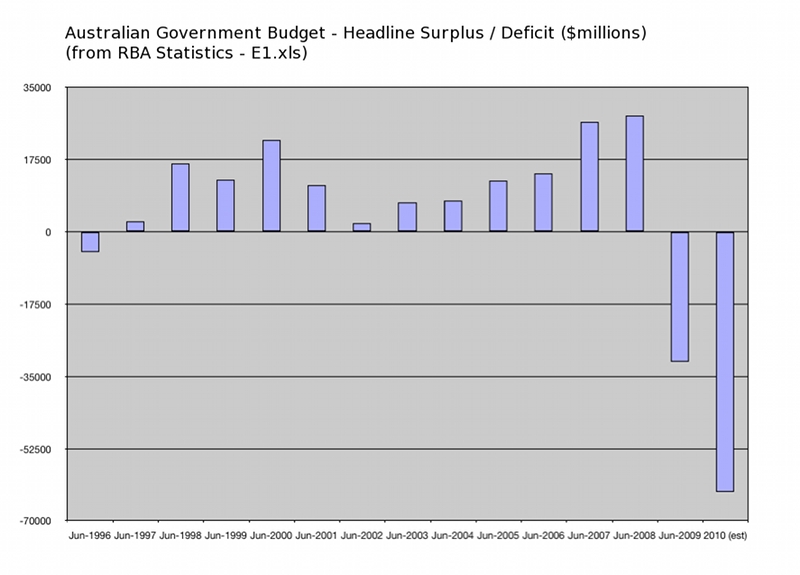
Here’s another picture that tells a thousand words.

Yesterday Barnaby wrote in The Australian about the annual Budget surpluses needed to pay back Labor’s ever rising debt ($1 Billion more today alone; another $1.8 Billion next week):

Let’s talk about the abundance of faith exhibited by Labor when it tells us of the eight consecutive $19bn surpluses that are required to bring the budget back into orbit when the continued stresses on the international economy are clear and evident, especially in Europe.

On the ABC’s Q&A program on Feb 15th, Barnaby pointed out that Labor’s “plan” to return the Budget to surplus is pure fantasy:

We have always got the view that you should try and reduce tax but the first thing, without harping on it, we’ve got to deal with the debt and because they keep racking up debt, that takes away our capacity to reduce your tax and there’s no other way around it. You either increase your revenues, decrease your costs – they talk about productivity and sort of the cyclical angel descending from heaven and making everything better

Well, just what is the likelihood of that cyclical angel descending?  And even if it does, can it produce eight consecutive surpluses of $19 Billion?

Decide for yourself.

Below is a chart of Australian Government Budget surplus / deficits, dating back to the beginning of the Howard Government. Source is the Reserve Bank of Australia’s Statistics section. Click on the chart to enlarge –

This country has never seen anything like eight consecutive years of $19 Billion surpluses. In fact, the Howard Government achieved it just 3 times… in 12 years… during an unprecedented mining boom.

Barnaby is right.

A Clear Picture of Australia’s Debt

25 Feb

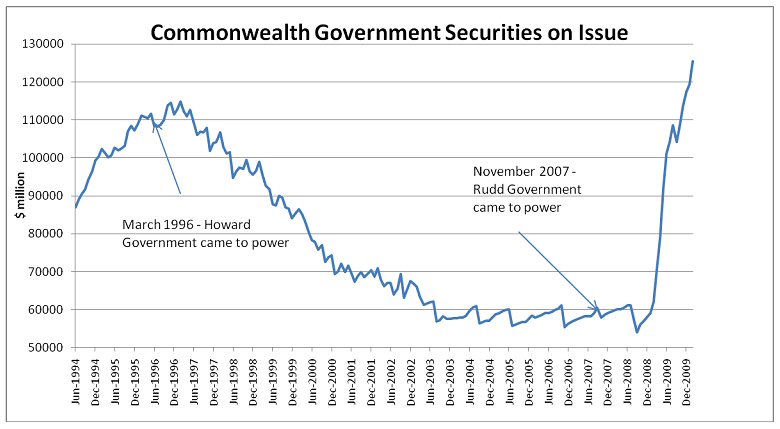
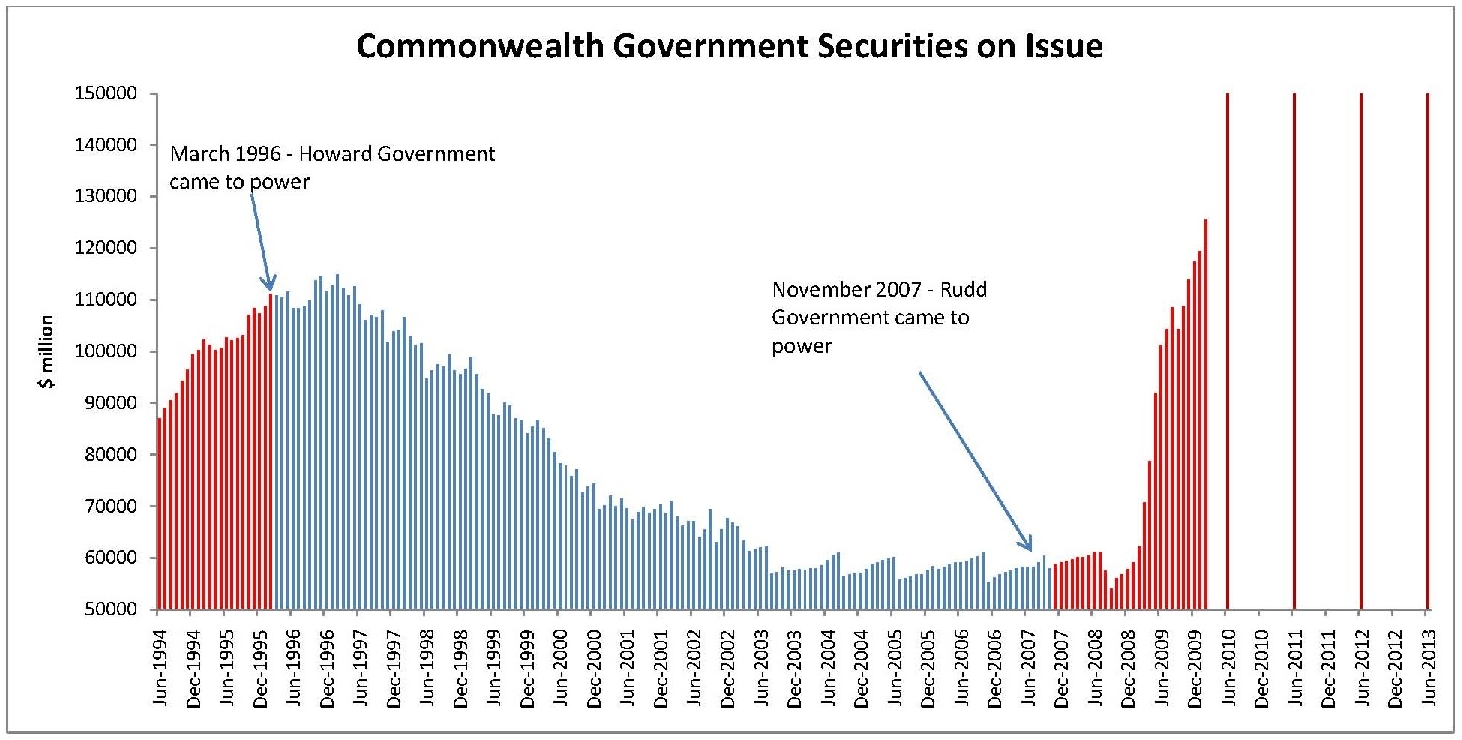
Barnaby Joyce produces a chart that says it all:

A picture paints a thousand words so a good understanding of our gross debt is seen in the graph (above).

It shows clearly that the Coalition is a government that pays off debt and that Labor is a government that creates debt and Mr Rudd is creating debt at a faster rate than has been seen in recent history. With gross debt currently in excess of $125 billion one would be foolish if they were not concerned by the trajectory of the growth in debt.   How would you feel taking this to your local bank manager as an example of your fiscal prudence, and the ceiling insulation program as an example of your management technique?

If we continue on the trajectory that is self evident in this graph we are most definitely going to arrive at a point of reckoning.

Read the entire article here.

UPDATE: Barnaby offers an updated version of the above graph –

If we continue on the trajectory that is self evident in this graph we are most definitely going to arrive at a point of reckoning. This point of reckoning will place immense pressure on the budget and the delivery of such services as health, education, defence, foreign aid, childcare and everything else that relies on the public purse for payment.
Labor cannot just go on borrowing money at the rate that is portrayed in this graph and it is absurd to look at the trajectory of this graph and say that you do not have a concern. It is vastly easier to manage problems when they are manageable. It is far more prudent to “dot the i’s and cross the t’s” and manage the problem now than to wander into the chamber at a later date with a sorrowful look on your face wishing if only we had that time again we’d have done things differently.
Design a site like this with WordPress.com
Get started