Tag Archives: IMF

9 Charts Show Why Eurozone Collapse Is Inevitable

10 May

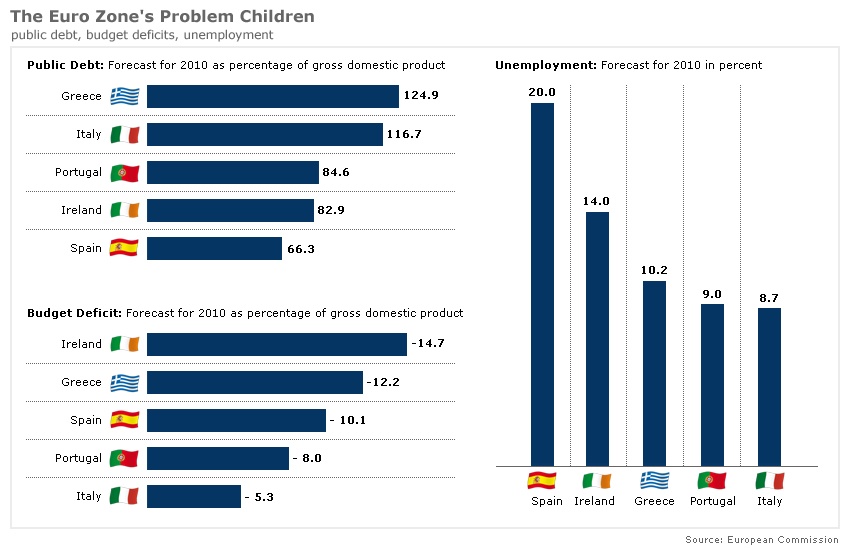
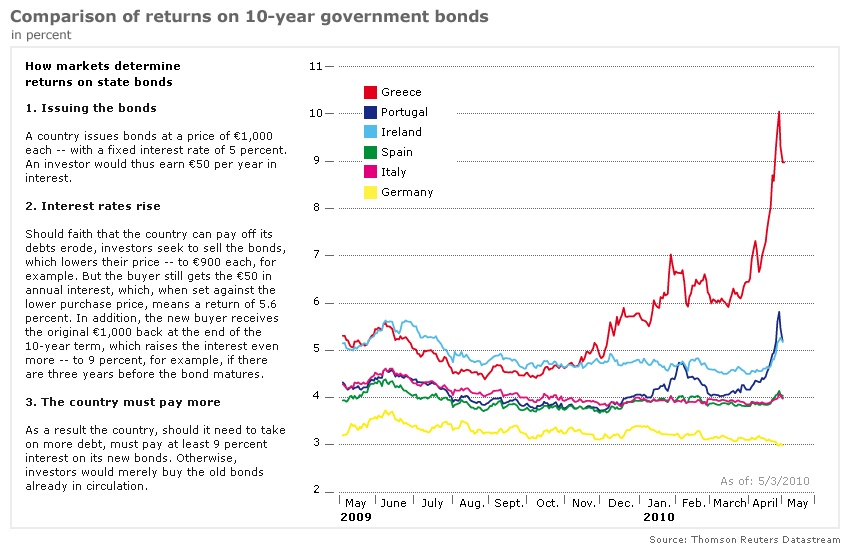
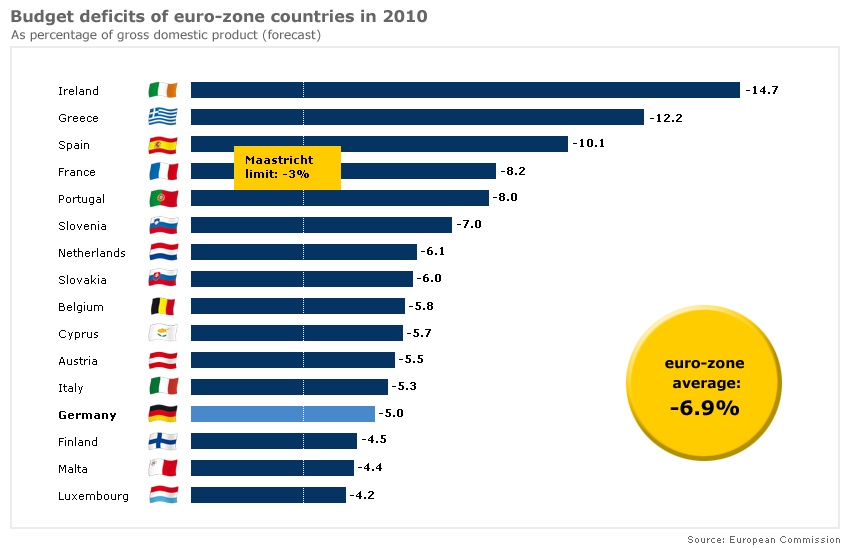
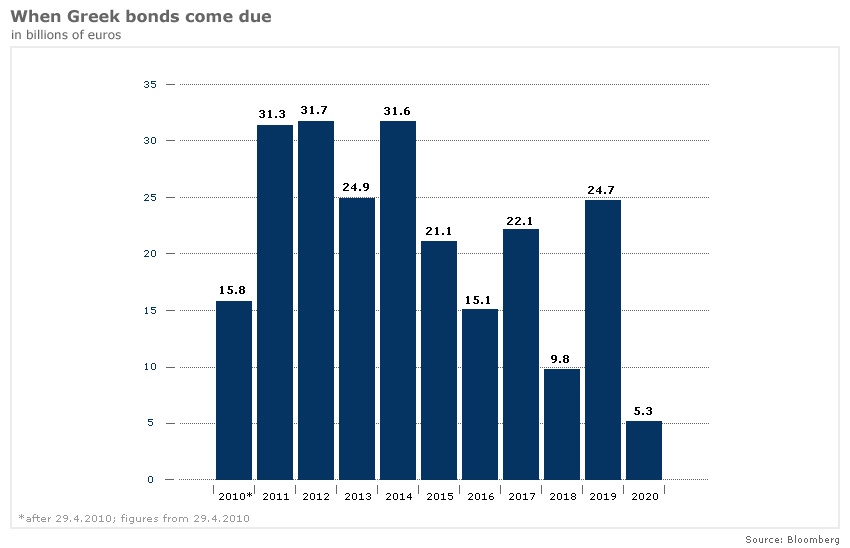
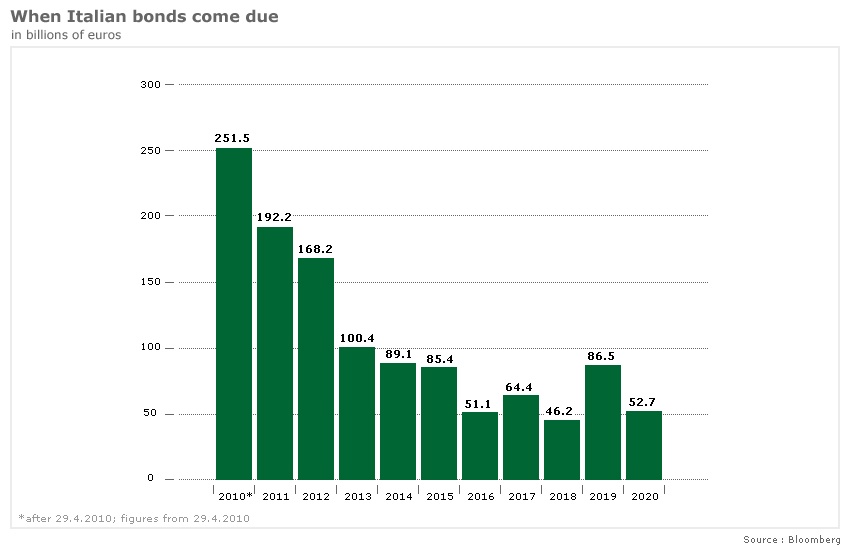
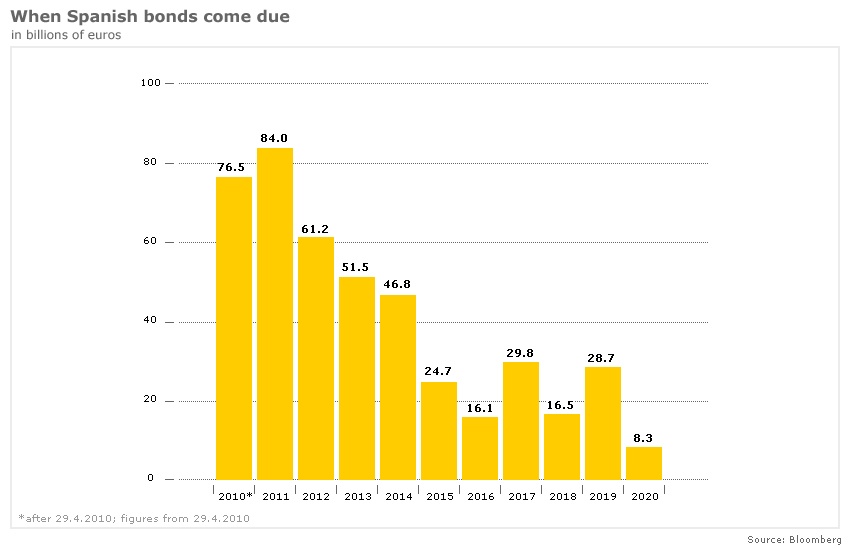
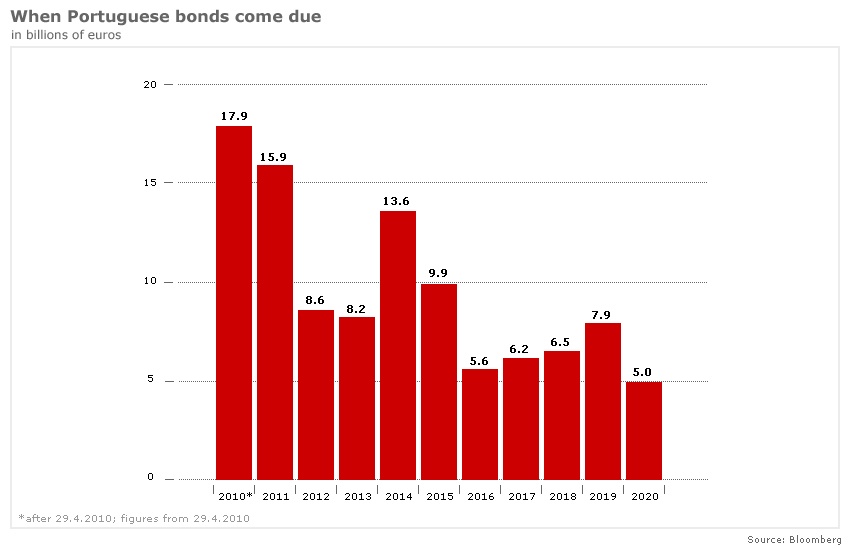
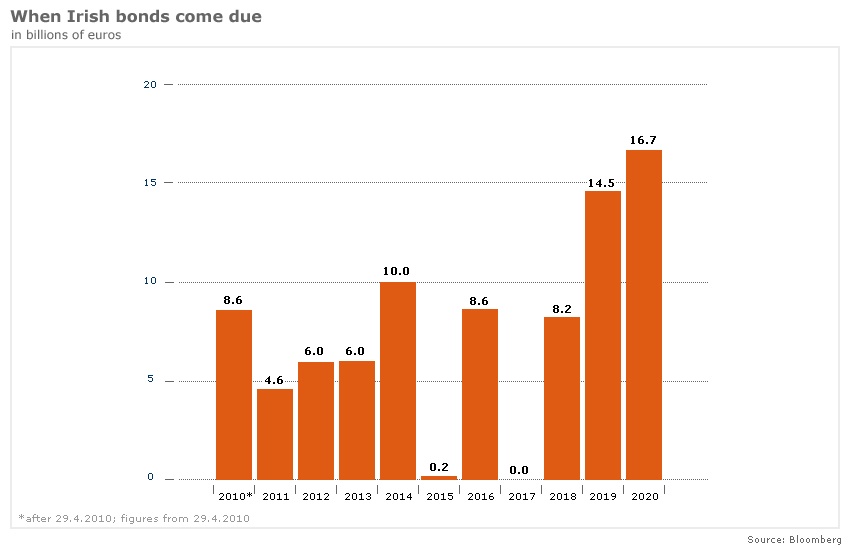
Here are some simple charts that demonstrate why anything and everything that the EU, ECB and/or the IMF can do now, is simply to delay the inevitable disintegration of the Eurozone.

From Der Spiegel: (click on images to enlarge)

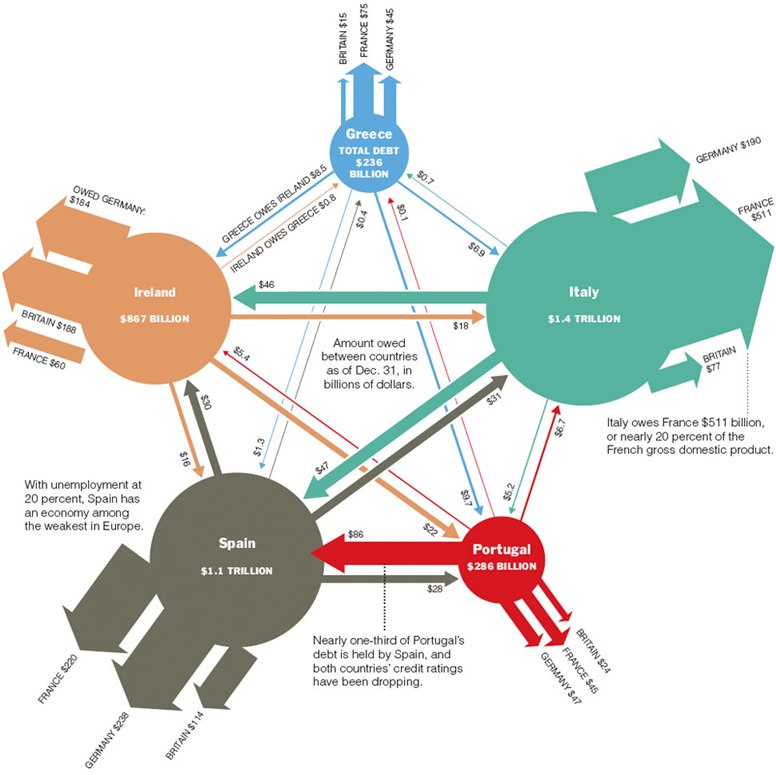
And finally, one more chart showing how interconnected (thus vulnerable) the Eurozone countries are, due to the enormous sums of money owed by member countries just to each other: (click on image to enlarge)

Eurozone Faces Bankruptcy, Disintegration

10 May

Could the Eurozone go bankrupt? One of Germany’s leading newspapers believes so.

From an excellent major article in Der Spiegel:

Huge National Debts Could Push Eurozone Into Bankruptcy

Greece is only the beginning. The world’s leading economies have long lived beyond their means, and the financial crisis caused government debt to swell dramatically. Now the bill is coming due, but not all countries will be able to pay it.

The euro zone is pinning its hopes on (IMF negotiator) Thomsen and his team. His goal is to achieve what Europe’s politicians are not confident they can do on their own, namely to bring discipline to a country that, through manipulation and financial inefficiency, has plunged the European single currency into its worst-ever crisis.

If the emergency surgery isn’t successful, there will be much more at stake than the fate of the euro. Indeed, Europe could begin to erode politically as a result. The historic project of a united continent, promoted by an entire generation of politicians, could suffer irreparable damage, and European integration would suffer a serious setback — perhaps even permanently.

And the global financial world would be faced with a new Lehman Brothers, the American investment bank that collapsed in September 2008, taking the global economy to the brink of the abyss. It was only through massive government bailout packages that a collapse of the entire financial system was averted at the time.

A similar scenario could unfold once again, except that this time it would be happening at a higher level, on the meta-level of exorbitant government debt. This fear has had Europe’s politicians worried for weeks, but their crisis management efforts have failed. For months, they have been unable to contain the Greek crisis.

There are, in fact, striking similarities to the Lehman bankruptcy. This isn’t exactly surprising. The financial crisis isn’t over by a long shot, but has only entered a new phase. Today, the world is no longer threatened by the debts of banks but by the debts of governments, including debts which were run up rescuing banks just a year ago.

The banking crisis has turned into a crisis of entire nations, and the subprime mortgage bubble into a government debt bubble. This is why precisely the same questions are being asked today, now that entire countries are at risk of collapse, as were being asked in the fall of 2008 when the banks were on the brink: How can the calamity be prevented without laying the ground for an even bigger disaster? Can a crisis based on debt be solved with even more debt? And who will actually rescue the rescuers in the end, the ones who overreached?

So, the GFC is ‘over’, is it Ken?

Cracks Multiply In Europe

7 May

From Business Spectator:

Global share markets plunged overnight as panicked investors worried that the eurozone could fragment as a result of the escalating European financial crisis.

The European banking system is under huge strain* as banks are increasingly reluctant to lend to each other. The European banks are worried about how much other banks have lent to the weaker eurozone countries – the so-called PIIGS (Portugal, Ireland, Italy, Greece and Spain) – and the catastrophic losses that could ensue if any of these countries defaulted on their debt.

At the same time, there’s been a flight of capital out of the eurozone as investors have worried the common currency might crumble as a result of the problems in the vulnerable economies of the PIIGS (Portugal, Ireland, Italy, Greece and Spain).

The huge question mark over the eurozone’s survival is causing the euro to plummet. Increasingly, market analysts are predicting that the currency, which broke through the $US1.30 earlier this week for the first tine since April 2009, is set to hit parity with the US dollar.

There is an increasing consensus that the $US145 billion European Union-IMF rescue package for Greece is not sufficient to solve Greece’s basic problem – that it is simply unable to service its colossal debts. There are also questions as to whether Greece will be able to implement the punitive austerity measures it is being forced to adopt in exchange for the bailout.

At the same time, there are increasing signs that even if it bails out Greece, Germany will not be prepared to write the huge cheques required to help other vulnerable PIIGS.

German taxpayers are already outraged at having to pick up a large chunk of the cost of the Greek bail-out, and Germany’s largest opposition party, the centre-left SPD, has said that it will not vote in favour of the bill.

Predictions that the cascading PIIGS debt crisis will cause the eurozone to collapse are becoming more widespread.

* That the European banking system is “under huge strain” and is beginning to freeze up (again) has profound implications for our economy. Why?

As explained in this post a few days ago, even the heads of our major banks quietly admit that our banking system has an “achilles heel” – it is desperately dependent on the international wholesale capital markets for funding.  If/when the banking system abroad seizes up again, our banks will be in deep trouble.

Watch out for the emergency reinstalment of the government’s Bank Guarantee, hoping to again prop up international confidence in our banks so that they can continue to attract funding in a second credit crunch.

Watch out also for higher interest rates charged by the banks – irrespective of the RBA cash rate – due to their having to pay ever higher interest rates in order to get that international funding in the first place.

OECD: Greek Crisis ‘Like Ebola’

29 Apr

From Bloomberg:

European policy makers may need to stump up as much as 600 billion euros ($794 billion) in aid or buy government bonds if they are to stamp out the region’s spreading fiscal crisis, said economists at JPMorgan Chase & Co. and Royal Bank of Scotland Group Plc.

With Greece’s budget turmoil infecting markets from Rome to Madrid, economists are urging German Chancellor Angela Merkel, European Central Bank President Jean-Claude Trichet and other officials to come up with unprecedented measures. Other steps could see governments guaranteeing bonds and the ECB abandoning collateral rules or reviving unlimited lending to banks, the economists said.

As OECD head Angel Gurria likens the crisis to the Ebola virus, Europe may need to come up with a plan equivalent to the $700 billion Troubled Asset Relief Program deployed by the U.S. after the collapse of Lehman Brothers Holdings Inc. “It is perhaps time to think of policy options of the last resort in the current sovereign crisis,” said David Mackie, chief European economist at JPMorgan in London.

“This is like Ebola,” Organization for Economic Cooperation and Development Secretary General Gurria told Bloomberg Television yesterday. “It’s threatening the stability of the financial system.” The World Health Organization calls Ebola “one of the most virulent viral diseases known to humankind.”

‘Shock And Awe’ Needed To Save Eurozone

29 Apr

Following close on the heels of the extraordinary revelation by Ben Bernanke that the US Federal Reserve has printed $1.3 Trillion out of thin air to buy toxic Mortgage Backed Securities and prop up the US economy, now the European Central Bank may have to invoke emergency powers in order to engage in massive money printing to prop up the collapsing European bond markets.

From the UK’s Telegraph:

The European Central Bank may soon have to invoke emergency powers to prevent the disintegration of southern European bond markets, with ominous signs of investor flight from Spain and Italy.

“We have gone past the point of no return,” said Jacques Cailloux, chief Europe economist at the Royal Bank of Scotland.“There is a complete loss of confidence. The bond markets are in disintegration and it is getting worse every day.

“The ECB has been side-lined in the Greek crisis so far but do you allow a bond crash in your region if you are the lender-of-last resort? They may have to act as contagion spreads to larger countries such as Italy. We started to see the first glimpse of that today.”

Mr Cailloux said the ECB should resort to its “nuclear option” of intervening directly in the markets to purchase government bonds.

This is prohibited in normal times under the EU Treaties but the bank can buy a wide range of assets under its “structural operations” mandate in times of systemic crisis, theoretically in unlimited quantities.

The issue of the ECB buying bonds is a political minefield. Any such action would inevitably be viewed in Germany as a form of printing money to bail out Club Med debtors, and the start of a slippery slope towards in an “inflation union”.

But the ECB may no longer have any choice. There is a growing view that nothing short of a monetary blitz — or “shock and awe” on the bonds markets — can halt the spiral under way.

Greece Downgraded To Junk Status

28 Apr

Readers will be aware that I’ve been highlighting news about the Greek debt situation for some months. As a member of the European Monetary Union, and the Eurozone country with the gravest debt situation, it was always likely to be the first domino to fall.  Now it has.

From AAP:

Greece’s debt has been downgraded to junk status by Standard & Poor’s amid mounting fears that the debt crisis in Europe is spiralling out of control.

In a statement on Tuesday, the agency says that it is lowering its rating on Greece’s debt to BB+ from BBB- – that means that the country’s debt does not carry the investment grade tag.

The agency is also warning debtholders that they only have an average chance of between 30 to 50 per cent of getting their money back in the event of a debt restructuring or default.

European stock markets and the euro sank on Tuesday amid growing fears that the Greek debt crisis will spread to other weak eurozone countries, with Portugal now in the firing line.

“It can really be summed up in one word – contagion,” said CMC Markets analyst Michael Hewson.

The markets fell after Standard & Poor’s, a leading international ratings agency, downgraded Greek sovereign debt to junk status and cut Portugal’s long-term credit score by two notches.

The London stock market dived 2.61 per cent, the Frankfurt DAX sank 2.73 per cent and the CAC 40 in Paris plunged by 3.82 per cent. The Lisbon stock market sank by 5.36 per cent and Athens plunged six per cent.

The euro, which has been rocked for months over the debt drama in Greece, plunged again against the US and Japanese currencies, falling to $1.3250 from $1.3378 a day earlier and to Y123.46 yen from Y125.72 on Monday.

….

“Greece’s fiscal problems, and the market’s lack of confidence in dealing with them, are spilling over to other countries seen as having a kindred fiscal spirit,” said Patrick O’Hare at Briefing.com.

Greece has asked the European Union and International Monetary Fund to activate a three-year rescue package worth up to E45 billion ($A64.98 billion) in the first year.

However, the bailout is shrouded in uncertainty, with Germany insisting that Athens must first demonstrate how it plans to get its public finances in order before it gets the money.

“It is still the uncertainty surrounding this Greece bailout,” added Spreadex trader David Rees.

To compound matters, the EU/IMF rescue package may not be enough to resolve the wider problem of debt, according to VTB Capital economist Neil MacKinnon.

“The markets are worried that any fresh EU/IMF package to cover Greece’s funding needs in the short term are not enough to resolve the problem of worsening debt sustainability,” MacKinnon told AFP.

“Double digit interest rates and triple-digit debt levels are a recipe for debt restructuring and eventual default.”

The Greek debt crisis also unnerved Wall Street, with the Dow Jones Industrial Average sliding 1.24 per cent, Nasdaq shedding 1.44 per cent and the Standard & Poor’s 500 index declining 1.57 per cent.

The first domino has fallen. Who will be next? And just how far will the contagion spread?

Barnaby Joyce began speaking out about the risks to our economy from excessive debt both here and in other countries as early as October last year. For this, he was ridiculed and smeared by our know-nothing media and “expert” economic commentariat, and by the pompous “authorities” in government, the Treasury, and the RBA.

All of these utterly failed the Australian public, by their complete failure to foresee the on-rushing first wave of the GFC in 2008.

Now they are failing us all over again, by their naïve and arrogant dismissal of the potential global impacts of the rapidly spreading Eurozone debt crisis.  They seem to believe that because our island “escaped” the first wave, that somehow means we will miss the next (bigger) one as well.

Barnaby Is Right.

Greek Debt Woes Rising

8 Apr

From the Associated Press:

European stock markets fell Wednesday amid mounting concerns about Greece’s debt crisis while U.S. shares drifted lower as the Dow Jones industrial average fell short of breaking above 11,000.

Once again, Greece took center stage as investors continued to fret about the country’s ability to pay off its debts — the ten-year spread between Greek and Germany bond yields stood at 4 percentage points, having earlier hit 4.12 percent, its highest level since the euro was introduced in 1999. The spread is also way up on the 3 percent level when the EU agreed on an aid program that would involve the International Monetary Fund.

“All of this puts a question mark over longer term debt sustainability as well as the threat of contagion elsewhere in the eurozone,” said Neil Mackinnon, global macro strategist at VTB Capital.

With fiscal retrenchment due in Greece, as well as Portugal and Spain, there are also mounting concerns that the debt crisis will weigh on eurozone economic growth for a long time yet, particularly as lower demand for German goods could squeeze the eurozone’s biggest economy.

“This does not look like a sensible strategy and will likely end up in economic slump for the eurozone generally alongside the risk of deflation,” said Mackinnon.

Worries about the strength of the eurozone economy were stoked further on Wednesday with the news that economic growth ground to a halt in the last three months of 2009 as output stagnated in Germany and contracted once again in Italy.

Only US Collapse Can Save The Euro

30 Mar

From Zerohedge:

For once, some actually good insight from a CNBC guest. Philip Manduca, Head of Investment of the ECU Group, discusses Greece and the very severe implications of what the final outcome will look like. “Trichet (Ed: President of the European Central Bank) said the Greeks are crooks, and they’ve been lying about the numbers. There is a deeply embedded corruption within the Eurozone. Combined with the endemic European socialism and there is just no way you are going to get spending cuts and tax raises and maintain a GDP that makes any sense of the percentage aspect of debt to GDP. So the whole show is wrong. This is an intractable situation, this is going to continue on and on. The only hope for the Eurozone, and the Euro as a currency, is that someone takes the spotlight soon, and that may be the United States.

IMF Warns Wealthiest Nations About Debt

22 Mar

From the New York Times:

In a speech at the China Development Forum in Beijing, the I.M.F. official, John Lipsky, who is the deputy managing director, offered a grim prognosis for the world’s wealthiest nations, which are at a level of indebtedness not seen since the aftermath of World War II.

For the United States, “a higher public savings rate will be required to ensure long-term fiscal sustainability,” Mr. Lipsky said.

Mr. Lipsky said the average ratio of debt to gross domestic product in advanced economies was expected this year to reach the level that prevailed in 1950. Even assuming that fiscal stimulus programs are withdrawn in the next few years, that ratio is projected to rise to 110 percent by the end of 2014, from 75 percent at the end of 2007.

Indeed, the ratio is expected to be close to or to exceed 100 percent for five of the Group of 7 countries — excluding Canada and Germany — by 2014.

Mr. Lipsky warned governments not to try to inflate their way out of their debts.

Henry Sees Cyclical Angel Descending

26 Feb

As recently as October 2009, Treasury Secretary Ken Henry predicted a Golden Age for the Australian economy, that will “stretch to 2050”:

“While the global financial crisis has taken some of the heat out of our export prices, we should get used to the idea that we could have structurally higher terms of trade for some time, possibly for several decades,” he said.

In a speech at the Brisbane University of Technology, Henry said Australia’s population will grow as the mining boom, fuelled by demand from China and India, will continue to bring in immigrant workers. Handled correctly, he said, this could provide a “period of unprecedented prosperity”.

Henry pointed to growth in several Asian countries, which he said will give a boost to the mining boom that will see it last for several more decades into 2050.

Just one week ago, RBA Governor Glenn Stevens‘ colleague, Assistant Governor Philip Lowe, also had a vision of the cyclical angel returning from the heavens:

I am quite optimistic that story has some decades to run and that underlies much of the positives for the Australian economy,” Lowe told an economic development forum in Sydney.

“It is going to be a good 20 years for China and us,” he said.

And only 3 days ago, RBA Deputy Governor Rick Battelino too, joined in the angel chorus:

Mr Battellino was uncertain about how long the current boom would last, but said past booms had lasted around 15 years.

“On this occasion, the growth potential of countries such as China and India suggests that the expansion in resource demand could continue for an extended period, though this will depend at least to some extent on the economic management skills of the authorities in these countries, not to mention our own,” he said.

Illustration - nicholsoncartoons.com.au

Reassuring stuff. Or is it?

Three days ago, former Morgan Stanley chief Asia economist Andy Xie and hedge fund manager James Chanos saw something rather different:

“There’s a monumental property bubble and fixed-asset investment bubble that China has underway right now,” Chanos said. “And deflating that gently will be difficult at best.”

A glut of factories in China is “wreaking far-reaching damage on the global economy,” stoking trade tensions and raising the risk of bad loans, the European Union Chamber of Commerce in China said in November.

The risks are so great that a decade of little or no growth, as Japan experienced in the 1990s, can’t be dismissed, said Patrick Chovanec, an associate professor in the School of Economics and Management at Beijing’s Tsinghua University.

And two days ago, the former chief economist of the International Monetary Fund, Professor Ken Rogoff, also failed to see a Chinese cyclical angel descending. He saw the angel of doom:

China’s economic growth will plunge to as low as 2 percent following the collapse of a “debt- fueled bubble” within 10 years, sparking a regional recession, according to Harvard University Professor Ken Rogoff.

“We would learn just how important China is when that happens. It would cause a recession everywhere surrounding” the country, including Japan and South Korea, and be “horrible” for Latin American commodity exporters, he said.

Rogoff was one of very few economists who predicted the GFC.

Ken Henry, and all the boffins at the RBA… did not.

Design a site like this with WordPress.com
Get started