Tag Archives: RBA

Tick Tick Tick – Aussie Banks’ $15 Trillion Time Bomb

6 May

*This post follows up on my August 2010 post, “Aussie Banks’ $14.2Trillion Time Bomb”. Please read the article for detailed background to this update.

How safe are Australia’s banks?

Previously we saw that our “safe as houses” banks have a massive disconnect between their On-Balance Sheet Assets, and their Off-Balance Sheet “Business” (specifically, OTC derivatives).  Last time we checked, they held $2.62 Trillion in Assets, and a new record $14.2 Trillion in Off-Balance Sheet “Business”.

The disconnect has widened even further.

First, let’s take a look at a chart of their “Assets”.

In the chart below, the yellow line represents the total value of Personal Loans. The green line represents Commercial Loans.  The red line represents Residential Loans.  And the blue line represents the grand Total of Bank Assets (click to enlarge):
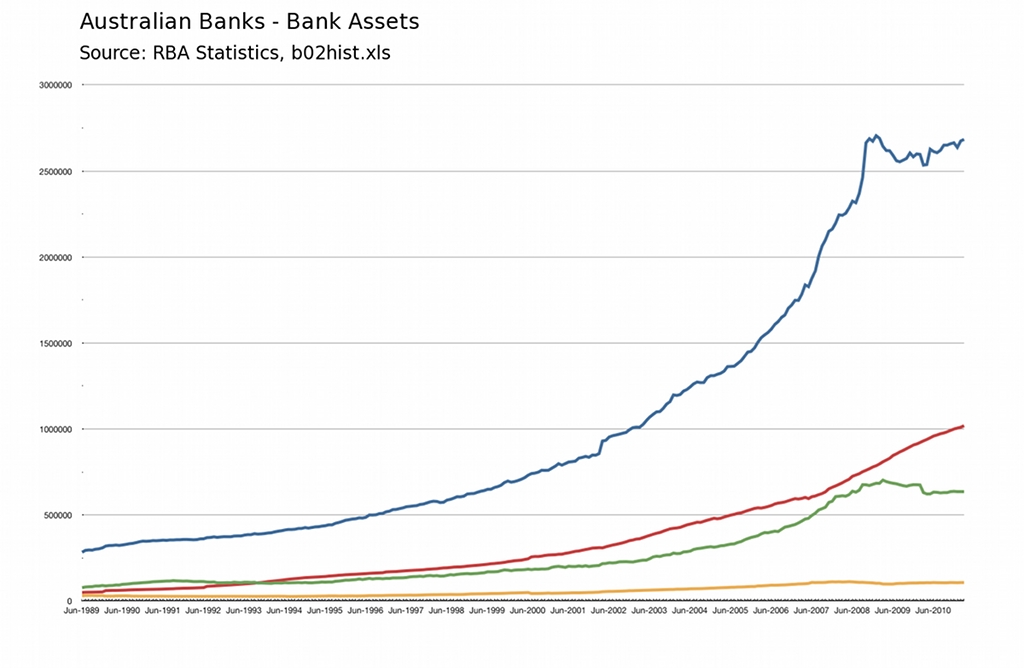
$1.77 Trillion of Total "Assets" = Loans

The total value of Bank Assets has barely moved – $2.66 Trillion. It has still to regain the peak of $2.67 Trillion in Dec 2008.

It’s worth noting that $1.77 Trillion (66%) of the banks’ $2.66 Trillion in “Assets”, is the value of Loans – personal, commercial, and residential.  That’s right.  Your debt to the bank is considered their “Asset”.  Slavery is still a thriving business in the 21st Century.  It’s how bank(ster)ing works.

What about their Off-Balance Sheet “Business”?

It has blown out by another $1.3 Trillion at its recent peak ($15.5 Trillion), and as at December 2010 sits at just under $15 Trillion.

To give an idea of the vast disconnect between our banks’ “Assets” (66% of which are loans), and their exposure to OTC derivatives, the following chart shows their total Assets – blue line from the above chart – versus a red line of total Off-Balance Sheet “business” (click to enlarge):
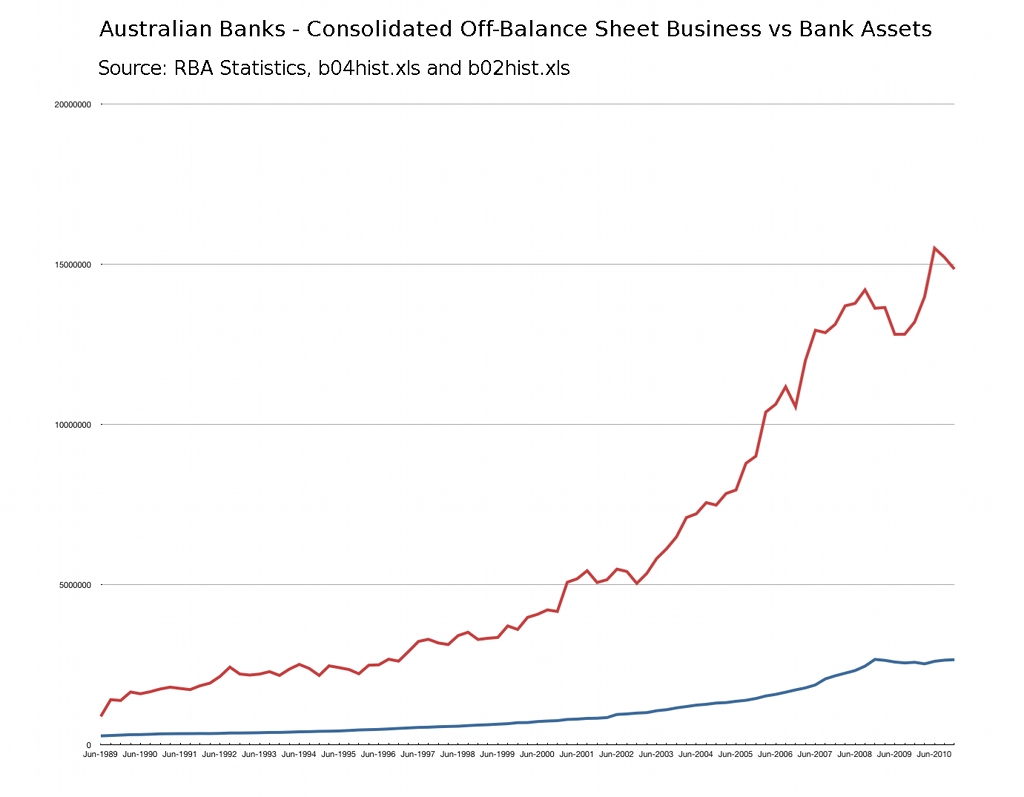
$2.66 Trillion in "Assets" versus $15 Trillion in Off-Balance Sheet "Business"

What are derivatives?

Derivatives are the exotic financial instruments at the very heart of the GFC.

Back in 2003, the world’s most famous investor, Warren Buffet, famously called derivatives “a mega-catastrophic risk”, “financial weapons of mass destruction”, and a “time bomb”.

Take note of the sharp dip in the near-parabolic rise in the red line on the chart. This coincides precisely with the late 2008 / early 2009 impact of the GFC on our banking system.

Our banks reduced a little of their exposure to OTC derivatives at that time (down $1.4 Trillion from Sep ’08 to Jun ’09) but quickly resumed their old ways.

At least, until September last year.  Again we see a sharp dip forming through the December quarter of 2010.

A final thought to consider.

If our banks were really so safe, why did two of our Big 4 (Westpac and NAB) both quietly borrow billions of dollars directly from the US Federal Reserve during the GFC?  And never advised shareholders, the prudential regulatory authority (APRA), the RBA, or the public?

An even bigger question – why did the RBA borrow $53 billion from the Federal Reserve without informing anyone?

National Australia Bank Ltd, Westpac Banking Corp Ltd and the Reserve Bank of Australia (RBA) were all recipients of emergency funds from the US Federal Reserve during the global financial crisis, according to media reports.

Data released by the Fed shows the RBA borrowed $US53 billion in 10 separate transactions during the financial crisis, which compares to the European Central Bank’s 271 transactions, according to a report in The Australian Financial Review.

NAB borrowed $US4.5 billion, and a New York-based entity owned by Westpac borrowed $US1 billion, according to The Age.

All is clearly not as safe as we are told in our “safe-as-houses” banking system.

UPDATE:

Still have confidence in our banks – especially the two that had to borrow from the US Federal Reserve?

Westpac, Australia’s second-largest bank, suffered a catastrophic IT meltdown yesterday when its entire banking system collapsed after an air-conditioning failure.

The bank’s ATM and eftpos facilities were useless for about six hours and its internet banking website was offline for 10 hours.

Customers reacted with fury over the system collapse, which came days after Westpac reported a record $3.96 billion net profit, up 38 per cent for the first half of the year…

Many Westpac customers flocked to Twitter to vent their anger, but the bank’s outage pales in comparison to the National Australia Bank‘s recent IT problems.

In late November, software issues at NAB lasted for more than a week and brought other financial institutions to their knees. The incident forced chief executive Cameron Clyne to issue an unprecedented public apology in major newspapers.

Three weeks ago, workers could not access their pay when a 24-hour IT failure affected employers who used NAB for their payroll processing.

The Commonwealth Bank has also had its share of IT glitches, from its internet banking going offline to ATMs discharging incorrect amounts of cash.

Swan Lies About Mortgage Payments

4 May

Proof below.

Too disgusted to comment.

From the Sydney Morning Herald:

The Reserve Bank’s decision to leave its cash rate unchanged is good news for households and businesses doing it tough in Australia’s current patchwork economy, Treasurer Wayne Swan says.

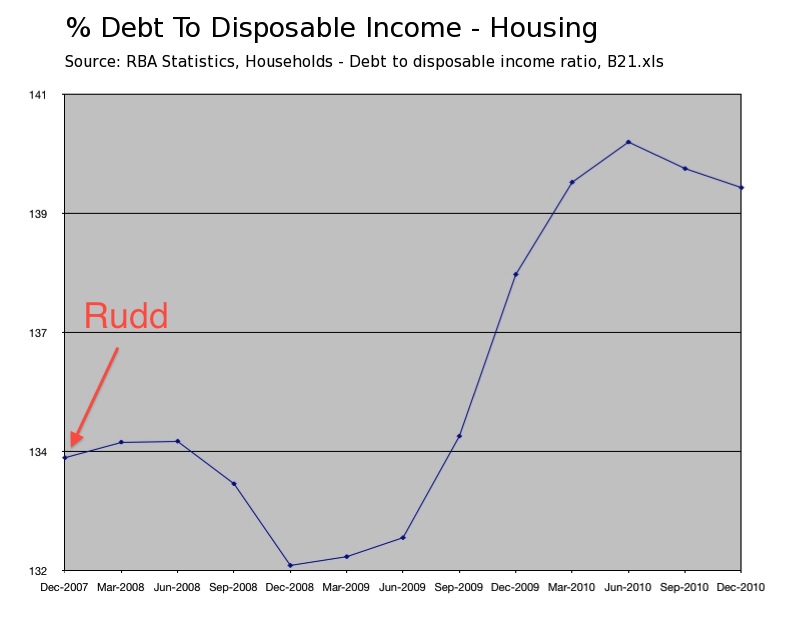
“Following today’s decision, an average family with a $300,000 mortgage is still paying nearly $160 less each month in repayments than they were when we came to government,” Mr Swan said in a brief statement.

“That’s a saving in the order of $1,880 a year – extra money that’s particularly important given the cost of living pressures many families are facing.”

From the Reserve Bank of Australia Statistics (click to enlarge):

Howard Government – March 1996

Rudd Government – November 2007

UPDATE:

Thanks Wayne. You super little economic manager you:

Who Owns 73% Of Our Debt?

24 Apr

Back on the 14th of March last year (“Who Owns Our Debt?“), we discovered that noted SMH economic commentator Ross Gittins was wrong. He had claimed –

You thought the pollies had done little else but spar about deficits and debt? Sorry, different debt. They’ve been arguing about the public debt – the amount the federal government owes (mainly to Australians).

At the time, a search through the RBA’s Statistics tables (“E3.xls”, Commonwealth Government Securities Classified By Holder) proved Gittins wrong.  We found that at September 2009, $65.972bn in Commonwealth debt was estimated to be held by non-residents. From a total of $104.228bn.  In percentage terms, an estimated 63.3% of public debt was actually held by non-residents of Australia.

Naturally we posed the question – Who exactly, are these ‘non-residents’ who hold 63.3% (or more?) of our public debt?

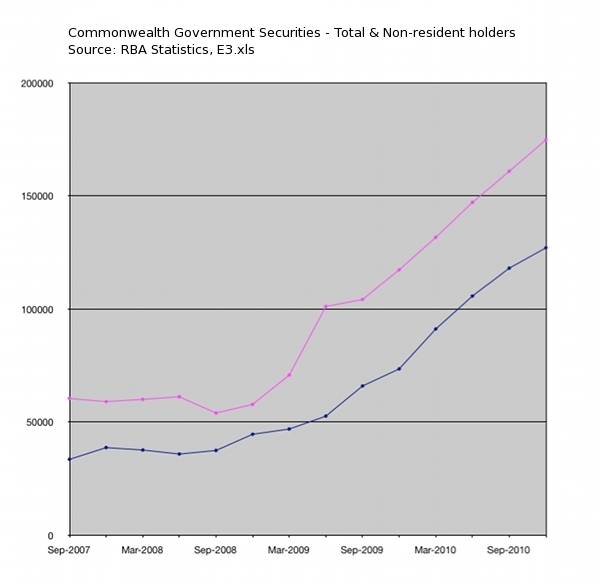
A little over a year later, we’ve had another look at those numbers (click to enlarge) –

Magenta - Total Public Debt. | Blue - Non-resident holders.

According to the updated RBA spreadsheet (“E3.xls”), at December 2010, $127.027bn in Commonwealth debt was estimated to be held by non-residents.  From a total of $174.794bn.

In other words, at December last year we owed $174.794bn.  And of that, $127bn – that is, 72.6% – was estimated to be owed to non-residents of Australia.

We ask again – Who exactly are the ‘non-residents’ who now own 72.6% (or more?) of our public debt?

McKibbin For PM 2010

23 Jun

Long something of an outsider – the lone outspoken voice of reason and commonsense on the otherwise “reserved” board of the Reserve Bank – Warwick McKibbin has again spoken out.  He has accused Rudd of panicking, and wasting huge sums of taxpayer money.

Who’d have thought!

From the Sydney Morning Herald:

A prominent university economist and member of the Reserve Bank board has delivered a scathing critique of Kevin Rudd’s response to the global financial crisis, saying his government ”panicked” and ”rammed through” decisions fraught with risk.

Warwick McKibbin, of the Australian National University, accused the government of overspending on its stimulus package, and then coming up with ”a really badly designed resource tax” to try to compensate.

And he described the government’s planned $43 billion national broadband network as ”a gigantic white elephant waiting to happen”.

It gets better.

McKibbin also attacks Treasury secretary Ken Henry.

Readers of this blog will know our scathing views of Henry’s “performance” before, during, and after the GFC.  We have been calling for him to be sacked… a call that is only now just beginning to resonate in the Opposition ranks.  And in the economic commentariat too. Highly esteemed business leader and commentator Robert Gottliebsen recently said this:

The position of Ken Henry as the head of Treasury is not sustainable.

Here’s what Professor McKibbin had to say about Henry:

Professor McKibbin also took aim at fellow Reserve Bank board member and Treasury secretary Ken Henry, accusing him of not only failing to consult experts on economic issues, but of trying to silence them…

(Professor McKibbin)… has told The Age he was stunned by Dr Henry’s call this week for academics to ”put down their weapons” and stop nitpicking over government proposals such at the emissions trading scheme.

”The ETS was a flawed scheme. Had the government got it through it would be dead by now because of the financial crisis,” Professor McKibbin said. ”I have enormous respect for Ken Henry, but he can’t believe that you should have consensus because it is better to have bad policy that everyone agrees with than eventually get good policy that will work.”

Enough of Henry. Really … enough!

Back to Rudd / Henry’s rushed and bungled “economic stimulus”:

And in a damning assessment of the government’s stimulus package, he (McKibbin) said: ”It wasn’t evidence-based policy, they panicked. They put the money into school buildings, they put it in insulation, they put it in stuff they could never reverse.

”The government rammed those decisions through the economy even though they were fraught with risk,” Professor McKibbin said. ”No one was consulted about an alternative view, and if you did say anything you were attacked by the Treasurer and the Prime Minister in public.”

He also accused the government of overspending on the stimulus package and then deciding that ”because of politics they had to get their spending back so they could claim they had fiscal surplus – for which there is no economic basis, by the way.

”So they come up with a really badly designed resource tax to try and get the position to look good three years from now and, in the middle of a sovereign risk crisis, exposed the economy to a reassessment of sovereign risk.”

Warwick, we need you in politics.  You have my vote.

McKibbin For PM 2010!

Bankers – The Root Of Evil

11 May

Banking was conceived in iniquity and born in sin. The Bankers own the earth. Take it away from them, but leave them the power to create deposits, and with the flick of the pen they will create enough deposits to buy it back again. However, take away that power, and all the great fortunes like mine will disappear — as they ought to in order to make this a happier and better world to live in. But, if you wish to remain the slaves of Bankers and pay the cost of your own slavery, then let them continue to create deposits.

Sir Josiah Stamp (1880-1941), one time governor of the Bank of England, in his Commencement Address at the University of Texas in 1927. Reportedly he was the second wealthiest individual in Britain.

Bankers have become even more ‘sophisticated’ in the many decades since Sir Josiah Stamp let the cat out of the bag. Now, not only do they create ‘money’ out of thin air by signing you up to a loan – which is entered into a computer as a brand new “deposit” for you to spend – they also ‘manufacture’ all kinds of ‘synthetic’ money substitutes too.

They’re called “derivatives”. Or, as Warren Buffet called them, “Financial weapons of mass destruction”.

And bankers can create as many of them as they wish, because there is absolutely zero regulation of the derivatives markets. To give you some idea, at the peak of the first wave of the GFC in 2008, there was around 1.44 Quadrillion $USD worth of OTC (“Over The Counter”) derivatives in existence.

Why is this important?

Because the $1 Trillion funding to save the Eurozone announced yesterday is meaningless.  The Eurozone cannot be saved, no matter how much money the EU tries to beg, borrow, steal… or print.  Because banksters like Goldman Sachs can simply create ever greater mountains of ‘synthetic’ derivatives with which to attack debt-laden countries, one by one, starting with the weakest.

From ZeroHedge:

Jim Rickards: “Goldman Can Create Shorts Faster Than Europe Can Print Money”

Jim Rickards, who recently has gotten massive media exposure on everything from the JPM Silver manipulation scandal, to the Greek default, was back on CNBC earlier with one of the most fascinating insights we have yet heard from anyone, which demonstrates beyond a doubt why any attempt by Europe to print its way out of its current default is doomed: “Look at what Soros did to the Bank of England in 1992 – he went after them, they had a finite amount of dollars, he was selling sterling and taking the dollars, and they were buying the sterling and selling the dollars to defend the peg. All he had to do was sell more than they had and he wins. But he needed real money to do that. Today you can break a country, you don’t need money you just need synthetic euroshorts or CDS. A trillion dollar bailout: Goldman can create 10 trillion of euroshorts. So it just dominates whatever governments can do. So basically Goldman can create shorts faster than Europe can create money.

The world is not ruled by politicians.  It is ruled by banksters.  Most of us simply don’t quite understand that, because we don’t understand how they do it.

It is very simple.  Well before most of us were born, bankers were given the exclusive power to create ‘deposits’.  Which you and I know as ‘debt’.  And which is now called ‘credit’ … because it appeals to our Pride, and sounds so much nicer, to delude ourselves that we have been given ‘credit’.

When in reality, what we have been given is a Debt.  By accepting the offer of ‘credit’ (Debt), we sell ourselves as slaves to the bankers.

They know it.  They’ve always known it.

Now you do too.

Credit Contraction Heralds Recession

5 May

Does a contraction in the growth of Broad Money Supply say that recession is looming?  Australia’s most recent history responds with a resounding ‘Yes’.

Take a look at the following chart, showing the 12 month percentage change in Broad Money Supply. Note in particular the time frame of Australia’s last recession – Paul Keating’s “recession we had to have” – back in the early 1990’s. See how Broad Money Supply growth peaked in June/July 1989, before falling sharply and eventually turning negative in Nov ’91 – Mar ’92  (click image to enlarge):

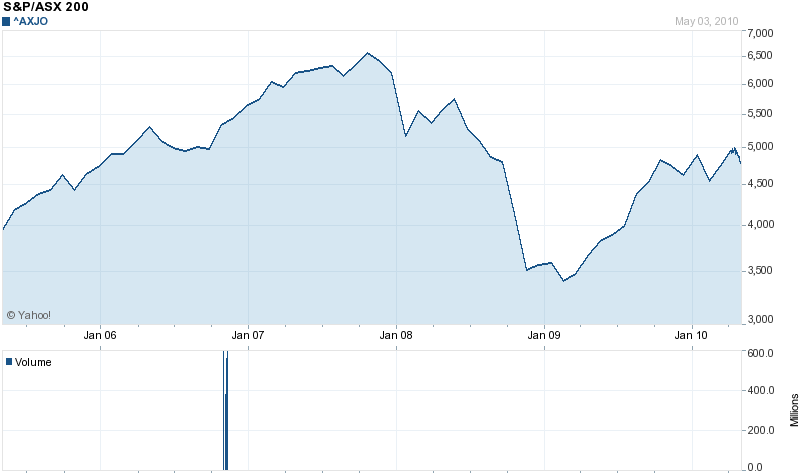
Now, consider the dates of the most recent peak (and fall), coinciding with the onset of the Global Financial Crisis.  Broad Money Supply growth peaked again in December 2007 – coincident with the peak in the Australian (and global) stock markets:


Broad Money Supply in Australia has been falling ever since December 2007.

According to John Williams of ShadowStats (commenting on the US economy) –

Money supply and credit are now generally contracting. We’re going to see an intensified downturn in the near future. I specialize in looking at leading indicators that have very successful track records in terms of predicting economic or financial turns. One such indicator is the broad money supply. Whenever the broad money supply–adjusted for inflation–has turned negative year over year, the economy has gone into recession, or if it already was in a recession, the downturn intensified. It’s happened four times before now, in modern reporting. You saw it in the terrible downturn of ‘73 to ‘75, the early ’80s and again in the early ’90s.

Greek Default Could Have Lehman-Like Impact

29 Apr

The rapidly spreading Greek debt contagion poses a very real and present danger to the Australian banking sector, and thus to our economy. Why? Because our banking system is desperately overreliant on sourcing its funding from the global capital markets.

From The Big Chair:

The chief executive of National Australia Bank, Cameron Clyne, referred last week to Australian banks’ dependence on wholesale funding markets as their Achilles heel.

The Treasury secretary, Ken Henry, has also talked about Australian banks not being “well insulated” from the fallout of events like the Lehman Bros collapse, and the International Monetary Fund has said Australian banks are exposed to rollover risks on their short-term wholesale funding.

On average, Australian banks are sourcing just under a third of their funding from overseas wholesale markets and still too much of their existing borrowings are short term.

Australian banks are among the more vulnerable plays in the world to another Lehman-style event because of their dependence on overseas wholesale markets, which have proven already they can freeze up for extended periods.

It is these very same wholesale markets that are now trembling with trepidation at the consequences of the Greek – and now Eurozone – debt crisis.

From the UK’s Independent:

Why does Greece’s debt crisis matter to the rest of us? The answer, in a word: contagion.

If Greece defaults or crashes out of the euro it will send an almighty shockwave through the global capital markets. First of all, French and German banks, which are estimated to hold up to 70 per cent of Greece’s debt, will register writedowns. If their exposure is great enough, they could even go bust.

The fear that commercial banks were on the verge of failure was responsible for the last credit crunch as financial firms grew wary of lending money to each other at anything other than penal interest rates. If that fear of failure returns, we might witness another savage contraction in lending. And another credit crunch would open the way for the long-feared “double dip” recession.

Most Australians remain oblivious to this threat of another, much larger wave of the GFC. Doubtless this is largely because our “experts” continue to tell us that the GFC is “over”, while preaching the dawning of a “period of unprecedented prosperity”, and downplaying any concerns for this country. Just as they did in 2008 when they all completely failed to foresee the onrushing first wave of the GFC.

From The Australian (Feb 2010):

Investor confidence was roiled in recent weeks on fears of sovereign default in Europe and some signs that the broader global economic recovery was slowing as policy stimulus measures wound down.

Dr Debelle (Assistant Governor of the RBA) said risks that still existed did not relate to Australia or Asia, however, where bank balance sheets remained in sound condition – instead they referred to banks in Europe and the US, where poor macroeconomic conditions were expected to weigh on loan books.

How Long Has The Lucky Country Got?

31 Mar

Edward Chancellor is the author of the classic text on financial manias, Devil Take the Hindmost. In 2005 he wrote Crunch time for credit: An enquiry into the state of the credit system in the United States and Great Britain, in which he correctly predicted the GFC. His recent report for Boston-based GMO outlined ten signs of a mania in progress, and showed that the Chinese economy meets all ten of those signs. He has also written recently about the Australian housing mania.

From the Financial Times:

Between 1996 and 2006, US home prices rose by nearly 90 per cent in real terms. Australian home prices rose by roughly the same amount.

Over this period, the US private sector increased its indebtedness by two-thirds of GDP. Australian private debt increased by a similar magnitude. Over the past three years, US home prices have fallen by 30 per cent, according to the S&P/Case-Shiller Composite Index. American households have started to deleverage. By contrast, Australian home prices have climbed 30 per cent since 2006 and households continue to pile on debt.

There are a number of explanations for this divergence…

While other governments expended their resources on shoring up busted banks, the Australian stimulus went straight to consumers. Fiscal transfers increased personal disposable incomes by 4 per cent, according to Professor Steve Keen of the University of Western Sydney. Canberra also bolstered the housing market, raising the subsidy for first-time home buyers to a maximum of A$21,000 (£12,200, €14,000, $18,600). Rising home prices arrested incipient deleveraging by Australian households. Outstanding mortgage debt has actually grown by 6 per cent of GDP since February 2009.

Australia may have been fortunate. But it is not out of the woods. For a start, the real estate market remains in bubble territory. Australian home prices are currently some 70 per cent above their long-term trend level. A recent survey by Demographia International finds that all of Australia’s major housing markets were valued at more than five times average incomes, and defines them as “severely unaffordable.” Initial mortgage payments for a home in Sydney or Melbourne are likely to exceed half of your disposable income, claims Demographia. The Australian housing market looks vulnerable to further rate rises.

Then there are the waning effects of the government’s stimulus to consider. The extra subsidy for first-time home buyers ended last year. The removal of this grant could have a similar effect on Australian real estate as the UK government’s reduction in mortgage interest relief in 1988, which killed off the frenzied Lawson housing boom. Prof Keen claims the first-homeowner’s grant has sucked people into the housing market who would not otherwise have bought. One report suggests many recent first-time buyers in Australia are already struggling to meet payments. This is eerily reminiscent of early stage delinquencies on subprime loans in the US back in late 2005. Australia is also exposed to the removal of China’s stimulus measures. China’s actions boosted commodity prices and improved Australia’s terms of trade. Now, Beijing appears more concerned about inflation and potential bad loans from uneconomic investments.

Aussie house prices have not fallen since the early 1950s. A certain complacency is therefore understandable. Yet not long ago many Americans also believed that domestic home prices could never fall. So far Australia has avoided its day of reckoning. But how long will the lucky country’s luck last?

Not long at all.

A recent survey of 26,000 mortgage borrowers showed that:

Almost half of first-home buyers lured into the market by the Rudd Government’s $14,000 grant are struggling to meet their mortgage repayments and many are already in arrears on their loans.

Thousands of young home buyers are using credit cards or other loans to meet obligations, while those in “severe stress” are missing payments.

Just weeks after the grant was withdrawn, a survey of more than 26,000 borrowers conducted by Fujitsu Consulting has found 45 per cent of first-home owners who entered the market during the past 18 months are experiencing “mortgage stress” or “severe mortgage stress”.

On Monday, RBA Governor Glenn Stevens appeared on commercial TV – an unprecedented act by an RBA official – to warn the public about the dangers of the property market.

On the same day, I came across the following comment by a reader of The Australian newspaper:

Waiting for the “correction” Posted at 1:22 PM Today

Now here’s something interesting. My “relationship manager” at Westpac says the housing market is heading for a “significant correction” because the major banks are about to insist on much higher deposits because of their alarm at the amount of questionable loans on their books. This guys says the word is that the Commonwealth will soon insist on a 30 per cent deposit for new purchases and then only to existing customers. “When that kind of thing happens, the heat will immediately go out of the market so stay out of it till the dust settles”. This bloke says Westpac is especially worried about the impact of the first home buyers grant and they’re already seeing significant loan defaults as interest rates rise. “These people took their $14-thousand, then got Mum and Dad to throw them the rest of their deposit because they were led to believe they’d miss the boat. Kevin Rudd has used taxpayer funds to entice a whole lot of young people into buying places they couldn’t afford and going bankrupt as interest rates rise”. That’s a direct quote from a guy at Westpac who used to be in the business of throwing money at you. God’s honour. Maybe the South Seas bubble IS about to pop?

To learn more about the dangers of debt, and how it has fueled the Australian housing bubble, visit the website and blog of Professor Steve Keen.

Special Note:

On April 15th through 23rd, I will be joining Professor Keen in his 230km “Keenwalk” from Parliament House to Mount Kosciuszko, in protest against Australia’s property (and debt) mania that has been driven directly by Federal Government and RBA policies.

Please consider joining us, for the whole trek or even just for an afternoon section of the walk.

If you’d care to assist a genuinely worthy cause, then please consider sponsoring Professor Keen, or indeed myself. Funds raised will support the wonderful charity Swags For Homeless.

Thanks!

Junk Bonds Record in ‘Goldilocks’ Market

29 Mar

From Bloomberg:

Junk bond sales reached a record this month as rising profits and record low Federal Reserve interest rates foster lending and investment to the lowest-rated borrowers.

Companies worldwide issued $38.3 billion of junk bonds this month, passing the previous high of $36 billion in November 2006, according to data compiled by Bloomberg. Yields fell 0.95 percentage point this month to within 5.96 percentage points of government debt, the narrowest gap since January 2008, Bank of America Merrill Lynch index data show.

This is “an almost ‘Goldilocks’ environment for leveraged credit markets,” JPMorgan Chase & Co. analysts led by Peter Acciavatti, the top-ranked high-yield strategist in Institutional Investor magazine’s annual survey for the past seven years, said in a March 26 report to the bank’s clients.

This is very bad news.

There has been growing concern around the world that the sales of junk bonds prior to the GFC will lead to a junk bond apocalypse in 2012:

“An avalanche is brewing in 2012 and beyond if companies don’t get out in front of this,” said Kevin Cassidy, a senior credit officer at Moody’s.

Private equity firms and many nonfinancial companies were able to borrow on easy terms until the credit crisis hit in 2007, but not until 2012 does the long-delayed reckoning begin for a series of leveraged buyouts and other deals that preceded the crisis.

Now, the ongoing Zero Interest Rate Policy (ZIRP) in the USA, and near zero interest rates in Japan and many other developed nations, has led to a new record in the sales of those same high risk ‘junk bonds’.

In other words, central banks and governments around the world are adding more fuel to the fire.

RBA Concerned About Greece

16 Mar

And about time too!

From The Australian:

The Reserve Bank lifted the cash rate to 4 per cent in early March in response to two months of data suggesting the economy might be growing at or close to trend.

But board members expressed concern that the fallout from the Greek financial crisis might have implications for the Australian economy, the minutes of the RBA’s March 2 board meeting say.

The minutes show the central bank was concerned about the possibility of contagion, that the Greek problem could spread to other parts of Europe.

“The main risk was the possibility of contagion to other sovereigns and perhaps other markets, primarily in the euro area.

“Members agreed the fiscal problems in Europe, if not resolved satisfactorily, could result in renewed turmoil in markets and fresh weakness in the global economy, which could have implications for Australia.

However, the RBA’s wishful thinking remains strong:

“But while that outcome could not be ruled out, it was not the most likely one.”

I would like to see RBA Governor Glenn Stevens and his cohorts called before the Senate, and forced to actually justify their crystal-ball gazing confidence  by producing real evidence.

They completely failed to predict the GFC.  That EPIC failure cost Australians literally billions in lost retirement savings and investments.

Why should we believe the RBA’s judgement is correct now?

Especially when there are ever-growing contrary views rolling in daily, from all around the world.  Many from those who did predict the GFC!

And they do not share the RBA’s judgement.

Design a site like this with WordPress.com
Get started