Tag Archives: RBA

China Warns of Double-Dip Recession

15 Mar

From The Australian today:

China’s Premier, Wen Jiabao, has warned that the world risks sliding back into recession and says his country faces a difficult year trying to maintain economic growth and spur development.

“The unemployment rate of the world’s main economy is still high, some countries’ debt crises are still deepening, and the world’s commodity prices and exchange rates are not stable, which are most likely to become the cause of any setback in the economic recovery,” Mr Wen said yesterday in Beijing’s Great Hall of the People.

China’s and Australia’s economies have become more intertwined in recent years: the country is now our largest trading partner with two-way trade surging to $83 billion in the year ending last June 30, and in December it passed Japan as our largest export market.

Any trouble in China’s economy would quickly resonate in Australia.

Perhaps Treasury Secretary Ken Henry might care to revise his recent declaration that the GFC is ‘over’?

Perhaps Henry, along with RBA Governor Glenn Stevens, and all their many mindless cheerleaders in the media, might pause to reconsider their claims that ‘the risk of serious contraction‘ has passed, and that Australia is now set to enjoy a multi-decade China-fueled mining boom?  One that will fix the massive Rudd hole in the Budget, and provide a “period of unprecedented prosperity” for Australia?

Please… inform yourself.  Understand what is really going on in the financial world. Unlike the lazy, short-sighted economic illiterates who are running this country.

Please browse through the posts on this blog, and follow the links that catch your eye.

You will find references and links to literally dozens of articles from around the world.  You will see that international economists, investors, financiers, world leaders, and many others, have been increasingly warning of the many threats to the global economy. And thus, to Australia’s economy too.

Our Australian economic “authorities” are living in La la land.

Only Barnaby is on the ball.

Rudd Labor, Ken Henry, RBA and friends

Who Owns Our Debt?

14 Mar

Yesterday I wrote an article commenting on the SMH economics editor Ross Gittins’ column about Australia’s foreign debt.

Something else Mr Gittins claimed in his article caught my notice and bugged me overnight:

What’s that you say? You thought the pollies had done little else but spar about deficits and debt? Sorry, different debt. They’ve been arguing about the public debt – the amount the federal government owes (mainly to Australians).

Mr Gittins is apparently claiming that when the Australian Government issues Commonwealth Securities to raise money, that these are mainly bought by Australians – investors, super funds, banks, big companies, etc.

But is that true?  Is our public debt “mainly” owed to Australians?

I decided it might be nice to know for sure.  Not just take Ross Gittins’ word for it.

In the RBA’s Statistics section, spreadsheet “E9.xls” – Commonwealth Government Securities Classified By Holder as at June 30, I found something interesting…

Continue reading ‘Who Owns Our Debt?’

15x More Debt

9 Mar

From the Sydney Morning Herald:

Australians now owe financial institutions more than $1 trillion in housing mortgages, almost 15 times as much as 20 years ago, new Reserve Bank figures show.

The Reserve revealed that people paying off their own homes now owe banks and other lenders $763 billion – almost 12 times more than the $65 billion owed in January 1990, when figures were first compiled.

Rental investors have increased their mortgage debt even more spectacularly. In January 1990, landlords owed banks $10.5 billion, but by January this year, the figure had swollen more than 30 times over, to $324 billion.

Household disposable income also rose in that period, but it only trebled. In January 1990, home mortgages ate up just 28 per cent of our disposable income. By January 2000, that had ballooned to 66 per cent, and by January this year, it doubled again to 134 per cent.

Even in the past year, despite the global financial crisis, the debt we owe on home mortgages climbed relentlessly, up $83.5 billion to $1087 billion.

Households’ willingness to take on greater debt powered much of Australia’s economic growth from 1990-2010 but with our households now as indebted as any in the Western world, economists say that will not be repeated.

This is a perfect illustration of how the Reserve Bank of Australia has indebted the nation by its inflationary policies, that have made our currency lose 968.1% of its buying power.

By creating ever more money (as debt, or ‘credit’ loaned to home buyers and consumers), the prices for everything are silently, relentlessly pushed ever higher.

But our wages never rise enough to match. So, we are driven ever more deeply into debt.

Now that Rudd Labor has so rapidly indebted the Federal government as well, we are in huge financial danger.  There is simply no ‘capacity’ for households, or the government, to keep on spending and support the economy when another crisis strikes.

Thanks to too much debt, the only way forward is… even more debt. And we all know what happens when you reach a point where your debt is so great that you cannot pay it back.

RBA Robs Us By Stealth

8 Mar

Ever wonder why things cost so much more today, than they did when you were a child?

Here’s a simple little exercise that shows how the Reserve Bank of Australia has robbed all of us by stealth. And continues to do so.

Take a look at the RBA’s Inflation Calculator.  Try it out for yourself. And be prepared for quite a shock.

Australia changed from the old imperial currency (pounds, shillings, pence) to decimal currency (dollars and cents) in 1966. So let’s take a look at how RBA-managed inflation has robbed us blind since 1966.

According to the RBA’s own calculator, an item costing $10 in 1966 would have cost you $106.81 in 2009.

Helpfully, their calculator also tells us that equals 968% inflation.  In 43 years.  At an average rate of 5.7% per year.

Why is this so important to know?  Because – as you can easily see –  inflation robs the national currency of its “buying power”.  Simply and bluntly, inflation robs you and I, the “working families” of Australia.

Continue reading ‘RBA Robs Us By Stealth’

Digging A Hole For Ourselves

5 Mar

From The Age:

In a series of speeches in recent days, senior economic officials from Reserve governor Glenn Stevens down have spread the same message: the brief interruption of the global financial crisis is over, and Australia has gone back to where it was – into a resources boom so big it will dwarf the booms of the late ’60s and early ’80s.

The Reserve Bank’s best and brightest argue that this will be good for Australia because it will allow us to earn more income now than we would if the minerals stayed in the ground for a few more years.

With the greatest respect, I sharply disagree. I think we need a national debate on whether it really is in our interests to try to sell off our mineral wealth as rapidly as possible, as our economic leaders believe…

We need to think hard about this. The implicit argument from our officials is that we should allow otherwise-viable industries to be put down in the interests of making room for us to extract as many minerals now as possible.

This is wrong: not just because they are picking winners, or just because China, too, has its vulnerabilities and could fall, but because you don’t put all your eggs in one basket.

We need to keep a mix of strong, diverse industries to guarantee our future. We need to debate how we do that, and learn from how others do it.

Stevens: ‘Risk of Serious Contraction’ Passed

2 Mar

The man who did not see trouble all around in 2008, continually raising interest rates right into the teeth of the GFC, has raised rates again today:

RBA governor Glenn Stevens said the “risk of serious economic contraction” had passed, and an economy that was growing faster than expected would warrant higher interest rates for the rest of the year.

Stevens clearly believes that the Australian economy is magically immune from the sovereign debt crises in the Eurozone, UK, USA, and Japan, and the massive speculative real estate bubble in China.

However, the Rudd Labor government no longer has a $20+ Billion budget buffer inherited from the previous government. Instead, they have put Australia into unprecedented debt that we can never pay back.

Stevens, allegedly a devout Baptist, had best start praying fervently that all the ongoing financial crises in the rest of the world somehow resolve themselves.  Else he will again be shown as a fool… at a terrible price to the Australian public.

Stevens’ Nonchalance ‘Stunning’

2 Mar

This excellent article by David Uren at The Australian suggests that he may be the only mainstream journalist in Australia who is awake to international developments, and not in awe of every utterance from RBA Governor Glenn Stevens:

If the Reserve Bank raises rates again tomorrow, it will risk repeating the mistake it made in early 2008, when it failed to see the global financial crisis coming.

Now, as then, it is beguiled by soaring commodity prices and believes Australia can shrug off what it sees as essentially local woes in the industrialised world.

In 2008, it was the subprime crisis, and today it is the sovereign debt crisis, focused for the moment in Europe.

Glenn Stevens’s nonchalance about the Greek debt crisis at the recent parliamentary hearings was stunning.

It had been no more than a marginal influence on the RBA’s decision to hold rates steady in February, he said.

“There is a bit of uncertainty about how all of that is going to be resolved. I do not think, myself, at this point, that those issues will directly present a serious problem for Australia. After all, it is a sovereign debt issue for Europe.”

Europe still represents about a quarter of world GDP and its unity and sound finances matter a lot for global financial stability.

US academics Kenneth Rogoff (a former IMF chief economist) and Carmen Reinhart have been among the most influential analysts of the developments of the past two years because of their analysis of crashes in 66 countries stretching back two centuries. “Serial default remains the norm,” they say.

There is often a lag of some years, leading policymakers to believe “this time it is different”.

Rogoff, who did predict the GFC, is currently warning that China is in a bubble, one that he believes will burst within ten years. If so, then so much for the belief that Australia is on the verge of a new China-fuelled mining boom.

Glenn Stevens appears to be in a bubble of his own, oblivious to the ever-growing warnings from leading international economists about the Eurozone crisis, and/or a new Asia Crisis triggered by the inevitable bust of China’s real estate bubble.

A man who apparently does not learn from his epic failures of the past, should no longer be permitted to retain such enormous power over the economy, and the lives of 22 million Australian citizens.

Henry Sees Cyclical Angel Descending

26 Feb

As recently as October 2009, Treasury Secretary Ken Henry predicted a Golden Age for the Australian economy, that will “stretch to 2050”:

“While the global financial crisis has taken some of the heat out of our export prices, we should get used to the idea that we could have structurally higher terms of trade for some time, possibly for several decades,” he said.

In a speech at the Brisbane University of Technology, Henry said Australia’s population will grow as the mining boom, fuelled by demand from China and India, will continue to bring in immigrant workers. Handled correctly, he said, this could provide a “period of unprecedented prosperity”.

Henry pointed to growth in several Asian countries, which he said will give a boost to the mining boom that will see it last for several more decades into 2050.

Just one week ago, RBA Governor Glenn Stevens‘ colleague, Assistant Governor Philip Lowe, also had a vision of the cyclical angel returning from the heavens:

I am quite optimistic that story has some decades to run and that underlies much of the positives for the Australian economy,” Lowe told an economic development forum in Sydney.

“It is going to be a good 20 years for China and us,” he said.

And only 3 days ago, RBA Deputy Governor Rick Battelino too, joined in the angel chorus:

Mr Battellino was uncertain about how long the current boom would last, but said past booms had lasted around 15 years.

“On this occasion, the growth potential of countries such as China and India suggests that the expansion in resource demand could continue for an extended period, though this will depend at least to some extent on the economic management skills of the authorities in these countries, not to mention our own,” he said.

Illustration - nicholsoncartoons.com.au

Reassuring stuff. Or is it?

Three days ago, former Morgan Stanley chief Asia economist Andy Xie and hedge fund manager James Chanos saw something rather different:

“There’s a monumental property bubble and fixed-asset investment bubble that China has underway right now,” Chanos said. “And deflating that gently will be difficult at best.”

A glut of factories in China is “wreaking far-reaching damage on the global economy,” stoking trade tensions and raising the risk of bad loans, the European Union Chamber of Commerce in China said in November.

The risks are so great that a decade of little or no growth, as Japan experienced in the 1990s, can’t be dismissed, said Patrick Chovanec, an associate professor in the School of Economics and Management at Beijing’s Tsinghua University.

And two days ago, the former chief economist of the International Monetary Fund, Professor Ken Rogoff, also failed to see a Chinese cyclical angel descending. He saw the angel of doom:

China’s economic growth will plunge to as low as 2 percent following the collapse of a “debt- fueled bubble” within 10 years, sparking a regional recession, according to Harvard University Professor Ken Rogoff.

“We would learn just how important China is when that happens. It would cause a recession everywhere surrounding” the country, including Japan and South Korea, and be “horrible” for Latin American commodity exporters, he said.

Rogoff was one of very few economists who predicted the GFC.

Ken Henry, and all the boffins at the RBA… did not.

No, We Cannot Pay Our Debt

26 Feb

Here’s another picture that tells a thousand words.

Yesterday Barnaby wrote in The Australian about the annual Budget surpluses needed to pay back Labor’s ever rising debt ($1 Billion more today alone; another $1.8 Billion next week):

Let’s talk about the abundance of faith exhibited by Labor when it tells us of the eight consecutive $19bn surpluses that are required to bring the budget back into orbit when the continued stresses on the international economy are clear and evident, especially in Europe.

On the ABC’s Q&A program on Feb 15th, Barnaby pointed out that Labor’s “plan” to return the Budget to surplus is pure fantasy:

We have always got the view that you should try and reduce tax but the first thing, without harping on it, we’ve got to deal with the debt and because they keep racking up debt, that takes away our capacity to reduce your tax and there’s no other way around it. You either increase your revenues, decrease your costs – they talk about productivity and sort of the cyclical angel descending from heaven and making everything better

Well, just what is the likelihood of that cyclical angel descending?  And even if it does, can it produce eight consecutive surpluses of $19 Billion?

Decide for yourself.

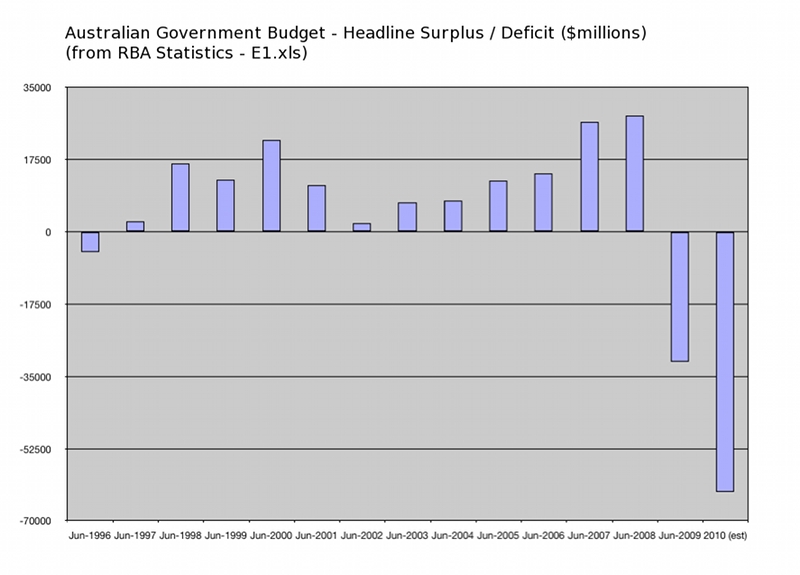
Below is a chart of Australian Government Budget surplus / deficits, dating back to the beginning of the Howard Government. Source is the Reserve Bank of Australia’s Statistics section. Click on the chart to enlarge –

This country has never seen anything like eight consecutive years of $19 Billion surpluses. In fact, the Howard Government achieved it just 3 times… in 12 years… during an unprecedented mining boom.

Barnaby is right.

Stevens – Australia’s Most Useless?

26 Feb

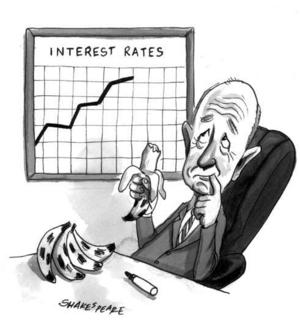
Illustration - John Shakespeare

In recent days the mainstream media have made much of Reserve Bank of Australia Governor Glenn Stevens’ response to comments made by Barnaby Joyce concerning Australia’s rising debt levels:

‘‘There has never been an event of sovereign default by Australia,’’ Mr Stevens told a parliamentary hearing in Canberra. ‘‘I very much doubt there ever will be.’’

Now, don’t you feel reassured? After all, if the esteemed Governor of the RBA is not worried, then why should you be?

Think again. This is the same “expert” who utterly failed to foresee any warning signs of the impending Global Financial Crisis. Indeed, Stevens kept raising interest rates right into the teeth of the GFC, prompting this scathing response from the Daily Telegraph:

The nation’s most powerful economic figure has committed a double betrayal of working families – urging big banks to ignore the RBA’s official interest rate and saying taxes could be increased.

For the second time in a fortnight, Reserve Bank Governor Glenn Stevens has gone public to encourage the biggest lenders to go beyond the current official interest rate and slug mortgagees at a higher rate.

His controversial comments effectively render him useless – because it is a key part of his job as Reserve Bank governor to use official interest rates as a guide for the major banks as to what they should charge on mortgages.

“I can’t tell you at what point rates will come down. I can’t promise they won’t rise. I can’t tell you that, mainly because I don’t know,” Mr Stevens said yesterday.

Note the date of those comments by Stevens. April 4, 2008. His last interest rate rise prior to the GFC, was on March 4, 2008, taking the official cash rate to 7.25%.

Less than 2 weeks after Stevens had again raised Australia’s interest rates, US banking giant Bear Stearns collapsed.

Less than 6 months later, all hell broke loose with the collapse of Lehman Brothers… the biggest corporate collapse in US history.

From September 2008, Stevens had to chainsaw 400 basis points (4%) off the cash rate, in a frantic bid to save the Australian economy from imploding.

Remember that, for next time you hear the media again twisting Stevens words into an alleged putdown of Barnaby Joyce’s concerns.

Design a site like this with WordPress.com
Get started