Tag Archives: sovereign debt

Henry: GFC Is ‘Over’

28 Feb

Earlier this month, Treasury Secretary Ken Henry declared that the Global Financial Crisis is “over”:

“What people have called the global financial crisis, that has passed, I think it’s safe to say,” Dr Henry said. “But that isn’t to say that there will not be further adverse shocks for financial markets down the track and some of those shocks … could be of some significance for individual countries, but I don’t imagine (they would be) shocks of the sort that would be globally significant.”

Remember that claim.

Ken Henry did not see the GFC coming in the first place. He later claimed that “only extraordinarily good forecasters” would have predicted the GFC.

Well, that would be lots of extra-ordinary folk like me then, Ken. Even I could see it coming, from late 2005. And despite the ridicule (familiar story?) of “trained” “expert” financial advisers, I chose to pull all my superannuation out of the sharemarket into cash in May 2007, completely avoiding the global crash that has wiped out the investments and retirement savings of countless millions –

Historical performance chart assumptions: Performance is calculated on an initial investment of $10,000, using entry to exit prices, with distributions reinvested. A 4% contribution fee has also been applied. This information is general information only


And what about those international economists who publicly warned of a looming GFC, Ken?  Men such as professors Ken Rogoff and Nouriel Roubini, and our very own “Dr Doom”, Professor Steve Keen?

You’d think Henry might have learned a few lessons about wide-ranging research… and caution… given his utter failure to foresee what many others did.  So has he learned anything?

Clearly not.

Henry presently remains ignorant of, oblivious to, or (worse) rejects the numerous dire warnings coming daily from all around the world. Not just from Barnaby Joyce, but from many leading international economists – several of whom did predict the GFC – who are now genuinely concerned with multiple threats to the global economy. Everything from the European debt crisis, to the China property bubble.

Scarily, it has become increasingly obvious that Ken Henry is the man who really holds the reins of Australia’s economy, since PM Rudd, Treasurer Swan, and Finance Minister Tanner, are all totally unqualified economic imbeciles. Never forget, all of them were frantically talking up “the inflation genie” danger in 2008, even as the GFC tsunami was breaking over the world economy.

If (when) it all goes pear-shaped… again… Ken Henry must be sacked.

Can We Even Pay The Interest?

27 Feb

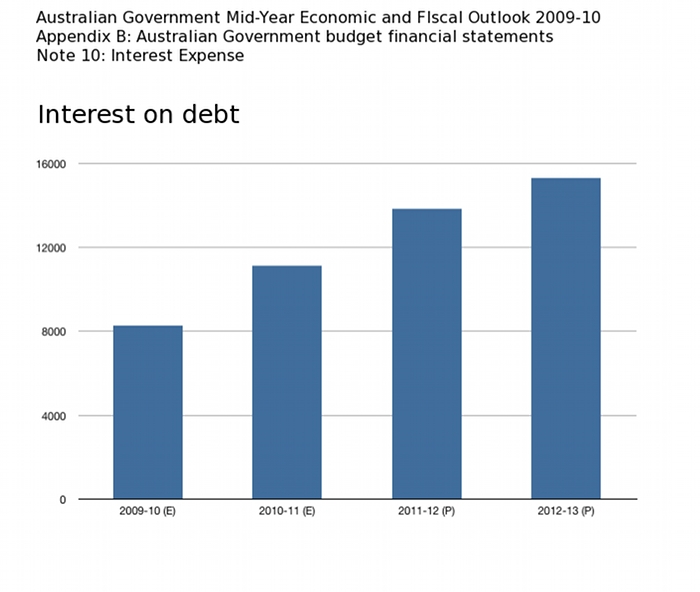
Estimated (E), Projected (P)

It seems that every man and his dog… except Barnaby Joyce… happily takes for granted the popular claim that Australia’s sovereign debt levels are nothing to worry about.  But have you ever stopped to think about whether we really can pay back the debt?

I made the chart above using the data from the Government’s Mid-Year Economic and Fiscal Outlook (MYEFO) 2009-10 Budget statements. It shows Treasury Secretary Ken Henry’s projected Interest on debt for this financial year, and the following three years. Those are interest-only repayments that Kevin Rudd incurred, and now we-the-taxpayers have to pay.

Doesn’t look too bad, you say?  An Interest bill starting at $8.26 Billion for 2009-10, rising to $15.28 Billion for 2012-13? Surely your $900 “bonus” cheque, and your dodgy roof insulation from the Fairy Ruddfather, make paying this Interest bill worthwhile?

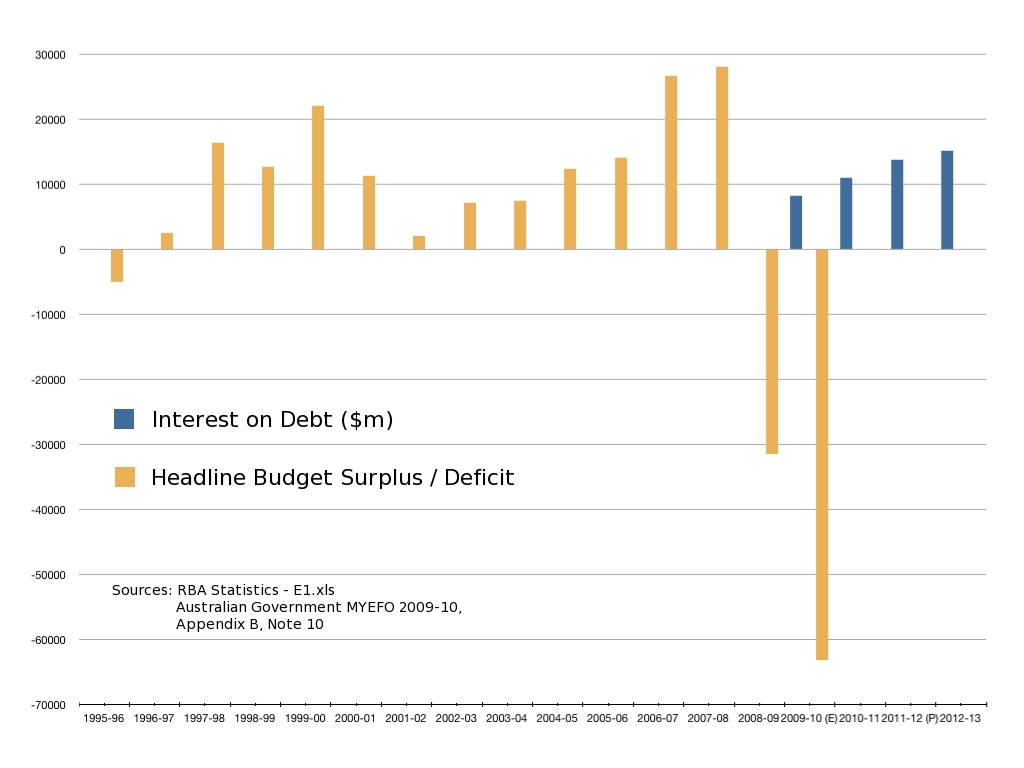
To put it into perspective, I’ve put together another chart (below).  It shows the Australian Government headline Surplus / Deficits going back to 1996, and adds in the projected Interest on debt (in blue) from the above chart. Simply click on the chart to enlarge –

As you can see, Ken Henry’s projected Interest on debt alone is greater than many of the 12 years of Howard Government surpluses. And they came during an unprecedented mining boom.

One other thing. Can anyone really believe Ken Henry’s projections?  This is a man who could not see the GFC coming.  And even now, he is confidently predicting a “Golden Age” of “unprecedented prosperity” for Australia, one that could “stretch to 2050”. All thanks to his belief in a 4o year continuous boom in China.  He is clearly ignorant of the fact that more and more leading international economists… including some who did predict the GFC… are now predicting that China is a bubble that will bust within ten years.

Paying back the projected Interest-only will obviously be a big challenge. So try to imagine how we are ever going to pay back the principal too.

Barnaby Joyce has recently stated that it would take eight (8) consecutive years of $19 Billion surpluses to bring the budget back to earth.  As you can see from the chart above, the Howard Government achieved a budget surplus that big only 3 times… in 12 years.

It is easy to see why Barnaby is so concerned about our ever-rising debt under Rudd Labor.

Because quite simply, we can not pay it back.

Greek PM: Worst Fears Confirmed

27 Feb

Greek Prime Minister George Papandreou told parliament on Friday, after a visit by EU economic inspectors, that the worst fears about Greece’s economy had been confirmed:

“Everything that was revealed after the elections proved that New Democracy (the previous, conservative administration) fled from its responsibilities,” Papandreou said. “History confirmed our worst fears.”

“The damage is incalculable. It is not only financial or fiscal but also affects the position of the state …

“Our duty today is to forget about the political cost and think only about the survival of our country.”

“There is only one dilemma: Will we let the country go bankrupt or will we react? Will we let the speculators strangle us, or will we take our fate in our own hands?” Papandreou said.

“We must do whatever we can now to address the immediate dangers today. Tomorrow it will be too late, and the consequences will be much more dire,” he added.

Leading economists around the world have been warning of dire consequences for the international economy should the Greek debt crisis become a contagion that spreads around the globe.

Yet in Australia, Senator Barnaby Joyce is ridiculed by all and sundry, for daring to warn of the impacts on Australia from this looming international sovereign debt crisis.

A crisis that Barnaby’s esteemed critics cannot see coming. Again.

No, We Cannot Pay Our Debt

26 Feb

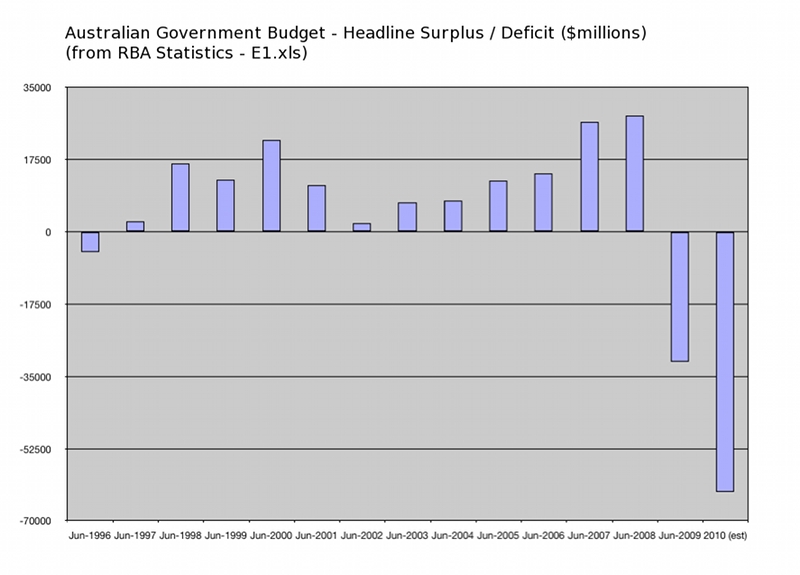
Here’s another picture that tells a thousand words.

Yesterday Barnaby wrote in The Australian about the annual Budget surpluses needed to pay back Labor’s ever rising debt ($1 Billion more today alone; another $1.8 Billion next week):

Let’s talk about the abundance of faith exhibited by Labor when it tells us of the eight consecutive $19bn surpluses that are required to bring the budget back into orbit when the continued stresses on the international economy are clear and evident, especially in Europe.

On the ABC’s Q&A program on Feb 15th, Barnaby pointed out that Labor’s “plan” to return the Budget to surplus is pure fantasy:

We have always got the view that you should try and reduce tax but the first thing, without harping on it, we’ve got to deal with the debt and because they keep racking up debt, that takes away our capacity to reduce your tax and there’s no other way around it. You either increase your revenues, decrease your costs – they talk about productivity and sort of the cyclical angel descending from heaven and making everything better

Well, just what is the likelihood of that cyclical angel descending?  And even if it does, can it produce eight consecutive surpluses of $19 Billion?

Decide for yourself.

Below is a chart of Australian Government Budget surplus / deficits, dating back to the beginning of the Howard Government. Source is the Reserve Bank of Australia’s Statistics section. Click on the chart to enlarge –

This country has never seen anything like eight consecutive years of $19 Billion surpluses. In fact, the Howard Government achieved it just 3 times… in 12 years… during an unprecedented mining boom.

Barnaby is right.

Roubini: ‘Risky Rich’ Countries in Greatest Danger of Default

26 Feb

New York University Professor Nouriel Roubini – famous for having predicted the GFC in 2006 – again defies the so-called ‘conventional wisdom’ by warning that it is the “risky rich” countries who are in greatest danger of sovereign debt default:

Today’s swollen fiscal deficits and public debt are fueling concerns about sovereign risk in many advanced economies. Traditionally, sovereign risk has been concentrated in emerging-market economies. After all, in the last decade or so, Russia, Argentina, and Ecuador defaulted on their public debts, while Pakistan, Ukraine, and Uruguay coercively restructured their public debt under the threat of default.

But, in large part – and with a few exceptions in Central and Eastern Europe – emerging-market economies improved their fiscal performance by reducing overall deficits, running large primary surpluses, lowering their stock of public debt-to-GDP ratios, and reducing the currency and maturity mismatches in their public debt. As a result, sovereign risk today is a greater problem in advanced economies than in most emerging-market economies.

Greek Crisis Coming to America

26 Feb

Professor Niall Ferguson, recently seen on ABC TV in his acclaimed documentary series The Ascent of Money, writes for the Financial Times:

It began in Athens. It is spreading to Lisbon and Madrid. But it would be a grave mistake to assume that the sovereign debt crisis that is unfolding will remain confined to the weaker eurozone economies. For this is more than just a Mediterranean problem with a farmyard acronym. It is a fiscal crisis of the western world. Its ramifications are far more profound than most investors currently appreciate…

What we in the western world are about to learn is that there is no such thing as a Keynesian free lunch. Deficits did not “save” us half so much as monetary policy – zero interest rates plus quantitative easing – did. First, the impact of government spending (the hallowed “multiplier”) has been much less than the proponents of stimulus hoped. Second, there is a good deal of “leakage” from open economies in a globalised world. Last, crucially, explosions of public debt incur bills that fall due much sooner than we expect.

This Crisis Won’t Stop Moving

26 Feb

From the New York Times:

You know we’re in trouble when we’re told that the economic problems in Greece, Portugal and Spain, the most indebted countries in the euro zone, are likely to remain safely contained in those nations.

After all, we heard the same nonsense in 2007 from United States financial leaders talking about the subprime mortgage mess. Both Ben S. Bernanke, the chairman of the Federal Reserve Board, and Henry M. Paulson Jr., then the Treasury secretary, rolled out to reassure concerned investors that troubles in mortgage land wouldn’t permeate the rest of the economy.

As we all now know, mortgage woes were contained — to planet Earth. And so it may be with overleveraged nations in Europe.

Simply put, contagion is a fact of life in our interconnected global economy and financial markets. And that means investors must strap in for more gyrations in the stock and bond markets as the great and painful deleveraging that began in 2007 continues around the world.

Hummel: The US Will Default On Its Debt

26 Feb

Barnaby warned about the possibility of US sovereign debt default. San Jose State University economist, Professor Jeffrey Rogers Hummel, makes a prediction:

It is not literally impossible that the Federal Reserve could unleash the Zimbabwe option and repudiate the national debt indirectly through hyperinflation, rather than have the Treasury repudiate it directly. But my guess is that, faced with the alternatives of seeing both the dollar and the debt become worthless or defaulting on the debt while saving the dollar, the U.S. government will choose the latter.

Magnus: Sovereign Default Threatens World

26 Feb

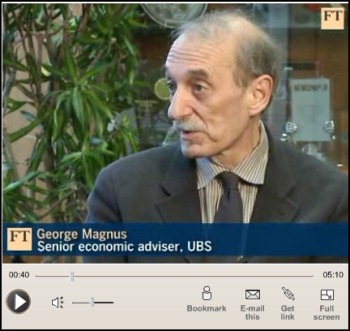
Respected UBS economist George Magnus says sovereign debt default now presents a grave risk to the global economy:

The sustainability of sovereign debt hangs heavily over bond markets, and the prospects for economic and financial stability…

There is no peacetime precedent for the current speed and scale of public debt accumulation and it is difficult to assess the social tolerance for high debt levels, and for the pain of protracted fiscal restraint. In several European Union member states, the threshold has already been breached. The spectre of sovereign default, therefore, has returned to the rich world.

Barnaby Warns of Bigger GFC

25 Feb

Could the USA default on its debts?  Barnaby thinks so… and said as much in October and December last year:

The Nationals Senate leader Barnaby Joyce is openly canvassing an economic upheaval that would dwarf the current global financial crisis, triggered by the US defaulting on its sovereign debt within the next few years.

In unusually pessimistic comments for a senior political figure, Senator Joyce said the US Government was running such large deficits and building up so much debt that it was in a similar position to Iceland or Germany before World War II.

Is Barnaby alone in expressing this concern?  Rudd Labor would have you think so. Others agree with Barnaby:

It is not literally impossible that the Federal Reserve could unleash the Zimbabwe option and repudiate the national debt indirectly through hyperinflation, rather than have the Treasury repudiate it directly. But my guess is that, faced with the alternatives of seeing both the dollar and the debt become worthless or defaulting on the debt while saving the dollar, the U.S. government will choose the latter.

And this:

The economic landscape still looks pretty gloomy despite (because of?) massive increases in federal government spending by Congress. Want something else to worry about? What if your government suddenly went “belly up” on some or all of its public debt IOU’s?

Impossible you say? Not really.

And this:

The specter of a wave of sovereign debt defaults is becoming more of a possibility daily. Historically, waves of sovereign debt defaults follow periods of relative calm in credit markets. In short, sovereign defaults are contagious.

And this:

Mr Ip believes the government will sooner try and inflate down the debt than default, which is probably true. But he reckons that in the unlikely event America must choose between hyperinflation and default, the unthinkable could occur.

And this:

The list of countries at risk of bankruptcy is increasing by the day. The acronym used to be PIGS (Portugal, Ireland, Greece and Spain). It is now PIIGSJUKUS and growing. The main contenders are currently: USA, UK, Japan, Spain, Italy, Greece, Ireland, France, Portugal, Baltic States, Eastern Europe and many more. On a proper accounting basis all of these countries are already bankrupt, but since many nations can either print money, like the US and the UK, or increase their already high borrowings, like Greece and the Baltic States, they have technically avoided bankruptcy.

And this:

But the ultimate financial question – until recently, unthinkable – is now being asked. Yes siree, the mighty US government could default. That’s how much the world has changed.

So why do Kevin Rudd, Wayne Swan, Lindsay Tanner, Ken Henry, and Glenn Stevens, not wish to discuss concerns about US debt, and the implications of a possible sovereign default on the Australian economy?  According to Treasury secretary Ken Henry, to do so could “alarm” the community:

”I don’t mind discussing hypotheticals in general … [but] one has to be careful not to discuss publicly hypotheticals that are that extreme,” Dr Henry said.

Right. This is the same Ken Henry who never saw the GFC coming. No doubt he would have considered it just another “extreme” hypothetical back in 2007.

Design a site like this with WordPress.com
Get started