Tag Archives: sovereign debt

How Much More Debt Next Week, Wayne?

4 Jun

$2.5 Billion.

Great, isn’t it.

Over the past 6 weeks since I began tracking the AOFM’s government debt auctions, Wayne’s pack of lunatics have borrowed no less than $2 Billion, and as much as $2.75 Billion.

Every single week.

And we can see here, that ever since JuLIAR Gillard knifed KRudd, she has been on a borrow-and-spendathon that puts even the jet-setting Mr Stimulus to shame.

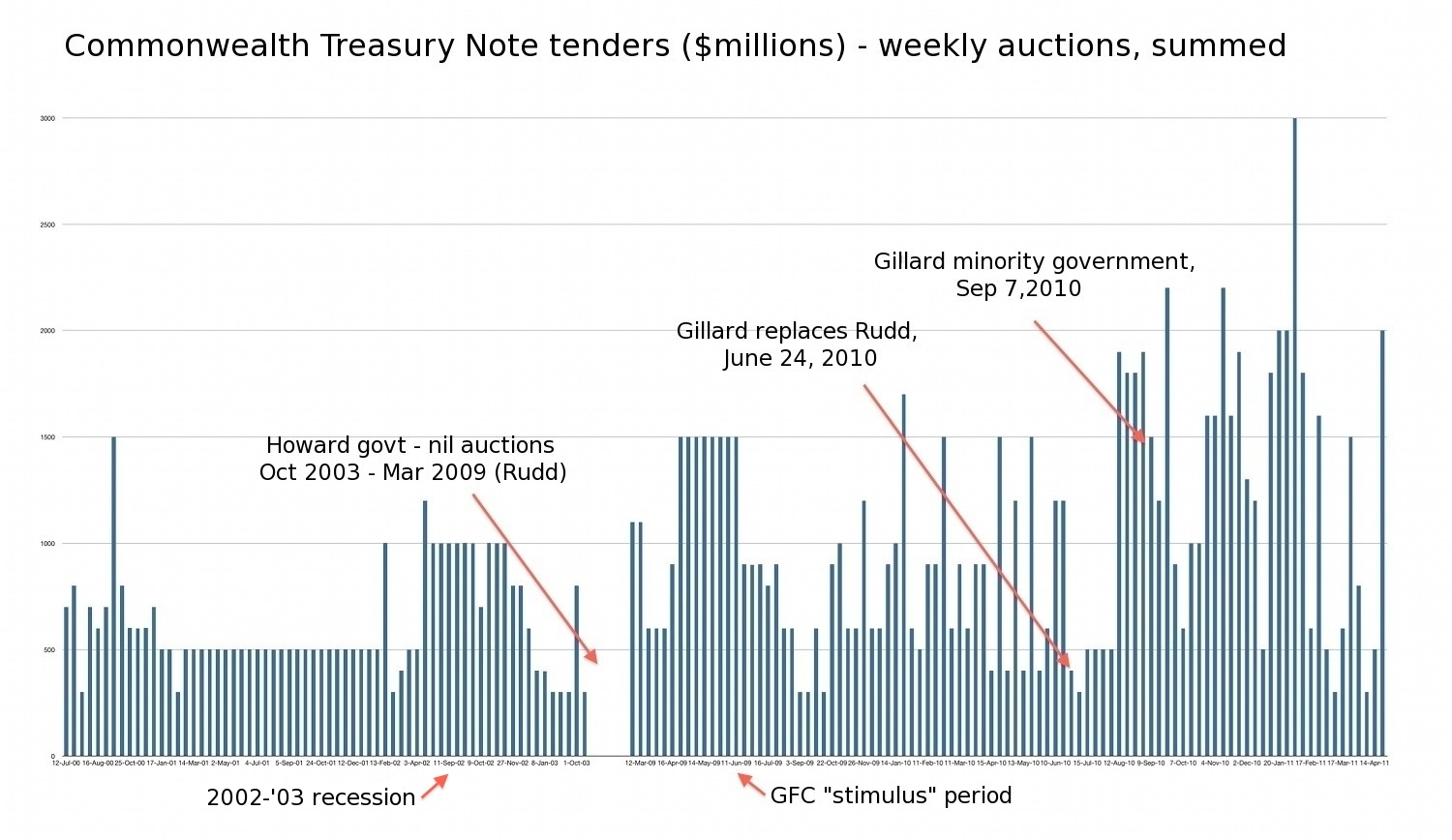
The following chart shows only the value of Treasury Notes auctioned by Labor. These are “short term” debt “instruments”, that typically must be repaid within 30-90 days.  They are supposed to be issued only when necessary to “smooth” cashflow requirements of the government.

Most of the government’s primary funding comes, instead, from the auction of Treasury Bonds, which are longer term debt “instruments”, that must be repaid over durations of anything up to 20+ years.

We take particular interest in the blowout in borrowing using Treasury Notes, because it indicates a government that has completely lost the plot.  An utterly incompetent government, that has no idea what it is doing.  Has no planning.  Cannot even manage to balance the weekly cashflow needs of government.  And so is constantly going back to the international debt markets, to borrow $2+ billion per week on the “short term” national credit card (click to enlarge):

Source: Australian Office of Financial Management (AOFM) - to end April 2011

Note carefully that this chart only goes up to end of April this year. During May, the government borrowed another $5.8 Billion using Treasury Notes. To picture this – since I’m too lazy to update the chart right now – just imagine another blue line on the end of that chart, one that is double the height of the tallest blue line.

So far in June – a mere 3 days in – they have already borrowed another $500 million using T-Notes.

And next Thursday 9th June, they will borrow another $1 Billion using T-Notes.

CDS Traders Agree – Barnaby Was Right

28 May

From the Financial Times:

Traders and investors have stepped up purchases of insurance against a US sovereign debt default, amid heated political wrangling over raising the US debt ceiling.

The gross value of derivatives contracts that pay out in the event of a US default has doubled from year ago levels, according to the Depository Trust and Clearing Corporation, which collects data on global trading of credit default swaps (CDS).

http://video.ft.com/v/959355486001/US-default-no-longer-unthinkable

Traders and investors are putting their money where their mouth is, in joining with Ronald Reagan’s budget director David Stockman, the Wall Street Journal, the U.S. Treasury, Southern Cross Equities’ Charlie Aitken, ANZ chief Mike Smith, global currency expert Savvas Savouri, ABC’s Inside Business and Business Spectator Alan Kohler, credit rating agency Standard & Poors, CNBC, Deutsche Bank, and Barack Obama, in conceding that when he forewarned of the risk of US debt default way back in 2009 (“Barnaby Warns of Bigger GFC“) …

Barnaby Was Right.

What’s Another $2 Billion Anyway, I’ll be Retired On A Taxpayer-Funded Pension

28 May

How’s that borrow-our-country-into-endless-servitude-to-foreign-lenders caper going, Wayne?

Four weeks ago – $2.2bn more debt.

Three weeks ago – $2.4bn more debt.

Last week – $2.75bn more debt.

This week – $2.5bn more debt.

Next week – $2bn more debt.

Wayne’s well on track to shatter the glass of Labor’s newly revised $250 Billion debt ceiling by around the 3rd week of August.

That’s just after Aug 2nd, when the US Treasury reckons the US could default on its debts.

CIA: The ALP Are Donut Punchers

14 May

While our lamestream media continue to look the other way, the CIA says that our Labor government is right up there with the Greeks at punching donuts:

There is no doubt Australia is one of the most heavily indebted countries. A list compiled by the American Central Intelligence Agency puts us at No. 14 on the foreign debt scale with about $1.2 trillion owing to offshore lenders.

When you consider our relatively small population, and our strong but comparatively tiny economy, that means we are punching well above our weight in the spendthrift stakes. In fact, total foreign debt easily outstrips national income. The CIA reckons we owe the rest of the world 132 per cent of our annual gross domestic product.

That’s not too far behind Greece which, at 165 per cent, finally appears to have tipped the balance and is heading towards bankruptcy (more politely expressed these days as a debt refinancing).

Yes, the ALP are good at punching O’s.

As are our “safe as houses” Big Four banks.

Bend over Australia, and grab your ankles.

This won’t hurt a bit.

Trust us.

Labor’s BAD: Getting Worse Every Week

14 May

Labor’s  “Building the Australia Devolution” continues apace.

Two weeks ago – $2.2bn more debt.

Last week – $2.4bn more debt.

Next week – $2.75bn more debt.

At this pace, they could shatter the glass of their newly revised $250 Billion debt ceiling by around the 3rd week of August.

That’s about a fortnight after Aug 2nd, when the US Treasury reckons the US could default on its debts.

US Treasury: August 2 Deadline To Avoid Debt Default

14 May

This Monday, the US government will hit its $14.3 Trillion debt ceiling.  By August 2nd, it could default on its mindboggling debts. So says the US Treasury (below).

Remember when Barnaby was widely ridiculed for warning that the US could default on its debts, and for suggesting that Australia needed a contingency plan?

He lost his new job as Opposition Finance spokesman as a result.

October 2009 (emphasis added):

The Nationals Senate leader Barnaby Joyce is openly canvassing an economic upheaval that would dwarf the current global financial crisis, triggered by the US defaulting on its sovereign debt within the next few years.

In unusually pessimistic comments for a senior political figure, Senator Joyce said the US Government was running such large deficits and building up so much debt that it was in a similar position to Iceland or Germany before World War II.

… Senator Joyce insisted yesterday that the dangers to the global economy from the run-up in US private and public sector debt were real and should be debated.

“It is the elephant in the room,” Senator Joyce said.  “This is a huge risk that Australia faces. What is the game plan, what happens if it comes unstuck?”

December 2009 (emphasis added):

The opposition finance spokesman, Barnaby Joyce, believes the United States government could default on its debt, triggering an “economic Armageddon” which will make the recent global financial crisis pale into insignificance.

Senator Joyce told the Herald yesterday he did not mean to alarm the public but there needed to be a debate about Australia’s “contingency plan” for a sovereign debt default by the US or even by a local state government.

“A default by the US means complete economic collapse around the world and the question we have got to ask ourselves is where are we in that,” Senator Joyce said.

His warning came as the Rudd Government ramped up its attack on Senator Joyce as an economic extremist…

Senator Joyce said the chances of a US debt default were distant but real and politicians were not doing the electorate a favour by refusing to acknowledge the risk.

Tick.

Tick.

Tick.

From the New York Times, May 9, 2011 (emphasis added):

Speaker John A. Boehner said Monday that Republicans would insist on trillions of dollars in federal spending cuts in exchange for their support of an increase in the federal debt limit sought by the Obama administration to prevent a government default later this year

[Senate leader] Mr. Schumer and Roger C. Altman, an investment banker and former Clinton administration Treasury official, said the consequences for the nation’s economy could be dire if the government defaulted for the first time in its history or if the debt-ceiling talks were pushed to the brink.

If America were to default, even for 24 hours, that would have an unprecedented and a catastrophic impact on global financial markets and on American markets,” Mr. Altman said.

From Reuters yesterday, May 13 2011 (emphasis added):

The United States is set to reach its $14.3 trillion debt limit on Monday, and will only be able to avoid default until Aug. 2, according to the U.S. Treasury. Efforts to forge a bipartisan deficit-reduction package as a step towards Congress raising the borrowing limit are in turmoil.

A thicket of plans to cut the deficit, which is expected to hit $1.4 trillion this year, have emerged in recent days with virtually no chance of passage in Congress.

The US Treasury now joins Southern Cross Equities’ Charlie Aitken, ANZ chief Mike Smith, global currency expert Savvas Savouri, ABC’s Inside Business and Business Spectator Alan Kohler, credit rating agency Standard & Poors, CNBC, Deutsche Bank, and Barack Obama, in conceding that Barnaby Was Right.

Does Labor have a contingency plan for a US debt default?

Hardly.

They don’t even have a plan on how to achieve a single year of budget surplus.  Instead, they are increasing Australia’s debt ceiling by another $50 Billion to $250 Billion.

And counting their budget chickens way before they’re hatched.

The “surplus” that Labor are proudly talking about as though it is fact, is nothing more than a “forecast”.  One based on Labor “estimates” of years of continuous record-high minerals prices and record-high terms of trade … in other words, on a never-ending China boom.  Even the Americans are laughing at them!

This not going to end well.

Barnaby is right.

UPDATE:

Add American centrist think tank Third Way to the growing list.  They will release a study on Monday regarding the likely impacts of a US default.

From Reuters again:

The Treasury Department is expected to hit its $14.3 trillion borrowing limit on Monday, making it unable to access the bond markets again.

The Treasury Department says it can stave off default until August 2 by drawing on other pots of money to pay its bills.

Treasury officials have warned of “catastrophic” consequences if Congress does not approve a further debt-ceiling increase by then, but have declined to say exactly what would happen.

The Third Way report, based on a survey of existing economic research, spells out the details…

Defaulting on our debt is not an abstract idea that might affect a few institutions on Wall Street; it would harm tens of millions of Americans in profound and lasting ways,” the report says.

Barnaby: Let’s Take A Closer Look At Our Spiralling National Debt

13 May

Barnaby writes for The Punch (emphasis added):

Let us first consider what Wayne Maxwell Swan said on the 10th of March 2009. He stated that “the emerging economies of China and India are now expected to slow markedly”. Because of this, Wayne Maxwell Swan stated “it will be necessary to increase Government borrowing”.

The result was Wayne Maxwell Swan increased by $125 billion the amount able to be borrowed by reason of the Commonwealth Inscribed Stock Act 1911 and the Loans and Securities Act 1919. This resulted in the nation’s credit card having a $200 billion limit.

Now as we know, China did not go into recession so neither did we, in fact China hardly missed a beat but Australia has now gained the ignominy clearly spelt out by Dr Ken Rogoff of Harvard when he noted the countries with the greatest cumulative increase in real public debt since 2007.

The order of infamy is as follows: Iceland is first, Ireland is second and Australia is third. Spain, Greece, Portugal and the US all experienced lower increases in their debt. I know that these other countries are already in crisis, so we start from a lower base but at this rate that will be a fleeting grace.

On Tuesday night’s budget, Labor sneaked in an Amendment of the Commonwealth Inscribed Stock Act 1911. Here is the most telling statement for where our nation is going under this Green-Labor-Independent Alliance. Under Part 5 Section 18 subsection 1 “omitting ‘$75’ and substituting ‘250’ ”.

Now that is in billons ladies and gentlemen and it is real money that really has to be paid back. If we have all this money stashed away under the lower net debt figure that is always quoted by Labor, then why not use some of this mystery money to pay off what we owe to the Chinese and others who we are hocked up to the eyeballs to.

The reason why we can’t is at least $70 billion that makes up ‘net’ debt is tied up in the Future Fund and student loans.

Of course, the public servants will not be happy when we use their retirement savings, put aside in the Future Fund, to pay off some of Labor’s massive debt. But that is what you must agree to if you believe in net debt. Likewise, you have to believe that you can track down all the students to pay all their HECS back immediately if you believe in net debt. Good luck patrolling the creeks and streams of Northern NSW looking for them.

So we are on the road and racing to serious problems. It is there in the figures. Debt ceiling issues in the US have now started visiting us in their primal form in Australia. I have been banging on about this, trying my best to warn about this, and generally vilified because of it and believe me, vindication is not what I was seeking.

We must realise what is happening or our nation will be like a bad accountancy client oblivious to the mechanism of their financial demise and the associated immense humiliation and hurt that comes because of it.

People generally do not understand the deficit and surplus concept, often believing that a surplus means all the debt has been paid. The surplus or deficit is broadly the profit or loss of the operation or the business of government.

Like a shop on the skids, the last three years profit and loss statements from 2010 have shown a $54 billion loss then a $49 billion loss which will be followed by another $22 billion loss. This was achieved while receiving record prices for our main sale items of coal and iron ore. How long will a shop like that be around for, and if you doubt the figures check their overdraft.

Where did the money go? What on earth have they done with it? How on earth will they pay it back? The answer to the last question is they will not, you the taxpayer will.

You will just have to spend more of your life working not for you but for the government. Instead of working Monday and half of Tuesday stacking bricks, shearing sheep, working behind a desk or on a checkout to pay your tax, you will have to spend more time through late Tuesday and Wednesday glancing at the clock saying more of my life is slavery for their incompetence.

Barnaby is right.

He has been warning of this since 2009. He quickly lost his job as Shadow Finance Spokesman, because he dared to say what most do not want to hear.

Now, more and more “experts” are slowly emerging from the woodwork to agree that Barnaby Was Right.

Swan Raises Govt Borrowing Limit By Another $50bn – And Don’t Ask Questions

12 May

But but but … we’ll have a surplus budget in 2013. Honest we will:

The Government has blamed Australia’s summer of disasters for its move to raise the cap on government debt by $50 billion.

As Treasurer Wayne Swan was congratulated by colleagues after Tuesday’s budget speech, Assistant Treasurer Bill Shorten introduced draft laws allowing the government to increase the amount it can borrow from $200 billion to $250 billion.

And what’s more:

The proposed legislation would also remove a requirement that the Treasurer explain why the extra money is needed.

Barnaby is right.

Budget Blowout: Interest-On-Debt $1.59m Per Hour

11 May

Six months.

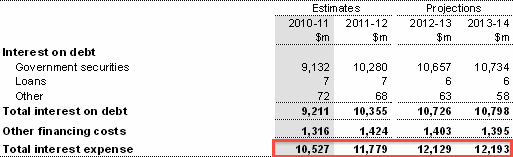
That’s all it has taken for Labor’s November 2010 MYEFO budget “estimate” for Interest-on-debt to blow out.

By $5.69 Billion to 2013-14.

The November MYEFO 2010-11 “estimate”:

MYEFO 2010-11, Appendix B, Note 10: Interest Expense

The new Budget 2011-12 “estimate”:

Budget 2011-12 | Budget Paper No. 1, Statement 9, Note 10

In March last year (“Rudd’s Interest Bill – $48.49bn to 2013“), we saw that Labor expected to lump taxpayers with $48.49 billion in Interest-on-debt through 2013.

A year later, that’s blown out yet again.

Including this year’s (2010-11) $10.845 Billion, we’re talking an “estimated” and “projected” grand total of $66.466 Billion through 2015.

That’s $1,587,357 ($1.59 million) per hour*, over the next 4 years.

Interest-only.

* The calculation = Total (66.466bn) – 2010-2011 (10.845bn) / 4 years / 365 days / 24 hours.

US$ To Hit A$0.58 – Currency Experts Agree, Barnaby Was Right

9 May

More experts line up with Alan KohlerStandard & Poors, CNBC, Deutsche Bank, and Barack Obama, in agreeing that Barnaby was right.

First, the head of ANZ:

ANZ chief Mike Smith said yesterday that the currency was likely to resume its climb above $US1.10, and one of the world’s leading foreign exchange experts predicted the dollar would continue to rise and could hit $US1.30 in 2013 and $US1.70 by 2014.

This spells bad news for non-resource sectors such as manufacturing and tourism…

“I can’t see that there is anything to knock it off its perch because it’s not only the strong Australian dollar, it’s also the weak US dollar,” Mr Smith said yesterday.

“And when you think about what is happening in the US, I can’t see them increasing rates for at least 18 months and that will have an impact.”

Next, a global currency expert:

Global currency expert Savvas Savouri, of the British-based Toscafund hedge fund, went a step further, predicting the greenback would be relegated to a “museum” …

Dr Savouri, in Sydney for a conference, predicts the dollar will reach $US1.30 by 2013 – and $US1.70 by 2014, as the greenback relinquishes its “exorbitant privilege” as the world’s default currency.

What the ‘experts’ aren’t telling you, is that the reason for the Aussie dollar’s rise is directly due to the slow-motion collapse of the US economy, and the unintended consequences caused by those trying to prop it up.

How’s that, you ask?

For several years, the US Federal Reserve has been creating literally trillions of US dollars out of thin air (“Quantitative Easing” 1 and 2).  By doing this, it believes it will achieve two things – (1) Keep interest rates in America extremely low (near zero), preventing further collapse in the housing market and broader economy; (2) pump up the stock market, creating public “confidence”. And it has achieved both those aims.

But what about the unintended consequences?

First, the immediate effect of printing money is to weaken the American currency.  That is the main reason why the Aussie dollar has risen against the USD.

It is not because our currency has strengthened.  It’s because the USD has been (deliberately) weakened.

Much of those trillions in near interest-free US money has been poured into speculation by international banks and hedge funds.  What are they speculating on?

Mostly on commodities – which our economy sells.

Hundreds of billions in “hot money” has been flowing from the Zero-Interest-Rate-Policy (ZIRP) United States into our currency, through speculation on our commodities.  Driving  up our currency’s apparent strength.

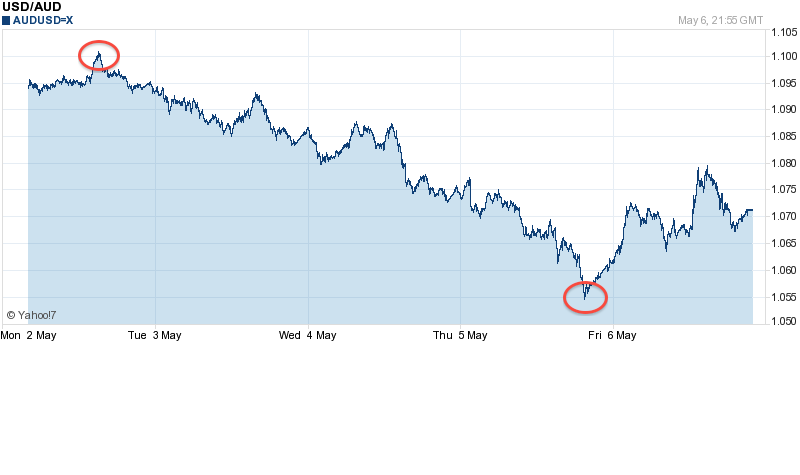
But “hot money” can flow out again just as fast.  As we saw in the GFC.  And again just last week, when the Aussie dollar hit US$1.10, and plummeted to US$1.05 in three days … due to a single bad economic news data release in the US:
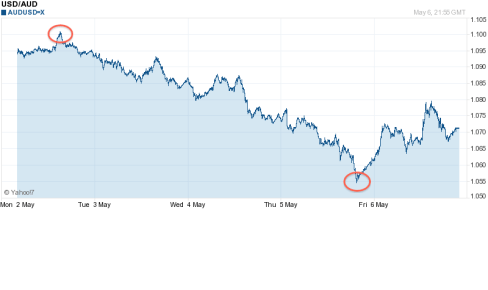
Yahoo Finance - AUD/USD 1.10 to 1.05

During the peak of GFC panic in Sep-Oct 2008, the Aussie dollar collapsed from US$0.98 to just US$0.60 in barely two months:
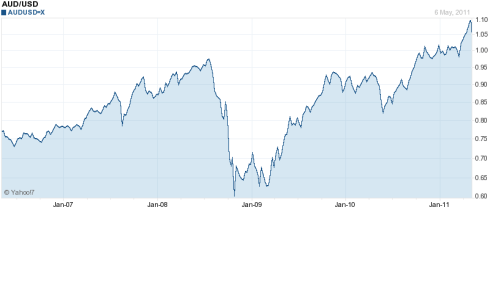
Yahoo Finance - AUD/USD

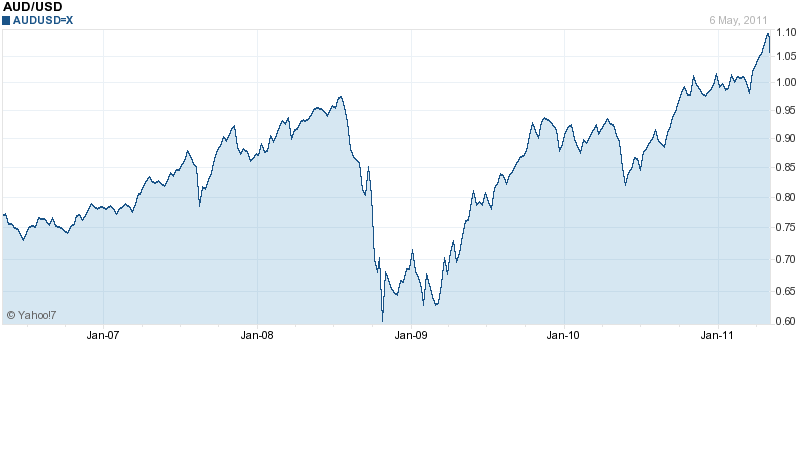
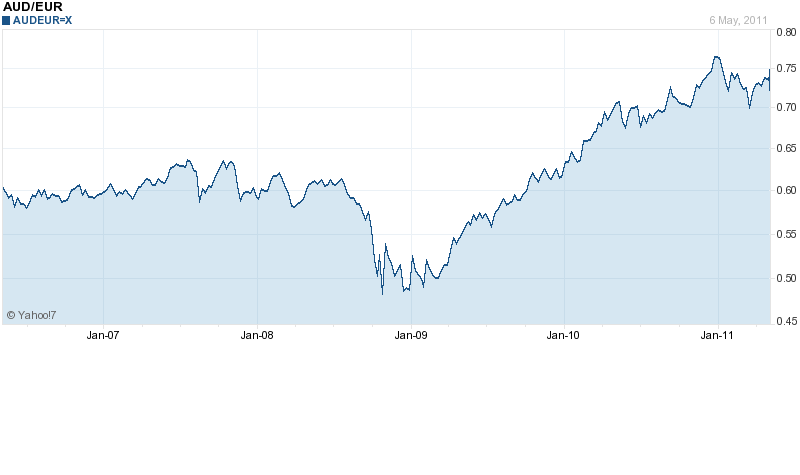
When you compare the Aussie dollar to the Euro, for example, it’s easy to see that our dollar only “appears” to be super strong when it is being compared – as usual – only to the ever-weakening USD.

Our dollar has risen against the Euro too. But by far less. And again, only after first falling significantly in the GFC.  Then rising only after the US Federal Reserve began seriously printing money, which has been poured into commodities and commodity currencies:
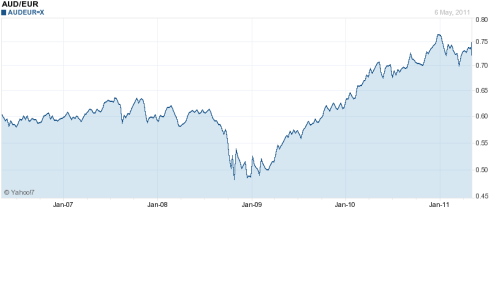
Yahoo Finance - AUD/EUR

Australia is a little cork floating on the ocean of other nations’ economic decisions.

As Barnaby forewarned in late 2009 / early 2010, the US is effectively defaulting on its debt right now.

By stealth.

Destroying the value of your currency by money printing, has always been the most common way in which nations have defaulted on their debts.

Barnaby was right.

Design a site like this with WordPress.com
Get started