Tag Archives: us debt default

Leading Australian Stock-Picker: Barnaby Was Right

11 May

Southern Cross Equities’ Charlie Aitken tells his clients to get out of the stockmarket and into cash:

Aitken says anyone looking closely at the markets at the moment has to entertain the possibility of something they have not seen before. “[Nationals senator] Barnaby Joyce was ridiculed last year for saying this, but I’m prepared to say that some sort of US debt default is now on the table as a risk for investors. I never thought I would say that. You would have to say that is the biggest black swan of them all.”

The term black swan refers to a completely unexpected, utterly improbable event. In the investment market sense, a black swan is a scary prospect, with its connotations of a sudden market fall. The origin of the term is in the astonishment of the Dutch explorers who arrived at the Swan River in the 17th century and discovered that swans could be black, when to all European experience they were only white.

Aitken joins ANZ chief Mike Smith, Toscafund’s global currency expert Savvas Savouri, ABC’s Inside Business and Business Spectator‘s Alan Kohler, credit rating agency Standard and Poors, CNBC TV “First in business worldwide”, Deutsche Bank, and Barack Obama, in conceding that Barnaby Was Right about the risk of US debt default.

Barnaby forewarned of the dangers to the global economy – and Australia – back in late 2009 through early 2010.

The “experts” are slowly, and finally catching up with the only politician in the country who is always on the ball.

More from Charlie Aitken – and independent derivatives expert Satyajit Das – in this must-read article.

US$ To Hit A$0.58 – Currency Experts Agree, Barnaby Was Right

9 May

More experts line up with Alan KohlerStandard & Poors, CNBC, Deutsche Bank, and Barack Obama, in agreeing that Barnaby was right.

First, the head of ANZ:

ANZ chief Mike Smith said yesterday that the currency was likely to resume its climb above $US1.10, and one of the world’s leading foreign exchange experts predicted the dollar would continue to rise and could hit $US1.30 in 2013 and $US1.70 by 2014.

This spells bad news for non-resource sectors such as manufacturing and tourism…

“I can’t see that there is anything to knock it off its perch because it’s not only the strong Australian dollar, it’s also the weak US dollar,” Mr Smith said yesterday.

“And when you think about what is happening in the US, I can’t see them increasing rates for at least 18 months and that will have an impact.”

Next, a global currency expert:

Global currency expert Savvas Savouri, of the British-based Toscafund hedge fund, went a step further, predicting the greenback would be relegated to a “museum” …

Dr Savouri, in Sydney for a conference, predicts the dollar will reach $US1.30 by 2013 – and $US1.70 by 2014, as the greenback relinquishes its “exorbitant privilege” as the world’s default currency.

What the ‘experts’ aren’t telling you, is that the reason for the Aussie dollar’s rise is directly due to the slow-motion collapse of the US economy, and the unintended consequences caused by those trying to prop it up.

How’s that, you ask?

For several years, the US Federal Reserve has been creating literally trillions of US dollars out of thin air (“Quantitative Easing” 1 and 2).  By doing this, it believes it will achieve two things – (1) Keep interest rates in America extremely low (near zero), preventing further collapse in the housing market and broader economy; (2) pump up the stock market, creating public “confidence”. And it has achieved both those aims.

But what about the unintended consequences?

First, the immediate effect of printing money is to weaken the American currency.  That is the main reason why the Aussie dollar has risen against the USD.

It is not because our currency has strengthened.  It’s because the USD has been (deliberately) weakened.

Much of those trillions in near interest-free US money has been poured into speculation by international banks and hedge funds.  What are they speculating on?

Mostly on commodities – which our economy sells.

Hundreds of billions in “hot money” has been flowing from the Zero-Interest-Rate-Policy (ZIRP) United States into our currency, through speculation on our commodities.  Driving  up our currency’s apparent strength.

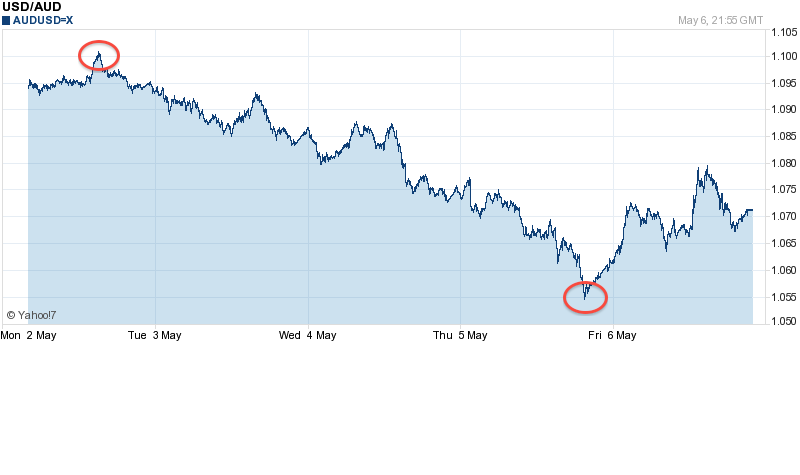
But “hot money” can flow out again just as fast.  As we saw in the GFC.  And again just last week, when the Aussie dollar hit US$1.10, and plummeted to US$1.05 in three days … due to a single bad economic news data release in the US:
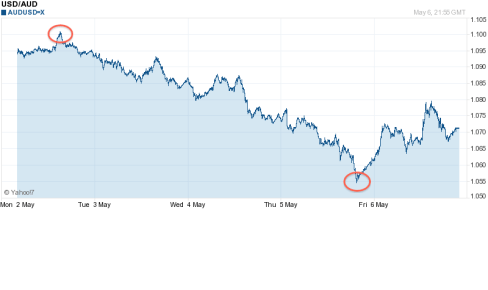
Yahoo Finance - AUD/USD 1.10 to 1.05

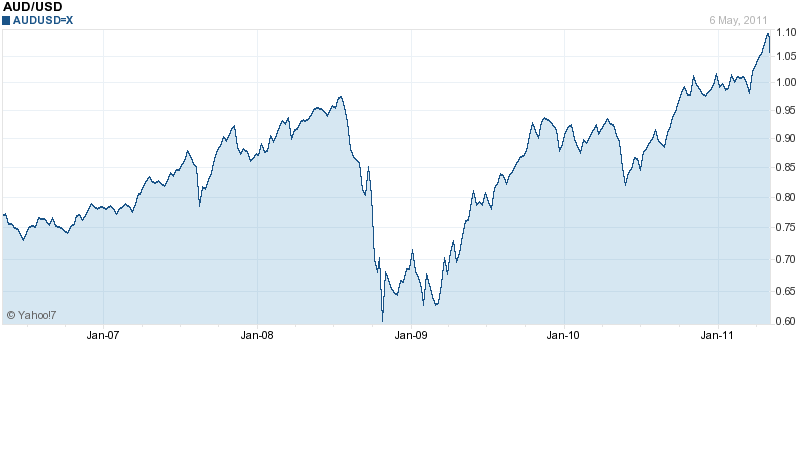
During the peak of GFC panic in Sep-Oct 2008, the Aussie dollar collapsed from US$0.98 to just US$0.60 in barely two months:
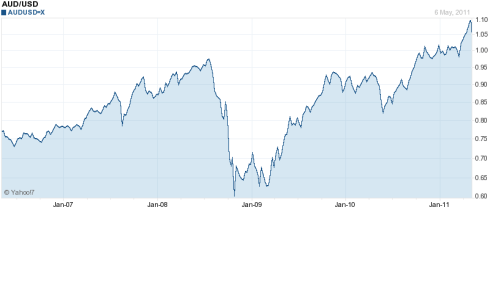
Yahoo Finance - AUD/USD

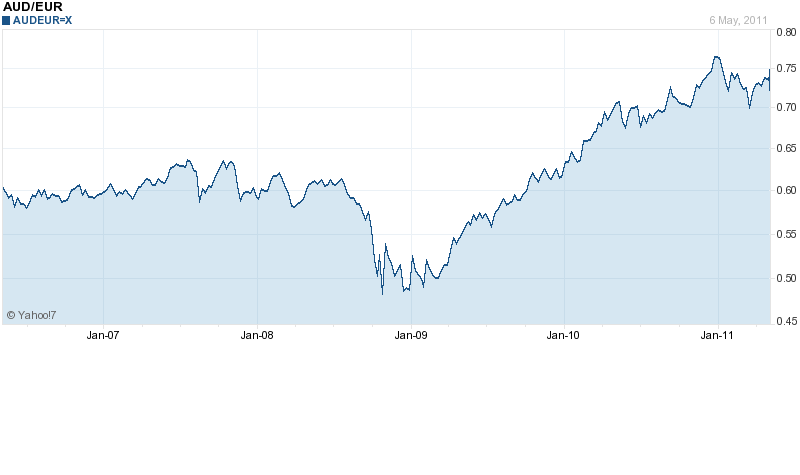
When you compare the Aussie dollar to the Euro, for example, it’s easy to see that our dollar only “appears” to be super strong when it is being compared – as usual – only to the ever-weakening USD.

Our dollar has risen against the Euro too. But by far less. And again, only after first falling significantly in the GFC.  Then rising only after the US Federal Reserve began seriously printing money, which has been poured into commodities and commodity currencies:
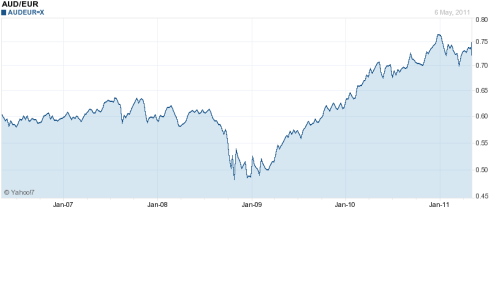
Yahoo Finance - AUD/EUR

Australia is a little cork floating on the ocean of other nations’ economic decisions.

As Barnaby forewarned in late 2009 / early 2010, the US is effectively defaulting on its debt right now.

By stealth.

Destroying the value of your currency by money printing, has always been the most common way in which nations have defaulted on their debts.

Barnaby was right.

CNBC Agrees – Barnaby Was Right

26 Apr

And still more come out to admit that Barnaby’s 2009 warnings about the possibility of a US debt default were prescient.

From the USA’s own CNBC network, “First in business worldwide”:

The United States has never defaulted on its debt and Democrats and Republicans say they don’t want it to happen now. But with partisan acrimony running at fever pitch, and Democrats and Republicans so far apart on how to tame the deficit, the unthinkable is suddenly being pondered.

The government now borrows about 42 cents of every dollar it spends. Imagine that one day soon, the borrowing slams up against the current debt limit ceiling of $14.3 trillion and Congress fails to raise it. The damage would ripple across the entire economy, eventually affecting nearly every American, and rocking global markets in the process.

A default would come if the government actually failed to fulfill a financial obligation, including repaying a loan or interest on that loan.

The alternate view is that the US is already defaulting on its debts.  How?  By devaluing (weakening) the USD, through “printing” trillions of new dollars out of thin air .. deceitfully retitled as “Quantitative Easing” –

Obama Agrees – Barnaby Was Right

24 Apr

Even the US President concedes that Barnaby was right

President Barack Obama, on a cross-country trip to sell his deficit reduction plan, said yesterday that the nation’s finances are “unsustainable.”

“We have an unsustainable situation,” he said. “We face a critical time where we are going to have to make some decisions – how do we bring down the debt in the short term, and how do we bring down the debt over the long term?”

Deutsche Bank Agrees – Barnaby Was Right

24 Apr

Will Goose, Henry, Stevens, and Co. now step up and apologise to Barnaby for mocking his warning about US debt levels?

US finances are in almost as troubled a state as the worst-hit members of the euro zone, economists say, underscoring the pressing need for Washington to reach agreement on how to reduce the deficit.

A gauge of “sovereign risk” from economists at Deutsche Bank placed the United States just behind Greece, Ireland and Portugal among 14 advanced economies.

S&P Agrees – Barnaby Was Right On US Debt

20 Apr

It’s taken a while.  But the wheels of the locomotive named Inevitability grind relentlessly onwards.

For the first time in history, Standard and Poors has placed the USA’s credit outlook on “negative”, warning that the government must take meaningful steps to reduce debt.

Back in October through December 2009, Barnaby Joyce forewarned of the possibility of the US defaulting on its debts.  He was roundly mocked and ridiculed by all the usual suspects – mainstream media, “expert” economists, (now former) Treasury Secretary Ken Henry, and the ALP’s band of genii led by “Goose” and Tanner.

Now, here we are barely 18 months later.  The US credit outlook is being downgraded.  It has almost completed a $600 Billion QE 2 (“Quantitative Easing”) – which means creating literally hundreds of billions of dollars out of thin air, Zimbabwe-style. There is every indication that QE 3 will inevitably follow.

(Printing money inflates the money supply, devalues your currency, and so effectively reduces your debt burden “by default”. Devaluing your currency is the most common form of national debt default.)

And the World Bank President warned a few days ago that the world economy is now just “one shock away from a full blown crisis”.

Barnaby was right.

Thanks to a hostile and clueless media pack, egged on by the “expert” ridicule of the likes of Henry and “Goose”, Barnaby was blasted out of his brief role as Opposition Finance Minister in early 2010.  Despite his being better qualified than the entire ALP cabinet combined.

Complete And Definitive Guide To The Sovereign Debt Crisis

30 Jun

Professor Niall Ferguson, of the acclaimed book and ABC documentary series The Ascent of Money, has recently published a brilliant guide to the global sovereign debt crisis.  Click here to read it.

Back in February, Professor Ferguson had this to say in the Financial Times:

… it would be a grave mistake to assume that the sovereign debt crisis that is unfolding will remain confined to the weaker eurozone economies. For this is more than just a Mediterranean problem with a farmyard acronym. It is a fiscal crisis of the western world. Its ramifications are far more profound than most investors currently appreciate…

IMF: US Faces Western World’s Biggest Crunch

18 May

From the UK’s Telegraph:

Earlier this week, the Bank of England Governor, Mervyn King, irked US authorities by pointing out that even the world’s economic superpower has a major fiscal problem –“even the United States, the world’s largest economy, has a very large fiscal deficit” were his words. They were rather vague, but by happy coincidence the International Monetary Fund has chosen to flesh out the issue today. Unfortunately this is a rather long post with a few chunky tables, but it is worth spending a bit of time with – the IMF analysis is fascinating.

Its cross-country Fiscal Monitor is not easy reading and is a VERY big pdf (17mb), so I’ve collected a few of the key points. The idea behind the document is to set out how much different countries around the world need to cut their deficits by in the next few years, and the bottom line is it’s going to be big and hard (ie 8.7pc of GDP in deficit cuts around the world, which works out at, gulp, about $4 trillion).

But the really interesting stuff is the detail, and what leaps out again and again is how much of a hill the US has to climb. Exhibit a is the fact that under the Obama administration’s current fiscal plans, the national debt in the US (on a gross basis) will climb to above 100pc of GDP by 2015 – a far steeper increase than almost any other country.

Another issue is that, according to the IMF, the cost of extra healthcare and pensions will increase by a further 5.8pc over the next 20 years. This is the biggest increase of any other country in the G20 apart from Russia, and comes despite America having far more favourable demographics.

But level of debt isn’t the only problem. Then there’s the fact that the US has a far shorter maturity of government debt than most other countries, meaning that even if it weren’t borrowing any extra cash it would have to issue a large chunk of new stuff each year as things are.

What does this mean? Basically with a large financing need, you are particularly vulnerable if the market suddenly decides it doesn’t want your debt, since those extra interest rates they charge you mount much more quickly. Japan, by the way, is the one with a real problem on this front. It could hardly be any more vulnerable to a sudden drop in investor demand, and many over there fear that the moment domestic savers stop buying JGBs, the country is doomed to Greek-style collapse…

Read the entire article (including IMF charts) here.

BIS: Western World Spending Its Way To Disaster

13 May

From the UK’s Globe and Mail:

The Swiss-based Bank of International Settlements (BIS), the oldest international financial institution in the world, has functioned as the central bank of central bankers for 80 years. In a working paper written by three senior staff economists (“The future of public debt: prospects and implications”), released in March, BIS warns that Greece isn’t the only Western economy with hazard lights flashing.

Indeed, it names 11 more: Austria, France, Germany, Ireland, Italy, Japan, the Netherlands, Portugal, Spain, Britain – and the United States. Without “drastic measures,” BIS says, all of these countries will hit a wall of debt.

When the senior economists at BIS warn 12 of the richest countries on Earth that they must take drastic action to reduce debt, you know that it’s time to check the air bags. The only thing you don’t know, that you need to know, is the precise time of the crash. The lesson is already obvious: Governments can’t drive recklessly, use only the accelerator for braking and not eventually crash.

By the end of 2011, the BIS economists calculate, U.S. government debt will have risen from 62 per cent of GDP in 2007, not quite three years ago, to 100 per cent. Britain’s debt will have risen from 47 per cent of GDP to 94 per cent. Italy’s debt will have risen from 112 per cent of GDP to 130 per cent. All together, the public debt of the 12 countries will have risen from 73 per cent of combined GDP to 105 per cent.

At this debt level, the risk of sovereign default rises rapidly. But the BIS analysis says this unprecedented debt level will itself increase “precipitously” in coming years. It will not, as each of these countries separately insists, fall.

For one thing, the BIS report says, countries that proclaim spending restraint generally do not actually do it. Normally, they hold the line – temporarily. Normally, they slow the rate of increase – temporarily. All pronouncements aside, the BIS report says, these 12 countries have made such grandiose spending commitments that they are predestined for higher debt. The U.S. debt-GDP ratio will hit 150 per cent in the next decade. Britain’s debt-GDP ratio will hit 200 per cent. Japan’s debt-GDP ratio will hit 300 per cent.

These increases in debt, the BIS report says, are untenable. The financial markets, of course, won’t permit them. The only mystery, the BIS report says, is exactly when the markets will intervene. History shows, the report says, that when the markets do rebel, they often do so instantaneously and decisively – often without much warning.

Eurozone Faces Bankruptcy, Disintegration

10 May

Could the Eurozone go bankrupt? One of Germany’s leading newspapers believes so.

From an excellent major article in Der Spiegel:

Huge National Debts Could Push Eurozone Into Bankruptcy

Greece is only the beginning. The world’s leading economies have long lived beyond their means, and the financial crisis caused government debt to swell dramatically. Now the bill is coming due, but not all countries will be able to pay it.

The euro zone is pinning its hopes on (IMF negotiator) Thomsen and his team. His goal is to achieve what Europe’s politicians are not confident they can do on their own, namely to bring discipline to a country that, through manipulation and financial inefficiency, has plunged the European single currency into its worst-ever crisis.

If the emergency surgery isn’t successful, there will be much more at stake than the fate of the euro. Indeed, Europe could begin to erode politically as a result. The historic project of a united continent, promoted by an entire generation of politicians, could suffer irreparable damage, and European integration would suffer a serious setback — perhaps even permanently.

And the global financial world would be faced with a new Lehman Brothers, the American investment bank that collapsed in September 2008, taking the global economy to the brink of the abyss. It was only through massive government bailout packages that a collapse of the entire financial system was averted at the time.

A similar scenario could unfold once again, except that this time it would be happening at a higher level, on the meta-level of exorbitant government debt. This fear has had Europe’s politicians worried for weeks, but their crisis management efforts have failed. For months, they have been unable to contain the Greek crisis.

There are, in fact, striking similarities to the Lehman bankruptcy. This isn’t exactly surprising. The financial crisis isn’t over by a long shot, but has only entered a new phase. Today, the world is no longer threatened by the debts of banks but by the debts of governments, including debts which were run up rescuing banks just a year ago.

The banking crisis has turned into a crisis of entire nations, and the subprime mortgage bubble into a government debt bubble. This is why precisely the same questions are being asked today, now that entire countries are at risk of collapse, as were being asked in the fall of 2008 when the banks were on the brink: How can the calamity be prevented without laying the ground for an even bigger disaster? Can a crisis based on debt be solved with even more debt? And who will actually rescue the rescuers in the end, the ones who overreached?

So, the GFC is ‘over’, is it Ken?

Design a site like this with WordPress.com
Get started