Tag Archives: usury

Usury Centralises Wealth

21 Jun

Cross-posted from Applied Philosophy, by author Anonemiss (my bold emphasis added):

I discovered on the exceedingly excellent website of Project Gutenberg a book, that although written 110 years ago, speaks to the heart of our modern economy problems. The book is called Usury: A Scriptural, Ethical and Economic View by Calvin Elliott. I was surprised by how much my own writings about usury follows his arguments. Of course no book about usury could bypass Francis Bacon’s attempt at legitimizing it:

The dictum of Bacon that “Usury gathers the wealth of the realm into few hands” is readily proven and fully verified in the experience of these times. The tendency to centralization under a system of usury or interest-taking is so strong, and the modern result so apparent that the statement only is necessary.

Usury not only enslaves the borrower and oppresses the poor who are innocent of all debt, but it also affects the rich by gathering the wealth of the wealthy into fewer and fewer hands. There is a centralizing draft that threatens and then finally absorbs the smaller fortunes into one colossal financial power. It is as futile to resist this as to resist fate. Wealth cannot be so fortified and guarded as to successfully resist the attack of superior wealth when the practice of usury is permitted. The smaller and weaker fortune, using the same weapon as the larger and stronger, must inevitably be defeated and overcome, and ultimately absorbed.

Rates of interest do not affect the ultimate result. Under a high rate the gathering is rapid, under a low rate the accretions are slower, but the gathering into few hands is none the less sure. Rates of interest only place the convergent center at a nearer or more remote period.

CHAPTER XXIX – USURY CENTRALIZES WEALTH

I advise all readers to study this book (do not be put off by the religious chapters at the start and continue to the purely economic arguments in the later chapter).

See Also:

Ten Economic Policies To Unite A Nation

29 May

he-who-experiences-the-unity-of-life-sees-buddha

Regular readers will be well aware of my excoriating views on the practice of usury — the making of gain (profit) from money; the unnatural “birth of money from money”.

In this, I happily find myself to be in esteemed company.

With all the forefathers of Western thought and jurisprudence (Plato, Aristotle, Cato, Cicero, Seneca, Plutarch, et al).

With the religious divines of all times and places (Buddha, Moses, Vashishtha, Jesus, Mohammed, Aquinas, Luther, and many more).

And … with Adolf Hitler.

(Do I have your attention now?)

I have no doubt that very few, if any, Australian readers would know that the central plank in the economic policy platform of The National Socialist German Workers’ Party, was the abolition of usury.

That following the devastating impacts of losing World War I, the crushingly punitive war reparations imposed by the Treaty of Versailles, and the resultant hyperinflation of the Weimar Republic, the economic policies introduced by the NSDA on coming to power inspired what is arguably the greatest, and most rapid economic transformation of a nation in modern history.

Or that — if we choose to first set aside our conditioned prejudices, and consider the matter with cool impartiality — we will discover that many of us would support precisely the same economic policies, in response to the economic challenges of our own times.

Before we get to those policies, let us first consider the following commentary/introduction by Pedert Gottfried in “The Program of the NSDA”, The National Socialist German Workers’ Party and its General Conceptions, translated by E.T.S. Digdale, Fritz Eher Verlag, Munich, 1932.

Read without prejudice.

I have included underlines for emphasis:

Adolf Hitler prints the Party Program’s two main points in leaded type: “The Common Interest Before Self: The Spirit of the Program” and, Abolition of the Thralldom of Interest: The Core of National Socialism.” Once these two points are achieved, it means a victory of the approaching universalist ordering of society in the true state over the present-day separation of state, nation and economics under the corrupting influence of the individualist theory of society as now constructed.

The sham state of today, oppressing the working classes and protecting the pirated gains of bankers and stock exchange speculators, is the area for reckless private enrichment and for the lowest political profiteering; it gives no thought to its people, and provides no high moral bond of union. The power of money, most ruthless of all powers, holds absolute control, and exercises corrupting, destroying influence on state, nation, society, morals, drama, literature and on all matters of morality, less easy to estimate.

Break down the thralldom of interest” is our war cry. What do we mean by thralldom of interest? The landowner is under this thralldom, who has to raise loans to finance his farming operations, loans at such high interest as almost to eat up the results of his labor or who is forced to make debts and to drag the mortgages after him like so much weight of lead.

So is the worker producing in shops and factories for a pittance, whilst the shareholder draws dividends and bonuses which he has not worked for. So is the earning middle class, whose work goes almost entirely to pay the interest on bank overdrafts.

Thralldom of interest is the real expression for the antagonisms, capital versus labor, blood versus money, creative work versus exploitation. The necessity of breaking this thralldom is of such vast importance for our nation and our race, that on it alone depends our nation’s hope of rising up from its shame and slavery; in fact, the hope of recovering happiness, prosperity and civilization through out the world. It is the pivot on which everything turns; it is far more than a mere necessity of financial policy. Whilst its principles and consequences bite deep into political and economic life, it is a leading question for economic study, and thus affects every single individual and demands a decision from each one: Service to the nation or unlimited private enrichment. It means a solution of the Social Question.

Our financial principle: Finance shall exist for the benefit of the state; the financial magnates shall not form a state within the state. Hence our aim to break the thralldom of interest.

Relief of the state, and hence of the nation, from its indebtedness to the great financial houses, which lend on interest.

Nationalization of the Reichsbank [central bank] and the issuing houses [commercial banks], which lend on interest.

Provision of money for all great public objects (waterpower, railroads etc), not by means of loans, but by granting non-interest bearing state bonds or without using ready money.

Introduction of a fixed standard of currency on a secured basis.

Creation of a national bank of business development for granting non-interest bearing loans.

Fundamental remodeling of the system of taxation on social-economic principles. Relief of the consumer from the burden of indirect taxation, and of the producer from crippling taxation.

Wanton printing of bank notes, without creating new values, means inflation. We all lived through it. But the correct conclusion is that an issue of non-interest-bearing bonds by the state cannot produce inflation if new values are at the same time created.

The fact that today great economic enterprises cannot be set on foot without recourse to loans is sheer lunacy. Here is where reasonable use of the state’s right to produce money which might produce most beneficial results.

Let it be clearly understood, gentle reader, that my statement of agreement with the above is just that.

Agreement with the above. In particular, with the underlined passages.

Hence, a polite request.

Please do not insult my intelligence, and more importantly, your own, by falsely conflating my agreement with the above, with any contrived notion or implication that this somehow also constitutes an approval — tacit, or otherwise — of any other words (much less, actions) of the German state of the 1930’s – 1940’s.

I have one observation to make in that regard.

And it is this.

It is entirely possible — indeed, it is exceedingly common — for a person (and by extension, a nation) to be right in principle, but wrong in practice.

Which is why I condemn the (a)moral code, cherished by power-hungry sociopaths of all stations in life, which asserts that “the Ends justify the Means”.

*************

It may now be of interest to the discerning reader, to consider thoughtfully and without prejudice the first of the economic policy demands listed in the NSDA’s 25 point “Program” of 1932 (underline added):

Therefore we demand:

11. That all unearned income, and all income that does not arise from work, be abolished.

Breaking the Bondage of Interest

12. Since every war imposes on the people fearful sacrifices in blood and treasure, all personal profit arising from the war must be regarded as treason to the people. We therefore demand the total confiscation of all war profits.

13. We demand the nationalization of all trusts.

14. We demand profit-sharing in large industries.

15. We demand a generous increase in old-age pensions.

16. We demand the creation and maintenance of a sound middle-class, the immediate communalization of large stores which will be rented cheaply to small tradespeople, and the strongest consideration must be given to ensure that small traders shall deliver the supplies needed by the State, the provinces and municipalities.

17. We demand an agrarian reform in accordance with our national requirements, and the enactment of a law to expropriate the owners without compensation of any land needed for the common purpose. The abolition of ground rents, and the prohibition of all speculation in land.

18. We demand that ruthless war be waged against those who work to the injury of the common welfare. Traitors, usurers, profiteers, etc., are to be punished with death, regardless of creed or race.

20. In order to make it possible for every capable and industrious German to obtain higher education, and thus the opportunity to reach into positions of leadership, the State must assume the responsibility of organizing thoroughly the entire cultural system of the people. The curricula of all educational establishments shall be adapted to practical life. The conception of the State Idea (science of citizenship) must be taught in the schools from the very beginning. We demand that specially talented children of poor parents, whatever their station or occupation, be educated at the expense of the State.

21. The State has the duty to help raise the standard of national health by providing maternity welfare centers, by prohibiting juvenile labor, by increasing physical fitness through the introduction of compulsory games and gymnastics, and by the greatest possible encouragement of associations concerned with the physical education of the young.

Would you be inclined to support any of these economic policies, here in our own times?

Looking For A Root

28 May

one-root-to-rule-them-all-fa41dc-e1341482332407

“In Keynes’s view capitalism’s driving force is a vice which he called ‘love of money’ … in the General Theory ‘the propensity to hoard’ or ‘liquidity preference’ plays a vital part in the mechanics of an economy’s rundown, once something has happened to make investment less attractive. And this links up with Keynes’s sense that, at some level too deep to be captured by mathematics, ‘love of money’ as an end, not a means, is at the root of the world’s economic problem.”

Robert Skidelsky; “John Maynard Keynes: Vol. 2, The Economist As Saviour 1920-1937″ (1994)

“There are a thousand hacking at the branches of evil to one striking at the root.”

– Henry David Thoreau

Would you be inclined to agree, that the best way to solve a problem, is to begin by looking for a root?

Economy

Definition of economy

1. the state of a country or region in terms of the production and consumption of goods and services and the supply of money

Oxford Dictionary

Who is responsible for the “supply of money”?

Changes in the quantity of money may originate with actions of the Federal Reserve System (the central bank), depository institutions (principally commercial banks), or the public. The major control, however, rests with the central bank.

– Federal Reserve Bank of Chicago, Modern Money Mechanics: A Workbook on Bank Reserves and Deposit Expansion

How is “money” supplied?

The actual process of money creation takes place primarily in banks. As noted earlier, checkable liabilities of banks are money. These liabilities are customers’ accounts. They increase when customers deposit currency and checks and when the proceeds of loans made by the banks are credited to borrowers’ accounts.

– Federal Reserve Bank of Chicago, Modern Money Mechanics: A Workbook on Bank Reserves and Deposit Expansion

Why is money supplied (by banks)?

…banks basically make money…

Investopedia

How do banks “make money” (ie, make profits)?

by lending money at rates higher than the cost of the money they lend. More specifically, banks collect interest on loans and interest payments from the debt securities they own, and pay interest on deposits, CDs, and short-term borrowings. The difference is known as the “spread,” or the net interest income…

Investopedia

Er… let’s hear that again … HOW do banks “make money” (profits)?

They make money just like any other business. The difference is that their product is money. In other words banks sell money, mostly in the form of loans. Their profit is the difference between what they pay in interest on your deposits and what you pay them in interest for the loan they made you. Banks also charge fees for services.

National Australia Bank, How Banks Work

What is “interest”?

The charge for the privilege of borrowing money, typically expressed as an annual percentage rate.

Investopedia

Is interest on money natural?

The most hated sort (of money-making), and with the greatest reason, is usury, which makes a gain out of money itself and not from the natural use of it. For money was intended merely for exchange, not for increase at interest. And this term interest (“tokos”, i.e., “children”), which implies the birth of money from money, is applied to the breeding of money, because the offspring resembles the parent. Wherefore of all modes of money-making, this is the most unnatural.

– Aristotle, Politics, Book One, Part X (c. 350 BC)

DIGGING DOWN

  • The global economy has a problem.
  • The supply of money is a defining component in the functioning of the economy.
  • Banks supply the money in the economy.
  • Banks supply the money by creating it ex nihilo (“out of nothing”).
  • Banks create new money when they make loans.
  • Banks make loans in order to make profits.
  • Banks make profits by charging interest on money they create.
  • Banks make profits by charging more in interest, than they pay in interest.
  • Interest is a charge for the “privilege” of borrowing money.
  • Making money out of money, by charging “interest” / usury on money … is not natural.

Would you be inclined to agree, that it is not a “privilege” but a burden, to have to borrow money at interest?

Would you be inclined to agree, that it is banks who have an incredibly privileged position and role in the functioning of the economy?

Would you be inclined to agree, that it is immoral and unjust to charge “interest” for the “privilege” of “borrowing” something that was created out of nothing — mere electronic digits, typed into a computer?

Would you be inclined to agree, that because banks are legally permitted to make profits from the production of money“their product is money” — that bankers are likely to have a vested interest in selling as much of their product — that is, creating as much debt — as they can get away with?

Is it possible that usury — the making of gains (profit) on the lending of money; the unnatural “birth of money from money” — is the root of the problem in the global economy?

For the love of money is the root of all evil: which while some coveted after, they have erred from the faith, and pierced themselves through with many sorrows.

– St. Paul, 1 Timothy 6:10

…no one shall deposit money with another whom he does not trust as a friend, nor shall he lend money upon interest; and the borrower should be under no obligation to repay either capital or interest.

– Plato, Laws, Book V (c. 348 BC)

And if you lend to those from whom you hope to receive back, what credit is that to you? For even sinners lend to sinners to receive as much back. But love your enemies, do good, and lend, hoping for nothing in return; and your reward will be great, and you will be sons of the Most High.

– Jesus Christ, Luke 6:34-35

See also:

Imagine A World With No Banks

A Tale Of Usury, Explosions, And A Used Car Salesman

Babylon = Usury: We Want Interest-Free Money at realcurrencies.com

The Apologia Of An Awakening Real Estate Agent

25 May

awakening

Reader “Phil” had the following to say, in response to Thursday’s post, Real Estate Marketers Now Out To Get Your Kids.

His words are an object lesson for real estate industry professionals everywhere (my bold added):

As a licensed real estate agent myself, I would like to suggest a difference between single office agencies and franchise groups. The typical stereotype of a real estate agent is derived from the high flying top 3%. There is no doubt there are some wankers in the industry. The rest that I know are hard working good people who support families and employ staff of 10 to 15 on average. That goes for many of the offices within franchise groups.

Since 2008, I have stood back and looked at the industry a bit differently. I have recognised that most real estate agents have no idea that it is bank credit expansion that causes house prices to rise. Or as Steve Keen explains, actually “growth” in credit expansion.

This is only possible due to legislation allowing private banks to use housing equity as security to create credit. We just continue to do this as that appears to be the way it always was. (IMO housing should be a consumable not an asset).

BTW, hat tip on your recent article exposing those who foster the continuation of the “housing industry” as a financial derivative.

Back to the franchise groups and franchises in general (Parasites!!!). This is not unlike usury or rent seeking. They take franchise fees from hard working small businesses and promote corporate ideals. The LJ Hooker promotion is revolting IMO.

I keep returning to your story of the used car salesman. Most people just keep doing what they know to do to get by or maybe get ahead. We are all preyed on by those who control and promote the FIRE structure.

As one who is now seeing the reality of this I feel a responsibility to speak. Much as you do. I tend to do this even as it makes me an outsider. Strange that huh?

My real name is Currency, but those that think they know me, call me Money

24 May

Cross-posted from ZenGardner:

EvalisticMoneyAttunement

My real name is Currency, but those that think they know me, call me Money.

Thanks to multi-generational conditioning, you unconsciously accept me in your life as normal and necessary. You use euphemisms to help you ignore my true character, by safely referring to me as a “medium of exchange”, and I’ve adapted numerous nicknames like bucks, dough, scratch, bread, juice and Benjamins. I like these references as they tend to disarm thinking minds.

Most people have no idea where I come from, and I like it that way. I create division by my very nature and I place arbitrary values on everything, including life. But I have no actual value other than that which you, and the other users, give me with your energy and time. By my nature, I enslave people and entire groups of people (protest if you will… but you are not immune). I am viral in nature and millions of people get paid with me just to keep track of me. I am extremely powerful and very unforgiving.

Doubting my power? I can create situations and circumstances that would otherwise probably not exist:

– Have several total strangers prepare, serve and clean-up an entire meal for you and your family at a restaurant.
– Get someone with less of me to mow your lawn.
– Buy shoes and clothing made by nameless, faceless children in far-away places that lack me.
– Use me to increase your “quality of life” by replacing your 42″ LCD with a 50″ LED.
– Buy a motor vehicle when others can’t afford a bicycle.
– Put YOUR kids in a safer neighborhood and better schools.
– Take a vacation to try to forget about me, while at the same time, spending lots of me in the process.
– Purchase a piece of paper from a university that suggests that you are intellectually superior, so you can take more of me from those deemed less intelligent, or that have not purchased the piece of paper themselves.
– Display me in various ways to demonstrate how successful you are.
– Attract people with me… friends, clients… even a wife or a husband.
– Spend me on hobbies, diversions and chemicals designed to help you forget about the process of getting me.
– Invest me so I magically reproduce myself (you don’t really now how this works, but you pretend to).
– Trade your time and freedom for me. I think you call it a job?
– Get your illnesses treated if you have a enough of me.
– Use me to help bring comfort to your life in a world where many are suffering.
– Pay people to govern you.
– With enough of me, you could run for a political office.
– Build a church with me, create a religion with me.
– Use me to worship your favorite sports teams.
– Lie, cheat or steal to get me.
– Have others lie, cheat and steal to get me, so you feel innocent.
– Wage wars using me.
– Get others to wage wars using me, so you feel innocent.
– Use me to determine which people should succeed, and which should fail.

I have only a few masters; those that created me. They work for the god that is printed on me. The rest of you are simply unwitting disciples.

You will think about me today, directly or indirectly, over 500 times.; how to get me, hold on to me, but mostly how to spend me. This keeps you completely detached from who and what you really are, and my masters like it that way. While I may be powerful, I’m nothing compared to what you were… before me.

By Scooter.

See also:

Imagine A World With No Banks

A Tale Of Usury, Explosions, And A Used Car Salesman

“$35 Million A Day” Usury-On-Debt: Sloppy Joe Hockey Finally Gets It Right

22 May

Congratulations Joe Hockey!

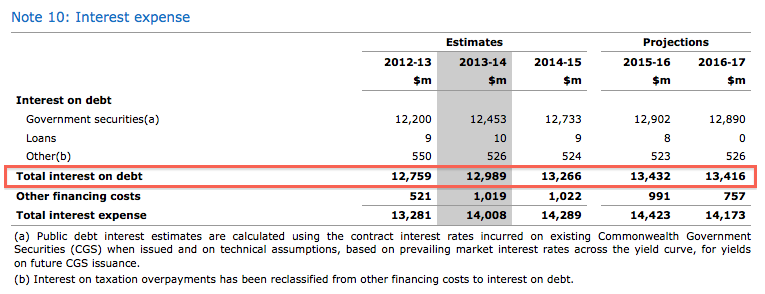
At long last, in his budget reply speech at the Press Club today, “Sloppy Joe” finally got around to correctly stating the cost to taxpayers of Usury (interest) on the Federal Government debt:

Screen shot 2013-05-14 at 7.50.25 PM

Though he still chose to use the lowest of those budget forecast numbers – the $12.759 billion for the current financial year, ending June 30.

All the forecast numbers for the years “going forward” .. are higher.

Try about $36.7 million a day Joe.

Or, be even more accurate, by taking the “Total interest expense” figure, which includes (projected) “other financing costs”.

The total usury expense is forecast (!!) to be more like $39 million a day.

Turning A Human Being Into This…

21 May
The Matrix: Pod-grown

The Matrix: Pod-grown

From the Daily Mail UK:

New spectre of cloned babies: Scientists create embryos in lab that ‘could grow to full term’

The prospect of cloned babies has moved a step closer after scientists extracted stem cells from human embryos created in a laboratory.

The breakthrough could lead to customised cells to help treat and even cure a range of diseases, from Alzheimer’s to multiple sclerosis.

However, it also raises the spectre of babies being cloned in laboratories

While human embryos have been cloned before, none have had healthy stem cells extracted from them. The latest advance means scientists are now even closer to being able to clone children.

The US team behind the work stress that they want to find treatments for incurable diseases – but critics fear there is little to stop a rogue scientist from copying their work to try to clone humans.

Dr David King, founder of the campaign group Human Genetics Alert, called for an international ban on human cloning and said it was ‘irresponsible in the extreme’ to have published details of the stem-cell technique.

The world first was achieved at Oregon Health and Science University, with a technique similar to the one used to clone Dolly the sheep…

Josephine Quintavalle, of campaign group Comment on Reproductive Ethics, questioned the need for the research, given that another, more simple way of making customised stem cells already exists.

She said: ‘The suspicion has to be that the real interest is not stem cell therapy per se, given that other uncontroversial approaches are already so successful. Let’s hope that the goal is not out and out reproductive cloning.’ …

…Dr King warned: ‘Scientists have finally delivered the baby that would-be human cloners have been waiting for: a method for reliably creating cloned human embryos.

‘This makes it imperative that we create an international ban on human cloning before any more research like this takes place.

‘It is irresponsible in the extreme to have published this research.’

From the Age:

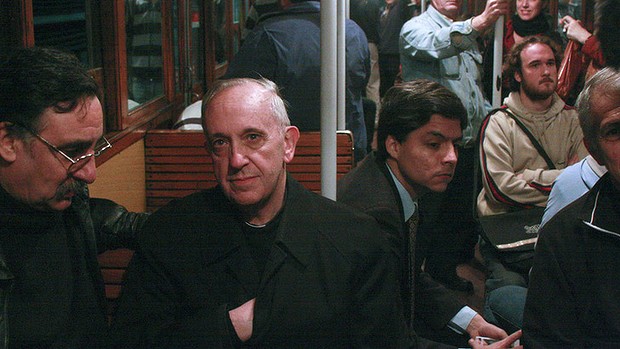
Pope Francis has denounced the global financial system, blasting the “cult of money” that he says is tyrannising the poor and turning humans into expendable consumer goods.

More correctly, the debt-at-usury “money” system — the 500 year rise of which can largely be blamed directly on failings of the ‘Church’ — turns human beings into milking cows.

Debt slaves.

Human cattle.

To be grown in number. Herded. Kept docile.

And milked, throughout their working lives.

Or — to use The Matrix’ parable — the usurious “money” system turns human beings into batteries.

To be slowly, steadily drained of their energy; used as fuel, for The Machines.

Once you understand what “makes the world go ’round” … and more importantly, how, and why … these latest scientific “developments” come as no surprise.

See also:

Imagine A World With No Banks

Ship Of State Wrecked On The Rocks Of Usury

19 May

Shipwreck-Arbutus-near-the-Dry-Tortugas-National-Park

The waters were always crystal clear. The rocks below, easy to discern. We even had a map to guide us.

We simply failed to keep watch.

And allowed treasure-hunters to reinterpret our map.

Roger Fenton (1565-1615) was a Fellow of Pembroke Hall, Cambridge University, rector of St Stephen’s in London, and one of the translators of the 1611 King James Bible. He declared that “Not until sixteen hundred years after Christ did interest find any defenders.” The following excerpt* is from his “Treatise On Usury” (London, 1612, pp. 2-3; 48-49); my bold emphasis added:

“…many Christians of reformed Churches being urged to flee persecution, and to convert their goods into money, yet lacking skill to employ the same in a strange country; tender hearts thought it a pity that usury in such a case were not lawful; and nimble wits began to search, if the matter might not be so handled, and qualified by cautions and limitations, that some such thing as we call usury might be practiced. For such is the subtlety of Satan, that if he cannot hinder the growth of good corn, yet tares shall grow up with it. He thought that when men were so busied about the reforming of those gross abuses of superstition; that then was the only time to begin a new seed-plot of usury, of sacrilege, of liberty and profaneness in the other extreme. Which vices, howsoever they were little feared or thought upon in those days; yet by our time we may easily perceive to what ripeness they have grown, which then were but as seeds under the ground…

“He that turns himself into an angel of light can set so fair a gloss upon a work of darkness, that the iniquity of it will hardly be discerned. He can so cunningly twist good and evil together, that the appearance of usury shall be presented without a show of injustice.

“…the gain of usury is a sweet gain, without labor, without cost, without peril… it is so pleasant and profitable a sin. This advantage then has the devil gotten against us in the practice of this sin; that usury being a trade so gainful in respect to others; so easy, so cheap, so secure without all labor… being also so common… it has bewitched even the consciences of those who are most tender in other matters…

“As usury is a sin in itself… so it is branded by the Holy Ghost for a sin of that nature and degree which does make shipwreck of conscience: the continuation of which sin cannot stand with the grace and favor of God.

“…Let some of those tender consciences who are so urgent to call for warrant out of the book of God for every ceremony and form in the Church, seek a warrant for this their practice (of usury), which so nearly concerns them, and let them seek it at the oracle of God, who has not left it, as he has many other things, to the discretion of the Church, or wisdom of the Commonwealths; but has vouchsafed to determine it in his own book to our hands: to set down an express law against it in Exodus; to renew that law again and again in Leviticus and Deuteronomy; to ratify and confirm it with no other words than he himself used at the publishing of the whole moral law…

“Since it has pleased Almighty God thus fully and exactly to express his will for our resolution in this point; let us not be ready to flee from his express word to human interventions — I mean those devised distinctions which favor the service of Mammon more than the service of God; which favor the things that be of men, to wit, the profit, the ease, the security, the sweet gain of interest; a trade which flesh and blood must needs affect and be greatly inclined unto.”

See also “Money Has To Serve, Not Rule!” – Pope Francis Is Right

* Source: Usury In Christendom: The Mortal Sin That Was, and Now Is Not, Michael Hoffman (2013)

“Money Has To Serve, Not Rule!” – Pope Francis Is Right

17 May

From the Age (my emphasis added):

francis-620x349

Vatican City: Pope Francis has denounced the global financial system, blasting the “cult of money” that he says is tyrannising the poor and turning humans into expendable consumer goods.

In his first major speech on the subject, Francis demanded Thursday that financial and political leaders reform the global financial system to make it more ethical and concerned for the common good. He said: “Money has to serve, not to rule!”

I suggest that, if ‘Frank’ is frank about his rhetoric, that he begin by carefully, prayerfully, and conscientiously reexamining ‘his’ church’s teaching, right back through its entire history, on the key question of Usury.

He might like to purchase Michael Hoffman’s “Usury In Christendom: The Mortal Sin that Was, and Now Is Not” to save him spending an eternity in research purgatory.

When ‘Frank’ humbly recognises that he, along with all his preceding “Infallible’s” since the Renaissance, are — by practice and decree of the church in its first millennia and a half — all flagrant heretics on the question of Usury, then this blogger might begin to take his preaching seriously.

In the meantime, I will continue pontificating my own “vision” for an alternative “money” system. One that would indeed “reform the global financial system to make it more ethical and concerned for the common good”

Imagine A World With No Banks

The People’s NWO: Every Man His Own Central Banker

$5.2 Billion Budget Blowout

15 May

Let’s hear a caustic cheer for all the “experts” who insist that Australia’s public debt is “small”, and does not matter.

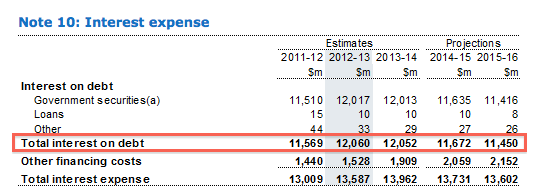
Interest on debt forecast, Budget 2012-13:

Screen shot 2013-05-15 at 9.48.48 AM

Interest on debt forecast, Budget 2013-14:

Screen shot 2013-05-14 at 7.50.25 PM

That’s a blowout of $699 million in 2012-13. $937 million in 2013-14. $1.594 billion in 2014-15. And $1.982 billion in 2015-16.

For a grand total blowout — just the blowout, not the total — of $5.2 billion “over the forward estimates.”

Now remember — all this is based on the forecast assumption of 5% per annum nominal GDP growth in the next two years. Even if that were to happen, the forecast is for another deficit (ie, more borrowing, at interest) of $18 billion in 2013-14, and $10.9 billion in 2014-15.

So, what do you think is going to happen to the forecast budget deficits — and the forecast interest on debt — if when that GDP forecast turns out to be highly optimistic … again?

Dear reader, I invite you to ponder, if you will, just how much productive investment could be made, if the economy were not loaded down with the ever-increasing burden of repaying a forecast $14 billion every year to (mostly foreign) bondholders, just for Interest on the Federal government’s debt?

Design a site like this with WordPress.com
Get started