Tag Archives: usury

A Tale Of Usury, Explosions, And A Used Car Salesman

16 Mar

used-car-salesman

Let me tell you a tale.

On a fine and sunny day this past week, your humble blogger accompanied his brother on a long journey.

To inspect a used car.

Having been reassured over the telephone by the salesman that this car – a premium brand convertible – was as-advertised in “excellent” condition, we embarked on our journey from the country to the Big City with my brother in high spirits. And myself in low expectations.

What we found in the Big City failed to live up to even my low expectations.

And yet, on the positive side, what we found may now serve the purpose of guiding you, dear reader, towards a better understanding of the negative impact of usury on our everyday lives.

Picture, if you will, a very small allotment of used cars, crammed mirror to mirror, in what must surely have been a low rent area on the outskirts of an outlying suburb. The sight of this site would have been enough to prompt your humble blogger to immediately turn around and drive away, had it not been for the innocent exuberance of his beloved brother, the budding buyer.

Prospects only sank the further on spotting the salesman and likely owner of this establishment, seated in the shade outside the hut which passed for an office. Perched on a stool, rotund beer gut resting on the table, his well-coiffed bouffant appropriately dyed rust red, talking earnestly on his mobile phone.

As my brother – a truly beautiful, innocent-in-the-ways-of-the-world fruit always ripe for the plucking – followed my advice to “Always go straight up to salesmen and state your purpose clearly, briefly, and confidently; don’t roam around aimlessly looking at stuff, waiting for them to size you up and plan their attack”, I walked to the front of the yard, where stood … actually, where slumped … the object of our long journey. Proudly positioned front and centre. The pinnacle, the most potent object of automotive desire that this particular dealership had to offer to the wandering eye of passing motorists.

Oh dear.

Not one body panel had escaped the telling sign of dents, scratches, or delaminating clear coat. The plastic rear window boasted an inconsistent, weak-piss shade of yellow discolouration, doubtless attained from many a long hour spent roasting beneath our sunny southern skies. The split seams and frayed stitching on the fabric roof loudly proclaimed their propensity to ingest any H2O that may fall in their immediate vicinity. And things only got worse from there.

Our aforementioned salesman approached, wide-eyed buyer in tow, car keys in hand. Having already questioned and confirmed that my brother “hasn’t had one of these before” – my alertly protective ears had overheard their conversation – he proceeded to inform him of a “unique safety feature”. One that “only these models” boast. Rust red-dyed bouffant then proceeded to demonstrate.

Inserting key in the lock, our beer-gutted new friend placed one pudgy paw upon the door, and gently pressed his not-inconsiderable body mass against it, while turning the key with the other.

Fail.

Try again. With rather less gentle application of body mass this time.

Win! We were in.

You see, extolled the salesman, most folks don’t know about this “safety feature”. Brilliantly, it renders the model less vulnerable to thieves, because most people don’t know how to open the door.

Groan.

I did mention that this was a premium brand automobile, did I not?

At this point, having taken but a single stroll around this four-wheeled (and mismatched-tyred) wonder, your humble blogger had seen and heard quite enough. His thoughts turned decisively to “Oh gawwwd!!! How can I get us the flock out of here, quickly, without hurting anyone’s feelings, or denting anyone’s pride?”

You see, my dear brother is, shall we say, a little socially inept. His still-innocent exuberance and enthusiasm for life and people – commonly manifested in an apparent belief in the good intentions of all strangers – typically overwhelms his negligible capacity to pick up on the many and varied non-verbal signals that are part and parcel of human interactions.

Nonetheless, I first tried the subtle, wordless communication medium of body language to convey my message to him.

Standing well aside from said vehicle, leaning against the flaking-painted post of the security fence protecting this yard-full of former automotive glories, spine stiffened, chest thrust out defiantly, arms folded, teeth clenched and jaw muscles twitching, exasperated expression writ large upon my darkened visage, and casting my gaze disinterestedly to yonder hills. The exasperation, it should be said, not wholly feigned, conscious as I was that such subtle signals would inevitably be overlooked by my excited brother with the pocketful of burning cash.

And why not overlook any negative signalling, indeed. After all, the tan leather interior was plush!

That, by the way, is the best thing that can be said of this particular automobile. The tan leather was plush. And remarkably, at a cursory glance, in reasonably good condition. Though not sufficiently so as to distract the discerning eye from immediately noting other significant interior features. Such as the two large, prominent, non-OEM holes in the driver’s door trim. And the numerous zip ties, struggling in vain to hold the roof lining in the position of the manufacturer’s original intent.

Having failed to catch my brother’s attention, I stepped it up. By stepping out. I spent the next minutes – which of course, seemed like hours – wandering off around the yard, arms still crossed and facial expression now transformed into a disinterested annoyance. But to no avail. Indeed, the fun had only just begun.

I gave up on sending the “disinterested wandering” signal and returned to the scene of the crime. How much of a crime we were only now set to discover. The salesman – given the size of the establishment, a sole trader would be my guess – kindly demonstrated the vehicle brand’s most famous attribute. The engine.

Now, you might reasonably be forgiven for expecting an automobile wearing the badge of this particular marque to respond to a turning of the ignition key in a manner rather like that we expect on flicking a light switch. And then, to convey a smoothness of sound and motion rather like that of a sewing machine.

Er… no.

Not to belabour the point – unlike the battery, which was most certainly belaboured – eventually the engine did burst into life. Most of it, anyway. What was immediately apparent, is that at least one cylinder was no longer responding to the spark of life. As evidenced by the engine note. And by the knocking noises. And by a significant rocking side-to-side of the engine, one that was sufficiently in excess of that which the engine mounts had been designed to absorb, that the entire car adopted a most determined lateral gyration in sympathy. Unlike the door locks, apparently this was not a “unique feature” of this particular model. Unless, that is, our now somewhat less enthusiastic-looking salesman simply forgot to mention it.

I do not know if his decidedly less eager expression can be attributed to his having picked up on my oh so subtle body language, or, to the less than encouraging response from his motor. In any event, he clambered clumsily out of the driver’s seat to come around and peer (un)knowingly into the engine bay.

Through the passenger window, I caught my brother’s eye. And rolled mine. Judging from his downcast glance in return, happily, it appeared that my brother too, had belatedly reached a similar conclusion. If not, then the events of the next few moments certainly did successfully transmit the “This is a sh!tbox, let’s leave NOW!!” signal that my own efforts had heretofore failed to do.

Bravely, my brother – who was now ensconced in the plush tan leather of the driver’s seat – tried gently pressing the accelerator. No doubt in a hopeful attempt to “clear its throat”.

The engine stalled.

He turned the key, and prodded the accelerator. Ever so briefly, the engine again sprang to life. And then…

BANG!!!

A very large volume of smoke belched from beneath the engine covers, and mushroomed out into the afternoon sunshine in a manner reminiscent of an atomic explosion. Seated inside the vehicle, my brother was quickly enveloped by a rush of acrid smoke billowing from every orifice in the dashboard.

Quickly escaping the fumes, he informed the salesman that the engine diagnostic warning light was on. Visibly straining to not appear crestfallen, the salesman went through the motions of checking the dashboard light for himself, and then flailing in vain with his rhetorical whip at a now quite dead horse, by quaveringly insisting: “That’s normal, it will go out soon”. After waiting for the interior smoke to clear, he climbed in and engaged the battery and starter motor in a futile struggle to revive the engine of this, the pride of his fleet.

With the salesman earnestly preoccupied and my brother out of the car, I seized the opportunity. Leaning over with a polite-but-firm “Thanks for your time”, I turned to my brother with a steely expression and a flick of the eyes towards our own car, grabbed him by the shoulder … and bolted.

Before my brother had a chance to reengage a pointless conversation.

And before anything else could happen that might cause that poor man’s dignity to melt away entirely, and join company with the other sad stains in the carpet.

I leave you, gentle reader, to imagine the conversation that ensued during the first minutes of our long journey home.

********

Given a little more time for emotions to settle and calm to return, as the kilometers rolled by beneath our wheels and the wind whispered quietly about our windows, I began to reflect on our experience.

And the longer I reflected, the more my feelings altered.

Instead of anger, or annoyance, or disgust, or contempt, I began to feel a great empathy with, and sadness for, that poor fellow soul.

An (other) Aussie brother.

Trying desperately to flog that complete heap of sh!t iron horse. Which had now suffered an apparently terminal myocardial infarction.

After all, what is he really doing, but that which we are all doing?

Just trying to get by.

Or is that, to “get buy”.

To pay the bills.

To feed the family.

To get ahead. Whatever that means.

Doing whatever we can, within and often beyond our personal limits – physically, mentally, spiritually, and morally – to take care of those whom we are closest to, and naturally love the most.

“Me and mine”.

I do not know anything of that used car salesman’s circumstances. His education and skills, or the limits thereof. The size and scale of the difficulties and stumbling blocks in his life’s journey. The pressure he feels to deliver.  Who am I to judge that poor soul, to feel affronted, or to criticise his means-to-an-end?

I reflected on the fact that there are so many in our world in not dissimilar circumstances.  Who find themselves resorting to not dissimilar actions, in order to “get buy”.  Indeed, this is in truth hardly a tale of woe at all, when one pauses to consider the plight of many 100’s of thousands of our brothers and sisters right here in our own “advanced” economy.  Not to mention the billions of others who are born into even less … “fortunate” … circumstances, and are right now living and dying just across the seas from our “Lucky Country”.

I was reminded of a short story that is recounted in a book that I have only just received and begun to read. It is called Rethinking Money: How New Currencies Turn Scarcity Into Prosperity.”

The story appears in an early chapter titled, “A Fate Worse Than Debt – Interest’s Hidden Consequences”. As it explains a subject that is very close to my heart with a style and a clarity far better than I could ever attain, I would like to share that story with you now (emphasis added):

The small village was bustling with locals proudly displaying their wares, chickens, eggs, cheeses, and bread as they entered into the time-honored ritual of negotiations and trade for what they needed. At harvests, or whenever someone’s barn needed repair after a storm, the village-dwellers simply exercised another age-old tradition of helping one another, knowing that if they themselves had a problem one day, others would come to their aid in turn. No coins ever changed hands.

One market day, a stranger with shiny black shoes and an elegant white hat came by and observed with a knowing smile. When one farmer who wanted a big ham ran around to corral the six chickens needed in exchange, the stranger could not refrain from laughing. “Poor people,” he said, “so primitive.”

Overhearing this, a farmer’s wife challenged him: “Do you think you can do a better job handling chickens?”

The stranger responded: “Chickens, no. But, I do know a way to eliminate the hassles. Bring me one large cowhide and gather the families. There’s a better way.”

As requested, the families gathered, and the stranger took the cowhide, cut perfect leather rounds and put an elaborate stamp on each. He then gave ten rounds to every family, stating that each one represented the value of a chicken. “Now you can trade and bargain with the rounds instead of those unwieldy chickens.”

It seemed to make sense, and everybody was quite impressed.

“One more thing,” the stranger added. “In one year’s time, I’ll return and I want all the families to bring me back an extra round – an eleventh round. That eleventh round is a token of appreciation for the improvements I made possible in your lives.”

“But where will that round come from?” asked another woman.

“You’ll see,” said the stranger with a knowing look.

A year passes and on another market day the stranger with the stylish hat returns, and from his vantage point he observes the village below. While sitting under the broad-limbed oak tree, he reaches into his knapsack and pulls out a silver canteen filled with single-malt whiskey, takes a swig, savoring the peaty warmth at the back of his throat, and waits for the village folk to file past him with each family’s repayment of the eleventh round.

Below on the village outskirts, a family begs for alms, having lost everything in a fire. Focused on their obligations, the villagers pass by without as much as a glance.

The eleventh round is a very simplified illustration of an important principle regarding money. The point of the anecdote is that, with all other things being equal, the competition to obtain the money necessary to pay the interest is structurally embedded in the current money system. Somebody will have to be without the eleventh round for payment for somebody else to have it and make the interest payment.

So how does a loan, whose interest is not created, get repaid?

Essentially, to pay back interest on a loan requires using someone else’s principal [Note: that principal is also debt, owing interest in turn]. In other words, not creating the money to pay interest is the device used to generate the scarcity necessary for a bank-debt monetary system to function. It forces people to compete with each other for money that was never created, and it penalizes them with bankruptcy should they not succeed. When a bank checks a customer’s creditworthiness, it is really verifying his or her ability to compete successfully against the other players – that is to say, assessing the customer’s ability to extract from others the money that is required to reimburse the interest payment. One is obliged in the current monetary system to incur debt and compete with others in order to perform exchanges and pay the resulting interest to the banks and lenders.

In a manner of speaking, it’s like a game of musical chairs in that there are never enough seats for everyone. Someone will end up getting squeezed out. There isn’t enough money to pay the interest on all the loans, just like the missing chair. Both are highly competitive games. In the money game, however, the stakes are elevated, as it means grappling with certain poverty or, worse still, having to declare bankruptcy.

Those billions of our brothers and sisters living in poverty and hardship around the world?

These are the families who have been forced to beg for alms on the outskirts of our global village. While the rest of us – focused as we are on our obligations, on the ceaseless struggle of competing for money – we daily pass them by, with neither a thought nor a glance, as we make our way to pay the usurers.

If, like me, you have ever pondered the reasons why people nowadays seem to be even more materialistic than in times past; why the business of doing business seems more cut-throat and profit-driven than ever; why advertising and marketing are seemingly all-pervasive and more aggressive than ever; why there are seemingly so many more, varied, and greater ills in the world than, say, 50 or 100 years ago – poverty, wealth and income inequality, “-ism’s”, dishonesty, disrespect, dishonour, amorality, fraud, corruption, drug and alcohol abuse, pharmaceutical dependency, and increasing physical, mental, and spiritual violence – then I hope you may now begin to see that here is a – and quite possibly the – major culprit.

Usury.

It is a prime cause of slowly but surely, devolving mankind. Of causing us to increasingly behave like … indeed, often much worse than … mere animals.

Just to “get buy”.

Here is a final thought for you to ponder.

It hails from a section of the above chapter, and is sub-titled “Compulsory Growth Pressure”. It concerns the direct relationship between our 300 year-old, central-banking driven, usury-based debt-money system, and the global obsession with economic “growth” that is often (and rightly) blamed for all manner of social and environmental ills.  For those readers who may hold concerns about climate change, natural resource depletion, environmental degradation and pollution, or similar ecological anxieties, please pay close attention (italics in original):

Interest… has hidden dynamics that result in detrimental costs not only to personal relationships, commerce, and society at large, but also to the sustainability of our fragile planetary home, Earth. The effects are so well-concealed, in addition to being so deeply embedded in the money system, that they go, for the most part, unnoticed.

Debt-based money requires endless growth because borrowers must find additional money to pay back the interest on their debt. For the better-rated debtors (e.g., in normal times, government debt), the interest is simply covered through additional debt, resulting in compound interest: paying interest on interest. Compound interest implies exponential growth in the long run, something mathematically impossible in a finite world.

…the exponential growth of money through interest rates has shattering real-life consequences in which entire nations of people are marginalized and stuck in debt forever. For instance, after a G8 summit former President Obasanjo of Nigeria stated: “All that we had borrowed up to 1985 or 1986 was around $5 billion and we have paid back so far about $16 billion. Yet, we are being told that we still owe about $28 billion. That $28 billion came about because of the foreign creditor’s interest rates. If you ask me, ‘What is the worst thing in the world,’ I will say, ‘It is compound interest.'”

See also –

A History Of The Legal Case Against Usury

24 Feb
Schistosoma_mansoni2

Schistosoma mansoni is an endoparasite that lives in human blood vessels.

Regular readers will know that I am an ardent opponent of the practice of usury.

In the classical meaning of the word.

Indeed, it is my view that the practice of usury is The Key to the power of the money-lenders.

While many others have argued that the key to their power is their exclusive right to create money (debt) whenever they make a loan, I tend to disagree.

In the absence of the legal right to charge interest (usury) on those loans, the money-lenders’ power would be effectively nobbled.

They could be replaced by full public banking. Or by alternate, free currency solutions like my own.

This key issue of the charging of interest on “money” lending, its origins, and its legal history, is awash with myths, theories, distortions, and outright falsehoods.

There are many eloquent and brilliant advocates for the alleged “need” for the charging (and offering) of a rate of usury on money. The theory of the so-called “time-value of money” is commonly cited in justification of what is, in truth, plain and simple parasitism –

Parasitism is a non-mutual relationship between organisms of different species where one organism, the parasite, benefits at the expense of the other, the host.

First used in English 1539, the word parasite comes from the Medieval French parasite, from the Latin parasitus, the latinisation of the Greek παράσιτος (parasitos), “one who eats at the table of another” and that from παρά (para), “beside, by” + σῖτος (sitos), “wheat”. Coined in English in 1611, the word parasitism comes from the Greek παρά (para) + σιτισμός (sitismos) “feeding, fattening.”

What I hope to do in today’s post is dispel some of the banking industry’s most powerful falsehoods.  That the charging (and offering) of “interest” on money is normal. That, at worst, it is a “necessary evil”.  That it is really something natural, and good, like a law of the universe, and vital to keeping our world turning.

I also hope to encourage readers to STOP using the banksters’ language.

And instead, to “call each thing by its right name.”

The original word used for the charging of interest on money … is USURY.

Usury does not mean charging “excessive” rates of interest.

The etymology of the word “usury” shows that it originally meant the charging of any interest, at all:

usury (n.)

c.1300, from Medieval Latin usuria, from Latin usura “usury, interest,” from usus, from stem of uti (see use (v.)). Originally the practice of lending money at interest, later, at excessive rates of interest.

How very convenient for the modern day money-lenders, that we have changed our language over the centuries.

No doubt with more than a little help from our “friends”.

In researching for more information on the origins of the word “usury”, recently I happened across an article published in the American Bar Association Journal, Volume 51, September 1965. It was written by a J.L. Bernstein, NYU Law School graduate and editor-in-chief of the New York State Bar journal. Following are some extended excerpts. It really is fascinating stuff.

But if you are tempted to leave before finishing, please do me one favour. Skip to the end, and read my closing observations concerning ancient Sumeria, the true origin of debt jubilees and New Year’s Eve celebrations, and the deeper meaning behind the Biblical story of Abraham.

Now, to the history of the legal case against usury (my bold emphasis added):

Background of a Gray Area in Law: The Checkered Career of Usury

Tracing the ancient and medieval history and development of usury, Mr Bernstein shows that at first it was any charge for the use of property, but later became only the charge of excessive interest on money. With the advent of our present consumer society, various procedures and methods of conditional selling have enabled what might otherwise be usury to escape illegality. It is time, the author suggests, to delineate what is fact and what is fiction in this shadowy world.

A CASE MAY BE MADE for usury as one of the oldest professions of man, yet the complexities of modern economic life “make fundamental a review” of the problem, as the late C.S. Lewis, Oxford and Cambridge don, scholar and theologian pointed out. The checkered career of usury cum interest is too long to detail here, but this mixed question of theology and law has always been a gray area for the courts – a veritable hodgepodge of legal decision, as this Journal once put it, with “no clearcut rationale”.

Even an elementary statement in a leading New Jersey case is questionable. The Supreme Court said: “Although the common law did not prohibit usurious exactions, our statutes have done so since 1738.” This view of the common law is challenged in Mark Ord’s authoritative Essay on the Law of Usury (1809), which states: “Usury in its strict and legal sense was always considered unlawful.” Likewise, Robert Buckley Comyn says: “Usury was in England an object of hatred and legal animadversion at least as early as the time of Alfred; and Glanville, Fleta, and Bracton bear ample testimony to the abhorrence in which it was held.”

All Interest Once Was Usury

At common law a usurious contract could not be enforced, and usury appears to have been an indictable offense, the punishment for it being fines and imprisonment. The fact is that from the earliest recorded times until the later Middle Ages even interest was forbidden by both canon and civil law, for interest then was synonymous with usury. Indeed, interest had no significant usage in English law until the statute of 21 Jac. 1, c. 17 (1624), although it had been employed in commerce, having been adapted from the Justinian Code of the Roman Empire.

The Lombard merchants, the principal moneylenders of medieval times, had made it a practice to charge a penalty on default, and the custom spread. Thus interest was not a charge for the use of money, but an exaction to make the creditor “whole”. In time it came to mean permissible usury, but it is noteworthy that neither the Old nor the New Testament recognizes this concept, except for the new Catholic edition of the Holy Bible (1954) which substitutes interest for usury and banker for exchanger.

Comyn describes the gradual transformation: “Usury was an offense which having first become odious from religious prejudices, at length became the object of political consideration, and parliamentary restraint. And as at first the taking of any profit upon money was denominated usury, so afterwards, when such profit was authorized by law, the profit was termed interest, and the illegal excess alone retained the odious name.” Thus usury began as malum in se, but at least from the time of Charlemagne in the ninth century (he considered all profit as “filthy lucre”), the secular arm had sought to reinforce the spiritual, making it also malum prohibitum. Speaking of the earliest English statutes, those of Henry VII (1487-1495), Coke declared that all usury was “damned and prohibited”. According to an ancient book of the Exchequer, entitled Magister et Tiburiensis, usury was ranked with murder as an offense.

But the general detestation was diminished by 37 Hen. 8, c. 9 (1545) which, while entitled “A Bill Against Usury”, tacitly legalized it to a maximum of 10 per cent per annum. This statute inaugurated the serviceable fiction that usury no longer meant any interest, but only excessive interest. As Ord puts it, this was the first English statute to “give any connivance to the practice of lending at interest”.

The statute still called usury “a thing unlawful”; it was an attempt at moderation, following the lead of the church. Earlier attempts to ban all interest had failed ignobly, but so did this new approach, and by 5 & 6 Edward 6, c. 20 (1552), repeal made interest and usury one and the same again. But this didn’t work, as before, and 13 Eliz. 1, c. 8 (1571) repealed the Edwardian edicts and revived the statute of Henry VIII. In order, 21 Jac. 1, c. 17 (1624); 12 Car. 2, c. 13 (1660); and 12 Anne, c. 16 (1713), toyed mainly with the rates, which went from a maximum of 10, to 8, to 6 and finally to 5 per cent in the statue of Anne of 1713. This is the one followed in this country. But the most common maximum rate of 6 per cent is derived from the Justinian Code.

The statute of 12 Anne, which served as a common model here, was abrogated 110 years ago in England by 17 & 18 Vict., c. 90 (1854). Therefore, the mother country has no general usury law today and interest of 48 per cent may be quite legal – even more, if the courts can be convinced. As H. Shields Rose puts it in his book, The Churches and Usury (1908), this was “the final capitulation of the state … as regards the maintenance of a legal maximum rate of interest in England”.

Note:  The abrogation of this 183-year-old English law placing limits on the charging of interest, came just ten years after the privately-owned Bank of England was granted exclusive power to issue the nation’s banknotes (Bank Charter Act, 1844). Coincidence? I think not.

The etymology of usury is from the Latin words usa and aera, meaning “the use of money”. But both by ecclesiastical and civil law it was always held that usury could exist in nonpecuniary transactions as well. Many state statutes, following the language of 12 Anne, speak generally of “money, wares, merchandise, goods and chattels”. The Bible is more inclusive: “Thou shalt not lend upon usury to thy brother; usury of money, usury of victuals, usury of any thing that is lent upon usury.”

But courts that maintain that usury was not prohibited by the common law are on firmer ground if they mean thereby the common law as it was interpreted by the colonial judges here. Blackstone says that the common law of England consists of “That ancient collection of unwritten maxims and customs …”. Our early courts seemed to regard English authority on the subject so dubious, indifferent or contradictory that, without legislative enactment, anything by way of usury was legal. This led to such abuses that the colonists petitioned for action, and general usury statutes were adopted everywhere.

It is useless to deny that confusion abounded in the common law, for usury was no less a gray area and a hodgepodge of thinking then. Coke, for example, said that: “All usury is not only against the law of God [but] the laws of the realm, and against the law of nature.” But on another occasion he avers that what was actually forbidden was “biting usury”, i.e., unconscionable charges…

Note: It is your humble blogger’s firm opinion that, in a technological age where 97% of all “money” is no more than electronic binary code, mere digital bookkeeping entries, created at the click of a bankers’ mouse in the form of new debt, there is no question that ALL usury charges are unconscionable.

Genesis of the Problem Is of Ancient Origin

But if the common law is no less a puzzle than our decisional law, the trouble goes far back – to Holy Writ itself. Until the later Middle Ages all interest was interdicted, for it was abhorrent that money – “barren” as Aristotle and the inspired writers of the early Church had taught – should increase unnaturally while lying fallow. That a lender should profit in his own idleness and that a borrower should be charged even though he may have lost money in the transaction, both were intolerable. Indeed, the worst form of usury in medieval times is considered a most respectable practice in our own. This was the custom of paying interest from the day of the loan. Banks today not only pay interest “from the date of deposit”, but even from before, so that money deposited by the fifteenth of a month will draw interest from the first.

Note how the author first refers to “paying interest from the day of the loan”, then immediately switches gears to speak of banks paying interest “from the day of deposit”? This is a classic and oh so subtle mind trick, commonly used in justification of the practice of charging interest on lending. How so? By redirecting the focus of the argument on the fact that banks pay interest as well.  It is a clever distraction, because what is overlooked, is that banks never pay more interest than they charge. As a so-called “intermediary” in the payments system of the economy, the banks achieve the easiest of profits.  Not just because they charge more interest than they pay, which in itself would be a form of parasitism. But because they are not mere intermediaries – banks are able to create money (debt), and charge interest on it.  Contrary to popular belief, banks do not simply lend out money deposited by other customers. See The World’s Most Immoral Institution Tells You How

We have come a long way in our view of the fertility of money. But, oddly, the statute of James I, which gave the word interest its first significance in Anglo-Saxon law, contained the proviso that “… no words in this statute contained shall be construed or expounded to allow a practice [of charging interest] in point of religion or conscience”. But what did morality actually hold? That is the most vexatious of all inquiries.

The Fifteenth Psalm is clear without cavil: “Lord, who shall abide in thy tabernacle? Who shall dwell in thy holy hill … He that putteth not out his money to usury…”. Throughout the Bible the angry prophets denounce what the early theologians called “horrible and damnable sinne”. But there are also loopholes born of contradiction, and the frustrations of the moralists came to be visited upon the jurists.

Although the quoted passage from Deuteronomy forbids all usury, the next verse is most tantalizing: “Unto a stranger thou mayest lend upon usury; but unto thy brother thou shalt not lend upon usury…”. What does this mean?

Indeed. There is much that can be said, and much evidence raised, in answer to that question.  But we will leave that particular controversy for another time.

From Biblical times until the later Middle Ages, a moneylender was simply a usurer, and a banker an exchanger. The distinction of moderate usury, called interest, received no recognition in the Church until after the Reformation. In a sense, therefore, the liberalization of religious thought also marked the turn to the “Money Society”, in which the medium of exchange achieved the status of a commodity of intrinsic value and became the lifeblood of commerce. The burgeoning materialism of the age, trading on the discovery of the New World, was in a mood no longer to tolerate philosophical and religious thought treating money as “infertile” and profit from it as “unnatural”, since it was not endowed by God or nature “with genital and procreative faculties” in the words of St. Basil (fourth century). In the end, it was the lawgiver, Justinian, who prevailed, rather than the philosophers and theologians.

And there you have it. What has ultimately prevailed with respect to usury, is the code of man. The Corpus Juris Civilis of the “lawgiver”, Justinian, a ruler of the late Roman Empire (c. 529AD), are the foundational documents of the Western legal tradition. It is ancient Roman law that serves as legal justification for the resurrected, and globally-dominating practice of usury in our day.

Theory of Moderate Usury or Interest Is Approved

This same logic, that there is nothing immoral about usury, was advanced in Parliament in the last century during the debates on the proposed abolition of the general usury statute of 12 Anne. “God did not so hate it, that he utterly forbade it”, contended one member; while another stated: “He could not have desired that the ban against all usury should be of moral and universal application”, for the Bible did not so clearly provide. An economist with the United States Treasury Department even advanced the view that usury could be traced “to the Creator Himself”, who first caused “all things to grow and increase”.

Nevertheless, that the total prohibition of all interest was at the center of canonist doctrine until the later Middle Ages is clear. “Not until sixteen hundred years after Christ did interest find any defenders”, proclaimed Roger Fenton. Then it was the Church which led the way to its acceptance, and the State which followed. Two principal reasons may be advanced for it: (1) the growing power of economic forces which chafed under enforced unselfishness and (2) the equivocations of Scriptures which encouraged the casuistries of “permissible instances”. Ultimately, perhaps, it was a hopeless struggle against human cupidity, or maybe only against “progress” for it is unlikely that, no matter what position it assumed, the Church could have stemmed the tide that was running.

Assailed on either side by those who, like St. Basil, called usury “the last pitch of inhumanity” and those who found it out of harmony with the facts of life, the Church sought to steer a middle course. Since its primary object has always been to protect the weak against the economically strong, it saw justifications for exceptions in commercial transactions between sophisticated parties.

“Sophisticated” parties? Now where have we heard that justification used more recently?

Moreover, on the allegation that, after 16 centuries, the Church succumbed to the pressures of economic greed and “progress”, it behooves one to point out that, in doing so, its ecclesiastical leaders and learned theologians all managed to lose sight of the simplest teachings of their own namesake, The Christ: 

“No one can serve two masters: Either he will hate the one and love the other, or he will be devoted to the one and despise the other. You cannot serve God and money.”

It is this blogger’s view that the vast, unfathomable wealth of “the Church” – the sheer obscenity of which induced a sense of nausea on his sole tour of the Vatican – stands as ample testimony to the identity of which “master” it has long chosen to serve.

“Interest”, laconically comments Roger Fenton, “is the brat of commerce.” By what Mark Twain would have called “theological gymnastics” the Church has been charged with acquiescing in contrivances and subterfuges; and its capitulation to usury – limited or otherwise – has been held to constitute a virtual abdication of the precept against avarice, a former “venal” sin.

The Church first approved the idea of interest as it originated in the Justinian Code, which implied a justified penalty on default, although it is likely that this in itself was a subterfuge to avoid the ban against usury. But theological approval of the dammum emergens, for actual loss incurred, was not satisfactory to business or its lawyers, who argued also for the lucrum cessans, certain gain lost. This the Church resisted for at least a century more, for it was not ready to concede that money, the love of which is “the root of all evil” in the Bible, was fertile. But in time it acceded to this, provided that the money was lent for an initial gratis period. Thus, technically, the interest was still not for the use of money, but as compensation for its nonreturn on the due date.

This attempt at charity led to an ingenious evasion. The grace period, accepted with high good humor in the market place, became a mere sham. The lenders merely fixed a due date so close that borrowers could not hope to repay by then, following which huge penalties were added. The evasion and the practice survive to this day, and the courts commonly enforce, after default, a rate of charge in excess of that permitted by general usury laws. It persists in “revolving” or “flexible” charge accounts, in which no charge is made if a bill is paid within ten days or so, after which interest (called a “service charge”) of 18 per cent is added.

But the Church never approved of lending to the poor in order to profit from their poverty, nor of such things as “consumer’s loans”, formerly called “consumptive loans”, a rather more descriptive phrase. Indeed, to lend for any but productive purposes or to engage in commerce except as a service to the community was still immoral. In 1515 the Lateran Council pronounced: “This is the proper interpretation of usury, when gain is sought to be acquired from the use of a thing not in itself fruitful, without labor, expense or risk, on the part of the lender.” The element of risk loomed larger in importance, but the Church having made distinctions, it was not long before the law of England followed suit. Within thirty years, in 1545, came 37 Hen. 8, the first statute to legalize moderate usury.

Today it is commonly argued that the charging of interest on loans simply represents a fair and reasonable “rate of return” to moneylenders, to compensate them for their “risk” in making the loan.

This is self-serving bunkum.

As we have seen previously, there is no labor or “risk” involved in the modern process of “money” creation and lending. It is simply typed into existence, as a new digital bookkeeping entry. And even when the moneylenders take their money debt-creation schemes to stratospheric levels, blowing asset bubbles that lead to the total insolvency not just of millions of common people, but of their own institutions – (eg) the predatory mortgage lending practices in the USA preceding the GFC – the government conspires with the bankers to make them “whole” again. In the modern era, it is perfectly clear and beyond refutation that the lending of money by the banking system is risk-free … for the bankers.

In closing this post on usury, there is one more piece of research I’d like to share.

Biblically-literate readers will be familiar with the story of Abraham. As the man chosen by God to be “the father of many nations”, he is a central figure in the history of three powerful world faiths and their billions of adherents. Indeed, they are named after him – the “Abrahamic” faiths of Christianity, Islam, and Judaism.

In the Genesis 11-12 account of Abraham, we learn that he lived in the region of ancient Sumeria (or Babylonia), in a place called “Ur of the Chaldees”. God told him to get out of Ur, and to go to a land that He would show him.

The Promised Land.

A metaphor for Heaven.

In David Graeber’s masterful work Debt: The First 5,000 Years, we learn a wealth of fascinating, myth-busting information on the true anthropological history of money, exchange, barter, and debt throughout recorded history. It is a “must read” book.

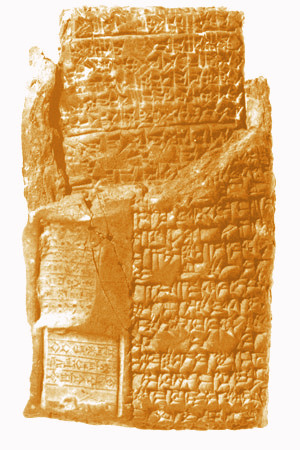
Many of us would be aware that the earliest written records of humankind are the clay tablet (cuneiform) writings from ancient Sumeria. The concept of a debt jubilee now being revived by Professor Steve Keen has its earliest origins in Sumeria/Babylonia, where actual “money” (eg, coins) was very little used; instead, the economy functioned almost entirely on a system of debts and credits, which (like today) were nothing more than bookkeeping entries, written originally on clay balls, later, on clay slates. The phrase “a clean slate”, meaning to have a fresh start or new beginning, has its origins here. New Year’s Eve celebrations also have their origins here – it was not uncommon practice for Sumerian kings to declare all debts annulled, to destroy all the records of debt and so begin with “a clean slate” in the new year; a cause for joyous celebration if ever there was one!

CunEnv

In chapter 7 of Graeber’s book, we also discover the meaning of the word “Ur,” from an early Sumerian dictionary:

ur (HAR): n, liver; spleen; heart; soul; bulk; main body; foundation; loan; obligation; interest; surplus; profit; interest-bearing debt; repayment; slavewoman.

I think there may well be a significance to the story of Abraham and his journey out of Ur to the Land of Promise, that is both far deeper, and far more practical, than most give it credit for.

Wealth, Virtual Wealth, And Debt

22 Feb

03WORLD-articleLarge

Yes, I do bang on a lot about bank(ster)ing, usury, and debt slavery. But I am far from the first.

Mankind has known of these great evils for millennia.

Literally, for thousands of years.

Great wise men have preached against the parasitic slave trade of the money-lenders throughout the ages.

Plato, Aristotle, Cato, Cicero, Seneca, Moses, Philo, Buddha, Jesus – all denounced the evil of money-lending at interest. The only Biblically-recorded instance of Jesus Christ resorting to violence, was when he chased the money-lenders out of the Temple with a whip.

And yet, in our so-called “Information Age”, when billions have access to heretofore unimaginable storehouses of historical records, books, and information, it almost seems as though humanity is further away than ever from having a solid understanding of HOW the dark worlds of “money” and “banking” really work.

Here are some quotes (bold added) from the writings of Frederick Soddy in the early 20th century (h/t Monetary Realism via Pragmatic Capitalism):

“THE PRIVATE ISSUE OF MONEY; A CHANCE RESULT OF THE BANK CHEQUE SYSTEM

No doubt there are still many people, if not the majority, who will be frankly incredulous that money vastly exceeding in amount the total national money can be, and is created and destroyed by the moneylender with a stroke of the pen. How frequently does one still read in the Press that the banks can only loan their customers spare money! Most people still think of what money once was, “a public instrument owned and controlled by the State.””

“Wealth, Virtual Wealth, And Debt”, p. 147, published 1926

“This book will show what money now is, what it does, and what it should do. From this it will emerge the recognition of what has always been the true rôle of money. The standpoint from which most books on modern money are written has been reversed. In this book it is not treated from the point of view of bankers—as those who create by far the greater proportion of money—but from that of the PUBLIC, who at present have to give up valuable goods and services to the bankers in return for the money that they have so cleverly created and create. This, surely, is what the public really wants to know about money.

It was recognised in Athens and Sparta ten centuries ago before the birth of Christ that one of the most vital prerogatives of the State was the sole right to issue money. How curious that the unique quality of this prerogative is only now being rediscovered. The “money power” which has been able to overshadow ostensibly responsible government, is not the power of the merely ultra-rich, but is nothing more nor less than a new technique designed to create and destroy money by adding and withdrawing figures in bank ledgers, without the slightest concern for the interests of the community or the real rôle that money ought to perform therein.”

Page x: “To allow it to become a source of revenues to private issuers is to create, first, a secret and illicit arm of the government and, last, a rival power strong enough ultimately to overthrow all other forms of government.”

– “The Role of Money”, p. ix-x, published 1934

“The Banker as Ruler.

—From that invention dates the modern era of the banker as ruler. The whole world after that was his for the taking. By the work of pure scientist the laws of conservation of matter and energy were established, and the new ways of life created which depended upon the contemptuous denial of primitive and puerile aspirations as perpetual motion and the ability ever really to get something for nothing. The whole marvellous civilisation that has sprung from that physical basis has been handed over, lock, stock, and barrel, to those who could not give and have not given the world as much as a bun without first robbing somebody else of it… The skilled creators of wealth [in industry and agriculture] are now become hewers of wood and drawers of water to the creators of debt, who have been doing in secret what they have condemned in public as unsound and immoral finance and have always refused to allow Governments and nations to do openly and above aboard. This without exaggeration is the most gargantuan farce that history has ever staged.”

– “The Role of Money”, p. 51, published 1934

Ever here someone insist that government “printing” money is always a terrible, idiotic thing?

Private banks do it. Every single day. And make vast profits from doing so.

In the modern technological age, it is even easier for the banks than in Soddy’s day. There’s no longer any need to waste paper and ink writing down their ledger entries.

The “money” that banks create today, is just typed into a computer, every time a new loan is made.

“Genuine and Fictitious Loans.

—For a loan, if it is a genuine loan, does not make a deposit, because what the borrower gets the lender gives up, and there is no increase in the quantity of money, but only an alteration in the identity of the individual owners of it. But if the lender gives up nothing at all what the borrower receives is a new issue of money and the quantity is proportionately increased. So elaborately has the real nature of this ridiculous proceeding been surrounded with confusion by some of the cleverest and most skilful advocates the world has ever known, that it is still something of a mystery to ordinary people, who hold their heads and confess they are “unable to understand finance.” It is not intended that they should.”

– “The Role of Money”, p. 62-3, published 1934

My view?

The human race is doomed to experience the darkest dystopian future imagined by any ancient prophet, seer, or modern “science fiction” novelist.

We are within sniffing distance of the worst “Big Brother” Orwellian nightmares.

That is our fate.

Unless the exclusive, government-legislated power to create “money” is taken away from private and quasi-“government” institutions – meaning, banks and central banks.

Because that is where the ultimate physical power in the world rests.

With the creators of “money”.

For them to lose that power, requires education.

It requires people who do understand how the “money” enslavement system works, to share that knowledge with people who don’t.

Even if they do not want to hear it. Which most do not – the truth is often very uncomfortable.

Ultimately, it requires alternatives.

New “money” solutions that inherently decentralise the power of money.

Perhaps even something like this –

The People’s NWO – Every Man His Own Central Banker

“Banks Are Frauds”: Insider

21 Feb

As I was saying.

From The Sovereign Man:

Why a banking insider says “It’s time to be very worried”

Despite all the commotion outside, I met up with my colleague, and we dove immediately into a conversation about international banking and the state of the global financial system. As a senior executive of a large international bank, he is the ultimate insider. And I was floored by what he told me.

He openly acknowledged, for example, that banks are frauds. Most banks, particularly in the developed west, only hold a tiny fraction of their customer’s deposits in cash. The rest is gambled away on whatever the popular toxic security du jour happens to be.

This entire system rests upon a very thin layer of confidence, reinforced by the occasional taxpayer bailout. Yet it struck him as incredible that people still had confidence in banks, especially given that most of the investment products promoted to their customers are “crap”.

He told me how destructive central bankers are, creating untold amounts of inflation that only serves to make people poorer, while enabling governments to go deeper into debt.

Most of all, he told me that very few of the banking sector’s underlying deficiencies have been addressed since the 2008 meltdown. Many western banks are still insolvent, with the key difference that their governments are now also insolvent.

He believes that in the coming years, this confluence of risk will finally burst, most likely induced by the effects of the currency wars and competitive devaluation.

It was astounding, he said, that the G7 actually published a statement trying to soothe concerns about the global currency wars. “Whenever the government tells you to not worry about something,” he said, “it’s time to be very worried.”

Unfortunately, most people don’t know what’s happening. They don’t know that their government is insolvent, and that the only way they can persist is to go deeper into debt and devalue their currency. They don’t know that the money in their bank account isn’t safe. And they don’t have any idea how far their government will go to maintain the status quo.

It turns out that the screaming teenagers outside were a perfect metaphor. Happily ignorant. Distracted. And completely unaware. Most people simply aren’t going to see it coming.

And yet, from a big picture perspective, it all seems so obvious. National balance sheets across the developed west are deeply in the red. Bank balance sheets are precarious at best. Central bankers are flooding the world with paper money. And governments are trying everything– capital controls, competitive devaluation, pension nationalization– to keep the party going.

The writing is on the wall.

Read the whole article here.

The Biggest Drag On Our Economy

20 Feb

ball-and-chain

What do you think is the biggest drag on our economy?

If you said “usury“, welcome to Club Classically Correct.

Usury is not, as so many would have you believe, the charging of an excessive rate of interest.

That is the modern definition. Banker approved.

The classical definition of usury is commonly attributed to Aristotle:

“There are two sorts of wealth-getting, as I have said; one is a part of household management, the other is retail trade: the former necessary and honorable, while that which consists in exchange is justly censured; for it is unnatural, and a mode by which men gain from one another. The most hated sort, and with the greatest reason, is usury, which makes a gain out of money itself, and not from the natural object of it. For money was intended to be used in exchange, but not to increase at interest. And this term interest (tokos), which means the birth of money from money, is applied to the breeding of money because the offspring resembles the parent. Wherefore of any modes of getting wealth this is the most unnatural.”

– Aristotle, c. 350BC (Politics, Book I, Part X)

Today, our modern “money” system is the pinnacle of the money-lenders’ art.

Or should I say rather, the money-lenders’ “artifice”:

ar·ti·fice
[ahr-tuh-fis]
noun
1. a clever trick or stratagem; a cunning, crafty device or expedient; wile.
2. trickery; guile; craftiness.
3. cunning; ingenuity; inventiveness: a drawing-room comedy crafted with artifice and elegance.
4. a skillful or artful contrivance or expedient.

The vast majority (around 97%) of “money” is simply electronic digits.

Digital bookkeeping entries.

Created by the banking system, every time a person signs up for a new (or bigger) loan.

(See The World’s Most Immoral Institution Tells You How + Think You’ve Got Cash In The Bank? Think Again)

And here is the key to the usurers’ immense power and wealth. They have been given the exclusive rights not just to create this digital “money” in the form of debt that must be repaid. You have to pay back those digital bookkeeping entries with interest.

It is interest – usury – that is the biggest drag on our economy.

Consider this.

According to the ABS, the average size loan for a first home buyer in Australia reached an all-time high $293,900 in December 2012. A typical variable home loan rate right now is 5.6% – that’s with the RBA’s official interest rate at record “emergency” lows, mind you. According to ASIC’s “MoneySmart” online calculator, taking out such a loan right now, and repaying $2,000 a month for the next 20 years and 9 months, would result in your repaying the bank $203,598 in usury alone.

Of course, this assumes that interest rates did not rise in the next 20-something years. If (when) they do, then so too does the amount of usury you must repay to the bank.

Just the other day I was wondering, “Has anyone ever bothered to calculate the total value of one year’s worth of usury repayments, on all home loans in the Australian economy”?

To be frank, I have neither the skills nor the knowledge to make an accurate calculation.

But it is not hard to work out a very rough approximation.  Something that helps give some idea of just what a drag on the economy the repayment of usury on the banks’ digital bookkeeping entries must be.

According to the RBA, at December 2012 the Australian banking system claimed a total $1.136 Trillion in residential loan “Assets”.

(Yes, that’s right. Your signature on a loan document, pledging yourself to decades of debt slavery to repay the bank their digits, is considered the bank’s “Asset”)

According to Canstar’s variable rate home loan comparison chart, a variable mortgage rate of around 5.6% would appear fairly typical right now.

So, as a very basic approximation, if the total value of all the banks’ mortgage “assets” at end December 2012 were on the variable rate of usury, thus earning the banks 5.6% p.a., then (ignoring compounding, which makes the total even higher) the banks’ would stand to earn $63.6 billion in usury on home loans in 2013.

Just imagine all the far better, more productive and valuable uses that much “money” could be put to in 2013 by Aussie households.

Now again, I stress my lack of knowledge on this data. For all I know, the value of expected usury repayments may already be included in the RBA’s total of banks’ mortgage “assets”.

If so, it matters very little. Even a mere 5.6% compound interest on >$1 Trillion in mortgage debts, is a huge annual sum.

Clearly, the drag on the economy from the burden of repaying usury to the bankers on home loans alone, is truly staggering. EPIC.

And when we consider that banks have done nothing to deserve this exclusive right to profit from our lifetime labours, the truth of Aristotle’s observation is only the more clear.

Of any modes of getting wealth, usury is indeed the most unnatural.

Jessica Irvine Shuns The Vested Usurers

17 Feb

vested usurers

Jessica Irvine is the National Economics Editor for News Limited.

She and her husband have carefully weighed the pros and cons, and decided that it makes more sense to join “Generation Rent”, than to spend the next 3 decades of their lives paying usury to the banks:

I’m moving in two weeks. Yep, it’s all cardboard boxes and roller tape at our house.

Happily married for two and a half months now, we’re on to the next big adventure.

Buying the dream home with white picket fence? No. Not for us. Not yet.

We’re signing a 12 month lease and moving to an apartment in the city to be closer to work.

You see, I’m part of Generation Rent – the generation the urge to buy property passed by.

Where our parents see rent money as “dead money”, Generation Rent baulks at the idea of becoming mortgage slaves, shackled to the high interest demands of a supersized mortgage. Interest paid to the bank is as dead as any rent money.

Far from frittering away our money, we’re actually showing a level of financial conservatism not seen since our grandparent’s generation. We’ll save now and minimise our debt burden later.

We’ll step on to the property ladder eventually, if it suits us. And if we don’t have to pay more in interest to the bank than it would cost to rent.

Click the link and read the whole thing.

Jessica’s reasoning for her decision makes sound financial sense.

And whether she realises it or not, it makes sound moral sense too.

That is far more important.

By choosing not to sign up for decades of debt slavery, by choosing not to pay “interest” to the vested usurers, she is striking a blow against The World’s Most Immoral Institution.

And setting a wonderful moral example for others to follow.

Well done Jessica!

DON’T BUY NOW!!

The World’s Most Immoral Institution Tells You How

1 Apr

To understand why The Banking System is The World’s Most Immoral Institution, you need only to understand how it actually works.

Not how it works in the lofty, rarefied atmosphere of incomprehensible acronyms like ARM and RMBS and CFD and CDO and QE and LTRO.

Just the basics of banking.

The works that you and I deal with every day, at our local bank.

Fortunately, The Banking System has grown so proud of its near God-like power, it is happy to tell us how the basics really work.

From Modern Money Mechanics – A Workbook on Bank Reserves and Deposit Expansion, a complete booklet originally produced and distributed free by the Public Information Center, Federal Reserve Bank of Chicago, now out-of-print (emphasis added):

Who Creates Money?

Changes in the quantity of money may originate with actions of the Federal Reserve System (the central bank), depository institutions (principally commercial banks), or the public. The major control, however, rests with the central bank.

The actual process of money creation takes place primarily in banks. As noted earlier, checkable liabilities of banks are money. These liabilities are customers’ accounts. They increase when customers deposit currency and checks and when the proceeds of loans made by the banks are credited to borrowers’ accounts.

In the absence of legal reserve requirements, banks can build up deposits by increasing loans and investments so long as they keep enough currency on hand to redeem whatever amounts the holders of deposits want to convert into currency. This unique attribute of the banking business was discovered many centuries ago.

NB: This is why governments the world over are so obsessed with maintaining public “con-fidence” in the banking system. It is why they so fear any hint of a “run on the banks”. As we have seen previously ( “Think You’ve Got Cash In The Bank? Think Again” ), the Australian banking system only has around $183.50 in stored ‘reserve’ cash for every employed person in the country.  According to Australia’s central bank, the RBA, there is only $53.2 billion in actual cash notes in existence (or $4,655 per employed person) … even though Australian households and non-financial businesses believe that they have a combined $986 billion in total Deposits. If 1 in every 19 Aussies insisted on withdrawing their bank “Deposits” at the same time … all the cash would be gone. To add injury to insult, The Banking System is “earning” (?!) interest (thus, profits) from a grand total $1.95 Trillion in “loans” created out of thin air, and “lent” to Australian households and businesses.  Interest on “money” that does not exist … except as a series of electronic digits that a banking clerk typed into a computer.

It started with goldsmiths. As early bankers, they initially provided safekeeping services, making a profit from vault storage fees for gold and coins deposited with them. People would redeem their “deposit receipts” whenever they needed gold or coins to purchase something, and physically take the gold or coins to the seller who, in turn, would deposit them for safekeeping, often with the same banker. Everyone soon found that it was a lot easier simply to use the deposit receipts directly as a means of payment. These receipts, which became known as notes, were acceptable as money since whoever held them could go to the banker and exchange them for metallic money.

Then, bankers discovered that they could make loans merely by giving their promises to pay, or bank notes, to borrowers. In this way, banks began to create money. More notes could be issued than the gold and coin on hand because only a portion of the notes outstanding would be presented for payment at any one time. Enough metallic money had to be kept on hand, of course, to redeem whatever volume of notes was presented for payment.

Transaction deposits are the modern counterpart of bank notes. It was a small step from printing notes to making book entries crediting deposits of borrowers, which the borrowers in turn could “spend” by writing checks, thereby “printing” their own money.

Consider what this really means.

A bank creates “money”, authorised by your signature on a loan document.

Your signature is your legally-binding agreement, to become the bank’s debt slave.

With a few taps on the keyboard and clicks of a mouse, the “loan” that you must pay back, with interest, is created right out of thin air.

An electronic book-keeping entry is made under your name, as a new bank “Deposit”.

And another electronic book-keeping entry is made under the bank’s name, as an “Asset”.

Your legally-binding agreement to pay back the “loan” … with interest … is the bank’s “Asset”.

Every person, every business, every nation with a debt to a banking institution, is in plain truth a slave to their own wilful ignorance.

Working and slaving away, day after day, to pay back with interest something that came from nothing.

While the “Big Club” of elite bankers stride the earth like princes, on the back of everyone else’s daily toil and trouble.

Producing no thing.

Gaining every thing.

The Banking System.

It is the World’s Most Immoral Institution.

It is also the World’s Most Unnecessary Institution.

Here is my solution, for how we should do it.

Some of you, we all know, are poor, find it hard to live, are sometimes, as it were, gasping for breath. I have no doubt that some of you who read this book are unable to pay for all the dinners which you have actually eaten, or for the coats and shoes which are fast wearing or are already worn out, and have come to this page to spend borrowed or stolen time, robbing your creditors of an hour. It is very evident what mean and sneaking lives many of you live, for my sight has been whetted by experience; always on the limits, trying to get into business and trying to get out of debt, a very ancient slough, called by the Latins aes alienum, another’s brass, for some of their coins were made of brass; still living, and dying, and buried by this other’s brass; always promising to pay, tomorrow, and dying today, insolvent; seeking to curry favor, to get custom, by how many modes, only not state-prison offences; lying, flattering, voting, contracting yourselves into a nutshell of civility or dilating into an atmosphere of thin and vaporous generosity, that you may persuade your neighbor to let you make his shoes, or his hat, or his coat, or his carriage, or import his groceries for him; making yourselves sick, that you may lay up something against a sick day, something to be tucked away in an old chest, or in a stocking behind the plastering, or, more safely, in the brick banks; no matter where, no matter how much or how little.

I sometimes wonder that we can be so frivolous, I may almost say, as to attend to the gross but somewhat foreign form of servitude called Negro Slavery, there are so many keen and subtle masters that enslave both North and South. It is hard to have a Southern overseer; it is worse to have a Northern one; but worst of all when you are the slave-driver of yourself.

– Henry David Thoreau, Walden; or, a Life in the Woods, 1854

Think You’ve Got Cash In The Bank? Think Again

5 Feb

From the Reserve Bank of Australia (RBA) website:

Click to enlarge

That’s $53.2 billion in Australian notes on issue.

Sounds like a lot, right?

According to the Australian Bureau of Statistics (ABS), in December 2011 there were 11.441 million employed people in Australia.

So $53.2 billion in notes equals just $4,655 per employed person.

Doesn’t sound like so much now, does it?

But wait. There’s more.

According to the RBA’s spreadsheet titled “Assets – Selected Assets and Liabilities of the Private Non-financial Sectors”, it seems that “Households and unincorporated enterprises” have $668 billion in “Financial Assets – Deposits.”

And “Private non-financial corporations” supposedly have another $318 billion in “Financial Assets – Bank Deposits.”

So that’s $986 billion in “Deposits” for households and private (non-bank) businesses … combined.

Versus a grand total of only $53.2 billion in actual Australian notes issued by the RBA.

Confused?

If so, then it is probably because you have not yet seen through the biggest, longest-running con in the history of the human race.

It used to be called “money-lending”.

Now it’s called “banking”.

In a nutshell, the “money” that most people think is in the bank … isn’t.

That’s why, during the peak of the GFC in October 2008, the RBA was printing up billions in extra cash, trying to keep up with a silent bank run:

The private banks keep reserves of cash distributed in 60 storerooms across the country with an average of about $35 million in each. They get topped up by the Reserve Bank before Christmas, when demand for cash typically rises by about 6 per cent, and at Easter, when there is a smaller increase.

[TBI note: That’s only $2.1 billion in stored ‘reserve’ cash at Aussie banks at any time … or a mere $183.50 for every employed person in the country!]

But in early October, the Reserve Bank started getting calls from the cash centres for more, especially in denominations of $50 and $100.

The Reserve Bank has its own cash stash. It is coy about exactly how much it holds, but it is understood to be in the region of $4 billion to $5bn.

As the Armaguard vans worked overtime ferrying bundles of $10,000 out to the cash centres, the Reserve Bank’s strategic reserve holdings of $50 and $100 notes started to run low and the call went out to the printer for more. The Reserve Bank ordered another $4.6bn in $100s and another $6bn in $50s…

Households pulled about $5.5bn out of their banks in the 10 weeks between US financial house Lehman Brothers going broke – the onset of the global financial crisis – and the beginning of December. That is roughly 80 tonnes of cash salted away in people’s homes. Mattress Bank is doing well, was the view at the Reserve. A year later, only $1.5bn had been put back.

(see Our Banking System Operates With Zero Reserves)

You see, dear reader, the global banking system is a colossal con-fidence trick.

Banksters have a government-issued exclusive licence to operate the most insidious “business” in the history of the human race.

They make a killing by lending us vast quantities of … digits. At interest.

Electronic code, in their computers.

Not actual cash money.

When you sign a form to borrow from a bank, the bank is ‘licenced’ to legally create new “money” to lend you. Right out of thin air.

The “money” loaned to you, does not exist.

It is just a new number, on their books.

Your new “loan”, is their new “Asset”.

What you have signed your working life away for, is nothing more than a new electronic bookkeeping entry.

You are working and slaving away, to pay back borrowed binary code … plus “interest”.

Tragically, most folks worldwide have fallen for this centuries-old con game.

Indeed, we have all been born into it. So, we consider it “normal”. We have known nothing different:

Most folks think that when they borrow from a bank, they are borrowing real money that someone else deposited.

Most folks think that banks pay interest to attract depositors, and then, lend that money out at a higher interest rate to people wanting a loan.

It just ain’t so.

As you can see from the RBA’s own statistics, even the “money” that we think we have deposited in the bank … just isn’t there.

There’s only $53 billion in actual cash notes issued by the RBA.

In total. For the whole country.

Versus $986 billion in “Deposits” that businesses and private citizens – you and I – think we have in the banks.

That’s about one (1) actual dollar in “face value”, for every eighteen dollars fifty (18.50) that we falsely imagine is deposited in the bank under our name.

If the “money” lent to you by banksters was only the money they had on deposit from other customers, then how would you explain the fact that (according to the RBA’s “Bank Lending by Sector”) Australian households owed $1.18 Trillion to the banks at December 2011 (including $721 billion for Owner-Occupier housing) … and Australian businesses owed a further $773 billion?

$53 billion in legal tender cash notes issued by the RBA.

$1.95 Trillion in bank loans to households and businesses … at interest.

That’s $36.80 in bank loans … at interest … for every $1 in actual cash printed by the RBA*.

It’s all bull$h!t folks.

By our lazy, ignorant complicity, in agreeing to allow our governments to grant banksters the exclusive power to create “money” and lend … electronic digits … at interest, we have all agreed to a system of human slavery.

Our own slavery.

We have enslaved ourselves, by agreeing to go along with this “system”.

It’s long past time that we all woke up.

And stopped playing along with the con game of “money”-lending.

And especially, of money-lending at “interest”.

There is a very good reason why so many great wise men – Plato, Aristotle, Cato, Cicero, Seneca, Moses, Philo, Buddha, and many many more – all denounced the evil of money-lending at interest. Indeed, it is the same reason why the only Biblically-recorded instance of Jesus Christ resorting to violence, was when he chased the money-lenders out of the Temple with a whip.

The wisdom of the ancients is even more relevant today.

In our modern technology-driven world – where “money” is now not even real gold and silver laboriously dug out of the ground, but mere electronic digits created at the tap of a keyboard and click of a mouse button – there is simply no intellectual or moral justification for the vast majority of mankind to continue allowing a tiny minority to profit from the life and labour of everyone else, by lending “money” at “interest” under government licence.

It is time to demand that our governments enact a single, simple, real reform that would change the whole world for the better.

For everyone.

(Except banksters)

It is time to ban usury … in the original meaning of the word.

And if our elected representatives refuse to act against the banksters’ interest, in our best interest?

Then the following essay outlines my suggestion for one way to beat the bastards at their own game –

The People’s NWO: Every Man His Own Central Banker

* Some may correctly point out that Australian banks do not only take “deposits” from Australians; they also borrow “money” from abroad, in order to lend in Australia. Indeed, this gives rise to the ever-controversial topic of the banks claiming that increases in the cost (ie, interest rate) they are paying for “wholesale” money they have borrowed from abroad supposedly justifies their refusal to pass on the full value of “official” interest rate cuts by the RBA. Nevertheless, the central point of this article remains unchallenged. According to the RBA at December 2011, AFI’s (All Financial Intermediaries) held $308.6 billion in “Offshore Borrowings” – a very far cry from the $1.95 Trillion in loans-at-interest to Aussie households and businesses. More important to note is that these “Offshore Borrowings” too, are mere electronic digits … not actual cash.

Design a site like this with WordPress.com
Get started