Tag Archives: wayne swan

Our Second Biggest Market Slumps, “Fundamentally On A Downward Slope”

30 Dec

Started out, just drinkin’ beer
I didn’t know how or why
Or what I was doin’ there
Just a couple more
Made me feel a little better
Believe me when I tell you
It was nothin’ to do with the letter

Sometimes I wonder
What all these chemicals
Are doin’ to my brain
Doesn’t worry me enough
To stop me from doin’ it agai-ai-ain
Wipin’ out brain cells
By the millions but I don’t care
It doesn’t worry me
Even though
I ain’t got a lot to spare-are-are

– The Nips Are Getting Bigger, Mental As Anything

If Treasurer Swan had enough grey matter to comprehend what is happening in the global economy Ponzi, then he’d probably be turning to the drink by now.

Because Japan’s economy is getting smaller.

From Bloomberg:

Japan’s rebound from the March earthquake and tsunami sputtered in November as production and retail sales tumbled, deepening the nation’s return to the deflation that first took hold a decade ago.

Industrial output slumped 2.6 percent from October, more than all the forecasts in a Bloomberg News survey of 29 economists, a government report showed today in Tokyo. Retail sales slid 2.1 percent…

“Fundamentally, Japan’s economy is on a downward slope,” said Yoshimasa Maruyama, chief economist at Itochu Corp. “Exports are falling and negatively impacting Japan’s economy due to the global slowdown.”

“Industrial production is unlikely to recover to” levels seen before the 2008 global financial crisis, Junko Nishioka, chief Japan economist at RBS Securities Japan Ltd., said before today’s reports.

Other data also suggest Japan’s recovery may be stalling. Exports fell for the second straight month in November from a year earlier and capital spending in the third quarter dropped 9.8 percent.

Japan is our second biggest export market.

According to DFAT, as of October 2011 … before the November slump reported by Bloomberg … our exports to Japan were worth 62% of our exports to China:

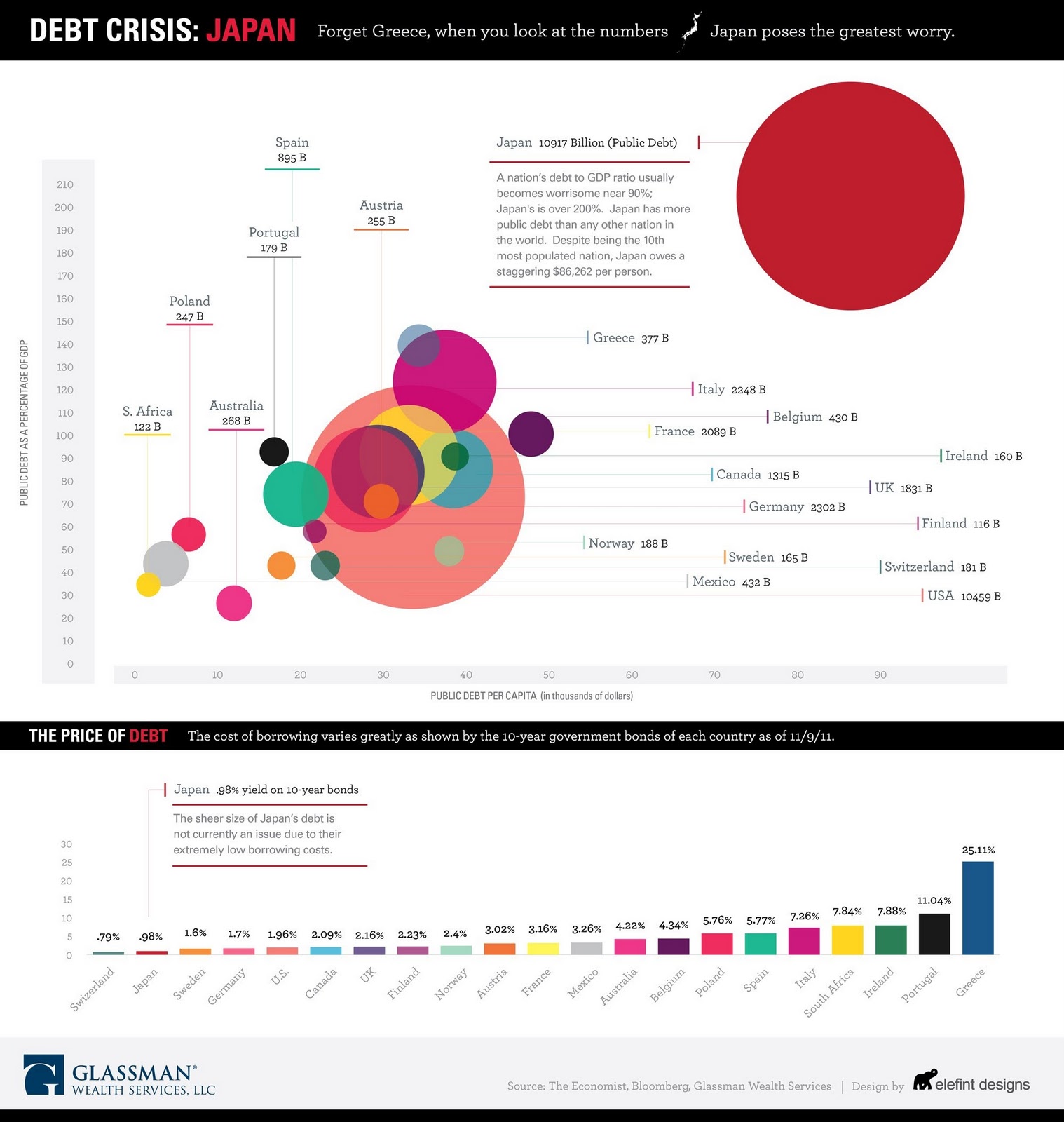
The world’s third largest economy is also the most debt-laden nation on the planet:

Click to enlarge

Back in June we brought you the warning that our biggest economic danger could be hiding in plain sight.

It’s worth recapping:

Buy a farm house in the middle of nowhere, pick up a gun or two, prepare for hyperinflation and brace for a catastrophic bankruptcy. Thirty minutes with hedge-fund manager J. Kyle Bass has you wanting to do all of the above.

The head of Dallas-based Hayman Advisors LP isn’t thinking about Greece or even Spain but Japan, the world’s third-biggest economy. He says his bet against Japanese government bonds is even “more compelling” than his gamble to sell short U.S. subprime-mortgage debt, which earned him $500 million in 2007.

Shorting Japan has been a losing proposition in recent years. But the earthquake, tsunami and nuclear crisis altered the outlook for a nation whose debt is more than double the size of the economy. Bass says a collapse is inevitable, making Japan’s 10-year bonds — they yield 1.3 percent, among the lowest in the world — a natural for a bear investor.

His argument is this: Japan now spends half of its central- government revenue on servicing debt. This task won’t get any easier as the country’s population ages and shrinks — provided rates stay the same. What’s more, the price tag for the earthquake and its effects will far exceed Japan’s initial $300 billion estimate, pushing the country over the edge. In Bass’s view, the biggest asset bubble ever is hiding in plain sight.

Feel like a drink?

It’s almost NYE after all.

Boom State Busts

29 Dec

The WA government has revised its 2011-12 budget forecast downwards … by more than 50%:

The West Australian government has slashed its projected surplus by more than $200 million because of risks in the global economy, weaker royalties, a weak housing market and the high Australian dollar.

WA is expected to record a $209 million surplus, making it the nation’s highest surplus for 2011-12.

But the projected surplus is significantly lower than the $442 million forecast at budget time.

The figure was released on Wednesday as part of the Liberal-National government’s mid-year review.

Reasons given?

Treasurer Christian Porter said there had been many changes to the global economy since the May state budget.

“There’s been one single unanticipated economic phenomena that has occurred since the time of delivering the budget in May, which has had a very significant impact on the WA state economy – that is the events that are unfolding in Europe.

“It is self-evident that what’s going on in Europe is very serious.”

Mr Porter said the European sovereign debt crisis and a slower than expected recovery in the US economy had been major factors in the revised estimates.

He said the royalty revenue had been revised downwards to $970 million over the budget and forward estimates period because of a higher $US/$A exchange rate and the impact of lower iron ore, oil and base metals prices.

Mr Porter said that while the European Union accounted for just six per cent of WA’s merchandise exports, it provided 20 per cent of China’s exports, which could affect WA.

He said that if conditions in Europe worsened and negatively affected the availability and cost of credit, major resource projects in WA could be delayed.

Anything else?

… the housing market remains weak with both house prices and sales volumes lower than the budget forecasts.

And the future beyond the next 6 months?

Budget surpluses are still forecast until 2013/14 though these too have been revised significantly downwards.

Why?

Softening iron ore prices over the last six months have hit the State Government’s revenue projections hard, with Treasurer Christian Porter forecasting an almost billion dollar drop in mining royalties in the state over the next four years.

Speaking to reporters today Mr Porter said the government has slashed $951 million from its projections of mining royalties, with almost $820 million coming off iron ore royalties alone over the next four years.

This is despite the State Government increasing royalty rates on fines iron ore from 5.25 per cent to 6.5 per cent from July next year, and up to 7.5 per cent from the following financial year.

The State Government’s mid year financial review forecast a steady fall in iron ore prices over the next four years, however, following sharp falls in spot prices earlier this year as uncertainty over European debt and the health of the Chinese economy hit markets.

So, our “boom” state is now expecting a bust.

Of 50%+.

What was it that Senator Joyce said in response to the Federal government’s “truly extraordinary” May budget forecast?

Opposition frontbencher Barnaby Joyce has taken a swipe at the Gillard government’s approach to the economy, saying it had an unbounded belief in Asia’s demand for Australia’s resources.

“God help you when the prices go down,” he told reporters in Canberra on Wednesday.

The government’s approach to economics was “a clever ability to charge people to dig up red and black rocks.”

“They (government) have an unbounded belief that the people in South-East Asia will have an eternal gratitude to pay an excessive price for red rocks and black rocks.”

And what did he say in September (a must-read)?

Australia avoided recession because of the export of red rocks (called iron ore) and black rocks (called coal) in record volumes at record prices, record shipments of wheat, a 425 basis point drop in interest rates and a comparatively low dollar.

Wayne Swan likes to regularly point to Australia’s $400 billion investment pipeline but he doesn’t control that. That is a promise of someone else’s benevolence. What he does control is the public sector debt and it is going through the roof.

Barnaby was right.

Again.

Now, about that revised fudged $1.5bn Federal government budget surplus, forecast for 18 months away.

Wayne? … Wayne?!?!

Oh, of course. Silly me. We don’t need to hear it again.

We all know the mantra by now:

“Our economy has blah blah strong fundamentals blah blah low debt blah blah trend growth blah blah a huge investment pipeline.”

Australia’s AAA Ponzi Rating: What Wayne Forgot To Mention

24 Dec

Everything’s fine.

Nothing to see here folks.

Move along now.

Back to your consumer spending.

Here, have another credit debt card:

Acting Prime Minister Wayne Swan says the reaffirmation of Australia’s triple-A credit rating by ratings agency Moody’s proves the economy is strong and the federal opposition is wrong to talk it down.

The treasurer on Thursday also labelled as “complete rubbish” media reports suggesting the country was on the brink of an unemployment catastrophe.

Moody’s said overnight that Australia’s AAA credit rating was “supported by the very low level of public debt and the country’s strong financial system”…

Uh … Wayne.

What else did Moody’s say?

The government’s debt rating of Aaa takes into account the aim of maintaining a balanced budget, on average, over the business cycle.

Oops.

As shadow treasurer Joe Hockey rightly (for a change) points out:

Without further detail, the government’s projection to reduce net debt to zero by 2020-21 is hardly believable, coming from a Treasurer who this year will chalk up his fourth huge deficit out of four budgets. It would require six consecutive annual reductions in net debt of $22bn. That is six consecutive surpluses larger in dollar terms than has been achieved previously (the largest underlying surplus was the $19.7bn achieved by the Coalition in 2007-08) or very solid growth in financial assets, which seems problematic given the likely continued financial and market volatility across the medium term.

Not. Gonna. Happen.

Even if the Green-Labor government succumb to Joe’s empty threat … which they won’t:

Default threat as Liberals issue debt warning

The Coalition has threatened to block any effort by the government to raise the $250 billion limit on public sector borrowing, potentially forcing the government to run out of money.

“Whilst the Coalition has supported this in the past, the government should not expect a rubber stamp this time,” Mr Hockey says in his article.

The Coalition demands could include scrapping the carbon tax and the mining tax, along with the benefits they are intended to finance, such as personal tax cuts and increased superannuation.

Does anyone seriously believe that the Opposition would force a government shutdown, and default on our public debt obligations, rather than increase the debt ceiling?

Not. Gonna. Happen.

What else did Moody’s say, that Wayne conveniently forgot to mention:

The stable ratings outlook is premised on the expectations that the government will maintain its low debt levels and macroeconomic conditions will continue to support fiscal consolidation.

Any trend or event that caused a long-term shift in budget balances to significant deficits and an increasing public debt burden might put downward pressure on the rating.

In other words, hope like hell that global macroeconomic conditions don’t continue over the cliff, and get back to annual budget surpluses pronto so that you can actually start paying down that “low” (but ever-rising) public debt level … or you can kiss your AAA rating goodbye.

Not. Gonna. Happen.

Mr Swan on Thursday also slammed a newspaper report that suggested the country was on the verge of a jobs crisis.

Sydney’s Daily Telegraph reported Australia was set to lose 100,000 jobs in the months after Christmas.

Not so, according to the treasurer.

“Our economy has strong fundamentals, we have low unemployment, we have strong public finances, we have trend economic growth and we have a huge investment pipeline.

We have “trend economic growth”, do we Wayne?

You’d better hope not.

Because if we do, then your budget surplus soothsaying is in very deep doo doo.

“The Liberals have been talking our economy down. But we have also got the Daily Telegraph today running a story which is simply exaggerated nonsense.”

Mr Swan said neither advertisers or their customers would appreciate the economy being talked down just before Christmas.

Why so much concern about “talking it down”?

You see, dear reader, the simple truth is this.

The word “economy” … in the modern, bankster-debt-driven sense … is exactly synonymous with the word “Ponzi”.

Both need continuous growth.

Generated by lots of fools at the bottom … whose money flows to the scum at the top.

Running a Ponzi is all about con-fidence.

You always have to be “talking it up”.

You can’t have anyone “talking it down”.

Because the moment that participants in the system begin to lose con-fidence … growth slows, then stops.

Horror of horrors … it goes backwards. The Ponzi begins to implode.

And the parasitic scum at the top begin to lose their sole source of sustenance.

You.

Likewise, a bankster-debt-driven “economy”.

Which is why the scum at the top are always so keen to … talk it up.

Australia has a AAA-rated economy Ponzi.

One of the last remaining AAA-rated Ponzi’s in the Western world.

More fool us.

GilSwan Conned – Mining Tax The Greens’ Pit Of Despair

22 Dec

See those storm clouds gathering?

Over the Pit of Despair?

I wonder how Greens’ supporters will respond, when they wake up and discover the truth.

That their party’s deal with Labor on the mining tax will have the opposite result of what they were told.

I wonder what will they say, when they discover that the Minerals Resource Rent Tax (MRRT) will not result in the kind of wealth redistribution that was touted, a “fair share of our mineral wealth for all Australians”.

That instead, it will result in the Big 3 multinational mining companies … getting bigger. And richer. And more powerful.

And the government’s budget digging even deeper into the red.

When PM Gillard and Treasurer Swan went behind closed doors with the Big 3 miners to thrash out a hasty “fix” to former PM Rudd’s Resource Super Profits Tax (RSPT) debacle, thinking folks knew it would not end well.

Except for the big miners, that is.

Rather than scoring a vital goal for her “decisive” new leadership before the 2010 election, the secretive deal always looked more likely to result in yet another decisive Labor own goal.

And indeed it has.

Especially after Gillard and Swan again went behind closed doors, this time with the Independents and Greens, to thrash out a political deal to secure passage of the legislation in the parliament.

Late last month, after the new MRRT legislation passed the lower house, mining correspondent for The Australian Andrew Burrell belled the cat:

FEWER than one in 10 iron ore and coal miners operating in Australia will earn enough profit to start paying the $11.1 billion minerals resource rent tax from next year, according to Gillard government estimates.

A spokesman for Wayne Swan said yesterday he could not provide the names of the “estimated 20 to 30″ companies that were likely to pay the MRRT in 2012-13 because it was impossible to say how many companies would earn more than the annual profit threshold of $75 million.

“We haven’t got a precise list,” the spokesman said.

“But we have said the vast bulk of MRRT will be paid by the big three (BHP Billiton, Rio Tinto and Xstrata).”

Mr Burrell went on to reference the PM’s ever-changing claim for how many miners will be impacted under her revised grand design.

A claim most noteworthy not for its credibility.

But for its familiarity.

A remarkable familiarity to her “1,000 biggest” / “500 biggest” / “more like in the order of like, 400 biggest polluters” claim.

And the “half a million” / “300,000” jobs creation claim.

And the “4%” / “3.25%” projected GDP growth claim.

And the “3.5bn surplus” / “1.5bn surplus” projected budget outcome claim.

Big Labor government claims that are always being revised … downward:

Julia Gillard said last year that 320 iron ore and coal miners operating in Australia could be eligible to pay the MRRT — down from 2500 under the original resource super-profits tax that applied to all commodities.

In a deal with Tasmanian independent MP Andrew Wilkie on Monday, the government agreed to raise the profit threshold for the tax from $50m to $75m.

Mr Wilkie revealed the move would restrict the number of companies paying the MRRT to fewer than 30.

But this failed to quell criticism from junior miners, which claim the design of the tax still favours the established miners.

It remains unclear how the government will raise $11.1bn in the first three years of the MRRT.

Billionaire miner Andrew Forrest added to the confusion last week when he estimated that his iron ore company, Fortescue Metals Group, would largely avoid paying the tax for at least five years thanks to the substantial writeoffs available to all big producers.

Many in the industry also doubt whether BHP, Rio and Xstrata will face big MRRT liabilities, particularly in the early years of the mining tax.

This is because the design of the tax allows iron ore and coalminers with existing operations to price their assets using today’s inflated market values and claim potentially massive deductions…

Glyn Lawcock, a top-rated mining analyst at UBS, said it was impossible to predict with accuracy how much MRRT companies would pay from next financial year because it was difficult to calculate a company’s market value, which was used to determine MRRT liability.

When asked whether he believed the government could raise $11.1bn over three years, he said: “I scratch my head a little bit at that.”

It certainly is a head scratcher. Especially when one takes the time to carefully review the Treasury department’s Minerals Resource Rent Tax Bill 2011 document.

Recently a mining industry chief executive walked your humble blogger through this document. And explained that there is a very good reason why there has been little except “token noise” from the mining industry over the GilSwan MRRT, in stark contrast to the spirited fight put up against the original Rudd RSPT.

It is because in his words, “big miners will pay nothing for years, and small miners will pay nothing at all”.

But there’s more. In having the details explained to me, an even bigger flaw dawned.

A key insight, that mainstream economic commentators have not cottoned on to.

The clever accountants and lawyers for the Big 3 appear to have conned GilSwan into creating a tax mechanism that not only allows the Big 3 to defer paying any MRRT for years. It is a “tax” that acts as a financial incentive for the Big 3 to increase their monopoly, by gobbling up their smaller competitors and getting MRRT write-offs for doing so.

To understand how, let’s work through the details of the Treasury department’s document (emphasis added):

New investment will be given generous treatment in the form of immediate write‐off, rather than depreciation over a number of years.  This allows mining projects to access the deductions immediately, and means a project will not pay any MRRT until it has made enough profit to pay off its upfront investment.

Sounds good if you are a start-up miner or explorer, right?  No doubt this idea was sold to GilSwan by the Big 3 as being “necessary” to encourage future mining investment, given that the MRRT places Australia at a competitive disadvantage versus other nations that do not have an MRRT.

But it’s also an obvious loophole that immediately dawned on your humble blogger. One that favours the Big 3 miners, who have the deepest pockets.

Consider.

What happens if a big multinational miner such as BHP, Rio Tinto, or Xstrata buys out a smaller mining company, such as a junior explorer or a company with proven but unrealised in-ground reserves?  It would appear they can claim the cost of that “new investment” as an immediate tax write-off, thus offsetting any MRRT they might otherwise be obliged to pay with respect to their other mining projects.

As you will see in a moment, this is no mere speculation by a sceptical blogger with an eye for detail.

It is exactly what the mechanism allows.

But it gets better for the big miners.

What if that smaller miner or junior explorer that they have now bought out, is presently making losses? Remembering that all do, typically for the first 5-10 years of the mine’s life:

• The MRRT will carry forward unutilised losses at the government long term bond rate plus 7 per cent.

Buy up a smaller, loss-making mining company. And claim the value of their unutilised losses against your other MRRT obligations.

Can’t believe that GilSwan (and the “bozos” in Treasury) could be this stupid?

They are:

• The MRRT will provide transferability of deductions. This supports mine development because it means a taxpayer can use the deductions that flow from investments in the construction phase of a project to offset the MRRT liability from another of its projects that is in the production phase.

No use to a small mining company with only one project. But manna from heaven to a large multinational miner with multiple projects.

Buy up a junior explorer, or a mining company that has proven reserves but has not yet begun/completed construction on the project. Claim 100% of the costs against your MRRT liabilities from other, active producing projects.

Thanks to the MRRT, the initial ‘new investment’ in swallowing up a junior mining company, and the ‘unutilised losses’ of that junior mining company, and the construction costs of taking that newly-acquired mining company’s project to production stage, all these now become tax-minimising assets to a hungry Big 3 multinational looking to take over their smaller, up-and-coming (Australian-owned) competitors.

But there’s still more:

• The MRRT will recognise the particular characteristics of different commodities, by applying a taxing point close to the point of extraction, and using appropriate pricing arrangements to ensure only the value of the resources extracted is taxed.

The Big 3 miners were very clever indeed in negotiating this “deal” with GilSwan.

As my mining industry source pointed out to me, the point of extraction is the point of lowest value of the ore; the grade is far below “shipping grade”, and so its value is far below the actual market value. He cited the example of copper ore.

At the point of extraction, the ore may only comprise 1% copper. The value of the ore at this point is around $20 per tonne.

But when subsequently processed into a 25% copper concentrate, the value is around $1,387 per tonne.

And the cost to the mining company of processing the raw 1% copper ore into 25% copper concentrate?

“About $30 per tonne.”

When the Big Miners insisted on the tax being applied “close to the point of extraction”, they took advantage of GilSwan’s abject ignorance of real-world business.  An ignorance that has been all too often seen in their many other policy calamities – think ceiling insulation, school halls, computers in schools, subsidised Toyota hybrids, green schemes, set-top boxes, and the daddy of them all, the no cost/benefit analysis NBN.

You should not be surprised, dear reader.  Not when our World’s Greatest Treasurer has an Arts degree, zero business experience, and has never worked a real job in his life.

Which explains, of course, why we are paying him $262,000 per year. And why we are about to increase his salary by $84,000 per year. And why we have spent $75,440 in 6 months on empty RAAF VIP “ghost” flights to ferry him about.

This ignorance of how things work in the real world is borne out even more starkly however. Not only have GilSwan agreed to impose the mining tax “close to the point of extraction”, (ie) at the ore’s lowest value, far below its value-added market value. They have also agreed to a 25% extraction allowance:

• The MRRT will provide a 25 per cent extraction allowance to further shield from tax the important value add and capital that mining companies bring to mineral extraction.

Further shield” it?!  When they are already applying the tax “close to” the point of its lowest value?!

Ignore if you can all the other write-offs and deductions for a moment. What this “extraction allowance” really means is that GilSwan have not only agreed to tax the ore at or near its lowest value. They have also agreed to an effective tax rate of only 22.5%. Not the headline 30%.

In other words, this so-called “super profits tax” will be applied at 25% less than the standard company tax rate that even my own small business has to pay!

But where the now-familiar Labor descent into complete farce reaches its denouement, is when we get to the Treasury department’s modelling:

How the MRRT works

The following example is intended to illustrate how the MRRT will apply to iron ore and coal projects, commencing after 1 July  2012.

The example presents outcomes for a single project company with an equity financed mine that operates for 5 years.  The company is assumed to invest $1 billion in the first year of the project.  Over the life of the project the pre‐tax rate of return (revenue less operating and investment costs) is 50 per cent.

Click to enlarge

As my mining industry source assured, the modelled assumptions are beyond fantastic.

They are positively delusional.

The Treasury assumes this fairytale mining company begins to show “Revenue” of $520 million at Year 2 (see table). In the real world, a start-up mining project typically absorbs 5-10 years of losses before they even begin productive operations. My mining industry source pointed out that he has never heard of any mining company ever going from zero revenue to half a billion in a single year.

The Treasury also assumes this fairytale company has Year 2 operating expenses of 25% of revenue, and 25.5% at Year 6. Again … unheard of figures.

Back to the modelling:

The MRRT is levied at a rate of 30 per cent of the operating margin (revenue less operating and investment costs) less the MRRT allowance and the extraction allowance.  The MRRT allowance is calculated as the value of unused losses uplifted by an allowance rate equal to the long term government bond rate plus 7 per cent…

When we look at Year 4 in the example, the year in which Treasury has modelled the first MRRT “profit” (an inconceivable $436m), we find another problem. It is unclear whether Treasury has modelled “Revenue” as being Company revenue, or, as the “extraction point” value of the ore. If, as appears likely, the modelled “Revenue” figure is actually Company revenue, then on this point alone Treasury’s modelling is gravely flawed. Company revenue has nothing to do with the value of the ore at the “extraction point”. Meaning, the Treasury figures are nonsense.

Indeed, my mining industry source described them as “totally made up and have no resemblance to reality”.

Rather like Treasury’s modelling for “green jobs” (see one of 2011’s most popular posts, Barnaby Bamboozles Chief Of Climate Change Modelling Unit … Again).

Back to the MRRT modelling:

State royalties are assumed in this example to be equal to 7.5 per cent of sales revenue and are credited against the MRRT liability to produce the net MRRT liability. Where royalty payments exceed the MRRT liability in any one year, the balance is uplifted at the allowance rate to be offset against future MRRT liabilities…

We’ve left the issue of how the MRRT impacts on the payment of State mining royalties until now, to avoid complication. This is already a source of political angst between the governments of the mining states, and the Federal government. For the purposes of our look at the modelling, however, it’s pretty simple. The GilSwan grand plan grants a 100% credit for State mining royalties paid by the mining company.

In summary then, the MRRT is essentially calculated as follows:

MRRT 30% x Operating Margin (ie, Revenue calculated “close to Extraction Point”, less Operating costs)

less 100% write-off of construction costs

less write-off of unutilised losses

less 100% write-off of construction costs of acquired companies/projects

less write-off of unutilised losses of acquired companies/projects

less write-down of “market value” of existing assets over 25 years, OR

less write-down of “current written down book value” of existing assets (less the value of the resource) at an accelerated rate over 5 years

less Extraction Allowance (25%)

less 100% State Royalty credit

It all begs the question … from where is the government’s claimed $11.1bn in MRRT revenue ever going to come from?

Treasurer Swan has claimed that “the vast bulk of MRRT will be paid by the big three”.

But in reality, given all the write-offs and concessions, the big miners will pay nothing for many years. If ever.

As Fortescue’s Andrew Forrest has affirmed.

So then, of GilSwan’s originally alleged “2,500 mining companies” in Australia, just who exactly are these “estimated 20-30” (small) iron and coal miners who will be earning profits of $75m per annum from July 2012?

Especially given that the boom in commodity prices has now peaked … and plummeted?

Others are asking the same question:

“Is this for real?

“Firstly, what 2500 companies are mining in Australia? There is NO WAY the number is that high unless one counts every Pty Ltd quarry and sand pit and borrow pit. Even then, it is an extraordinary figure and I cannot believe for one minute that it is real.

“But secondly, Gillard says only 320 iron and coal companies were captured under the MRRT. Really? Are there really 300-plus coal companies? Because as far as I know, there are only about 14 iron ore companies. And if you believe those figures to be true (i.e 320 dropping to around 30) that means that there are 290 iron ore and coal mining companies that are operating at an annual profit of between $50m and $75m since that is the only difference between MRRT Mk 1 and MRRT Mk 2. This is patently absurd.”

The broader point here is that there is just not a whole lot in the sustaining rhetoric of the MRRT that stands a cold hard reality check. Yet the government continues to represent the tax as a great leap forward in the commonwealth’s chase for a fairer share of the resources boom.

It isn’t.

As colleague David Uren made clear in his insightful dismantling of a tax “so compromised by its bastard birth that it puts the commonwealth budget at risk and cannot be considered an economic reform”.

Uren observed that a 20 per cent fall in commodities prices would wipe out the government’s MRRT revenue and leave it stumping up for the $4.5bn of recurrent spending commitments that were supposed to be funded from the fairer share.

And folks I am here to tell you that this is exactly the scenario that the government is facing.

The sustained retreat of iron ore and coal prices means that big mining is now some months past peak cashflows.

Indeed.

With the China bubble deflating, iron ore and coking coal spot prices are currently trading around 30% below their 2011 peaks:

Source: RBA Chart Pack, Dec 2011 | Click to enlarge

At least the Coalition is aware of the budget risk. Even if they too appear not to have twigged to what is a blindingly obvious extension of logic – that the MRRT is designed to help the Big 3 multinationals increase their profits, and their monopoly:

“There are serious question marks over who will pay what and when under Labor’s mining tax deal,” Shadow Assistant Treasurer Mathias Cormann said.

“FMG says it won’t pay any MRRT for a number of years given the tax design features favouring larger miners,” he said.

“There are credible suggestions that the big three miners who had exclusive access to the Prime Minister and the Treasurer to design the mining tax behind closed doors won’t pay any MRRT for years either.

No wonder the big three say they are happy with the MRRT, while the smaller local miners are not.

“Wayne Swan has consistently refused to release the commodity price and production volume assumptions used to estimate MRRT revenue claiming that they’re based on commercial-in-confidence data provided by the big three miners.

“So not only are the big three miners allowed to design the tax to suit their needs, they’re also the only ones allowed to know the governments mining tax revenue assumptions. That’s just not good enough.

Even on the government’s own figures, the mining tax package is a fiscal train wreck in the making.

The Great Big Mining Tax … that isn’t.

As my kind mentor concluded:

“This bill was drafted BY miners, FOR miners”

“I think the miners and their accountants outsmarted Gillard and Swan, and bamboozled them with mining jargon”

The miners in reality love it.” 

Greens’ supporters … welcome to the Pit of Despair.

“What did this do to you? Tell me. And remember, this is for posterity so, be honest. How do you feel?”

How’s This For A Comparison, Wayne?

21 Dec

Economist Judith Sloan writes (my emphasis added):

In the past week, both the Treasurer and the Treasury secretary have highlighted Australia’s favourable fiscal position relative to our European cousins.

“Maintaining our fiscal rigour is absolutely essential at a time when markets are punishing those without discipline” the Treasurer’s economic note stated.

And rest assured, “Australia remains among the best placed of all the world’s advanced economies to weather the fallout from global developments,” according to Treasury secretary Martin Parkinson.

One of the ironies of Swan’s defence of Australia’s “rigorous” budgetary policy is that had the eurozone’s proposed new fiscal rules – that deficits not exceed 3 per cent of gross domestic product – been in place here, they would have been flouted in two of the past three financial years. In 2009-10, Australia’s fiscal balance was minus 4.2 per cent of GDP (the highest figure recorded since 1945) and in 2010-11, the figure was minus 3.7 per cent.

General government expenditure went from 23.8 per cent of GDP to 25.9 per cent in one year (2007-08 to 2008-09). It rose further in 2009-10, to 26.3 per cent.

This short period saw the biggest splurge in government spending since Gough Whitlam was in office.

The increase in real government spending was twice the rate of the period 2002-03 to 2007-08, a period Kevin Rudd used to fashion that laughable statement that “this reckless spending must stop”.

Another lesson that we might care to learn from our economically irresponsible cousins in Europe is that budgetary and debt positions can actually deteriorate very rapidly.

It was not that long ago that both Ireland and Spain were running small surpluses and government debt was at acceptable levels.

In 2005 Ireland was judged as having the best quality of life in the world by The Economist magazine. In 2007, Ireland recorded a balanced budget; by last year, the budget deficit was over 30 per cent.

Spain went from having a budget surplus of 1.9 per cent in 2007 to a deficit of nearly 11 per cent two years later. Irish government debt now stands at close to 100 per cent of GDP; for Spain, the ratio is over 60 per cent.

In both cases, the need for taxpayers to bail out banks to avert a default crisis – once their property bubbles had popped – led quickly to budgetary and government debt calamities in both countries, particularly Ireland.

Just as we have long argued here at barnabyisright.com.

The tireless (and tiresome) refrain that Australia’s public debt is “low”, compares “well/better/favourably with other advanced economies” etc etc ad nauseum, is a wilful distraction.

The claim that our banking system is “the safest in the world” is a wilful deception.

The circumstances, and sequence of events that have flattened our northern hemisphere “cousins”, will flatten us too.

It’s just a matter of time.

IMF Gives Goose His Cue To Lay Their Golden Egg

16 Dec

It’s not that Wayne needs much convincing to create more debt.

One need only look at the epic, world-beating rise in Australia’s public debt under The Goose, using the GFC as the excuse.

Now, just when he might be beginning to run out of excuses, here comes the IMF with the cue Wayne needs:

IMF boss says no country in the world is immune from the crisis and all must take steps to boost growth, with risks of inaction including ‘isolation and other elements reminiscent of the 1930s depression’.

Regular readers know that the IMF has decades of ‘form’.

It will always call for nations to “stimulate” growth. Why? The deeper in debt, the sooner the IMF is called in to “bail out”.

Taking the nation’s infrastructure (airports, highways, ports, railways, telecomms, electricity grids, etc) as collateral.

And, the nation’s sovereignty.

Wayne is just the Goose to lay the IMF’s golden egg.

Global Cooling, Unemployment Rising, Government Lies Unravelling

10 Dec

The World’s Greatest Finance Minister, May 2nd, 2011:

“We created 750,000 jobs since we came to office when other nations shed millions of jobs, and we will create half a million more in the next two years.”

PM Julia Gillard, December 2nd, 2011:

“We are on track to create 300,000 new jobs over the next two years”

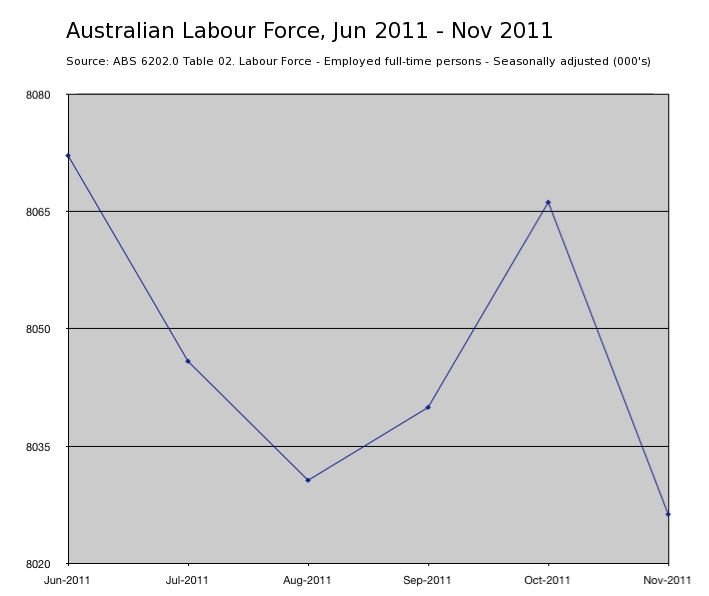
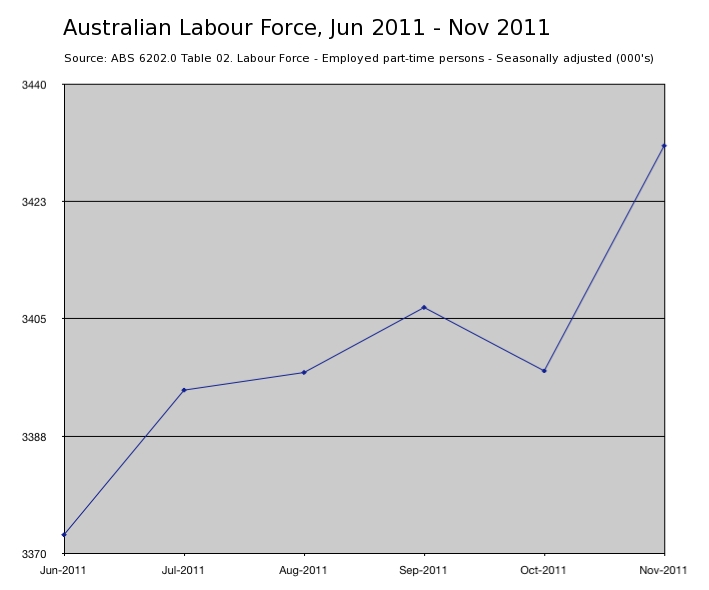
The latest Labour Force data from the Australian Bureau of Statistics:

Employed Full-time Persons | Click to enlarge

Employed Part-time persons | Click to enlarge

Employed Total persons | Click to enlarge

Number of Full-time employed? Down 45,900.

Number of Part-time employed? Up 58,000.

Number of Employed persons? Up 12,200 (with allowance for rounding).

Since June.

2,440 per month.

At that rate of part-time “jobs created” (to replace Full-time jobs lost), it will take over 10 years for Julia to achieve her “300,000” jobs created. Assuming you believe that the government creates all the new jobs, with zero from the private sector.

It will take 18 years to reach Wayne’s promised “half a million more”.

It’s also worth noting the ABS statistic for just how many are “Unemployed, looking for full-time work”.  That number has risen by 33,900 since June, the month following Wayne’s pre-budget promise.

And the number of persons in total who are “Unemployed” has risen by 38,100 over that time.

So essentially, part-time jobs are replacing full-time jobs. And at a rate way insufficient to meet the rise in total unemployed job-seekers (eg, retrenched full-time employees, school leavers, immigrants, refugees, retirees forced to look for work due having their superannuation “nest egg” decimated, etc).

Now, this is just the “seasonally adjusted fiddled” ABS data.

Some say that Australian government “official statistics” are about as believable as government statistics in other countries.

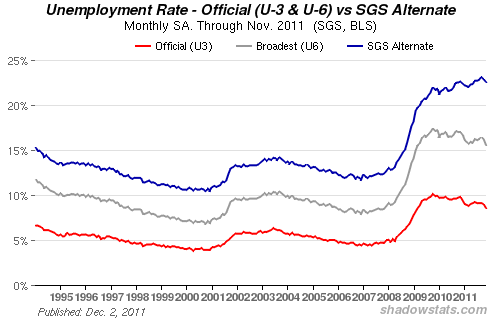
Like the USA, where “official” unemployment has allegedly just fallen to 8.6% … thanks to their simply not counting the millions of people who are unemployed but have given up looking.  Alternate statistics researchers such as the venerable ShadowStats claim US unemployment is more like 22.5%:

Source: ShadowStats.com

In Australia, Roy Morgan research publishes an alternate measure of unemployment. And surprise surprise, it too consistently shows unemployment rates significantly higher than our government’s “official” statistics.

Here’s the latest Roy Morgan stats (emphasis added):

# In November Australia’s total unemployment as measured by Roy Morgan was 1,044,000, or 8.6% (unchanged in percentage terms, but up 18,000) from October 2011 and up 229,000 (up 1.7%) since November 2010 — Australia’s equal highest unemployment rate since March 2004 (8.8%). It is also the highest number of unemployed Australians for nearly a decade — since January 2002 (1,075,000).

# The Roy Morgan November 2011 ‘underemployed’* estimate was 938,000 (7.7%), up 90,000 (0.6%) from October 2011, and up 126,000 (0.9%) since November 2010.

# In total in November 2011 an estimated 1,982,000 (16.3%) of Australians were unemployed or ‘underemployed.’ This is up 108,000 (0.6%) on October 2011 and up 355,000 (2.6%) since November 2010.

# The latest Roy Morgan unemployment estimate is 3.4% above the 5.2% currently quoted by the ABS for October 2011 — this is the equal largest gap since December 2005 (8.5% Roy Morgan cf. 5.1% ABS).

Who to believe?

You decide.

Just remember the indignant words of Sir Humphrey Appleby, in an episode of the classic BBC satire Yes Prime Minister titled “The Smoke Screen”:

“They’re government statis…. they’re facts”

UPDATE:

For any reader questioning the “Global Cooling” reference, I have no interest in pointing you to the many websites where you can find evidence that the world has experienced a slight cooling over the past decade. Instead, in keeping with Thursday’s reference to The Golden Rule (ie, “Follow The Money”), I give you instead the opening paragraph of the official press release for the 2010 Bilderberg Meeting of the world’s ‘elite’ … and suggest you think about it:

Click to enlarge

GDP Growth Hangs On China Thread

7 Dec

September quarter GDP data is out from the ABS.

Prepare yourself for much trumpeting from all the usual suspects (Government, lamestream media, Labor supporters) about the headline figure – “strong” growth of 1% (“seasonally adjusted” ie, fiddled) in the September quarter, thus lifting “annual growth” to 2.5%.

Prepare yourself to not hear any trumpeting of the fact that is still 30% below the Treasury’s very recently revised 3.25% “estimate” for 2011-12 … and now half the year is over.

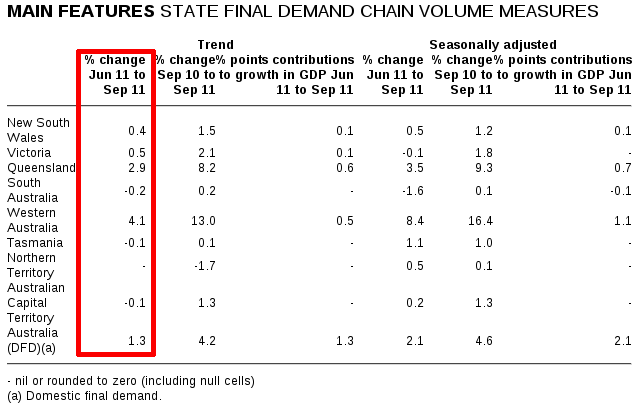
Or, any trumpeting of the important detail. State Final Demand:

Click to enlarge

All the “growth” in July-September came from the mining states of WA (4.1%) and QLD (2.9%).

The rest of the country is either in (SA, TAS, ACT), or near (NSW, VIC) recession.

Make no mistake dear reader.

Australia’s economy … and Wayne’s “surplus” … is hanging on China.

Everything else is noise.

Wayne Predicts 57% Blowout In Net Debt … This Year

2 Dec

Your humble blogger will not bore readers with another tirade about the wilful deception of governments (and lapdog economic commentators) always preferring to reference Australia’s “net” government debt position, rather than what is actually owed … the (much bigger) gross figure.

Instead, let us simply take a look at the government’s own preferred measure, in their own budget statements.

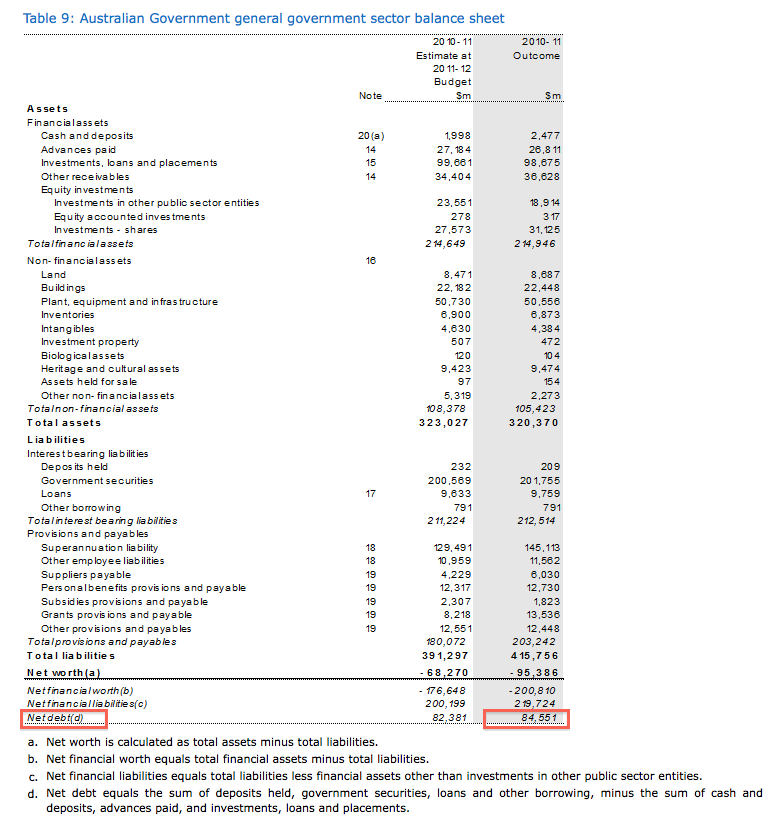
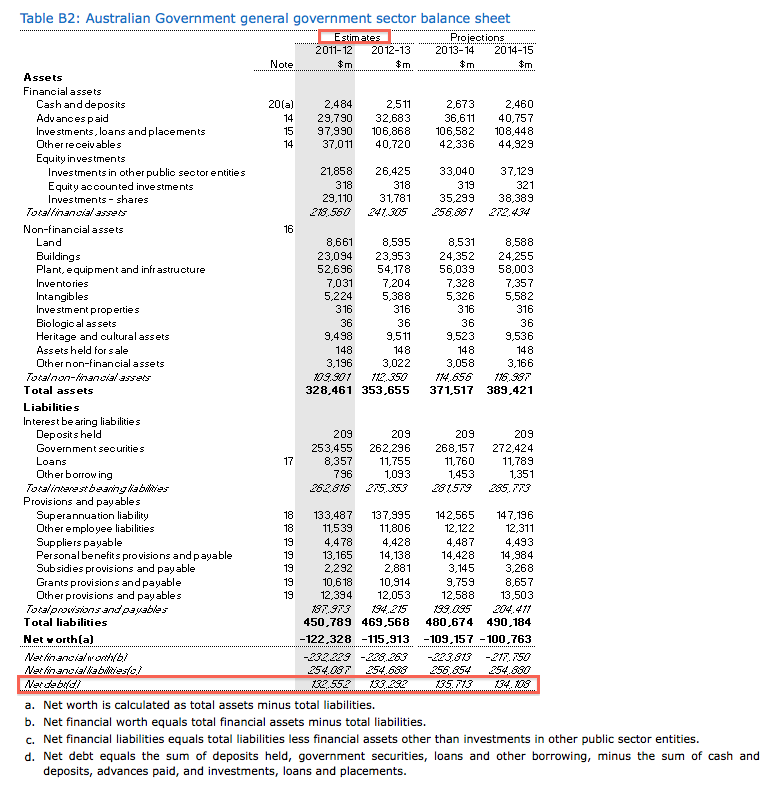
Here’s the government’s stated net debt position in the Final Budget Outcome for 2010-11 – that’s only 5 months ago:

Final Budget Outcome 2010-11, Part 2, Table 9 | Click to enlarge

Note that the “estimate” for net debt for the year ending June 2011, as given in the mid-May budget ($82.3 billion), was blown out by more than $2 billion just 6 weeks later ($84.5 billion).

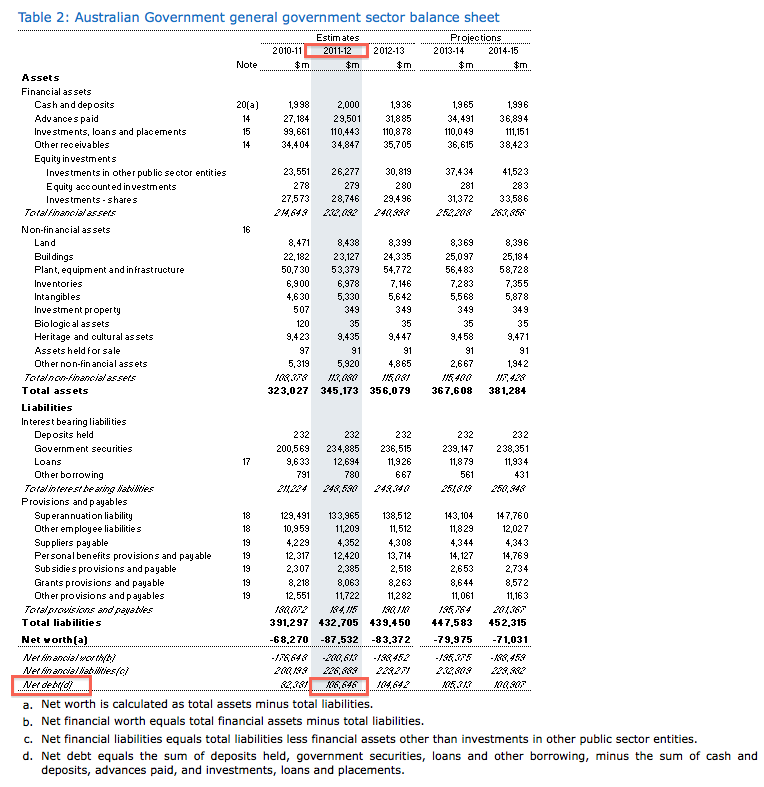
Now, let’s look at the May budget, and the original “estimate” for net debt at year ending 2011-12:

Budget 2011-12, Budget Paper No. 1, Statement 9, Table 2 | Click to enlarge

Original “estimate”? $106.65 billion in net debt, for the year ending June 2012.

And now, 6 months later, let’s look at the latest 2011-12 MYEFO, and the revised “estimate” for net debt at year ending June 2012:

MYEFO 2011-12, Appendix B, Table B2 | Click to enlarge

Ok.

So, net debt was $84.5 billion at end June 2011.

In the May budget, it was “estimated” to reach $106.65 billion by end June 2012.

The reality?

Barely 6 months later, net debt is now “estimated” to be $132.5 billion at end June 2012.

IF the government can keep net debt down to their latest upwardly revised estimate, that would be an actual blowout of 57% in total net debt … in just one year.

And it would be a 24% blowout on the Treasury #JAFA’s original “estimate” made in the May budget just 6 months ago.

The chances of this government keeping net debt down to their latest “estimate”? Based on track record, somewhere between Buckleys and none.

Finally, note that net debt is now “estimated” to not increase by more than $3 billion over the three years following 2011-12.

This prediction from the same ‘experts’ whose “estimate” in mid-May for net debt at end June, was wrong by $2 billion.

Now now dear reader … stop laughing.

Come on.

That’s enough now.

Seriously … this is serious.

Is THIS The “Trend” Growth You Are Banking On, Wayne?

1 Dec

Isn’t it wonderful how inveterate liars and deceivers eventually get caught out?

From the Australian:

The Treasurer today declared the government was banking on growth remaining at trend to deliver its wafer-thin budget surplus in 2012-13, despite the threat posed by worsening economic circumstances in Europe and the United States.

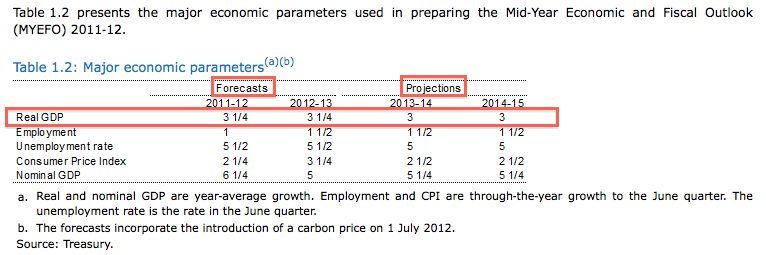
Here is the newly-revised MYEFO budget “forecast” for GDP growth that Wayne is “banking on”:

MYEFO 2011-12, Part 1 Overview | Click to enlarge

Er … 3.25% annual GDP growth?

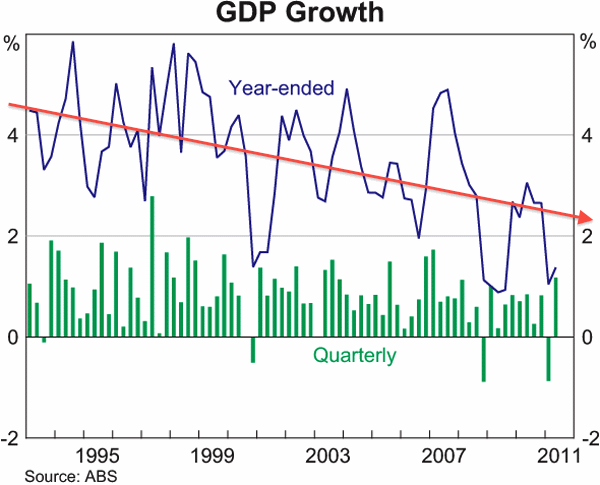
I have one chart for you Wayne.

From the RBA’s latest chart pack (trend line added):

Click to enlarge

So … Wayne.

“Trend growth” for Australia over at least the past 18 years (since 1993), has been slowly but steadily sinking towards 2%.

And yet, you really expect us to believe that we will witness way above-trend 3.25% growth both this financial year, and next? In spite of all the increasing turmoil and volatility in a debt-saturated world right now?

Mr Swan said revised budget forecasts outlined yesterday were based on the “best judgment” of Treasury.

Having confidence in Treasury’s “best judgment”, is akin to having confidence in the “best judgment” of the band playing “In the Shadows” as the Titanic slowly sank beneath the waves.

Rather like Australia’s GDP “trend growth” slowly but surely sinking beneath the waves of a debt-soaked world economy.

And to think this government is introducing a world’s-highest carbon dioxide derivatives trading scheme scam from July next year.

Based on more modelling tea-leaf reading by the same Treasury “bozos” who originally predicted 4% GDP growth back in May.

The same “bozos” who could not foresee an onrushing GFC that even Blind Freddy could see (“Why Would Any Sane Person Believe Treasury’s Carbon Tax Modelling When Its Budget Forecasting Record Is This Bad?”).

Design a site like this with WordPress.com
Get started