Archive | February, 2010

OECD Economist: Double-Dip Recession Looms

28 Feb

One can only wonder if Treasury Secretary Ken Henry watched the ABC’s “Inside Business” this morning:

One of the OECD’s leading economists says there is a strong chance that the world’s leading economies could quickly slide back into recession.

The deputy director of the OECD’s financial and enterprise affairs, Dr Adrian Blundell-Wignall, has told ABC1’s Inside Business program that the threat of a double dip recession remained because problems in the banking system have not been solved.

“There are many icebergs the ship has to negotiate before we’re out of jail here. This is going to be a 10 year process, not a one year process,” he said.

Dr Blundell-Wignall says many of the banks’ problems have been hidden by changes to accounting rules and their most toxic assets have been shifted to the balance sheets of the big central banks in the US and Europe.

Dr Henry recently stated that the GFC is “over”:

“What people have called the global financial crisis, that has passed“.

Dr Henry went on to predict a “period of unprecedented prosperity” for Australia, one that could “stretch to 2050”.

Dr Henry failed to predict the GFC.

Joyce: Rudd ‘A Deadly Risk’

28 Feb

Barnaby Joyce has returned fire at Kevin Rudd on Saturday, after the PM suggested that Barnaby should be sacked:

“Surely Mr Rudd must see the paradox of his statement,” Senator Joyce told AAP.

“The person who has now admitted responsibility for a program that has burnt down 100 houses, killed four people, electrified 1000 houses and created fatal death traps and is going to cost $100 million just to fix, is stating that I may appear a risk.

“Quite evidently he is absolutely a risk, a deadly risk.”

Earlier on Saturday, PM Rudd had again tried to discredit Barnaby over his warnings late last year concerning the possibility of the USA defaulting on its massive debts:

“It’s now, I think, 87 days since Mr Abbott took the reckless decision, the risky decision, of making Barnaby Joyce the alternative finance minister of Australia,” Mr Rudd told reporters in Adelaide.

“In just 87 days he said that America could default on its sovereign debt, he said that the Australian states could or would default on their sovereign debt, he has said that the Australian government could or would default on its sovereign debt.

Kevin Rudd is a liar.  Barnaby Joyce never said that Australia could or would “default”.  Instead, he questioned whether we could repay our debt, if the Government continues on its present rapidly-rising trajectory of wasteful (and deadly) spending with borrowed money –

Kevin Rudd is oblivious to the warnings of many acclaimed international economists who share Barnaby’s concerns.

Kevin Rudd also appears ignorant of the deep concerns about US sovereign debt that were expressed by none other than Secretary of State Hillary Clinton just three days ago.  She warned that the US deficit is a risk to national security:

“We have to address this deficit and the debt of the United States as a matter of national security not only as a matter of economics,” Clinton said. “I do not like to be in a position where the United States is a debtor nation to the extent that we are.”

Having to rely on foreign creditors hit “our ability to protect our security, to manage difficult problems and to show the leadership that we deserve,” she said.

The moment of reckoning cannot be put off forever,” she said. “I really honestly wish I could turn the clock back.”

Kevin Rudd is a proven liar, an economic imbecile, and an arrogant, financially reckless fool.

Barnaby is right.

UPDATE: Abbott backs Joyce, happy with performance

UPDATE 2: ‘Fix the stuff ups’, Joyce Tells Rudd –

‘I am flattered that Mr Rudd would come out on Saturday to go after little old me but I really thought he had other things to do and if he has spare time my humble suggestion is to concentrate on fixing up your stuff ups.

‘If he wants me to make suggestions for his little notebook I will forward my mobile number later.’

Henry: GFC Is ‘Over’

28 Feb

Earlier this month, Treasury Secretary Ken Henry declared that the Global Financial Crisis is “over”:

“What people have called the global financial crisis, that has passed, I think it’s safe to say,” Dr Henry said. “But that isn’t to say that there will not be further adverse shocks for financial markets down the track and some of those shocks … could be of some significance for individual countries, but I don’t imagine (they would be) shocks of the sort that would be globally significant.”

Remember that claim.

Ken Henry did not see the GFC coming in the first place. He later claimed that “only extraordinarily good forecasters” would have predicted the GFC.

Well, that would be lots of extra-ordinary folk like me then, Ken. Even I could see it coming, from late 2005. And despite the ridicule (familiar story?) of “trained” “expert” financial advisers, I chose to pull all my superannuation out of the sharemarket into cash in May 2007, completely avoiding the global crash that has wiped out the investments and retirement savings of countless millions –

Historical performance chart assumptions: Performance is calculated on an initial investment of $10,000, using entry to exit prices, with distributions reinvested. A 4% contribution fee has also been applied. This information is general information only


And what about those international economists who publicly warned of a looming GFC, Ken?  Men such as professors Ken Rogoff and Nouriel Roubini, and our very own “Dr Doom”, Professor Steve Keen?

You’d think Henry might have learned a few lessons about wide-ranging research… and caution… given his utter failure to foresee what many others did.  So has he learned anything?

Clearly not.

Henry presently remains ignorant of, oblivious to, or (worse) rejects the numerous dire warnings coming daily from all around the world. Not just from Barnaby Joyce, but from many leading international economists – several of whom did predict the GFC – who are now genuinely concerned with multiple threats to the global economy. Everything from the European debt crisis, to the China property bubble.

Scarily, it has become increasingly obvious that Ken Henry is the man who really holds the reins of Australia’s economy, since PM Rudd, Treasurer Swan, and Finance Minister Tanner, are all totally unqualified economic imbeciles. Never forget, all of them were frantically talking up “the inflation genie” danger in 2008, even as the GFC tsunami was breaking over the world economy.

If (when) it all goes pear-shaped… again… Ken Henry must be sacked.

Stutchbury Sees The Angel Too

28 Feb

Brandishing the headline “Chinese Can Fund Our Boom”, The Australian economics editor Michael Stutchbury sees that Chinese cyclical angel descending from heaven too… and joins in the smearing of Barnaby Joyce:

The method and madness of Barnaby Joyce won’t lie down because it strikes at the heart of Australia’s economic risks and opportunities amid the mother of all mining booms…

The opposition finance spokesman has tweaked his reckless claim that Australia could default on its sovereign debt…

His incoherence invites ridicule. “He does not have a clue what he is talking about,” Wayne Swan responded, mocking Joyce’s reference to “net debt gross, public and private”. The Nationals senator was saying “ridiculous, stupid and damaging” things about Australia’s debt position. Swan’s Treasury head Ken Henry has accused Joyce to his face of “a gross oversimplification of economic understanding”.

Doesn’t have a clue, ‘eh Wayne?  Remind us again how your Bachelor of Arts (thence career political hack) compares with Barnaby’s qualifications?

As for Ken Henry’s arrogant comments, perhaps Mr Stutchbury might care to do a little research. He might learn just how many international economists directly refute Henry’s confident visions of a multi-decade China Miracle.

Mr Stutchbury goes on to imply that Barnaby poses a threat to that Chinese angel descending, thanks to his warnings about Australia’s levels of debt:

So Joyce now begins with private debt, particularly Australia’s gross foreign debt of $1.2 trillion, or about 100 per cent of gross domestic product.

At $638bn or 47 per cent of GDP, Australia’s net foreign debt is one of the highest in the developed world and much higher than in 1986 when Paul Keating warned that Australia could become a banana republic.

You’d think that fact might concern Mr Stutchbury. Not at all. Immediately comes the justification:

Continue reading ‘Stutchbury Sees The Angel Too’

Can We Even Pay The Interest?

27 Feb

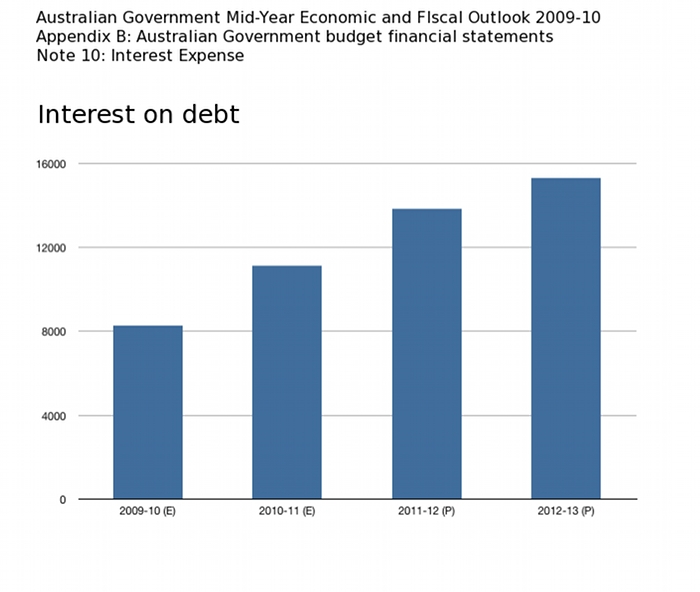
Estimated (E), Projected (P)

It seems that every man and his dog… except Barnaby Joyce… happily takes for granted the popular claim that Australia’s sovereign debt levels are nothing to worry about.  But have you ever stopped to think about whether we really can pay back the debt?

I made the chart above using the data from the Government’s Mid-Year Economic and Fiscal Outlook (MYEFO) 2009-10 Budget statements. It shows Treasury Secretary Ken Henry’s projected Interest on debt for this financial year, and the following three years. Those are interest-only repayments that Kevin Rudd incurred, and now we-the-taxpayers have to pay.

Doesn’t look too bad, you say?  An Interest bill starting at $8.26 Billion for 2009-10, rising to $15.28 Billion for 2012-13? Surely your $900 “bonus” cheque, and your dodgy roof insulation from the Fairy Ruddfather, make paying this Interest bill worthwhile?

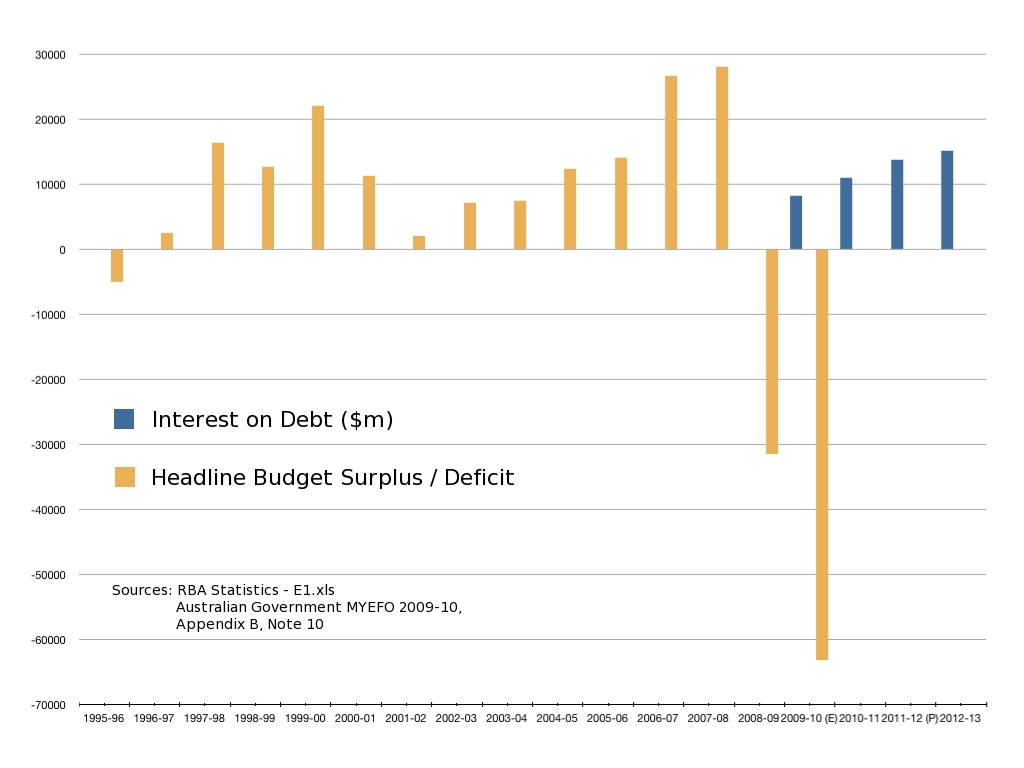
To put it into perspective, I’ve put together another chart (below).  It shows the Australian Government headline Surplus / Deficits going back to 1996, and adds in the projected Interest on debt (in blue) from the above chart. Simply click on the chart to enlarge –

As you can see, Ken Henry’s projected Interest on debt alone is greater than many of the 12 years of Howard Government surpluses. And they came during an unprecedented mining boom.

One other thing. Can anyone really believe Ken Henry’s projections?  This is a man who could not see the GFC coming.  And even now, he is confidently predicting a “Golden Age” of “unprecedented prosperity” for Australia, one that could “stretch to 2050”. All thanks to his belief in a 4o year continuous boom in China.  He is clearly ignorant of the fact that more and more leading international economists… including some who did predict the GFC… are now predicting that China is a bubble that will bust within ten years.

Paying back the projected Interest-only will obviously be a big challenge. So try to imagine how we are ever going to pay back the principal too.

Barnaby Joyce has recently stated that it would take eight (8) consecutive years of $19 Billion surpluses to bring the budget back to earth.  As you can see from the chart above, the Howard Government achieved a budget surplus that big only 3 times… in 12 years.

It is easy to see why Barnaby is so concerned about our ever-rising debt under Rudd Labor.

Because quite simply, we can not pay it back.

Clinton: US Deficit A National Security Risk

27 Feb

US Secretary of State Hillary Clinton says that “outrageous” advice from former Federal Reserve Chairman Alan Greenspan helped create record U.S. budget deficits that put national security at risk:

“We have to address this deficit and the debt of the United States as a matter of national security not only as a matter of economics,” Clinton said. “I do not like to be in a position where the United States is a debtor nation to the extent that we are.”

Having to rely on foreign creditors hit “our ability to protect our security, to manage difficult problems and to show the leadership that we deserve,” she said.

The moment of reckoning cannot be put off forever,” she said. “I really honestly wish I could turn the clock back.”

Barnaby Joyce has been pilloried mercilessly for daring to voice concerns about the USA and its massive debts. Even though many acclaimed international economists agree with his concerns.

In light of Secretary of State Clinton’s testimony, will Rudd Labor and the Australian mainstream media now apologise for their smears, abuse, and ridicule of Senator Joyce?

More importantly, will Lindsay Tanner, Wayne Swan, Ken Henry, Glenn Stevens, and the media now pause to properly consider Barnaby’s prescient warnings about an impending Day of Reckoning for Australia?

Soros: ‘Very Cautious’ On China

27 Feb

International financier George Soros has confirmed concerns expressed by leading international economists on the possibility that the Chinese economy is in a “bubble”:

A hard landing for Chinese markets could come, Soros said, due to a significant increase in supply offset by falling demand. China’s regulatory authorities have managed the situation well thus far, he said, but he’s concerned about how various countries are maneuvering in the face of global imbalances…

I’m very cautious, until the economy cools off a little“…

“The overheating, the inflation, the harsh policy tightening is happening right now and it will continue to happen until the economy cools off. And with this explosion of credit, there are bound to be non-performing loans in due course. The extent depends on whether it is a hard landing or soft landing…”

Speaking about the global economic recovery, Soros commented:

“The recovery has been anemic; this was to be expected. But now, the increasing concern about rising sovereign debt is working against continued stimulus. And that increases the threat of a double dip. The rising concerns on sovereign debt increases the prospect of a double dip.”

Asked whether he thought that the major economies have taken sufficient action to address fundamental problems of the world economy in the wake of the Global Financial Crisis, such as global imbalances, Soros responded:

No. The global imbalances have continued to increase. Notably, China continues to run a very big current account surplus. That is one reason why an appreciation of the renminbi would be desirable. The task of correcting those imbalances hasn’t yet begun to be addressed.

Meanwhile, in Australia all our economic leaders remain convinced of a China-funded economic miracle, confidently expecting that the Chinese economy will give us up to 4 more decades of “unprecedented prosperity”.

It seems only Barnaby Joyce has his head out of the sand.

Greek PM: Worst Fears Confirmed

27 Feb

Greek Prime Minister George Papandreou told parliament on Friday, after a visit by EU economic inspectors, that the worst fears about Greece’s economy had been confirmed:

“Everything that was revealed after the elections proved that New Democracy (the previous, conservative administration) fled from its responsibilities,” Papandreou said. “History confirmed our worst fears.”

“The damage is incalculable. It is not only financial or fiscal but also affects the position of the state …

“Our duty today is to forget about the political cost and think only about the survival of our country.”

“There is only one dilemma: Will we let the country go bankrupt or will we react? Will we let the speculators strangle us, or will we take our fate in our own hands?” Papandreou said.

“We must do whatever we can now to address the immediate dangers today. Tomorrow it will be too late, and the consequences will be much more dire,” he added.

Leading economists around the world have been warning of dire consequences for the international economy should the Greek debt crisis become a contagion that spreads around the globe.

Yet in Australia, Senator Barnaby Joyce is ridiculed by all and sundry, for daring to warn of the impacts on Australia from this looming international sovereign debt crisis.

A crisis that Barnaby’s esteemed critics cannot see coming. Again.

Henry Sees Cyclical Angel Descending

26 Feb

As recently as October 2009, Treasury Secretary Ken Henry predicted a Golden Age for the Australian economy, that will “stretch to 2050”:

“While the global financial crisis has taken some of the heat out of our export prices, we should get used to the idea that we could have structurally higher terms of trade for some time, possibly for several decades,” he said.

In a speech at the Brisbane University of Technology, Henry said Australia’s population will grow as the mining boom, fuelled by demand from China and India, will continue to bring in immigrant workers. Handled correctly, he said, this could provide a “period of unprecedented prosperity”.

Henry pointed to growth in several Asian countries, which he said will give a boost to the mining boom that will see it last for several more decades into 2050.

Just one week ago, RBA Governor Glenn Stevens‘ colleague, Assistant Governor Philip Lowe, also had a vision of the cyclical angel returning from the heavens:

I am quite optimistic that story has some decades to run and that underlies much of the positives for the Australian economy,” Lowe told an economic development forum in Sydney.

“It is going to be a good 20 years for China and us,” he said.

And only 3 days ago, RBA Deputy Governor Rick Battelino too, joined in the angel chorus:

Mr Battellino was uncertain about how long the current boom would last, but said past booms had lasted around 15 years.

“On this occasion, the growth potential of countries such as China and India suggests that the expansion in resource demand could continue for an extended period, though this will depend at least to some extent on the economic management skills of the authorities in these countries, not to mention our own,” he said.

Illustration - nicholsoncartoons.com.au

Reassuring stuff. Or is it?

Three days ago, former Morgan Stanley chief Asia economist Andy Xie and hedge fund manager James Chanos saw something rather different:

“There’s a monumental property bubble and fixed-asset investment bubble that China has underway right now,” Chanos said. “And deflating that gently will be difficult at best.”

A glut of factories in China is “wreaking far-reaching damage on the global economy,” stoking trade tensions and raising the risk of bad loans, the European Union Chamber of Commerce in China said in November.

The risks are so great that a decade of little or no growth, as Japan experienced in the 1990s, can’t be dismissed, said Patrick Chovanec, an associate professor in the School of Economics and Management at Beijing’s Tsinghua University.

And two days ago, the former chief economist of the International Monetary Fund, Professor Ken Rogoff, also failed to see a Chinese cyclical angel descending. He saw the angel of doom:

China’s economic growth will plunge to as low as 2 percent following the collapse of a “debt- fueled bubble” within 10 years, sparking a regional recession, according to Harvard University Professor Ken Rogoff.

“We would learn just how important China is when that happens. It would cause a recession everywhere surrounding” the country, including Japan and South Korea, and be “horrible” for Latin American commodity exporters, he said.

Rogoff was one of very few economists who predicted the GFC.

Ken Henry, and all the boffins at the RBA… did not.

No, We Cannot Pay Our Debt

26 Feb

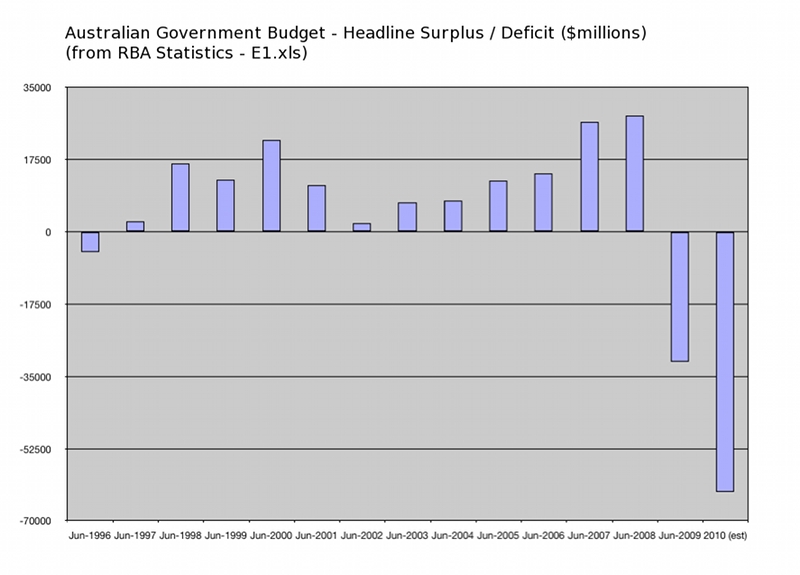
Here’s another picture that tells a thousand words.

Yesterday Barnaby wrote in The Australian about the annual Budget surpluses needed to pay back Labor’s ever rising debt ($1 Billion more today alone; another $1.8 Billion next week):

Let’s talk about the abundance of faith exhibited by Labor when it tells us of the eight consecutive $19bn surpluses that are required to bring the budget back into orbit when the continued stresses on the international economy are clear and evident, especially in Europe.

On the ABC’s Q&A program on Feb 15th, Barnaby pointed out that Labor’s “plan” to return the Budget to surplus is pure fantasy:

We have always got the view that you should try and reduce tax but the first thing, without harping on it, we’ve got to deal with the debt and because they keep racking up debt, that takes away our capacity to reduce your tax and there’s no other way around it. You either increase your revenues, decrease your costs – they talk about productivity and sort of the cyclical angel descending from heaven and making everything better

Well, just what is the likelihood of that cyclical angel descending?  And even if it does, can it produce eight consecutive surpluses of $19 Billion?

Decide for yourself.

Below is a chart of Australian Government Budget surplus / deficits, dating back to the beginning of the Howard Government. Source is the Reserve Bank of Australia’s Statistics section. Click on the chart to enlarge –

This country has never seen anything like eight consecutive years of $19 Billion surpluses. In fact, the Howard Government achieved it just 3 times… in 12 years… during an unprecedented mining boom.

Barnaby is right.

Design a site like this with WordPress.com
Get started