Archive | March, 2010

More Labor Bad Accounting

20 Mar

Media Release – Senator Barnaby Joyce, 20 March 2010:

The Labor Party has added another $2.1 billion to our debt in the last fortnight which cracks the $130 billion mark. This is slightly less than the Clem 7 tunnel in Brisbane and would build 10,000 kilometres of sealed roads in regional Australia. They know they will never be responsible for paying it back.

Every week we find out more and more of what they have purchased with our credit card. The Building Education Revolution (BER) appears to be a very choice piece of work. Yet another brilliant example of the Labor Party not dotting the ‘i’s and crossing the ‘t’s, as Mr Tanner pointed out with regard to his input into the Ceiling Insulation Program.

The Labor Party cannot control costs. It appears they have never had experience in running a business and have now decided to experiment with the Australian economy as an economic crash test dummy with silly and dangerous ideas.

The cost overruns, inside deals for unions, burning houses and electrocution fatalities are just the start of understanding how the Labor Party manages the economy.

Today, what inspired this media release is that I have just walked out of a K Mart, after a buying a cheap pair of working trousers, and a mother with two children and an older couple were lined up to tell me about money that has been squandered in their district. They were concerned what the effect of going public with their story would have on their local school teacher but the story has grabbed my attention.

$250 000 has just been spent on a school hall in a local village/town. They could identify $110 000 worth of costs but $140 000 was for them “mystery money”. The school raised a complaint with the contractor and has since been refunded in excess of $30 000.This seems to be the story nearly everywhere you go and now is more widely ventilated with what we are reading in the papers.

Mr Tanner, Mr Swan and Mr Rudd are responsible for this. Their whole management critique is farcical. The ceiling insulation program has literally turned into a national crisis; the BER is the Big Education Rip off; the hidden Henry Tax Review; the $43 billion NBN project that was begun without a cost benefit analysis. To top it all off, is the Labor Party’s continued insane desire to re-jig the whole Australian economy based on a colourless, odourless gas that will apparently lead to Australia, single handedly, cooling the planet. On and on it goes, this rolling Greek tragedy, which is Labor Party management.

As an accountant, I have seen this form of management that the Labor Party indulges in.  It reminds me of the new arrival in the family business who is flash as a rat with a gold tooth and is quickly swindling away years of hard work.

They have the whole household on hire purchase, with the new car, the new boat, the new pool, the new stereo, multiple overseas trips to many and varied destinations but they have no new income and the result is a massive debt. You get this sinking feeling that just like they blew in, they are going to blow up then blow out.

More information- Jenny Swan 0438 578402

Next week, the Rudd Government has scheduled to take us another$2.1bn into debt.
Household Finances Deteriorate

20 Mar

From the Sydney Morning Herald:

The Australian economy is set to grow further in 2010, but household financial conditions are deteriorating to the extent the nation could experience a W shaped economic recovery, a report shows.

Melbourne Institute bulletin of economic trends shows the domestic economy is set to grow by 0.8 per cent in the March quarter and by 0.6 per cent in the June, September and December quarters.

But the report’s household financial conditions index fell 16.6 per cent to 28.8 index points in the March quarter of 2010.

It was the first fall in the index after four consecutive quarters of improvement.

More than half of the 14.4 per cent households who consider themselves to be financially stressed, are employed while employed people with a household income of over $80,000 are the most financially stressed out of all income groups.

The report said part of the deterioration in financial conditions was due to the increased need to service household debt, in particular mortgage debt.

This report indirectly highlights the very real danger of Australia’s unprecedented level of private debt. And in particular, mortgage debt.

Economist Steve Keen, who predicted the GFC in 2005, is Australia’s leading proponent of the argument warning against high private debt levels, and against government policies which have dangerously inflated Australia’s private debt, such as the First Home Owers Boost.

Visit Professor Keen’s ‘Debtwatch‘ website to learn more.

Special Note:

On April 15th through 23rd, I will be joining Professor Keen in his 230km “Keenwalk” from Parliament House to Mount Kosciuszko, in protest against Australia’s property (and debt) mania that has been driven directly by Federal Government and RBA policies.

Please consider joining us, for the whole trek or even just for an afternoon section of the walk.

If you’d care to assist a genuinely worthy cause, then please consider sponsoring Professor Keen, or indeed myself. Funds raised will support the wonderful charity Swags For Homeless.

Thanks!

Japan: ‘Extremely Little’ Room For Stimulus

20 Mar

From Bloomberg:

National Strategy Minister Yoshito Sengoku said Japan has “extremely little” room for further stimulus spending because of the country’s financial condition.

“From a fiscal point of view, there’s extremely little room for such a thing,” Sengoku said in an interview in Tokyo yesterday when asked about the prospects for another spending plan. “We need to carefully watch whether the situation would go to such lengths.”

His remarks contrast with comments made this week by Financial Services Minister Shizuka Kamei, who urged the government to compile a stimulus package to bolster the deflation-plagued economy. Prime Minister Yukio Hatoyama said on March 17 that he hadn’t discussed such a proposal.

Standard & Poor’s cut its outlook on Japan’s AA sovereign rating to “negative” in January, a move Sengoku described at the time as a “wake-up call” to repair the nation’s finances. Japan’s ratio of debt to gross domestic product is approaching 200 percent, the highest among developed nations, according to the Organization for Economic Cooperation and Development.

Japan is closer to the edge than any other major economy,” said Julian Jessop, chief international economist at Capital Economics Ltd. in London. “There is the risk that the higher the debt numbers are, the more another stimulus package is going to backfire by pushing up interest rates or by making people worry about the need for even bigger fiscal tightening in the future.”

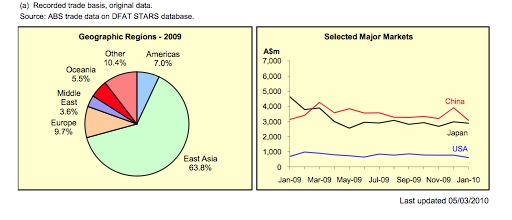
Japan is Australia’s second largest trading partner.

While China has become our largest trading partner in recent times, it is interesting to note the latest trade figures from the Department of Foreign Affairs and Trade

It seems our export trade with China has fallen sharply from Dec ’09 to Jan ’10.  And has been in slow decline since March 2009. That is a trend to watch closely.

There are many grave questions being raised about the sustainability of the China boom. And Japan’s economy is clearly in very deep trouble indeed.

So it is gross incompetence for our financial authorities – such as RBA Governor Glenn Stevens and Treasury Secretary Ken Henry – to continue to plan on our two largest trading partners being able to sustain our economy and get us out of debt in the years ahead.

Labor Less ‘Creative’ Than Greece

19 Mar

From the Korea Times:

The Greek crisis is a textbook example of the interconnectedness of the global economy and the foreign policy environment.

For most of the last decade, the Greek economy grew faster than others in the euro area. Yet, the country’s balance sheets worsened.

(Sound familiar?)

So, when the global recession hit, and the Greek economy contracted by 2 percent in 2009, international bond markets panicked, fearing that Athens was going to have trouble meeting its obligations. By mid-February the Greek government was paying three percentage points more to borrow money than the interest rate charged Germany, worsening the mismatch between Greek revenues and expenditures.

Wall Street bears some of the blame for this mess. Goldman Sachs and possibly other American financial institutions reportedly helped Athens understate its true indebtedness through the creation of innovative financial instruments.

The Rudd Government has used a more traditional way to understate our true indebtedness. ‘Creative accounting’. Or ‘cooking the books’.

First, Rudd Labor has made changes to the ‘methodology’ used for reporting Gross Domestic Product (GDP).  And they have applied those changes to all the previously reported Budget numbers too.  The result?  A “substantial increase” in Australia’s GDP.  As much as (eg) 4.5% per annum added to the real, inflation-adjusted GDP that was originally reported in the Howard Government’s 2006-07 Final Budget Outcome.

The benefit to Rudd Labor in making this “substantial increase” to GDP in the historical data, is that their spending (as a percentage of that GDP) looks lower.  Their annual spending growth (as a percentage of GDP) looks lower. Their debt (as a percentage of GDP) looks lower. And, their Interest-on-debt (as a percentage of GDP) looks lower too. This explains why Rudd Labor politicians always love to quote everything in percentages. “As a percentage of GDP”.

Second, Rudd Labor has also changed the ‘methodology’ used to calculate the inflation-adjusted value of ‘real’ spending growth.  This was a sudden decision, for the November 2009 MYEFO budget update. The result? The Rudd Government’s reported ‘real spending growth’ is a whopping 30.1% lower under their new calculation method.

Finally, Rudd Labor lies about the GFC whenever it needs to defend its massive spending spree. They have repeatedly told the public that “the GFC punched a huge hole in our projected revenues”.  But the official Budget documents show that this is a lie.  In the May 2009 Budget, the estimated government “Receipts” were only 2.7% lower than for the previous year.  And by the November MYEFO update, government revenues were expected to be slightly higher than for the previous year.

Please follow those links. View for yourself the actual Budget documents that show how Rudd Labor have ‘cooked the books’.

You will see that, unlike Greece, our Labor Government does not need to hide our true state of indebtness through the use of creative financial instruments.

They use good old-fashioned ‘creative accounting’ instead.

Hell Freezes Over

18 Mar

Media Release – Senator Barnaby Joyce, 18 March 2010:

Hell Freezes Over: Cameron / Barnaby Agree

For once, Senator Barnaby Joyce agrees with the government. In the Senate today Senator Doug Cameron said, “This government has a good record on tax”.  They have a great record if it is about increasing taxes. Barnaby Joyce says he is glad that they recognise this. The Rudd Government’s ETS is one of the biggest imposts on every aspect of life ever invented.  So it is great that the members of the Senate do recognise that they have a fine record of creating taxes. Remember this is a tax on everything that will achieve nothing. It will not change the weather patterns but it will increase the prices on everything.

Mr Rudd did give us hope that there may be some real efforts on tax reform, but the report is conspicuous by its absence. Perhaps the Henry Tax Report has become a doorstop, a coffee table book or elaborate origami, buried somewhere in Mr Swan’s office?  Without the report, how can the Federal Government expect the states to agree to any change of GST funding for their proposed health plans?

More information- Jenny Swan 0538 578 402

Junk Bond ‘Apocalypse’ in 2012

18 Mar

From the New York Times:

When the Mayans envisioned the world coming to an end in 2012 — at least in the Hollywood telling — they didn’t count junk bonds among the perils that would lead to worldwide disaster.

Maybe they should have, because 2012 also is the beginning of a three-year period in which more than $700 billion in risky, high-yield corporate debt begins to come due, an extraordinary surge that some analysts fear could overload the debt markets.

With huge bills about to hit corporations and the federal government around the same time, the worry is that some companies will have trouble getting new loans, spurring defaults and a wave of bankruptcies.

The United States government alone will need to borrow nearly $2 trillion in 2012, to bridge the projected budget deficit for that year and to refinance existing debt.

The apocalyptic talk is not limited to perpetual bears and the rest of the doom-and-gloom crowd.

Even Moody’s, which is known for its sober public statements, is sounding the alarm.

“An avalanche is brewing in 2012 and beyond if companies don’t get out in front of this,” said Kevin Cassidy, a senior credit officer at Moody’s.

Private equity firms and many nonfinancial companies were able to borrow on easy terms until the credit crisis hit in 2007, but not until 2012 does the long-delayed reckoning begin for a series of leveraged buyouts and other deals that preceded the crisis.

The attacks on Barnaby Joyce’s economic credibility began in late 2009, when he publicly questioned whether the US could default on its debts.

Take a look at this chart.

It’s from the US Federal Reserve, using data sourced from The White House Office of Management and Budget. It shows the US Budget surplus / deficit for the last 108 years. But only up to September last year.

It’s far worse today.

Barnaby is right.

China ‘Greatest Bubble In History’

18 Mar

From BusinessWeek:

China is in the midst of “the greatest bubble in history,” said James Rickards, former general counsel of hedge fund Long-Term Capital Management LP.

The Chinese central bank’s balance sheet resembles that of a hedge fund buying dollars and short-selling the yuan, said Rickards, now the senior managing director for market intelligence at McLean, Virginia-based consulting firm Omnis Inc.

“As I see it, it is the greatest bubble in history with the most massive misallocation of wealth,” Rickards said at the Asset Allocation Summit Asia 2010 organized by Terrapinn Pte in Hong Kong yesterday. China “is a bubble waiting to burst.”

Rickards joins hedge fund manager Jim Chanos, Gloom, Boom & Doom publisher Marc Faber and Harvard University professor Kenneth Rogoff in warning of a potential crash in China’s economy.

And yet, RBA Governor Glenn Stevens, Treasury Secretary Ken Henry, and their many cheerleaders in the Australian media still believe that we are all set for another China-fueled mining boom, this time to 2050.

They failed to predict the GFC (see the many links in this blog for background).  That epic failure has cost Australians literally hundreds of billions of dollars in lost retirement savings and investments in 2007-2009.

So why should we trust their judgement now?

Barnaby Fights Gouging Banks

18 Mar

From the Sydney Morning Herald:

Kevin Rudd is at odds with experts over his claim that new laws give government regulators the power to stop big banks from ”gouging” mortgage payers through excessively high interest rates, consumer advocates say.

Asked about a recent Reserve Bank report suggesting the banks have been profiteering with recent interest rate rises, Mr Rudd said: ”The Reserve Bank is right. The banks have been gouging. That’s the bottom line here.”

But the laws, still before the Senate, are about protecting borrowers from unfair loan contracts, not from unjustified increases in interest rates, according to a Choice spokesman, Christopher Zinn.

The Opposition Finance spokesman, Senator Barnaby Joyce, also said the new consumer laws had no relevance to rates and suggested that if Mr Rudd was truly concerned about borrowers being charged too much he would give the competition watchdog the power to solve the problem.

”The Prime Minister appears to be saying the banking market is over-concentrated and the big banks are exploiting that market power to put their rates up. If that’s what he thinks, then he should give the Australian Competition and Consumer Commission the power to step in and fix it … this is a job for the ACCC: it’s got nothing to do with the consumer credit laws,” Senator Joyce said.

Once again, we see Barnaby Joyce front and centre, fighting to defend the little guy.

Labor Fakes GDP By 4.5%

17 Mar

*This post follows on from my recent article, “Labor: Hide The Increase”.  There, I showed that the Rudd Government has fiddled the books to hide their massive increase in borrowing and spending. Please read the article for background to this new article.

In the fine print on the Rudd Government’s Budget 2009-10 MYEFO website, we learned that Rudd Labor made a change in the accounting method that was previously used to calculate Gross Domestic Product (GDP).  This change resulted in a “substantial increase” to the official GDP figures:

* The 2008-09 Annual National Accounts show a substantial increase in the level of GDP over history due to the ABS adopting the new System of National Accounts 2008. Given the degree of increase in the level of nominal GDP, the Government has released updated tables of fiscal aggregates contained within Appendix D of the 2009-10 MYEFO.

So just how much is that “substantial increase”?

4.5%. Or $47bn. In just one year.

Here’s a chart I’ve put together from the official Australian Government Budget data. It shows my reverse calculation* of the value (in $millions) of Rudd Labor’s “revisions” to historic GDP.

That is, it shows just how much the Rudd government has simply tacked on to the previously-reported official GDP figures (click to enlarge):

Rudd Labor "revisions" to past GDP figures

This chart only goes up to 2006-07.  The last year of a Coalition government Budget report.

That is because the Rudd government has gone back and “revised” the figures in the Rudd Labor 2007-08 and 2008-09 Final Budget Outcome documents too.  So I could not find the original reported figures for those years in order to calculate the GDP, and compare to their newly “revised” figures.

Even so, you can easily see that Rudd Labor’s “revisions” to past GDP are indeed, a “substantial increase”.  For the 2006-07 year – the last year that I am able to compare original vs “revised” figures – it appears that they have adjusted GDP upwards by $47 billion (4.49%) over the original figures reported by the Howard Government.

Of course, we can easily perceive just why Rudd Labor would wish to do this….

Continue reading ‘Labor Fakes GDP By 4.5%’

ECB: Stark Warning of Eurozone Debt Crisis

17 Mar

From BusinessWeek:

European Central Bank Executive Board member Juergen Stark said the euro region may face a sovereign debt crisis unless governments reduce budget deficits.

There is “a clear risk that we will enter a third wave,” which is “a sovereign debt crisis in most advanced economies,” Stark told lawmakers in the European Parliament in Brussels today.

In Australia, our government is continuing to increase our budget deficit, by refusing to withdraw its woefully incompetent and wasteful “stimulus” spending.

Even though we had no recession, and RBA Governor Glenn Stevens recently referred to 2008-09 as “the mildest downturn” we have had since WW2.

Design a site like this with WordPress.com
Get started