Archive | March, 2010

Home Loans Slump Most In A Decade

10 Mar

From the Sydney Morning Herald:

The number of home loans plummeted by 7.9 per cent in January, the biggest fall since June 2000, after the phasing out of last year’s first-home buyers’ grant boost and interest rate rises sapped demand.

January’s result follows a revised 5.1 per cent drop in December, the Australian Bureau of Statistics reported, citing seasonally adjusted figures. Economists had been predicting a 2 per cent increase in January.

As usual, over the “long run” we again see that the predictions of mainstream economic “experts” are wrong.

This result underlines what contrarian economists such as Professor Steve Keen have been warning for several years.  That the government and Reserve Bank of Australia have, together, fuelled a massive bubble in property prices.  Rudd Labor’s doubling of the First Home Owners Boost, and the RBA’s slashing of interest rates in late 2008, have encouraged tens of thousands of borrowers to take on ever greater levels of debt. In the process, these buyers armed with cash handouts from the government and tempted by record-low interest rates, have bidded up the already record-high prices of Australian real estate.

Now that the FHOB has been withdrawn by a debt-laden government, and interest rates are beginning to rise, immediately we see a dramatic fall in demand for the loans that support Australia’s unprecedented housing bubble.
Debt Bubble Has To Burst

10 Mar

From Business Spectator:

This week is the one-year anniversary of the historic stock market rally which has seen US shares climb by almost 70 per cent – and we’re getting set to celebrate in style…

After all, what’s to worry about? Governments across the world are continuing to run massive budget deficits and interest rates are close to zero. The markets aren’t worried about the massive explosion in government debt, because they figure it’ll just mean that governments will have to keep interest rates at historic lows while they continue to pour liquidity into the system.

But while the markets continue to party, one dark thought presents itself. What happens if someone looks outside and sees that the real US economy is still in deep trouble? It is plagued by high unemployment, continuing weakness in the housing market, and faces mounting problems in commercial real estate that threaten to further destabilise the banking system.

What happens when the penny drops that massive government spending packages, combined with unprecedented money printing by central banks, have not produced a sustainable economic recovery?

As RBS strategist Bob Janjuah points out in his latest newsletter, the “gap between the fantasy in markets…versus the reality of the real economy/private sector, is already worryingly large, but risks becoming dangerously large.”

Janjuah says that there hasn’t been any sustainable recovery in private sector demand, and there won’t be for some years to come. Furthermore, there is nothing that can be done about it. Major economies can not generate growth by devaluing their currencies and trying to export their way out of trouble, because this is a strategy that everyone is using. All the big economies are trying to devalue and every country is looking to export. The problem is that there’s no obvious candidate to buy all these exports.

Janjuah also takes aim at those who believe that the massive build-up in government debt isn’t a problem because governments can simply erode the value of the debt through higher inflation. This strategy, he says, only works when inflation is unanticipated. When the market is expecting higher inflation, it pre-emptively prices in this risk of inflation in the form of higher interest rates. And already half the market is expecting to see governments try to inflate away their debts.

The other massive delusion that is buoying markets is that governments can keep pumping/printing/borrowing for long enough to compensate for the slump in demand from the private sector as it cuts back spending and tries to pay back debt. According to Janjuah, the time limits on this strategy are drawing nigh. “Those limits are pretty much already with us (Greece), or are soon to be with us, give or take a few months (in the United Kingdom), or at best, give or take a few quarters (in the case of the United States).”

The conclusion is inevitable; the bubble must burst. And Janjuah fervently hopes that that this happens sooner, rather than later. “The longer we are forced to wait, the bigger the bubble will be and the more horribly damaging the bursting process will be. And if we are forced to wait and the bubble gets anywhere like the one that went pop in late 2007 I have zero idea who will credibly be able to bail us all out the next time round. Certainly not our governments.”

China’s Banks In Trouble

9 Mar

From Bloomberg:

China plans to nullify all guarantees local governments have provided for loans taken by their financing vehicles as concerns about credit risks on such debt surges.

China’s local governments are raising funds through investment vehicles to circumvent regulations that prevent them from borrowing directly. A crackdown on local-government borrowing, estimated at about 24 trillion yuan ($3.5 trillion) by Northwestern University Professor Victor Shih, could trigger a “gigantic wave” of bad loans as projects are left without funding, Shih said this month.

“Beijing’s fiscal situation probably isn’t as good as it looks at first glance,” said Brian Jackson, an emerging markets strategist at Royal Bank of Canada in Hong Kong. “Perhaps at some stage the central government is going to have to bail out the banks or the regional governments and take it on its own balance sheet.”

Premier Wen Jiabao recently warned of ‘latent risk’ in China’s banking system due to the massive speculative loans taken on by local governments in China.

Warnings of an inevitable crash in China’s real estate market have been growing louder, with former chief economist for the IMF, Ken Rogoff, predicting that China’s property market is in a speculative bubble that will burst ‘within 10 years’, triggering a regional recession.

In Australia, our economic authorities such as RBA Governor Glenn Stevens, and Treasury Secretary Ken Henry, are banking on a China-fueled multi-decade mining boom to carry Australia out of debt.

They both failed to predict the GFC.  It seems they still cannot see, or will not hear, the warning signals today.

China: ‘Large Financial Crisis’ By 2012

9 Mar

From the Times Online:

Recently there have been even more alarming views on China. Victor Shih, of America’s Northwestern University, looked into 8,000 local governments in China and warned that a wall of “hidden borrowing” could push Chinese government debt to 96 per cent of GDP next year. He feared a “large financial crisis” as a worst case scenario by 2012. Kenneth Rogoff, of Harvard, fears that a Chinese asset bubble, fuelled by the recent surge in debt, could trigger regional recession within a decade.

China May Let Banks Fail

9 Mar

From Business Insider:

Last spring, in the midst of China’s huge lending boom, the China Banking Regulatory Commission (CBRC) was reassuring skeptics there was no reason to fear an explosion of bad debt because most loans were going into government-sponsored infrastructure projects and would almost certainly be repaid.  A year later, they’re a lot more worried, and are sending a strong message to lenders that such loans should not be considered risk free.  Even with the guarantees in place, Bloomberg reports that “a few cities and counties may face very large repayment pressure in coming years because of debt ratios [outstanding debt compared to annual revenue] already exceeding 400 percent.”

Whether regulators will really leave banks holding the bag for the loans that have already been made is another matter.  The government has no interest in undermining the balance sheets of the big banks, which it would be forced to bail out in any event.  But I found the Bloomberg article’s allusion the 1998 collapse of Guangdong International Trust & Investment Corp. (GITIC) potentially prophetic.  Besides the “big four” banks, China has literally hundreds of smaller lending institutions, from municipal banks to trust companies to rural credit co-ops.  I wouldn’t be surprised if many of these institutions, with their close ties to local governments, own a big piece of the loans being called into question.  It’s too early to say, but if GITIC offers any precedent, we could see a handful of less-favored institutions cut loose and allowed to implode.

15x More Debt

9 Mar

From the Sydney Morning Herald:

Australians now owe financial institutions more than $1 trillion in housing mortgages, almost 15 times as much as 20 years ago, new Reserve Bank figures show.

The Reserve revealed that people paying off their own homes now owe banks and other lenders $763 billion – almost 12 times more than the $65 billion owed in January 1990, when figures were first compiled.

Rental investors have increased their mortgage debt even more spectacularly. In January 1990, landlords owed banks $10.5 billion, but by January this year, the figure had swollen more than 30 times over, to $324 billion.

Household disposable income also rose in that period, but it only trebled. In January 1990, home mortgages ate up just 28 per cent of our disposable income. By January 2000, that had ballooned to 66 per cent, and by January this year, it doubled again to 134 per cent.

Even in the past year, despite the global financial crisis, the debt we owe on home mortgages climbed relentlessly, up $83.5 billion to $1087 billion.

Households’ willingness to take on greater debt powered much of Australia’s economic growth from 1990-2010 but with our households now as indebted as any in the Western world, economists say that will not be repeated.

This is a perfect illustration of how the Reserve Bank of Australia has indebted the nation by its inflationary policies, that have made our currency lose 968.1% of its buying power.

By creating ever more money (as debt, or ‘credit’ loaned to home buyers and consumers), the prices for everything are silently, relentlessly pushed ever higher.

But our wages never rise enough to match. So, we are driven ever more deeply into debt.

Now that Rudd Labor has so rapidly indebted the Federal government as well, we are in huge financial danger.  There is simply no ‘capacity’ for households, or the government, to keep on spending and support the economy when another crisis strikes.

Thanks to too much debt, the only way forward is… even more debt. And we all know what happens when you reach a point where your debt is so great that you cannot pay it back.

RBA Robs Us By Stealth

8 Mar

Ever wonder why things cost so much more today, than they did when you were a child?

Here’s a simple little exercise that shows how the Reserve Bank of Australia has robbed all of us by stealth. And continues to do so.

Take a look at the RBA’s Inflation Calculator.  Try it out for yourself. And be prepared for quite a shock.

Australia changed from the old imperial currency (pounds, shillings, pence) to decimal currency (dollars and cents) in 1966. So let’s take a look at how RBA-managed inflation has robbed us blind since 1966.

According to the RBA’s own calculator, an item costing $10 in 1966 would have cost you $106.81 in 2009.

Helpfully, their calculator also tells us that equals 968% inflation.  In 43 years.  At an average rate of 5.7% per year.

Why is this so important to know?  Because – as you can easily see –  inflation robs the national currency of its “buying power”.  Simply and bluntly, inflation robs you and I, the “working families” of Australia.

Continue reading ‘RBA Robs Us By Stealth’

Soros: Euro ‘May Not Survive’

8 Mar

From Bloomberg:

The euro is being “severely tested” and “may not survive” the Greek deficit crisis, billionaire investor George Soros said.

The European currency’s construction is “flawed” because there is “a common central bank, but you don’t have a common treasury,” Soros said on CNN’s “Fareed Zacharia GPS” program.

“The exchange rate is fixed. If a country gets into difficulty, it can’t depreciate its currency, which would be the normal way,” Soros said.

The sovereign debt crisis in the Eurozone is far more serious than Australia’s economic authorities at Treasury and the Reserve Bank are admitting. A collapse of the Euro – and the European Monetary Union – would clearly have huge impacts for the global economy, including Australia.

Barnaby is right.

Hockey Supports Joyce

8 Mar

From The Australian:

Opposition Treasury spokesman Joe Hockey has been forced to defend fellow frontbencher Barnaby Joyce amid speculation the Nationals Senate leader will be dumped from the finance portfolio in the lead-up to the budget.

Love the biased opening statement – ‘forced to defend’.

I watched the interview on ABC1’s ‘Insiders’. Mr Hockey simply answered a question, posed near the end of an interview focussing on multiple other issues. On that basis, you could say that a politician is ‘forced to defend’ something every time they are asked a question!

The bush accountant asked for the finance position when Tony Abbott offered him a frontbench job after the former took the Liberal leadership in December.

More deliberate anti-Barnaby bias. ‘The bush accountant’. Right. A deliberate attempt to imply that, somehow, Mr Joyce’s accountancy credentials are inferior to those of a city accountant.  The University of New England, where Mr Joyce attained his Commerce degree, and CPA Australia, of which Mr Joyce is a Fellow, might just disagree with the implication that their standards vary depending on the locale of the applicant!

But the Joyce homespun style has been ridiculed by the government, and influential Liberals fear he has failed to make a mark with voters as the opposition tries to focus on economic management before the pre-election budget.

Oh really? These ‘influential Liberals’ – if existing, rather than just another figment of the msm’s anti-Barnaby imagination – must not yet have noticed this blog. Or the frequent pro-Barnaby comments on blogs and forums all over the internet, and in Letters to the Editor sections of major newspapers.

Mr Hockey insisted Senator Joyce would remain the opposition’s finance spokesman, describing him as a “very qualified, very focused individual”, and dismissing criticisms of his style.

A spokesman for Nationals leader Warren Truss praised Senator Joyce for “a brilliant job“.

Rudd’s Interest Bill – $48.49bn to 2013

6 Mar

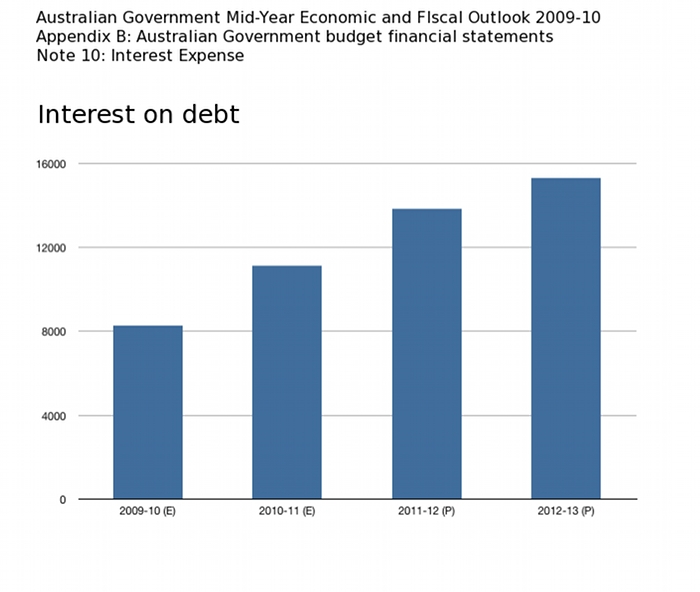
How much will Rudd’s spending spree cost Australian taxpayers… just in Interest-only?

$48.488 Billion to 2013. With more to come.

That’s enough to buy a No-business-plan-No-cost/benefit-analysis National Broadband Network.  With $5.5 Billion left over in loose change for, let’s say, a disastrous home insulation scheme plus the costs of fixing it afterwards.

Need proof?

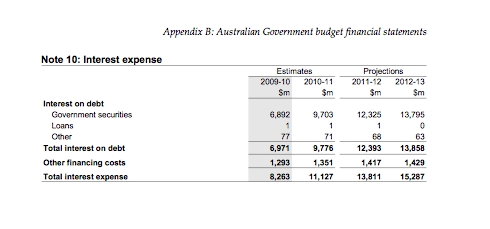
I made the chart below using the data from the Government’s Mid-Year Economic and Fiscal Outlook (MYEFO) 2009-10 Budget statements. It shows the government’s projections of Interest on debt for this financial year, and the following three years. These are the Total Interest* (not principal) repayments that Kevin Rudd has incurred, and we-the-taxpayers must pay back –

Interest on debt - Total $48.488 Billion

Interest Expense - MYEFO 2009-10, Appendix B, Note 10

Note:  This is only the “Estimates” (2009-10, 2010-11) and “Projections” (2011-12, 2012-13) for Interest-on-debt, as at November 2009 when the MYEFO was published. With the Rudd Government still borrowing well over $1 billion a week, who knows just how big the Interest-only bill is now.

One thing we do know.  We cannot pay it back.

* Total Interest includes $5.49 Billion in ‘Other financing costs’ – What exactly is that, and who gets it?

Design a site like this with WordPress.com
Get started