Tag Archives: GFC

Australia “Almost Certainly” In Recession In 2011, Economists Warn

13 Jun

From the Sunday Telegraph (sorry, no link), Finance Writer Nick Gardner dares to say the unspeakable:

Rates To Trigger Recession

Australia is on the verge of a recession.

Economists warn the economy will almost certainly be in recession later in the year as the Reserve Bank raises rates to avoid excessive inflation.

The forecast comes as most of the domestic economy continues to shrink in the face of weak consumer spending and a record-breaking strong dollar.

The economy contracted by 1.2 per cent in the March quarter, exaggerated by damage to our iron ore and coal exports because of natural disasters. And last week the ABS released jobs data showing the economy has lost 80,000 full-time jobs in the past two months. However, we are likely to skirt a recession this month.

“Miners are now having to work double time to fill not only the orders they would normally be catering for this quarter but also the coal they did not deliver in the previous three months because of the weather disruption,” said Steve Keen, professor of economics at the University of Western Sydney.

“That is likely to produce a pronounced bounce in the volumes this quarter, so we’ll probably have mildly positive growth by the end of June.

“However, after those orders have been filled, we’ll be back to our normal levels of exports and that’s when I think we will hit the skids and our growth will turn negative again for the last six months of the year.”

Shane Oliver, chief economist at AMP Capital, agrees.

“It’s later in the year we have to worry, especially if the RBA raises rates. It risks bringing the entire economy outside of resources to a standstill.”

The Australian Industry Group said the manufacturing, construction, and services sectors all shrank in May. Its indices, where 50 indicates an expanding sector and below 50 a contracting sector, showed manufacturing reached 47.7, services hit 49.9, and construction hit 39.6 – its 12th straight month of contraction.

In the lead up to the recent May budget, Treasurer Wayne “Goose” Swan was loudly propagandising that the coming budget would be all about “jobs jobs jobs”.  Indeed, he claimed that Labor has “created 750,000 jobs” since coming to power. No proof, of course. And noone in the lamestream media asked for any either.  Or bothered to try and check if Wayne’s claim was true.

We debunked that claim here … using his own budget documents.

Wayne also claimed that the Green-Labor government will create “half a million more” “in the next two years”.

We debunked that claim here … using his own budget documents.

Now, according to the ABS, we learn that “the economy lost 80,000 full-time jobs in the very same two month period that he was loudly parrotting his BS, unchecked by the media and “expert” commentators.

Off to another brilliant start on that “half a million more” jobs pledge, aren’t you Wayne.

"Goose" talking jobs jobs jobs

China’s Economy At Risk Of “Hard Landing”, 60% Chance of Banking Crisis By Mid-2013

12 Jun

Nouriel Roubini, one of the dozen or so economists who predicted the GFC, has just given an ominous warning for all those – like Wayne Swan, the Treasury department, former Treasury secretary (and now personal adviser to Gillard) Ken Henry, and the RBA – who are blindly banking on a never-ending China boom, with continuous record high terms-of-trade, to get us out of their $1.59 million per hour Interest-only debt hole.

From Bloomberg, 11 June 2011:

China’s economy is at risk of a “hard landing” after 2013 as efforts to spur growth through investment cause excess capacity, said Nouriel Roubini, the New York University professor who predicted the financial crisis.

“China is now relying increasingly not just on net exports but on fixed investment” which has climbed to about 50 percent of gross domestic product, Roubini said in Singapore today. “Down the line, you are going to have two problems: a massive non-performing loan problem in the banking system and a massive amount of overcapacity is going to lead to a hard landing.”

The nation faces a 60 percent chance of a banking crisis by mid-2013 in the aftermath of record lending and surging property prices, according to Fitch Ratings. A record $2.7 trillion of loans extended over two years has pushed property prices in China to all-time highs even as authorities set price ceilings, demanded higher deposits and limited second-home purchases.

Anything else?

There is increasing evidence of a potentially “excessive” slowdown in the world economy and crude prices may climb to as much as $150 per barrel if unrest in major oil-producing nations intensifies, Roubini said.

Roubini in July 2006 predicted a “catastrophic” global financial meltdown that central bankers would be unable to prevent. The collapse of Lehman Brothers Holdings Inc. in 2008 sparked turmoil that led to the worst financial crisis since the 1930s.

Oops.

There goes the neighbourhood.

And your super.

Hmmm, what was that warning Barnaby gave us around a year ago? Something about “a bigger GFC”?

Barnaby is right.

Dr Steve Keen Explains That Our Banks Have Lent Irresponsibly

11 Jun

Dr Steve Keen is one of only 13 economists world-wide who predicted the GFC in advance. And not just on a guess or a hunch … only these 13 advanced reasons why they believed that a GFC was coming.

Indeed, in May 2010 Dr Keen was the winner of the Revere Award – voted by his peers – for being the international economist who first and most cogently forewarned of the coming GFC

Here’s Dr Keen explaining how our “safe as houses” banks have lent irresponsibly. Even moreso than American banks.

Listen and learn, from a rare expert who is still in touch with the real world, and therefore does know more than just useless intellectual “theories”:

2012 U.S. Presidential Candidate Ron Paul Agrees: Barnaby Was Right

10 Jun

U.S. Republican Congressman Ron Paul, the Chairman of the House Financial Services Subcommittee on Domestic Monetary Policy, who is again running for President in 2012, confirms that the USA is already defaulting on its debts.

From Think Progress, 6 June 2011:

Paul, who is running for President, claimed we are already in default but that the government was mitigating the effects through inflation.

KEYES: Congressman, there’s been a lot of heated rhetoric about this upcoming debt ceiling fight. Do you think it’s really going to be that bad if a default were to happen come August 2nd?

PAUL: Well, they’re not going to let it happen. They’re going to do it. But I try to tell people, a default is already occurring, it’s just how they do it. Governments always default, but most of the time, they don’t quit paying their bills because they’ll just print the money. They default by giving you money back that doesn’t have as much value and that’s when prices go up. So that’s how they’re defaulting and since there’s inflation back and hurting us, there’s plenty of default going on right now.

Barnaby was ridiculed up hill and down dale in late 2009 / early 2010, for daring to forewarn of the risk that the USA “could” default on its debts. He even lost his job as Shadow Finance spokesman, thanks to the flack he received from smart-arse, all-knowing and all-wise “experts” on all sides.

Not one of whom had the simple commonsense to see and predict the onrushing GFC.

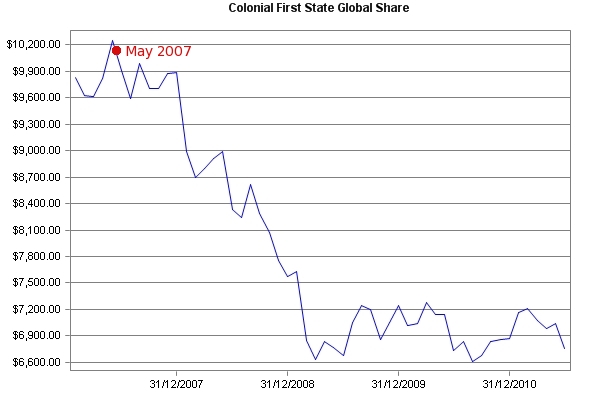
Even I – a humble small businessman, and lowly blogger – was able to see that coming easily. Backed my intuition and commonsense, and put all my super into cash in May 2007, in defiance of “expert” financial advice.  And completely avoided any losses in the global sharemarket crash:

If even I could see that coming, then why – after millions of Aussies lost billions in the GFC – why do we continue to bend our knees and doff our caps to the very same so-called “experts” in the Treasury department, the Reserve Bank, and the financial media, who all completely and utterly failed us?  And, massively overpay them for crappy / wrong / non-existent “advice”?

Barnaby foresaw the risk of a coming US debt default back in late 2009, and had the courage to warn that Australia should have a “contingency plan”.

Now, a highly respected longstanding US congressman and 2012 Presidential candidate has outright conceded the truth … that Barnaby was right.

Perhaps some Australians might now think to heed Barnaby’s most recent warning.

Both of our major political parties are planning to steal our super to pay down ever-rising debts.

Just like the USA, France, Ireland, Poland, and many more have done, and are doing right now.

Wall Street ‘Vastly Underestimating’ Risk Of US Debt Default

1 Jun

From Forbes magazine’s Robert Lenzner in StreetTalk:

“I was up in Wall Street  this week,” (renowned NY Times columnist) Brooks said. “They’re vastly underestimating the source of political risk here. We could have a major problem, I think, either this summer or the next couple years. And I’d be worried about investing too much in the market. That’s my financial advice.”

And Lenzner’s take on this?

I have to admit Brooks woke me up. I had blithely been assuming a deal to raise the debt limit would get resolved at the last minute–the classic American way…

It’s a future scenario few of us want to contemplate. A runup to possible default will not be positive for the stock market. Even if default is avoided then the notion that Wall Street doesn’t get the crisis means there’s too much denial of reality in stock prices. I’m with David Brooks.

We can now add Forbes’ Robert Lenzner and the New York Times’ David Brooks to “foreign powers”, Wells Fargo senior economist Mark Vitner , CDS traders and investors, Ronald Reagan’s budget director David Stockman, the Wall Street Journal, the U.S. Treasury, Southern Cross Equities’ Charlie Aitken, ANZ chief Mike Smith, global currency expert Savvas Savouri, ABC’s Inside Business and Business Spectator Alan Kohler, credit rating agency Standard & Poors, CNBC, Deutsche Bank, and Barack Obama.

All agree that Barnaby was right when he forewarned of the risk of US debt default back in 2009 (“Barnaby Warns of Bigger GFC“).

Apologies please, Messr’s Swan, Tanner, Henry, Stevens, and assorted mainstream media “experts”. You were all wrong.

Fresh Financial Crisis “Around The Corner”

31 May

More warnings that GFC 2.0 is on the way … and that those toxic financial inventions called derivatives will be front and centre again.

From Bloomberg:

Mark Mobius, executive chairman of Templeton Asset Management’s emerging markets group, said another financial crisis is “around the corner” because the causes of the previous crisis haven’t been solved.

The total value of derivatives in the world exceeds total global gross domestic product, creating volatility and crisis in stock markets, Mobius told reporters inTokyo today.

“Are the banks bigger than they were before? They’re bigger,” Mobius said. “Are the derivatives regulated? No. Are you still getting growth in derivatives? Yes.”

The global financial crisis three years ago was caused in part by the proliferation of derivative products tied to U.S. subprime loans and contributed to the collapse of Lehman Brothers Holdings Inc. in September 2008.

How relevant is all this to Australia?

Very.

Australia’s Big Four banks have recently been downgraded by Moody’s credit rating agency, mainly due to their reliance on off-shore borrowing.

What this means in practice, is that another GFC-style credit “freeze” in the USA and/or Europe would again bring our banks to their knees in a matter of weeks, begging for Government (ie, taxpayer) financial support.  The granting of which is exactly what has brought Ireland to the brink of total bankruptcy.

Even more worrying, Fitch’s credit rating agency recently placed 54 ‘tranches’ of Australian residential mortgage-backed securities (RMBS) on ratings watch “negative”, due to increasing arrears by overstretched mortgage borrowers.

These are the same kind of exotic financial derivatives that brought down the USA financial system.  And the same clever “investments” that Wayne Swan has poured $20 Billion into.  What’s worse, Wayne has even invested in RMBS that include “low doc” loans. Can you say “sub-prime”?

But in my view, perhaps the biggest concern of all is our banking system’s combined $15 Trillion in Off-Balance Sheet “Business”, which is mostly in, that’s right, derivatives.

Barnaby was right.

Foreign Powers Pull Out Of USD$, Agree That Barnaby Was Right

30 May

From the Huffington Post Business:

As lawmakers in Washington delay authorizing additional public debt, investors are treating the prospect of a U.S. government default — while still highly unlikely — as growing in probability.

With Congress showing little progress on a deal to raise the debt ceiling, some economists say the possibility of a default by the Treasury, once unimaginable, has now become a factor in investment decisions.

“It’s still extremely unlikely, but it is now something that can be talked about. That moves us into a different world,” said Mark Vitner, a senior economist at Wells Fargo. “It was unthinkable not too long ago.”

In the last couple months, investors have piled into bets that the Treasury will default. The cost of holding one-year credit default swaps on U.S. debt — insurance that pays out if the government misses a debt payment — has skyrocketed, more than tripling since the beginning of April, the Wall Street Journal reported this week.

Nervousness apparently isn’t limited to derivatives investors. Treasury securities held in custody at the Federal Reserve for foreign accounts this week experienced their biggest drop in four years, Zero Hedge noted Thursday. While the precise meaning of the drop isn’t clear, it could suggest foreign powers are scaling back investment in the U.S. government.

So that’s “foreign powers” and Wells Fargo Bank’s senior economist now adding their voices to that of CDS traders and investors, Ronald Reagan’s budget director David Stockman, the Wall Street Journal, the U.S. Treasury, Southern Cross Equities’ Charlie Aitken, ANZ chief Mike Smith, global currency expert Savvas Savouri, ABC’s Inside Business and Business Spectator Alan Kohler, credit rating agency Standard & Poors, CNBC, Deutsche Bank, and Barack Obama.

All these agree that when he forewarned of the risk of US debt default back in 2009 (“Barnaby Warns of Bigger GFC“) …

Barnaby Was Right.

It’s time for a BIG apology from Wayne Swan, former Treasury Secretary Ken Henry, RBA Governor Glen Stevens, and the Australian media, to the only political figure in this country with the foresight, wisdom, and courage to speak out and warn of this very real mega-threat to the global economy, and thus to Australia.

How Wayne “Franked” Another $20 Billion

27 May

It’s long past due time that Wayne Swan formally adopted the name of his alter ego, Frank Spencer.

From ceiling insulation to school halls to “green” loans to computers in schools to set-top boxes, every “investment” that our Treasurer touches, ends up totally ‘Franked’.

From the SMH:

Arrears on mortgage repayments spiked to a record high in the first three months of 2011, as more Australians struggle with rising costs, Fitch ratings agency says.

Arrears on prime residential mortgage-backed securities (RMBS) of 30 days or more hit a record high of 1.79 per cent in the first quarter, from 1.37 in the final quarter of 2010, the group said, as Christmas spending and the Queensland floods forced more Australians to struggle in repaying their mortgages.

RMBS are home loans which are bundled together and sold to institutional investors by banks and mortgage lenders. Misrated RMBS were at the heart of the subprime crisis in the US which lingers to today.

As we have seen previously (How Australia Will Look When The SHTF), Wayne has “invested” $20 billion of borrowed money into Australian RMBS since the GFC, to prop up our housing bubble.

Including an extra $4 Billion which he approved in April – (ie) after the period of increasing arrears that is mentioned in the SMH article.

This news gets much worse though:

The increase in arrears for the most fragile band of mortgage borrowers, low-doc loans, with payment delays of 30 days or more hit 6.74 per cent in the first quarter, up from 5.7 per cent in the final quarter of 2010, a higher level than December 2008 quarter, when the financial crisis hit and the Reserve Bank began rapidly lowering rates.

Low-doc mortgages are written for riskier borrower than prime mortgages, which are written for customers who have a reasonably safe ability to borrow.

Delinquencies of three months or more on conforming low-doc mortgages, which are used by people who are self-employed for example, soared past 5 per cent in the March quarter, from about 3 per cent the December 2010 quarter.

Would our Wayne have “invested” any of that borrowed $20 Billion in low-doc RMBS?  Or, did he stick with “prime” RMBS?

From the AOFM website:

Purchase of RMBS – Program Update

Minimum Eligibility Requirements

* Low documentation loans, that is loans underwritten using alternative income verification procedures, may be included in mortgage pools.

Oooooooooo!

Wayne’s ‘franked’ another $20 Billion.

Some Mothers Do ‘Ave ‘Em

UPDATE:

Another ‘franked’ “stimulus” program from Wayne. Remember the doubled First Home Owners Grant, that also helped to prop up our housing bubble?

The Reserve Bank has warned many first home owners who bought into the market with the help of generous federal government assistance may now be vulnerable to rising interest rates.

RBA deputy governor Ric Battellino said today there were concerns that buyers who bought into the market in 2009, when the federal government grant was increased, may have over-committed themselves.

Are any of those hundreds of thousands of “vulnerable” first home owner mortgages actually “low doc” loans, Wayne?

Are any of them packaged up in the $20 Billion worth of RMBS that you “invested” borrowed money in … Wayne Frank?

Reagan’s Budget Director Agrees: Barnaby Was Right

26 May

h/t ZeroHedge

Former US President Ronald Reagan’s budget director, David Stockman, appears on Bloomberg TV to discuss the USA’s debt crisis, and says that a “technical default is now a virtual certainty“:

According to Stockman, both major political parties are implicitly pushing for a US default.  At the same time, thanks to their inability to reach a political compromise, each party is blaming each other for this inevitable outcome:

The real problem is the de facto policy of both parties is default. When the Republicans say no tax increases, they’re saying we want the U.S. government to default. Because there isn’t enough political will in this country to solve the problem even halfway on spending cuts. When the Democrats say you can’t touch Social Security, when you have Obama sponsoring a war budget for defense that is even bigger than Bush, then I say the policy of the White House is default as well…That is the question that really needs to be understood better and appraised by the bond market. Both parties are advocating default even as they point the finger at each other.

Add a former US budget director to the evergrowing list of those who now agree that Barnaby Was Right in 2009 when he warned about the risk of US debt default.

Take a moment to review Barnaby’s prescient warning (“Barnaby Warns Of Bigger GFC“).  A warning that cost him his job as Opposition Finance Spokesman, and now is deserving of a knee-scraping apology from the likes of Swan, former Treasury chief Ken Henry, “$1M Man” RBA Governor Glenn Stevens, and the rabid media pack who denounced Barnaby as an economic illiterate, when in fact he is more qualified to manage money than the entire Labor economic team put together.

Then, take a much longer moment to ponder Barnaby’s most recent warning.

That our government plans to steal your superannuation, to pay down spiralling government debt (“No Super For You!“, “Grand Theft Pēnsiō“, and “Grand Theft Pēnsiō – Europe’s ‘Economic Superstar’ Steals 5% Of Private Super Funds“).

What Happens When Greece Defaults?

24 May

Andrew Lilico, an economist with Europe Economics and a member of the Shadow Monetary Policy Committee in the UK, outlines the coming domino effect.

From The Telegraph UK ‘Finance’:

It is when, not if. Financial markets merely aren’t sure whether it’ll be tomorrow, a month’s time, a year’s time, or two years’ time (it won’t be longer than that). Given that the ECB has played the “final card” it employed to force a bailout upon the Irish – threatening to bankrupt the country’s banking sector – presumably we will now see either another Greek bailout or default within days.

What happens when Greece defaults. Here are a few things:

– Every bank in Greece will instantly go insolvent.

– The Greek government will nationalise every bank in Greece.

– The Greek government will forbid withdrawals from Greek banks.

– To prevent Greek depositors from rioting on the streets, Argentina-2002-style (when the Argentinian president had to flee by helicopter from the roof of the presidential palace to evade a mob of such depositors), the Greek government will declare a curfew, perhaps even general martial law.

– Greece will redenominate all its debts into “New Drachmas” or whatever it calls the new currency (this is a classic ploy of countries defaulting)

– The New Drachma will devalue by some 30-70 per cent (probably around 50 per cent, though perhaps more), effectively defaulting 0n 50 per cent or more of all Greek euro-denominated debts.

– The Irish will, within a few days, walk away from the debts of its banking system.

– The Portuguese government will wait to see whether there is chaos in Greece before deciding whether to default in turn.

– A number of French and German banks will make sufficient losses that they no longer meet regulatory capital adequacy requirements.

– The European Central Bank will become insolvent, given its very high exposure to Greek government debt, and to Greek banking sector and Irish banking sector debt.

– The French and German governments will meet to decide whether (a) to recapitalise the ECB, or (b) to allow the ECB to print money to restore its solvency. (Because the ECB has relatively little foreign currency-denominated exposure, it could in principle print its way out, but this is forbidden by its founding charter.  On the other hand, the EU Treaty explicitly, and in terms, forbids the form of bailouts used for Greece, Portugal and Ireland, but a little thing like their being blatantly illegal hasn’t prevented that from happening, so it’s not intrinsically obvious that its being illegal for the ECB to print its way out will prove much of a hurdle.)

– They will recapitalise, and recapitalise their own banks, but declare an end to all bailouts.

– There will be carnage in the market for Spanish banking sector bonds, as bondholders anticipate imposed debt-equity swaps.

– This assumption will prove justified, as the Spaniards choose to over-ride the structure of current bond contracts in the Spanish banking sector, recapitalising a number of banks via debt-equity swaps.

– Bondholders will take the Spanish Banking Sector to the European Court of Human Rights (and probably other courts, also), claiming violations of property rights. These cases won’t be heard for years. By the time they are finally heard, no-one will care.

– Attention will turn to the British banks. Then we shall see…

Design a site like this with WordPress.com
Get started