Tag Archives: wayne swan

Mining Tax Puts Australia On Frontline of Market Fury

21 May

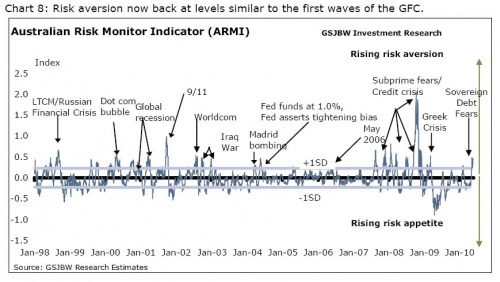
Highly respected Australian economics commentator, Robert Gottliebsen, puts forward the same basic point as investment giant Goldman Sachs/JB Were in their recent note to clients – that the Rudd’s government’s mining tax is a prime cause of the dramatic collapse in the Aussie sharemarket and Aussie Dollar.

From Business Spectator:

Global stock markets are losing faith in governments to manage the escalating problems stemming from the sovereign debt situation. But it is worse than that. Bankers are also losing confidence in governments. The sharp falls in stock markets will affect business activities and will have repercussions on economies around the world.

Solvent governments such as Germany are effectively borrowing vast sums to prop up bankrupt countries like Greece and most of the other PIIGS . The bankers say it will not work. Traders are liquidating their portfolios and the shorters are selling European shares.

And whereas we should have been one of the pillars of stability in this global crisis, our crazy mining tax has caused Australia to be in the front line of the market fury.

We have already been hit by a massive bear raid and now we will hit again by the falls on Wall Street.

We need good government at this crucial point in history. Instead we have bad government, so our economic recovery will be stalled if markets keep plunging. Treasury’s optimistic budget forecasts now look as silly as its mining tax.

Smashed $A – Rudd’s Super Tax Blamed

21 May

Goldman Sachs’ Australian subsidiary, JBWere, has issued a note to clients highlighting the reasons for the ongoing rout in the Australian Dollar, which has nose-dived from USD93c to just USD81c (at time of writing) in just three weeks since April 30.

via ZeroHedge:

Despite our belief that relative growth and relative interest rates suggest some support for the A$ over coming months, it is hard to see a swift resolution to the major sources of risk aversion impacting Australia and its hard to build a compelling case for offshore investors to bid the A$ higher. In that environment it will be difficult for our long-standing 95c target for the A$ around mid-year to be met; however, we still think our 12 month 90c target is still feasible, albeit with the path to 90 now likely to be via near-term weakness. Whether an ongoing decline in the A$ is in prospect will partly hinge on whether the Treasury Secretary’s suggestions that the WACC for the resource sector will be lower are viewed by the market as valid arguments or not. In sum, it is not just risk aversion that is driving the A% lower at present, fundamental factors have also been very important (relative growth, shifting rate expectations, lower commodity prices and capital exit) and the path to lower risk aversion is less dependant on the typical ebb and flow of market sentiment and highly dependant upon the actions of policy makers in Australia and Europe. Our A$ forecasts are now under review.

(emphasis added)

So there you have it, from one of the world’s most powerful investment banks, in their advice to clients. “Fundamental factors” have been “very important” in the rapid sell-off of the Australian Dollar.  And a key factor blamed, is the Rudd government’s “Resource Super-Profits Tax” (RSPT), inspired by Treasury Secretary Ken Henry.

(This is the same Ken Henry who utterly failed to foresee the GFC coming in 2007-08.  The same Ken Henry who, in February this year, publicly announced that the GFC is ‘over’, and predicted that Australia is set for a period of “unprecedented prosperity” lasting to 2050)

The financial markets are now considering the AUD to be a high risk currency. And according to JBWere, the “path to lower risk aversion” is “highly dependant on the actions of policy makers in Australia…”.

Rudd’s proposed “super tax” on the mining industry is not just wiping tens of billions off the value of Australian mining company shares – and the value of your Superannuation account.  It has also pulled the floor out from under the Aussie Dollar.

Insulation program. School halls. Border protection. Computers in schools. Renewable energy. FuelWatch. GroceryWatch. “The greatest moral challenge of our time”.

Does everything this government does turn to $***?

Gittins Nails ‘Rudd’s Budget Trick’

17 May

Economics Editor for the Sydney Morning Herald, Ross Gittins, hits the nail squarely on the head in critiquing the latest Budget, and at the same time, smashes the lamestream media’s pathetic reporting of the Rudd smoke ‘n mirrors ‘trick’:

The annual debate about the budget gets ever more unreal. This year it reached the height of absurdity. Budgets used to be about what the government plans to do in the coming financial year. Now they’re about what supposedly will happen any time over the next four years.

How unreal can you get? Who on earth knows what will happen over the next four years? No one. Certainly not Treasury (nor any of the smarties who think they know better than it). This time last year Treasury’s best guess was that unemployment would peak at 8.5 per cent next year; now we know it peaked at 5.8 per cent in the middle of last year.

This time last year we were told revenue collections over five years would be down $210 billion on what the ”forward estimates” had told us the year before. Now we’re told they’ll be down $110 billion – but why would you set much store by that guess? We know from repeated experience that Treasury is quite bad at telling us in early May what the budget balance will be at the end of the following month. And yet we take seriously what it says the balance will be in three or four years’ time.

This year there’s been huge emphasis – encouraged by the government’s rhetoric and amplified by the media (including yours truly) – on one figure: the projected budget balance in three years’ time, a surplus of $1 billion. Hallelujah! Home and hosed. All over bar the shouting.

How absurd can you get? Treasury isn’t even prepared to dignify this figure with the status of a ”forecast”? It’s the product of a completely mechanical, punch-in-predetermined-numbers ”projection”. Here’s another absurdity: the public debate about the budget treats all its figures as if they were accomplished facts. No ifs or buts or maybes. And do the purse-string ministers – who know better than anyone how unreliable these figures are – make it their responsibility to warn us not to take them too literally? Not a bit of it.

Here’s Lindsay Tanner: ”The result is that we are back in surplus three years ahead of schedule in three years’ time and the level of debt Australia has will be half of what was initially projected” (my emphasis).

Last year’s projection was rubbish, but this year’s is fact. Of all the (inescapably) rubbery figures in the budget, the one we’ve fixated on is the rubberiest: the $1 billion cash surplus in 2012-13. The one thing you can bet on is that the budget balance that year won’t be a surplus of $1 billion.

This relatively recent shift from focusing on the budget year to taking a blurry look at the next four years has made it easier for governments to manipulate our perceptions of the budget. And boy, weren’t the pollies working hard at it this year.

Read the rest of Gittins’ detailed and brilliant critique here.

Is The China Bubble Starting To Burst?

14 May

We’ve just seen the Rudd Government present a truly fantastical budget.  One that relies completely on the hopeful fantasy that the Chinese building boom will continue for a decade to come, and so, a “great big new tax” on the “super profits” of mining companies can return the budget to surplus.

A lovely story.

But what do professional strategists on the China economy have to say about China’s prospects?

From MarketWatch:

China’s economy is teetering on the edge of a major slowdown … according to a noted China strategist.

David Roche, an economic and political analyst who manages the Hong Kong-based hedge fund Independent Strategy, says the world’s third-largest economy is now on the brink, faced with the inevitable reckoning that follows an extended bank-lending binge.

“We’ve got the beginnings of a credit-bubble collapse in China,” said Roche, predicting the economy will likely cool from its stellar double-digit growth rate to a 6% annual expansion as a result.

While that may not sound bad, Roche believes the collateral damage from the cooling will be anything but mild, as the banking sector comes under pressure from cumulative years of bad investment and mispriced capital.

The emerging picture is one of a substantial contraction in credit growth and infrastructure expenditure, he says.

The shrinkage is grim news for an economy heavily dependent on such outlays. China managed to escape recession during the global crisis mainly because of bridges, railways and other infrastructure-project spending, estimated to have accounted for about 90% of economic growth last year, according to Roche.

About 85% of the funding for these projects was arranged by local government financing vehicles “borrowing money they can never repay” from state-owned banks, says Roche. Nearly 3 trillion yuan ($440 billion) of the 11 trillion yuan extended to these entities has been wasted or stolen, he estimated.

***

More worryingly, as bank lending dries up, there won’t be the firepower to sustain new investments in infrastructure, eroding a core pillar of China’s growth model, he said.

Much of the focus on potential asset bubbles in China has been on the property sector, but Roche suggested that housing-price inflation is intertwined with unsustainable gains in other areas.

***

A slowing Chinese economy could also have ramifications for the resource sector.

A scaling back of the infrastructure-building binge is negative for industrial commodity prices such as copper and iron ore, with the latter potentially slumping 50%, he said.

“I would not own resource stocks,” Roche said.

Iron ore prices to fall by 50%?

Hmmmmm… any guesses what that would do to the “super profits” of mining companies? And to the “great big new tax” that Rudd Labor is relying on to get the budget back to surplus?

UPDATE:

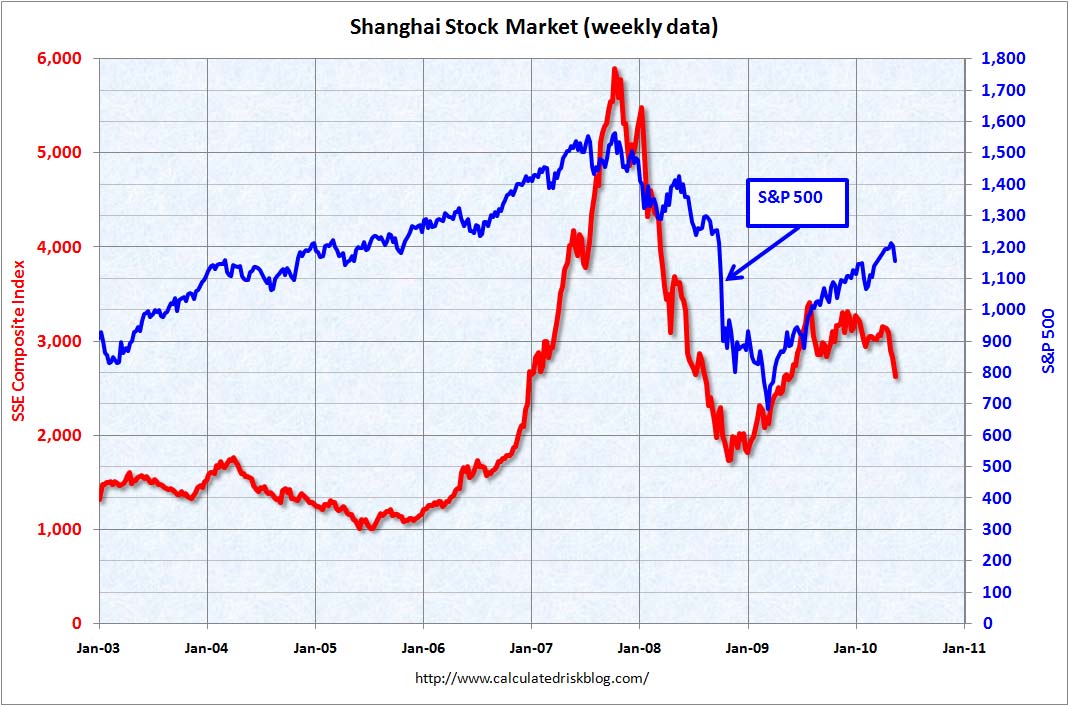
Calculated Risk notes that the Shanghai Composite Index is falling already –

Keep an eye on the Shanghai index (in red). It appears China’s economy is slowing.

Shanghai SSE in red (click to enlarge)

Surpluses By Sophists

13 May

Stephen Bartholomeusz at Business Spectator shines a brilliant, all-revealing light on the Rudd Labor “return to surplus”. Unsurprisingly, he shows that the government’s latest budget is really just an exercise in pure political sophistry:

Wayne Swan might claim that the Federal Budget wasn’t a political document but the lengths the government has gone to so it is able to forecast a $1 billion surplus in 2012-13 while still being able to announce some popular pre-election spending tends to contradict his stance. In fact the budget represents a very clever political strategy.

It is a strategy built on the mislabelled resource super profits tax and the increase in tobacco excise announced just ahead of the budget. Without those taxes the surplus wouldn’t have arrived three years earlier than originally forecast, assuming it does arrivethe whole budget is predicated on a massive windfall from the terms of trade generated by a continuing book in commodities.

The really clever bit is that Swan and Rudd know that the opposition can’t support the RSPT, at least in its present form.

By dedicating the revenues they say they will raise from that tax to spending on health, superannuation, cuts to company taxes et al they appear to have funded the core of their platform and will be able to go into the election with the cloak of fiscal rectitude – even though the detail of the tax and the actual revenue it will raise, if any, won’t be known until after the election.

The opposition, therefore, if it wants to match the government in terms of fiscal credibility and deliver that surplus in three year’s time, will start at least $12 billion behind it. It will either have to propose slashing spending or raising taxes, or both to fill in that gap.

The government is presumably betting that the RSPT and its attack on greedy miners and their foreign owners will play favourably in the electorate, particularly as the tax will be dedicated to probably popular measures. So, the opposition will be accused of supporting big miners and opposing worthy spending if it opposes the tax and the measures it is supposed to fund.

After the election, of course, if the Rudd government were returned, their planned protracted ‘consultation’ with the resource sector could, and almost certainly will, lead to significant changes to the detail of the tax.

However, while it might look like clever politics, the RSPT is destructive economics which is going to have a chilling effect on resource industry investment until it is finalised and certainty is restored and which will have long-term and damaging implications for perceptions of sovereign risk and Australia’s attitude towards foreign investment and investors, given the way the sector was ambushed by the nature of the tax and the language the government has used in promoting it.

Whether the tax is ultimately imposed in its current form or redesigned, it won’t raise the revenue the government is claiming it will to get to that $1 billion surplus and, in the meantime an increasingly angry resource sector is telling the world that Australia is now a less attractive and less stable destination for mining sector investment – direct or portfolio.

The RSPT might represent a clever political strategy but the way it has been unveiled and the anti-industry and xenophobic language the government has used to leverage the political mileage in it is increasingly damaging to the national interest.

Labor’s $50bn Budget Fraud

13 May

Economist Terry McCrann exposes yet more of the same blatant fiddling the books in this year’s Budget from Labor.  $50 Billion worth of “fiddling”.

From the Herald Sun:

Wayne Swan’s budget is built on two great fiddles. Appropriately, the fiddles relate to the Rudd Government’s two great stupidities – the National Broadband Network and the Emissions Trading Scheme.

The fiddles enable the government to hide up to a massive $50 billion of new spending. So much for the claim they’ve pulled the pursestrings tight.

They also enable the government to ‘keep’ the growth in spending in the 2013-14 year to just 1.9 per cent. Without the fiddles, spending would actually have grown by at least 3.5 per cent in that year – shattering the government’s 2 per cent ceiling.

Now yes, the government’s second great stupidity, the ETS, has been ‘deferred’, while the first marches on…

Ditching the ETS enables the government to take up to $30 billion of proposed spending on it out of the budget and replace it – or most of it – by new spending. With, in an exercise of fiscal magic, no increase in the total spending number!

While separately the $26 billion-going-on-$43 billion to be spent on the NBN is just ‘disappeared’ almost completely from the budget! …

So, put the two together – the ditching of the ETS and the “no formal response” to the NBN – and the government has quite probably hidden as much as $50 billion of very real new spending out to 2013-14.

And blown its 2 per cent growth target right out of the very dirty fiscal water.

Barnaby’s Reminder Of The Obvious

13 May

From AAP:

Nationals Senate Leader Barnaby Joyce said he would leave it to Mr Abbott to outline the coalition’s response to the budget.

But he did take a swipe at the government’s debt position, which he said was in the range of $141 billion.

“I know this is obvious, but you have to tell the Australian people this, just because you get a surplus, doesn’t mean you’ve paid off your debt,” Senator Joyce told reporters.

Barnaby is right, of course.

You need to achieve budget surpluses – lots of them – in order to pay down your debt.

I wonder how many mainstream reporters actually know that this is obvious?  And I wonder how many reporters will heed Barnaby’s advice, that you have to tell the Australian people this?

Few if any, I’ll wager.  I would happily bet that a poll taken now would show that most Aussies have been thoroughly hoodwinked by the Rudd Labor and media ‘spin’ lies campaign… and think that a (claimed) return to surplus in 2012-13 means that the debt wil be all paid off.

Regions Lose Under Budget

12 May

Media Release – Senator Barnaby Joyce, 12 May 2010:

Senator Barnaby Joyce asked today, “What has regional Australia been given in this budget?”

“Australia is heading toward a peak debt position, so the Labor Party tells us, of $222 billion. However, they are so totally unbelievable with every other prediction they make, you can take this prediction with a grain of salt.

Their plan to pay for their stuff ups comes from another attack on the mining wealth of regional Australia. Trouble is the stuff ups seem to be continuing at break neck pace. The Labor Party has managed to avoid this absurd form of economics since the attempt to nationalise the banks in 1949.

If you tax the mining profits to 57 per cent, the mining companies will be sure to be highly motivated to do one of two things. Move their operation to somewhere else or move their profits somewhere else. With the presence of vertically integrated cross border mining companies in Australia, this will not be as hard as some think. The trick will be how you trace profits. I can see a lot of hard work and brave souls that will have to exist in the tax department if this tax ever comes in.

The only sensible thing to do is to stop the tax. Mining has provided many regional areas with a once in a lifetime chance for development and the Labor Party has once more become a  parasite on the benefits.

If the Labor Party was interested in getting a fair deal for regional Australia, they would have announced in the budget a plan to return some of these extra funds to the areas where they were generated.

This budget is yet another promise the Australian people are expected to believe even though the Labor party has never got within a bulls roar of being an economically responsible government.

This time we’re supposed to believe they will be earnest, just like when they were earnest about the ‘greatest moral challenge of our time’,” said Senator Joyce.

More Information- Jenny Swan 0438 578 402

Rudd Ruins Businesses

7 May

Media Release – Senator Barnaby Joyce, 7 May 2010:

“I still have a distinct vision of Mr Rudd earnestly going to the front of Parliament House with a brand new note book and pen as props for the media grab at the one-on-one with the ceiling insulation industry representatives and the press gallery. He said something about fixing it all up himself, before zipping off. The news our office is getting is that this mess is far from being fixed,” says Senator Barnaby Joyce.

“Not happy with upsetting the resources sector in Australia and slashing millions of dollars off the share market, the Rudd Labor government has not just upset, but sent to the wall, hundreds of legitimate insulation companies. Yes, there needs to be recourse against shonky companies, who, let’s face it, took advantage of a sloppy government scheme, but where is the compassion for the “working Families” Mr Rudd likes to be seen to champion?”

“We have been contacted by many of these honest people who are beginning to have telephones disconnected, locked out of businesses premises, losing motor vehicles to finance companies and some have had mortgagee possession notices on their family homes, because the government will not pay them what is legitimately owed. Minister Combet’s media release on the 20th of April 2010 stated GST deferral was to be made available to insulation companies, yet the Australian Taxation office has sent debt collectors after these same debts. According to industry sources, you Mr Rudd, Mr Combet and Mr Garrett, have ruined a whole industry. So much for the stimulus package sent to save us.”

“Come on Mr Rudd. Where is the fair play you claim to have for “working families”? Why is this insulation program continuing to be such a debacle? Fix it now!”

More Information- Jenny Swan 0746 251500

History Repeating

5 May

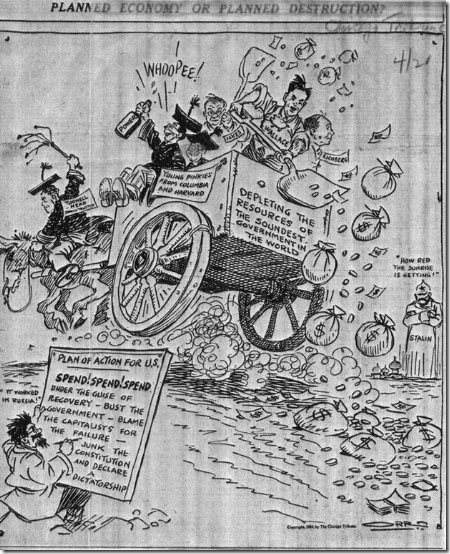
From the Chicago Tribune, 1934:

Note carefully the title at top, and the ‘plan of action’ in the lower left corner.

Rudd’s borrow-and-spendathon – playing straight from the old Marxist playbook.

Design a site like this with WordPress.com
Get started