Archive | July, 2013

Electro-Physics: The Theory Of Economic Warfare

6 Jul
Click to enlarge

Click to enlarge

We all know that mainstream economists are usually wrong.

But did you ever get the feeling that perhaps all the gobbledygook spouted by economists in support of their latest “analysis” and predictions, was — possibly unbeknown even to those economists — little more than an intellectual distraction? An obsession with trees, by those who are, despite sitting in ivory towers, unable to see the forest? A mass of abstractions, assumptions, and guesstimations, serving only to obscure the truth about economic reality?

If so, then the following excerpts will not only confirm your intuition. They will shine a blazing spotlight on the reality of mainstream economics theory — and practice — post-WW2.

And much more besides.

These excerpts are only a small portion of what is a lengthy, and far more technical document. One purportedly discovered on July 7, 1986 in an IBM photocopier purchased at a surplus sale.

I have chosen to quote only some of those few sections that might be more approachable to the typical reader of this blog. Those interested in far more detailed theoretical, mathematical, and technical information will find much food for thought and analysis in the full document (linked at the conclusion).

My bold emphasis is added:

Energy

Energy is recognized as the key to all activity on earth. Natural science is the study of the sources and control of natural energy, and social science, theoretically expressed as economics, is the study of the sources and control of social energy. Both are bookkeeping systems: mathematics. Therefore, mathematics is the primary energy science. And the bookkeeper can be king if the public can be kept ignorant of the methodology of the bookkeeping.

the objective of economic research, as conducted by the magnates of capital (banking) and the industries of commodities (goods) and services, is the establishment of an economy which is totally predictable and manipulatable.

General Energy Concepts

In the study of energy systems, there always appears three elementary concepts. These are potential energy, kinetic energy, and energy dissipation. And corresponding to these concepts, there are three idealized, essentially pure physical counterparts called passive components.

  1. In the science of physical mechanics, the phenomenon of potential energy is associated with a physical property called elasticity or stiffness, and can be represented by a stretched spring.In electronic science, potential energy is stored in a capacitor instead of a spring. This property is called capacitance instead of elasticity or stiffness.
  2. In the science of physical mechanics, the phenomenon of kinetic energy is associated with a physical property called inertia or mass, and can be represented by a mass or a flywheel in motion.In electronic science, kinetic energy is stored in an inductor (in a magnetic field) instead of a mass. This property is called inductance instead of inertia.
  3. In the science of physical mechanics, the phenomenon of energy dissipation is associated with a physical property called friction or resistance, and can be represented by a dashpot or other device which converts energy into heat.In electronic science, dissipation of energy is performed by an element called either a resistor or a conductor, the term “resistor” being the one generally used to describe a more ideal device (e.g., wire) employed to convey electronic energy efficiently from one location to another. The property of a resistance or conductor is measured as either resistance or conductance reciprocals.

In economics these three energy concepts are associated with:

  1. Economic Capacitance – Capital (money, stock/inventory, investments in buildings and durables, etc.)
  2. Economic Conductance – Goods (production flow coefficients)
  3. Economic Inductance – Services (the influence of the population of industry on output)

All of the mathematical theory developed in the study of one energy system (e.g., mechanics, electronics, etc.) can be immediately applied in the study of any other energy system (e.g., economics).

Mr. _________’s Energy Discovery

What Mr. _________ had discovered was the basic principle of power, influence, and control over people as applied to economics. That principle is “when you assume the appearance of power, people soon give it to you.”

Mr. _________ had discovered that currency or deposit loan accounts had the required appearance of power that could be used to induce people (inductance, with people corresponding to a magnetic field) into surrendering their real wealth in exchange for a promise of greater wealth (instead of real compensation). They would put up real collateral in exchange for a loan of promissory notes. Mr. _________ found that he could issue more notes than he had backing for, so long as he had someone’s stock of gold as a persuader to show his customers.

[Readers of my essay, The People’s NWO: Every Man His Own Central Banker will recognise here the reason why I — and many others — have argued that Usury is The Key to the whole economic system here described. In past times, it was primarily the offering of security for one’s money (gold/silver) that induced people to deposit their stored wealth in the vaults of the goldsmiths / money-lenders (bankers). In modern times, it is the offering of usury (interest) on bank deposits that “induce(s) people into surrendering their real wealth in exchange for a promise of greater wealth”. More importantly, it is the offering of usury on bank deposits that distorts and confuses our ability to understand the fundamental difference between, and critical need to separate the functions of, those conceptual elements labelled “currency” (medium of exchange), and “money” (store of value).]

Mr. _________ loaned his promissory notes to individuals and to governments. These would create overconfidence. Then he would make money scarce, tighten control of the system, and collect the collateral through the obligation of contracts. The cycle was then repeated. These pressures could be used to ignite a war. Then he would control the availability of currency to determine who would win the war. That government which agreed to give him control of its economic system got his support.

Collection of debts was guaranteed by economic aid to the enemy of the debtor. The profit derived from this economic methodology made Mr. _________ all the more able to expand his wealth. He found that the public greed would allow currency to be printed by government order beyond the limits (inflation) of backing in precious metal or the production of goods and services.

Apparent Capital as “Paper” Inductor

In this structure, credit, presented as a pure element called “currency,” has the appearance of capital, but is in effect negative capital. Hence, it has the appearance of service, but is in fact, indebtedness or debt. It is therefore an economic inductance instead of an economic capacitance, and if balanced in no other way, will be balanced by the negation of population (war, genocide). The total goods and services represent real capital called the gross national product, and currency may be printed up to this level and still represent economic capacitance; but currency printed beyond this level is subtractive, represents the introduction of economic inductance, and constitutes notes of indebtedness.

War is therefore the balancing of the system by killing the true creditors (the public which we have taught to exchange true value for inflated currency) and falling back on whatever is left of the resources of nature and regeneration of those resources.

Mr. _________ had discovered that currency gave him the power to rearrange the economic structure to his own advantage, to shift economic inductance to those economic positions which would encourage the greatest economic instability and oscillation.

[Regular readers will here find a powerful affirmation of the reason why your humble blogger has long advocated that only a correct understanding of the difference between “money” as store-of-value, and “currency” as medium-of-exchange, with resultant currency reform, can save the world from the predations of the usurers — that is, the money/currency/”credit” issuers. See Imagine A World With No Banks]

The final key to economic control had to wait until there was sufficient data and high-speed computing equipment to keep close watch on the economic oscillations created by price shocking and excess paper energy credits – paper inductance/inflation.

Breakthrough

The aviation field provided the greatest evolution in economic engineering by way of the mathematical theory of shock testing. In this process, a projectile is fired from an airframe on the ground and the impulse of the recoil is monitored by vibration transducers connected to the airframe and wired to chart recorders.

By studying the echoes or reflections of the recoil impulse in the airframe, it is possible to discover critical vibrations in the structure of the airframe which either vibrations of the engine or aeolian vibrations of the wings, or a combination of the two, might reinforce resulting in a resonant self-destruction of the airframe in flight as an aircraft. From the standpoint of engineering, this means that the strengths and weaknesses of the structure of the airframe in terms of vibrational energy can be discovered and manipulated.

Application in Economics

To use this method of airframe shock testing in economic engineering, the prices of commodities are shocked, and the public consumer reaction is monitored. The resulting echoes of the economic shock are interpreted theoretically by computers and the psycho-economic structure of the economy is thus discovered. It is by this process that partial differential and difference matrices are discovered that define the family household and make possible its evaluation as an economic industry (dissipative consumer structure).

Then the response of the household to future shocks can be predicted and manipulated, and society becomes a well-regulated animal with its reins under the control of a sophisticated computer-regulated social energy bookkeeping system.

Eventually every individual element of the structure comes under computer control through a knowledge of personal preferences, such knowledge guaranteed by computer association of consumer preferences (universal product code, UPC; zebra-striped pricing codes on packages) with identified consumers (identified via association with the use of a credit card and later a permanent “tattooed” body number invisible under normal ambient illumination).

[Who can dispute the evidence of the rise and rise of exactly this phenomenon today — Facebook, Amazon, YouTube, Google, indeed all the dominant players in the Internet Age use ever more sophisticated computer systems to monitor user behaviour, and gather information on users’ personal consumer preferences, in order to sell more products, or advertising space, or user data to governments and commercial entities.]

Summary

Economics is only a social extension of a natural energy system. It, also, has its three passive components. Because of the distribution of wealth and the lack of communication and lack of data, this field has been the last energy field for which a knowledge of these three passive components has been developed.

Since energy is the key to all activity on the face of the earth, it follows that in order to attain a monopoly of energy, raw materials, goods, and services and to establish a world system of slave labor, it is necessary to have a first strike capability in the field of economics. In order to maintain our position, it is necessary that we have absolute first knowledge of the science of control over all economic factors and the first experience at engineering the world economy.

In order to achieve such sovereignty, we must at least achieve this one end: that the public will not make either the logical or mathematical connection between economics and the other energy sciences or learn to apply such knowledge.

This is becoming increasingly difficult to control because more and more businesses are making demands upon their computer programmers to create and apply mathematical models for the management of those businesses.

It is only a matter of time before the new breed of private programmer/economists will catch on to the far reaching implications of the work begun at Harvard in 1948. The speed with which they can communicate their warning to the public will largely depend upon how effective we have been at controlling the media, subverting education, and keeping the public distracted with matters of no real importance.

***************************

This should be sufficient for the typical reader — and the serious economics enthusiast — to see a blazing ray of light.

For those interested in the theoretical/technical and mathematical foundations, subsequent topic areas include:

Click here for the entire document.

h/t and thanks to reader Kevin Moore for bringing this to our attention.

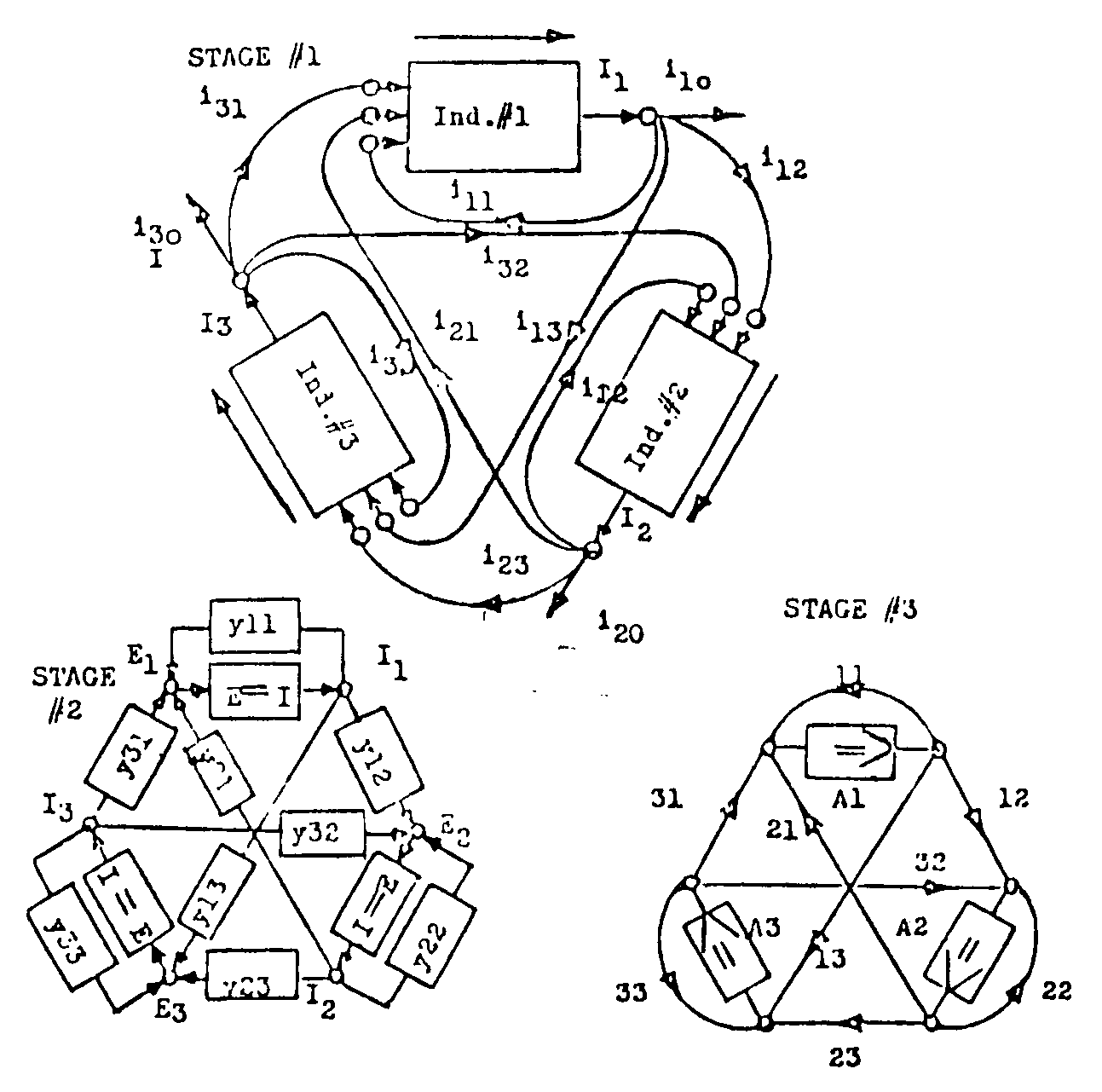
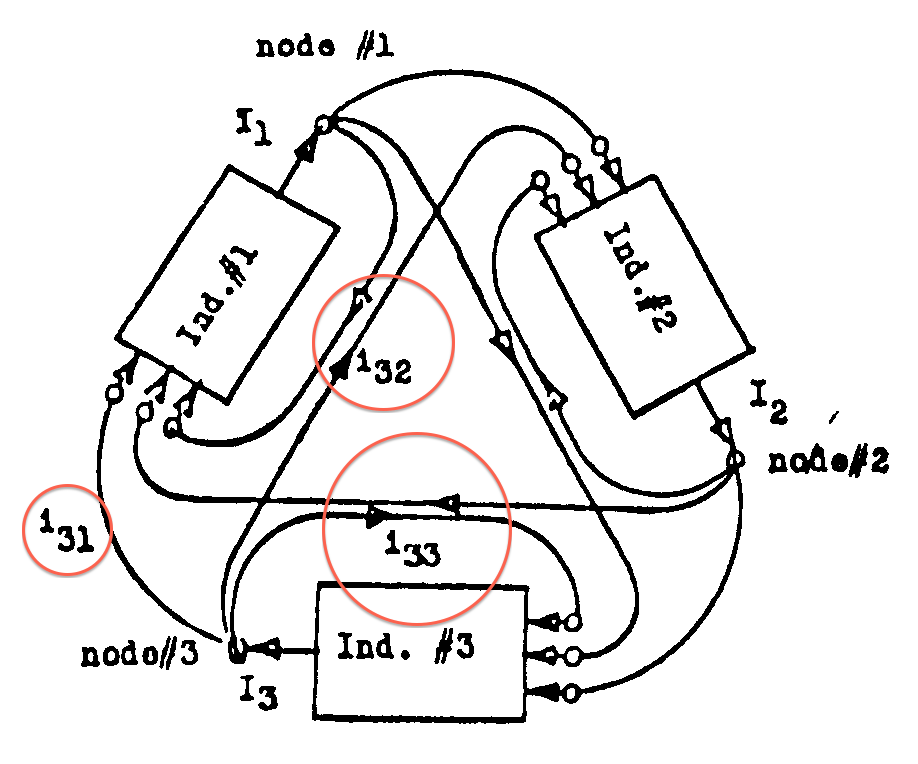
Finally, for conspiracy buffs with a keen eye, the following network diagram of the “three industrial classes” taken from the document may be of interest. Particularly the form (ie, shape), and, the numbers (circled in red):
Click to enlarge

Click to enlarge

Compare:

EvalisticMoneyAttunement

EU Confirms Plan For Cyprus-Style Theft of Bank Deposits

6 Jul

As warned here repeatedly…

G20 Governments All Agreed To Cyprus-Style Theft Of Bank Deposits… In 2010

Federal Reserve Governor Confirms – Bank Depositors Will Be Cyprused

Growing Political Deception On Bank Deposits Theft

The Bankers’ Net Is Closing

Federal Reserve Says Bank Bail-Ins Coming To The USA

… the internationalist banksters’ plan to set up a global regime for “resolution” of failing banks, wherein governments will give themselves free reign to “bail-in” the banks using depositors’ savings, is now slowly but surely being enacted by governments worldwide.

From The Telegraph (UK):

EU makes bank creditors bear losses as Cyprus bail-in becomes blue-print for rescues

New European Union “bail-in” rules to impose the losses of failed banks on shareholders, bondholders and some large depositors were agreed early this morning by Europe’s finance ministers.

…Jeroen Dijsselbloem, the chairman of the Eurogroup of finance ministers, hailed the agreement as a major step towards a “banking union” and away from state funded aid to recapitalise or bailout troubled banks across Europe.

…Greg Clark, the financial secretary to the Treasury, declared that Britain was happy with the new rules after securing concessions allowing governments flexibility on how to tailor bank “resolution” to national circumstances and existing British arrangements on banking levies.

…Under the deal, after 2018 bank shareholders will be first in line for assuming the losses of a failed bank before bondholders and certain large depositors. Insured deposits under £85,000 (€100,000) are exempt and, with specific exemptions, uninsured deposits of individuals and small companies are given preferred status in the bail-in pecking order for taking losses.

It is most important to recall what we have shown previously.

Do not be fooled into believing that, because Australia’s government has “guaranteed” (ie, insured) bank deposits up to $250,000, that this means your savings are safe, and that a failing Aussie bank will not be “bailed-in” using your money.

The government’s “guarantee” is limited, to just $20 billion per failed bank.

That’s less than one-tenth of the total amount of customer deposits — digital bookkeeping entries — actually “held” by Australian banks.

(see The Bank Deposits Guarantee Is No Guarantee At All )

To the best of my knowledge, Australia’s politicians have not yet begun to legislate the new, FSB-mandated and G20-agreed bank “bail-in” regime here.

But when they do, your savings will be exposed to confiscation.

Just as intended:

Earlier on Monday, Bank of England Deputy Governor Paul Tucker said the EU law on bank recovery and resolution would be a milestone towards a global system.

The Clinching Argument In The “Private vs Public Debt” Debate

5 Jul

“He’s pretending that he’s elected by the people, and he’s actually elected by the banks”

In the following interview, Professor Steve Keen discusses how government “stimulus” or “help” programs that hand out borrowed (by the government) money to entice prospective house buyers, are actually Ponzi schemes.

But the most important truth of all is revealed from 10:14sec onwards:

INTERVIEWER: The Chancellor of the Exchequer, George Osborne, says he wants to reduce debt in Britain, while simultaneously launching the “Help To Buy” scheme which is an increase in debt. So my simple question is, Is the Chancellor lying?

KEEN: I think the Chancellor, like most politicians, is focussing on the level of government debt, not on the level of household and private debt, and they think that’s the real problem. The cause of this crisis was an out of control private banking sector lending to the private sector to encourage it to speculate on assets….

INTERVIEWER: (interrupts) Let me, let me, let me jump in for a second, because what we have found out in 2008 and going forward is that there really is no such thing as private debt, because when these private debts become unsustainable the private sector simply gives them to the government. So ultimately taxpayers always end up footing the bill for this debt, all the combined debt of household debt, bank debt, government debt, it’s all the same debt, that’s all underwritten by the same abused taxpayers, and the Chancellor — by ignoring this — is pretending that the UK people are brain dead!

KEEN: Well, what he’s pretending is that he is elected by the English people and he’s actually elected by the English banks. All this happens because the banks have got the politicians by the intellectual balls. They believe that the economy has to have a growing banking sector to be healthy, and that’s just like believing that you have to have a growing cancer to be a healthy human being. Past a certain stage the financial sector becomes a parasite. But it becomes such a strong and powerful parasite that the politicians think that if they let it die the economy will die. That’s precisely the opposite of the case — you’ve got to get the financial sector to shrink, you’ve got to cut it down, say in England, by a factor of at least 2 — and then in terms of abolishing debt, writing it off, not honouring the stuff, and standing up for the debtors, rather than standing up and voting for the creditors which, unfortunately, is what the politicians around the world have been doing this time around…

Unfortunately, Steve sidestepped the critical observation made by the interviewer — that because banksters simply palm off their out-of-control debt problems to the government, aided and abetted by compliant politicians, what this means is that, in the end, private debt and public debt must be considered in sum, not separately.

This is why Barnaby is right.

Although relatively “low” compared to that of “other advanced economies”, nevertheless Australia’s ever-rising public debt trajectory does matter a helluva lot.

Why?

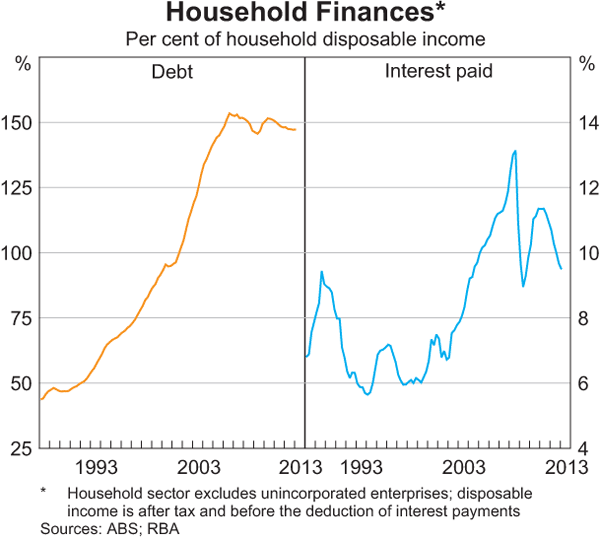
Because — even though (sadly) Barnaby never points this out — Australia’s private debt levels are the highest in the world.

Our Household Debt sits around 150% of household disposable income.

6tl-hhfin

Our government-guaranteed banking sector is massively leveraged to Australia’s world-leading house price Ponzi.

So, simply stated, because of our massive private debt problem, our nation absolutely cannot afford the added risk of an ever-rising public debt level too.

Say NO To These Sneaky, Power-Grubbing BureaucRats

5 Jul

Usury And The Irrelevant Complicit Church

4 Jul

With thanks and h/t to reader Phil, the following article dated May 2010 is cross-posted from the Economic Edge:

Damon thinks this is one of the most important articles he’s written. I think it’s powerful and should get you thinking regardless of your personal views. I also think it’s important to note that he is addressing religion from this perspective, “We need to avoid dialectical conflict… left vs. right, religion vs. non-religion, black vs. white, immigrant vs. citizen, etc. We need to come together to fight the monetary powers that are bringing us all down together.”

Amen to that.

The Coming Crash: Usury and the Irrelevant Church

By Damon Vrabel

Please, let us stop this usury! – Nehemiah 5:10

It’s been a wild couple of weeks—increasing unemployment, Greek debt crisis, yet another ridiculous bailout, pressure on Goldman Sachs, accusations of commodities manipulation by JP Morgan Chase, and new freakish levels of market volatility that might be signaling the next phase of market collapse. The many day-to-day issues can leave us dazed and confused, so most people ignore them. Huge mistake.They are all related to the most powerful force on earth that controls our lives because it is the very foundation of our society—usury. We are ruled not by governments anymore but by financial powers that use interest-bearing debt to exert control over governments, corporations, and people. Almost all other political issues with which we concern ourselves are secondary symptoms of or purposeful distractions from this larger narrative that is never reported by the Wall-Street-funded media. Sadly the church has remained silent as well.Explaining the details can be extremely complicated, but the basic core to understand is that the US government issues no money. Instead all money comes from private banking institutions with interest attached. At times in the past the US government issued real money for people to use—US notes and coins. But today all money comes from the Federal Reserve’s private banking system by putting the US government, i.e. 308,000,000 Americans, in debt. If the US government were not in debt to the banking system, the American people would have no money.More technically, the Fed and its Wall Street cartel banks like JP Morgan Chase and Goldman Sachs make billions by doing nothing but controlling our money. They have the monopoly license to create the core money in our system from holding US Treasury bonds on their balance sheets. These bonds represent the debt of the United States. Thanks to interest, the bonds pull a large portion of our wages to the banks. The primary purpose of the IRS is to take your wages to pay the interest back to the banks. In effect, Wall Street owns a good bit of your labor. And the more bonds they hold, i.e. the more debt the population is in, the more money they make thanks to the interest flows and the profits from gambling on your debt. The system is very much one of “us vs. them.” Such is the nature of monopoly power and usury.

Economics and Morality

Controlling others and living off their backs by forcing them to borrow with interest in order to have any money is called usury (this does not include standard, self-liquidating bank loans to businesses to fund production). It is a system that ensures everything we do, whether in the public or private sector, feeds Wall Street and the controllers above it. It creates a two-tiered societal pyramid of money pushers on top vs. money users on bottom. The power differential is huge. Everyone is hostage. In doing something as simple as buying food to survive, we contribute to usury because we only have usury-based money, not real money. Like the slaves who built the Egyptian pyramids, today we are stuck building an invisible pyramid of monetary power.In such a system there is never enough money to pay back all the interest to the money pushers. The only solution is for the money users—government, corporations, individuals—to borrow more. This is the reason our debt continues skyrocketing to increasingly insane levels. It isn’t about politics, but the fundamental exponential math underlying the system—the users must borrow more and more to pay back interest and keep the system afloat. Such math is guaranteed to fail. Iceland and Greece have reached the point of failure. The rest of the Europe and the US will experience failure as well. Then we will see money and assets vacuumed up the pyramid by the money pushers—the banking establishment that owns the collateral and can take your property.The exponential math not only creates exponential debt growth, but also exponentially increasing:

  • Scale – government and businesses keep getting bigger; we get smaller and local communities lose their meaning
  • Velocity – the hamster wheel keeps spinning faster; human life suffers
  • Consumption – we buy more and more things that break more quickly
  • Production – we make more and more things that break more quickly
  • Inflation – the dollar buys less and less; we can’t seem to make progress

None of these things have to happen in an economic system. They only happen in ours because of debt-based money, usury, that greatly benefits the top of the pyramid while everyone else suffers to a certain degree depending on their level in the pyramid.

So this system is guaranteed to fail due to not only the impossible math, but also the fundamental immorality. Taken together those five issues paint a horrible picture. Republicans blame Democrats and vice-versa. Nope. It’s all a very simple result of a system based on usury, which used to be considered profoundly immoral. It was a fundamental violation of every major religion. It still is for Islam, but Christianity succumbed long ago. They thought a free market economic system would be beneficial, but got snookered into thinking that usury had to be part of that system. On the contrary, monolithic usury kills the free market.

Our monetary system is a top-down controlling machine, not a free market. It is run not by government, but by the most powerful financial interests in the world. Some people feel in their guts that someone must be stealing from them because they just can’t get ahead no matter how hard they work. Well that’s because it’s true—someone is legally stealing from them. The simple math of usury pulls money from people on the bottom of the pyramid who create real value toward those at the top who create no value. MBAs and others serving the system must reckon with this truth rather than remaining blind. Farmers understand it well, having lost their property over the years to the bankers. Families feel it in the fact that it’s difficult to get enough money to feed the kids compared to 50 years ago when one parent could work a standard week and feed a family of five. Everyone in the system will feel it once the debt system collapses as it is doing in Greece.

Living off the backs of others was called feudalism 300 years ago. It was slavery 100 years ago. Today it’s called the “free market” thanks to the propaganda and fraud of neoclassical economics. It completely ignores the truth of our monetary system, the math behind it, and the eventual collapse that will result from it. Greece is giving us a glimpse, but it is only a mild pre-game warmup compared to what’s coming. The world will rue the day it was ever seduced into accepting usury and the illusion of prosperity driven by nothing but debt.

The Irrelevant Church

On this issue of monolithic usury, the issue from which many of our other problems spawn, the church seems to have no voice. Recently, an older church leader told me, “Keep it up, this needs to be addressed, but you have more guts than me, I don’t want to be killed.” Sobering comment, to be sure, but in the shadow of Gandhi, Dietrich Bonhoeffer, Oscar Romero, and Martin Luther King, is the church now impotent? Are its leaders now too afraid to speak truth to power, to stand against darkness? Or is the problem that the church is, like most of us, fooled by the myth that we live in a free market so we don’t realize we are immersed in an immoral system of controlling usury?

Lower class Greek citizens are now learning the painful truth about the mythical free market. A few of them have died as the police brutally repress them to enforce the usury system for the rich bankers like Goldman Sachs. Where is the voice of Bishop Romero? “I order you, stop the repression!” Iceland learned the lesson a few months ago. Several other populations have learned the lesson in the past as the controlling debt peddlers punished, conquered, and restructured their countries (Indonesia, Malaysia, Thailand, India, Argentina, Chile, Mexico, England, etc.). The same lesson is coming to the rest of Europe and the United States. But again, the church seems to be oblivious. It failed to heed Martin Luther King’s warning, “One of the great liabilities of history is that all too many people fail to remain awake…today our very survival depends on our ability to stay awake.” The church has fallen asleep.

The Dialectic of Left vs. Right

A possible reason is that the church has been co-opted by the manipulative left vs. right civil war created by the corporate media. In fact, Protestant denominations have split into conservative vs. liberal camps so they war against each other—Wall Street is brilliant at divide and conquer. Some sermons in conservative denominations sound like speeches from conservative politicians. Liberal Christian magazines sometimes seem to be just liberal political magazines with an added dash of Jesus.

Postmodernism should inform us that the left vs. right narrative is contrived to keep people from noticing the real power structure behind Wall Street that controls our lives. As long as the church submits to the false framework, church leaders will be “safe.” But that means they will also be irrelevant because they are not speaking to the primary narrative in our world that has always caused problems and is getting ready to unleash far more pain and poverty in the near future—the issue of monolithic usury and debt servitude. By not speaking against usury, the church has become a pawn of it. So the church has largely been conquered by the same concocted civil war that has divided society.

Dollar Tyranny

Another reason the church may be silent is the simple fact that it depends on money just like everything else does. Since all money in our system comes from usury, it is difficult to even notice it. And what authority would the church have to speak against it since it is itself complicit in it? Anybody or any organization that uses a Federal Reserve Note or a credit/debit card, which everyone must do, is unknowingly participating in usury because, again, all of that money comes from the bonds held by Wall Street. But knowingly or not, how could the church or any organization speak against the very thing that fuels its own existence?

The church’s tax-exempt status may be another reason for the silence. Tax exemption is one of the powerful ways the financial empire system influences and controls other entities. If the wrong person says the wrong thing, the IRS has the ability to suddenly remove the exemption, which doubles the cost of running that organization. The church never should have submitted to such tyranny over what may or may not be said.

Comfort of the Middle Class Bubble

Finally, it seems the comfort provided by the monetary system for the great mass in the middle, which is a key part of the church, keeps us from wanting to really think about it. The illusion of peace and prosperity that has lasted for so long has been nice. Some of us even thought we had that comfort because we were better people, so God blessed us. Reckoning with the truth will be painful for those who believe this. The fact is that our perceived comfort today is a result of the darkness of usury. The middle can only exist because there is a bottom that keeps our system afloat. They are the only reason the middle class exists. Moreover, the comfort is currently an illusion because most in the middle class don’t realize how indebted they are. Total unfunded liabilities currently hidden on the government’s financials put each American in an extra $300,000+ in debt that they currently aren’t aware of. That debt comes from the fact that, again, our money comes from usury.

Since the bubble was built on usury, its very existence is immoral, and everyone who participates in it becomes infected. It is also flimsy because usury means the bubble is sustained by debt. Many are already aware of the hollowness of the bubble since it has destroyed the fabric of our communities and a sense of deeper meaning in life. But others are able to ignore that and focus on the material comfort. What will happen to them once the material comfort itself crashes? It will soon. Some market forecasters predict the final collapse of our debt system will be worse than the Great Depression. The math is clear—it will be worse. Just like Greece, we will then see Wall Street paying the government to crackdown on the people, cancel social programs, and take their assets from them to hand them over to the upper class behind the banks. That is the end result of usury—using debt to control others and take their assets so they have no equity. At that point it will be too late for the church to save the lower and middle classes from violent repression and the upper class from their narcissistic detachment from the horror.

“Silence is Betrayal”

So is there a wing of the church that has not yet sold its soul? Is there a remaining Christian voice against usury, or are Muslims the only people in the world who stand against it? The church must wake up to the truth of our system and become relevant again. This is the civil rights issue of the 21st century, only this time it is not black vs. white but a few money pushers vs. the great mass of users. The power of the bond market is getting ready to wreak havoc. We’re all in it together this time. As Martin Luther King said, “There comes a time when silence is betrayal….That time has come for us today.” Will the real church please speak up?

Damon added the following commentary, “We are heading toward a very dark future, unless we fix it, because our system is built on a fundamental evil–usury. This force has taken over not just our economic system, but our governments, our lives, and everything else from schools, to nonprofits, to families, and even the church. I hope the word gets out on this one. And if you attend a church, regardless of religion or denomination, I think the leadership needs to be informed about this.”

***************

For readers interested in further research on this topic area, your humble  blogger recommends Michael Hoffman’s excellent book, Usury In Christendom: The Mortal Sin that Was, and Now Is Not.

See also:

There’s No Other Game In Town: Banking Fraud (But I Repeat Myself)

2 Jul

h/t reader Kevin Moore for the following story, from presstv.ir –

Top Vatican bank officials resign after arrest of senior Italian cleric

The director and deputy director of the Vatican Bank have resigned after a senior Italian priest with close ties to the bank was arrested on suspicion of fraud and corruption.

In a statement issued on Monday, the Vatican announced that the bank’s director, Paolo Cipriani, and his deputy, Massimo Tulli, had stepped down.

On Friday, Italian authorities arrested a senior cleric known as Nunzio Scarano after an investigation of the bank, also known as the Institute for Works of Religion (IOR), produced evidence showing it may have been involved in an international fraud scheme.

Scarano was arrested along with Giovanni Maria Zito, a former Italian intelligence agent, and Giovanni Carinzo, a financial broker.

Prosecutors say Scarano paid Zito 400,000 euros ($523,000) to transport 20 million euros in cash from Switzerland to Italy onboard Zito’s private jet

The Italian daily La Repubblica reported that Scarano is also under investigation in the city of Salerno on suspicion of money laundering.

Only priests, religious, Catholic institutions, employees of the Vatican City State, and diplomats accredited to the Holy See are allowed to have accounts at the IOR, but Italian politicians and organized crime figures allegedly also have accounts at the bank.

Over the years, the Vatican Bank has been involved in a series of scandals.

The bank’s governor in the 1980s, Archbishop Paul Marcinkus, was indicted over his involvement with the collapse of Italy’s largest private bank, Banco Ambrosiano, which was owned in part by the Vatican Bank.

In the aftermath of the scandal, the chairman of the bank, Roberto Calvi, was found hanged under Blackfriars Bridge in London in 1982. Calvi was known as God’s Banker because of his close ties to the Vatican. The death was initially ruled a suicide but later prosecuted as a murder.

The activities of the infamous P2 Masonic lodge were brought out of the shadows by the collapse of Banco Ambrosiano. Some investigative journalists suspected that some of the plundered funds went to P2 or to its members.

Propaganda Due, or P2, was a Masonic lodge operating under the jurisdiction of the Grand Orient of Italy from 1945 to 1976. P2 was sometimes referred to as a “state within a state” or a “shadow government.”

And still the greatest banking fraud of all — usury — goes on.

Unchecked, and unchallenged.

With the heretical support of the Roman Catholic Church, and indeed, pretty much all of modern-day Churchianity.

Aussie Jobs For Aussie Workers? Not In Our Capitalist Corporatocracy

2 Jul

From Tim Colebatch at The Age:

Rudd’s efforts to reach out to business have got nowhere. Some groups made impractical demands for Labor to withdraw its legislation to stop rorting of section 457 visas – which, as I reported earlier, has meant that in two years Australian-born workers have gained just 34,000 new full-time jobs. Brendan O’Connor as minister deserves credit for trying to restore the integrity of the system so that it operates as intended.

See also Colebatch’s earlier article, The books are being cooked on 457 visas

Last month Immigration Minister Brendan O’Connor announced new reforms to stop alleged rorting of section 457 visas. Prime Minister Julia Gillard then beefed up the issue by telling western Sydney the reforms would stop ”foreign workers being put at the front of the queue with Australian workers at the back”.

Since then Gillard’s opponents have claimed she is out to destroy the 457 visa program, which allows business to import temporary workers at will if they cannot find suitable workers in Australia. And at the other extreme, some tell us the whole 457 program is a rort allowing business to bring in foreign workers to undercut wages and save firms from the need to invest in training their own workers.

So far Gillard seems to be losing the debate; but then, she usually does. What do the figures show?

They show that while demand for section 457 visas had declined in most sectors with the slowing economy – visa applications from mining companies are down 15 per cent so far in 2012-13 – that is outweighed by surging demand in other industries that seems at odds with what we know about how they are faring.

For example:

Until mid-2011, few firms used 457 visas to import cooks; in 2010-11, just 45 visas a month were issued for skilled kitchen staff. Yet by January this year, 1690 cooks had been granted 457 visas, 240 a month. Cooks have suddenly become the biggest users of section 457 visas.

Why? It’s not because of any surge in demand. The Bureau of Statistics estimates that spending in hotels and restaurants fell 1.1 per cent last year, as Australians economised on discretionary spending to avoid more debt. Where is the labour shortage that requires us to suddenly import thousands of foreign cooks?

It’s not just cooks. This year alone, the number of chefs, their superiors, entering on 457 visas has shot up 150 per cent to almost 90 a month. Imports of cafe and restaurant managers have quintupled, from 27 a month to 134 a month. Does anyone smell a rat here?

Digging right down to the true root of the problem, I blame usury.

The central evil in our wonderful world of “capitalist” “competition”.

It means the “survival of the fittest”, you see — another pernicious doctrine.

The “fittest” are those most willing and able to borrow and then repay the banks their debt “money” … plus usury.

“When You Are Busting For A Pizza” – Barnaby’s Valedictory

1 Jul

From Barnaby Joyce’s office (my bold emphasis added) –

Senate Valedictory Statement
Wednesday, 26 June 2013

You will have to give me some latitude tonight because, on the other side of the building, we have what is obviously of momentous effect to our nation, in that we are about to go through the process of changing prime ministers again, we have the State of Origin on television, and I have just listened to a speech by Pliny the Elder. It reminds me very much of what the Grateful Dead said when they came on between The Who and Jimi Hendrix. They said they were the most forgettable act at Woodstock, and I think I will be too.

I have not written a speech, because there has been so much that should be in it that I could not really do it justice. But it has been a great honour to be a part of this collegiate atmosphere which is the Senate. It has been an incredible honour to represent Australia, to wear this pin—as I always have—in my lapel, and be one of 76 Australians who have the right to go beyond the bar and come into this chamber and vote. That honour comes with immense responsibilities—immense responsibilities, because it determines the texture and nature and culture of our nation. We are reflections of that nature and its diversity.

I would like to acknowledge, most importantly, my colleagues around the chamber and the work that they have done. Although you might not presume it, I hold you in the highest respect. There are people that I have worked with, and, without mentioning all, I just wanted to mention a few—not the ones you would suspect—for the certain things that they take to this chamber. As we go around, and in no particular order, I would always like to acknowledge the work that people such as Senator John Faulkner have done—the fact that he has always held this chamber in respect. He is a person of incredible decency, a person that I do not necessarily agree with on virtually anything, but you always knew that he took the job seriously, that he held the office with respect, that he added to the office and that he was the person you could trust.

I would like to thank the vitality that Senator Doug Cameron has, and the fact that he is always getting rolled on everything—but not tonight. Tonight, Dougie wins! I would like to thank—and I really mean this—the work rate that is shown by people such as Rachel Siewert. Senator Siewert and I started at the same time and I have always looked across and thought, ‘Now there is a person who is always doing their homework.’ They are always across it and not acknowledged in the form that they should be for the immense work they do. Behind me is Senator Nick Xenophon. When you are busting for a pizza and you need someone to go out with, someone to bounce a few ideas off, someone you can hold in your confidence, Nick Xenophon is the person that you recognise.

Obviously, I would have to go through my own team. Not only have I had the chance to be a senator, but I have had the chance to work with an incredible team, a team that for our own part, have never leaked—and that should be advice to some on the other side. It is not that we did not have our differences. At times we did. But we always worked together in a form of collegiate experience. It was a representation within the National Party that I had, and I loved it. There was me as a little old bush accountant, I had Fiona as a farmer, I had Wacka as an ex-shearer, I had Bozzie as a paint brush salesman and I had Nige—who is not here—who was a fisherman. We managed to work together in such a way as to do the job of the representation of the people of our respective states and, most specifically, the people of regional Australia. There is also Bridget McKenzie who has now climbed to the rank of wanting to be on every possible committee that has ever been devised in this building.

There are so many others of my Liberal party colleagues that I would like to acknowledge. I would like to acknowledge them all, but time does not permit. But I would like to make special mention of those with the courage to stand up on issues where they get derided, because I have had that experience myself. So I have great empathy for people such as Cory Bernardi. I have great empathy, as I have said, for the tenacity of Bill Heffernan. When he was not haunting me and trying to track me down, he was generally focused on something that was going to bring about a better outcome for regional Australia. It is my colleagues from Queensland, most importantly, Bretto—Brett Mason—because every day is fun if Brett Mason is there. Everything is always about looking to the better angels of the people that he is with. With Macka, it is his parochialism for North Queensland—not that North Queenslanders are parochial—and the representation of that. George has perfected the form of the erudite salesman for the coalition, and, with his work as the shadow Attorney-General, he will make a great Attorney-General of this nation.

These were people at the start, and I had a very peculiar start.

People talk about doing the James Bond act, and it has been done before when the National Party tried to win back the Senate seat. It was a time when nobody gave us a chance. It is so confronting when not one paper writes you up as having a prospect of winning back a Senate seat that had been previously lost. We were up against everybody from the Greens to Pauline Hanson, from the Labor Party to the Democrats, from One Nation—and because we had to stand on our own barrel—to John Howard. They were all campaigning for their turf, and into that environment we had to try to win. When we did win it was an amazing experience. From that I did carry a sense of combativeness, which I have probably expressed a range of times. If Senator Humphries was the trendsetter for crossing the floor, I can assure you I verge on Coco Chanel. It was the time to make sure, in that iteration, that the National Party never lost that position again. We made sure that we were relevant to the people who had elected us.

I would also like to reflect on the people who have supported me so well through that path. They are here tonight. It is incredibly humbling for me to see Lenore Johnson from Longreach. Lenore and I basically drove a bus around Queensland numerous times. We thought it was a huge hit if we got on a community radio station. We thought that was really cutting the mustard. Lenore has been my friend, guide and philosopher for so many years, with Bill Taylor, and with Denise Jacks, who is also here. These people are like gold. They are called branch members and they are like gold because they are the ones that carry you along. There are so many people’s names that I could go through. I can see Lou Edwards and Bruce McIver, President of the LNP. I call these people friends because we work together in a team as friends. We could always trust each other’s confidences as we went through the difficult times and the not-so-difficult times as we combined two different parties into one organisation with all the contentions that that involved.

During the election campaign of trying to reclaim this Senate seat, you had to make every item work on your behalf. I remember at one stage being in Paul Neville’ seat and I saw an opportunity. We were at an air show and I saw a camera crew filming a skydive which was about to happen, and I knew that I had to insert myself into play between that skydiver and that camera crew because that is how I would get coverage, so I did. I said to my colleagues, ‘Guys, I’m going to ask these people for their vote, and just watch this.’ So, I looked up and I saw two dots come out of the plane. As they got closer I noted that they had, obviously, lycra on and were coming down at a rate of knots and, as they were coming down, I thought, ‘This will work well.’ As they got closer I saw that it was mottled lycra of a pinkish colour. As they got even closer I noticed that one of the lycra-people had something that looked awfully like a penis—they were nude! They landed, and they did not particularly want to meet a politician. They most certainly did not want to meet a camera crew, and I do not think they ever voted for me. These are part and parcel experiences of being a senator.

During this time I have had some great staff. I have never asked my staff which way they vote. They vote whichever way they are inclined; it is their right. I have always believed absolutely in the liberty of the individual and their expression of how they vote. I do not know, but I think I have crossed the floor 19 times or something, and if you add up some others it gets into the high 20s. That is important because we are in a chamber that is supposed to express the nation’s freedom, and if we do not have it, then who does have it? Where does that freedom reside? This is no longer, to be honest, a states’ house, but it should be. I thought it would be a states’ house but it is not. It is a house made up of party bodies. If it were a states’ house we would sit as states and not as political parties, so there must be other virtues to this house. I think one of the important ones is that there must be the right of philosophical freedom, of your capacity to express your views, as ardent as they are, you should have the right to do it. If your argument is not sustainable, then you will be torn to pieces by right of argument but not by right of intimidation. That is what this place should provide.

I remember Karen Lee, who came to me from the Democrats, and was my chief of staff at one stage. I am pretty sure that if Karen had voted for me she would not have voted for my party. We had a good working relationship and she would always make me aware that you have to know how to step off your left and your right if you are going to make your way through. I have had some brilliant other staff members. I can see Matt Canavan who is going to be a senator for Queensland. He will be a great contributor to the debate in this chamber, and he has already earned himself laurels around this chamber. I have had Scottie Buchholz who obviously is a typical representative of the other chamber—oh, there he is! It has been a joy to be able to work with these people and see their careers progress. I would like to make special mention of the staff members who were there day after day. Alanna Brosnan who started with me from day 3 and is still with me today. Hayley Winks, who is now Haley Wildman, who left and came back, so we must be doing something right. She is a person who could get you in and out of purgatory or in and out of hell. She is the most incredible person who can organise someone’s life. They have all of my bank account details—the whole lot—so I will never sack them!

I want to acknowledge Raelene McVinish, Robyn Mills and Sam Muller. This is a great story. Sam Muller went for an interview with us when our plane landed at Toowoomba. She got on. I said, ‘The plane is taking off; you will have to come with me for the interview.’ By the time we got to Dalby her dog had just about given up trying to keep up with the plane! We got back to Toowoomba and I said, ‘You’ve got the job,’ and she’s been there ever since. These are the sorts of people I have in my office. There is Deborah Dennis and Jenny Swan. As you would note, the vast majority of my staff have been ladies. I am thankful for that because they take the harder edge off so much of what I say and do.

Some of the formative debates probably left people a little bit perplexed. I know I had a lot of friends on the right when we took on the ETS. We took on the ETS when the polling said only seven per cent of people agreed with our position. But with tenaciousness dedication and support from Senator Boswell and so many others we managed to change the position of the National Party and change the position of the coalition. And then we changed the position of the nation. That shows that every person in this chamber is given the keys to affect the nation, at times against impossible odds. If you wish to do it, you can, but you must have the fortitude to pursue that course. And that right should be yours, because it is vital for our nation that you have it.

The Birdsville amendment is something that I worked on with Frank Zumbo—a great guy—to try and reinvest in the liberty of the individual as expressed in small business, because small business is where you can be who you really wish to be, where you do not have to follow the corporate manual, where you can set up the time that you come to work and the time that you leave, where the sweat of your brow is reflected in your bank balance and you are not guided by others. Therefore it must be precious and something that we must always stand behind.

I acknowledge the corporate interests that come in here and say that that is not the case. They always try to cajole us into moving away from the protection of the rights of the individual. But we must stand behind those small businesses because they are the powerhouses that are the expression of the philosophies that we hold in this chamber. And I believe those philosophies are held, in many instances, by senators from both sides.

There is more room to move on that issue, and we must go into that space to battle for the things that I spoke about in my maiden speech—such as the over-centralisation of the retail market—and that we do not find excuses to remove ourselves from that battle. We need to step into that space and say, ‘Big business is great. It has a role—and congratulations to it!—but it must not compromise the rights of individuals in the expression of their freedom in that space.

The nation has to take the next step. I have been very lucky to have been part of the process of being deputy chair of the dams committee, as we move the nation into what is our new horizon—our new agenda. We have to make that next step because the world is changing around us. We say we live in the Asian century but we have to start understanding what it is that we are going to do in that area. If we are going to survive in the service industry it is going to be difficult, considering many of the people we will compete with—because the internet is ubiquitous—will not necessarily by in Sydney and Brisbane but will be in Singapore, Taipei and Shanghai. And those people will be on a lower wage structure than ours. And to be honest, their standard of education in many areas is now higher than ours. The standard of English in Singapore is better than our English, and we are supposed to speak English! And as well as English they speak Bahasa, Cantonese and Mandarin.

So we must read into this Asian century what it actually means. We must understand that other nations are more proximate to the major markets. And we must understand that in many instances they have developed trade agreements which give them greater access to the world they live in.

So, where do our strengths lie? We have been blessed in this nation with mineral wealth and agricultural potential, and we have to make sure that we do not lose sight of our strengths. Sure, the others will grow. They will grow in the tertiary sector. We acknowledge that. But we must not lose sight of our strengths because, as any accountant will tell you, you must not lose sight of your strengths.

I was instructed in my accountancy by another gentleman who is here today—Phil Maltby, who I started with. Through that form of accountancy I carried certain fears. I had two groups of people that I was always very aware of—the ones who were the roaring successes and the ones who were the unmitigated failures. The rest were kind of irrelevant. The roaring successes and the unmitigated failures had one thing in common—their capacity or the lack of capacity to manage money. That is why I am almost apoplectic about our nation’s debt. I have watched it and watched it because it concerns me deeply. If you do not manage debt, debt will manage you. It will become your master. The hardest task master you will ever have is trying to pay off debt.

I acknowledge the work of my parents who instructed me in that. Marie and Jim are here today. I can see my daughters there as well. My parents were not parsimonious but they were most definitely frugal. They made you respect the dollar. They made you account for what you did. They made you note that the money you spent was the sheep that you would have to shear, the steer that you could sell. And money can be saved by being completely diligent about how money is spent around the property. That stayed with me. So when I saw our nation going down a path where we were getting ourselves further and further into debt I remembered the experience of working under Phil Maltby and others, and how hard it is to pay it all back. That task will be before us in the future. It will be a massive task. I firmly believe that none of the people in this chamber—none of us—will be here by the time we have got on top of the debt we currently have. And I find that to be an incredible indictment and legacy for our nation.

On other issues, on sideline issues, I hope that in the way I have conducted myself I have brought a form of pragmatism into how we see things.

There is no such thing as a free trade agreement. There are things euphemistically called free trade agreements, but there is no such thing as a free trade agreement. The world works pragmatically. It is ruthless. It is governed by commerce. We have to also acknowledge where we are. We call BHP the big Australian . It is not; it is 60 per cent foreign owned. We say Rio is another Australian company. It is not; it is majority foreign owned. The biggest farm in Australia is foreign owned. If you look around the skyscrapers and look for the neon sign that is a reflection of the Australian owned international champion—what is it? Where does our success lie if all the international champions are someone else’s international champions? We must deal with them, and they will be part of an open marketplace.

But we must realise that it is not selfish to want to have one of our own. It is actually wise and diligent, if we want to be a strong nation—and we must be a strong nation—to have our own champions in our own country. I do not see that happening. I see us more and more becoming the servants of other people. We romanticise it, but we will be working predominantly for others. What we must do is create a culture to create our own champions. The latest iteration of that, obviously, is ADM and GrainCorp. We say we are going to live in the agricultural century. Well, where is our international agricultural champion? Which one is it going to be?

I just want to remind the people on my own side of three issues that they probably disagreed with me on. Much to the disgust of so many of my colleagues, I supported David Hicks getting a proper trial, I strongly believed, and I was guided by my mother, that a person deserves their day in court, that we cannot abscond from the legal process. It is for people to be proven guilty or innocent by the legal process, not by our beliefs. Obviously VSU got me lots of friends, but not on this side of the chamber. That was an issue about the provision of services to regional universities—that is how we saw it. We saw it as being about football fields and obviously, the other one was the West Papuan boat issue. We are the neighbours of West Papua, so when the West Papuans turn up here it is different to when other people decide to make their way here through myriad countries.

Why do I bring these issues up? It is to try, as I leave, to reinvigorate your beliefs as senators, no matter which side of the chamber you are on. If you have a belief that you strongly hold, that might not be the belief of the colleagues beside you, it is your right—in fact, it is your duty—to stand up and say something about it and to express your view. If you do not, you are letting yourself down and, worse than that, you are letting your nation down.

I have enjoyed my time here. My final thanks go to the most important group. I want to thank deeply, with the most conviction I can possibly muster, my wife, Natalie. Natalie is a person who shuns the public spotlight. She does not want to be the politician’s wife. She was dragged there, unfortunately, by a person who wanted to be a politician. She has been both mother and father to my children as they have been brought up. Everybody says what a good job we have done. We did not do much of a job at all—she did a very good job. I apologise to Natalie for all the times that I have spent away and for the times that, basically, I have been the absent father and the absent husband. I was reminded that, in the first six months of last year, I spend eight days in my own bed. Natalie would get to the end of the year and remind me how many days I had been home, and it would be 25 or 28. When I had a good year, it was 42. As I was out saving the planet, Nat was managing the house. I apologise to Natalie and also to my daughters, Bridgette, Julia, Caroline and Odette, for not being there as much as I should have been.

Likewise, you cannot do this job without a support crew. To see the Travis family here tonight is to see an incredible part of that support group. When you live in a country town, you can just go to someone and say, ‘We’re dropping our kids off.’ Sometimes we did not come back for weeks.

The final group is obviously my National Party colleagues, who are around me here. This is going to be, I believe, a momentous time. We are coming to an election. The Australian people, whatever choice they make, will make the right one, and then once more we will be servants of those people. I thank you all for your tolerance of me over so many years. If I am successful, if I do the right job and walk humbly with the people of New England, I may get the opportunity to represent this great nation in another place. But I will always hold in fondness and admiration my time here. I hope I have not disgraced you too much. All the best and God bless.

Design a site like this with WordPress.com
Get started