“When You Are Busting For A Pizza” – Barnaby’s Valedictory

1 Jul

From Barnaby Joyce’s office (my bold emphasis added) –

Senate Valedictory Statement
Wednesday, 26 June 2013

You will have to give me some latitude tonight because, on the other side of the building, we have what is obviously of momentous effect to our nation, in that we are about to go through the process of changing prime ministers again, we have the State of Origin on television, and I have just listened to a speech by Pliny the Elder. It reminds me very much of what the Grateful Dead said when they came on between The Who and Jimi Hendrix. They said they were the most forgettable act at Woodstock, and I think I will be too.

I have not written a speech, because there has been so much that should be in it that I could not really do it justice. But it has been a great honour to be a part of this collegiate atmosphere which is the Senate. It has been an incredible honour to represent Australia, to wear this pin—as I always have—in my lapel, and be one of 76 Australians who have the right to go beyond the bar and come into this chamber and vote. That honour comes with immense responsibilities—immense responsibilities, because it determines the texture and nature and culture of our nation. We are reflections of that nature and its diversity.

I would like to acknowledge, most importantly, my colleagues around the chamber and the work that they have done. Although you might not presume it, I hold you in the highest respect. There are people that I have worked with, and, without mentioning all, I just wanted to mention a few—not the ones you would suspect—for the certain things that they take to this chamber. As we go around, and in no particular order, I would always like to acknowledge the work that people such as Senator John Faulkner have done—the fact that he has always held this chamber in respect. He is a person of incredible decency, a person that I do not necessarily agree with on virtually anything, but you always knew that he took the job seriously, that he held the office with respect, that he added to the office and that he was the person you could trust.

I would like to thank the vitality that Senator Doug Cameron has, and the fact that he is always getting rolled on everything—but not tonight. Tonight, Dougie wins! I would like to thank—and I really mean this—the work rate that is shown by people such as Rachel Siewert. Senator Siewert and I started at the same time and I have always looked across and thought, ‘Now there is a person who is always doing their homework.’ They are always across it and not acknowledged in the form that they should be for the immense work they do. Behind me is Senator Nick Xenophon. When you are busting for a pizza and you need someone to go out with, someone to bounce a few ideas off, someone you can hold in your confidence, Nick Xenophon is the person that you recognise.

Obviously, I would have to go through my own team. Not only have I had the chance to be a senator, but I have had the chance to work with an incredible team, a team that for our own part, have never leaked—and that should be advice to some on the other side. It is not that we did not have our differences. At times we did. But we always worked together in a form of collegiate experience. It was a representation within the National Party that I had, and I loved it. There was me as a little old bush accountant, I had Fiona as a farmer, I had Wacka as an ex-shearer, I had Bozzie as a paint brush salesman and I had Nige—who is not here—who was a fisherman. We managed to work together in such a way as to do the job of the representation of the people of our respective states and, most specifically, the people of regional Australia. There is also Bridget McKenzie who has now climbed to the rank of wanting to be on every possible committee that has ever been devised in this building.

There are so many others of my Liberal party colleagues that I would like to acknowledge. I would like to acknowledge them all, but time does not permit. But I would like to make special mention of those with the courage to stand up on issues where they get derided, because I have had that experience myself. So I have great empathy for people such as Cory Bernardi. I have great empathy, as I have said, for the tenacity of Bill Heffernan. When he was not haunting me and trying to track me down, he was generally focused on something that was going to bring about a better outcome for regional Australia. It is my colleagues from Queensland, most importantly, Bretto—Brett Mason—because every day is fun if Brett Mason is there. Everything is always about looking to the better angels of the people that he is with. With Macka, it is his parochialism for North Queensland—not that North Queenslanders are parochial—and the representation of that. George has perfected the form of the erudite salesman for the coalition, and, with his work as the shadow Attorney-General, he will make a great Attorney-General of this nation.

These were people at the start, and I had a very peculiar start.

People talk about doing the James Bond act, and it has been done before when the National Party tried to win back the Senate seat. It was a time when nobody gave us a chance. It is so confronting when not one paper writes you up as having a prospect of winning back a Senate seat that had been previously lost. We were up against everybody from the Greens to Pauline Hanson, from the Labor Party to the Democrats, from One Nation—and because we had to stand on our own barrel—to John Howard. They were all campaigning for their turf, and into that environment we had to try to win. When we did win it was an amazing experience. From that I did carry a sense of combativeness, which I have probably expressed a range of times. If Senator Humphries was the trendsetter for crossing the floor, I can assure you I verge on Coco Chanel. It was the time to make sure, in that iteration, that the National Party never lost that position again. We made sure that we were relevant to the people who had elected us.

I would also like to reflect on the people who have supported me so well through that path. They are here tonight. It is incredibly humbling for me to see Lenore Johnson from Longreach. Lenore and I basically drove a bus around Queensland numerous times. We thought it was a huge hit if we got on a community radio station. We thought that was really cutting the mustard. Lenore has been my friend, guide and philosopher for so many years, with Bill Taylor, and with Denise Jacks, who is also here. These people are like gold. They are called branch members and they are like gold because they are the ones that carry you along. There are so many people’s names that I could go through. I can see Lou Edwards and Bruce McIver, President of the LNP. I call these people friends because we work together in a team as friends. We could always trust each other’s confidences as we went through the difficult times and the not-so-difficult times as we combined two different parties into one organisation with all the contentions that that involved.

During the election campaign of trying to reclaim this Senate seat, you had to make every item work on your behalf. I remember at one stage being in Paul Neville’ seat and I saw an opportunity. We were at an air show and I saw a camera crew filming a skydive which was about to happen, and I knew that I had to insert myself into play between that skydiver and that camera crew because that is how I would get coverage, so I did. I said to my colleagues, ‘Guys, I’m going to ask these people for their vote, and just watch this.’ So, I looked up and I saw two dots come out of the plane. As they got closer I noted that they had, obviously, lycra on and were coming down at a rate of knots and, as they were coming down, I thought, ‘This will work well.’ As they got closer I saw that it was mottled lycra of a pinkish colour. As they got even closer I noticed that one of the lycra-people had something that looked awfully like a penis—they were nude! They landed, and they did not particularly want to meet a politician. They most certainly did not want to meet a camera crew, and I do not think they ever voted for me. These are part and parcel experiences of being a senator.

During this time I have had some great staff. I have never asked my staff which way they vote. They vote whichever way they are inclined; it is their right. I have always believed absolutely in the liberty of the individual and their expression of how they vote. I do not know, but I think I have crossed the floor 19 times or something, and if you add up some others it gets into the high 20s. That is important because we are in a chamber that is supposed to express the nation’s freedom, and if we do not have it, then who does have it? Where does that freedom reside? This is no longer, to be honest, a states’ house, but it should be. I thought it would be a states’ house but it is not. It is a house made up of party bodies. If it were a states’ house we would sit as states and not as political parties, so there must be other virtues to this house. I think one of the important ones is that there must be the right of philosophical freedom, of your capacity to express your views, as ardent as they are, you should have the right to do it. If your argument is not sustainable, then you will be torn to pieces by right of argument but not by right of intimidation. That is what this place should provide.

I remember Karen Lee, who came to me from the Democrats, and was my chief of staff at one stage. I am pretty sure that if Karen had voted for me she would not have voted for my party. We had a good working relationship and she would always make me aware that you have to know how to step off your left and your right if you are going to make your way through. I have had some brilliant other staff members. I can see Matt Canavan who is going to be a senator for Queensland. He will be a great contributor to the debate in this chamber, and he has already earned himself laurels around this chamber. I have had Scottie Buchholz who obviously is a typical representative of the other chamber—oh, there he is! It has been a joy to be able to work with these people and see their careers progress. I would like to make special mention of the staff members who were there day after day. Alanna Brosnan who started with me from day 3 and is still with me today. Hayley Winks, who is now Haley Wildman, who left and came back, so we must be doing something right. She is a person who could get you in and out of purgatory or in and out of hell. She is the most incredible person who can organise someone’s life. They have all of my bank account details—the whole lot—so I will never sack them!

I want to acknowledge Raelene McVinish, Robyn Mills and Sam Muller. This is a great story. Sam Muller went for an interview with us when our plane landed at Toowoomba. She got on. I said, ‘The plane is taking off; you will have to come with me for the interview.’ By the time we got to Dalby her dog had just about given up trying to keep up with the plane! We got back to Toowoomba and I said, ‘You’ve got the job,’ and she’s been there ever since. These are the sorts of people I have in my office. There is Deborah Dennis and Jenny Swan. As you would note, the vast majority of my staff have been ladies. I am thankful for that because they take the harder edge off so much of what I say and do.

Some of the formative debates probably left people a little bit perplexed. I know I had a lot of friends on the right when we took on the ETS. We took on the ETS when the polling said only seven per cent of people agreed with our position. But with tenaciousness dedication and support from Senator Boswell and so many others we managed to change the position of the National Party and change the position of the coalition. And then we changed the position of the nation. That shows that every person in this chamber is given the keys to affect the nation, at times against impossible odds. If you wish to do it, you can, but you must have the fortitude to pursue that course. And that right should be yours, because it is vital for our nation that you have it.

The Birdsville amendment is something that I worked on with Frank Zumbo—a great guy—to try and reinvest in the liberty of the individual as expressed in small business, because small business is where you can be who you really wish to be, where you do not have to follow the corporate manual, where you can set up the time that you come to work and the time that you leave, where the sweat of your brow is reflected in your bank balance and you are not guided by others. Therefore it must be precious and something that we must always stand behind.

I acknowledge the corporate interests that come in here and say that that is not the case. They always try to cajole us into moving away from the protection of the rights of the individual. But we must stand behind those small businesses because they are the powerhouses that are the expression of the philosophies that we hold in this chamber. And I believe those philosophies are held, in many instances, by senators from both sides.

There is more room to move on that issue, and we must go into that space to battle for the things that I spoke about in my maiden speech—such as the over-centralisation of the retail market—and that we do not find excuses to remove ourselves from that battle. We need to step into that space and say, ‘Big business is great. It has a role—and congratulations to it!—but it must not compromise the rights of individuals in the expression of their freedom in that space.

The nation has to take the next step. I have been very lucky to have been part of the process of being deputy chair of the dams committee, as we move the nation into what is our new horizon—our new agenda. We have to make that next step because the world is changing around us. We say we live in the Asian century but we have to start understanding what it is that we are going to do in that area. If we are going to survive in the service industry it is going to be difficult, considering many of the people we will compete with—because the internet is ubiquitous—will not necessarily by in Sydney and Brisbane but will be in Singapore, Taipei and Shanghai. And those people will be on a lower wage structure than ours. And to be honest, their standard of education in many areas is now higher than ours. The standard of English in Singapore is better than our English, and we are supposed to speak English! And as well as English they speak Bahasa, Cantonese and Mandarin.

So we must read into this Asian century what it actually means. We must understand that other nations are more proximate to the major markets. And we must understand that in many instances they have developed trade agreements which give them greater access to the world they live in.

So, where do our strengths lie? We have been blessed in this nation with mineral wealth and agricultural potential, and we have to make sure that we do not lose sight of our strengths. Sure, the others will grow. They will grow in the tertiary sector. We acknowledge that. But we must not lose sight of our strengths because, as any accountant will tell you, you must not lose sight of your strengths.

I was instructed in my accountancy by another gentleman who is here today—Phil Maltby, who I started with. Through that form of accountancy I carried certain fears. I had two groups of people that I was always very aware of—the ones who were the roaring successes and the ones who were the unmitigated failures. The rest were kind of irrelevant. The roaring successes and the unmitigated failures had one thing in common—their capacity or the lack of capacity to manage money. That is why I am almost apoplectic about our nation’s debt. I have watched it and watched it because it concerns me deeply. If you do not manage debt, debt will manage you. It will become your master. The hardest task master you will ever have is trying to pay off debt.

I acknowledge the work of my parents who instructed me in that. Marie and Jim are here today. I can see my daughters there as well. My parents were not parsimonious but they were most definitely frugal. They made you respect the dollar. They made you account for what you did. They made you note that the money you spent was the sheep that you would have to shear, the steer that you could sell. And money can be saved by being completely diligent about how money is spent around the property. That stayed with me. So when I saw our nation going down a path where we were getting ourselves further and further into debt I remembered the experience of working under Phil Maltby and others, and how hard it is to pay it all back. That task will be before us in the future. It will be a massive task. I firmly believe that none of the people in this chamber—none of us—will be here by the time we have got on top of the debt we currently have. And I find that to be an incredible indictment and legacy for our nation.

On other issues, on sideline issues, I hope that in the way I have conducted myself I have brought a form of pragmatism into how we see things.

There is no such thing as a free trade agreement. There are things euphemistically called free trade agreements, but there is no such thing as a free trade agreement. The world works pragmatically. It is ruthless. It is governed by commerce. We have to also acknowledge where we are. We call BHP the big Australian . It is not; it is 60 per cent foreign owned. We say Rio is another Australian company. It is not; it is majority foreign owned. The biggest farm in Australia is foreign owned. If you look around the skyscrapers and look for the neon sign that is a reflection of the Australian owned international champion—what is it? Where does our success lie if all the international champions are someone else’s international champions? We must deal with them, and they will be part of an open marketplace.

But we must realise that it is not selfish to want to have one of our own. It is actually wise and diligent, if we want to be a strong nation—and we must be a strong nation—to have our own champions in our own country. I do not see that happening. I see us more and more becoming the servants of other people. We romanticise it, but we will be working predominantly for others. What we must do is create a culture to create our own champions. The latest iteration of that, obviously, is ADM and GrainCorp. We say we are going to live in the agricultural century. Well, where is our international agricultural champion? Which one is it going to be?

I just want to remind the people on my own side of three issues that they probably disagreed with me on. Much to the disgust of so many of my colleagues, I supported David Hicks getting a proper trial, I strongly believed, and I was guided by my mother, that a person deserves their day in court, that we cannot abscond from the legal process. It is for people to be proven guilty or innocent by the legal process, not by our beliefs. Obviously VSU got me lots of friends, but not on this side of the chamber. That was an issue about the provision of services to regional universities—that is how we saw it. We saw it as being about football fields and obviously, the other one was the West Papuan boat issue. We are the neighbours of West Papua, so when the West Papuans turn up here it is different to when other people decide to make their way here through myriad countries.

Why do I bring these issues up? It is to try, as I leave, to reinvigorate your beliefs as senators, no matter which side of the chamber you are on. If you have a belief that you strongly hold, that might not be the belief of the colleagues beside you, it is your right—in fact, it is your duty—to stand up and say something about it and to express your view. If you do not, you are letting yourself down and, worse than that, you are letting your nation down.

I have enjoyed my time here. My final thanks go to the most important group. I want to thank deeply, with the most conviction I can possibly muster, my wife, Natalie. Natalie is a person who shuns the public spotlight. She does not want to be the politician’s wife. She was dragged there, unfortunately, by a person who wanted to be a politician. She has been both mother and father to my children as they have been brought up. Everybody says what a good job we have done. We did not do much of a job at all—she did a very good job. I apologise to Natalie for all the times that I have spent away and for the times that, basically, I have been the absent father and the absent husband. I was reminded that, in the first six months of last year, I spend eight days in my own bed. Natalie would get to the end of the year and remind me how many days I had been home, and it would be 25 or 28. When I had a good year, it was 42. As I was out saving the planet, Nat was managing the house. I apologise to Natalie and also to my daughters, Bridgette, Julia, Caroline and Odette, for not being there as much as I should have been.

Likewise, you cannot do this job without a support crew. To see the Travis family here tonight is to see an incredible part of that support group. When you live in a country town, you can just go to someone and say, ‘We’re dropping our kids off.’ Sometimes we did not come back for weeks.

The final group is obviously my National Party colleagues, who are around me here. This is going to be, I believe, a momentous time. We are coming to an election. The Australian people, whatever choice they make, will make the right one, and then once more we will be servants of those people. I thank you all for your tolerance of me over so many years. If I am successful, if I do the right job and walk humbly with the people of New England, I may get the opportunity to represent this great nation in another place. But I will always hold in fondness and admiration my time here. I hope I have not disgraced you too much. All the best and God bless.
Gutless Wonders

26 Jun

art-oakeshorr-windsor-420x0

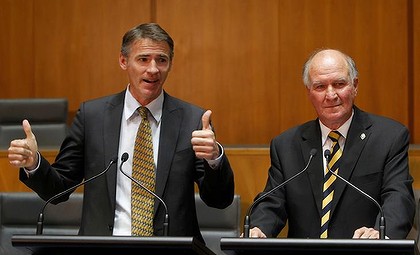
BREAKING UPDATE: Tony Windsor too. Good news for Barnaby. More below.

From the Australian:

FEDERAL independent MP Rob Oakeshott, whose crucial support helped Labor form the minority government after the 2010 election, has announced he is quitting politics.

The federal member for Lyne has told his local newspaper he will not contest the September 14 election, saying he wants to spend more time with his family and had achieved his goals in parliament.

“Now is the moment,” he told the Macleay Argus.

“I have done everything I said I was going to do and done the best I can.”

Mr Oakeshott, who held the NSW north-coast seat of Lyne for five years, denied his decision was prompted by fear of losing at the upcoming federal election.

Pathetic.

UPDATE:

From the Australian:

THE two independents who backed Julia Gillard personally to form a minority Labor government – Tony Windsor and Rob Oakeshott – are bowing out of politics.

Congratulations BJ.

Presumably you’re now a shoe-in to win New England.

“I Picked 7 Billion Out Of My Arse”: Audio Reveals Bankers Joking About Bailouts

26 Jun

Screen shot 2013-06-26 at 9.07.18 AM

This is the culture, the mind-set, the spirit which has now almost completely enslaved the world to the power of usury.

From Business Insider:

Once again, we have some more embarrassing conversations between bankers…

The Irish Independent, a Dublin-based newspaper, has uncovered tapes of an internal phone conversation from September 2008 between two executives at Anglo Irish Bank during its bailout deal and they sound pretty scandalous.   The Irish Independent points out that the recordings show they misled the Central Bank.

The executives from the recording have been identified as John Bowe (head of the bank’s capital markets) and Peter Fitzgerald (director of retail banking).

However, Bowe “categorically denied” that he misled the Central Bank and Fitzgerald, who wasn’t involved in discussions with regulators, said he was unaware of any intention to mislead, the report said.

Either way, the newly revealed recordings are still embarrassing.

Here are some partial excerpts (via the Irish Independent):

The two bankers begin their conversation jokingly comparing themselves to being able to walk on water and drink beer out of both hands.

John Bowe: “Hello”

Receptionist: “John I have Peter Fitz for you.”

Bowe: “Oh yeah, OK.”

Bowe: “As me granny used to say, you must be therapeutic…”

Peter Fitzgerald: “What does that mean? Can I work the computer is it? (Both laugh)

Bowe: “Therapeutic. Therapeutic…I was just ringing you.”

Fitzgerald: “I’m ambidextrous as well. It means I can walk on land and water.” (More laughter)

Bowe: “You can drink, you can drink beer out of both hands…” (laughter)

Then they get down to business.  Bowe tells Fitzgerald that they met with the Irish Financial Services Regulatory Authority (IFSRA) the previous day about getting €7 billion.  They laugh how they will never be able to pay it back.

Bowe:  ”So we went down..and we basically said. In Central, yeah. And I mean, to cut a long story short we sort of said. ‘Look, what we need is seven billion euros…and we’re going to give you and we’re going to give you, what we’re going to give you is our loan collateral so we’re not giving you ECB, we’re giving you the loan clause.

“We gave him a term sheet and we put a pro not facility together and we said that’s what we need. And that kind of sobered up everybody pretty quickly, you know.”

Fitzgerald: “Yeah.”

Fitzgerald: “And is that €7 billion a term?”

Bowe: “This is €7 billion bridging.”

Fitzgerald: “Yeah.”

Bowe: “So…so it is bridged until we can pay you back…which is never.” (Both laugh)

Then they joke how the regulators would need to change their underpants after hearing the terms of that deal.

Bowe: ”So under the terms that say repayment, we say; ‘No…’” (laughter)

Fitzgerald: (Laughing) “None…just none. Not applicable. OK and what did he say? ‘I need a change of underwear?’

Fitzgerald: “Jesus that’s a lot of dosh…Jesus f—–g hell and God…well do you know the Central Bank only has €14 billion of total investments so that would be going up 20…Gee..that would be seen.

Bowe: (Laughing) “There was a bit of that…there was a bit of that.  ’And how would we do that? We would need to give you…we need to…’Jesus you’re kind of asking us to play ducks and drakes with the regulations.’ And we said: ‘Yeah.’ We said: ‘Look what we are telling you is if we get into difficulties, we have 100,000 plus lump sum depositors in Ireland all of whom would be very vocal.’”

Fitzgerald asks Bowe how he came up with the 7 billion figure.  Bowe responds that like then-CEO David Drumm, he picked it out of his “arse.”

Fitzgerald: “Ah we are, yeah, yeah and, em, what, how did you arrive at the seven?

Bowe: “Just, as Drummer would say, ‘picked it out of my arse’, you know. Em…I mean, look, what we did was we basically said: ‘What is the amount we can securitize over the next six months?’ And basically say to them: ‘Look our problem is time, it’s not our ability to create the liquidity, the enemy is time here.’”

Fitzgerald: “Yeah.”

Bowe: “So we can rebuild, in other words, we can rebuild the liquidity off our loan book, but what we can’t do, we can’t do it now and the balance sheet’s leaking now.”

Bowe tells Fitzgerald that they actually need more money than the 7 billion figure.

Bowe: Yeah and that number is seven, but the reality is that actually we need more than that. But the strategy here is you pull them in, you get them to write a big [check] and they have to keep, they have to support their money, you know.”

Fitzgerald: “Yeah, yeah, yeah, yeah, yeah. They’ve got skin in the game and that’s the key.”

Bowe: “They have and they have invested a lot. If they saw, if they saw, the enormity of it up front, they might decide, they might decide they have a choice. You know what I mean? They might say the cost to the taxpayer is too high. But…em…if it doesn’t look too big at the outset…if it looks big, big enough to be important, but not too big that it kind of spoils everything,

Fitzgerald: “Yeah, Yeah.”

….

The actual audio recording is available at the link.

UPDATE:

Good to see the mainstream media picking up this story. From The Australian:

IRISH government ministers have been accused of turning a blind eye to the country’s financial collapse after tapes emerged of top bankers joking about bailouts.

In a set of phone calls recorded five years ago, executives at the toxic Anglo Irish Bank laugh about abusing a blanket bank guarantee to beef up the books at the expense of the UK and Germany.

One conversation – taped two days after the fateful September 30 2008 bank guarantee, and published by the Irish Independent – features former chief executive David Drumm giggling while his colleague John Bowe recites lines from Deutschland Uber Alles.

Drumm, who has since fled to the US, and Bowe are heard laughing about concerns that the guarantee would drive a wedge between Ireland and its EU partners.

The former said he would give “two fingers” to UK concerns…

Drumm and Bowe laugh about damage being done to Ireland’s reputation and concerns of flight of deposits out of Britain.

“So f***in’ what. Just take it anyway… stick the fingers up,” Drumm said about cash flowing in from Europe.

The bankers, recorded in January 2009, sound delighted with the temporary financial windfall, saying it was “fantastic” that if Anglo was nationalised they would keep their jobs and become civil servants.

Ah yes, a common dream of parasites everywhere.

To be a highly-paid, job-guaranteed, Big Government “employee”. A “public servant”.

Like politicians.

Federal Reserve Says Bank Bail-Ins Coming To The USA

26 Jun
Click to enlarge

Click to enlarge

On April 1st, this blog broke the full story of how G20 Governments All Agreed To Cyprus-Style Theft Of Banks Deposits … In 2010.

In recent days, numerous alternate media outlets have reported that Federal Reserve board member Jeremy Stein has confirmed this at an IMF-sponsored conference.

From Anglo Far East:

Please find a review of some data from a recent speech by a central banker that reinforces the rapid approach of “bail-ins”.

Link to download PDF of Jeremy Stein speech

The speech by Federal Reserve Board Member Jeremy Stein at an IMF-sponsored conference focused on “too big to fail” (TBTF) banks and “systemically important financial institutions” (SIFIs).

Stein said: “First, and most obviously, one goal is to get to the point where all market participants understand with certainty that if a large SIFI were to fail, the losses would fall on its shareholders and creditors, and taxpayers would have no exposure.”

And from gold proponent Jim Sinclair:

Bail-in is coming faster then we know. For god’s sake protect yourself. Come to the Q&A.

Governor Jeremy C. Stein
At the “Rethinking Macro Policy II,” a conference sponsored by the International Monetary Fund, Washington, D.C.
April 17, 2013

“First, and most obviously, one goal is to get to the point where all market participants understand with certainty that if a large SIFI (Significantly Important Financial Institutions) were to fail, the losses would fall on its shareholders and creditors……”

It is worth reviewing this blog’s report of April 1st for the full details of the BIS-funded, FSB-directed plan to steal your bank deposits when our banks begin to go under.

To “enable authorities to resolve failing financial firms in an orderly manner without exposing the taxpayer to the risk of loss.”

Conveniently ignoring that bank deposit holders are taxpayers too.

The Bankers’ Net Is Closing

25 Jun

a-tug-towing-a-tuna-cage-betwe-2

MacroBusiness’ chief economist Leith van Onselen, aka Unconventional Economist, has today posted a video clip from CNBC featuring one Stephen Cecchetti, economic advisor to the Bank for International Settlements (BIS). The context of the interview is the recent annual report from the BIS warning against continued “stimulus” by the world’s central banks (my bold emphasis added):

“What we are saying is not that there needs to be immediate austerity, but that the trajectories, the long run health of the balance sheets of the governments in many of the advanced industrialised economies is pretty bad at this point; that with aging populations and with commitments that have been made to the elderly for pension and health care, that the debt that’s created by governments is going to skyrocket, and before it does that they need to implement reforms. Now what this means is that you have to worry about the long run…”

Note the use of the term “trajectories”. This is precisely the description that has been used by our own Barnaby Joyce in making the same warning, since late 2009.

However, that is not the primary point I wish to make here.

What most captured my attention on reading the Unconventional Economists’ post, was the title he chose.

“Are central banks living on borrowed time?”

Presumably this is referring to the BIS’s warning that central banks cannot continue “printing” monetary “stimulus”. But I see a deeper, if unintended truth in that title. I suggest that it might be interpreted literally.

It would not surprise this blogger in the least to see a global scenario begin to play out at some point in the not-too-distant future, one somewhat similar to the following abbreviated plot line:

1. GFC 2.0 — stock markets crash, global credit “squeeze”, economic collapse, mass bank failures.

2. Attempted “bail-in” to “save” banks using account holders’ deposits; proves insufficient, governments “have” to assist anyway.

3. Government balance sheets continue to explode with unsustainable debt; those (like Australia) not yet underwater are now drawn into the maelstrom.

4. Austerity measures plus unemployment lead to social chaos, war/s, etc.

5. Central banks increasingly blamed for (a) failing to foresee trouble, (b) poor interest rate settings leading to high debt levels, thus causing the crisis, and (c) excessive money “printing” in failed attempts to restore the economy.

6. Growing calls for Public Central Banking; (ie) the end of fractional reserve banking, and of “independent” central banks.

7. Under the “guidance” of a Grand Plan designed by a “neutral”, global body — the BIS, IMF, etc — national governments take over control of the money supply in their country — or region.

8. The BIS, IMF etc establish a new “global reserve currency”, that each national / regional currency must be linked to — for “financial stability”.

This scenario is not so far-fetched as some may imagine.

Already there are increasing numbers of “experts” and other august entities arguing for point #6. Perhaps the most prominent example being the IMF’s 2012 paper, “The Chicago Plan Revisited”:

IMF’s epic plan to conjure away debt and dethrone bankers

One could slash private debt by 100pc of GDP, boost growth, stabilize prices, and dethrone bankers all at the same time. It could be done cleanly and painlessly, by legislative command, far more quickly than anybody imagined.

The conjuring trick is to replace our system of private bank-created money — roughly 97pc of the money supply — with state-created money.

We return to the historical norm, before Charles II placed control of the money supply in private hands with the English Free Coinage Act of 1666.

Specifically, it means an assault on “fractional reserve banking”. If lenders are forced to put up 100pc reserve backing for deposits, they lose the exorbitant privilege of creating money out of thin air.

The nation regains sovereign control over the money supply.

And if the sovereign has lost (or loses) control over itself, due to that sovereign debt “trajectory”?

The real question we might ask ourselves is, “Who or what would really control the ‘money’ supply then?”

For my part, the long history of predatory incursions on national sovereignty by the IMF in particular, is reason sufficient to vigorously oppose any idea or suggestion that comes from within their ranks.

Or the BIS ranks.

Remember, it is thanks to the Financial Stability Board (FSB) — an entity under the auspices of the BIS — that the G20 Governments All Agreed To Cyprus-Style Theft of Bank Deposits … In 2010.

The speed with which the FSB co-opted the agreement of the world’s politicians, granting the FSB the power to design a new regulatory system for achieving “financial stability” — in April 2009, mere months after ‘Peak Fear’ in October 2008 — should cause any critically-thinking person to wonder whether this has come about entirely by “unforeseen” accident, or by design.

UPDATE:

With thanks to reader Kevin Moore, the following clip offers some insight into why supposedly “neutral”, harmless, above-politics, centralised global bodies such as the IMF, BIS, World Bank et al, should never be trusted –

UPDATE:

MacroBusiness contributor Greg McKenna, aka Deus Forex Machina, says that central bankers appear to be coordinating their language, and potentially causing increased negative sentiment, in the midst of the present global stock market falls (my bold emphasis added) –

Central banks want stocks lower

“With so many Fed Governors talking this week I thought we would get soothing words from them so as to not spook the market any further than it had already been but in the release from the BIS over the weekend, in the statement from the PBOC yesterday and in comments from two senior Fed Governors overnight I see almost the exact opposite to what I had expected.

Clearly there is a global central bank compact that has emerged which says that stock and property market bubbles are not the way to get a sustainable cure to the economic woes of the globe…”

Could it simply be that certain people now want the markets (thus, economies) to crash?

Usury Centralises Wealth

21 Jun

Cross-posted from Applied Philosophy, by author Anonemiss (my bold emphasis added):

I discovered on the exceedingly excellent website of Project Gutenberg a book, that although written 110 years ago, speaks to the heart of our modern economy problems. The book is called Usury: A Scriptural, Ethical and Economic View by Calvin Elliott. I was surprised by how much my own writings about usury follows his arguments. Of course no book about usury could bypass Francis Bacon’s attempt at legitimizing it:

The dictum of Bacon that “Usury gathers the wealth of the realm into few hands” is readily proven and fully verified in the experience of these times. The tendency to centralization under a system of usury or interest-taking is so strong, and the modern result so apparent that the statement only is necessary.

Usury not only enslaves the borrower and oppresses the poor who are innocent of all debt, but it also affects the rich by gathering the wealth of the wealthy into fewer and fewer hands. There is a centralizing draft that threatens and then finally absorbs the smaller fortunes into one colossal financial power. It is as futile to resist this as to resist fate. Wealth cannot be so fortified and guarded as to successfully resist the attack of superior wealth when the practice of usury is permitted. The smaller and weaker fortune, using the same weapon as the larger and stronger, must inevitably be defeated and overcome, and ultimately absorbed.

Rates of interest do not affect the ultimate result. Under a high rate the gathering is rapid, under a low rate the accretions are slower, but the gathering into few hands is none the less sure. Rates of interest only place the convergent center at a nearer or more remote period.

CHAPTER XXIX – USURY CENTRALIZES WEALTH

I advise all readers to study this book (do not be put off by the religious chapters at the start and continue to the purely economic arguments in the later chapter).

See Also:

“Sympathy Does Not Vote These Days”

21 Jun

Barnaby Joyce writes for the Canberra Times:

With merely one week to go in this Parliament, a party based on politicians from the school of union organisation cannot organise the numbers either to effect a change in leadership or to dispel the prospect of one. In the final fortnight we have had a rolling Labor soap opera, which will do little to endear Australia to the party’s management potential.

It is as if the Labor Party has frozen in the headlights of the nation’s gaze, unable to extricate itself from either the Gillard-inspired coup or the relentless Rudd retaliation. The result is a bitter, personal feud that has festered into a full-blown brawl.

Three years ago Paul Howes, the head of the Australian Workers Union, decided that he was ”the Australian voting public” and he went out and unelected the elected Prime Minister on Lateline. A few months later he said ”it was probably an error”. Just then, Paul ”The Australian Voting Public” Howes popped up on Sky News to tell the Australian people that his Prime Minister must stay there.

I have come to the conclusion that instead of voting for the Prime Minister, I should be voting for whatever office Paul Howes occupies. The problem I have got is that this ballot is stacked. Now this is starting to sound like a Joseph Conrad novel; it’s certainly not the Australia that Mum and Dad told me about.

This week brings the shortest day of the year for the lowest ebb in our Parliament, and from here we head to spring, where we’ll see a new Parliament, new members, regrets and recriminations. The batting order is going to change and the tenants of the parliamentary offices will be shuffled and dealt. The next week is going to be crucial for Labor.

It will be certain political decimation to stay the course and the reality of the Queensland and NSW elections will be the fate of federal Labor if they cannot break out into adulthood in the next month. If you grasp for the bitter end, it is bitter; sympathy does not vote these days. It is like expecting greater attention from students five minutes before the end of school.

Read the whole article here.

If This Does Not Chill You To The Bone, You Are Already Dead

14 Jun

Heard anything about the PRISM scandal?

No?

Well then, as we have grown accustomed to saying (but why?), “Google it … Google is your friend”.

Er … perhaps not.

In our world of digital everything, no one is your friend.

From Zero Hedge, a must read (reproduced in full, all emphasis in original … and watch carefully for the “Telstra” reference):

The rabbit hole just got deeper. A whole lot deeper.

On Sunday we predicated that “there’s one reason why the administration, James Clapper and the NSA should just keep their mouths shut as the PRISM-gate fallout escalates: with every incremental attempt to refute some previously unknown facet of the US Big Brother state, a new piece of previously unleaked information from the same intelligence organization now scrambling for damage control, emerges and exposes the brand new narrative as yet another lie, forcing even more lies, more retribution against sources, more journalist persecution and so on.”

And like a hole that just gets deeper the more you dug and exposes ever more dirt, tonight’s installment revealing one more facet of the conversion of a once great republic into a great fascist, “big brother” state, comes from Bloomberg which reports that “thousands of technology, finance and manufacturing companies are working closely with U.S. national security agencies, providing sensitive information and in return receiving benefits that include access to classified intelligence, four people familiar with the process said.”

The companies extend far wider than the legacy telcos, such as Verizon, that launched the entire NSA-spying scandal a week ago: “Makers of hardware and software, banks, Internet security providers, satellite telecommunications companies and many other companies also participate in the government programs. In some cases, the information gathered may be used not just to defend the nation but to help infiltrate computers of its adversaries.”

Many of these same Internet and telecommunications companies voluntarily provide U.S. intelligence organizations with additional data, such as equipment specifications, that don’t involve private communications of their customers, the four people said.

And since what goes on behind the scenes is confidential, literally anything goes: “Along with the NSA, the Central Intelligence Agency, the Federal Bureau of Investigation and branches of the U.S. military have agreements with such companies to gather data that might seem innocuous but could be highly useful in the hands of U.S. intelligence or cyber warfare units, according to the people, who have either worked for the government or are in companies that have these accords.”

Some of the back and forth is innocuous, such as Microsoft revealing ahead of time the nature of its exposed bugs (ostensibly providing the government with a back door into any system using a Microsoft OS, but since it’s don’t ask, dont’ tell, nobody really knows). However the bulk of the interaction is steeped in secrecy: “Most of the arrangements are so sensitive that only a handful of people in a company know of them, and they are sometimes brokered directly between chief executive officers and the heads of the U.S.’s major spy agencies, the people familiar with those programs said.”

More on this “company within a company”:

Typically, a key executive at a company and a small number of technical people cooperate with different agencies and sometimes multiple units within an agency, according to the four people who described the arrangements.

If necessary, a company executive, known as a “committing officer,” is given documents that guarantee immunity from civil actions resulting from the transfer of data. The companies are provided with regular updates, which may include the broad parameters of how that information is used.

Remember how they say conspiracies are impossible because too many people know about them, and the information always eventually leaks? Well not if you contain it to a handful of people in any organization, and force them to sign a bloody NDA, pledging one’s first born in the case of secrecy breach.

An example of a company that is happy to “communicate” with tht the government is Intel’s McAfee internet security unit, which in addition to everything is one giant backdoor entrance for the government. If need be of course:

Intel Corp. (INTC)’s McAfee unit, which makes Internet security software, regularly cooperates with the NSA, FBI and the CIA, for example, and is a valuable partner because of its broad view of malicious Internet traffic, including espionage operations by foreign powers, according to one of the four people, who is familiar with the arrangement.

Such a relationship would start with an approach to McAfee’s chief executive, who would then clear specific individuals to work with investigators or provide the requested data, the person said. The public would be surprised at how much help the government seeks, the person said.

McAfee firewalls collect information on hackers who use legitimate servers to do their work, and the company data can be used to pinpoint where attacks begin. The company also has knowledge of the architecture of information networks worldwide, which may be useful to spy agencies who tap into them, the person said.

Google, another participant in PRISM, already lied about its participation in the covert-op:

Following an attack on his company by Chinese hackers in 2010, Sergey Brin, Google’s co-founder, was provided with highly sensitive government intelligence linking the attack to a specific unit of the People’s Liberation Army, China’s military, according to one of the people, who is familiar with the government’s investigation. Brin was given a temporary classified clearance to sit in on the briefing, the person said.

According to information provided by Snowden, Google, owner of the world’s most popular search engine, had at that point been a Prism participant for more than a year.

Google CEO Larry Page said in a blog posting June 7 that he hadn’t heard of a program called Prism until after Snowden’s disclosures and that the Mountain View, California-based company didn’t allow the U.S. government direct access to its servers or some back-door to its data centers. He said Google provides user data to governments “only in accordance with the law.”

Ah yes, the law that no mere mortal can observe in action, and which has zero popular checks and balances. So what specifically does Google provide to the government? “Highly offensive information” it appears.

That metadata includes which version of the operating system, browser and Java software are being used on millions of devices around the world, information that U.S. spy agencies could use to infiltrate those computers or phones and spy on their users.

“It’s highly offensive information,” said Glenn Chisholm, the former chief information officer for Telstra Corp (TLS)., one of Australia’s largest telecommunications companies, contrasting it to defensive information used to protect computers rather than infiltrate them.

Going back to Obama’s promise on live TV that nobody was listening in to any conversations, one wonders: why did the major telecom companies “ask for guarantees that they wouldn’t be held liable under U.S. wiretap laws.” Because if the companies demanded a waiver, they obviously were wiretapping, i.e., eavesdropping, and doing so on US citizens, or those protected by US laws. And that’s why Obama should have just kept his mouth shut, instead of having to explain what he meant and that he never said what he said.

Before they agreed to install the system on their networks, some of the five major Internet companies — AT&T Inc. (T), Verizon Communications Inc (VZ)., Sprint Nextel Corp. (S), Level 3 Communications Inc (LVLT). and CenturyLink Inc (CTL). — asked for guarantees that they wouldn’t be held liable under U.S. wiretap laws. Those companies that asked received a letter signed by the U.S. attorney general indicating such exposure didn’t meet the legal definition of a wiretap and granting them immunity from civil lawsuits, the person said.

Ah, the US Attorney General – because what is another Obama scandal that doesn’t involve his primary henchman Eric Holder…

Mark Siegel, a spokesman for Dallas-based AT&T, the nation’s biggest phone carrier, declined to comment. Edward McFadden, a spokesman for New York-based Verizon, the second-largest phone company, declined to comment. Scott Sloat, a spokesman for Overland Park, Kansas-based Sprint, and Monica Martinez, a spokeswoman for Broomfield, Colorado-based Level 3, didn’t immediately respond to requests for comment.

No need to comment – it’s quite clear.

The last question remains: what do companies get out of this proactive betrayal of their clients? Well, in some cases, such as those of IBM and Amazon as we described yesterday, they get lucrative government (CIA) contracts for billions of dollars. But that’s just taxpayer cash. Where it gets worse is when the kickbacks are yet more secrets.

In exchange, leaders of companies are showered with attention and information by the agencies to help maintain the relationship, the person said. In other cases, companies are given quick warnings about threats that could affect their bottom line, including serious Internet attacks and who is behind them.

In other words, what is going on behind the scenes is nothing more than one vast, very selective, extremely secretive, symbiotic and perfectly “legal” giant information exchange network, which allows corporations to profit off classified government information either in kind or in cash, and which allows the government to have all the information at its disposal, collected using public and private venues, in order to protect itself, to take out those it designates as targets, or simply said – to get ever bigger.

The loser in all of this?

You.

UPDATE:

From the UK Express –

NSA whistleblower Edward Snowden not welcome in the UK

THE whistleblower behind the largest leak of classified information in the history of the US National Security Agency (NSA) is not welcome in Britain, the Home Office has said because he is “detrimental to the public good.”

Edward Snowden has not been welcomed to come to the UK

Edward Snowden has not been welcomed to come to the UK

The Government has issued an alert to airlines around the world, urging them not to allow Edward Snowden to fly to the United Kingdom.

The alert, on a Home Office letterhead, said carriers should deny boarding to Snowden because “the individual is highly likely to be refused entry to the UK.”

Snowden, 29, revealed himself last week as the source of top-secret documents about controversial American surveillance programs.

He said he revealed America’s snooping of citizens’ internet use for a “better world”.

“I don’t want to live in a society that does these sort of things … I do not want to live in a world where everything I do and say is recorded. That is not something I am willing to support or live under,” he said.

“On Tuesday I Will Blow The Bloody Show Up!”

14 Jun

From The Daily Telegraph’s Simon Benson:

Bill Shorten, who is doing the dance of the seven veils, says publicly he still supports Julia Gillard.

But he will only support her until he doesn’t. And that could be very soon.

Shorten’s choice of words this week was telling.

When asked if he thought Gillard would still be leader by the time of the election, he said: “I believe so.”

These are not the words of a powerbroker confident in the survival of his leader.

As The Daily Telegraph revealed, Shorten is now counting numbers. And those numbers are falling Rudd’s way.

The mood even among many of Gillard’s supporters is bleak. And, after this week’s performance, their support is said to now be soft at best.

One senior Labor MP said that, unless something happens, he was prepared to walk into caucus on Tuesday next week and challenge the PM himself.

“I’ll blow the bloody show up,” they said.

Do it.

Do it do it do it do it do it do it do it do it do it do it do it do it do it do it do it do it do it do it do it do it do it do it do it do it do it do it do it do it do it do it do it do it do it do it do it do it do it do it do it do it do it do it do it do it do it do it do it do it do it do it do it do it do it do it do it do it do it do it do it do it do it do it do it do it do it do it do it do it do it do it do it do it do it do it do it do it do it do it do it do it do it do it do it do it do it do it do it do it do it do it do it do it do it do it do it do it do it do it do it do it do it do it do it do it do it do it do it do it do it do it do it do it do it do it do it do it do it do it do it do it do it do it do it do it do it do it do it do it do it do it do it do it do it do it do it do it do it do it do it do it do it do it do it do it do it do it do it do it do it do it do it do it.

5 Reasons Why Politicians Deserve Their Latest Pay Rise

14 Jun

After much painstaking research, ponderous analysis, and calm reflection, I finally worked why it is that Australian politicians (and senior public servants) deserve their latest 2.4% pay rise … and their next one too, scheduled for December 2013.

So without further ado, here are 5 compelling reasons why the PM deserves an extra $11.9k (now $507k per annum), and why dozy backbench MP’s deserve an extra $4.5k ($195k per annum):

1. Low paid workers were last week awarded a 2.6% pay rise ($821.60 per annum), taking the minimum wage to $622.20 per week ($32k per annum)

2.

3.

4.

5.

Ain’t percentages grand?

Design a site like this with WordPress.com
Get started