Our Banks Sell 30-Year Mortgages To 100 Year-Olds

1 Jun

mucciLW-620x349

Australia’s own sub-prime mortgage bubble has a face … and it’s very wrinkly.

From the always superb Michael West, of BusinessDay:

Why you’re never too old for the banks

Heather Simmers turned 102 years of age this week. When she was 98, Westpac signed her up for a 30-year mortgage. Lending that personal touch, the bank manager even made the sojourn to the Clem Jones Nursing Home in Bulimba to sign up Heather for the ”Rocket” investment loan.

It may seem an act of supreme optimism by Westpac to be providing a $440,000 loan facility to a customer who would soon receive her letter from Her Majesty. Yet it is not beyond the realms of possibility that Ms Simmers may have met her obligations.

The greatest authenticated age to which any human has ever lived is French woman Jeanne Louise Calment, who was born on February 21, 1875, and died at a nursing home in Arles in the south of France on August 4, 1997.

Had Jean Louise signed up for Westpac’s Rocket package at the age of 98, she could plausibly have met her obligations by the time she passed at the age of 122 years and 164 days – assuming she made early repayments. It is an attractive option of the Rocket facility that extra repayments can be made at any time without charge.

Incidentally, nine of the 10 oldest people in the world ever are women. But the man is still alive. He is Jiroemon Kimura, who lives in Japan and is 116 years and 43 days old.

Born on April 19, 1897, the supercentarian has survived the rule of no less than 61 Japanese prime ministers. And, as it happens, he is also a client of Westpac, having signed up for a Rocket facility (available with a special 100 per cent offset transaction account for a limited time only, conditions apply).

OK, just kidding, sorry. Mr Kimura is not a client of Westpac, as far as we are aware. He may be. As long as he could sign a piece of paper, he would certainly be eligible.

To be fair to Westpac, though, it is by no means alone in attending to the centarian market. If you are a mature reader of this column, and you are concerned that a Westpac bank manager is about to stride past your nursing station at any moment, toting a clipboard, a pen and a loan application form, fear not!

He could be from ANZ. When challenged during a legal dispute as to its practice of signing up an octogenarian – these are mere ankle-biters by Westpac standards – ANZ declared: ”We don’t discriminate against our customers on the basis of age.”

Dignity hath no bounds.

It would be remiss to omit the celebrated case of Storm Financial too, where the Commonwealth Bank was stitching up pensioners with margin loans.

When it comes to usury, as long as there is a potentially deceased estate as security for the loan, a customer’s age is no barrier. Though longevity is a nuisance for the banks when the ”buffer money” runs dry. This buffer is the extra loan that is structured into the package, for those with little or no income, to meet the interest payments on the main loan. Many of these are coming up for a refinance now.

THANK YOU Michael, for using the correct term!

Perhaps, like the insurance companies who fret about population age, the banks could consider ”longevity swaps” to hedge their rising exposure to the more, er, life-experienced demographic.

Europe’s biggest defence company, BAE Systems, recently struck the largest ever pensions insurance transaction, a £3.2 billion longevity swap to cover 31,000 pensioners. Insurers Legal & General and reinsurers Hannover Re agreed to take on 30 per cent and 70 per cent of the risk respectively.

There is also a risk for the banks that somebody might invent a longer life pill.

Returning to the case of Heather Simmers, Westpac recently and quietly forgave the loans to both Simmers and her 70-year-old daughter, Del Black. They had been inveigled into borrowing to invest in a dodgy Gold Coast property play touting 15 per cent returns. That quickly blew up.

Westpac executive Jim Tate told the Senate banking inquiry last year: ”It was an outright fraud. There is no question about that. Obviously the bank will be disgusted about it, and we would want to take action against the person involved, if it has not already been taken.”

Senator John Williams pointed out that Westpac had even provided oral references for Heather Simmers’ banker, David St Pierre, who had left the bank to work for another mortgage broker. Zero action taken, apart from the provision of job references.

As in the US, it is hard to think of a single action against a banker, by regulators or by the banks themselves, although the abuses of the credit boom are prolific. Bankers are clearly off limits, a protected species.

On Monday, we will reveal the results of an investigation into low doc lending in Australia, along with emails between banks and brokers – and claims of widespread forging of loan documents.

The banks and regulators have their stories ready. They question the credibility of those making the claims and blame any irregularities on ”rogue” mortgage brokers. The victims say the banks are the puppet-masters in a widespread systemic rort and the brokers are merely their agents.

“question the credibility of those making the claims” = The deceitful logic of the ad hominem fallacy.

“blame any irregularities on ‘rogue’ mortgage brokers” – The deceitful logic of the “red herring” fallacy.

Banks. The unnecessary scourge of Planet Earth.

Let us be rid of them.

Into The Unknown And With So Much At Stake

1 Jun

Barnaby Joyce writes for the Canberra Times:

It is 5.45am on Monday morning as I leave St George for what will be my final budget estimates as a senator for Queensland.

Below me is the Western Downs of Queensland and to the east is the sun rising over the Bunya Mountains between Kingaroy and Dalby.

I have an unsurprising sense of apprehension because if I fail at the next election, this won’t just be my last budget estimates as a senator for Queensland, it will be my last full stop. This puts my personal position in somewhat of a correlation to my nation. In the next few months the nation will make a decision that will influence our future financial health in an emphatic way.

Budget estimates, if properly pursued, should flesh out the capacity of ministers and departments to manage the finances of the nation in straitened times. The combined picture, across departments, should cast some light as to whether there is any hope of extracting the country from the financial deficit death spiral that could drive the government’s social contract with the Australian people into the ground. Because of the complexion of the political participants, budget estimates becomes more of an Alice in Wonderland wander in the political park, hoping to stumble across a wondrous mushroom that will illuminate the path to the political knockout punch.

If you are supported in anyway by a government payment then the position of the budget should be of crucial importance. If you receive medicine subsidised by the Pharmaceutical Benefits Scheme, if you drive on a federally funded road, if you go to a doctor that gets paid by Medicare, if you rely on States who rely on federal funding to pay your school teachers, if you drop off kids at child care, if you want a defence force to stop your nation falling into foreign hands and if you work for the public service then you should be a fiscal conservative, if for no other reason than self-preservation.

What will Australia look like if the cheques bounce? How on earth do we repay the debt if it arrives at the market value on the budget statements of $370 billion, remembering there is no legislation to increase the limit above the current $300 billion limit?

It is 9.35pm on Tuesday night and I have just been to a function for Tom Sefton, Liberal candidate for Canberra. Two tours of Afghanistan, former conference president of St Vincent de Paul, married with one kid but up against a 9 per cent margin. He is in for a real test of his mettle. In a Liberal-Labor stoush where the public service is under the pump, even though it is Labor debt that has to be repaid, Tom will need skills in this battle. He has to work hard if he is to have a chance of a close fight.

Last year the Gillard government reduced the public service by more than 3000 people. The pressure that is on the public service right now is because of the reckless and wasteful spending of the government right now. When the last Coalition government left office, there was not that pressure on the public service because the budget was managed responsibly and, whether you agreed or disagreed with them, you got a sense of stability from those controlling the reins of power.

The best thing for Canberra would be to restore that sense of stability and competence to the federal government.

Down the road from where the function is happening at Marcus Clarke Street, Civic, is the new ASIO headquarters where apparently the plans have been lifted and are now in the hot hands of someone in Beijing.

Everything is closing in. We owe so much money to the same country, and that same country is acquiring interests in our power supplies, rural land and more. I wonder if the Foreign Investment Review Board is taking any notes and taking into account what may be contrary to the national interest.

The interesting thing for me is soon, for whatever the outcome may be, I will be a free agent. Yes, I will have to and so I shall, resign. Tom Sefton shall stand in what would otherwise be an impossible task in the seat of Canberra but this current fiasco parlaying as a government makes all seats possibilities. Political correctness will state that “there is nothing to look at here” as far as Chinese infiltration into Australia’s national interest is concerned. What else could they say?

“I F***n Sacked Her”: Gillard’s Boss

31 May

From Michael Smith News:

It was about this time last year when Michael came to Melb to visit me. We had lunch at a great little Vietnamese rest on the corner of Bridge road and Church streets in the Melb suburb of Richmond. (probably the only time that I have shouted Michael a meal, by gosh it was cheap…LOL)

Not long into our soup, (which was a meal in its self) I rang Peter Gordon, former senior partner of Slater and Gordon. Peter Gordon an I go way back to the late 1980s where we both contributed to the save the bulldogs campaign against the then VFL. At the time the VFL were doing everything they could to relocate the Bulldogs and / or force them into a merger with another club. Peter answered my call and told me that he was in Darwin to see the Bulldogs game.

I told Peter that I was being hounded by the media to clarify certain points of my August sworn 2010 Statutory Declaration. I asked Peter what the circumstances of Gillard’s departure from Slater and Gordon were and he offered this comment “I could never go on the record but I f……n sacked her”. Michael was sitting right beside me. Further Peter Gordon told me to keep the pressure on Gillard’s renovations because I had only scratched the surface. This discussion took place long before Gillard’s exit interview was released. More reminiscing of the facts from me from time to time….

Bob Kernohan

Would that the nation had the power to do the same thing — to any politician — without having to endure the damage caused while waiting for an election.

Bring on a Direct Democracy movement!

“I Am No Longer Angry. I Am Ashamed” – ALP Heavyweight

31 May

Ashamed+head-in-handsFrom the Daily Telegraph, Paul Sheehan writes an epitaph on “the worst week, of the worst year, of the worst parliament in the history of Australian parliaments”:

Tony Abbott described it, in a more unique use of subtleties: “We are now at the fag end of a very contentious parliament.”

He was referring to the very issue that started the PM’s Hebdomas Horribillis, and ended it. The bungled attempt by the government to pass new electoral funding laws that proposed to take $60 million from taxpayers and put it in to political parties campaign coffers is emblematic of just how out of touch the political class in Canberra is with the rest of the country.

How Labor strategists didn’t twig to the potential for Abbott to back away from it is staggering in itself. But Gillard’s own failure to walk away, even after it was dead, instead continuing to back it, is symbolic of how out of touch her leadership team is with the mood not just in the electorate but inside her own caucus.

Labor elder John Faulkner couldn’t have been more blunt about his views on it when he labelled it a “disgrace”.

But it wasn’t the only thing that ruined the PM’s week and diverted attention from the one issue Labor does have over the Coalition and is desperately trying to find clear air to campaign on: education.

The well known Rudd supporter Anthony Byrne, the chair of the intelligence committee, fired the second missile on Monday when he attacked the government in parliament over funding cuts to the spy agencies. That too, was labelled a “disgrace”.

Then there was the Attorney-General Mark Dreyfus’ spectacularly inept response to suggestions that Chinese hackers had stolen the blueprints to its new $650 million office block. It all went pear shaped from there.

The PM couldn’t buy a trick when it was revealed the NBN was exposing people to asbestos. And then news that a suspected terrorist wanted by Interpol had been living in low security detention centre in South Australia for a year as an asylum seeker.

Labor MPs this week were even talking of just “bringing on” an election to put them out of their misery. The malaise that has been hanging over Labor MPs has now become a blanket of abject despair.

Most MPs, if they are honest, now live day to day under Murphy’s famous law: If anything can go wrong, it will.

And this week it has.

A greater symbol of the despondency that now grips the federal Labor Party there is not than Martin Ferguson’s decision this week to pull the pin on an 18 year career as a parliamentarian. Labor sources claim he won’t be the last to hang up his boots before the end of June.

Ferguson was rightly and ironically hailed as a true Labor hero by Tony Abbott.

Well may the Prime Minister have rolled her eyes when the Opposition Leader wiped tears from his, but his words were nonetheless true.

Ferguson was a Labor warrior, and not in the class war sense – which he abhorred. Not only did his departure deliver a final vote of no-confidence in Gillard and the new Labor she has fashioned, it revealed a man who believes there is nothing more he can do to save the party from itself.

Another Labor heavyweight, Faulkner, is equally dispirited. “I’m no longer angry,” he wearily told the caucus this week of the party funding bill. “I am ashamed.”

Thank God there are only three weeks of parliament left before the September election.

At least such shame will be fleeting.

Well might we all join hands with Senator Faulkner — of what was once the “working man’s” party — and cry “Hear Hear!”

Selling Papers – The Corrupt Ethics Of Economic Academia

31 May

1361821699_Money-is-the-Root-of-All-Evil_2577-l

Wonder not that the West is floundering in such grave economic straits. Nor that the post-Renaissance economics profession cannot “see” the true root cause of our Ship of State’s rotten planking.

From Economics Job Market Rumors, and a discussion thread entitled “Want an easy top pub[lication]?”:

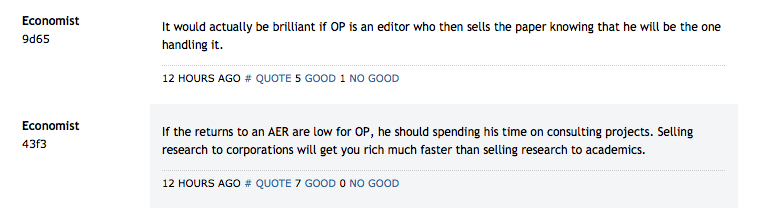
Screen shot 2013-05-31 at 12.11.43 PM

Perhaps what is most troubling, is the 248:8 ratio of “Good” vs “No Good” votes from readers. Presumably, fellow economic / academic professionals.

Now, we should of course be mindful of the possibility that the “OP” (original poster) of the above may simply be “trolling”. In which case, the purported offer to sell his/her economic paper would be of somewhat less import.

What is of real import, quite irrespective of the sincerity or otherwise of the OP’s offer, is the comments of others in response.

These tell us all we need to know about the corrupt ethics of the economics professional class; those that have, for several centuries, given academic licence to a multiplicity of self-ish, amoral theories and belief systems, that have ultimately given us the present Global Financial Crisis:

Click to enlarge

Click to enlarge

Click to enlarge

Click to enlarge

Click to enlarge

Click to enlarge

Click to enlarge

Click to enlarge

At least there are some in the economics profession who do still appear to have a functioning Conscience:

Click to enlarge

Click to enlarge

Click to enlarge

Click to enlarge

And those with a cuttingly ironic sense of humour:

Click to enlarge

Click to enlarge

Quite so.

The begged question that should need no answer is, “To whom?”

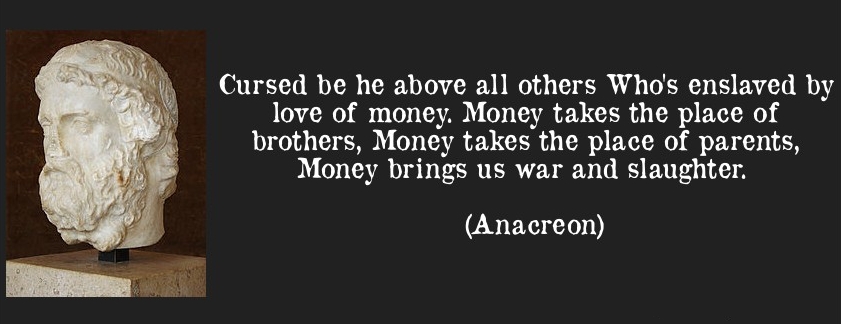
quote-cursed-be-he-above-all-others-who-s-enslaved-by-love-of-money-money-takes-the-place-of-brothers-anacreon-4591

h/t MacroBusiness blogger and Twitterer, Rumplestatskin.

An Historical Warning For Proponents Of A Modern Debt Jubilee

30 May

943190966d1257268299-info-command-conquer-4-concept10

Australia’s own Professor Steve Keen — one of only 13 economists worldwide to predict the Global Financial Crisis beginning in the mid 2000’s, and explain why — is perhaps the foremost proponent of a Modern Debt Jubilee “for the public”, as a solution to the ongoing global debt crisis:

Michael Hudson’s sim­ple phrase that “Debts that can’t be repaid, won’t be repaid” sums up the eco­nomic dilemma of our times. This does not involve sanc­tion­ing “moral haz­ard”, since the real moral haz­ard was in the behav­iour of the finance sec­tor in cre­at­ing this debt in the first place. Most of this debt should never have been cre­ated, since all it did was fund dis­guised Ponzi Schemes that inflated asset val­ues with­out adding to society’s pro­duc­tiv­ity. Here the irresponsibility—and Moral Hazard—clearly lay with the lenders rather than the borrowers.

The only real ques­tion we face is not whether we should or should not repay this debt, but how are we going to go about not repay­ing it?

We should … find a means to reduce the pri­vate debt bur­den now, and reduce the length of time we spend in this dam­ag­ing process of delever­ag­ing. Pre-capitalist soci­eties insti­tuted the prac­tice of the Jubilee to escape from sim­i­lar traps (Hud­son 2000; Hud­son 2004), and debt defaults have been a reg­u­lar expe­ri­ence in the his­tory of cap­i­tal­ism too (Rein­hart and Rogoff 2008). So a prima facie alter­na­tive to 15 years of delever­ag­ing would be an old-fashioned debt Jubilee…

We … need a way to short-circuit the process of debt-deleveraging, while not destroy­ing the assets of both the bank­ing sec­tor and the mem­bers of the non-banking pub­lic who pur­chased ABSs. One fea­si­ble means to do this is a “Mod­ern Jubilee”, which could also be described as “Quan­ti­ta­tive Eas­ing for the public”.

Quan­ti­ta­tive Eas­ing was under­taken in the false belief that this would “kick start” the econ­omy by spurring bank lending.

Instead, its main effect was to dra­mat­i­cally increase the idle reserves of the bank­ing sec­tor while the broad money sup­ply stag­nated or fell, for the obvi­ous rea­sons that there is already too much pri­vate sec­tor debt, and nei­ther lenders nor the pub­lic want to take on more debt.

A Mod­ern Jubilee would cre­ate fiat money in the same way as with Quan­ti­ta­tive Eas­ing, but would direct that money to the bank accounts of the pub­lic with the require­ment that the first use of this money would be to reduce debt. Debtors whose debt exceeded their injec­tion would have their debt reduced but not elim­i­nated, while at the other extreme, recip­i­ents with no debt would receive a cash injec­tion into their deposit accounts…

Alas, in wisely looking to the past for a guiding light to present action, proponents of a Modern Debt Jubilee appear to have glimpsed only a small part of the full historical picture. Indeed, it seems that they have failed to duly note the significance of what is the veritable mastodon in the room of recorded economic history.

This is somewhat inexplicable to this observer, particularly when one considers Professor Keen’s referencing of the research of his colleague, Professor Michael Hudson, in making the case for his modern jubilee proposal.

It would be well for all modern proponents of “wiping the slate clean” to heed the warning bell tolling from the depths of recorded history, the echoes of which ring out most clearly in Professor Hudson’s fascinating and exhaustive research study, How Interest Rates Were Set, 2500 BC to 1000 AD. The following excerpts are instructive, and most germane to our present inquiry (my emphasis added):

For economic historians, the Riddle of the Sphinx (if not the Holy Grail) has long been to explain how interest-bearing debts originated, and why interest rates differed from one society to the next. Interest rates are known to have been set in three primary civilizations at the outset of their commercial takeoff — Bronze Age Sumer, classical Greece and Rome…

Many economists theorize that interest rates reflect productivity and profit levels, subject to the risks of lending. A century ago, for instance, the German economic historian Wilhelm Roscher attributed the long decline in interest rates since antiquity to the “advance of civilization.”[1] He suggested that these rates declined because the riskiness of investment, for example, had been lessened by improvements in social stability, market efficiency and the security of credit. Also, shrinking profit margins and/or falling yields of cattle or crops would have reduced the ability of debtors to pay interest.

Following this approach, economic historians interpret the “kid” or “calf” words for interest (máš in Sumerian, tokos in Greek and fænus in Latin) as reflecting the growth of herds. But this begs the question of why such growth would have declined from Sumer through Greece and Rome. Already a century ago, Böhm-Bawerk rejected such “naive productivity explanations” of interest rates.[2]

We need not assume that interest rates were “economic” in the sense of being within the ability of most cultivators to pay. Abject need was the motive for agrarian debt. A key financial dynamic of ancient civilizations was precisely the problem of debt arrears (including unpaid tax collections) mounting up beyond the ability of many borrowers to pay. This is what led to the royal amargi, andurarum and misharum “Clean Slate” proclamations of Mesopotamia during 2400-1700 BC, cancelling agrarian debts…

Referring to the Levitical Jubilee Year, [Morris] Silver insists on “the counterproductive nature of the [Biblical] prophets’ economic ideas from a real world standpoint,” that is, the standpoint of modern laissez faire urging governments to refrain from interference with market forces. The modern assumption is that no matter what governments do to steer the economy, the market will undo such efforts.[12]

What were the Babylonians (and for that matter, the Judaeans and Israelites) thinking of? I think they knew something that modern economic theory does not acknowledge: if “market forces” are left to themselves, they lead to widening economic polarization and growing disequilibrium as financial claims on wealth and income tend inexorably to exceed the ability to pay (the Frederick Soddy principle). Interest rates exceeded profit and crop-surplus (“real rent”) rates.

One is reminded of Samuel Kramer’s complaint that Urukagina’s reforms were fruitless, for the usury and impoverishment problem simply began again.[13] Of course it did — and when the economy’s financial balance veered too far out of an equitable equilibrium, or simply when a new ruler ascended the throne, the debts were cancelled yet again. This was how the Sumerian and Babylonian debt overhead was prevented from growing too far out of bounds (a counterpart to the “overgrowth” of hubris in Greek social-economic thought).

One would think that — in the perhaps unlikely absence of an ideological and/or conceptual blind spot regarding the putative “time-value” of “money”; that is, the popularly-accepted post-Renaissance casuistic rationalisation for the charging of “interest” rates — the modern-day economic problem-solver should easily recognise the obvious lesson of history contained here.

Merely establishing a Modern Debt Jubilee cannot solve the global debt problem for the longue durée (“long term”). Any “wiping the slate clean”, or “debt reset”, would be an exercise in futility, in the absence of addressing the root cause of excessive debt.

It would not be unreasonable to suggest that the repeated failure of Sumerian/Babylonian “Clean Slate” proclamations to address the root problem causing indebtedness in the first place, offers a compelling explanation as to why the Biblical (Hebrew) prophets invoked the authority of God in explicitly commanding not only that all debts should be annulled every 7 years (the “Sabbatical” Year Jubilee), and that all property rights must be restored after 49 years (50th Year Jubilee), but also that usury in any form was a mortal sin, and thus outlawed within their society (e.g., “Thou shalt not lend upon usury to thy brother—usury of money, usury of victuals (food), usury of any thing that is lent upon usury.” – Deut 23:19).

Professor Hudson concludes (my emphasis added):

Usury became the major force polarizing ancient society as credit passed out of the hands of public institutions into those of private households. By classical Greek and Roman times, no palace rulers were left to cancel agrarian debts and otherwise keep creditor power in check. Thus, what seems to have begun as justifiable debt in third‑millennium Mesopotamia evolved into classical usury. Its corrosive dynamics polarized ancient society more than any other factor, destroying the archaic social balance between rich and poor, mercantile creditors and cultivators, despite the nominal decline in interest rates.

The power of creditors increased in the face of declining royal authority. Although the normal lending rate declined from Bronze Age Mesopotamia through classical Greece and Rome, creditors were able to render irreversible the forfeiture of land and personal freedom which debtors traditionally had been obliged to pledge as a condition for obtaining loans. In sum, what is first documented in Sumer is a revolutionary institution, revolutionary in that interest-bearing debt ended up by inciting populations to revolution at the end of antiquity, in the second and first centuries BC throughout the Romanized Mediterranean world.

Can the lesson of antiquity regarding debt cancellation, and the repeated need for it having arisen as a direct result of allowing the practice of usury (i.e., gains on lending), be any more clear?

Now, it would be a disservice to the estimable Professor Keen were your present author to neglect to draw readers’ attention to the fact that he (the good professor) does not advocate for a Modern Debt Jubilee in isolation from other measures. Indeed, “Taming the Finance Sector” is the second plank of his proposed solution. It includes suggestions for “Jubilee Shares”, and “The PILL” (or “Property Income Limited Leverage”).  Inquiring readers can delve into those details in Professor Keen’s Manifesto.

Not to put too fine a point on it — and with the deepest respect to Professor Keen — your present author remains avowedly sceptical as to the likely efficacy of these proposals.

Indeed, he would politely suggest that the good professor draws somewhat nearer to the realisation of a truly efficacious solution, in his briefly commenting on the proposals of others (my emphasis added):

There are many other pro­pos­als for reform­ing finance, most of which focus on chang­ing the nature of the mon­e­tary sys­tem itself. The best of these focus on insti­tut­ing a sys­tem that removes the capac­ity of the bank­ing sys­tem to cre­ate money via “Full Reserve Banking”.

“The best of these …”?

I would humbly beg to differ.

Firstly, an important, if rather obvious, clarification. The “monetary system” is not an independent life form. It should not be misunderstood as being a unique entity, one somehow separate and distinct from the human beings who act within and upon it. The monetary system is, and always has been, an artificial, conceptual, and very human construct. One shaped by very human motives. And that construct has, at various times and places across the span of recorded human history, existed in rather different forms and with rather different characteristics to those we observe today.

Secondly, I submit that Full Reserve Banking, while laudable, would not change “the nature” of the (present) monetary system itself.

Indeed, Professor Keen himself appears to sense this reality, albeit for the wrong reason (my emphasis added):

Banks profit by cre­at­ing debt, and they are always going to want to cre­ate more debt. This is sim­ply the nature of bank­ing.

Again, I beg to differ. As does the National Australia Bank (my emphasis added):

How Banks Work

…Their profit is the difference between what they pay in interest on your deposits and what you pay them in interest for the loan they made you.

It is not the nature of banking, but the nature of bankers, to seek out ways to make profits.

Bankers do not make profits by creating debt.

Bankers make profits, by practicing usury.

Or, to use the modern euphemism (since changing our words can conceal all manner of sins) – by “maximising” their “net interest income”.

Creating debt ex nihilo (“out of nothing”) — in the modern era, by mere digital bookkeeping entry — only affords bankers an additional power; to leverage the true root source of their profit-making.

Which is usury.

It is worth reminding ourselves of Professor Hudson’s summary observation on usury in ancient times:

The power of creditors increased in the face of declining royal authority.

This should give the thoughtful reader pause to reflect on, and reevaluate much of what we have been taught to believe concerning the past 500 years of “modern” Western “progress”.

Since the Renaissance (meaning “a revival of or renewed interest in something”) of the early 16th century — the days of the morally “liberal” King Henry VIII of England, and Giovanni di Lorenzo de’ Medici (son of Lorenzo the Magnificent, of the Medici banking family), better known as Pope Leo X of the European “Holy” Roman Empire — the authorities that were previously invoked against the practice of usury (i.e., God, Pope, King) for some 1,500 years, have declined.

Indeed, in a manner remarkably akin to that in which the white blood cells of our physical body’s natural immune system are seen to mutate and instead become the cancerous cells of leukaemia, those (human) authorities that had long been invoked in order to restrict and repel the power of usurious “creditors”, instead turned to rot the Western body politic, from the inside out.

Beginning with the reigns of England’s Henry VIII and Europe’s Leo X, after nearly two millennia of philosophical, divine, monarchical, and legal prohibition, the “nature” of Western banking (money-lending) became legally usurious.

In light of the historical evidences, it is your present author’s view, that were the wise urgings and proclamations of Plato, Aristotle, Cato, Cicero, Seneca, Plutarch, Buddha, Moses, Vashishtha, Jesus, Mohammed, Aquinas, Luther, and many more to be heeded today, and were the old Western laws banning usury in all its forms to be reinstated, then the core incentive for bankers to create excessive debt in the first place — for usurious profit/gain, or “net interest income” — could once again be effectively brought to heel.

In the absence of same, any advocacy for partial revival of ancient Biblical economic prescriptions, is doomed to come to naught.

ADDENDUM

Further to Professor Hudson’s research, readers who may be even superficially acquainted with the unequivocally economic reference to “Mystery, Babylon” in the Apocalypse (“Revelation”) of St. John’s epochal 18th chapter, will find the following revelation concerning the geographic origins of usury rather telling (my emphasis added):

Only recently has it been recognized that the charging of interest is not a universally spontaneous phenomenon, but was invented in Sumer — yet another Sumerian “first,” as Samuel Kramer would have said. No Early Bronze Age evidence for interest‑bearing debt has been found in the Indus civilization or the Hittite kingdom. The Hittite debt cancellation edict of Tudhaliya IV refer to wergild-type compensation owed for personal injury, not interest-bearing debt.[27] The fact that no archaic Egyptian debt records exist might possibly be the result of destruction of the papyrus writing medium, but regions that used clay tablets for public administration, such as Crete and Mycenaean Greece during 1600‑1200 BC likewise have left no hint of commercial credit, no pooling of money by partnerships, and — most telling of all — no agrarian debt cancellations. Egypt’s sed festivals, unlike their Mesopotamian counterparts, did not allude to debts. The absence of such debt records outside of Mesopotamia prior to the first millennium BC thus does not seem simply to reflect the absence of written documentation. It is the very essence of such debt to be documented.

Where the charging of interest appears earliest outside Mesopotamia — as in Assyria’s Asia Minor trade colonies — a comparative analysis of public and sacred laws shows these to derive from southern Mesopotamian practice. In any case, the role of debt was quite circumscribed outside of Mesopotamia, even in commercial economies such as Ugarit, the city‑state with the closest ties to the Aegean during 1400-1200 BC. As for Europe’s less centralized, tribally organized economies, the historian Tacitus noted as late as the first century of our era that the Germans, whose debts were mainly of the wergild type for legal restitution of damages, were not acquainted with loans at interest.[28] This probably can be taken as applying to European tribal communities generally. It follows that the origins of interest are to be understood in terms of Sumerian economic institutions.

If the Mesopotamian term for interest, máš, was not a literal reference to payment in young animals but a metaphor for the numerical accrual of interest, the next question to be addressed is whether this usage was reinvented spontaneously by classical Greece and Italy or was borrowed from the Near East.

I have argued elsewhere that the idea of interest-bearing debt was brought to Greece and Italy by Phoenician or Syrian merchants, probably in the 8th century BC.[44] For if the practice of charging interest and other commercial procedures were not pristine indigenous developments in Greece and Italy, the calf metaphor for interest likewise is unlikely to be inherent and universal. I believe that the semantic imagery of interest was adopted from the same Near Eastern sources that pioneered in charging interest on debts.

Ten Economic Policies To Unite A Nation

29 May

he-who-experiences-the-unity-of-life-sees-buddha

Regular readers will be well aware of my excoriating views on the practice of usury — the making of gain (profit) from money; the unnatural “birth of money from money”.

In this, I happily find myself to be in esteemed company.

With all the forefathers of Western thought and jurisprudence (Plato, Aristotle, Cato, Cicero, Seneca, Plutarch, et al).

With the religious divines of all times and places (Buddha, Moses, Vashishtha, Jesus, Mohammed, Aquinas, Luther, and many more).

And … with Adolf Hitler.

(Do I have your attention now?)

I have no doubt that very few, if any, Australian readers would know that the central plank in the economic policy platform of The National Socialist German Workers’ Party, was the abolition of usury.

That following the devastating impacts of losing World War I, the crushingly punitive war reparations imposed by the Treaty of Versailles, and the resultant hyperinflation of the Weimar Republic, the economic policies introduced by the NSDA on coming to power inspired what is arguably the greatest, and most rapid economic transformation of a nation in modern history.

Or that — if we choose to first set aside our conditioned prejudices, and consider the matter with cool impartiality — we will discover that many of us would support precisely the same economic policies, in response to the economic challenges of our own times.

Before we get to those policies, let us first consider the following commentary/introduction by Pedert Gottfried in “The Program of the NSDA”, The National Socialist German Workers’ Party and its General Conceptions, translated by E.T.S. Digdale, Fritz Eher Verlag, Munich, 1932.

Read without prejudice.

I have included underlines for emphasis:

Adolf Hitler prints the Party Program’s two main points in leaded type: “The Common Interest Before Self: The Spirit of the Program” and, Abolition of the Thralldom of Interest: The Core of National Socialism.” Once these two points are achieved, it means a victory of the approaching universalist ordering of society in the true state over the present-day separation of state, nation and economics under the corrupting influence of the individualist theory of society as now constructed.

The sham state of today, oppressing the working classes and protecting the pirated gains of bankers and stock exchange speculators, is the area for reckless private enrichment and for the lowest political profiteering; it gives no thought to its people, and provides no high moral bond of union. The power of money, most ruthless of all powers, holds absolute control, and exercises corrupting, destroying influence on state, nation, society, morals, drama, literature and on all matters of morality, less easy to estimate.

Break down the thralldom of interest” is our war cry. What do we mean by thralldom of interest? The landowner is under this thralldom, who has to raise loans to finance his farming operations, loans at such high interest as almost to eat up the results of his labor or who is forced to make debts and to drag the mortgages after him like so much weight of lead.

So is the worker producing in shops and factories for a pittance, whilst the shareholder draws dividends and bonuses which he has not worked for. So is the earning middle class, whose work goes almost entirely to pay the interest on bank overdrafts.

Thralldom of interest is the real expression for the antagonisms, capital versus labor, blood versus money, creative work versus exploitation. The necessity of breaking this thralldom is of such vast importance for our nation and our race, that on it alone depends our nation’s hope of rising up from its shame and slavery; in fact, the hope of recovering happiness, prosperity and civilization through out the world. It is the pivot on which everything turns; it is far more than a mere necessity of financial policy. Whilst its principles and consequences bite deep into political and economic life, it is a leading question for economic study, and thus affects every single individual and demands a decision from each one: Service to the nation or unlimited private enrichment. It means a solution of the Social Question.

Our financial principle: Finance shall exist for the benefit of the state; the financial magnates shall not form a state within the state. Hence our aim to break the thralldom of interest.

Relief of the state, and hence of the nation, from its indebtedness to the great financial houses, which lend on interest.

Nationalization of the Reichsbank [central bank] and the issuing houses [commercial banks], which lend on interest.

Provision of money for all great public objects (waterpower, railroads etc), not by means of loans, but by granting non-interest bearing state bonds or without using ready money.

Introduction of a fixed standard of currency on a secured basis.

Creation of a national bank of business development for granting non-interest bearing loans.

Fundamental remodeling of the system of taxation on social-economic principles. Relief of the consumer from the burden of indirect taxation, and of the producer from crippling taxation.

Wanton printing of bank notes, without creating new values, means inflation. We all lived through it. But the correct conclusion is that an issue of non-interest-bearing bonds by the state cannot produce inflation if new values are at the same time created.

The fact that today great economic enterprises cannot be set on foot without recourse to loans is sheer lunacy. Here is where reasonable use of the state’s right to produce money which might produce most beneficial results.

Let it be clearly understood, gentle reader, that my statement of agreement with the above is just that.

Agreement with the above. In particular, with the underlined passages.

Hence, a polite request.

Please do not insult my intelligence, and more importantly, your own, by falsely conflating my agreement with the above, with any contrived notion or implication that this somehow also constitutes an approval — tacit, or otherwise — of any other words (much less, actions) of the German state of the 1930’s – 1940’s.

I have one observation to make in that regard.

And it is this.

It is entirely possible — indeed, it is exceedingly common — for a person (and by extension, a nation) to be right in principle, but wrong in practice.

Which is why I condemn the (a)moral code, cherished by power-hungry sociopaths of all stations in life, which asserts that “the Ends justify the Means”.

*************

It may now be of interest to the discerning reader, to consider thoughtfully and without prejudice the first of the economic policy demands listed in the NSDA’s 25 point “Program” of 1932 (underline added):

Therefore we demand:

11. That all unearned income, and all income that does not arise from work, be abolished.

Breaking the Bondage of Interest

12. Since every war imposes on the people fearful sacrifices in blood and treasure, all personal profit arising from the war must be regarded as treason to the people. We therefore demand the total confiscation of all war profits.

13. We demand the nationalization of all trusts.

14. We demand profit-sharing in large industries.

15. We demand a generous increase in old-age pensions.

16. We demand the creation and maintenance of a sound middle-class, the immediate communalization of large stores which will be rented cheaply to small tradespeople, and the strongest consideration must be given to ensure that small traders shall deliver the supplies needed by the State, the provinces and municipalities.

17. We demand an agrarian reform in accordance with our national requirements, and the enactment of a law to expropriate the owners without compensation of any land needed for the common purpose. The abolition of ground rents, and the prohibition of all speculation in land.

18. We demand that ruthless war be waged against those who work to the injury of the common welfare. Traitors, usurers, profiteers, etc., are to be punished with death, regardless of creed or race.

20. In order to make it possible for every capable and industrious German to obtain higher education, and thus the opportunity to reach into positions of leadership, the State must assume the responsibility of organizing thoroughly the entire cultural system of the people. The curricula of all educational establishments shall be adapted to practical life. The conception of the State Idea (science of citizenship) must be taught in the schools from the very beginning. We demand that specially talented children of poor parents, whatever their station or occupation, be educated at the expense of the State.

21. The State has the duty to help raise the standard of national health by providing maternity welfare centers, by prohibiting juvenile labor, by increasing physical fitness through the introduction of compulsory games and gymnastics, and by the greatest possible encouragement of associations concerned with the physical education of the young.

Would you be inclined to support any of these economic policies, here in our own times?

Looking For A Root

28 May

one-root-to-rule-them-all-fa41dc-e1341482332407

“In Keynes’s view capitalism’s driving force is a vice which he called ‘love of money’ … in the General Theory ‘the propensity to hoard’ or ‘liquidity preference’ plays a vital part in the mechanics of an economy’s rundown, once something has happened to make investment less attractive. And this links up with Keynes’s sense that, at some level too deep to be captured by mathematics, ‘love of money’ as an end, not a means, is at the root of the world’s economic problem.”

Robert Skidelsky; “John Maynard Keynes: Vol. 2, The Economist As Saviour 1920-1937″ (1994)

“There are a thousand hacking at the branches of evil to one striking at the root.”

– Henry David Thoreau

Would you be inclined to agree, that the best way to solve a problem, is to begin by looking for a root?

Economy

Definition of economy

1. the state of a country or region in terms of the production and consumption of goods and services and the supply of money

Oxford Dictionary

Who is responsible for the “supply of money”?

Changes in the quantity of money may originate with actions of the Federal Reserve System (the central bank), depository institutions (principally commercial banks), or the public. The major control, however, rests with the central bank.

– Federal Reserve Bank of Chicago, Modern Money Mechanics: A Workbook on Bank Reserves and Deposit Expansion

How is “money” supplied?

The actual process of money creation takes place primarily in banks. As noted earlier, checkable liabilities of banks are money. These liabilities are customers’ accounts. They increase when customers deposit currency and checks and when the proceeds of loans made by the banks are credited to borrowers’ accounts.

– Federal Reserve Bank of Chicago, Modern Money Mechanics: A Workbook on Bank Reserves and Deposit Expansion

Why is money supplied (by banks)?

…banks basically make money…

Investopedia

How do banks “make money” (ie, make profits)?

by lending money at rates higher than the cost of the money they lend. More specifically, banks collect interest on loans and interest payments from the debt securities they own, and pay interest on deposits, CDs, and short-term borrowings. The difference is known as the “spread,” or the net interest income…

Investopedia

Er… let’s hear that again … HOW do banks “make money” (profits)?

They make money just like any other business. The difference is that their product is money. In other words banks sell money, mostly in the form of loans. Their profit is the difference between what they pay in interest on your deposits and what you pay them in interest for the loan they made you. Banks also charge fees for services.

National Australia Bank, How Banks Work

What is “interest”?

The charge for the privilege of borrowing money, typically expressed as an annual percentage rate.

Investopedia

Is interest on money natural?

The most hated sort (of money-making), and with the greatest reason, is usury, which makes a gain out of money itself and not from the natural use of it. For money was intended merely for exchange, not for increase at interest. And this term interest (“tokos”, i.e., “children”), which implies the birth of money from money, is applied to the breeding of money, because the offspring resembles the parent. Wherefore of all modes of money-making, this is the most unnatural.

– Aristotle, Politics, Book One, Part X (c. 350 BC)

DIGGING DOWN

  • The global economy has a problem.
  • The supply of money is a defining component in the functioning of the economy.
  • Banks supply the money in the economy.
  • Banks supply the money by creating it ex nihilo (“out of nothing”).
  • Banks create new money when they make loans.
  • Banks make loans in order to make profits.
  • Banks make profits by charging interest on money they create.
  • Banks make profits by charging more in interest, than they pay in interest.
  • Interest is a charge for the “privilege” of borrowing money.
  • Making money out of money, by charging “interest” / usury on money … is not natural.

Would you be inclined to agree, that it is not a “privilege” but a burden, to have to borrow money at interest?

Would you be inclined to agree, that it is banks who have an incredibly privileged position and role in the functioning of the economy?

Would you be inclined to agree, that it is immoral and unjust to charge “interest” for the “privilege” of “borrowing” something that was created out of nothing — mere electronic digits, typed into a computer?

Would you be inclined to agree, that because banks are legally permitted to make profits from the production of money“their product is money” — that bankers are likely to have a vested interest in selling as much of their product — that is, creating as much debt — as they can get away with?

Is it possible that usury — the making of gains (profit) on the lending of money; the unnatural “birth of money from money” — is the root of the problem in the global economy?

For the love of money is the root of all evil: which while some coveted after, they have erred from the faith, and pierced themselves through with many sorrows.

– St. Paul, 1 Timothy 6:10

…no one shall deposit money with another whom he does not trust as a friend, nor shall he lend money upon interest; and the borrower should be under no obligation to repay either capital or interest.

– Plato, Laws, Book V (c. 348 BC)

And if you lend to those from whom you hope to receive back, what credit is that to you? For even sinners lend to sinners to receive as much back. But love your enemies, do good, and lend, hoping for nothing in return; and your reward will be great, and you will be sons of the Most High.

– Jesus Christ, Luke 6:34-35

See also:

Imagine A World With No Banks

A Tale Of Usury, Explosions, And A Used Car Salesman

Babylon = Usury: We Want Interest-Free Money at realcurrencies.com

When Banks Write Government Legislation, It’s Time To Kill The Banks … And The Government

25 May

From the New York Times:

WASHINGTON — Bank lobbyists are not leaving it to lawmakers to draft legislation that softens financial regulations. Instead, the lobbyists are helping to write it themselves.

One bill that sailed through the House Financial Services Committee this month — over the objections of the Treasury Department — was essentially Citigroup’s, according to e-mails reviewed by The New York Times. The bill would exempt broad swathes of trades from new regulation.

In a sign of Wall Street’s resurgent influence in Washington, Citigroup’s recommendations were reflected in more than 70 lines of the House committee’s 85-line bill. Two crucial paragraphs, prepared by Citigroup in conjunction with other Wall Street banks, were copied nearly word for word. (Lawmakers changed two words to make them plural.)

The lobbying campaign shows how, three years after Congress passed the most comprehensive overhaul of regulation since the Depression, Wall Street is finding Washington a friendlier place.

The cordial relations now include a growing number of Democrats in both the House and the Senate, whose support the banks need if they want to roll back parts of the 2010 financial overhaul, known as Dodd-Frank.

This legislative push is a second front, with Wall Street’s other battle being waged against regulators who are drafting detailed rules allowing them to enforce the law.

And as its lobbying campaign steps up, the financial industry has doubled its already considerable giving to political causes. The lawmakers who this month supported the bills championed by Wall Street received twice as much in contributions from financial institutions compared with those who opposed them, according to an analysis of campaign finance records performed by MapLight, a nonprofit group.

The passage of the Dodd-Frank Act, which took aim at culprits of the financial crisis like lax mortgage lending and the $700 trillion derivatives market, ushered in a new phase of Wall Street lobbying. Over the last three years, bank lobbyists have blitzed the regulatory agencies writing rules under Dodd-Frank, chipping away at some regulations.

But the industry lobbyists also realized that Congress can play a critical role in the campaign to mute Dodd-Frank.

The House Financial Services Committee has been a natural target. Not only is it controlled by Republicans, who had opposed Dodd-Frank, but freshmen lawmakers are often appointed to the unusually large committee because it is seen as a helpful base from which they can raise campaign funds.

For Wall Street, the committee is a place to push back against Dodd-Frank. When banks and other corporations, for example, feared that regulators would demand new scrutiny of derivatives trades, they appealed to the committee. At the time, regulators were completing Dodd-Frank’s overhaul of derivatives, contracts that allow companies to either speculate in the markets or protect against risk. Derivatives had pushed the insurance giant American International Group to the brink of collapse in 2008. The question was whether regulators would exempt certain in-house derivatives trades between affiliates of big banks.

As the House committee was drafting a bill that would force regulators to exempt many such trades, corporate lawyers like Michael Bopp weighed in with their suggested changes, according to e-mails reviewed by The Times. At one point, when a House aide sent a potential compromise to Mr. Bopp, he replied with additional tweaks.

Ultimately, the committee inserted every word of Mr. Bopp’s suggestion into a 2012 version of the bill that passed the House, save for a slight change in phrasing…

Citigroup and other major banks used a similar approach on another derivatives bill. Under Dodd-Frank, banks must push some derivatives trading into separate units that are not backed by the government’s insurance fund. The goal was to isolate this risky trading.

The provision exempted many derivatives from the requirement, but some Republicans proposed striking the so-called push out provision altogether. After objections were raised about the Republican plan, Citigroup lobbyists sent around the bank’s own compromise proposal that simply exempted a wider array of derivatives. That recommendation, put forth in late 2011, was largely part of the bill approved by the House committee on May 7 and is now pending before both the Senate and the House.

[Full article here]

One wonders how similarly “helped” our local lawmakers are.

The final word goes to UK Independent Party politician, Nigel Farage –

The Apologia Of An Awakening Real Estate Agent

25 May

awakening

Reader “Phil” had the following to say, in response to Thursday’s post, Real Estate Marketers Now Out To Get Your Kids.

His words are an object lesson for real estate industry professionals everywhere (my bold added):

As a licensed real estate agent myself, I would like to suggest a difference between single office agencies and franchise groups. The typical stereotype of a real estate agent is derived from the high flying top 3%. There is no doubt there are some wankers in the industry. The rest that I know are hard working good people who support families and employ staff of 10 to 15 on average. That goes for many of the offices within franchise groups.

Since 2008, I have stood back and looked at the industry a bit differently. I have recognised that most real estate agents have no idea that it is bank credit expansion that causes house prices to rise. Or as Steve Keen explains, actually “growth” in credit expansion.

This is only possible due to legislation allowing private banks to use housing equity as security to create credit. We just continue to do this as that appears to be the way it always was. (IMO housing should be a consumable not an asset).

BTW, hat tip on your recent article exposing those who foster the continuation of the “housing industry” as a financial derivative.

Back to the franchise groups and franchises in general (Parasites!!!). This is not unlike usury or rent seeking. They take franchise fees from hard working small businesses and promote corporate ideals. The LJ Hooker promotion is revolting IMO.

I keep returning to your story of the used car salesman. Most people just keep doing what they know to do to get by or maybe get ahead. We are all preyed on by those who control and promote the FIRE structure.

As one who is now seeing the reality of this I feel a responsibility to speak. Much as you do. I tend to do this even as it makes me an outsider. Strange that huh?

Design a site like this with WordPress.com
Get started