The IPCC’s Dilemma In 1 Chart

18 Sep

Cross-posted from the Financial Post (my bold added):

In the next five years, the global warming paradigm may fall apart if the models prove worthless

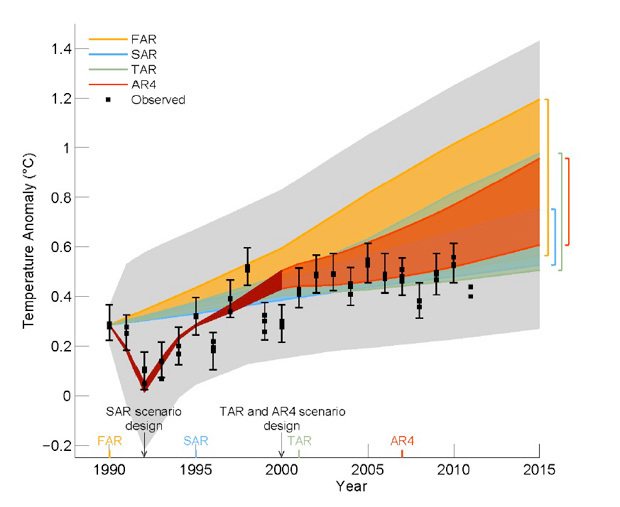
There has been a lot of talk lately about the upcoming Intergovernmental Panel on Climate Change (IPCC) report, and whether it will take into account the lack of warming since the 1990s. Everything you need to know about the dilemma the IPCC faces is summed up in one remarkable graph.

The above graphic is Figure 1.4 from Chapter 1 of a draft of the Fifth Assessment Report from the Intergovernmental Panel on Climate Change. The initials at the top represent the First Assessment Report (FAR) in 1990, the Second (SAR) in 1995. Shaded banks show range of predictions from each of the four climate models used for all four reports since 1990. That last report, AR4, was issued in 2007. Model runs after 1992 were tuned to track temporary cooling due to the 1991 Mount Pinatubo eruption in The Philippines. The black squares, show with uncertainty bars, measure the observed average surface temperatures over the same interval. The range of model runs is syndicated by the vertical bars. The light grey area above and below is not part of the model prediction range. The final version of the new IPCC report, AR5, will be issued later this month.

The above graphic is Figure 1.4 from Chapter 1 of a draft of the Fifth Assessment Report from the Intergovernmental Panel on Climate Change. The initials at the top represent the First Assessment Report (FAR) in 1990, the Second (SAR) in 1995. Shaded banks show range of predictions from each of the four climate models used for all four reports since 1990. That last report, AR4, was issued in 2007. Model runs after 1992 were tuned to track temporary cooling due to the 1991 Mount Pinatubo eruption in The Philippines. The black squares, show with uncertainty bars, measure the observed average surface temperatures over the same interval. The range of model runs is syndicated by the vertical bars. The light grey area above and below is not part of the model prediction range. The final version of the new IPCC report, AR5, will be issued later this month.

The figure nearby is from the draft version that underwent expert review last winter. It compares climate model simulations of the global average temperature to observations over the post-1990 interval. During this time atmospheric carbon dioxide rose by 12%, from 355 parts per million (ppm) to 396 ppm. The IPCC graph shows that climate models predicted temperatures should have responded by rising somewhere between about 0.2 and 0.9 degrees C over the same period. But the actual temperature change was only about 0.1 degrees, and was within the margin of error around zero. In other words, models significantly over-predicted the warming effect of CO2 emissions for the past 22 years.

Chapter 9 of the IPCC draft also shows that overestimation of warming was observed on even longer time scales in data collected by weather satellites and weather balloons over the tropics. Because of its dominant role in planetary energy and precipitation patterns, models have to get the tropical region right if they are credibly to simulate the global climate system. Based on all climate models used by the IPCC, this region of the atmosphere (specifically the tropical mid-troposphere) should exhibit the most rapid greenhouse warming anywhere. Yet most data sets show virtually no temperature change for over 30 years.

The IPCC’s view of the science, consistently held since the 1990s, is that CO2 is the key driver of modern climate change, and that natural variability is too small to count in comparison. This is the “mainstream” view of climate science, and it is what is programmed into all modern climate models. Outputs from the models, in turn, have driven the extraordinarily costly global climate agenda of recent decades. But it is now becoming clear that the models have sharply over predicted warming, and therein lies a problem.

As the gap between models and reality has grown wider, so has the number of mainstream scientists gingerly raising the possibility that climate models may soon need a bit of a re-think. A recent study by some well-known German climate modelers put the probability that models can currently be reconciled with observations at less than 2%, and they said that if we see another five years without a large warming, the probability will drop to zero.

“The IPCC must take everybody for fools”

What’s more, the U.K.’s main climate modeling lab just this summer revised its long-term weather forecasts to show it now expects there to be no warming for at least another five years. Ironically, if its model is right, it will have proven itself and all others like it to be fundamentally wrong.

To those of us who have been following the climate debate for decades, the next few years will be electrifying. There is a high probability we will witness the crackup of one of the most influential scientific paradigms of the 20th century, and the implications for policy and global politics could be staggering.

It is the job of the giant UN IPCC panel to inform world leaders of up-to-the-minute developments in the field. With its report due out within days, you would think it would be jumping at the chance to report on these amazing developments, wouldn’t you? Well, guess again.

Judging by the drafts circulated this year, it is in full denial mode. Its own figure reveals a discrepancy between models and observations, yet its discussion says something entirely different. On page 9 of Chapter 1 it explains where the numbers come from, it talks about the various challenges faced by models, and then it sums up the graph as follows: “In summary, the globally-averaged surface temperatures are well within the uncertainty range of all previous IPCC projections, and generally are in the middle of the scenario ranges.” Later, in Chapter 9, it states with “very high confidence” that models can correctly simulate global surface temperature trends.

The IPCC must take everybody for fools. Its own graph shows that observed temperatures are not within the uncertainty range of projections; they have fallen below the bottom of the entire span. Nor do models simulate surface warming trends accurately; instead they grossly exaggerate them. (Nor do they match them on regional scales, where the fit is typically no better than random numbers.)

“This is no time for costly and permanent climate policy commitments”

In the section of the report where it discusses the model-observation mismatch in the tropics, it admits (with “high confidence”) that models overestimate warming in the tropics. Then it says with a shrug that the cause of this bias is “elusive” and promptly drops the subject. What about the implications of this bias? The IPCC not only falls conspicuously silent on that point, it goes on to conclude, despite all evidence to the contrary, that it has “very high confidence” that climate models correctly represent the atmospheric effects of changing CO2 levels.

There are five key points to take away from this situation.

First, something big is about to happen. Models predict one thing and the data show another. The various attempts in recent years to patch over the difference are disintegrating. Over the next few years, either there is going to be a sudden, rapid warming that shoots temperatures up to where the models say they should be, or the mainstream climate modeling paradigm is going to fall apart.

Second, since we are on the verge of seeing the emergence of data that could rock the foundations of mainstream climatology, this is obviously no time for entering into costly and permanent climate policy commitments based on failed model forecasts. The real message of the science is: Hold on a bit longer, information is coming soon that could radically change our understanding of this issue.

Third, what is commonly called the “mainstream” view of climate science is contained in the spread of results from computer models. What is commonly dismissed as the “skeptical” or “denier” view coincides with the real-world observations. Now you know how to interpret those terms when you hear them.

Fourth, we often hear (from no less an authority than Obama himself, among many others) slogans to the effect that 97% of climate experts, 97% of published climate science papers, and all the world’s leading scientific societies agree with the mainstream science as encoded in climate models. But the models don’t match reality. The climate science community has picked a terrible time to brag about the uniformity of groupthink in its ranks.

Finally, the IPCC has proven, yet again, that it is incapable of being objective. Canadian journalist Donna LaFramboise has meticulously documented the extent to which the IPCC has been colonized by environmental activists over the years, and we now see the result. As the model-versus-reality discrepancy plays out, the last place you will learn about it will be in IPCC reports.

This Is Bliss

18 Sep

How long has it been since you experienced bliss like this?

download

Hitler’s Finances And The Myth Of Nazi Anti-Usury Activism

17 Sep

Cross-posted from Anthony Migchels’ Real Currencies:

There is the widespread notion that Hitler was fighting the Money Power and that he was a problem for the Bankers because he created a Usury free economy. But there was no Usury free Third Reich economy. The German taxpayer continued to pay interest over the substantial national debt and commercial banking received interest for its fractional reserve banking based loans, which to a large extent financed the war.

“Our greatest social task is the abolition of interest slavery. This responsibility to abolish interest slavery towers above all other issues of the day. It is the only solution to the greatest problem of our time. The breaking of interest slavery is the most important moral imperative in social terms, it rises in its general significance far beyond all questions of the day, it is the solution of social questions, it is the only way out of the terrible confusion of the time. The abolition of interest slavery will deliver us from ultra-capitalist domination while avoiding both Communist destruction of the human spirit and Capitalist degradation of labour. The abolition of interest slavery opens the way to a truly social economy, by liberating us from the overwhelming domination of money. It opens the way to a state based on creative work and genuine accomplishment.” – Gottfried Feder 1919

By Anthony Migchels

Where does Hitler’s reputation for anti-Usury activism come from? It was more Nazi propaganda to get him to power than his actual policies after he did. It was not Hitler, but Gottfried Feder who was the anti-Usury man of the Nazi. Hitler in Mein Kampf:

“For the first time in my life I heard (through Feder, AM) a discussion which dealt with the principles of stock exchange capital and capital which was used for loan activities. After hearing the first lecture delivered by Feder, the idea immediately came into my head that I had found a way to one of the most essential prerequisites for the founding of a new party.

To my mind, Feder’s merit consisted in the ruthless and trenchant way in which he described the double character of the capital engaged in stock exchange and loan transactions, laying bare the fact that this capital is ever and always dependent on the payment of interest.”

And:

“The struggle against international finance capital and loan capital has become one of the most important points in the program on which the German nation has based its fight for economic freedom and independence.”

Point 11 of the NSDAP 25 point program, a manifesto that officially (but not in practice) expressed Nazi policy:

“Abolition of unearned (work and labour) incomes. Breaking of debt (interest)-slavery.”

Hitler put it this way:

“Our financial principle: Finance shall exist for the benefit of the state; the financial magnates shall not form a state within the state. Hence our aim to break the thralldom of interest.

Relief of the state, and hence of the nation, from its indebtedness to the great financial houses, which lend on interest.

Nationalization of the Reichsbank and the issuing houses, which lend on interest.”

But as we shall see, Hitler did not implement any serious monetary reform after he came to power. He did make finance completely subservient to the State and, more specifically, rearmament. But he did not nationalize any banks and the Reichsbank was already nationalized by the Weimar Republic by the time he came to power. He did not end interest payments to ‘the issuing houses’, who must have made an uncanny fortune throughout the war. He did nothing to decouple the Stock Exchange from the economy.

Feder was made Secretary of State for Economic Affairs, but was from day one sabotaged by Reichsbank President Hjalmar Schacht and replaced by him in August 1934. It was Schacht who was to manage the Nazi economy, not Feder.

Schacht’s and Hitler’s policies allowed full control of the economy, which was used to maximize production for the sake of war. But it did absolutely nothing to limit in any way massive war profiteering by the financial and industrial classes that brought him to power.

The Reichsmark

The Reichsmark was created 1924 after its predecessor, the Papiermark, had been inflated into oblivion. 1 Reichsmark was 1 Trillion Papiermark. The Reichsmark lasted until 1948, when it was replaced by the Deutsche Mark. So Hitler simply used the monetary system that he inherited from the Weimar Republic. The Reichsmark, like any other banking unit, was lent into circulation. It was a Gold backed unit until 1931, when the depression forced the Reichsbank (the Central Bank) to implement exchange controls, which effectively took Germany off the Gold Standard. A Gold peg remained in place. There were 1, 2 and 5 Reichsmark silver coins.

Hitler inherited the official Weimar 4,5% maximum interest rate. He ruled by decree, but never changed this. In fact, after the Nazi economy began to boom due to heavy spending on rearmament, it seems interest rates were raised to combat inflation. I’ve been unable to find any data on real interest rates during the Nazi era.

Who was Hjalmar Schacht?

Schacht was born in 1877 as the son of an aristocratic family. He joined Dresdner Bank in 1903 and already in 1905 was meeting people like JP Morgan and Theodore Roosevelt. He studied Hebrew to advance his career. In 1908 he joined Freemasonry. He oversaw the financing of Belgian/German trade during WW1 and used his former employer Dresdner Bank for this. This blatant conflict of interest led to his dismissal, but the revolving door was not invented recently and he was taken back by Dresdner Bank after this.

In 1923 he joined the Reichsbank and played a key role in ending the hyperinflation of the day. A little later he was made President of the Reichsbank and remained in this post until 1930. Since at least 1923 he was actively resisting the war reparations that were destroying the German economy and called for resurrection of German power. In 1926 he became involved with the NSDAP and supported their rise to power, although he never became a member.

He oversaw the formation of I.G. Farben in the twenties.

Schacht was a member of the Keppler Circle, a small group of businessmen that were at the heart of the Nazi movement and which financed Hitler’s rise to power. Wall Street was very influential in this group and contrary to what many Hitler apologists claim, played a heavy role in both financing him and war profiteering.

Shortly after Hitler came to power he was reinstated as President of the Reichsbank and when he replaced Feder as Reichscommissar for the Economy, he basically gained full control over the economy. This lasted until he was fired in 1939, when the German economy was overheating and Schacht wanted to limit spending on rearmament and was accused of ‘mutiny’ by Hitler.

Banking in Nazi Germany before the war

After becoming President of the Reichsbank, Schacht immediately started implementing policies aiming at giving the State full control of financial markets. This was known as ‘the New Plan’:

“(1) restriction of the demand for such foreign exchange as would be used for purposes unrelated to the conspirators’ rearmament program; (2) increase of the supply of foreign exchange, as a means of paying for essential imports which could not otherwise be acquired; and (3) clearing agreements and other devices obviating the need for foreign exchange. Under the “New Plan”, economic transactions between Germany and the outside world were no longer governed by the autonomous price mechanism; they were determined by a number of Government agencies whose primary aim was to satisfy the needs of the Nazi’s military economy.”

Foreign exchange controls were implemented to manage shortages in foreign currencies. Rules for credit creation by the Reichsbank were cancelled, aimed at potentially limitless credit creation to provide the economy with the liquidity it needed to get back at full employment.

All policies were aimed at 1) making sure the Government was basically the only borrower at domestic capital markets and 2) to make sure there was always enough credit available.

Price and wage controls and indeed rising interest rates were used to combat rising prices that would have resulted from these inflating policies.

Between 31 December and 30 June 1938, the national debt of the Reich rose from 10.4 billion Marks to 19 billion Marks.

There was no nationalization of banks. In fact: some banks that the Weimar republic had nationalized during the early days of the depression, were again privatized. Private banks played a crucial role in financing the rearmament effort. They were put under close Reichsbank control to make sure their lending was what the State wanted, but nothing was done to limit their profitability.

The Stock Exchange

While railing against this typical exploitative instrument of finance during his rise to power, Hitler did nothing to limit the stock exchange’s scope and operations once he had the chance. The stock exchange system in the Reich was superficially reformed: a number of its outlets were merged and the number of exchanges declined from 25 to 9 as a result. But volume of trading was never threatened and during the early Hitler years it saw annual double digit rises until 1937, when the Reich’s economy started faltering and the stock exchange lost about 10% of its capitalization between 1937 and 1939. After the war broke out the stock market saw a massive boom, rising 50% between the falls 1939 and 1941.

In 1934 heavy taxes were levied on dividend payments higher than 6%, but the aim of this was not to limit profiteering, but to enhance self-financing of publicly traded corporations. They were expected to recycle more of their profits into their own operations, to make them independent of capital markets, which the State intended and managed to completely dominate for its own financing needs. There were loopholes to evade this measure and shareholders were not damaged, as it implied deferment of dividend payments and not real limitations.

The Reich’s policies also made sure the common man did not enter the stock market, as they were expected to lend to the Government and not to speculate. But still, the amount of funds being diverted to the stock market were not invested in the war and “It was then (1942, AM) that the government stepped in and destroyed the last relatively free market in the economy. Loans for the purchase of stocks were prohibited. Shareholders had to file a declaration with the government of all shares purchased since the outbreak of war if their market value exceeded 100,000 Reichsmark. The government could, at any time, request that any of these shares be delivered to it for cash and that the proceeds be invested in securities to be specified by the government. (Nathan)”

MEFO

While every effort was made to assure the State’s domination of capital markets, there was simply not enough liquidity in the economy to create full employment and unlock the German Folk’s full productive capacity for rearmament. This could have been solved by having the State go massively into debt, in typical Keynesian fashion. But this would have created both political and economic problems and, equally important, would have shown the full extent of rearmament to the Reich’s enemies.

Instead, Hitler, right after coming to power, fired Reichsbank President Hans Luther and reinstated Hjalmar Schacht, who was willing to build on Luther’s Oeffa’s: Government promissory notes aimed at creating employment that would create the extra liquidity needed to finance Hitler’s plans.

Schacht created a special purpose vehicle (SPV, a dummy corporation) called MEtallurgische FOrschungsgesellschaft (MEFO), which was used to accept bills of exchange drawn by German weapons manufacturers and received by all German banks for possible re-discounting by the Reichsbank. The bills were guaranteed by the Reich for five years and were thus (indirectly) convertible to Reichsmark.

MEFO bills of exchange were a pure bookkeeping operation and there were no actual paper certificates. They circulated between MEFO, the Reichsbank, commercial banks and manufacturers, not in the wider economy. At its peak there were about 12 billion worth in circulation. Key was that they were kept off the Reich’s books as all transactions were logged at the MEFO SPV. Because of this, nobody really knew the extent of spending on weaponry.

While they solved the depression and allowed for the Nazi war machine, they also created fairly serious inflationary pressures. And while this kind of construct may sound ‘innovative’ to the uninitiated, they would have been a no brainer for an experienced banker like Schacht. As said, they were based on certificates (called Oeffa) that the Weimar Republic was already circulating and national treasuries had been circulating their own certificates routinely, when pressing political issues forced them to increase their financial clout. The US Treasury had its Treasury notes before the Civil War. The UK printed ‘Bradbury Pounds’ (debt free notes) to finance WW1. The Canadian Treasury printed its own debt free money as of 1935 and during the twenties and thirties advanced monetary reform programs were widely discussed throughout the West.

Conclusion

Hitler was heavily indebted to Feder’s anti-Usury stance in coming to power. But early on during his reign he got rid of Feder and relied on Schacht for the financing of his war plans. Unlike Schacht, Feder was not heavily involved with the top bankers and industrialists of the age. The German economy was directed completely to rearmament. Consumption levels were kept low through taxation and wage controls. Imports and production of luxuries were severely restricted.

Schacht made sure the financial industry was focused solely on war preparation and in effect allowed only the State to borrow on the domestic capital markets. International trade was primarily reliant on (scarce) foreign currencies and while there was some international bartering, it was far from dominant. The Reich’s financial industry did not decouple entirely from international finance, although foreign exchange controls were strict. For instance: the Bank of International Settlements continued dealings with the Reich.

There was no usury free economy. The common man or small business actually would have next to no access to credit at all. Even manufacturers were forced to become self financing, so the State could monopolize borrowing on the capital markets. The stock market boomed like never before.

Instead, all policies were directed at securing sufficient funds for rearmament, not at minimizing financial exploitation by the parasitical class that Hitler so vehemently attacked with his rhetoric. Finance was a matter of volume, not cost. Schacht’s MEFO bills have been wrongly jumped upon to claim Hitler was an anti banker man, while Schacht himself has the typical bio of a high level Money Power operative. He was a life long friend of BoE chief Montague Norman and was acquitted at Neurenberg, where the Soviets wanted a conviction while the British made sure he was released.

The myth of Nazi anti-Usury activism is damaging, not only because of its mythological character, but because it allows the Money Power to defame anti-Usury activism through ‘guilt by association’. In fact, many Austrians and Mainstreamers, call usury-free monetary reform programs ‘fascist’. Fascism itself is being rehabilitated because of its supposed stance against finance capitalism. But as we have learned from Bolton’s ‘The Banking Swindle’, the twenties and thirties saw many monetary reform programs throughout the West, far from all associated with fascism. After the war they were relegated to a memory hole because of this false association with fascism.

War profiteering by the industrial and financial class was in no way restricted. As a result, they profited immensely from the war. This was indeed the main reason for them to enable Hitler’s rise to power and their loyal support of his policies during the rearmament and the war. Even today, the main culprits like the Thyssen family, Krupp and the Goebbels step-children owning BMW are among the richest people in Germany. The same banks that financed the Reich’s war are now among the biggest in the world.

(with special thanks to Niels Verduijn and Ad Broere)

Afterthought 1
Let me be the first to admit I, until recently, believed much of what was said about Hitler’s ‘usury-free’ economy and have inadvertently contributed to the harnessing of this meme.

Afterthought 2
I agree with much of revisionist history. Post war historiography is just wartime propaganda. The Holocaust needs serious revaluation. Stalin, Roosevelt and Churchill were psychopaths who committed horrible crimes, against the Japanese, their own people, the people the colonized and against the Germans.

I do feel that at this point many in the Alternative Media go overboard, making Hitler a hero. This is unwarranted. The current article shows, in spite of what many believe, he was far from a renegade in a financial sense. There is also the Hunger Plan: Hitler and the Wehrmacht High Command intended to have the Wehrmacht live of the Russian land they were to occupy by robbing the farmers of their harvests. They cynically calculated this would starve 30 million Russians. Thankfully they never had the chance to fully implement this, but still millions of Russians starved because of the Wehrmacht taking their supplies.

The fact is that Hitler always wanted to invade Russia and his explanation that it was to save the world of Marxism, which he well analyzed to be a Jewish front, is irreconcilable with his take that Britain was a nation of Aryan brothers and the British Empire ‘necessary’ and a great civilizing force in the world: even at that time it was well known that the British Aristocracy had merged with Jewish Money and that the City of London was the Money Power’s capital.

Hitler was an imperialist who wanted to conquer Russia for the third Reich and intended to kill untold millions of Russians to take their land. His rise and fall gave the Money Power everything it wanted, including the war itself, the Zionist Entity in Palestine, the EU, Soviet domination of Eastern Europe, the destruction of the British Empire, the UN and the Cold War.

We will probably never know whether he was a useful idiot or willing stooge, but while he may have been no worse than his antagonists, he certainly also was no better.

Sources:
Hitler and the Banksters, by Ingrid Rimland
Nazi War Financing and Banking, by Otto Nathan
Ziopedia on MEFO’s
Jewish Virtual Library on Schacht
Wall Street and the Rise of Hitler, by Antony Sutton

IPCC Forecasts Of Climate Doom Drastically Wrong

16 Sep

5e8

More on the unravelling of the Great Global Warming Swindle.

From the Mail on Sunday (UK):

A leaked copy of the world’s most authoritative climate study reveals scientific forecasts of imminent doom were drastically wrong.

The Mail on Sunday has obtained the final draft of a report to be published later this month by the UN Intergovernmental Panel on Climate Change (IPCC), the ultimate watchdog whose massive, six-yearly ‘assessments’ are accepted by environmentalists, politicians and experts as the gospel of climate science.

They are cited worldwide to justify swingeing fossil fuel taxes and subsidies for ‘renewable’ energy.

Yet the leaked report makes the extraordinary concession that the world has been warming at only just over half the rate claimed by the IPCC in its last assessment, published in 2007.

Back then, it said that the planet was warming at a rate of 0.2C every decade – a figure it claimed was in line with the forecasts made by computer climate models.

But the new report says the true figure since 1951 has been only 0.12C per decade – a rate far below even the lowest computer prediction.

The 31-page ‘summary for policymakers’ is based on a more technical 2,000-page analysis which will be issued at the same time. It also surprisingly reveals: IPCC scientists accept their forecast computers may have exaggerated the effect of increased carbon emissions on world temperatures – and not taken enough notice of natural variability.

They recognise the global warming ‘pause’ first reported by The Mail on Sunday last year is real – and concede that their computer models did not predict it. But they cannot explain why world average temperatures have not shown any statistically significant increase since 1997.

They admit large parts of the world were as warm as they are now for decades at a time between 950 and 1250 AD – centuries before the Industrial Revolution, and when the population and CO2 levels were both much lower.

The IPCC admits that while computer models forecast a decline in Antarctic sea ice, it has actually grown to a new record high. Again, the IPCC cannot say why…

article-2420783-1BD2956A000005DC-553_634x376

One of the report’s own authors, Professor Myles Allen, the director of Oxford University’s Climate Research Network, last night said this should be the last IPCC assessment – accusing its cumbersome production process of ‘misrepresenting how science works’.

Despite the many scientific uncertainties disclosed by the leaked report, it nonetheless draws familiar, apocalyptic conclusions – insisting that the IPCC is more confident than ever that global warming is mainly humans’ fault…

Last night Professor Judith Curry, head of climate science at Georgia Institute of Technology in Atlanta, said the leaked summary showed that ‘the science is clearly not settled, and is in a state of flux’.

She said it therefore made no sense that the IPCC was claiming that its confidence in its forecasts and conclusions has increased.

We Got It Wrong On Global Warming: IPCC

16 Sep

dunce

From the Environment Editor at The Australian:

THE Intergovernmental Panel on Climate Change’s latest assessment reportedly admits its computer drastically overestimated rising temperatures, and over the past 60 years the world has in fact been warming at half the rate claimed in the previous IPCC report in 2007.

More importantly, according to reports in British and US media, the draft report appears to suggest global temperatures were less sensitive to rising levels of atmospheric carbon dioxide than was previously thought.

The 2007 assessment report said the planet was warming at a rate of 0.2C every decade, but according to Britain’s The Daily Mail the draft update report says the true figure since 1951 has been 0.12C.

Last week, the IPCC was forced to deny it was locked in crisis talks as reports intensified that scientists were preparing to revise down the speed at which climate change is happening and its likely impact.

Professor Judith Curry, head of climate science at the Georgia Institute of Technology in Atlanta, told The Daily Mail the leaked summary showed “the science is clearly not settled, and is in a state of flux”.

The Wall Street Journal said the updated report, due out on September 27, would show “the temperature rise we can expect as a result of manmade emissions of carbon dioxide is lower than the IPCC thought in 2007”.

The WSJ report said the change was small but “it is significant because it points to the very real possibility that, over the next several generations, the overall effect of climate change will be positive for humankind and the planet”.

After several leaks and reports on how climate scientists would deal with a slowdown in the rate of average global surface temperatures over the past decade, the IPCC was last week forced to deny it had called for crisis talks.

“Contrary to the articles the IPCC is not holding any crisis meeting,” it said in a statement.

The IPCC said more than 1800 comments had been received on the final draft of the “summary for policymakers” to be considered at a meeting in Stockholm before the release of the final report. It did not comment on the latest report, which said scientists accepted their forecast computers may have exaggerated the effect of increased carbon emissions on world temperatures and not taken enough notice of natural variability.

According to The Daily Mail, the draft report recognised the global warming “pause”, with average temperatures not showing any statistically significant increase since 1997.

Scientists admitted large parts of the world had been as warm as they were now for decades at a time between 950 and 1250, centuries before the Industrial Revolution.

And, The Daily Mail said, a forecast in the 2007 report that hurricanes would become more intense had been dropped.

Writing in The Wall Street Journal, Matt Ridley said the draft report had revised downwards the “equilibrium climate sensitivity”, a measure of eventual warming induced by a doubling of carbon dioxide in the atmosphere. It had also revised down the Transient Climate Response, the actual climate change expected from a doubling of atmospheric carbon dioxide about 70 years from now.

Ridley said most experts believed that warming of less than 2C from pre-industrial levels would result in no net economic and ecological damage. “Therefore, the new report is effectively saying (based on the middle of the range of the IPCC’s emissions scenarios) that there is a better than 50-50 chance that by 2083 the benefits of climate change will still outweigh the harm,” he said.

Abbott’s “Yes Minister”-Style Economy Drive

15 Sep

Oh dear, perhaps I’m becoming a tad too sceptical.

Admittedly, this is a good look for the incoming LNP government.

Which, of course, is the whole point of the exercise.

But I for one cannot help but be reminded of the classic episode of BBC’s Yes Minister, the first episode of Series 3, entitled ‘The Economy Drive’:

229645-682b03d4-1ce3-11e3-885a-29191a963f6e

TONY Abbott has decided to bunk with Australian Federal Police recruits in a $120-a-night flat while renovations are conducted at the possum-infested prime ministerial residence The Lodge.

The modest and unusual digs, in a red brick AFP building close to Parliament, will feature a kitchenette and around-the-clock security from his AFP security officers and their junior colleagues.

229699-67883884-1ce3-11e3-885a-29191a963f6e

229753-66ebea1a-1ce3-11e3-885a-29191a963f6e

Perhaps most importantly for the fitness fanatic, the student quarters also include an impressive gym…

Mr Abbott rejected the other options on offer: a $3,000 a week dress circle rental in the nation’s capital. Mr Abbott currently stays at the five-star Hotel Realm.

Providing proper security to the Prime Minister was the biggest problem in finding a temporary new abode, with many options requiring significant security upgrades if AFP officers were to properly protect the PM. For that reason, staying a hotel was swiftly discounted as an option…

The plan represents one of the most unusual Canberra living arrangements for a politician since former Liberal leader Brendan Nelson camped out in Joe Hockey’s shed to save money after his divorce settlement. When Mr Abbott needs to entertain VIP guests he will do so at his Prime ministerial offices at Parliament House.

And then there is this:

Incoming foreign minister Julie Bishop has already clashed with her department over luxury hotel accommodation on an upcoming trip to New York.

The minister-elect told Department of Foreign Affairs and Trade bureaucrats to slash the cost of the trip after they planned to book $1850-a-night rooms at a swish Manhattan hotel for an entourage of dozens.

Ms Bishop also instructed DFAT not to book her on first-class flights when she travels overseas in her new brief.

It is understood departmental bosses want to take a delegation of 23 public servants to the United Nations leaders’ summit on September 19-20 along with two ministers and three of their staff with the travelling party staying at the four-star Westin Midtown Hotel. The department planned to put Ms Bishop and her colleagues in a suite at the Westin as part of an accommodation package worth $132,048.

But the incoming minister, who has yet to be sworn in, told her department she wanted to stay in an ordinary room and that they should ditch the idea of the suite and that, for future reference they should not book her in first-class on international flights. She sent the public servants back to their department to revise the cost of the trip.

After all the scene-setting headlines, and seed-planting news stories like this are done, and the positive PR benefits enjoyed, I wonder how long it will take for reality to set in.

About as long as Jim Hacker’s ‘Economy Drive’ lasted?

I wonder if any in the mainstream media will bother to follow up on this in … oh, let’s say, a month or three … to see how Abbott’s Economy Drive is really going?

75% Of U.S. Military Oppose Strikes On Syria

14 Sep

From Military Times:

Click to enlarge

Click to enlarge

To the list of skeptics who question the need for air strikes against Syria, add an another unlikely group — many U.S. troops.

“I haven’t heard one single person be supportive of it,” said an Army staff sergeant at Fort Hood who asked not to be identified by name.

A Military Times survey of more than 750 active-duty troops this week found service members oppose military action in Syria by a margin of about three to one.

The survey conducted online Monday and Tuesday found that about 75 percent of troops are not in favor of air strikes in response to reports that the Syrian government used chemical weapons to kill civilians in that country.

A higher percentage of troops, about 80 percent, say they do not believe getting involved in the two-year-old civil war is in the U.S. national interest.

For many troops, money is a key consideration. Troops question the cost of bombing Syria at a time when budget cuts are shrinking their pay raises, putting their benefits package at risk and forcing some of their friends to separate involuntarily.

“We don’t have money for anything else but we have a couple hundred million dollars to lob some Tomahawks and mount an expensive campaign in Syria?” said Army Sgt. 1st Class Chris Larue, a 39-year-old maintenance expert at Fort Eustis, Va., referring to the precision-guided missiles that are likely to be used in any strike.

The debate about striking Syria is also revealing a strain of isolationism growing inside a battle-weary military that has spent more than a decade supporting high-tempo war operations overseas.

“People are just sick of it,” said Lt. Cmdr. Jeffrey Harvey, a nuclear-trained officer who works at Newport News Shipbuilding in Virginia.

“It’s like the old pre-World War II isolationism, I hear grumblings of that. People would rather withdraw all our troops and let the rest of the world figure out what to do. I think there is a lot of credence to that argument.”

War Now “Inevitable”, To Restore U.S. GDP Growth

13 Sep

I recommend following the link to read this article in full. There are a number of charts and related information that are well worth studying, to properly understand the whole argument.

From Zero Hedge (bold and italics in original, red font mine):

In a moment of surprising clarity, Deutsche Bank’s Jim Reid pointed out what is largely taboo in the financial industry – the truth. “Looking back, real GDP growth in the US through the latter half of the 2000s and the 2010s has been at the lowest levels since the cyclically scarred decades of the Great Depression and the First World War.”

What is amusing, is the constant state of shock of supposedly serious people who are stunned that despite the Fed being constantly in the markets, and buying up trillions in securities, the US economy has not responded in a favorable manner. Of course, nobody has pointed out that if all it took to generate growth out of thin air without consequences was for the Fed to print, i.e., monetize debt, this would have started 100 years ago in 1913, and by now the US economy would be so advanced it would be colonizing Uranus. Logic, however, is not a Keynesian economist’s best friend.

That said, the reasons surrounding the lack of US growth are secondary for the time being. A bigger question is what happens from here, now that even respected banks, and even ivory tower economists have admitted that QE has been a complete failure for the broader economy, and the common American, benefiting only the uber-wealthy. Which leads us to a different topic. Syria.

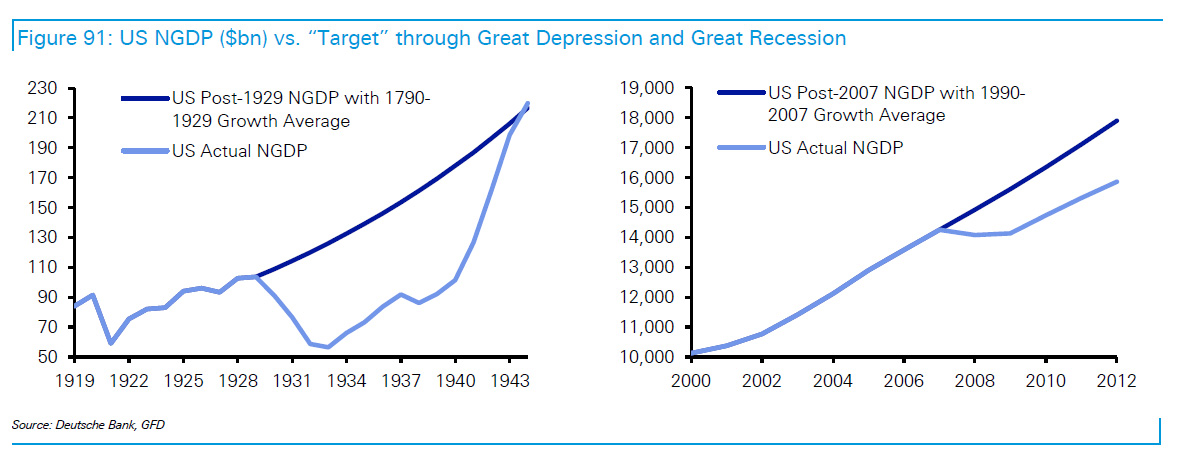
In an uncanny historical analogue of the current economic predicament, we have to go back only 70 years or so back, to the time of the first Great Depression: that was the first and ostensibly last time, when the US economy was performing in a comparably subpar fashion to trendline.

Click to enlarge

Click to enlarge

So in an extreme (if logically forthcoming) scenario when the Fed’s final proposed fallback strategy of “forward guidance” which is destined to replace QE now that tapering is on the table, were to fail, as many already suggest it will (just look at the BOE), the final solution for the US central bank is one – Nominal GDP Targetting, which stripped of its fancy title is really a euphemism for “print until you drop”, or rather monetize securities and inject money without regard for inflation (paradropping bundles cash may well be allowed as Ben Bernanke would be happy to admit), with the only intention of promoting growth at any cost.

But will “Nominal GDP Targetting” work?

After quite a detailed analysis, including multiple charts, we get to the answer, and the crux of the article:

In other words, targeting GDP for the sake of GDP, concerns about inflation aside, when soaring inflation would also lead to surging interest rates, has become impossible.

So what is the only possible way out left for a country in which monetary policy has failed on all fronts except to inflate asset prices to stratospheric levels, and yet the economy still refuses to budge? For the answer we go to Deutsche Bank one last time:

During the US Great Depression the huge declines in consumer and businesses confidence in the face of mass unemployment can be seen in the extremely and persistently low level of velocity…. As it turned out, the US economy managed to grow at an average of 13.5% a year over the next 10 years and was back on ‘target’ by 1944….  Velocity also moved during the recovery from the Great Depression as the US war machine swung into action in the early 1940s.

In other words, at a time when the US was in almost an identical predicament and GDP catch up would have been impossible by any other means, what happened? World War. Luckily, for the US it generated unprecedented growth and cemented its status as the world’s super power, and the USD as the reserve currency. Others were not so lucky.

Are we the only ones who suggest that the only outcome is a military one? No. Recall from Kyle Bass:

 Trillions of dollars of debts will be restructured and millions of financially prudent savers will lose large percentages of their real purchasing power at exactly the wrong time in their lives. Again, the world will not end, but the social fabric of the profligate nations will be stretched and in some cases torn. Sadly, looking back through economic history, all too often war is the manifestation of simple economic entropy played to its logical conclusion. We believe that war is an inevitable consequence of the current global economic situation.

“Inevitable”

Which also means preconceived from the start. So despite a recent sense of detente in Syria, pay close attention: never since the cold war has the world been so close to the edge of a full-blown global military conflict. Whether or not the Syria “trigger” has been produced as the catalyst that will spark growth, or is merely a precursor to such an event is still unclear. However with every passing day, the US economy lags ever more behind its “trendline” and the common man gets left ever further behind the superclass of financial asset oligarchs, a state which the president opined recently was unacceptable. The question is whether millions of war casualties for the sake of yet another economic “golden age” aren’t.

The Victims List: Why Bernie Madoff Is The Only Crook Who Went To Gaol

13 Sep

In case you didn’t know, today is not only Friday the 13th, an “unlucky” day in Western superstition.

It is also Yom Kippur. Otherwise known as the “Day of Atonement”.

A day of “love and forgiveness”, and “The day on which G-d forgives for the less desirable actions of His nation”, according to the Jerusalem Post.

Which is both an ironic, and an apropos theme to carefully consider, in the light of today’s post.

Ever wonder why Bernie Madoff so famously and publicly went to gaol for his ponzi crimes, when no other banker or “investment adviser” did?

Take a slow, careful, thoughtful look at the list of his victims below.

See anything in those names that strikes you?

From the Wall Street Journal, March 6 2009:

Description
Fairfield Greenwich Advisors
An investment management firm
$7,500,000,000
Tremont Group Holdings
Asset management firm
$3,300,000,000
Banco Santander
Spanish bank
$2,870,000,000
Bank Medici
Austrian bank
$2,100,000,000
Ascot Partners
A hedge fund founded by billionaire investor, philanthropist and GMAC chief J. Ezra Merkin
$1,800,000,000
Access International Advisors
A New York-based investment firm
$1,500,000,000
Fortis
Dutch bank
$1,350,000,000
Union Bancaire Privee
Swiss bank
$700,000,000
HSBC
British bank
$1,000,000,000
Natixis SA
A French investment bank
$554,400,000
Carl Shapiro
The founder and former chairman of apparel company Kay Windsor Inc., and his wife
$500,000,000
Royal Bank of Scotland Group PLC
British bank
$492,760,000
BNP Paribas
French bank
$431,170,000
BBVA
Spanish bank
$369,570,000
Man Group PLC
A U.K. hedge fund
$360,000,000
Reichmuth & Co.
A Swiss private bank
$327,000,000
Nomura Holdings
Japanese brokerage firm
$358,900,000
Maxam Capital Management
A fund of funds based in Darien, Connecticut
$280,000,000
EIM SA
A European investment manager with about $11 billion in assets
$230,000,000
AXA SA
French insurance giant
N/A
UniCredit SpA
Italian Bank
$92,390,000
Nordea Bank AB
Swedish Bank
$59,130,000
Hyposwiss
A Swiss private bank owned by St. Galler Kantonalbank
$50,000,000
Banque Benedict Hentsch & Cie. SA
A Swiss-based private bank
$48,800,000
Fairfield, Conn.
town pension fund
$42,000,000
Bramdean Alternatives
An asset manager
$31,200,000
Jewish Community Foundation of Los Angeles
The largest manager of charitable gift assets for Los Angeles Jewish philanthropists
$18,000,000
Harel Insurance Investments & Financial Services Ltd.
Israel-based insurance firm
$14,200,000
Baloise Holding AG
Swiss insurer
$13,000,000
Societe Generale
French Bank
$12,320,000
Groupama SA
French insurer
$12,320,000
Credit Agricole SA
French bank
$12,320,000
Richard Spring
individual investor
$11,000,000
RAB Capital
hedge fund
$10,000,000
Banco Popolare
Italian bank
$9,860,000
Korea Teachers Pension
A 10 trillion won Korean pension fund
$9,100,000
Swiss Life Holding
Swiss insurer
$78,900,000
North Shore-Long Island Jewish Health System
health system
$5,700,000
Neue Privat Bank
Swiss bank
$5,000,000
Clal Insurance Enterprise Holdings
An Israel-based financial services company
$3,100,000
Ira Roth
individual investor
$1,000,000
Mediobanca SpA
via its subsidiary Compagnie Monegasque de Banque.
$671,000
Fred Wilpon
owner of New York Mets
N/A
Steven Spielberg
The Spielberg charity — the Wunderkinder Foundation
N/A
JEHT Foundation
A New York foundation focused on electoral and criminal justice reform
N/A
Mortimer B. Zuckerman Charitable Remainder Trust
The charitable trust of real-estate magnate, who owns the Daily News and U.S. News & World Report
N/A
Robert I. Lappin Charitable Foundation
A Massachusetts-based Jewish charity
N/A
Chais Family Foundation
A charity that gave to Jewish causes
N/A
KBC Group NV
Belgian banking and insurance group
N/A
Barclays PLC
British bank
N/A
Dexia
French bank
N/A
Allianz Global Investors
The asset management unit of German insurer Allianz SE
N/A
Banco Espanol de Credito SA (Banesto)
A Spanish bank contolled by Banco Santander
N/A
CNP Assurances
French insurer
N/A
UBS AG
Swiss bank
N/A
Yeshiva University
A New York-based private university
$14,500,000
The Elie Wiesel Foundation for Humanity
The charitable foundation of Nobel laureate
$15,200,000
Leonard Feinstein
The co-founder of retailer Bed Bath & Beyond
N/A
Sen. Frank Lautenberg
The charitable foundation of the New Jersey Senator’s family
N/A
Norman Braman
former owner of Philadelphia Eagles
N/A
Jeffrey Katzenberg
The chief executive of DreamWorks Animation SKG Inc.
N/A
Gerald Breslauer
The Hollywood financial advisor to Steven Spielberg and Jeffrey Katzenberg
N/A
Kingate Management
hedge fund
N/A
Julian J. Levitt Foundation
Texas-based charity
N/A
Loeb family
N/A
N/A
Lawrence Velvel
individual investor
N/A
Fix Asset Management.
hedge fund
N/A
Genevalor, Benbassat & Cie.
money manager in Geneva
N/A
Banco Espirito Santo
Portugese bank
$21,400,000
Great Eastern Holding
Singapore insurer
$44,266,000
M&B Capital Advisers
Spanish brokerage
$52,800,000
Oddo et Cie
French financial services firm
$36,957,000
Royal Dutch Shell pension fund
Global energy and petrochemical company
N/A
Phoenix Holdings
Israeli financial services company
$12,600,000
Credicorp
Peruvian financial services company
$4,500,000
Fukoku Mutual Life Co.
Japanese insurer
N/A
New York Law School
law school in New York City
$300,000
Nipponkoa Insurance
Japanese insurer
N/A
Sumitomo Life Insurance Co.
Japanese insurer
$22,000,000
Swiss Reinsurance Co.
Swiss insurer
$3,000,000
Aozora Bank Ltd
Japanese lender
$137,000,000
UBI Banca
Italian bank
$86,000,000
Taiyo Life Insurance Co.
Japanese insurer
$221,000
Caisse d’Epargne
French bank
$11,100,000
J. Gurwin Foundation
Charity
N/A
EFG International
Swiss private bank
N/A
Fire and Police Pension Association of Colorado
Pension fund
N/A
International Olympic Committee
Olympic organizer
$4,800,000
Support Organization for the Madison Cultural Arts District
Wisconsin cultural organization
N/A
Credit Industrial et Commercial
French financial-services group
$125,400,000
Hadassah
U.S. women’s zionist organization
$90,000,000
United Association Plumbers & Steamfitters Local 267 in Syracuse
Local union pension and health care funds
N/A
Ramaz School
A Jewish school in New York
$6,000,000
Congregation Kehilath Jeshurun
A synagogue in New York
$3,500,000
The Maimonides School
A Jewish day school in Brookline, Mass.
$3,000,000
Yad Sarah
An Israeli nonprofit
$1,500,000
Kevin Bacon and wife Kyra Sedgwick
Hollywood actors
N/A
Eric Roth
Hollywood screenwriter
N/A
Henry Kaufman
Individual investor, former Salomon Brothers chief economist
N/A
New York University
University
$24,000,000
Aioi Insurance Co.
Japanese insurer
$1,100,000
Meiji Yasuda Life Insurance Co.
Japanese insurer
$1,100,000
Mitsui Sumitomo Insurance Co.
Japanese insurer
$8,800,000
Burt Ross
former mayor of a town in New Jersey
$5,000,000
Genium Advisors
Swiss money manager
$281,400
Sterling Stamos Capital Management LP
Investment firm with offices in New York City and Menlo Park, Calif.
N/A
Gabriel Partners
Money-management firm run by GMAC Chairman Ezra Merkin.
N/A
The Diocese of St. Thomas
Catholic church in the U.S. Virgin Islands
$2,000,000
Phyllis Molchatsky
individual investor
$17,000,000
Members of the Hillcrest Golf Club of St. Paul, Minn. and Oak Ridge Country Club in Hopkins, Minn.
country clubs
N/A
Bard College
University in New York
$3,000,000
Martin Rosenman
New York City-based heating oil distributor
$10,000,000
Marc Rich
Fugitive financier
N/A
Zsa Zsa Gabor
Actress
$10,000,000
Hadleigh Holdings LLC
Miami firm owned by businessman Stanley Kriegler
$1,000,000
Argus Group Holdings
Bermuda insurance and financial services company
N/A
Auriga International Advisors Ltd.
British Virgin Islands hedge fund
$348,400,000
Repex Ventures SA
British Virgin Islands firm
$700,000
SAR Academy
A Yeshiva school in New York
N/A
Picower Foundation
Florida-based philanthropy
N/A
John Malkovich
actor
N/A
Sandy Koufax
Former Los Angeles Dodger pitcher
N/A
Tim Teufel
Former baseball player
N/A
Larry King
Talk-show host
N/A
Phyllis George
Former Miss America
N/A
Mark Green
Former NYC public advocate
N/A
Larry Silverstein
New York developer who is currently working with partners to rebuild the World Trade Center
N/A
Scott Rechler
CEO of RXR Corp.; Former CEO of Reckson Associates
N/A
Sources: WSJ reporting; Associated Press; the companies and charities

Why Do We Jolt The Little Children Out Of Heaven?

12 Sep

Riding my motorcycle on a quick round trip to the local shops yesterday, I witnessed what seems like the very best of our world on the journey out.

And the very worst on the journey back.

I live in a narrow valley, surrounded by mountains. From my home, a view of the panorama of the heavens is pretty much limited to straight up. So it is always difficult to know what the weather conditions are really like until getting out of “my” valley. Many are the occasions when I have discovered myself to be wrongly clothed for the conditions “out there”.

On turning east out of my road yesterday, I was greeted by the sight of a truly spectacular, beautiful, mesmerising (to me) lenticular cloud formation floating over the coast. In all my years, I have never seen quite its like before. If only I’d had a camera. The sight of this cloud formation filled me with a profound sense of awe and wonder. And inner peace.

On the return journey, I noticed two children in school uniform walking on the footpath. A girl, age perhaps 11-13 years, followed by an adorable little boy — presumably her little brother — age about 5 years. As I rode up beside them, I saw the older girl turn abruptly back towards the little boy. Arms rigid by her sides, she leaned forward and down towards the little fellow, in an aggressive, threatening manner, and spat some words at him. Words that I could neither hear nor lip read, thanks to the sound and speed of my motorcycle.

What happened in the next instant sent a sharp dart of pain into the core of my being.

That beautiful little boy cowered.

Like a frightened, oft-abused puppy.

I will share something deeply personal with you, dear reader.

I love children.

And yet … alas … my fate, it seems, is that I will likely not ever have any of my own.

I have many friends with children. I have spent countless hours nursing, playing with, and most valuable of all, observing them as they grow.

It is from observing children — and from many more hours sitting still and silent in nature, simply watching, and listening — that I can wholeheartedly endorse the Truth of these words, attributed to Jesus of the Bible:

And calling to him a child, he put him in the midst of them, and said, “Truly, I say to you, unless you turn (around) and become like children, you will never enter the kingdom of heaven. (Matthew 18:2-3)

Over the millennia, many persons far wiser than I have written many far finer words about the virtues of having a child-like outlook, and disposition, than I could ever hope to conceive.

For the moment, the best I can think to say this.

To frighten a small child out of his living in the heavenly moment of the Present — his natural state of existence — is, I think, in most cases likely a crime against Heaven itself.

The small child lives in a state of time-less-ness — “heaven”, to many — because he lives purely, wholly, and simply in every moment.

There is no past. There is no future. There is only Now.

To jar a little child out of that heavenly state, seems to require an act of violence.

From someone else.

Usually, an “adult”.

As time ticks on, small children continue to be jolted out of Heaven. By the thoughtlessness, and selfishness, of others.

They are introduced — by us — to a new state of experience.

Fear.

Fear causes the little child, for the first time, to begin to dwell — at least at times — outside of the heaven of Now.

And in the hell of “What if?”

I think that if we adults would all take far, far greater care, to guard ALL the little children of the world against those acts of violence that would jolt them out of heaven, and into our world of fear and “what if?”, then in constantly standing watch for them, we would begin to share in their heaven.

We too, would begin to experience — at least at times — their blessed state of Timelessness.

Design a site like this with WordPress.com
Get started