
Australian Banks Demand Protection From Derivatives Losses Under Bail-In Plan

8 Aug

DeathStarFiring2

It has been well-documented by others that the Cyprus-style bank “bail-in” scheme that is presently being prepared right across the G20, is really all about derivatives — those “financial weapons of mass destruction” that were at the heart of the GFC in 2008 (see Derivatives Managed By Mega-Banks Threaten Your Bank Account).

To briefly summarise, a critical aspect of what the bail-in scheme is intended to do, is to prioritise the payment of banks’ derivatives obligations to each other, ahead of depositors. In other words, it is about stealing the public’s bank deposits, to pay out at least some of the big banks’ Death Star-massive — and toxic — derivatives positions.

Yves Smith of Naked Capitalism explains:

In the US, depositors have actually been put in a worse position than Cyprus deposit-holders, at least if they are at the big banks that play in the derivatives casino. The regulators have turned a blind eye as banks use their depositories to fund derivatives exposures. And as bad as that is, the depositors, unlike their Cypriot confreres, aren’t even senior creditors. Remember Lehman? When the investment bank failed, unsecured creditors (and remember, depositors are unsecured creditors) got eight cents on the dollar. One big reason was that derivatives counterparties require collateral for any exposures, meaning they are secured creditors. The 2005 bankruptcy reforms made derivatives counterparties senior to unsecured lenders.

Note carefully that last point about the “collateral” for derivatives exposures, which means that derivatives counterparties are deemed “secured” creditors, making them “senior” to unsecured “lenders”.

In layman’s terms, what all that means is that when banks take out a derivatives bet, the bank on the other side of that bet (the “counterparty”) requires some collateral to be put up. Thanks to deregulation of the financial system over the past couple of decades, banks have — unbeknown to the public — been putting up their customers deposits as collateral for their derivatives bets.

Now, because collateral (or “security”) has been put up for those derivatives bets (or “positions”), this means that those bets are considered “secured”. And in a bank “resolution” (ie, a “bail-in”), the secured creditor has seniority (ie, priority) over “unsecured” creditors (ie, depositors).

Got that?

The big banks are all counterparties to each other on their derivatives bets. They have pledged “collateral” — often, your deposits — as “security” on those derivatives bets. When a bank fails, and is “resolved” under the new, FSB-directed bail-in regime, payouts on those “secured” derivatives bets get priority over paying you back your deposit.

Here at barnabyisright.com, we have recently been looking at the documents going back and forth between the Australian Treasury and the Australian banks. And it is here that we find confirmation of what has been reported by Yves Smith and others.

In the Australian Financial Markets Association (AFMA) 11 January 2013 letter in reply to the Australian Treasury’s September 2012 consultation paper, Strengthening APRA’s Crisis Management Powers,” we see clearly that our banks consider the issue of how derivatives would be handled in a bank bail-in to be “critical”:

Legal certainty around the enforceability of the netting and collateral arrangements in connection with OTC derivatives is critical to the stability of the market.

AFMA, January 2013, page 14

AFMA, January 2013, page 14

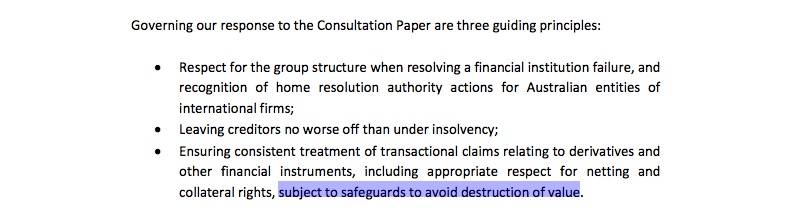
In particular, what the banks are concerned with — so much so, they call it a “guiding principle” in their response to Treasury — is ensuring that the implementation of bail-ins in Australia will “include appropriate respect for…collateral rights”, with safeguards to protect their derivatives positions against “destruction of value”:

Governing our response to the Consultation Paper are three guiding principles:

Ensuring consistent treatment of transactional claims relating to derivatives and other financial instrument, including appropriate respect for netting and collateral rights, subject to safeguards to avoid destruction of value.
AFMA, January 2013, page 2

AFMA, January 2013, page 2

The international bankers (the Financial Stability Board) who are behind the G20-wide bank bail-in scheme, have sought to portray it as being designed to “resolve” failing banks, while at the same time, “protecting” bank depositors.

However, the truth is that the FSB bail-in scheme is really designed to ensure that the mega-banks — “systemically important financial institutions (SIFI)” — will receive priority for payout on their derivatives positions, in any “resolution” of a failing bank.

Because for the bankers, propping themselves and their compadres up is all that matters. What we call “theft”, they call “ensuring financial system stability”.

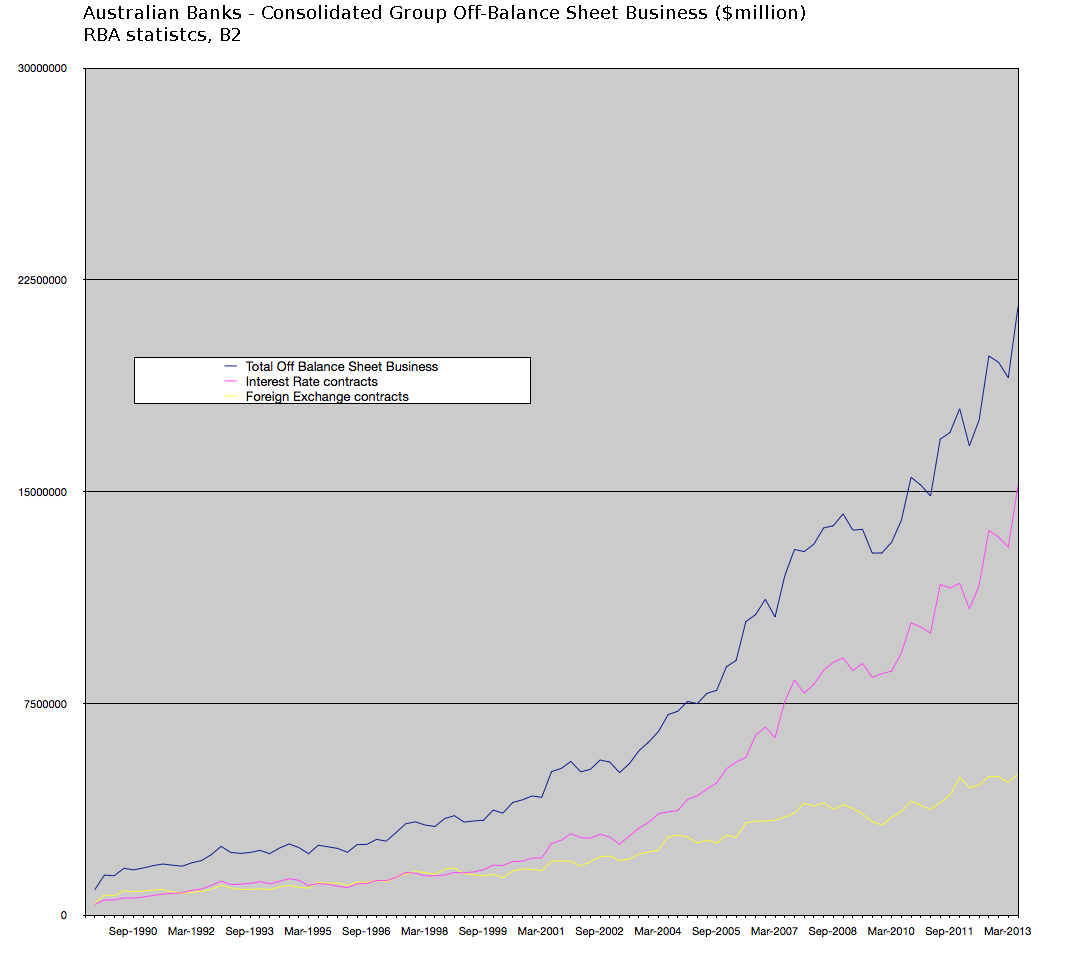
According to the RBA, our banking system holds $21.5 Trillion in “Off-Balance Sheet” derivatives exposures:
Screen shot 2013-07-10 at 6.24.32 PM

Over $15 Trillion of that is the “value” of derivatives betting on interest rates.

In the “bail-in” of an Australian bank, do you really think there would be anything left to pay you back your deposit, after the banks get “seniority” for payout on their “secured” derivative positions?

See also:

Australian Banks “Welcome” Cyprus-Style Bail-In Plan

IMF Tells Australian Lawmakers To “Prevent Premature Disclosure Of Sensitive Information” On Bank Bail-Ins

Australia Plans Cyprus-Style “Bail-In” Of Banks In 2013-14 Budget
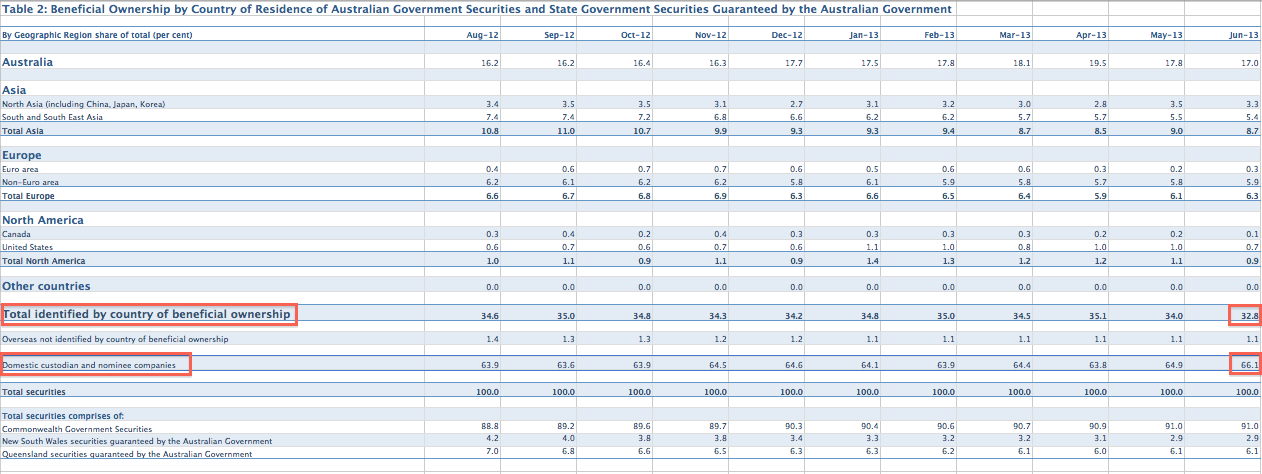
Who Owns 66% Of Australia’s Debt? Anonymous Fronts

7 Aug

From the Australian Office of Financial Management (AOFM) Public Register:

Click to enlarge

Click to enlarge

Australia’s Public Debt Now 61% Worse Than Ireland Before It Crashed

7 Aug

There are many who want you to believe that Australia’s public debt level is “low”, and nothing to be concerned about.

The truth is, there are a lot of lies told about our public debt. Usually, they are lies of omission. A deliberate choice to not give you the truth, the whole truth, and nothing but the truth.

Recently the Australian Financial Review published an article that — unlike politicians’ claims — would hold up in court:

You’ve been grossly misled about Australia’s finances – again.

Getting insight into the true state of the government’s finances is as important as understanding your own. The government’s liabilities are ultimately our debts, and will be paid back by taxing our earnings.

Last time I sunk my teeth into these issues I explained how the ostensibly very low “net debt” figures bandied around by many, including the PBO [Parliamentary Budget Office] are a complete fiction: they assume the debts of wholly owned government companies and state governments simply do not exist.

The net debt numbers are also artificially reduced by taking cash from the Future Fund, which was set up to meet unfunded superannuation liabilities, which are not – surprise, surprise – included in the debt estimates.

It’s the same as ignoring money you owe to someone but recognising the cash you have saved to repay them.

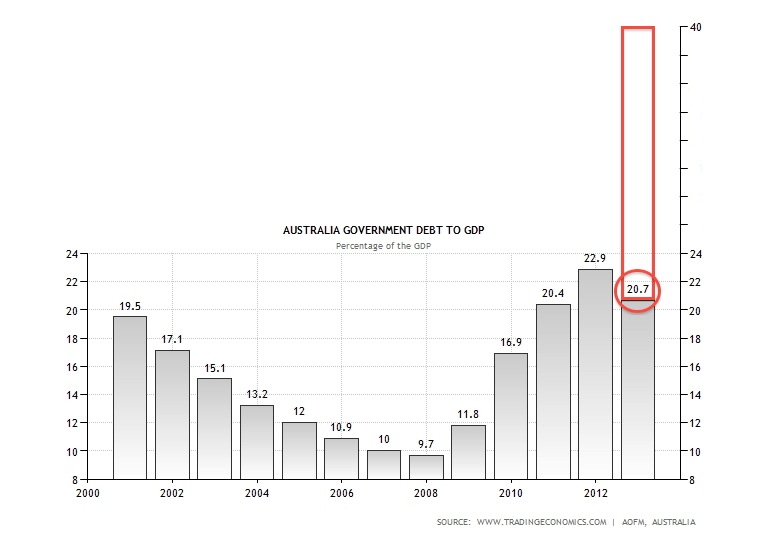
Once you add back in state and wholly owned government entity liabilities, Australia’s net debt almost doubles from 10.6 per cent to over 20 per cent of gross domestic product. Since net debt is open to so much fudging, real analysts focus on true debt. Since 2007 federal and state government debt has exploded from $150 billion to $500 billion, with the actual debt-to-GDP ratio approaching… 40 per cent

This is precisely what Barnaby Joyce has been saying, since late 2009.

In recent days here at Barnaby Is Right, we have seen how our Treasury department boffins have completely failed to recognise the true reason for Australia’s structural budget deficit.

It is exactly the same reason that Ireland crashed in 2008.

A banking system — and a government — that had become dependent on profits (and taxes) flowing from “an unsustainable boom in the housing sector”:

ScreenHunter_08-Jul.-23-08.09

So our supposedly “low” and ever-rising public debt level does matter.

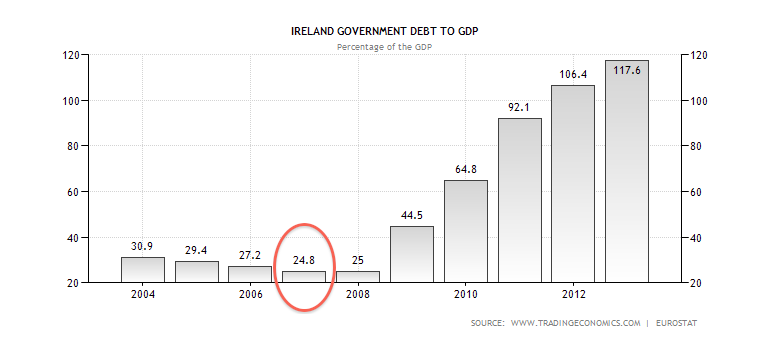
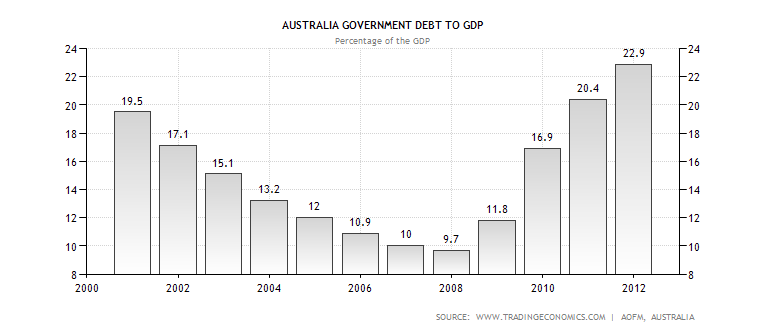
Because at 40% of GDP (Federal and state debt combined), our true public debt level is now 61% worse than Ireland before it crashed … and bailed out its banks:

Screen shot 2013-08-05 at 7.37.30 PM

PublicDebt_total

You may notice that the chart for Australia shows an apparent small decline in (Federal) government debt in 2013, to 20.7% of GDP (circled in red).

That is the Federal government’s forecast.

We all know what their forecasts are worth.

See also:

Australia Plans Cyprus-Style Bail-In Of Banks In 2013-14 Budget
Australian Banks “Welcome” Cyprus-Style Bail-In Plan

IMF Tells Australian Lawmakers To “Prevent Premature Disclosure Of Sensitive Information” On Bank Bail-Ins

UPDATE:

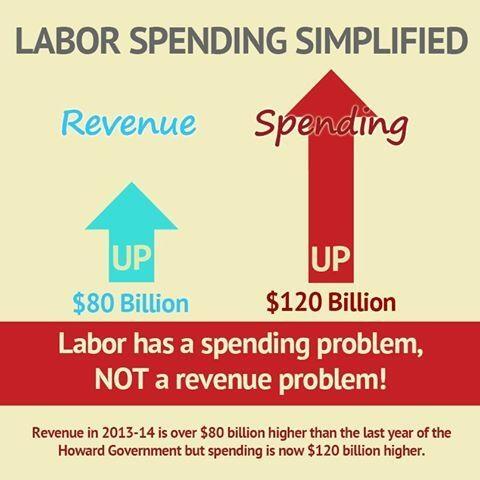
Labor spending simplified –

BQ-q4DeCAAALEGc

À la folie … pas du tout (He Loves Me, He Loves Me Not)

6 Aug

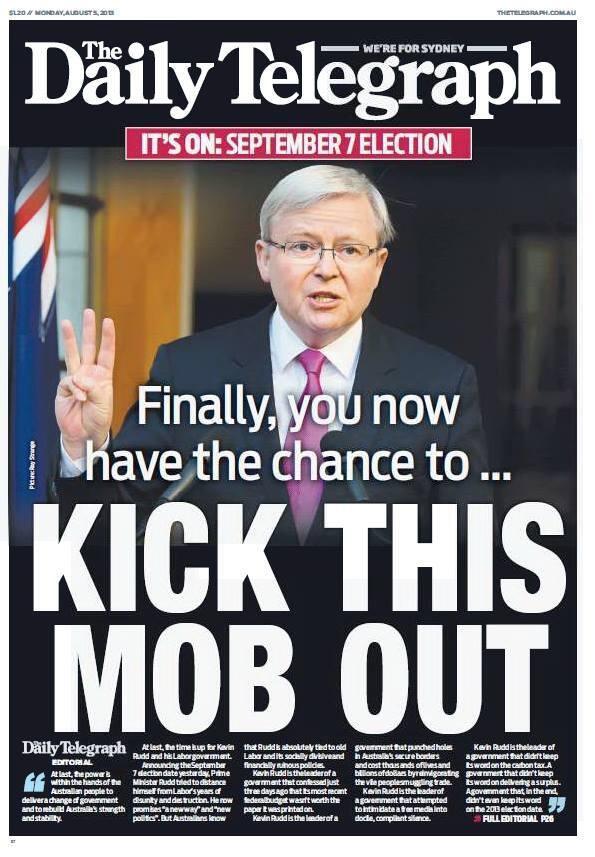
Poor widdle Kevvy.

That awful Rupert Murdoch, whose media empire backed him for PM in 2007 …

Crikey, November 2007:

The biggest surprise is the strong support for Labor in the Murdoch press — a marked difference from 2004. The Australian, Daily Telegraph, Courier-Mail and The Mercury are all throwing their support behind Kevin Rudd.

… is not backing him to remain PM in 2013 –

BQ0xPLiCMAEshrV

À la folie … pas du tout.

He loves me. He loves me not.

Grow up. Take it like a man Kev.

Shameless, Disgraceful, Bombastic Liar

6 Aug

aap_2596_121024_DavidBradbury_800x600

This is what Australian politics has been reduced to.

Shameless, disgraceful, bombastic lies.

From shameless, disgraceful, bombastic liars.

Assistant Treasurer David Bradbury was interviewed on DMG Radio today, by journalist Glenn Daniel.

Daniel challenged Bradbury on his shameless, disgraceful, bombastic lies regarding Joe Hockey’s observation on what lowering of interest rates really means for the current state of the economy.

An observation that even Fairfax newspapers’ “PolitiFact” FactChecker says is correct:

Mr Hockey is right. The Reserve Bank is cutting rates “not because the economy is doing well, it’s because the economy is deteriorating”. That’s always why it cuts rates.

Listen to the interview here — and try to keep all hurlable objects out of arms’ reach as you do so.

This is the ASSISTANT TREASURER of the nation you are listening to.

Business Leaders Urge Action On Problem They Do Not Want Solved, And Treasury Does Not Understand

6 Aug

see_no_evil_hear_no_evil_speak_no_evil___three_monkeys_photo-1280x1024

There must have been something in the air last night.

While I was writing today’s blog on Treasury’s epic fail in its analysis of Australia’s structural budget deficit, it seems that our business elite were bending the ears of the nation’s journalists on the same topic:

Call to tackle deficit as business blasts budget

AUSTRALIA’S failure to prepare for the end of the mining boom is damaging the nation, business leaders warned as they expressed “zero” confidence the election campaign would deal with the structural budget deficit.

…business leaders also questioned Labor’s reliance on Australia’s AAA credit rating to bolster its economic credentials.

Former Future Fund chairman and Commonwealth Bank chief executive David Murray said some states that later suffered credit ratings downgrades or had been told a downgrade was possible had “done this for years – tell everyone it’s OK”…

Commonwealth Bank director and former AMP chief executive Andrew Mohl attacked politicians because they “don’t want to do anything structural” and warned that “current tinkering is doing nothing but creating uncertainty”.

“The chance of the structural deficit being addressed in this election campaign is zero,” he said. “I have no doubt the budget policy over the past five years, given the resources boom, has been too loose. There has been wasteful expenditure, policy formulation has been dysfunctional. If we face a fiscal shock, the economy is more vulnerable than it was. We have spent our ammunition and we don’t have much to show for it.”

The comments come after the government on Friday revealed a $33.3 billion revenue writedown in barely 10 weeks – a situation that Brambles and BlueScope chairman Graham Kraehe described yesterday as “incredible”.

“My fundamental view is that economic policy at the moment is absolutely ad hoc from day to day without any long-term cohesive, integrated plan,” said Mr Kraehe, who is also a former Reserve Bank board member.

“We have a history of increasing government spending throughout the resources boom and now that the resources boom is tapering off, there is no suggestion that we are planning to reduce government spending, instead of which we are just increasing taxes.

“To have a credible economic strategy, government of either persuasion needs to tackle government spending in a serious and co-ordinated way. That’s spending in the commonwealth budget and the overlaps in commonwealth and state. Unless we do that, with an ageing population we are going to continue to build on deficits.”

Last night, Mr Hockey said that on Mr Rudd’s logic, the European and American economies “with virtually zero per cent interest rates would be doing well, but they are not”.

Some business figures also said interest rates had been cut as the economy softened.

Aussie Home Loans founder John Symond said: “You’ve got to remember that the reason for the RBA dropping is because the economy isn’t performing as well as we would like.

“That’s on the back of some poor government decision-making – some has been fine, some has been awful.”

We really are screwed, when the loudest voices in calling for action on budget mismanagement are our business elites.

Especially when they — like Treasury — fail to correctly identify the cause/s of the structural budget deficit.

But then, this is to be expected.

Every .. single .. one .. of those “business leaders” quoted in the above article — yes, including Graham Kraehe — either are now, or were formerly, senior executives in the finance industry.

Merchants of Debt.

They are hardly likely to tell us the truth.

That the reason for Australia’s structural budget deficit, is not the mismanagement of the mining boom.

The prime cause of our structural budget deficit is exactly the same as Ireland’s:

While part of the revision to the IMF’s pre-crisis estimates of the structural budget balance is due to a lower estimate of potential GDP, the main reason for the change is that these estimates failed to capture the dependence of the fiscal position on an unsustainable boom in the housing sector (Kanda 2010). With residential investment and house prices soaring, property-based taxes grew at a pace well above GDP growth. Failure to recognise at the time that the bulk of these revenues were cyclical led to significant tax cuts and expenditure increases, which created a large structural hole in Ireland’s public finances.

At Business Spectator, leading business commentator and ABC presenter Alan Kohler also has a go at the structural deficit problem today. And he too, fails to identify the real cause:

What neither party will admit: budget heading for large structural deficit

What does all this mean for Australia, as it starts the first post-boom election campaign?

It means any promises based on confidence about knowing the future are meaningless.

The economic statement issued on Friday was both recognition of how rapidly the world is changing and a stab in the dark about government revenue between now and 2016-17. In truth no one has any idea, and least of all Treasury.

What we do know is that there is a structural budget problem related primarily to the ageing population and the growing cost of health care.

Sorry Alan.

Epic fail.

That’s a problem. Sure.

But it’s a coming problem.

The structural deficit is here, and now. It was caused in the past.

Interestingly, Mr Kohler flatly contradicts the Treasury in their working paper Estimating The Structural Budget Balance Of The Australian Government.

Their brilliant economic modellers are convinced that:

The key point to draw from the analysis is not the specific year in which the budget returns to structural surplus, but the steady improvement over time…

The estimates over the forward estimates and the projection periods suggest a steady improvement in the structural balance over time, reflecting over the forward estimates, the Government’s structural savings measures and, over the medium term, its commitments to limit real spending growth and allow tax receipts to recover naturally.

Treasury Ignores Housing Sector In Structural Budget Comparison With Ireland

6 Aug

4310128050_aedf7596f9

The Australian Treasury’s recent update to its working paper Estimating The Structural Budget Balance Of The Australian Government, makes for interesting reading.

Interesting, in that it provides all the reason needed to put a broom through the entire department.

Why so?

Treasury points to an analysis which shows that the IMF has repeatedly over-estimated Ireland’s true structural budget position, and calls it a “cautionary tale” for Australia:

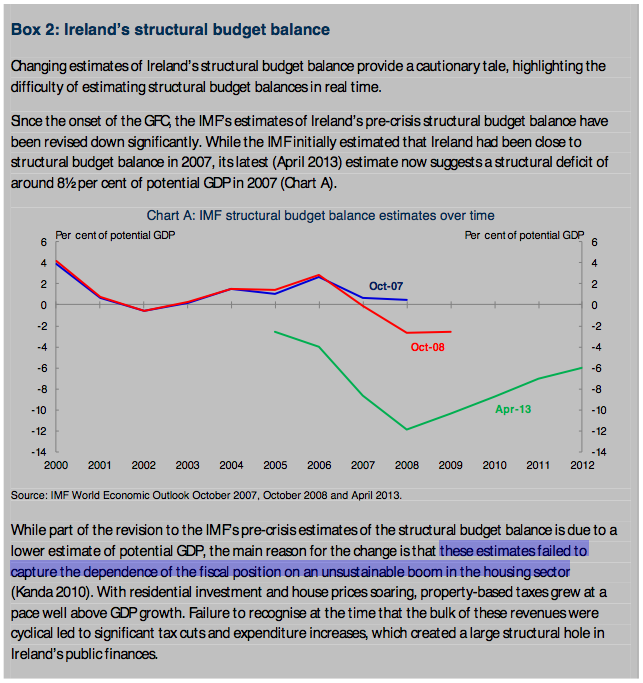
Box 2: Ireland’s structural budget balance

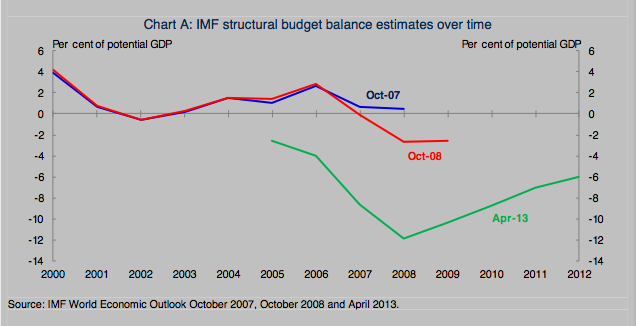
Changing estimates of Ireland’s structural budget balance provide a cautionary tale, highlighting the difficulty of estimating structural budget balances in real time.

Since the onset of the GFC, the IMF’s estimates of Ireland’s pre-crisis structural budget balance have been revised down significantly. While the IMF initially estimated that Ireland had been close to structural budget balance in 2007, its latest (April 2013) estimate now suggests a structural deficit of around 8½ per cent of potential GDP in 2007 (Chart A).

Australian Treasury, "Estimate The Structural Budget Balance", May 2013, page 10

Australian Treasury, “Estimating The Structural Budget Balance Of The Australian Government”, May 2013, page 10

The authors then promptly ignore the striking similarities between Australia’s structural position now, and Ireland’s pre-GFC:

While part of the revision to the IMF’s pre-crisis estimates of the structural budget balance is due to a lower estimate of potential GDP, the main reason for the change is that these estimates failed to capture the dependence of the fiscal position on an unsustainable boom in the housing sector (Kanda 2010). With residential investment and house prices soaring, property-based taxes grew at a pace well above GDP growth. Failure to recognise at the time that the bulk of these revenues were cyclical led to significant tax cuts and expenditure increases, which created a large structural hole in Ireland’s public finances.

Alas, the ivory-towered Treasury wonks fail to see that this is not just Ireland … this is Australia they are talking about.

They are too busy obsessing over the process of estimating the structural budget balance, to notice the stark similarity in what has actually happened out here in the real economy.

Indeed, it is clear from the paragraph preceding all of this, that the only lesson they have learned from the “international experience”, is not to over-rely on “point estimates” in making their calculations:

The key point to draw from the analysis is not the specific year in which the [Australian] budget returns to structural surplus, but the steady improvement over time. Indeed, international experience has illustrated the difficulties in disentangling temporary and permanent economic influences on the budget, which cautions against overreliance on point estimates of the structural budget balance (see Box 2).

Australian Treasury, Estimating The Structural Budget Balance, May 2013, page 9

Australian Treasury, “Estimating The Structural Budget Balance Of The Australian Government”, May 2013, page 9

Australian Treasury, "Estimating The Structural Budget Balance For Australia", May 2013, page 10

Australian Treasury, “Estimating The Structural Budget Balance For Australia”, May 2013, Box 2, page 10

Er … no.

The “international experience” does not caution against “overreliance on point estimates”.

It cautions against allowing “an unsustainable boom in the housing sector … with residential investment and house prices soaring”.

It cautions against government fiscal policy that relies on “property-based taxes” growing “at a pace well above GDP growth”.

It cautions against “failing to recognise at the time that the bulk of these revenues were cyclical”.

It cautions against “significant tax cuts and expenditure increases” creating “a large structural hole in Australia’s public finances”.

It also cautions against something else.

Allowing technical wonks, with no real world business experience, no commonsense, and no wisdom, to be employed in what is arguably the most important department in the Australian Government.

Is it any surprise that Treasury cannot get any of its budget estimates and projections within a bulls roar of reality?

Their over-educated eggheads cannot see the forest for the trees.

Here is another striking similarity with Ireland, that Treasury doubtless has not noticed either.

When you add the public debt of Australia’s state governments to the federal government debt, Australia’s total public debt position is now worse than Ireland pre-GFC:

Screen shot 2013-08-05 at 7.39.04 PM

Screen shot 2013-08-05 at 7.37.30 PM

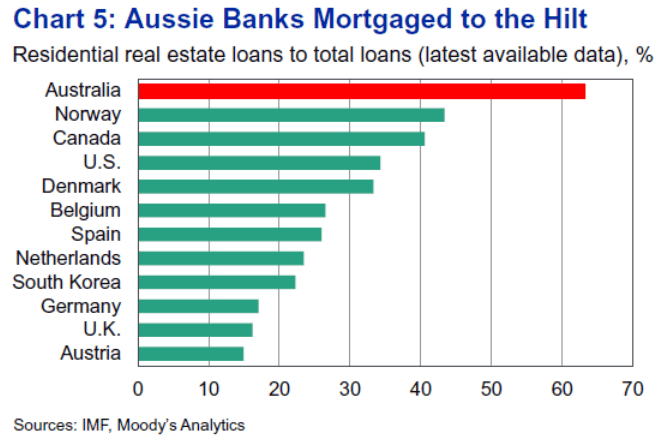
And with Australia’s banking system being the most exposed to residential mortgages in the world…

ScreenHunter_08-Jul.-23-08.09

… now you know why Moody’s has warned of an Australian banking system collapse:

The continued strong expansion in real estate loans—at least relative to other lending segments—has raised some eyebrows. The Australian banking sector has the highest exposure to residential mortgages in the world… The high degree of exposure to the domestic mortgage market raises many concerns. Recent experience has shown that house prices can fall significantly and trigger serious banking meltdowns. But what are the chances of a similar housing collapse in Australia? Many international analysts think the chances of an antipodean housing bust are quite high—it would take a bold economist who has been in a decade-long coma to declare that an Australian housing correction was impossible. When trends in Australian house prices are compared globally, the signs look worrying. House prices have increased for longer and faster than in many of the markets where prices cratered during the Great Recession.

With even our panglossian Labor government now predicting rising unemployment, does all this sound rather like Ireland to you?

Can you see the forest … or only the trees?

See also:

Australia Plans Cyprus-Style Bail-In Of Banks In 2013-14 Budget

Australian Banks “Welcome” Cyprus-Style Bail-In Plan

IMF Tells Australian Lawmakers To “Prevent Premature Disclosure Of Sensitive Information” On Bank Bail-Ins

Leading Social Democrat Answers Rudd’s Question On AAA Rating

5 Aug

titanic-7

Kevin Rudd has made much of his being — according to him — a Social Democrat.

He has also made much of Australia’s AAA credit rating.

Interestingly, another leading light of the so-called “Left”, who also sees himself as a Social Democrat, has a rather different view about Australia’s AAA rating.

Indeed, Professor John Quiggin — someone with whom I agree on many topics — says that he agrees with Shadow Finance minister Andrew Robb’s recent observation; one that was much ridiculed by Labor, and its many Cyclopsian supporters:

Which politician, holding a senior frontbench economic position, made the following sensible observation

“I remind you that Lehman Brothers, the collapse of Lehman Brothers, which started this global financial crisis, on that very day, they still had a AAA credit rating. What does a AAA credit rating really amount to? What I’m saying is you can’t place enormous store in the rating agencies. They do get things very badly wrong, and they totally missed those major firms and economies that were driving and the reason for the GFC.”

The answer to Kevin Rudd’s arrogant challenge on why Australia still has a AAA credit rating “from all 3 ratings agencies” is, ironically, the very same argument that Labor has been using to proclaim how great a job they’ve done managing the economy.

Relativism.

Relative to the other basket-case economies in the Western world, Australia’s ability to service the $16 billion a year interest payments on its public debt, is still considered “AAA”.

For now.

As always, the truly important point is what the politician does not tell you.

That the ratings agencies have issued several stark warnings about our AAA rating.

If the Federal government cannot demonstrate a credible “path to surplus”, then our AAA rating is in jeopardy.

One look at Labor’s revised Economic Statement released on Friday, is sufficient to tell anyone with half a clue that Labor does not have a credible path to surplus.

Far from it, in fact.

The “major economic parameters” for the newly revised “projections” in that $33 billion black hole Economic Statement, have holes you could drive a truck through.

That is, if you could afford the fuel, after Rudd includes transport fuels for heavy on road vehicles in his CO2 trading scheme from 1 July next year.

And Labor’s sole idea for how to “manage the economic transition” from a collapsing mining boom — one they predicted would give us a period of “unprecedented prosperity” “stretching to 2050” — is to copy Cyprus and Iceland.

By turning Australia into a “financial services centre to the region”.

Brilliant. We know how well that grand plan panned out for the Icelanders and the Cypriots.

As your humble blogger observed on Twitter last evening:

Australia’s AAA rating simply means this:

We are 1st class passengers on the Titanic.

#gfc #lasttodrown

Is Bowen’s Budget Update Predicting A Mass Extinction?

4 Aug

undated_engraving_of_dodo11508941

Here is a classic example of why this government’s constantly revised economic predictions are not worth the paper they are printed on.

And why — as quoth MacroBusiness reader “Mav” — we could replace the Treasury department with a monkey and a dartboard, and get the same standard of accuracy with economic forecasts.

According to Bowen / Treasury in their “$33 billion black hole” Economic Statement released on Friday, this year the headline unemployment rate will rise to 6.25%. With an annual growth rate in employment of 1%. It will remain at 6.25% in 2014-15, with employment growth of 1.5%.

In 2015-16, however, something magical is predicted to happen.

Despite employment growth remaining steady at 1.5%, the unemployment rate will, somehow, plummet to 5%:

August Economic Statement, Overview, page 1

August Economic Statement, Overview, page 1

Er … say what now?

I am not the only one questioning this “major economic parameter”, on which all the budget predictions are based — including tax revenues, the public debt level, interest expenses, and an alleged return of that mythical creature in the ALP museum, a surplus in 2016-17.

National Australia Bank were quickly out with an economic statement of their own on Friday, where they too remarked on this amazing budget prediction:

The estimates beyond 2014/15 appear unrealistic, with employment growth too weak to reduce the unemployment rate to 5%. While 1½% employment growth in 2014/15 is expected to maintain the unemployment rate at 6¼%, the same employment growth in 2015/16 reduces the unemployment rate to 5%.”

The only way that is possible, is if they are expecting an awful lot of people to leave the work force, and yet, not be counted as “unemployed”.

A mass extinction event?

Or a mass retirement of baby boomers, perhaps.

If so, then all those folks looking forward to retiring in 2015-16 will be very pleased to know that, under the government’s Crisis Management strategy, APRA is being given “robust” new statutory powers — “direction powers”, they say — which enable the government to order your super fund where and how it should “direct” your super.

For your benefit, of course (see Crisis Management: APRA To Be Given Power To “Direct” Your Super).

Somehow though, I don’t think a mass retirement of baby boomers is a plausible, or sufficient explanation for that amazing budget update prediction.

A more plausible explanation is one that I came across recently … alas, I cannot recall where.

And that explanation was, that in the years beyond the “Estimates” period — those years labelled “Projections” in government budget figures — the Treasury modellers simply assume a “return to trend” for major economic variables.

How does that return to “trend” happen?

Who knows.

It is an assumption.

Just like so much of the pseudo-science we call “economics”.

Oh yes, by the way.

In 2015-16, when unemployment will magically plummet from 6.25% to 5%, the government is predicting a deficit of $4.7 billion. And then, a surplus of $4 billion the following year:

August Economic Statement, Overview, page 1

August Economic Statement, Overview, page 1

It’s magic Johnny … magic!

ALP “Reform” Encourages New Industry Of Financial Predators

4 Aug

Stories continue to emerge of Australians discovering that their “inactive” bank accounts have been emptied by our cash-strapped government.

In yet another unintended consequence of ALP policy, it appears this “reform” may have encouraged the start of a new industry — financial predators, who seek out those affected, and try to con them out of thousands of dollars for help in getting their “lost” money back.

More on that below.

First though, the latest headline example of how this government “reform” has taken the life savings of one Sydney man.

A common man who clearly did know how to balance a budget, and achieve a surplus.

Maybe “Leonard” should have been our PM.

From the Sunday Telegraph’s consumer affairs reporter, John Rolfe:

Leonard worked hard and saved diligently. Source: News Limited

Leonard worked hard and saved diligently. Source: News Limited

Family’s anger as Leonard’s secret fortune claimed by government

THROUGH a lifetime of self-sacrifice, this humble carpenter amassed a secret seven-figure stash meant to benefit his children and theirs after he died.

Instead, the Federal Government has claimed the money through changes to lost-account rules.

At the time of his death last year, 88-year-old Leonard – his family asked that he be referred to by his first name only – had covertly accumulated an extraordinary $2.42 million. The hard way. There was no Lotto win. There was no inheritance.

Just scrimping – he serviced his 1992 Ford Laser himself until his passing. And saving – every spare cent of his Sydney Water Board wage was invested with care.

Leonard’s exceptional wealth – and parsimony – have come to light as part of News Corp Australia’s efforts to create awareness about Australia’s rapidly growing pile of unclaimed money.

More than $1.2 billion is currently declared “lost”, including $816 million from bank accounts.

The largest of the 277,000 lost bank accounts now in the hands of the Australian Securities and Investments Commission is Leonard’s. His family and its lawyer says ASIC shouldn’t be anywhere near the money.

About $450 million worth of bank accounts – including Leonard’s – only became “lost” in May, after the government changed the rules. Previously, an account had to be inactive for seven years. Now it’s three. The change netted Treasury additional revenue of $109 million.

“It’s ridiculous,” lawyer Ashley Smith said. “There would be hundreds of thousands of people who would have accounts that just sit there.”

A spokesman for Bernie Ripoll, Parliamentary Secretary to the Treasurer, said the government’s “reforms will help reunite Australians with their lost money sooner, and protect them from being eroded by fees, charges and inflation”.

“It is far easier for people to track down lost bank accounts once they are transferred to ASIC and added to the online database at the moneysmart.gov.au website,” Mr Ripoll’s spokesman said.

Leonard’s family sees it differently. If the seven-year rule was still in place the account would not have become lost in the first place.

Indeed.

Back in May this year, in comments to a blog on this issue (“‘I Call It Stealing’ – Pensioner Shock At Bank Savings Grab“), reader “Charlie” informed us of how the government’s cash grab has impacted him:

I have just discovered that an account I am trustee for has been emptied of over $120,000 by the federal labour government, in january this year…the statements only come twice a year and I mislaid the february one so did not see that the money had been stolen until yesterday! The trust I look after is a charity which looks after a church. How low and how wrong can the federal government get? Basically, federal labour plus Katter, Windsor, Bandt and Oakeshot voted it through late one night. Good on Wilkie for voting against it.
I will get it back- but when can it ever be OK to simply take money out of an account without signature and verbal permission?
I`m gobsmacked….they are a disgrace. A pox on the lot of them.

But there is another dimension to Charlie’s experience that’s worth noting:

no-one contacted me before taking over $120,000 out of a charity cash management account that I look after…No phone call, no signature. It simply disappeared over 6 months ago and i was not informed until a leach who wanted $7000 to get it back for me sent me a letter.

Unfortunately, “Charlie” did not respond to this blog’s request for further details.

If any other readers are aware of similar circumstances — in particular, of persons receiving unsolicited offers to help (for a fee) recover savings “lost” to the government’s cash grab — please let us know in Comments below.

Design a site like this with WordPress.com
Get started