Tag Archives: barnaby joyce

“Our Debt Has A Life Of Its Own And Is Out Of Control”

7 Dec

Barnaby writes for The Drum, on Their ABC (h/t @margotdate):

What to do with all this water

Why is it that every time the Labor party involve themselves with anything that relates to competency it turns into an unmitigated disaster?

Why is it that every time you look to the details behind their doorstop interview they are just never there? There is a pattern of behaviour that is quite evident in this Green-Labor Party administration. When they announced the NBN, the largest infrastructure program in the nation’s history – larger than the Snowy Mountain Scheme – there was no cost benefit analysis, and of course we are now suffering the affliction of a monster that is starting to commercially wander around the yard in a very similar fashion to a big white elephant.

Our desire to cool the planet via a carbon tax works on the rather peculiar premise that there will be a global climate change agreement by 2015. There is not even a sign of that, but we handed away one of our greatest strategic advantages, cheap power. Australia’s plan is nothing more than a mad gesture which no-one else is following and no-one cares about. On top of this, the only climatic effect it will have is inside buildings rather than outside, as people find they can’t afford to keep themselves warm in winter and cool in summer.

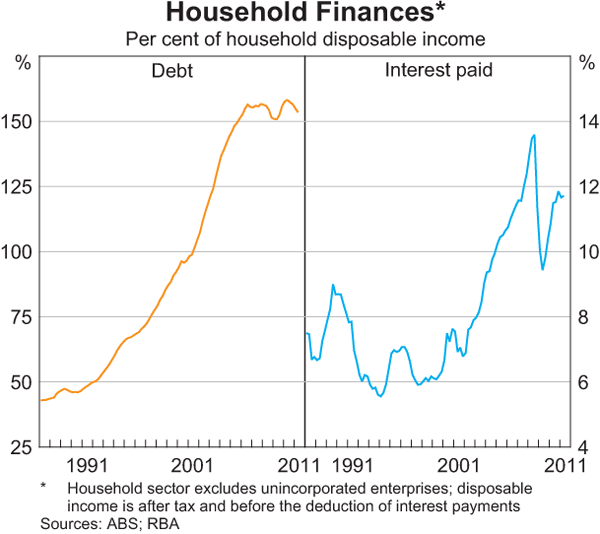
Our debt, which as I stated years ago would get a life of its own and go out of control, now has a life of its own and is increasingly out of control. We are heading towards our third debt ceiling. We have increased the ceiling from $75 billion to $200 billion to $250 billion and it is not stopping.   Lately we have been borrowing $2 billion a week and our Gross Debt is now $221 billion. If we don’t depressingly extend the nation’s credit limit again, then soon the presentation of our nation’s credit card at the checkout will result in the attendant telling us that “transaction declined, see bank for details.”

Now this pathological ineptness in management has arrived in water policy. Your government is now the biggest irrigator in the country through the Environmental Water Holder, Ian Robinson, but instead of watering spuds and onions, they water 2,400 venues for frogs and swamps.

In the very last sentence of the Commonwealth Environmental Water Holder’s 2010-11 annual report, Mr Robinson states that “the Commonwealth environmental water is required to be managed in accordance with the Environmental Water Plan, which will be set out in the Basin Plan.”

Mr Robinson only wrote this in July this year but it is already out of date. The draft Basin Plan released last month does not include an environmental watering plan.  Instead, that task will now be flicked to state governments, who won’t need to come up with one for another three years.

A farmer will tell you exactly how they get their water, exactly how much water is stored in dams, how much water is lost when it is moved to a field to water a crop and how much water it takes to water a crop through the season.  They will also be able to tell you how much is left to start next year’s crop.

Every farmer has their watering plan. If a farmer didn’t have a watering plan, they wouldn’t be much of a farmer.  The Commonwealth Environmental Water Holder currently has 1,075 GL – 1,075 billion litres – of water. Quite a bit; in fact more than what would fill Sydney Harbour twice and they are buying much more. This is to water 2,442 environmental assets, 2,442 environmental crops so to speak.

But when the very valid question is asked, “where is your watering plan?” the predictable answer comes back – they don’t have one. It’s obviously in the draw with the cost benefit analysis of the NBN, the global modelling of the carbon tax, the plan to control our debt, and a myriad of other incredible statements that come without a clue of how to deliver them.

Australia is merrily spending billions of dollars buying an asset but there is really no plan of where exactly it will come from, how it is to be used or where it will be stored. There is a rough idea, but that’s as good as it gets. When there is no plan, the environmental water is dropped arbitrarily in the river from public dams to flood out farms and close public bridges like it did on the Murrumbidgee earlier in the year, at a time when there was not a cloud in the sky. The environmental benefit of these actions is at best vague most likely unknown.

If I was back with my accountancy hat on, I would make sure I got my money off this Green-Labor client prior to starting their work; from what I have seen they are not going to be with us as a business for long.
GDP Growth Hangs On China Thread

7 Dec

September quarter GDP data is out from the ABS.

Prepare yourself for much trumpeting from all the usual suspects (Government, lamestream media, Labor supporters) about the headline figure – “strong” growth of 1% (“seasonally adjusted” ie, fiddled) in the September quarter, thus lifting “annual growth” to 2.5%.

Prepare yourself to not hear any trumpeting of the fact that is still 30% below the Treasury’s very recently revised 3.25% “estimate” for 2011-12 … and now half the year is over.

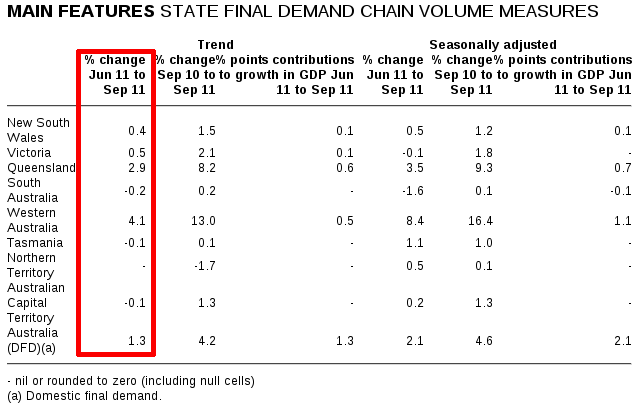
Or, any trumpeting of the important detail. State Final Demand:

Click to enlarge

All the “growth” in July-September came from the mining states of WA (4.1%) and QLD (2.9%).

The rest of the country is either in (SA, TAS, ACT), or near (NSW, VIC) recession.

Make no mistake dear reader.

Australia’s economy … and Wayne’s “surplus” … is hanging on China.

Everything else is noise.

Grand Theft Super – A Very Subtle Form Of Theft

7 Dec

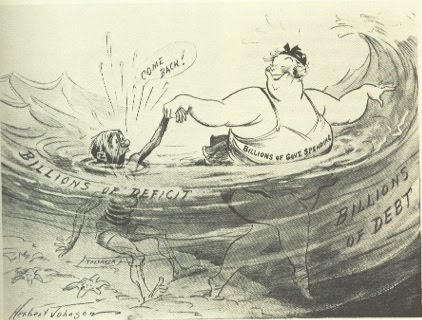
1930's Depression-era cartoon

The Sovereign Man, Simon Black, explains how our very system of modern government public sector financing is … just like private sector financing … nothing more than a Ponzi scheme.

Don’t miss his comment at the end, about how the UK government is effectively stealing citizens’ super. It’s just one of the several ways that our own government has already set in train the policies to do the same (emphasis added):

Say what you want about him, but Bernie Madoff was a guy who knew how to keep the party going. For years, he ran one of the largest private-sector Ponzi schemes in history and always heeded the golden rule of financial scams: make sure your inflows are greater than your outflows.

He was finally done in when redemptions exceeded new investments. He didn’t have enough cash to pay out investors, and he wasn’t able to scam more people into paying in to the scheme. As a result, Madoff finally had to admit that the whole thing was a total fraud.

Governments around the world are in similar situations right now with their own public sector Ponzi schemes. Faced with failed auctions, declining demand, and rising yields, politicians are having to resort to desperate measures.

Like any good scam artist, they’re appealing to the masses first; all over Europe, governments are sponsoring new marketing campaigns suggesting that it’s people’s patriotic duty to buy government debt.

In Spain, they’re actually issuing instruments called ‘Bonos Patrioticos,’ or ‘patriotic bonds.’ Ad campaigns say that the bonds are “good for you, good for the future.”

In Ireland, they’ve issued “Prize Bonds” which carry a 0% interest rate; instead of receiving interest, bondholders are entered into a weekly lottery contest.  Naturally, lottery winnings are only possible as long as people keep buying the bonds… pretty much the definition of a Ponzi scheme!

In Italy, they’re rolling out the country’s sports celebrities to encourage everyone to buy Italian sovereign debt.

What’s ironic is that Italy’s dismal balance sheet is almost universally acknowledged. It’s as if everyone knows the country has almost no chance of making good on its obligations, but they still feel the need to willingly throw away their hard earned savings for the greater good of political incompetence.

Thing is, it’s not the millionaire sports stars, wealthy business leaders, or political elite who are buying these bonds… at least, not in anything beyond a token, symbolic amount. It’s the average guy on the street who really stands to get hurt when the government finally capitulates.

This is a truly despicable act and amounts to theft, plain and simple.

The United Kingdom, which is rapidly reaching this banana republic sovereign debt status itself, has unveiled a plan to issue roughly $50 billion in infrastructure bonds. This would be the equivalent of issuing $300 billion in the US– not exactly chump change.

Given Britain’s already colossal debt level, private investors aren’t exact diving in head first to loan the government even more money.

Undeterred, British Chancellor George Osborne plans to ‘highly encourage’ UK pension funds to mop up about 60% of the total amount. “We have got to make sure that British savings in things like pension funds are employed here and British taxpayers’ money is well used,” he said.

In other words, ‘we are going to make sure that British people buy our junk, one way or another.’

The last year has seen numerous pension funds around the world, from the United States to Argentina to Hungary, be raided for the sake of keeping these Ponzi scheme going.  The UK is already lining up to be the next.

It’s one of the last acts of a truly desperate government to begin directing public and private savings into their Ponzi schemes.

Fast-forward a few downgrades and you can plan on seeing the exact same thing in the United States– appealing to people’s patriotism to loan their hard-earned savings (if they even have any) to the Federal government at a rate of interest that fails to keep up with inflation.

It’s nothing more than a very clever (and subtle) form of theft.

Those UK plans ring any bells?

They should … alarm bells.

Your humble blogger has been ringing that same alarm bell ever since the May budget, when our government quietly announced exactly the same plan:

… Barnaby is warning that it could happen here too.

The first steps in that direction have already begun.

From Global Custodian (Australia edition), 11 May 2011:

The Gillard government’s 2011-12 budget has proposed a raft of initiatives aimed at encouraging superannuation fund and private investment in infrastructure projects.

In light of the botched “school halls” program, and the stalled white elephant NBN – which so far has only achieved a 12% takeup rate, versus their predicted 58% – would you really trust this government to wisely and prudently invest your super in Government infrastructure?

Others have their doubts.

From The Australian, 12 May 2011:

The government’s plan to use tax incentives to encourage superannuation funds to invest in new infrastructure could be thwarted by inadequate returns on projects and a reluctance by the states to take on project risk, experts say.

First, a little “encouragement” for super funds to invest in government spending programs.

Then, when the costs blow out, or when the government debt becomes unmanageable?

“No super for you!”

We also said this:

Labor’s PM-in-waiting, the Minister for Financial Services and Superannuation, Bill Shorten, already thinks of your super as a “significant national asset” … a kind of “sovereign wealth fund”.

From The Australian, 4 May 2011:

Superannuation is our sovereign wealth fund

This week marks 12 months exactly since the government announced plans to take compulsory superannuation from 9 per cent to 12 per cent.

… our superannuation savings place Australia fourth in the world. Its $1.3 trillion in funds under management through superannuation significantly boosts national savings and provides greater retirement security for millions of Australians. Superannuation is also a significant national asset because it strengthens our financial sector.

Have no illusions, dear reader.

Green-Labor already have their eyes firmly fixed on stealing your super, using exactly the same “infrastructure bonds” scam as the Pommy government.

After all, why not?

In their twisted rationale, your super is a “significant national asset”.

“Nation building” infrastructure is a “national asset” too, right?

You know … electrified ceiling insulation, overpriced school halls, “green scheme” rorts, the no cost/benefit analysis Nation Bankrupting Network.

So of course it makes perfect sense to “encourage” your super fund (mis)manager to “invest” your super the “significant national asset” in … significant national infrastructure assets.

Then, when the economy nosedives, the banks collapse, our government hocks the taxpayer (and their children and grandchildren) to the moon to bail them out, and ultimately (like the rest of the West) goes cap-in-hand to the IMF for loans, your super that’s been invested in that “national infrastructure” … will get handed over to the IMF as collateral on unpayable sovereign loans.

Just like in every other country where the IMF is asked for “help”.

If you’ve not yet woken up to the reality that neither “side” of our political spectrum can be trusted (at all, much less) to keep their hands off your retirement savings, then consider this.

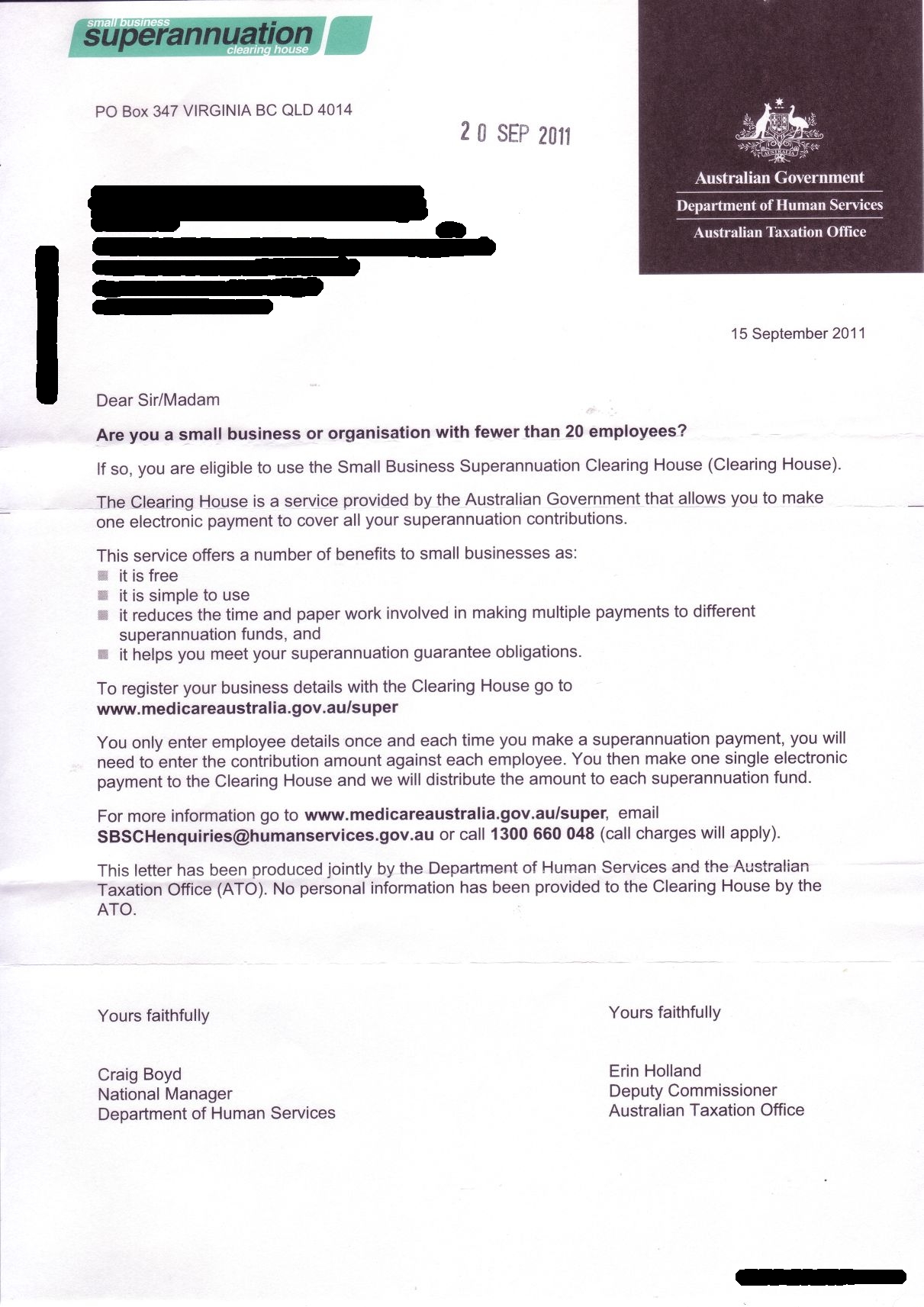
Labor has already begun the subtle, insidious process of “encouraging” your employer to funnel your future super payments directly to the ATO.

A policy stolen from the Liberal Party.

I know.

I got their letter:

(Click to enlarge)

Wake up Australia!

It’s time to take the red pill.

The Matrix: "You take the blue pill – the story ends, you wake up in your bed and believe whatever you want to believe. You take the red pill – you stay in Wonderland and I show you how deep the rabbit-hole goes." - Morpheus

UPDATE:

(h/t reader JMD) Another example of a desperately over-indebted government trying to bribe/coerce/con the citizenry into keeping the Ponzi scheme going:

‘Gold For Bonds’ in Japan as Bond Buyers Get Gold Coins

Japan will reward investors who buy reconstruction bonds with half an ounce of gold, an added incentive that could boost the return by nearly six times according to Japanese Finance Minister Jun Azumi.

Individual investors who purchase more than 10 million yen ($129,000) in the debt with a 0.05 percent return and keep it for three years will receive a gold commemorative coin weighing 15.6 grams (0.55 ounces), the Finance Ministry said in Tokyo today, worth about $948 based on current prices for the precious metal.

Barnaby: “This Protein And Chemical-Enriched Abomination”

6 Dec

From Strewth! in The Australian:

A stretch too far

While the [ALP national] conference was heading towards its conclusion, senators Barnaby Joyce and George Brandis were off to the wedding of former 2UE broadcaster Michael Smith on the NSW central coast. Expecting a regular hire car to collect them, they walked out to be confronted by a stretch limousine. Remarked Brandis, “I think that hideous thing is for us.” Joyce asked the driver who he was waiting for. Consulting a piece of paper, the driver confirmed Brandis’s worst fears: “Someone called Barnaby.” As a “tired” Joyce related to Strewth yesterday, “We sat in the back among the changing neon colours of this protein and chemical-enriched abomination, glancing at one another uncomfortably.” The measured Brandis ignored Joyce’s exhortation to “be loud and proud” and disembark in style at the venue, instead waiting inside the limo until any possible eyewitnesses had moved away.

Follow Strewth! (aka @JamesJeffrey) on Twitter.

(h/t @margotdate)

“How Are We Going To Get Through The Most Severe Financial Position Since The Great Depression”

4 Dec

Barnaby is right:

Our “Lehman Moment” Near – S&P Downgrades Banks

4 Dec

Just four days ago, your humble blogger noted that our mainstream news media, financial commentariat, and blogosphere, have (again) overlooked the key issue, in their reporting of Treasurer Swan’s MYEFO budget update.

Once again, they have all overlooked the critical economic risk; the joined-at-the-hip relationship between our Big Four banks, and our government’s financial position, as perceived by the major credit ratings agencies.

To wit, back in May this year Moody’s Ratings agency essentially declared our Big Four banks are Too Big To Fail. And in downgrading the Big Four’s credit ratings, Moody’s tacitly warned the government that it must maintain the implicit and explicit government (taxpayer) guarantees propping up the Big Four, else Moody’s will cut their ratings by another 2 notches.

By inference, this means that Moody’s was also warning the government that it must achieve and maintain a pristine government sector balance sheet, in order to support the plausibility of its guarantees for our Ponzi banking system.

If the government cannot reverse the direction of its ever-rising debt trajectory, and demonstrate a plausible path back to achieving an annual budget surplus (in order to start paying off the gross debt), at some point in the not-too-distant future their failure to manage the debt will be taken as a sign that our government’s guarantees of our banking system are less than reliable.

Wayne’s (unreported) MYEFO prediction of a 57% blowout in net public debt this year alone, will only hasten the arrival of that day.

As will his blowing through our third increased debt ceiling in just 3 years, by around mid-2012.

Commonwealth Government Securities On Issue | Source: Australian Office of Financial Management (AOFM)

Inevitably, our banks will have their credit ratings cut further.

They will find it increasingly difficult to attract funding from international money markets, upon whom the banks are dependent for around 40% of their wholesale funding. (Indeed, as we saw on Wednesday, the yield spread on Aussie banks’ bonds compared to non-financial Aussie corporate bonds, has just hit an all-time high).

Funding costs for the banks will rise.

Interest rates for Australian borrowers debt slaves will rise. (Or at the very least, RBA interest rate cuts will not be passed on).

Availability of loans to businesses will fall even further, choking the economy.

Unemployment will rise.

Bad loans (defaults) will increase.

Our housing bubble’s gentle 10-month price deflation, will accelerate.

Our economy will crash.

Our banks will collapse like the Ponzi house of cards that they are.

And the all-time record debt-soaked government taxpayer …

Click to enlarge

… will be obliged to bail out the banks, as per the Government Guarantees.

Now, we have a further red flag that my Missing The Key Economic Point For Dummies blog was right.

From The Australian (emphasis added):

Australia’s major banks are confident the first ratings downgrade by Standard & Poor’s in two decades will not have a major impact on their funding costs, despite the ongoing volatility created by the European sovereign debt crisis.

The share prices of the major banks — Commonwealth Bank, ANZ, Westpac and National Australia Bank — rose by 1.5-2 per cent, despite the one-notch ratings downgrade from AA to AA- as the overall market rose 1.4 per cent for a sparkling weekly gain of 7.6 per cent…

… The banks’ ratings were last cut in the early 1990s as the Australian economy struggled with recession.

S&P defended the ratings downgrades, which it attributed to Australian banks’ heavy reliance on wholesale funding markets.

And from ABC News (emphasis added):

BBY banking analyst Brett Le Messurier says the downgrade is not too serious but could lead to higher borrowing costs in the long term.

Mr Le Messurier says the big four banks still have plenty of liquidity to help them “ride out the current turmoil in Europe for some time”.

“In and of itself it doesn’t matter that much, but if another one follows then they get into the “A” category,” Mr Le Messurier said.

“And that is going to lead to increased wholesale funding costs over and above what’s resulted from the current European crisis and therefore that will ultimately feed through to consumers.”

And from the Wall Street Journal (emphasis added):

When it comes to Australia’s banks, don’t listen to the spin.

Late last night, Standard & Poor’s cut its rating on all of the big 4 — Australia & New Zealand Banking Group, Commonwealth Bank of Australia, Westpac and National Australia Bank — warning about rising costs and a continued increase in wholesale funding costs. Given Australia’s banks predominantly fund themselves offshore, the ongoing European sovereign debt crisis has raised concerns about the contagion possibilities…

… The moves come about six months after Moody’s did almost exactly the same thing and predictably, just like then, each of the banks have come out today to defend their balance sheets and businesses.

But while ratings agencies certainly don’t carry the clout they used to, make no mistake, there are a stream of issues for Australia’s banks.

For one, a credit facility from the Reserve Bank of Australia, or RBA, established to help banks satisfy new global banking rules, known as Basel III, are certain to lower each of the banks’ risk-taking possibilities and profits.

But actions speak louder than words and when the RBA cut its key cash rate a month ago, NAB refused to pass on the favor in full. If Europe gets worse, and the RBA cuts a few more times, all those banks that today are talking about their strong balance sheets will change their refrain when they decide to hold back on passing those cuts on.

The NZ Herald’s Liam Dann debunks the spin, and explains why the banks’ attempt to downplay the ratings cuts masks an important truth (emphasis added):

You can say all you like about yesterday’s banking downgrade being “anticipated”, “reflecting methodology changes” and not “impacting on consumers” – but down is still down. It’s the wrong direction.

So despite the spin suggesting this is no big deal, the big Australasian banks should hopefully be paying close attention to the Standard & Poors review which saw their ratings cut from AA to AA-…

… taking a step back from the technical stuff, it’s important to recognise that this methodology change is not some just arbitrary fiddling with numbers.

It’s grounded in the very real increase in risk to lenders that has occurred since the global financial crisis struck.

The changes stem from the failure of the ratings agencies to identify that crisis in 2007 and 2008.

So, in some respects, this downgrade represents the credit agencies doing their job properly – finally.

The big shift in the way S&P now looks at banking risk is that it has weighted its focus away from the cyclical ups and downs which are reflected in an institution’s quarterly financial performance and towards the underlying structural risks of a region’s banking sector.

So now, S&P is analysing first the structural risks in the Australasian banking system as a starting point, and then assessing the relative position of each bank’s performance within that context.

And finally, from Ireland’s The Journal (emphasis added):

S&P said the decision was based on the cost posed by sourcing cash from overseas markets and the country’s foreign debt.

Following the crash of Lehman Brothers in 2008, which S&P failed to foresee, the agency revised its rating criteria – and it is in the context of these new considerations that the banks were downgraded, reports The Australian.

Meanwhile, rival rating agency Moody’s said it would keep the banks on their AA rating and retain their outlook as positive.

Experts have warned that a continuing European debt crisis could expose the banks to a further downgrade.

As noted in Wednesday’s blog, our Net Foreign Debt is yet another key factor that our politicians (on both “sides”) and lapdog media studiously avoid focussing any attention on. Why? According to the latest RBA data, our Net Foreign Debt at June 2011 was a whopping $675 billion. More than 50% of GDP. So naturally, noone in positions of power want to mention it, even though it is a very serious structural problem, and one that is now fundamental to triggering negative consequences such as this S&P rating downgrade.

Break out the popcorn folks.

It has begun.

As usual … Barnaby is right:

“If you do not manage debt, debt manages you” – Feb 2010

Barnaby’s Budget Reply

1 Dec

I’ve been eagerly awaiting this.

Senator Joyce’s response to Wayne’s budget update.

Yes, he’s been busy with the Murray-Darling Basin Plan. But we just knew it wouldn’t take long for Australia’s prophet on debt risk to speak outside his portfolio again … as pledged.

From the Canberra Times (emphasis added):

Swan drowns in a sea of debt

In GK Chesterton’s Father Brown novels the world renowned criminal Flambeau makes a name for himself by forming a successful London dairy company even though he owns no cows, no carts and no milk. Instead, he served his customers by moving the milk bottles outside people’s homes to the homes of his customers.

All very similar to Wayne Swan’s crisis budget. Moving money from his year of surplus to his years of non-surplus years before and after. No cows, no milk, no focus on increased production just a bunch of very tricky, very sneaky accounting tricks. Remember their surplus does not pay off the extra $15 billion they will now borrow this year.

A crisis budget from a crisis government who reflect the sobriety of the situation with the appointment of a new Speaker for the House of Representatives. Greeting the Queen or President at the next official soiree will be; Peter Neil Slipper. Yes all is under control on the Good Green Ship Labor.

There is no better recent portrayal of their exemplary management skills than the announcement of “regional experts” to help the 2.1 million people of the Murray-Darling “adapt” to the challenges of the precision hydrology skills so evidently amorphous in the draft Murray-Darling Basin Plan. I have always thought floor 30, Martin Place, Sydney is precisely the place to be to help those at the south-west NSW town of Griffith who have failed to better appreciate the Green-Labor-Independent government’s empathy and earnest desire to maintain our major food producing asset.

I love the way Labor rise to the challenge. If they are not cooling houses before setting fire to 194 of them, they are cooling the whole planet with a carbon tax and now they are redesigning how we feed ourselves with the glossy wonder of the latest draft Plan for the Murray-Darling Basin.

Canberra you are the canary in the coal mine on Australian Government debt. With debt rising by $2.1 billion, again, last week to $219 billion gross, the crossword puzzle at the bottom of this enclosure is moving into depressing focus as we hold on by our talons to the inverse view of this mad bird cage.

Surprise, surprise then the government has announced further cuts to the public service. Does the $2.5 billion spent on ceiling insulation look smart now? What about $16 billion on school halls? Now’s the perfect time to spend $50 billion on a second telephone network.

Now Wayne Swan predicts that the gross debt will race over our current debt ceiling of $250 billion by the end of this financial year* and over $270 billion by the end of the forward estimates. It looks like that unless we extend the overdraft again next year our nation will get the notice at the checkout “transaction declined, see bank for details.”

Why is it that after years of warning about a lack of cost management we now have to believe that those that are so witless as not to see it coming are competent enough to manage us through it. I publicly offered a bet in 2009 for a thousand dollars, which Mr Swan never took, that Labor would never deliver their predicted surplus. An organisation that delivers week in, week out rolling deficits covered with accelerated borrowing is not going to deliver an annualised surplus. No change in behaviour, no change in outcome.

They told us to throw the scales out the window, it is your net weight that matters and your gross weight is only going up because each week you are wearing an additional two kilograms of clothes, apparently. Oh, it is all so clear now, depressingly so.

The bleeding obvious from years ago has now mugged our inept government and Canberra, the cuts I predicted have now crystallised in their initial stage in Wong and Swan’s announcement. It will get worse.

Yes I have a palpable sense of frustration that not only did the government not react earlier when the remedy would be a less bitter pill, but others, the economic commentariat of the fourth estate, did not forensically question the Government’s rhetoric that we had no issues.

Does the crisis budget deal with the crisis? Nope. Carbon Taxes, NBNs and now shutting down sections of the Murray-Darling, there is no stomach in this management for the hard decisions. The golden rule is invest where you make money and cut where it costs you, prioritise and know your threats and be pragmatic not romantic in your long term plan.

Barnaby is right.

* And so was I … see Nov 2 post “Australia On Target To Hit Debt Ceiling By Mid-2012”

Barnaby On Labor’s People Skills

30 Nov

Media Release – Senator Barnaby Joyce, 30 November 2011:


Crean confuses consult with insult

Well Tony Burke and Simon Crean are doing a job that would make the United Nations proud. They are such good negotiators.

Tony passed through Deniliquin yesterday at around about 30,000 feet and 700 kilometres an hour on his way to somewhere else in an air force jet. That is his way of covering the ground.

Simon was actually in Deniliquin in a meeting with a select panel of people but he appeared to pass through the room at only a slightly lower velocity as Tony was passing overhead. Reports from those at the meeting say that he spoke to the chosen few for less than five minutes on the basin plan (See Attachment)*.

Simon has obviously come to the conclusion that unfortunately you have to actually go to a place before you put out a media release. He has yet to learn that you should actually make your media release an accurate reflection of the visit.

The bush telegraph is a pretty good honesty serum when it is matched up to his media release.

If you didn’t laugh you would cry because this is the process that is dealing with the mechanism that feeds Australia and keeps the cost of living on groceries down for working families across our major cities.

If they show the same management acumen as they showed with ceiling insulation, when they set fire to 194 houses, or the crisis budget for a crisis government, which has just informed us that we are going to break through our third debt ceiling, or the rollicking fiasco of the carbon tax on our solo crusade to cool the planet from a room in Canberra, then I have a real fear for what is about to happen to Australia’s food basket.

It looks awfully like the Labor dynamic duo of Simon and Tony would find the job so much easier if they didn’t have to deal with people.

*2011 11 30 MGCC Press Release – Crean’s hollow launch (click to download pdf)

Click to enlarge

Missing The Key Economic Point, For Dummies

30 Nov

It is rather bemusing to browse around the economic commentaries on Wayne’s MYEFO (Mid Year Economic and Fiscal Outlook) announced yesterday. In particular, the commentaries from those with a leftist bent.

By and large, from these folk we hear the same refrain as that parrotted on down the line from Treasury via their talking head (Wayne Swan). To wit, “strongest economy in the developed world”, “envy of the developed world”, “lower debt-to-GDP than other advanced economies”, “nothing to see here, move along folks”.

Here’s some good examples that caught my eye:

Secondly, let’s tackle the Opposition canard – gleefully recycled by some media outlets – that somehow we are drowning in debt. It doesn’t take much – like five minutes on the Internet – to show that total government liabilities at around around 22 per cent of GDP are the lowest in the OECD and compare extremely favourably to just about every other developed economy.

It appears rather obvious from The Failed Estate’s analysis, that he did indeed spend “like 5 minutes on the internet” researching his momentous piece of groupthink.

And then there was New Matilda’s Ben Eltham. See if you can spot the drive-a-truck-through-it hole in his effusion (hint, emphasis added):

Step back from all the sound and fury about budget surpluses and the European debt crisis for a moment, and have an unbiased look at the latest Treasury figures on the health of Australia’s economy.

Unemployment is expected to peak at 5.5 per cent next year, and remain at the level into 2013. Inflation will be 3.25 per cent. Wages will grow at 4 per cent. Consumer spending will grow at 3 per cent, and the economy as a whole at 3.25 per cent.

These are figures that would make finance ministers in Europe weep. The Australian economy is growing. We’re adding jobs and keeping unemployment low, consumers are still spending, and inflation is modest. And yes, the budget will return to surplus.

Note to Mr Eltham: These are “estimates” and “projections”. Not outcomes. “Expected” does not equal “will”.

Indeed, as regular readers know, both the budget and MYEFO are all about “estimates” and “projections”.  And the Treasury department has a sterling record of abject failure when it comes to getting within a bulls roar of accurately predicting the final budget outcomes. Indeed, in less than 6 months, their “truly extraordinary” growth forecasts underpinning the May 2011 budget “estimates” and “projections”, are already shot to hell.

But our purpose today, dear reader, is not to dissect the ignorant parrotry of “leftist” journalists and bloggers.

Or “rightists”, for that matter.

Our purpose is to identify the key economic point that they are all missing.

One that even respected mainstream economic commentators like Access Economics’ Chris Richardson, here implying that it may not be wise for the government to be cutting spending at this time, have universally overlooked:

Deloitte Access Economics director Chris Richardson said the government planned to cut spending when the Reserve Bank of Australia (RBA) had cut its cash rate in early November.

The RBA cut the cash rate from 4.75 per cent to 4.5 per cent to provide some stimulus for a slowing economy.

“What the government is doing here is actually taking money back out again solely to get a surplus next year,” Mr Richardson told ABC Radio on Tuesday.

“It is not clear that it is smart to have the Reserve Bank tipping money but the government then taking it back out when the outlook especially with Europe is somewhat fraught.”

Let’s help out Messr’s Denmore, Eltham, and Richardson, with a brief guide on how to miss the key economic point.

For dummies:

1. Focus on the Federal government public debt figure.

2. Emphasise comparison of Federal government public debt-to-GDP versus other “developed” countries, praise Labor government for comparatively “low debt-to-GDP”.

3. Downplay importance of return to balanced annual budget / budget surplus. Cite 2. as primary justification.

4. Belittle any who express concern over ever rising government debt trajectory. Cite 2. as primary justification.

Commonwealth Government Securities On Issue | Source: Australian Office of Financial Management (AOFM)

5. Ignore the fact that while Federal Government public debt is “only” relatively small, our total Net Foreign Debt at June 2011 was almost $675 Billion, or over 50% of GDP (RBA Statistics, H5).

6. Ignore the fact that our banking system (thus, economy) relies on international money markets for some 40% of its “wholesale funding”.

7. Ignore the fact that in May 2011, Moody’s downgraded our Big Four banks’ credit ratings, cited their wholesale funding dependence as a key concern, and tacitly threatened the government that without the government’s explicit and implicit Guarantees propping them up, our Big Four banks would have their credit ratings slashed by at least two more ‘notches’.

8. Ignore the fact that in late June 2011, Fitch Ratings warned that Australia’s banks are amongst the most vulnerable in the world to the EU debt crisis, due to their reliance on wholesale funding from international money markets.

9. Ignore the fact that the spread on bond yields for Australia’s Big Four banks (versus non-financial institutions) have just hit record highs (from Bloomberg via SMH):

 Yields on bonds of Australian banks reached a record high relative to debt of the nation’s nonfinancial borrowers as Europe’s debt crisis threatens to freeze credit markets

Lenders including Commonwealth Bank, Westpac, ANZ and National Australia Bank Ltd., may need to sell about $144 billion of bonds in the 12 months ended June, 2012, according to a July research report from Deutsche Bank …

Trading conditions in the euro area have deteriorated this month as the region’s sovereign debt crisis deepens. Germany failed to get bids for 35 per cent of the 10-year bonds offered for sale on November 23 and traders were left seeking prices in the aftermath of a Spanish debt sale on November 17.

10. Ignore the fact that due to the very real vulnerability of our banking system, it is near-inevitable that the government will need to reinstate the Government (taxpayer) Wholesale Funding Guarantee to prop up our Too Big To Fail banks.

11. Ignore the fact that the government’s present “low” public debt comparison versus other countries is largely rendered a moot point, because the credit ratings agencies have already effectively served notice that they will have a lower tolerance for anything less than pristine government finances – and thus, a genuinely convincing case for return to surplus – due to the compulsion upon the Australian Government to (continue to) prop up a highly vulnerable banking system.

12. Blithely skip merrily through cherry-strewn intellectual fields, hand-in-hand with fellow groupthinkers, picking fruit and singing la la la la, wilfully ignoring the reality that (in the words of Senator Joyce) …

… “If you do not manage debt, debt manages you.”

Don’t Worry, A Consultant Will Fix It

29 Nov

Media Release – Senator Barnaby Joyce, 29 November 2011:

The Hitchhiker’s Guide to the Murray-Darling basin results in the answer of 2750 gigalitres, and all grief can be alleviated with a consultant. Of course! What the people of Griffith need at this time of crisis is for someone from Pitt Street in Sydney to come out and tell them how to adapt.

A form of Darwinian enforcement from an opulent airy spire from somewhere in Martin Place.

I must say the crowd in Griffith was really happy when they found out they were going to send out a consultant. They were really worried for a while that the Labor party was going to stuff this up again. Like the crisis budget from this crisis government. Like the $219 billion in gross debt they have left us.

Minister Crean, when you say something like that I get a sinking feeling that you really do not have a clue.

It’s some perverse form of logic that you have never ever understood the realities of an area and that is why this is turning into a debacle. And when you really need to understand this issue you send out a consultant instead of doing your homework and understanding the issue.

Minister Crean said in a media release issued today that, ‘regional experts would work across the Murray, Murrumbidgee, Goulburn-Broken and Condamine-Balonne catchments to help communities adapt to a future with less water.’*

Minister Crean has announced that he will be using more of your money borrowed from overseas to pay inner city experts to tell people in the regions how to run their lives.

Farmers aren’t mugs Mr Crean, neither are people who live in the regions. They run their businesses and households just like any other Australian, they have to account for every dollar they earn and penny they spend.

Which is more than can be said for this government. They have already spent over $10 million on consultants to deliver a plan that does not even say how they are going to use that water.

The bush doesn’t need more consultants, the government needs to do its homework.

More information – Matthew Canavan 0262773244

*http://www.minister.regional.gov.au/sc/releases/2011/november/sc140_2011.aspx

Design a site like this with WordPress.com
Get started