Tag Archives: budget

Barnaby: You Can Count On Swan’s Debt Pile

5 May

Barnaby Joyce in the Canberra Times today:

Next week’s budget is shaping up as another rollicking frolic on the road to pandemonium.

Almost a year ago, Wayne Swan delivered a budget for 2010-11 with what he predicted would be a $40.8 billion deficit which is a massive loss on the nation’s books. Next week he will reveal that the financial morass is more than $50 billion out the back door.

We are getting used to this unfortunately, the 25% Swan-error factor, incompetence, massive deficits and now massive debt.

If Labor can not manage the nation’s business, balance income to expenditure, in the middle of a resources boom, how on earth will it do it when the boom comes to an end?

When the Government announced the $90 billion spree in response to the North Atlantic financial crisis, Treasury officials told me that our debt would reach its $200 billion ceiling in 2013-2014. We are already at $190 billion in debt and rising.

Australia never went into a recession because China never went into a recession. School halls did not put any coal on a boat, ceiling insulation did not sell one tonne of iron ore and $900 cheques did not plant one acre of wheat.

In the parallel universe of Wayne Swan hocking the Australian credit card up with rubbish increases demand for soft and hard commodities in south-east Asia. The same way, I imagine that buying a new Playstation helps you get a wage rise at work.

Half of Mr Swan’s life is a promise; the other half is an excuse. Next week we will get both.

The promise will be a surplus, not now, but later. Labor will start paying the debt back not now but later. The excuses will be the GFC, the Tsunami, Yasi, Swanny and trust me.

He will tell you about new jobs and you might need one as his profligate spending will start to put the screws on the capacity for expenditure on government services.

The Treasurer will promise to cool the planet from a room in Parliament House by reducing carbon dioxide usage domestically, while selling record amounts of coal overseas. He will take you on a guilt trip about the price of power in Australia. He will try to convince you that it is morally just that the fundamentals of life become prohibitive for the average Australian consumer and that the trade advantage of our industry, cheap power, is an evil that should be removed and sent overseas. This is the Green-Labor-Independent economic miracle, future alternate “green” jobs in their future alternate green universe.

Earlier this week, Wayne Swan had the temerity to accuse the previous Coalition government of wasting the mining boom. Remember that terrible time? It was when we had tens of billions of money in the bank. Wayne just has massive debts.

He will say that it is not the gross debt that matters but the net debt. Yet he has never explained the difference between the two. He has never explained it because I don’t think he knows the difference.

Now maybe he might not know but his department does. In response to a question I put in Senate estimates, Treasury revealed that $64 billion of the difference between our gross debt and our net debt is made up of the cash and non-equity investments of the Future Fund. The Future Fund is there to cover the otherwise unfunded costs of public servants’ superannuation.

That is a little fact that the people of Canberra might be interested in. When Wayne mentions net debt translate that to, I am going to pay his debt off with my retirement savings.

If you want to test the competency of Mr Swan then it is similar to how you test the competency of anyone in any field. Pay a little bit of attention to their promises but pay immense attention to their delivery.

The last Coalition government delivered 10 surpluses in 12 years. A Labor treasurer has not delivered a budget with a surplus in it since 1989.

In the 21 years since, Labor delivered 9 budgets and racked up a cumulative debt of $200 billion.

The Coalition delivered 12 budgets producing cumulative savings of $97 billion.

Labor borrows at double the rate that Coalition governments can save.

The Coalition left Labor with a $60 billion Future Fund and a $20 billion surplus. We are now racing towards $200 billion in gross debt.

Next week’s budget is shaping up as another rollicking frolic on the road to pandemonium.
Another $2.2bn In Debt This Week

5 May

Yesterday, the AOFM auctioned another $600 million in Treasury Bonds. Lumping the taxpayer with a (weighted-average) interest-burden of 5.35%.

Today, the AOFM will auction another $1 Billion in Treasury Notes.

Tomorrow, the AOFM will auction another $600 million in Treasury Bonds.

How much will this week’s national credit card binge add to last year’s “Estimates” and “Projections” of Interest-on-debt?

MYEFO 2010-11, Appendix B, Note 10: Interest Expense

According to their own “Estimate” just for this year 2010-11, we’re paying $1,201,712 per hour in Interest-on-debt.

UPDATE:

Today’s $1 Billion Treasury Notes auction completed.

Slug to taxpayers? 4.73% interest rate (weighted average yield).

How Gillard’s Use Of The Credit Card Makes Rudd’s GFC Spending Spree Look A Model Of Financial Prudence

5 May

A few days ago I wrote an article titled “The Real Reason Why Gillard’s A Spinster“.  It ruffled feathers.  Not for the intended reason, unfortunately.

Humourless critics were so rankled by my [insert self-righteous PC perjorative] that they did not see the point.

So here’s a follow up.  Without the creative literary device/s for decoration.

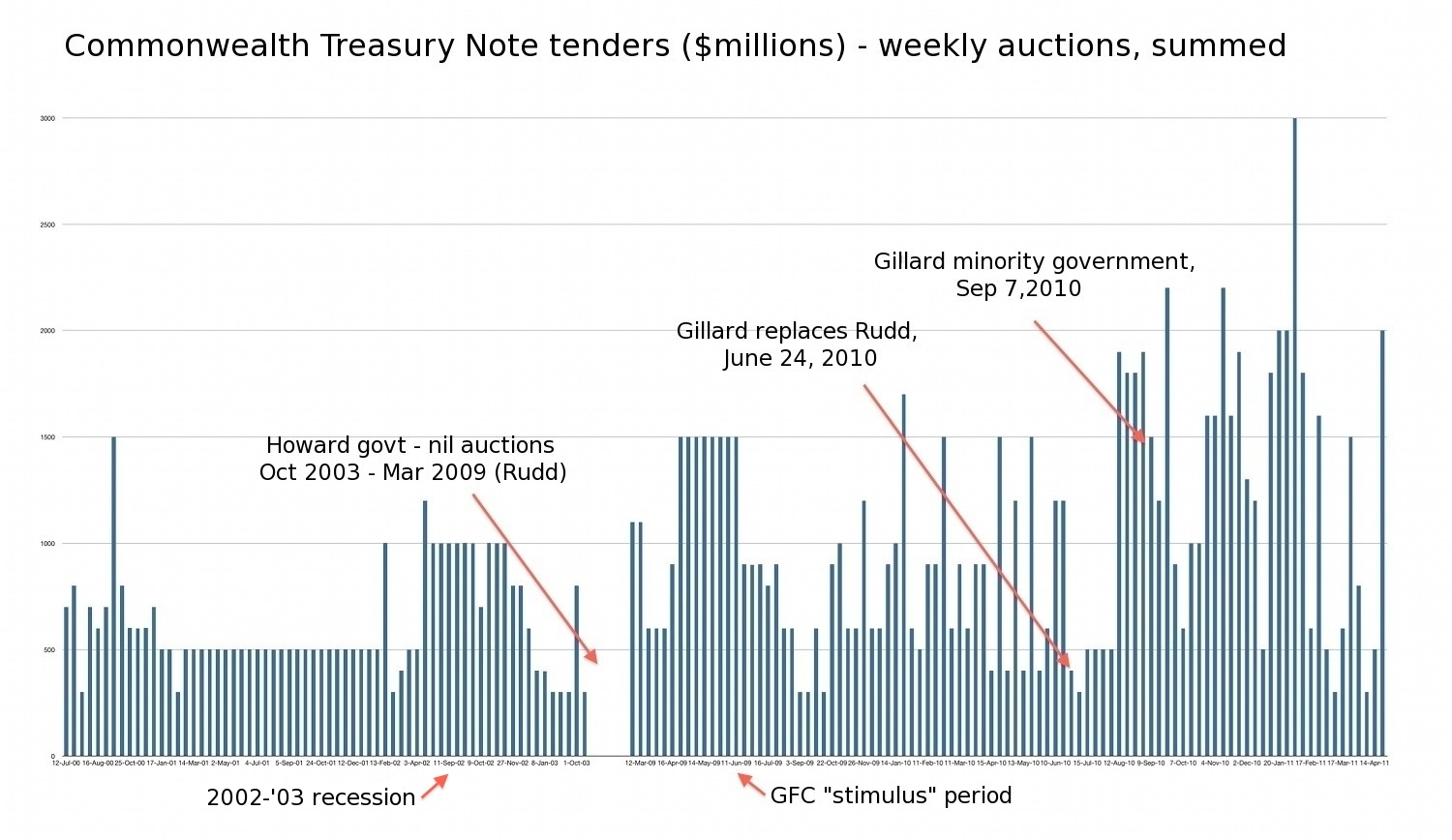
The following chart is an updated and extended version of the one used in the previous article.  This shows Treasury Note auctions from 2000 through to end April 2011 (the previous chart began at March 2009).

The other difference, is that the previous chart listed each individual auction separately.  It escaped my notice that there has been as many as 3 auctions p.w. in recent times.  So this new chart sums the total of all auctions of Treasury Notes in a given week into a single bar on the chart (click to enlarge):

Source: Australian Office of Financial Management (AOFM)

Some key points to note.

Firstly, there’s clearly quite a difference between how much the Howard Government relied on short-term debt (Treasury Notes), compared with the subsequent Labor Government.  The period when the largest block of Howard-era short term debt auctions occurred was through the year 2002 – coinciding with the 2002-03 global recession, which Australia largely avoided.

Secondly, for four (4) full years between October 2003 and the Rudd election win in November 2007, the Howard Government raised no short-term debt. Not one cent.

Neither did Kevin07.  For 16 months.  Until the GFC.

Thirdly, you can see clearly the period from March 2009 through around September 2009, during which the Rudd Government was regularly raising around $800m to $1,500m a week from short-term debt auctions. I assume that this reflects (at least in part) the government’s urgent need for cash to fund their “stimulus” response to the GFC.  Stimulus 1 – $10.4 billion in cash handouts in late 2008 (goodbye 50% of Howard surplus).  Stimulus 2 – another $42 billion in cash handouts and “nation-building”, beginning in … February/March 2009.

You remember. “Swift and decisive”. Rushed and bungled. $900 cheques to dead people. Electrifying foil insulation. Blazing pink batts. Rorted “green” schemes. Overpriced school halls. Literally billions more, to investigate and repair these Rudd-made disasters.

Finally, note the significant jump in both the frequency and the totals of short-term debt auctions, coinciding exactly with Ms Gillard’s rise to power. The fact is, she has presided over a $10.1bn (31.5%) increase in issuances of short-term debt in just 10 months, compared to the previous 12 months of the Rudd Government.

The big unanswered question that I have is this: WHY would a Gillard-led government suddenly need to bash the nation’s short-term credit card 31.5% harder than even the profligate Kevin Rudd did? After all, he had a GFC “stimulus” package or two to finance.

What is Ms Gillard’s excuse?

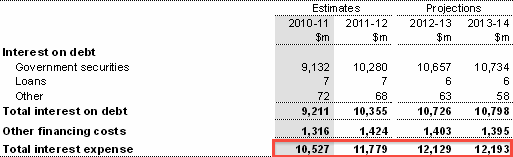
According to the government’s own budget records, we-the-taxpayers are already wearing an Interest-on-debt bill of more than $10 Billion per year:

MYEFO 2010-11, Appendix B, Note 10: Interest Expense

According to the AOFM, short-term Treasury debt is supposed to be used for financing “within-year”, daily cashflow requirements of the Government. And then there’s this official prediction:

Treasury Notes are not expected to make a major contribution to overall funding for the 2010-11 financial year as a whole.

Why has the Gillard-led government apparently been so incapable of planning their week-to-week expenses, that since that statement was published they have resorted to bashing the national credit card more than 31.5% harder than Kevin Rudd “needed” to?

The data supports the increasingly widespread view that the Gillard minority government is a shambles.  They have no financial plan – even over the short-term.  And so, from Day 1, have had to pull out the national credit card 31.5% more than Kevin Rudd, just to manage the week-to-week cashflow requirements of government.

One can only wonder just how much Interest-on-debt we will end up paying in total over the coming years.

While Gillard and Co comfortably retire.  On mega-buck, index-linked, taxpayer-funded pensions.

Behold, Wayne’s Große Lüge

4 May

Treasurer Wayne Swan is busily preparing hearts and minds for his fourth consecutive Budget … deficit.  A deficit that’s going to be epic.

Oops.

Time to wave a big red herring:

We created 750,000 jobs since we came to office when other nations shed millions of jobs…

Let’s take a bite out of his red herring.  Is the jobs claim true?

Wayne’s former colleague Lindsay Tanner –  recently confessed expert in the “dark arts” of lying with numbers– has given us this timely warning:

“… whenever a politician cites… figures to show what a fine job he or she is doing, examine the fine print very carefully.”

Ok. Let’s do that.

If it’s true that Labor has created 750,000 jobs since coming to power, one would think this “fact” might be reflected in some official statistics.  Say, in the official government Final Budget Outcome reports.

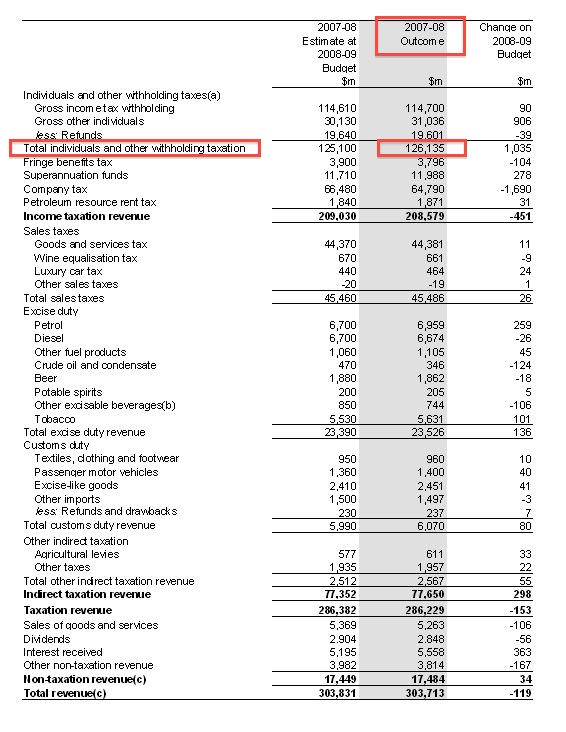
According to the 2007-08 Final Budget Outcome, the last year of the Howard Government brought in $126.135 Billion in Total individuals and other withholding taxation:

Source: Final Budget Outcome 2007-08 | Part One, Table 2: Australian Government general government sector revenue

Now, if Labor really has created 750,000 jobs since they came to office, then you’d expect the Total individuals and other withholding taxation for last year (2009-10) to be a lot higher than in 2007-08, right?

After all, even if these “750,000 jobs” were all only modestly paid jobs – say, $35K p.a. – then you would expect the government should have received around 750,000 x $4,350 = $3.26 Billion more individual income tax revenue than in 2007-08 … right?

Wrong.

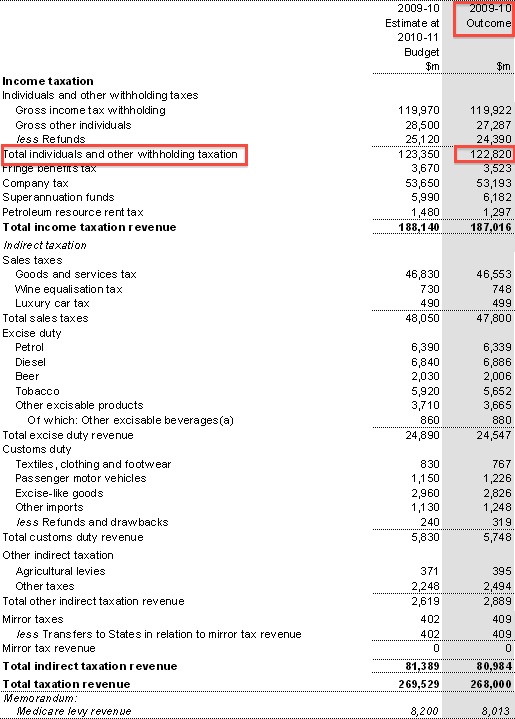
According to the 2009-10 Final Budget Outcome, the Labor Government brought in $3.31 Billion less from individual income taxes last year than in 2007-08:

Final Budget Outcome 2009-10 | Part Two, Table 8, Note 3: Taxation revenue by type

There you have it.

In Wayne’s World, 750,000 jobs created means $3.31 Billion less income tax revenue.

Who knew?

Rather than adding to Government revenue, “job creation” actually loses money.

On the eve of Budget 2011 … and a fourth consecutive mega-deficit … this is Wayne’s headline argument for Labor’s record in economic management.

“750,000 jobs created”.

But wait … there’s more!

“Half a million more”. “In the next two years”.

Be-holed, Wayne’s Große Lüge.

If you are going to lie, make it a Big Lie. And repeat it often.

Everyone will believe you because –

“They’re government statis…. they’re facts(2.27min)

Kohler Agrees – Barnaby Was Right

2 May

It’s getting embarrassing now.  Not only has Standard & Poors, CNBC, Deutsche Bank, and Barack Obama all agreed that Barnaby was right on US debt.  Now our very own ABC News Finance, ABC Inside Business, and Business Spectator heavyweight, Alan Kohler, has conceded it too.

From ABC’s The Drum, buried within comment about the impossibility of Labor achieving their promised surplus budget next year:

The revenue shortfall will be worsened by a rising exchange rate over the next two or three years as the United States approaches an inevitable fiscal crisis.

Barnaby is right.

Korean’s Use Our Coal, Get Power 30% Cheaper Than We Do

28 Apr

Barnaby on ABC PM yesterday:

One of the most basic necessities of life, the greatest reflection of our standard of living, is the price of power.

I remember that a very salient time for me was having a discussion with my mother-in-law, and talking about the carbon price, and her quietly sitting back and in sort of a disdainful way, which I think reflects the disgust held by so many in the community.

She said look, you know, in winter, in the New England, when she’s working on Meals and Wheels, it’s at times it’s very easy to find out where the pensioner is, because you will find them in bed because that is the only place they can afford to stay warm.

So they’re not there because they’re sick, they’re there because they’re cold, and I find that disgusting that would be happening in my nation now. We’re the nation that supplies coal to the world, yet we can’t afford to look after our own.

Another reflection on that is the people of South Korea manage to deliver power to their people, at 30 per cent cheaper than what we can deliver it to ours, yet they’re doing it with our coal after a journey of, I suppose, around about 10,000 kilometres.

So.  We merrily sell our coal to the world, for them to use in their coal-fired power stations.  But we introduce a big new tax on our own coal-fired power stations.  So that our already-overpriced electricity, will become even more overpriced … by (minority) government decree.

(Oh yes, and we refuse to consider nuclear.  The only viable, base-load power alternative to coal.  But, we merrily keep selling our uranium to the world, for their nuclear power stations).

#@^&%$!?!

Labor Racks Up Half-Century On Electricity Price Increases

27 Apr

Media Release – Senator Barnaby Joyce, 27 April 2011:

Today’s consumer price index figures from the Australian Bureau of Statistics show that utility price increases are accelerating not slowing down under Labor, Senator Barnaby Joyce said today.

“Last week public buildings were burning down in the centre of Sydney while homeless people merely miles away slept on the street. This week we find that good honest hard working people are struggling with the fundamentals of life because the Labor party’s management is incompetent.

“The elixir of the quality of life is the price of power.

“Labor can raise its bat today. Under this Labor government electricity prices have gone up by over 50% in not much more than 3 years. That is a bigger total increase than under the 11 years of the previous Coalition government.

“It doesn’t stop there. Ill-considered investments in desalination have caused water prices to go up by 46% and gas prices have gone up by 30%.

“Last winter my mother-in-law told me that on her meals-on-wheels runs she often finds pensioners in bed, not because they are sick, but because it is the warmest part of the house when they can’t afford the heating.

“Under Labor things aren’t getting any easier and they are not going to with a carbon tax that will push up electricity bills by another $200 per year at least.

“Australians don’t need more excuses to save on power; they have plenty of reasons already.

“But it’s not just household bills that will get hit. Combined with a high Australian dollar, these price increases are hurting Australian manufacturing. Do we want to make life even tougher for them and risk having no manufacturing industry in this country at all?

“All for a plan to cool the planet from a room in Canberra.”

(click to enlarge)

Even after adjusting for inflation:

· Electricity prices have been going up 10% per year under Labor, compared to 1% under previous Coalition government

· Water prices have gone up by 9% per year under Labor, compared to 1% under previous Coalition government

· Gas prices have gone up by 5% per year under Labor, compared to 1% under previous Coalition government

More Information – Matthew Canavan 0458 709433

Friday On My Mind – Another $700m In Debt

27 Apr

While most everyone else is obsessing about this Friday’s royal wedding, I’m thinking about another kind of “marriage” contract.

Til Debt Do Us Part.

You see, $189.84 Billion in debt is not a big enough ball-and-chain for the Goose.  Come this Friday, he’s signing us up to another $700 Million in the red contract.

Noone with two brain cells to rub together could still believe this government’s line that they will produce a surplus budget for the year (just 1 year, mind) in 2012-13.  Their ongoing dalliance with debt is all the evidence needed.  They are addicts, who will never go a single year without borrowing-and-spending far more than they take from us in taxes.

The simple fact is, we’ll all be paying for Goose’s indiscretions.  For decades to come.  Our creditors must be paid.

So tell us Wayne … who’s buying now?  Who Really Owns 73% Of Our Debt?

Barnaby’s Quick Quiz

14 Apr

Media Release – Senator Barnaby Joyce, 14 April 2011:

Q. Who am I? Two weeks ago there were 183.8 of me, this week there is 187.3 of me.
A. Billions of dollars in gross debt.
Is there any way we can get the penny to drop on why this is not healthy for the Australian people? Look at it this way; we had all those demonstrations on Tuesday because of a prospective $400 million loss in medical research funding; in two weeks we dropped almost 9 times that amount. We could have built the Toowoomba Range Crossing twice, or we could have completed the required sections of the inland rail for this amount. We could have put slightly more money, than $1.4 million towards myrtle rust, an introduced direct threat to eucalypts in Australia.
Something smells. Ken Henry has left, Julia Gillard is panicking, and our gross debt is tearing through the roof.
Seeing as Mr Swan always talks about net debt, maybe he would like to find some of these funds he used in netting off this $187.3 billion and use it now to pay off some of the debt. I will tell you there are two things, he won’t be able to tell us where the money is and secondly, if he did know where it was, he would be terrified of what would happen if he actually used it to pay off the debt. For example, the largest section of the money used in the netting process is for public servants’ superannuation.
I have been banging on about this for about two years and I am not going stop till Wayne stops borrowing and starts paying the money back.
We have found ourselves in this position because we have got a government that spent like a person who should have been swabbed. We will look back in history and cringe as to how on earth we got ourselves into such strife. $2.5 billion on ceiling insulation, $16.8 billion on school halls and random $900 cheques, for who only knows what purpose followed by a little home cooked policy cake to cool the planet. Australia asks where do these manic ideas come from, and how on earth are you going to repay this debt?

Same Old Labor Govt – Same Old Debt

9 Oct

Media Release – Senator Barnaby Joyce, 4th October 2010:

Senator Barnaby Joyce says that the Labor government seems to be getting back to normal. “Our gross debt went up by $3 billion last week, the week before it went up by $4 billion. The gross Federal debt is now $163.152 billion.

This is the issue that should be front and centre of Labor Government’s attention, beyond private members bills for euthanasia, same sex marriage and a bid to cool the planet with a new carbon tax.

The reality is there in the numbers. The debt is racing ahead; it is not under control, it is not going to stop.

There is no argument for this profligate waste of money. How much money do we want to owe people overseas?

This money does not include the states’ debt which is on its miserable way to $240 billion, as noted in front page articles of recent weeks.

We also have to note now that local governments too are expected to borrow money.

If we do not get on top of the debt, these debts will get on top of us.

More Information – Jenny Swan 0746 251500

Design a site like this with WordPress.com
Get started