Tag Archives: lindsay tanner

Tanner Is GAWN!!

24 Jun

Is it Christmas?  Seriously … is it Christmas?!

Not only is Liar And Incompetent of The Millennia, former PM Kevin Rudd, now confined to the dustbin of ignominious history.

Breaking news has it that Lindsay Tanner will not contest the next election.  From Business Spectator:

Finance Minister Lindsay Tanner has announced he will not be contesting his seat at the next federal election.

Mr Tanner made the announcement to parliament this afternoon, saying his decision was unconnected to the Labor leadership change.

“I want to assure the house that this decision is … totally unconnected to the events of the past 24 hours,” Mr Tanner said.

“It involves no reflection on the government’s policies.”

It is Christmas!

One of the primary motivations for launching this blog, was your author’s outrage at the blatant lies and vicious, underhanded misrepresentations by soon-to-be former Finance Minister Lindsay Tanner, and his singular role in feeding the media with lie after lie after lie, all aimed at vilifying the then-new (now former) Shadow Finance Minister, Senator Barnaby Joyce.

Not only that.

As regular readers will know, your author has written many columns and analyses, using the official Government Budget documents, showing the countless lies and misrepresentations of truth by Tanner.  In fact, much of this blog has been devoted to exposing his lies and deceit.

While we joyously await his departure from Parliament, enjoy catching up on all these lies and misrepresentations made by Tanner in recent times.

Just click on any of the links to your right, under the main title “Pages“, and sub-heading “Resources & Articles“.

Ahhhhhhh … our work is done 🙂

Barnaby – thank you.

You’ve seen off the ETS.  And Kevin Rudd.  Now, your arch-enemy Lindsay Tanner is gawn too.

And you’re still here for us.  Well done champ!

Rudd’s Smoke And Mirrors Accounting

26 May

Media Release – Senator Barnaby Joyce, 26 May 2010:

Questioning in Senate Estimates today showed that the Labor Party has been cooking the books to make their spending plans look better.

In the budget the Labor Party brought forward about $1.5 billion, which was earmarked for spending in future years for State and Local Governments, to this financial year.

“Much of this will be paid on June 7. It is not clear what State and Local governments will do with the money for the 23 days that will be left in this financial year. Perhaps the interest will help their bottom line at the expense of the Commonwealth’s”, Senator Barnaby Joyce said.

“The Government could not provide a cogent reason for bringing forward this spending. They could not produce one letter from a local government requesting an early transfer of spending.”

“Labor has produced an accounting trick to increase the base of their funding in 2009-10 and therefore make the amount they can spend higher under the 2% expenditure cap in forward years.”

“The Government’s financial acumen is demonstrated by them losing $11 million on the Sydney West Metro project. In last year’s budget the Government gave NSW $91 million for this project. Not much more than six months later the NSW government scrapped the project, with $11 million of the Commonwealth’s contribution going west on helpful things like ‘consultant fees’.”

“This is another clear example that the Australian people simply cannot trust this Labor Government to deliver economic responsibility.”

More Information- Jenny Swan 0746 251500

This government is constantly ‘cooking the books’.

Please take the time to review the following exposés of other accounting ‘tricks’, in previous Rudd government budgets –

Labor: Hide The Increase

Labor Fakes GDP By 4.5%

Tanner Lies About Budget, GFC

Labor’s $50bn Budget Fraud

Smashed $A – Rudd’s Super Tax Blamed

21 May

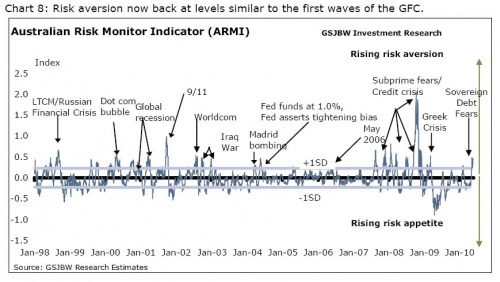
Goldman Sachs’ Australian subsidiary, JBWere, has issued a note to clients highlighting the reasons for the ongoing rout in the Australian Dollar, which has nose-dived from USD93c to just USD81c (at time of writing) in just three weeks since April 30.

via ZeroHedge:

Despite our belief that relative growth and relative interest rates suggest some support for the A$ over coming months, it is hard to see a swift resolution to the major sources of risk aversion impacting Australia and its hard to build a compelling case for offshore investors to bid the A$ higher. In that environment it will be difficult for our long-standing 95c target for the A$ around mid-year to be met; however, we still think our 12 month 90c target is still feasible, albeit with the path to 90 now likely to be via near-term weakness. Whether an ongoing decline in the A$ is in prospect will partly hinge on whether the Treasury Secretary’s suggestions that the WACC for the resource sector will be lower are viewed by the market as valid arguments or not. In sum, it is not just risk aversion that is driving the A% lower at present, fundamental factors have also been very important (relative growth, shifting rate expectations, lower commodity prices and capital exit) and the path to lower risk aversion is less dependant on the typical ebb and flow of market sentiment and highly dependant upon the actions of policy makers in Australia and Europe. Our A$ forecasts are now under review.

(emphasis added)

So there you have it, from one of the world’s most powerful investment banks, in their advice to clients. “Fundamental factors” have been “very important” in the rapid sell-off of the Australian Dollar.  And a key factor blamed, is the Rudd government’s “Resource Super-Profits Tax” (RSPT), inspired by Treasury Secretary Ken Henry.

(This is the same Ken Henry who utterly failed to foresee the GFC coming in 2007-08.  The same Ken Henry who, in February this year, publicly announced that the GFC is ‘over’, and predicted that Australia is set for a period of “unprecedented prosperity” lasting to 2050)

The financial markets are now considering the AUD to be a high risk currency. And according to JBWere, the “path to lower risk aversion” is “highly dependant on the actions of policy makers in Australia…”.

Rudd’s proposed “super tax” on the mining industry is not just wiping tens of billions off the value of Australian mining company shares – and the value of your Superannuation account.  It has also pulled the floor out from under the Aussie Dollar.

Insulation program. School halls. Border protection. Computers in schools. Renewable energy. FuelWatch. GroceryWatch. “The greatest moral challenge of our time”.

Does everything this government does turn to $***?

Gittins Nails ‘Rudd’s Budget Trick’

17 May

Economics Editor for the Sydney Morning Herald, Ross Gittins, hits the nail squarely on the head in critiquing the latest Budget, and at the same time, smashes the lamestream media’s pathetic reporting of the Rudd smoke ‘n mirrors ‘trick’:

The annual debate about the budget gets ever more unreal. This year it reached the height of absurdity. Budgets used to be about what the government plans to do in the coming financial year. Now they’re about what supposedly will happen any time over the next four years.

How unreal can you get? Who on earth knows what will happen over the next four years? No one. Certainly not Treasury (nor any of the smarties who think they know better than it). This time last year Treasury’s best guess was that unemployment would peak at 8.5 per cent next year; now we know it peaked at 5.8 per cent in the middle of last year.

This time last year we were told revenue collections over five years would be down $210 billion on what the ”forward estimates” had told us the year before. Now we’re told they’ll be down $110 billion – but why would you set much store by that guess? We know from repeated experience that Treasury is quite bad at telling us in early May what the budget balance will be at the end of the following month. And yet we take seriously what it says the balance will be in three or four years’ time.

This year there’s been huge emphasis – encouraged by the government’s rhetoric and amplified by the media (including yours truly) – on one figure: the projected budget balance in three years’ time, a surplus of $1 billion. Hallelujah! Home and hosed. All over bar the shouting.

How absurd can you get? Treasury isn’t even prepared to dignify this figure with the status of a ”forecast”? It’s the product of a completely mechanical, punch-in-predetermined-numbers ”projection”. Here’s another absurdity: the public debate about the budget treats all its figures as if they were accomplished facts. No ifs or buts or maybes. And do the purse-string ministers – who know better than anyone how unreliable these figures are – make it their responsibility to warn us not to take them too literally? Not a bit of it.

Here’s Lindsay Tanner: ”The result is that we are back in surplus three years ahead of schedule in three years’ time and the level of debt Australia has will be half of what was initially projected” (my emphasis).

Last year’s projection was rubbish, but this year’s is fact. Of all the (inescapably) rubbery figures in the budget, the one we’ve fixated on is the rubberiest: the $1 billion cash surplus in 2012-13. The one thing you can bet on is that the budget balance that year won’t be a surplus of $1 billion.

This relatively recent shift from focusing on the budget year to taking a blurry look at the next four years has made it easier for governments to manipulate our perceptions of the budget. And boy, weren’t the pollies working hard at it this year.

Read the rest of Gittins’ detailed and brilliant critique here.

Labor’s $50bn Budget Fraud

13 May

Economist Terry McCrann exposes yet more of the same blatant fiddling the books in this year’s Budget from Labor.  $50 Billion worth of “fiddling”.

From the Herald Sun:

Wayne Swan’s budget is built on two great fiddles. Appropriately, the fiddles relate to the Rudd Government’s two great stupidities – the National Broadband Network and the Emissions Trading Scheme.

The fiddles enable the government to hide up to a massive $50 billion of new spending. So much for the claim they’ve pulled the pursestrings tight.

They also enable the government to ‘keep’ the growth in spending in the 2013-14 year to just 1.9 per cent. Without the fiddles, spending would actually have grown by at least 3.5 per cent in that year – shattering the government’s 2 per cent ceiling.

Now yes, the government’s second great stupidity, the ETS, has been ‘deferred’, while the first marches on…

Ditching the ETS enables the government to take up to $30 billion of proposed spending on it out of the budget and replace it – or most of it – by new spending. With, in an exercise of fiscal magic, no increase in the total spending number!

While separately the $26 billion-going-on-$43 billion to be spent on the NBN is just ‘disappeared’ almost completely from the budget! …

So, put the two together – the ditching of the ETS and the “no formal response” to the NBN – and the government has quite probably hidden as much as $50 billion of very real new spending out to 2013-14.

And blown its 2 per cent growth target right out of the very dirty fiscal water.

Rudd Ruins Businesses

7 May

Media Release – Senator Barnaby Joyce, 7 May 2010:

“I still have a distinct vision of Mr Rudd earnestly going to the front of Parliament House with a brand new note book and pen as props for the media grab at the one-on-one with the ceiling insulation industry representatives and the press gallery. He said something about fixing it all up himself, before zipping off. The news our office is getting is that this mess is far from being fixed,” says Senator Barnaby Joyce.

“Not happy with upsetting the resources sector in Australia and slashing millions of dollars off the share market, the Rudd Labor government has not just upset, but sent to the wall, hundreds of legitimate insulation companies. Yes, there needs to be recourse against shonky companies, who, let’s face it, took advantage of a sloppy government scheme, but where is the compassion for the “working Families” Mr Rudd likes to be seen to champion?”

“We have been contacted by many of these honest people who are beginning to have telephones disconnected, locked out of businesses premises, losing motor vehicles to finance companies and some have had mortgagee possession notices on their family homes, because the government will not pay them what is legitimately owed. Minister Combet’s media release on the 20th of April 2010 stated GST deferral was to be made available to insulation companies, yet the Australian Taxation office has sent debt collectors after these same debts. According to industry sources, you Mr Rudd, Mr Combet and Mr Garrett, have ruined a whole industry. So much for the stimulus package sent to save us.”

“Come on Mr Rudd. Where is the fair play you claim to have for “working families”? Why is this insulation program continuing to be such a debacle? Fix it now!”

More Information- Jenny Swan 0746 251500

Don’t Bet The House On China

4 May

An excellent and timely article by Karen Maley in today’s Business Spectator (reproduced here in full):

Kevin Rudd’s resource super profits tax has one massive risk – that commodity prices collapse before he gets to collect one cent of it.

Yesterday, the influential forecaster, Marc Faber joined those warning of problems ahead in China. “The market is telling you that something is not quite right”, he said in an interview on Bloomberg television. “The Chinese economy is going to slow down regardless. It is more likely that we will even have a crash sometime in the next nine to 12 months.”

On Sunday – as Kevin Rudd and Wayne Swan were announcing their new resources tax – China’s central bank made another attempt to dampen property market speculation. It lifted its reserve requirement ratio by a further half a percentage point, so that most Chinese banks will now have to hold 17 per cent of their deposits on reserve.

But this latest increase in the reserve ratio will likely prove as ineffective as the two previous rises in January and February this year. Many believe the Chinese property bubble will continue to expand for as long as the Chinese government maintains interest rates below the rate of inflation.

And that’s the core of the problem. The Chinese government is reluctant to increase interest rates because it risks exposing the huge fault lines that exist in the economy.

Over the past decade, China has built factories and expanded its manufacturing capacity in the expectation that the United States and Europe would continue to demonstrate a robust appetite for Chinese-produced goods. But western demand for Chinese products slowed in the wake of the financial crisis, leaving the Chinese economy with substantial overcapacity in manufacturing.

The problem was exacerbated during the financial crisis. With Chinese exports plunging, the Chinese government launched a massive economic stimulus program, equivalent to around 14 per cent of the country’s GDP. It also ordered Chinese banks to lend, and instructed Chinese state-owned companies to borrow.

The program had the desired result. The Chinese economy grew at an 11.9 per cent annual clip in the first three months of the year, the fastest pace since 2007. And we benefited too, because this strong Chinese growth pushed up the prices of our commodity exports, such as iron ore and coal.

But there are huge concerns over how the Chinese stimulus money was spent. Provincial governments, under instructions from Beijing to reach specified growth targets, undertook massive construction projects that have resulted in a glut of commercial office space, and huge shopping malls that are near-vacant. And much of the increase in bank lending was funnelled into property market speculation, pushing up housing prices to astronomic levels.

The Chinese government has tinkered with various measures to contain its property bubble – increasing the reserve requirement, lifting the minimum deposit that home buyers must have before they’re allowed to borrow, and urging banks to monitor their risks.

But it is loathe to raise interest rates for fear that it will cause mass defaults among manufacturers and property developers, leading to huge problem loans in the banking system.

Eventually, however, an end-point will be reached. Either the Chinese government will raise interest rates, or the property market bubble will collapse under its own weight. At that point, commodity prices will plummet, slashing the profits of the big mining companies.

And if this happens before 1 July 2012 when the new tax regime for the miners comes into effect, Rudd is unlikely to ever see a cent of his new resource super profits tax.

Betting the house on China is exactly what the numbskulls in the Rudd Labor government, the Treasury, and the RBA are doing.

Please take some time to review some of the many earlier articles in this blog, showing how the likes of Treasury secretary Ken Henry and RBA Governor Glenn Stevens have declared that the GFC is ‘over’, and forecast that (thanks to China) we are all set for a ‘period of unprecedented prosperity’ lasting until 2050.

What is vital to bear in mind always, is that these are the very same incompetents who all completely and utterly failed to foresee the onrushing Global Financial Crisis in 2008… even though its first wave had already broken in the USA and on global share markets during 2007!

Roubini: Rising Sovereign Debt Leads to Defaults

30 Apr

Nouriel Roubini, one of just a dozen economists who publicly forecast the GFC, and who recently declared that ‘risky rich’ countries are in greatest danger of default, comments again on the rapidly spreading sovereign debt crisis (from Bloomberg):

Nouriel Roubini, the New York University professor who forecast the U.S. recession more than a year before it began, said sovereign debt from the U.S. to Japan and Greece will lead to higher inflation or government defaults.

“The bond vigilantes are walking out on Greece, Spain, Portugal, the U.K. and Iceland,” Roubini, 52, said yesterday during a panel discussion on financial markets at the Milken Institute Global Conference in Beverly Hills, California. “Unfortunately in the U.S., the bond-market vigilantes are not walking out.”

“The thing I worry about is the buildup of sovereign debt,” said Roubini, a former adviser to the U.S. Treasury and IMF consultant, who in August 2006 predicted a “painful” U.S. recession that came to fruition in December 2007. If the problem isn’t addressed, he said, nations will either fail to meet obligations or see faster inflation as officials “monetize” their debts, or print money to tackle the shortfalls.

Roubini, who teaches at NYU’s Stern School of Business, told attendees at the Beverly Hilton hotel that “Greece is just the tip of the iceberg, or the canary in the coal mine for a much broader range of fiscal problems.”

“Eventually, the fiscal problems of the U.S. will also come to the fore,” Roubini said during the panel discussion. “The risk of something serious happening in the U.S. in the next two or three years is going to be significant” because there’s “no willingness in Washington to do anything” unless forced by the bond markets.

Barnaby Joyce began trying to draw attention to the dangers of growing sovereign debt – warning of a coming day of reckoning in the USA and Europe and here in Australia – as far back as October 2009. As I have shown in countless posts on this blog, many leading economists, financiers, and informed commentators in other countries have been raising almost exactly the same concerns as Barnaby.

Few in Australia chose to listen.

Instead, Barnaby was ridiculed by the government and the media for every minor gaffe or slip of the tongue, his every statement misquoted or twisted out of context. With the ultimate result that he lost his position as opposition Finance spokesman thanks to the relentless attacks on his economic credibility. Despite his being better qualified to comment on finance than the entire Rudd Government economic team.

Only weeks later, those who do choose to look and listen can see ever more clearly… Barnaby Is Right.

Cost of Living Pressures Increase

28 Apr

Media Release – Senator Barnaby Joyce, 28 April 2010:

Senator Barnaby Joyce noted today that the release of the latest consumer price index figures show that electricity prices have increased by 26%, in real terms, since the election of the Rudd Government. These results are partly due to their Minister for Infrastructure’s complete failure to build on the Howard Government’s legacy of successful National Competition Policy, as shown by reports in the Australian Financial Review today.

Senator Joyce said that “The Labor party are incapable of decisive outcomes because of their insatiable desire to put polls ahead of statesmanship. Even their own core issues, such as the ETS, are jettisoned as the need requires.

“This government has shown that they cannot deliver on bread and butter issues such as infrastructure. The implausible and pathetic episodes of spending on the home insulation program and the building the education revolution are part and parcel of Australia’s debt currently reaching almost $137 billion. But real investment to bring real outcomes in power, water, roads and rail has been left wanting.

“Minister Albanese’s claim yesterday that the infrastructure reform agenda was “as full as it ever was” simply reflects the Rudd Government’s inaction in this important area. The COAG Reform Council has reported that this government is failing to progress reform in 4 out of 8 competition areas, including energy and transport.”

Reports today in the Australian Financial Review today suggest the government is trying to reinvigorate National Competition Policy.

In response Senator Joyce commented, “What has taken them almost three years? This government has been busy announcing flashy projects and big spending but ignored the hard work necessary to get more out of our existing infrastructure stock. We have waited 12 months for the National Freight Strategy and where is the greater transparency and cost-benefit analysis that this government promised? Greater efficiency, not bigger spending, is what will help reduce electricity, gas and water prices.”

Electricity prices have increased 11 per cent a year on average, in real terms, since the election of the Rudd Government. In comparison, during the Howard Government, electricity prices increased by an average of 0.5 per cent year, in real terms.

More Information- Jenny Swan 0746 251500

Labor Can’t Balance Fiddled Books

28 Apr

It seems Rudd Labor’s massive, panicked, and bungled response to the first wave of the GFC – roof insulation, the horrendously wasteful school buildings rort – is now making it difficult for them to keep yet another promise, to keep spending growth below 2% of GDP.

From The Australian:

The government is facing a battle to keep costs under its self-imposed 2 per cent growth cap, with blowouts in some programs and higher interest payments adding to the deficit.

Spending in the federal budget, to be released in two weeks, could be at least $10 billion higher in 2010-11 than was forecast when Treasury updated the government’s accounts last November.

Government officials confirm that the budget will forecast economic growth in excess of 3 per cent, which will trigger the rules devised by Treasury for returning the budget to surplus.

These rules dictate that once growth returns to normal, the government will keep spending growth below 2 per cent after allowing for inflation. They also require it to cover the cost of new spending with savings elsewhere in the budget and to bank any increase in tax revenue.

When the mid-year budget update was released six months ago, it looked as though the spending growth target would be easy to reach in 2010-11 because spending on the stimulus program was expected to fall by about $9bn in that year.

In one of the most popular articles I’ve written – “Labor Fakes GDP By 4.5%” – I showed from the government’s own budget documents how Rudd Labor have “revised” the historical data to artificially increase Australia’s GDP figures. Why is that important?

Because it has allowed the government to hoodwink the public and the lazy “we-check-nothing” media that they can keep spending growth below 2% of GDP.  That seems like an easy promise to make, when you’ve simply faked the GDP numbers upwards.

I also showed in “Labor: Hide The Increase” that, according to the government’s own “adjustments”, if they were required to abide by the previous traditional deflator method for calculating the effect of inflation on government spending, they would fail to meet their own 2% spending cap.

Now, we see from today’s article in The Australian, that even with all their massive fiddling of the nation’s accounts and historical records, the government is still struggling to balance their books.

Perhaps they might ask for the assistance of a qualified, experienced, and honest Accountant?

Design a site like this with WordPress.com
Get started